Russia’s barbaric war on Ukraine—and before that on Syria, Libya, Georgia, and Chechnya—has exposed the Russian Federation’s viciously imperial character to the entire world. Its aggression also is catalyzing a long-overdue conversation about Russia’s interior empire, given Moscow’s dominion over many indigenous non-Russian nations, and the brutal extent to which the Kremlin has taken to suppress their national self-expression and self-determination.
Serious and controversial discussions are now underway about reckoning with Russia’s fundamental imperialism and the need to “decolonize” Russia for it to become a viable stakeholder in European security and stability. As the successor to the Soviet Union, which cloaked its colonial agenda in anti-imperial and anti-capitalist nomenclature, Russia has yet to attract appropriate scrutiny for its consistent and oftentimes brutal imperial tendencies.
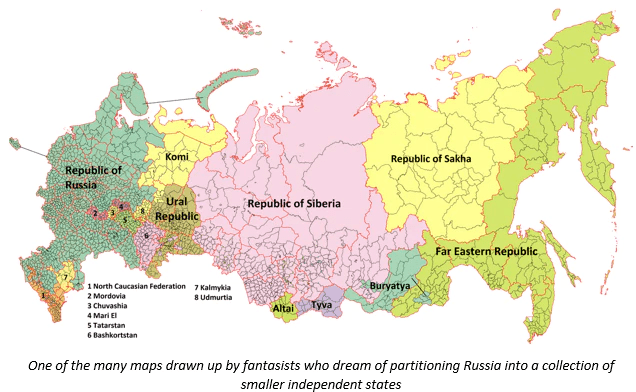
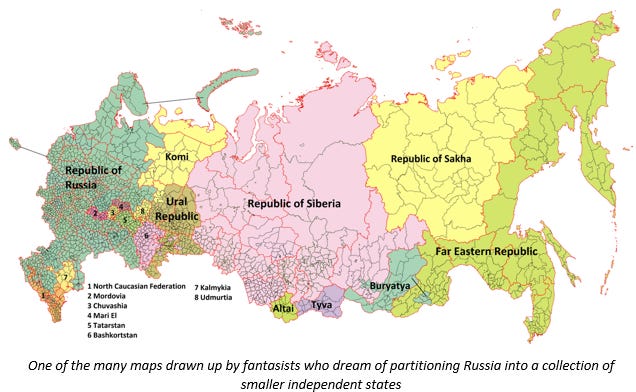
Now, “decolonizing”, taken in the total context of this statement, can only mean: partition. To “decolonize” Russia, based providing for the “national self-expression and self-determination” of “non-Russian nations” currently a part of the Russian Federation can only mean: dismembering the Russian Federation as it currently exists.
Also, please note two additional takeaways. First, the announcement doesn’t speak of a need for Russia to decolonize itself—rather, the implication is that others will decolonize Russia. Second, the further implication is the purpose decolonization is to make Russia “a viable stakeholder in European security and stability.” This means that Russia will be incorporated into the Rules-Based Order of the New World Order. Decolonization of Russia actually means the colonization of Russia by the West, to be mined for its natural resources. The colonization can only proceed if Russia is first decolonized—partitioned, dismembered, defanged, rendered subservient.
To provide a concrete example of what they’re talking about …
Who, you might ask, are these people, this Commission on Security and Cooperation in Europe? Is there any reason why Russia should take them seriously? Well:
You can learn more at the link above, but here’s what the site says about the Commissioners (as opposed to the Staff)—follow the link for the names:
The Helsinki Commission consists of 21 Commissioners, 18 of whom come from the U.S. Congress. Nine Senators and nine Representatives – five from the majority and four from the minority in each chamber – are selected by the President of the Senate and the Speaker of the House, respectively. The remaining three Commissioners are appointed by the President of the United States from the Departments of State, Defense and Commerce, usually at the Assistant Secretary level.
Is it any wonder that Russia regards the current conflict as an existential conflict against the West, led by the US? And with tensions at just under a boil, why would the US conduct such an “online briefing”?
The operative reality, of course, is that Russia is not going to be decolonized—although the very fact of such an online briefing taking place surely speaks volumes about the madmen who make policy in DC. However, just to make this mentality perfectly clear, we hear from a national security reporter at the WaPo:
NEW: Even if Western arms don’t change the battlefield equation, US officials describe the stakes of ensuring Russia doesn’t win in Ukraine as so high that they are willing to countenance even a global recession & mounting hunger. From @DanLamothe & me washingtonpost.com/national-secur…
NEW: Even if Western arms don't change the battlefield equation, US officials describe the stakes of ensuring Russia doesn't win in Ukraine as so high that they are willing to countenance even a global recession & mounting hunger. From @danlamothe & me https://t.co/HeOdarWHOB
The operative reality is that all signals are that Russia has shifted from somewhat minimalist goals in Ukraine to a much more maximalist strategy. From everything I’ve been reading and hearing the following tweet (which precisely reflects my early and often expressed view) represents official Russian thinking. Note that Pomorenko describes this map as representing the minimal outcome that Russia is seeking:
The red line i drew here is the minimal outcome that #Russia is looking for and will achieve by the end of this SMO.
This would encompass safeguarding the vast majority of ethnically Russian population in Ukraine and prohibiting any future #Ukrainian attempts at a genoc1de. pic.twitter.com/U8KjRQJEK5
FWIW, I was listening to Alex Mercouris earlier. He compared the Donbass to the Ruhr, in terms of productivity. He stated point blank that the the areas of Ukraine that Russia currently occupies account for 80% of Ukrainian GDP. Without being able to vouch for the exact numbers, I do believe that Mercouris’ comparison is a fair one and that the numbers are probably pretty accurate.
Mercouris was also speaking about the Lithuania situation. He suggested that it’s high time that Lithuanians understood that the US is not about to risk its existence just for the sake of Lithuania—no matter what Article 5 of the NATO treaty says. As it happens, Russia addressed those fantasies today:
MOSCOW, June 22 (Reuters) – A top Russian official warned the West on Wednesday to stop talking about triggering NATO’s “Article 5” mutual defence clause in a standoff between Lithuania and Russia.
Moscow has promised practical retaliation that will affect Lithuania’s population after the Baltic state blocked the transit of goods subject to EU sanctions from Russia to its Baltic exclave.
“I would like to warn Europeans against dangerous rhetorical games on the topic of conflict,” the Interfax news agency quoted Russian Deputy Foreign Minister Sergei Ryabkov as saying on Wednesday.
The U.S. State Department said on Tuesday its commitment to Article 5 of NATO’s founding treaty – which states that an attack on one member of the alliance is an attack on all – was “ironclad”.
The US commitment to Article 5 is “ironclad”. However, it reserves the right to its own interpretation of Article 5 within its overall understanding of the Rules-Based Order, in which the US makes the rules. #1, We make the rules. #2, the rules don’t apply to us.
Are we witnessing the consequences of legalized marijuana causing contact highs among the intelligence community that surrounds Washington, DC? How else to explain the parade of political and military analysts now seized with angst over the growing gulf between what they claimed would happen to Russia in Ukraine and the stark reality. Hell, even the CIA is trying to figure out what went wrong with its analysis and is still getting it wrong. Remarkable.
The problem with the CIA is simple–when you prioritize hiring people because of their embrace of pronouns and degenerate sexuality over recruiting accomplished, genuinely educated people equipped with critical thinking skills, do not be surprised that the juvenile mediocrities perform poorly. How is a gender fluid “them” with no military experience and no foreign language skills going to predict the military outcome of a conflict where the attacking force is outnumbered 3 to 1?
Russia is now a “hollow force?” The only hollow thing in this example are the empty noggins of the morons masquerading as intelligence analysts. Check out their excuses for getting it wrong:
The Russian force the US military and intelligence agencies believed to be a near-peer adversary hasn’t shown up. The force that did appear had its main thrust blunted by smaller Ukrainian units.
“What we did not see from the inside was sort of this hollow force” that lacked an effective non-commissioned officer corps, leadership training, and effective doctrines, Berrier said of the Russians.
While US intelligence agencies misinterpreted the effectiveness of the Russian and Ukrainian militaries, they provided accurate information about Russia’s intentions in the months prior to Russia’s attack, which began on February 24.
“When you deal with a foreign actor, analysts can fall prey to a number of mental traps, from confirmation bias, availability bias, or even favoring existing analytic lines over new information,” Michael E. van Landingham, a former Russia analyst at the CIA, told Insider.
But this is all nonsense. There is this thing called the internet. It actually allows an inquiring mind to go back in time and see what the CIA was saying in February and March. This is not my opinion. You may read the facts for yourself:
The Intelligence Community Hits a Grand Slam. Now, It Must Help Ukraine Win–The Biden administration is also entitled to some applause. It “flooded the zone” with authorized disclosures of intelligence prior to the Russian invasion. . . . The more recent disclosures were also designed as a deterrent, to get inside Russian President Vladimir Putin’s decision-making process and perhaps cause him to think twice before hitting the “go” button. . . . The intelligence community along with U.S. military special operations forces must prepare to conduct and/or support a Ukrainian insurgency campaign. The model should be Afghanistan in 1980, just after the Soviet invasion. . . . At the same time, the intelligence community must — and will — look for and encourage diplomats and intelligence officers serving at Russian embassies abroad who are making the decision whether or not to jump from Putin’s ship. . . . The intelligence community will also watch to see signs that tens of thousands, or perhaps more, brave Russians are getting ready to take to their streets. . . . Finally, there’s the intelligence community’s support of Ukrainian President Volodymyr Zelensky. . . . Zelensky vs. Putin. Leonidas vs. Xerxes. Will history repeat itself? Perhaps. But let’s hope that the new Leonidas lives this time to tell the tale. And that his people triumph in sovereign democracy alongside him. America has a stake in this fight. It’s time to make some history. It’s time to help Ukraine win.
Top American generals on three key lessons learned from Ukraine–“The computer models would have said Russia wins in 72 to 96 hours,” said Marine Corps Commandant Gen. David Berger. They “cannot explain why Ukraine is still hanging on. Why is that?” . . . . It took months for Russian President Vladimir Putin to amass more than 175,000 Russian troops on the Ukrainian border. But since those forces mobilized on Feb. 23, the Russian military has been embarrassed by one logistical failure after another. Videos posted on social media showed lines of tanks and military vehicles stalled on Ukrainian roads, with no spare parts available to fix broken vehicles and no fuel to get them running again. Other viral videos showed hungry Russian soldiers who had apparently run out of rations accepting food from Ukrainians.
The ignorance of the U.S. military commanders and the oxymoronically named intelligence community is breathtaking. If you are trying to predict the outcome of a military operation there are, as Andrei Martyanov describes in his must read book (The (Real) Revolution in Military Affairs) key variables that must be weighed. One of these is the nature of the defensive fortifications of the Ukrainian army. For the love of God, the entire damn U.S. intelligence community had eight years to track and identify the formidable system of trenches, revetments and bunkers the Ukrainians had constructed. Then there is the fact that Ukraine’s army outnumbered Russia by three-to-one. In what drug addled universe does an analyst conclude and promulgate that a out-manned Russian army will conquer a country twice the size of the United Kingdom in four days?
Perhaps this was a deliberate straw-man strategy–i.e., play up the Russians as ten feet tall (knowing all along that they have the ability to eventually grind the Ukrainians into talcum powder) and then portray them as a weak, doddering power. Maybe the terrible analytical predictions were part of a broader propaganda campaign.
What I do not understand is why the technical collection systems at NSA and NIMA (i.e., National Imagery and Mapping Agency) apparently failed to identify the robust Ukrainian defenses? What should alarm U.S. legislators is that the CIA still does not have a damn clue about what is going on. Specifically, describing Russia as a “hollowed” out force is baseless nonsense. The complex military operations the Russians are conducting across a 900 mile front that stretches from Kharkiv in the north, thru the Donbas and then southwest to Odessa. Besides supplying ground forces with ammunition, fuel, food and medical care, Russian logicians also are feeding hundreds of thousands of civilians left homeless because of the fighting. Then there is the coordination of artillery and sea-based cruise missiles along with close air support from fixed wing and rotary wing air craft.
The CIA is learning the hardway the truth of Sun Tzu’s aphorism:
If you know the enemy and know yourself, you need not fear the result of a hundred battles. If you know yourself but not the enemy, for every victory gained you will also suffer a defeat. If you know neither the enemy nor yourself, you will succumb in every battle.
That is where the United States intelligence community is; it is ignorant of itself and the Russians.
One of the old intel codgers, Graham E. Fuller, who was Vice Chair of the National Intelligence Council at CIA back when I was an analyst, has it figured out. He wrote a piece sure to get him removed from woke Washington, DC parties:
The war in Ukraine has dragged on long enough now to reveal certain clear trajectories. First, two fundamental realities:
Putin is to be condemned for launching this war– as is virtually any leader who launches any war. Putin can be termed a war criminal–in good company with George W. Bush who has killed vastly greater numbers than Putin.
Secondary condemnation belongs to the US (NATO) in deliberately provoking a war with Russia by implacably pushing its hostile military organization, despite Moscow’s repeated notifications about crossing red lines, right up to the gates of Russia. This war did not have to be if Ukranian neutrality, á la Finland and Austria, had been accepted. Instead Washington has called for clear Russian defeat.
Contrary to Washington’s triumphalist pronouncements, Russia is winning the war, Ukraine has lost the war. Any longer-term damage to Russia is open to debate.
Sadly for Washington, nearly every single one of its expectations about this war are turning out to be incorrect. Indeed the West may come to look back at this moment as the final argument against following Washington’s quest for global dominance into ever newer and more dangerous and damaging confrontations with Eurasia. And most of the rest of the world–Latin America, India, the Middle East and Africa– find few national interests in this fundamentally American war against Russia.
Graham, I could not have conveyed the message with more clarity. You nailed it.
The war in Ukraine has dragged on long enough now to reveal certain clear trajectories. First, two fundamental realities:
Putin is to be condemned for launching this war– as is virtually any leader who launches any war. Putin can be termed a war criminal–in good company with George W. Bush who has killed vastly greater numbers than Putin.
secondary condemnation belongs to the US (NATO) in deliberately provoking a war with Russia by implacably pushing its hostile military organization, despite Moscow’s repeated notifications about crossing red lines, right up to the gates of Russia. This war did not have to be if Ukranian neutrality, á la Finland and Austria, had been accepted. Instead Washington has called for clear Russian defeat.
As the war grinds to a close, where will things go?
Contrary to Washington’s triumphalist pronouncements, Russia is winning the war, Ukraine has lost the war. Any longer-term damage to Russia is open to debate.
American sanctions against Russia have turned out to be far more devastating to Europe than to Russia. The global economy has slowed and many developing nations face serious food shortages and risk of broad starvation.
There are already deep cracks in the European façade of so-called “NATO unity.” Western Europe will increasingly rue the day that it blindly followed the American Pied Piper to war against Russia. Indeed, this is not a Ukrainian-Russian war but an American-Russian war fought by proxy to the last Ukrainian.
Contrary to optimistic declarations, NATO may in fact ultimately emerge weakened. Western Europeans will think long and hard about the wisdom and deep costs of provoking deeper long term confrontations with Russia or other “competitors”of the US.
Europe will sooner or later return to the purchase of inexpensive Russian energy. Russia lies on the doorstep and a natural economic relationship with Russia will possess overwhelming logic in the end.
Europe already perceives the US as a declining power with an erratic and hypocritical foreign policy “vision” premised upon the desperate need to preserve “American leadership” in the world. America’s willingness to go to war to this end is increasingly dangerous to others.
Washington has also made it clear that Europe must sign on to an “ideological” struggle against China as well in some kind of protean struggle of “democracy against authoritarianism”. Yet, if anything this is a classic struggle for power across the globe. And Europe can even less afford to blunder into confrontation with China–a “threat” perceived primarily by Washington yet unconvincing to many European states and much of the world..
China’s Belt and Road initiative is perhaps the most ambitious economic and geopolitical project in world history. It is already linking China with Europe by rail and sea. European exclusion from the Belt and Road project will cost it dearly. Note that the Belt and Road runs right through Russia. It is impossible for Europe to close its doors to Russia while maintaining access to this Eurasian mega project. Thus a Europe that perceives the US already in decline has a little incentive to join the bandwagon against China. The end of the Ukraine war will bring serious reconsideration in Europe about the benefits of propping up Washington’s desperate bid to maintain its global hegemony.
Europe will undergo increasing identity crisis in determining its future global role. Western Europeans will tire of subservience to the 75 year American domination of European foreign policy. Right now NATO is European foreign policy and Europe remains inexplicably timid in asserting any independent voice.How long will that prevail?
We now see how massive US sanctions against Russia, including confiscation of Russian funds in western banks, is causing most of the world to reconsider the wisdom of banking entirely on the US dollar into the future. Diversification of international economic instruments is already in the cards and willl only act to weaken Washington’s once dominant economic position and its unilateral weaponisation of the dollar.
One of the most disturbing features of this US-Russian struggle in Ukraine has been the utter corruption of independent media. Indeed Washington has won the information and propaganda war hands down, orchestrating all Western media to sing from the same hymnbook in characterizing the Ukraine war. The West has never before witnessed such a blanket imposition by one country’s ideologically-driven geopolitical perspective at home. Nor, of course, is the Russian press to be trusted either. In the midst of a virulent anti-Russian propaganda barrage whose likes I have never seen during my Cold Warrior days, serious analysts must dig deep these days to gain some objective understanding of what is actually taking place in Ukraine.
Would that this American media dominance that denies nearly all alternative voices were merely a blip occasioned by Ukraine events. But European elites are perhaps slowly coming to the realization that they have been stampeded into this position of total “unanimity”; cracks are already beginning to appear in the façade of “EU and NATO unity.” But the more dangerous implication is that as we head into future global crises, a genuine independent free press is largely disappearing, falling into the hands of corporate-dominated media close to policy circles , and now bolstered by electronic social media, all manipulating the narrative to its own ends. As we move into a predictably greater and more dangerous crises of instability through global warming, refugee flows, natural disasters, and likely new pandemics, rigorous state and corporate domination of the western media becomes very dangerous indeed to the future of democracy. We no longer hear alternative voices on Ukraine today.
Finally, Russia’s geopolitical character has very likely now decisively tilted towards Eurasia. Russians have sought for centuries to be accepted within Europe but have been consistently held at arms length. The West will not discuss a new strategic and security architecture. Ukraine has simply intensified this trend. Russian elites now no longer possess an alternative to accepting that its economic future lies in the Pacific where Vladivostok lies only one or two hours away by air from the vast economies of Beijing, Tokyo, and Seoul. China and Russia have now been decisively pushed ever more closely together specifically out of common concern to block unfettered US freedom of unilateral military and economic intervention around the world. That the US can split US-induced Russian and Chinese cooperation is a fantasy. Russia has scientific brilliance, abundant energy, rich rare minerals and metals, while global warming will increase the agricultural potential of Siberia. China has the capital, the markets, and the manpower to contribute to what becomes a natural partnership across Eurasia.
Sadly for Washington, nearly every single one of its expectations about this war are turning out to be incorrect. Indeed the West may come to look back at this moment as the final argument against following Washington’s quest for global dominance into ever newer and more dangerous and damaging confrontations with Eurasia. And most of the rest of the world–Latin America, India, the Middle East and Africa– find few national interests in this fundamentally American war against Russia.
==================
Graham E. Fuller is a former Vice Chair of the National Intelligence Council at CIA with responsibility for global intelligence estimates.
Deflationary Tsunami On Deck: A “Tidal Wave” Of Discounts And Crashing Prices
BY TYLER DURDEN
FRIDAY, JUN 17, 2022 – 12:00 PM
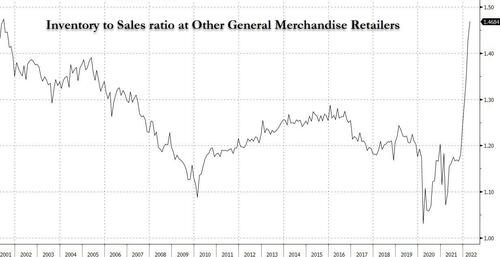
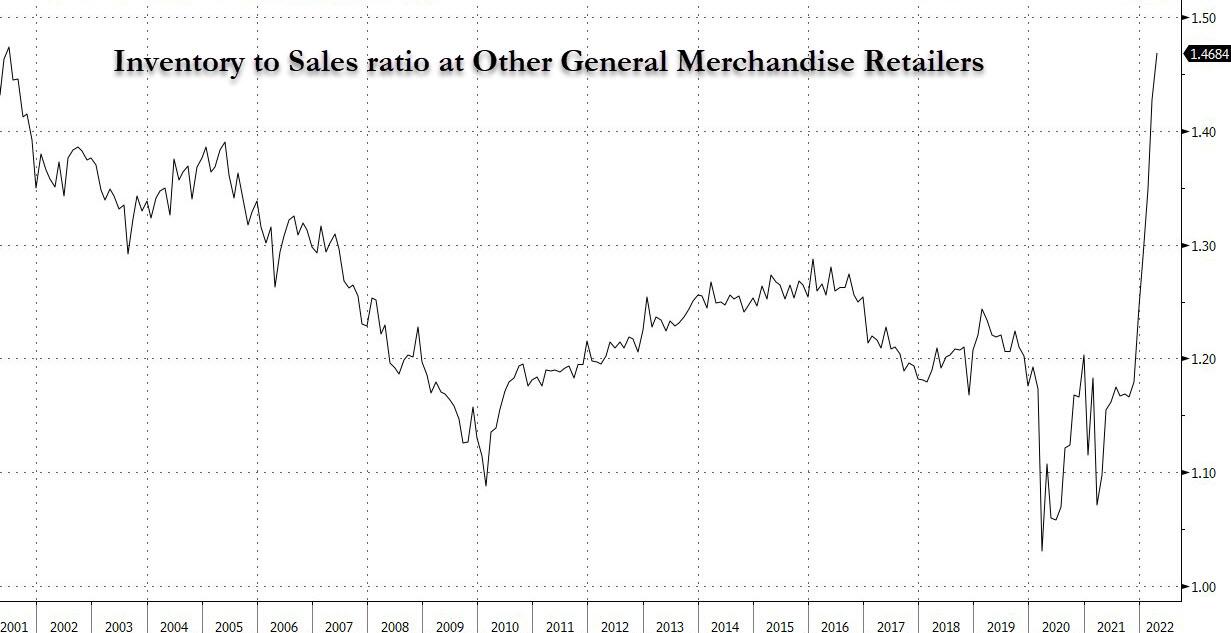
Three weeks ago, we showed readers what happens when the infamous “Bullwhip effect” reversal takes place by presenting the unprecedented surge in the “Inventory to Sales” ratio for a broad range of US retailers covering the furniture, home furnishings and appliances, building materials and garden equipment, and a category known as “other general merchandise,” which includes Walmart and Target. Since then, this ratio has only gotten even more extended, and as shown below it is now at the highest level since the bursting of the dot com bubble!
What does this mean for retailers and the price of goods? Three weeks ago we said “Think: widespread inventory liquidations” and added…
To be sure, not every product will see its price cut: commodities, whose bullwhip effect take much longer to manifest itself, usually lasting several years in either direction, are only just starting to see their price cycle higher. However, other products – like those carried by the Walmarts and Targets of the world – are about to see a deflationary plunge the likes of which we have not seen since the global financial crisis as retailers commence a voluntary destocking wave the likes of which have not been seen in over a decade.
Today both Wall Street and the mainstream media have caught up, with both predicting unprecedented deflationary price cuts in the coming weeks.
We start with Morgan Stanley’s bearish strategist Michael Wilson, who in his latest bearish weekly note (available to pro subs) focused on shrinking margins in general, and on retailer discounting in particular, and wrote that while there is a modest pick up in over sales, the far more concerning issue is that “inventory across the sector is up about 30% YOY and sales growth is up about 0% YOY translating to approximately 30% YOY of excess inventory” and while mark down/margin pressure did not hit in 1Q it should hit June/July. Indeed, “store checks show that aggressive discounting has already started as of the Memorial Day holiday weekend. Discounting pressure could accelerate through July.” And since more retailers are now discounting, “companies are having to offer even bigger discounts to compel consumers to buy, and it is a race to the bottom in margins in order to clear through inventory.”
It gets much worse, however, because courtesy of the delayed nature of the bullwhip effect, Morgan Stanley thinks it will be some time before retailers can cut back on forward inventory orders! Companies are no longer in a position to order 6 months in advance because of delays in the supply chain, and are currently working with about an 8 month lead time. Shockingly, this means decisions today to cut forward orders could begin to eliminate the inventory problem in 1Q23, but not likely before then.
As a result, Wilson concludes, “we are likely to see a tidal wave of discounts that carry us through December because 2022 inventory orders have already been placed.“
It’s not just Wall Street finally catching up, however: overnight the WSJ also writes that “Big discounts are coming.”
Echoing everything we have written in the past two months, the Journal writes that Target, Walmart and Macy’s announced recently that they are starting to receive large shipments of outdoor furniture, loungewear and electronics (and if Morgan Stanley is correct and lead times are indeed 8 months they will keep receiving these into 2023!) everyone wanted, but couldn’t find, during the pandemic.
The problem for retailers is a windfall for those in the market for sweatpants or couches. Look for prices to start dropping around July 4, analysts say when the deflationary retail tsunami is unleashed in full force.
“There are going to be discounts like you’ve never seen before,” says Mickey Chadha, a Moody’s Investors Service analyst who tracks the retail industry.
Retailer discounts are part of an effort to get shoppers interested in buying things again as Americans shift their spending to services such as concerts, eating out, and travel they missed out on during the pandemic. Deep discounts are expected on oversize couches, appliances and patio furniture that are more expensive for companies to store in their warehouses, analysts say. In fact, in everything this has some component of consumer goods demand to it.
Look to e-retailers that specialize in larger goods like furniture to lower their prices, says Chirag Modi, who oversees supply chain execution and warehousing at consulting firm Blue Yonder.
And if your drawers aren’t already bursting with work-from-home loungewear, stores will try hard to get you to take it off their shelves. “It might be a good time to buy sweatpants. They’re certainly going to be on sale this summer,” says Dan Wallace-Brewster, who directs marketing at e-commerce software company Scalefast. Office wear might not be discounted, he says.
Some retailers, like Target, have already announced they’re planning big discounts. Others with robust warehouse capacity, like Walmart, may be more likely to hold on to their excess inventory, analysts say.
Chadha said that retailers who sell their own lines of clothing and décor, like Gap, could be especially inclined to mark down their inventory, because they can’t pass the cost onto anyone else. Companies that carry other brands, like Macy’s, can potentially pass some of the surplus back to the producers.
Consumer electronics are another category ripe for overstock discounts, Mr. Wallace-Brewster says, because the chip shortage is showing signs of abating. Items such as TVs and laptops are about to see major price cuts.
Gwen Baer says she now wishes she had waited before splurging on a $3,000 couch for her new home that took six months to arrive in 2020. The 30-year-old Atlanta digital-media strategist plans to watch for sales at Target, West Elm and other retailers to finish outfitting her house, which she and her fiancé purchased in August 2020.
Her fiancé, Thomas Li, hopes to buy a new TV to replace the 10-year-old one in their bedroom. He’s hoping the sales mean lower prices on OLED screens.
“The stores are really making lemonade out of some lemons,” Ms. Baer says.
If you miss the wave of sales coming in a few weeks fear not: sales will likely continue well into back-to-school season and beyond. Modi says he is waiting until Thanksgiving to buy furniture for his own home renovation, and regrets already preordering kitchen cabinets. “I’m hedging my bets I’ll be able to get better deals in the fall,” Modi says adding that inventory surpluses are unlikely to affect the price of home staples and food. Discount retailers like TJ Maxx and Ross that specialize in surplus goods may not have great sales.
Bigger metro areas may be poised for higher discounts than their rural counterparts, according to Modi, since they ordered based on demand at the height of the pandemic—which was higher in areas that are more population-dense.
Not everything is set for a deflationary crash: don’t expect luxury items to see price cuts. If anything, luxury prices for things like handbags and shoes are poised to keep climbing, said Oliver Chen, a retail analyst for Cowen: “Demand is so strong, and it’s a supply-constrained industry, generally, so quite the opposite rebalancing is happening.”
And while inflation is likely to persist in the ultra high, the implication for broader inflation is clear: most prices that make up the core CPI basket are about to fall off a cliff in weeks if not days, with upcoming core CPI prints set to plunge, which means that the only thing that will remain red hot is headline inflation, i.e., food and energy prices, the same prices which the Fed has traditionally ignored. It remains to be seen if it will do so this time around, or if – realizing that the US is entering a recession – it will resume easing even in the face of $5 gas prices…
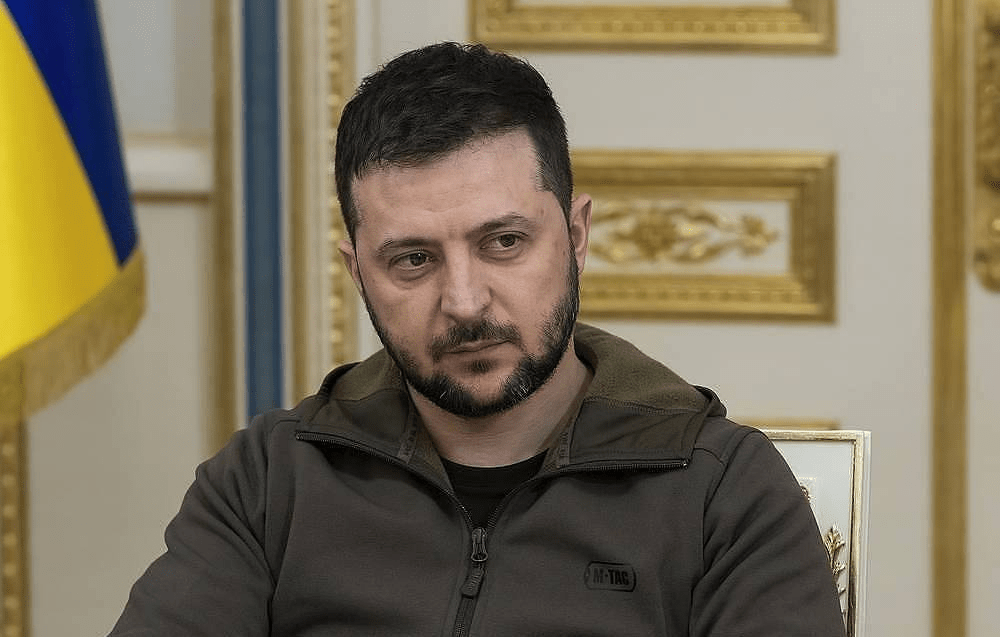
As reported by Tass, Ukrainian President Vladimir Zelensky has signed a law allowing to send servicemen of Ukraine’s Territorial Defense Forces to combat zones, according to the Ukrainian parliament’s website.
The document was signed by parliament chair Ruslan Stefanchuk on May 6, and submitted to the president for signing on the same day.
For the time being, units of Ukraine’s Territorial Defense Forces perform tasks solely within their region or community. The law, if signed, will authorize their deployment all across the country, including not only the current zones of hostilities, but also regions that Kiev views as its occupied territories.
The decision on the deployment will be made by the commander-in-chief of the Ukrainian armed forces.
According to the parliament’s website, the law will come into force on the day after its official publication.
However, the procedural term for the president to sign the document expired on June 7. The Ukrainian authorities gave no explanation for the delay.
Earlier, Ukrainian Defense Minister Alexey Reznikov said his country must increase the number of servicemen directly engaged in hostilities to one million people.
In accordance with the law “On foundations of national resistance,” signed last July, the Territorial Defense Forces are a separate branch of troops within the Armed Forces of Ukraine. As of January 2022, Ukraine had 25 territorial defense brigades, comprising up to 100,000 personnel. In May, Zelensky relieved of duty the Territorial Defense Forces commander without providing any explanation for the move.
he Territorial Defense is a paramilitary structure created in the wake of Euromaidan. At the beginning of 2022, its brigades included about two million fighters.
The so-called Teroborona units consist of Maidan activists, nationalists and veterans of the war in Donbass. Basically, these are not professional military, but rather civilians who have not received the necessary training. They were mainly used as armed groups serving the interests of local business.
Previously, members of Teroborona were exempted from conscription in case of hostilities in Ukraine. However, after the start of Russia’s military operation, some of them had to take part in hostilities for which they were not ready either morally or technically.
Dozens of Ukrainian units complained about the huge losses and lack of weapons and training, pointing out that they were sent to the front lines illegally.
As a result, Zelensky’s decree legalized sending untrained members of Teroborona to the front as cannon fodder for the professional Russian army. Zelensky’s current decision confirms the huge losses of the Armed Forces of Ukraine.
The President of Ukraine has already admitted that Ukraine is losing to Russia in technology and is not capable of conducting offensive actions. He confirmed that the Ukrainian offensive is impossible.
On June 12, one of the main propagandists of the Kiev regime Alexey Arestovich claimed that a significant part of the Ukrainian military could join the Russian army.
According to him, if the West does not help Ukraine, 500 thousand Ukrainians will join the 1.5 million service members of the Russian Federation and the Republic of Belarus, after which these forces will allegedly go to war on Europe.
Arestovich confirmed the pro-Russian sentiment among a large part of the population of Ukraine, including among the military.
Zelensky’s complains and threats from Arestovich had no result and the West does not believe in the victory of Ukraine any longer.
NATO Secretary General Jens Stoltenberg claimed that peace in Ukraine is possible only if Kiev makes territorial concessions. In its turn, NATO is helping the Kiev regime to pay the lowest price.
Thus, the hysteria among the leaders of the Ukrainian regime and the recognition of Kiev’s inevitable defeat in the war confirm that the changes in the military tactics of the Russian command are bearing fruit. The orderly grinding down of Ukrainian forces in the small boilers in the Donbas continues.
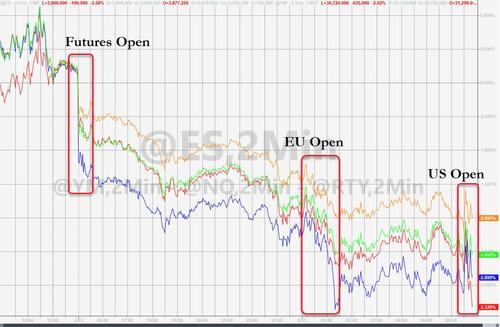
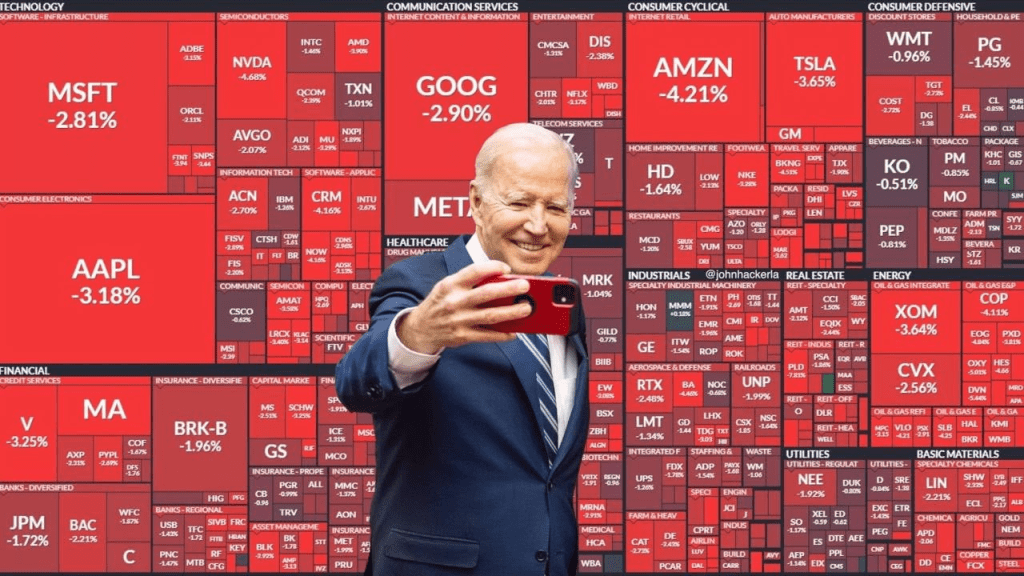
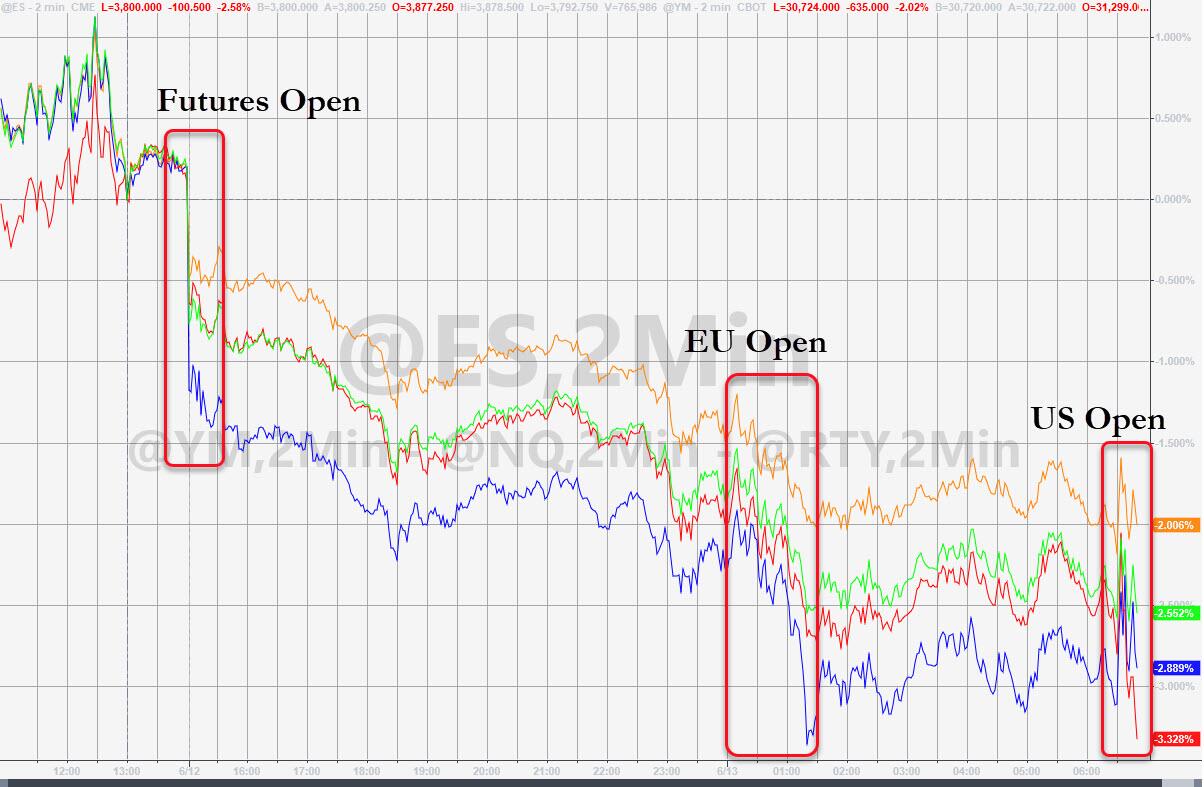
US cash equity markets opened with no panic-bid, instead being met with a wall of selling after the ugly overnight futures session.
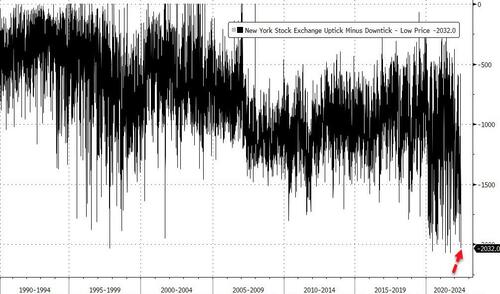
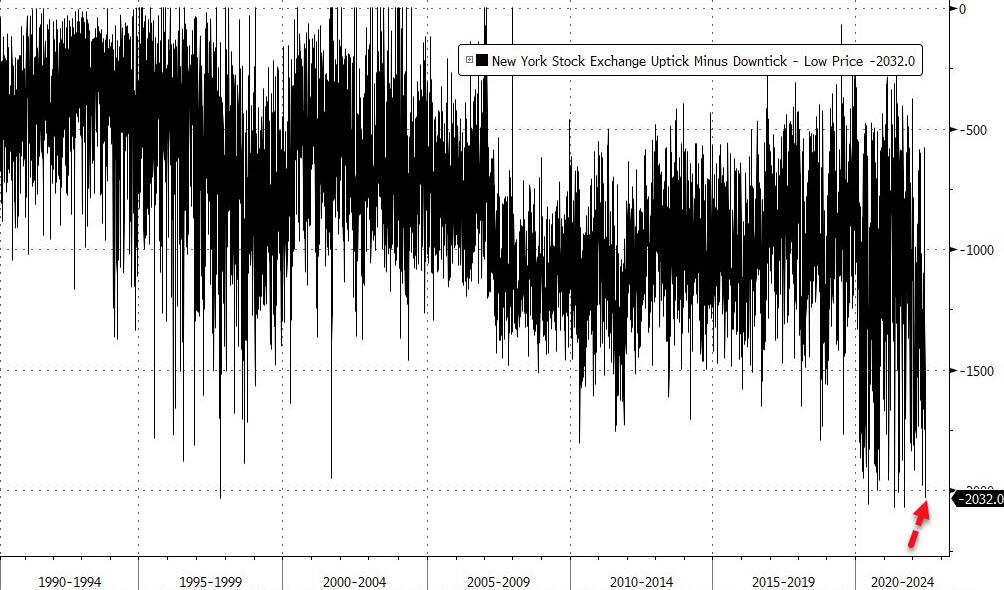
The selling wave was almost unprecedented, with a TICK below -2000 – the fifth largest ‘sell program’ in history…
As Bloomberg notes, sell programs of this size are typically not single events. They tend to happen in clusters and that probably means stocks might be in store for bigger losses.
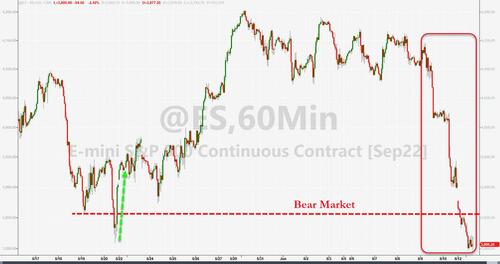
This puke sent the S&P 500 to the lows of the year and into bear market territory…
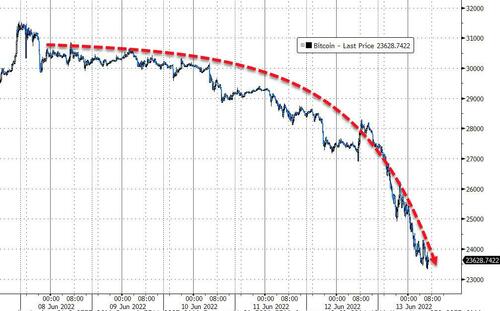
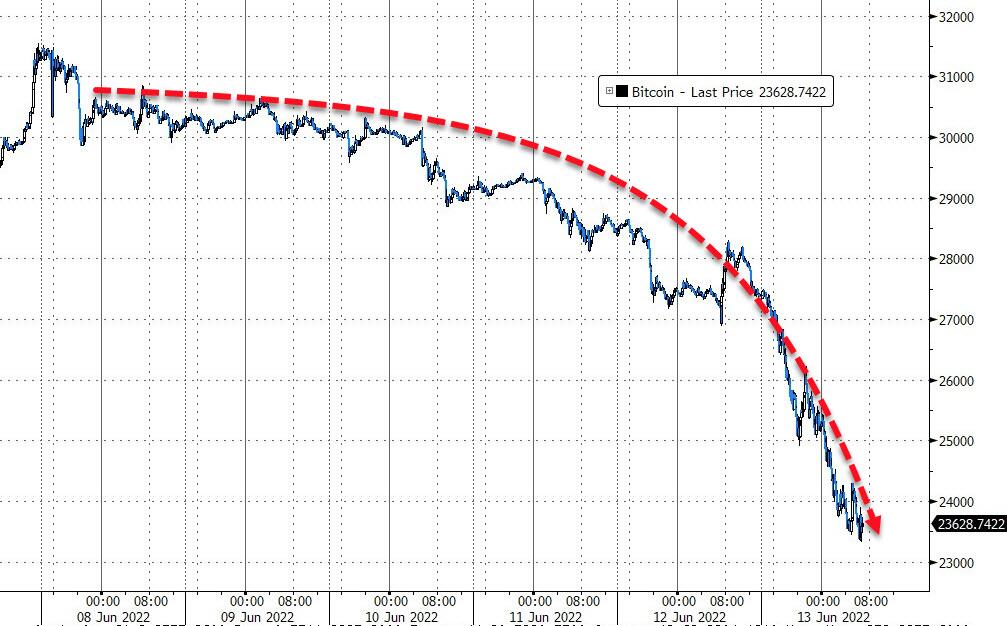
Elsewhere, the picture is just as bloodbath-y with Bitcoin puked back below $24k…
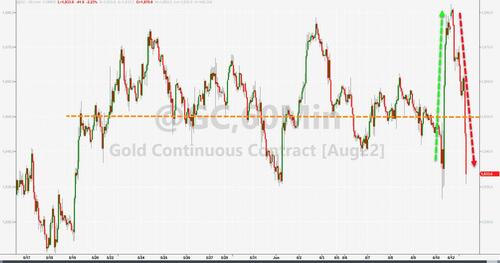
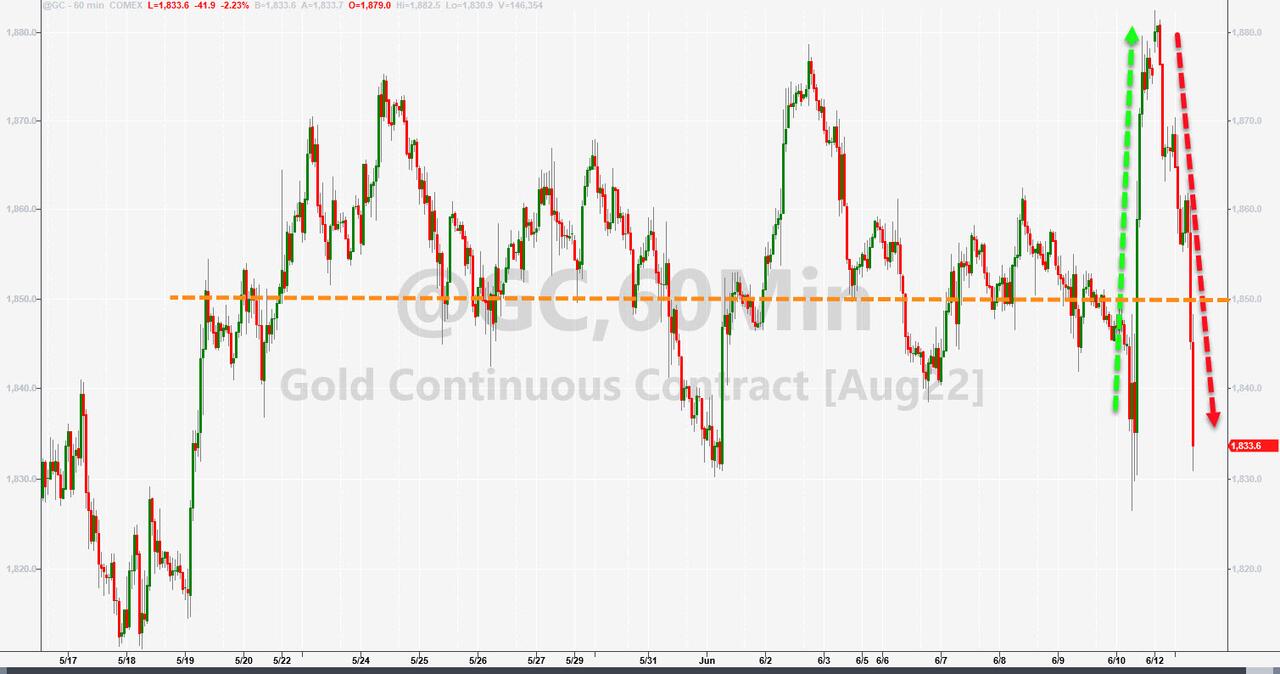
Gold topped $1880 briefly then plunged back below $1840…
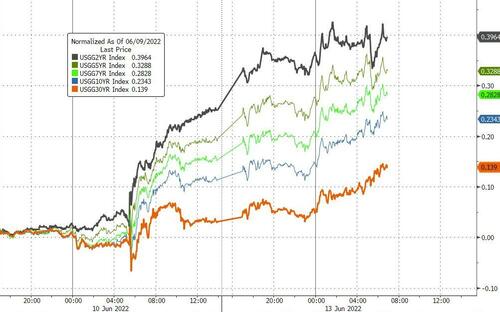
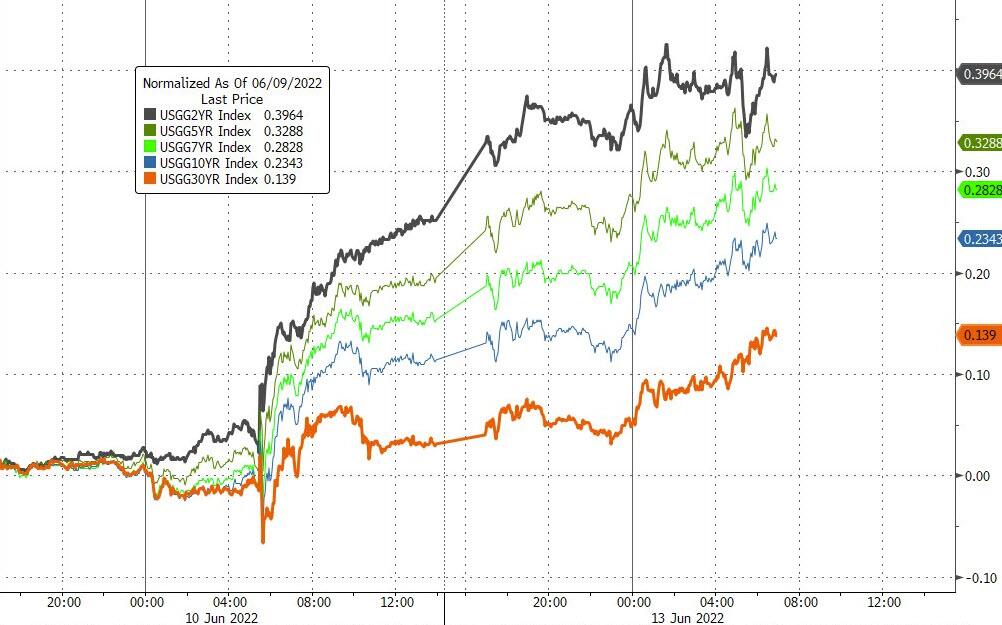
The yield curve (2s10s) briefly inverted this morning, as the short-end underperforms (but the entire Treasury market is getting hammered)…
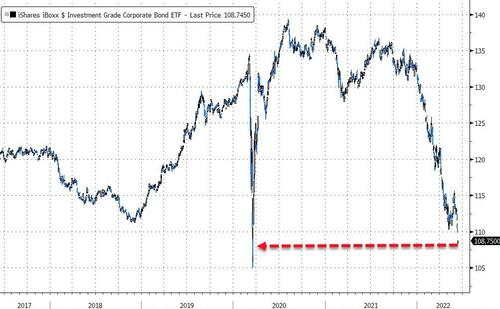
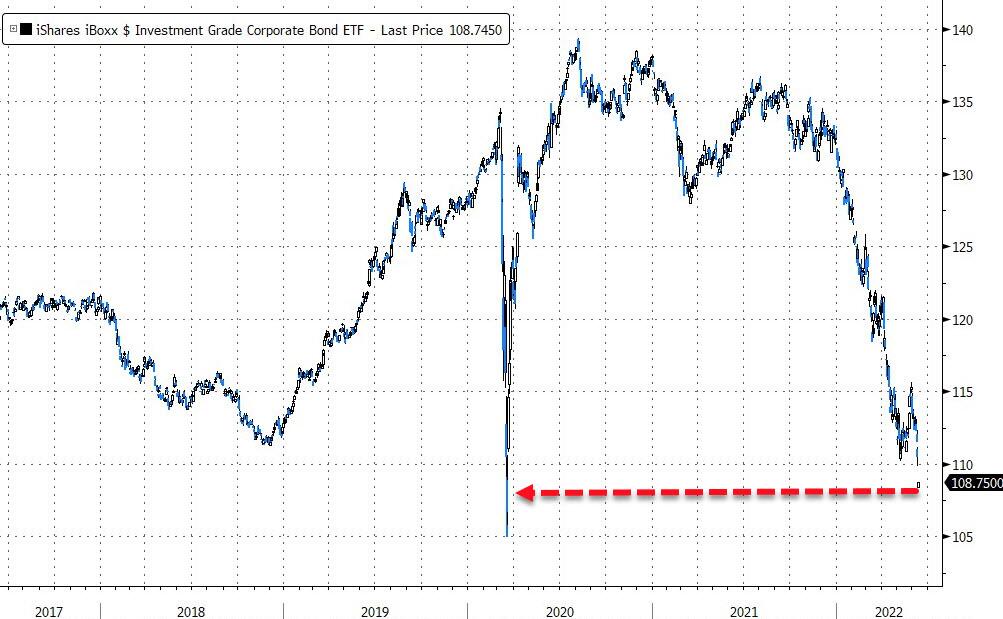
And credit markets are really hemorrhaging with IG credit crashing back to its COVID lockdown spike lows…
The last time credit markets puked like this, The Fed turned up the intervention amplifier to ’11’.
Is that a silver lining? A few ticks lower and Powell throws in the towel – the Fed will not risk a depression… or will he?
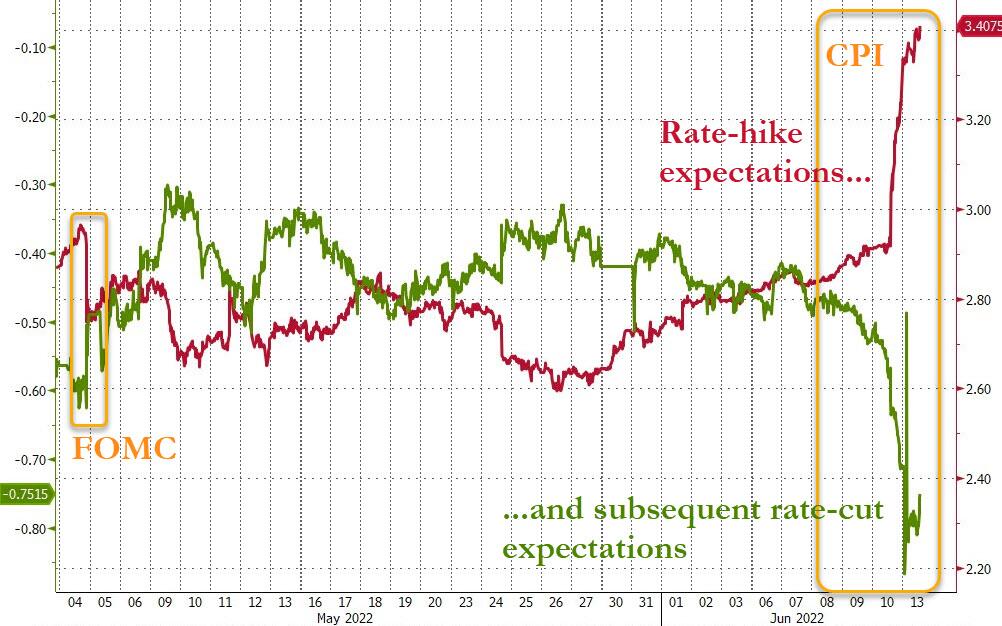
The market is starting to capitulate on the hope of an imminent Fed Put for now…
And is pricing in 3 rate-cuts after, to ‘rescue’ us from the imminent shitshow.
The below video shows what I assume to be two Russian Su-25 “Grach” ground attack jets flying very low over southeastern or southern Ukraine, soon to be part of the Russian Federation.
The video has been “enriched” with a soundtrack, namely the iconic song Prekrasnoe Dalyoko (which I veeeeeery roughly translate as “Splendid Someday“) from the 1980s hit TV miniseries Gostia iz Budush’evo (“Guest from the Future.“)
The last few seconds of the video, show a blank screen with the Russian words for, “Today, what have I done for tomorrow?“, a key phrase in the song’s lyrics. The relevance is obvious.
These pilots are part of a war effort to guarantee Russia’s physical-political and economic (e.g. control over Black Sea oil and grain export routes as well as oil and gas resources) security for the coming decades. Moreover, using this beautiful song—with its searing lyrics—in the given context, is intended to evoke feelings of mission and participation in a Russian audience.
“Today, what have I done for tomorrow?”
First, some musings on working for tomorrow, then later we’ll analyze the video and Russia’s air war more broadly, both of these from a technical, tactical, and strategic perspective.
The U.S. Government agency where I work my dayjob—and which I don’t represent or speak for in any capacity whatsoever on this blog—sent out an email a few days ago, praising the more than 20,000 (out of 400,000-plus) employees who chose to include their “pro-noun” preferences in their email profiles, in line with management’s encouragement. (So far, I’ve not seen any gender-flipping—if anything, I’m guessing it’s an act of protest or ridicule in most cases.)
“Today, what have I done for tomorrow?” For America’s tomorrow, the Brandon fre@kshow hasn’t done squat. My God, what a bunch of Limp D*ck Losers. Their rule started with a military occupation of the nation’s capital, to keep any residual protestors from heckling within two miles of their inauguration, and it’s all been downhill from there.
Now, they intend to withhold school lunch funding from states that won’t let boys use the girls’ bathroom. What a G@WD D@MN CIRCUS. They are daring the Universe to DESTROY them. I’m convinced the korona is coming back soon, and it will bury them and their pro-nouns under millions of vakk-syn-ay-ted corpses. But, посмотрим, as they say in Russian—we’ll see what happens.
What does this video tell us?
As you can see, the craft taking up most of the video, is flying in a pair (at least.) It is flying EXTREMELY low. Between it and its partner, they deploy decoy flares two or three times in the span of less than one minute of footage (the third time might be a repeat—please leave a comment if you’re sure one way or the other—and quite a bit of “downtime” may have been edited out.) Most likely, they both deploy flares simultaneously, but the visible focus is on one at a time.
The flares are intended to confuse the infrared homing on Uncle Sam’s Stinger missiles, which have been “donated” (with a time-delay) to ISIS or other as-yet-unknown international terrorists, using the Ukraine as middle-man. Of course, the middle-man will cook most of them off himself, but you may wish to think twice about flying anything but El Al and Arkia from now on. (Israel’s main airlines are believed to load “countermeasures” on their planes.)
This may have been a “trailblazer” flight, to draw Stinger fire so as to clear the way for another flight, perhaps a bombing run by more Su-25’s, or a strafing run by attack helicopters.
Many readers have asked, where is the Russian air force, why don’t we see them? It’s a valid question, but an odd one. There are many videos of Russian aircraft flying by. I think what the questioners really mean is, why don’t we see the sort of “target destroyed from 20,000 feet” videos that Americans got used to, starting with the 1991 war against Iraq?
FIRST, either Russia doesn’t have the sort of video recording capabilities that CNN viewers have come to expect, or if it does, it’s not releasing the video, as such might be used by U.S. planners to understand Russian techniques and to defend/mask ground targets or even help bring down Russian aircraft.
SECOND, most Russian manned aircraft activity consists of tactical bombing and strafing runs. There is extensive footage of Russian attack helicopters shooting at ground targets, often with success. As for the fixed-wing aircraft (planes), they typically drop “dumb” (unguided) bombs onto targets from a height of as little as 40 meters (to avoid being seen at a distance by Stinger operators), and there’s simply nothing that can be recorded under those circumstances.
Of course, these bombing runs are not particularly accurate with respect to limited, perhaps unseen targets such as, for example, a platoon-sized strongpoint in a forest. These aircraft would be more useful against columns on a road, but the Ukrainians mostly hide and play static defense.
THIRD, “no one” expected this, but it turns out Russia had (perhaps still has) so many cruise missiles—with explosive payloads of up to 500 kilograms—that it hardly needs to use its heavy bombers. After all, the Ukraine still has some limited, high-altitude air defenses (now less than 10 percent of what it started the war with, but air defense is air defense), so why take the risk?
Strategic bombers have indeed been used to drop blockbusters on the Azovstal complex in Mariupol, and to launch cruise missiles against targets in Kiev and elsewhere, but these flights have not been “well advertised”, with not even so much as video of the planes taking off or landing. It’s clear that Russian military censorship and discretion is at work here. No doubt, Uncle Sam is salivating to learn which types of aircraft, where are they based, etc. But, why give anything away for free? Let the U.S. work for it.
Russia’s cruise missiles have been such a blast, they are taboo in the MSM
Cruise missiles have been THE greatest Russian success story of this war, which is probably why they have gone almost unmentioned in the U.S. and UK press.
First, “no one” expected Russia to have so many. As of now, somewhere north of 1500 of various types (mostly the Kalibr but also the Oniks, Kh-22, Kinzhal, etc.) have been launched against targets in the Ukraine, which isABOUT THREE-QUARTERS AS MANY CRUISE MISSILES AS THE UNITED STATED HAS LAUNCHED IN **ALL** ITS WARS AND OPERATIONS SINCE 1991.
Second, these things have proven to be amazingly accurate, usually to within just a few meters. In over 100 days of war, with over 1500 launches, excluding the 10 percent or so that have been shot down, the number of Russian cruise missiles that have fallen so short of their targets as to kill civilians or damage civilian homes (without damaging their intended targets at all) can probably be counted on two hands.
Third, Russian cruise missiles have destroyed likely hundreds of tons and hundreds of millions (if not billions) of dollars of NATO country hardware and munitions being moved inside, or stored in, the Ukraine, before it even reached the “front lines.”
Much of this stuff was supposed to be “hidden”, but was discovered by Russian intelligence using satellite imagery or in many cases, informers on the ground. This is an embarrassment, and not something Uncle Sam wants to advertise.
Of course, in war there are losses, but as it’s not supposed to be “their” war, it’s not something “they” want to highlight to their taxpaying publics. As far as the party line goes, all the “donations” are reaching Ukrainian forces in the field.
Is it any wonder that this success story has been fully ignored by the “Russia is losing” crowd?
It was a tough call for me whether to go with the above title of the Daily today, or for ‘These are not serious people, and I refuse to take them seriously’.
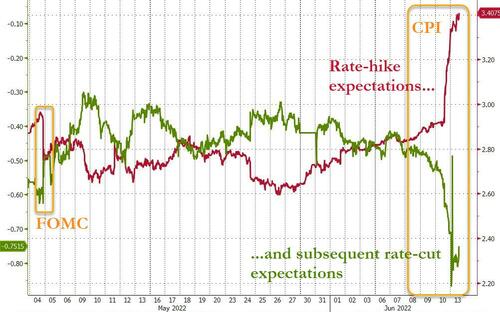
Friday’s shocking US inflation came in well above expectations at 1.0% m-o-m / 8.6% y-o-y headline, and 0.6% m-o-m / 6.0% y-o-y core. That’s the highest y-o-y headline CPI since December 1981, even further back in time than the first ‘Top Gun’ movie. Indeed, in Tom Cruise terms, it’s back to his second-ever movie, ‘Taps’.
Over the past decade, US CPI averaged 1.6% y-o-y. Over the past 12 months, it was 6.9%. Food, energy, and services inflation is rampant, and while goods inflation is edging lower and inventories need to be cleared, there is still an implied manufacturing shock coming from the input side with a lag. Indeed, core inflation has only seen one monthly print lower than 0.5% (6% annualized) since October last year, the trend in energy is not going to stop, and neither will that in Owners’ Equivalent Rent given soaring mortgage rates force more people to rent.
There is now some talk of so-called “core-core” inflation excluding food and energy, and airfares, rents, vehicles, hotels, and health insurance, which shows inflation is ebbing. Logically, if we take out everything going up then inflation is zero. Likewise, the Fed and the White House told us there was no inflation; was going to be no inflation; if there was any inflation it was mild; and once it got high, that it would be transitory. These are not serious people, and I refuse to take them seriously.
Yet the Michigan consumer survey collapsing to a lower level than during the Global Financial Crisis should be, with 1-year ahead inflation seen at 5.4% and 5- to 10-year inflation up to 3.3%. Given it is estimated US households need over $430 more a month just to stand still vs. inflation, this is not a surprise. Indeed, what Philip Marey had already flagged the Financial Times’ today makes clear is now the widespread view: ‘US set for recession next year, economists predict’. Yet we were repeatedly told by the Fed, the White House, and many in markets that a US recession was not a risk. Likewise, RaboResearch flagged the energy-shock risks for Europe weeks ago, which the ECB still does not recognize. Even Australia is now seeing market calls for a 15% drop in house prices ahead, which is hardly GDP positive for an asset-addled economy.
In short, we can ignore ‘stagflation’ and can proceed to a new word shared by an incisive reader:“Incession” – inflation and recession. I repeat that we aren’t used to that concept in developed markets by any name, but emerging markets know the phenomenon all too well. Congratulations to the Western leadership of the past four decades, who have successfully turned our economies into something closer to emerging markets!
Markets are obviously far from happy. US 2-year yields leaped from 2.81% to 3.14% Friday, the kind of spike few see in a career. 5-years jumped from 3.07% to 3.31%. 10-years rose less, from 3.04% to 3.16%, so 2s-10s is close to inversion again, and 5s-10s already is. 30-years, despite wild swings, only rose 3bp at the close to 3.19%, so 5s-30s is also inverted and 2s-30s is close to it.
Stocks went down again despite the hordes of deeply unserious people telling you they only go up. We also saw the US dollar surge, with EUR back below 1.05 this morning in Asian trading, and JPY moving past 135, as the DXY sits close to 104.5. Moreover, commodities dropped back only a little, with Brent -1.4% to $120.3. Imagine how much more is needed to get oil back to $100.
So, what should the Fed do this week? The expectation is Wednesday’s meeting will still the pre-flagged 50bps move. However, we are starting to hear whispers of a 75bps hike, and this weekend saw the first suggestion of 100bps and the Fed opening the door to inter-meeting hikes of indeterminate size. A good emerging-market central bank would do exactly that in these kinds of circumstances. Of course, the author of the 100bps call made clear this will not happen,… because these are not serious people, who we should refuse to take seriously.
A far broader range of policies are needed to fight inflation. Back in the late 70s and early 80s, supply-side reform moved the West away from a fiscal Keynesianism unable to cope with higher oil prices and tight labor markets by moving manufacturing jobs to emerging markets. Today, the trend is moving back towards fiscal populism and away from manufacturing in key emerging markets. However, these policies aren’t joined up in the way they were in the 70s and 80s, either intellectually or practically.
On the fiscal side, UK PM BYO is promising tax cuts, which don’t help those who aren’t earning much suffering most from high inflation. On the production side, he is launching a scheme to grow more food in the UK,… while cutting subsidies to farmers, signing free trade deals with cheaper producers, closing off EU markets and cheap EU labour, and pushing ahead with green reforms that raise costs. As an anguished farmer notes in The Guardian in an article about “rural fury”, “We want to be eating more British and more local food but again I just ask how. It’s all very well to have words but it’s got to have really meaningful delivery and we aren’t seeing that yet.”
In France, President Macron is projected to probably scrape a narrow parliamentary majority but is only going to take around 25% of the vote share. That will make it more difficult for him to cut taxes and raise the retirement age from 62 to 65, as pledged. So, perhaps just the tax cut then?
In the US, the White House is talking about fighting inflation while doing little to expand domestic supply over imports, and winking at slashing student debt, which is a direct fiscal transfer (to the relatively better off).
Markets won’t like it, but if we get “incession”, we are also going to get such “unpopulism”.
So, back to the question of ‘what to do?’ On the UK front, there is a simple theoretical answer: shift away from ‘Brexit means Hard Brexit’ to re-join the European Free Trade Area (EFTA), or the so-called Norwegian Model. True, it would be politically impossible under present leadership, but it might perhaps happen after the next election under Labour.
Yet what is the EU to do about its own self-inflicted structural problems that are far more difficult to resolve than Brexit? Note that Ukraine will find out within a week or so if it is going to get the green light to begin the (slow) EU membership process or not. At the same time, Ukraine is running out of ammunition with which to fight Russia, so determining what the country that joins will physically look like. Many Western soliloquies have been delivered, but far fewer arms: and Russia wants ‘its’ land back.
That is also ammunition to those who dispute that a globalised, free-trade economy holds all the best answers to our existential economic questions. How many EU countries would find themselves in the same boat as Ukraine in a similar crisis, which cannot be ruled out? Arguably all of them expect France. They would end up relying on the US – as ever. And whom can the US rely on? Didn’t we just go through this with Covid? Despite that, and Ukraine, the West is still firing geopolitical/geoeconomic blanks.
The simple fact is that if you push your commodities and manufacturing to other countries to lower inflation, you let those countries push you back by withholding supply, raising inflation again. Imagine if the US or EU were major net exporters to Russia or China, and D.C./Brussels didn’t like what they were doing: wouldn’t they withhold key goods as an economic pressure point? (Assuming American or EU firms cared more about home than their own profits – but there is always legislation/sanctions to give them a shove in the right direction.)
Geopolitical logic says the West needs to increase supply. It needs to do it now. And it needs to reduce supply from those who threaten to withhold it. Yes, that is as “unpopulist” as the Fed hiking 75bps or 100bps to also reduce demand and refusing to spoon-feed pampered markets as to what happens next on rates to keep them on edge. However, it does not stop either being true. The fact that this is not happening only shows that those at the top are not serious people, and that we should refuse to take them seriously.
Bringing it back to inflation, we are close to the summer solstice: then it’s six months until the depths of winter. At that point, Europe says it won’t be buying any Russian oil. If global supply is then constricted and demand hasn’t fallen, US retail gasoline prices might be $6 or $7 a gallon, or higher. Is that a recession? Yes, a deep one. Is it an inflation crisis too? Yes, a large one. And, crucially, it is driven by the geopolitical backdrop.
Relatedly, at the Singapore Shangri-La Dialogue, the good news was that the US and China are talking again. The bad news was what they were saying to each other. The US stressed they aren’t looking to form an ‘Asian NATO’, but don’t want any forced changes in the region. China claimed the US is stirring up problems, smearing it, and Beijing is prepared to fight a war to the end to take Taiwan if it moves towards independence, while escalating claims to the South China Sea: the only stated route to de-escalation is the US acceding to Chinese demands.
Meanwhile, Japanese PM Kishida’s keynote speech noted, “I will seek to build a stable international order through dialogue, not confrontation. At the same time, however, we must be prepared for the emergence of an entity that tramples on the peace and security of other countries by force or threat without honoring the rules.” He was not referring to the US.
“This will be absolutely essential if Japan is to learn to survive in the new era and keep speaking out as a standard-bearer of peace. I am determined to… secure substantial increase of Japan’s defence budget… In doing so, we will not rule out any options, including so-called “counterstrike capabilities”, and will realistically consider what is necessary to protect the lives and livelihoods of our people.” He also spoke of the Quad offering $50bn in infrastructure funding to ASEAN over next 5 years, obviously as a counter-offer to Chinese capital.
In short, the Japanese warning is that we risk stumbling towards a conflict like Ukraine in the Indo-Pacific too: and yet the West are *still* not moving supply chains fast enough to avoid calamity if it were to happen.
So, what to do? Shift supply as if this were a war *now*. And raise rates as high as needed for as long as needed to stifle capital flowing into frivolous and vampiric asset-speculation over desperately-needed physical production. It’s an Austrian view; it’s a realpolitik view; and it’s a post-Keynesian MMT view on how to fund it. But we aren’t seeing any rapid movement in that direction because those at the top in D.C. thinktanks and key parts of the Pentagon are also not serious people – and we should also refuse to take them seriously.
As the Modern War Institute at West Point puts it in its op-ed ‘We’re Doing It Wrong’, “The US just lost two wars. How is it possible that the war colleges have educated more than twenty thousand “strategists” over the last two decades and have nothing to show for it but two strategic defeats?… Take, for instance, economics. Students need to understand how economics works in the real world, such as how markets, debt, or rapid currency moves influence strategic decisions.”Equally, the Fed, which bankrolls the fading military hegemon propping up the entire global financial system, needs to understand the Pentagon’s needs and geostrategy better – rather than how to get on the $250,000 after-dinner speech circuit. (Though those prices have surely risen with inflation.)
Which brings me back to 1981’s ‘Taps’, where the movie description is: “When an exclusive military school is threatened with demolition by a rapacious real-estate company, the students stage an uprising and siege control of the campus.” So, Wall Street triumphing over national security was a thing back in 1981 in Hollywood imaginations. Now it’s real life, and some are worried about playing Taps (a bugle call during flag ceremonies at military funerals by the US Armed Forces) for real.
Reversing that US drift, and reversing a 1981 level of US inflation, requires new policies that are joined at the hip: and serious people we could take seriously. But for now we will probably just get 50bps this week and strategic inaction; and so higher commodity prices; and so higher inflation; and so incession.
As a result, we will also get populist political distractions.
Today, the British government will release legislation that opens the door to tearing-up the Northern Ireland Protocol, so breaking international law. The CBI are warning the UK this will be a huge error, and the EU have made clear it will trigger a trade war. Nonetheless, sausage rolls, the need to distract from two seemingly-inevitable byelection defeats this week, and PM BYO’s desire to stay in office all suggest the UK will nonetheless go down this route. Just don’t think the EU and US are immune from their own forms of such “unpopulism”.
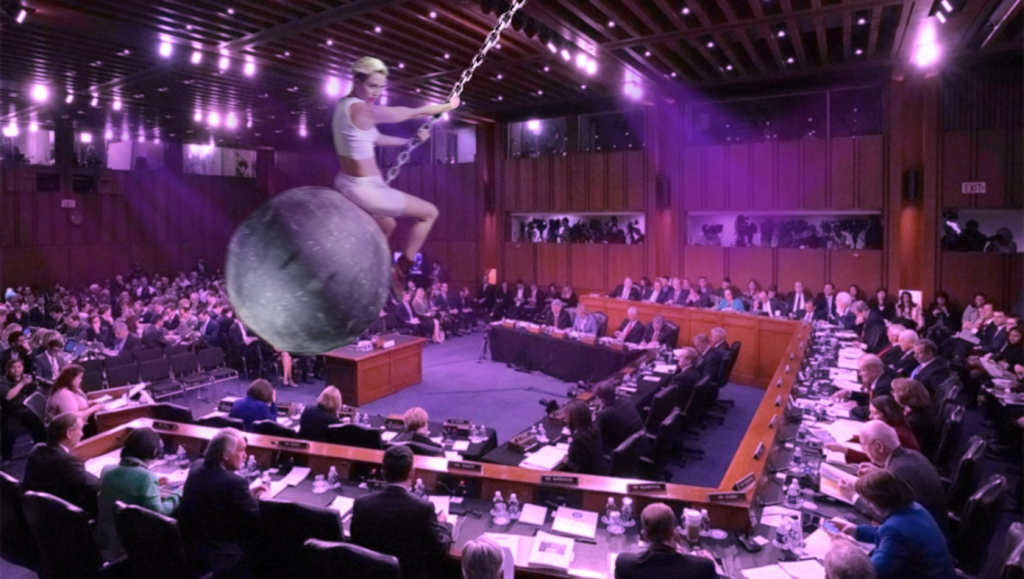
WASHINGTON, D.C.—The nation is abuzz with anticipation of the televised January 6 Committee hearing making its prime time debut at 8 p.m. ET. To top off the excitement of the House select committee’s investigation, producers of the star-studded extravaganza have announced that Miley Cyrus will be the featured performer during the hearing’s halftime show.
Other performers during the bedazzling spectacle will include Neil Young, Bruce Springsteen, Demi Lovato, and the ghost of Alexandria Ocasio-Cortez.
“If you thought the Depp-Heard trial was exciting, wait until you get a load of this baby,” said James Goldston, a former ABC News executive hired by the Democrat-led committee to really “wow” the American people with a multimedia presentation aimed at objectively and judiciously seeking the truth of what really happened that fateful day.
Republican lawmakers have pounced on the House select committee, accusing them of putting on a politicized, narrative-driven stunt rather than seeking truth. In response, GOP lawmakers have sworn to make their own January 6 Committee with cool, Republican members, lots of American flags, and a concert on Mt. Rushmore featuring Toby Keith and Morgan Wallen.
The January 6 Committee said the opening ceremony of the hearing will include previously-unseen video footage of the Capitol riots, followed by a ritual burning of Trump in effigy.
To celebrate Pride Month, Mattel has released its first-ever pregnant man doll: Pregnant Ken! You can have all sorts of fun with the clearly MALE Ken doll and his pregnant belly! Available wherever non-gender-specific toys are sold.
Shocking Consumer Credit Numbers: Everyone Maxing Out Their Credit Card Ahead Of The Recession
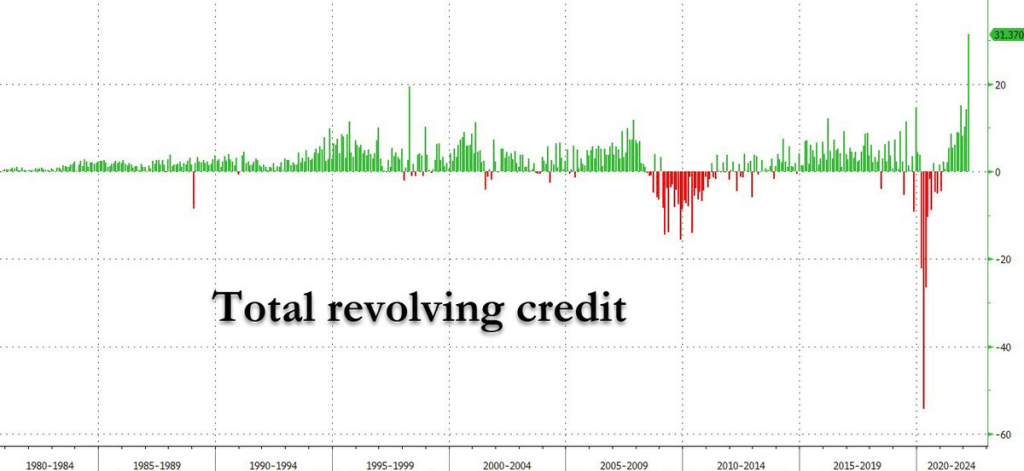
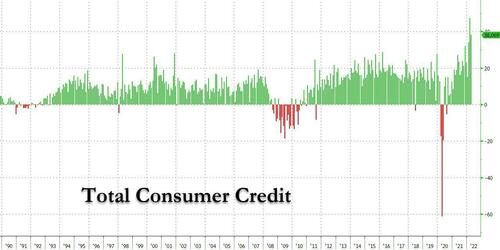
While it is traditionally viewed as a B-grade economic indicator, the April consumer credit report from the Federal Reserve was another shocker especially after last month’s stunning surge in credit card debt which saw the biggest increase in revolving credit on record which is why we said that today’s G.19 print straight from the Fed would be just as important as Friday’s CPI print…
Forget CPI: the week's most important data point is today's monthly consumer credit update. Last month we saw a blowout, record surge in credit card usage as consumers tapped out pic.twitter.com/FoZ5XE4JWI
… and sure enough it was, while again confirming what we have been saying for month: any excess savings accumulated by the US middle class are long gone, and in their place Americans have unleashed a credit-card fueled spending spree.
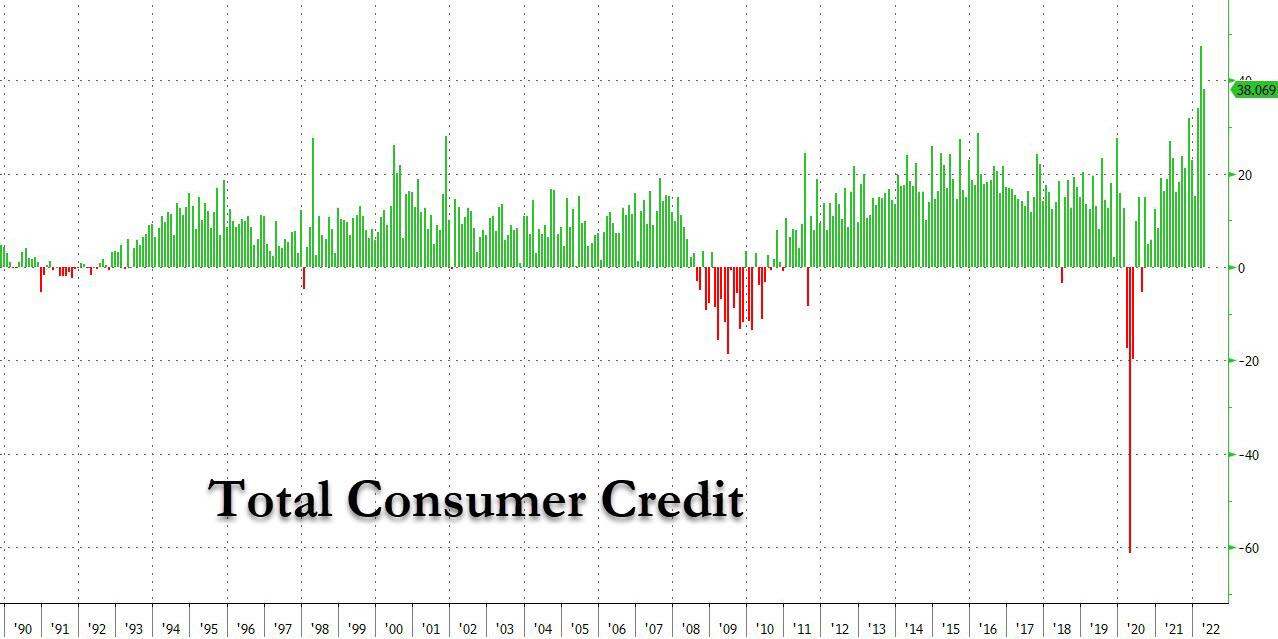
Here are the shocking numbers: in April one month after the jarring March print again came in more than double the $25 billion expected to $52.435 billion, in April consumer credit again exploded to a ridiculous $38.1 billion, again blowing away expectations of a $35 billion increase (and not much lower than last month’s downward revised $47.3 billion).
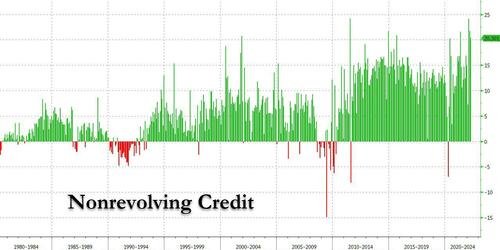
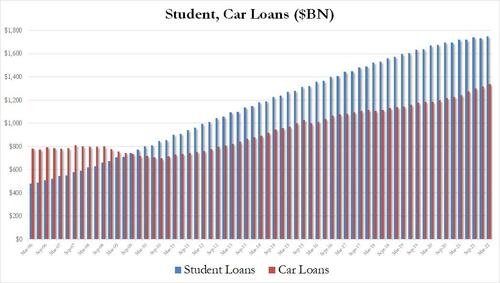
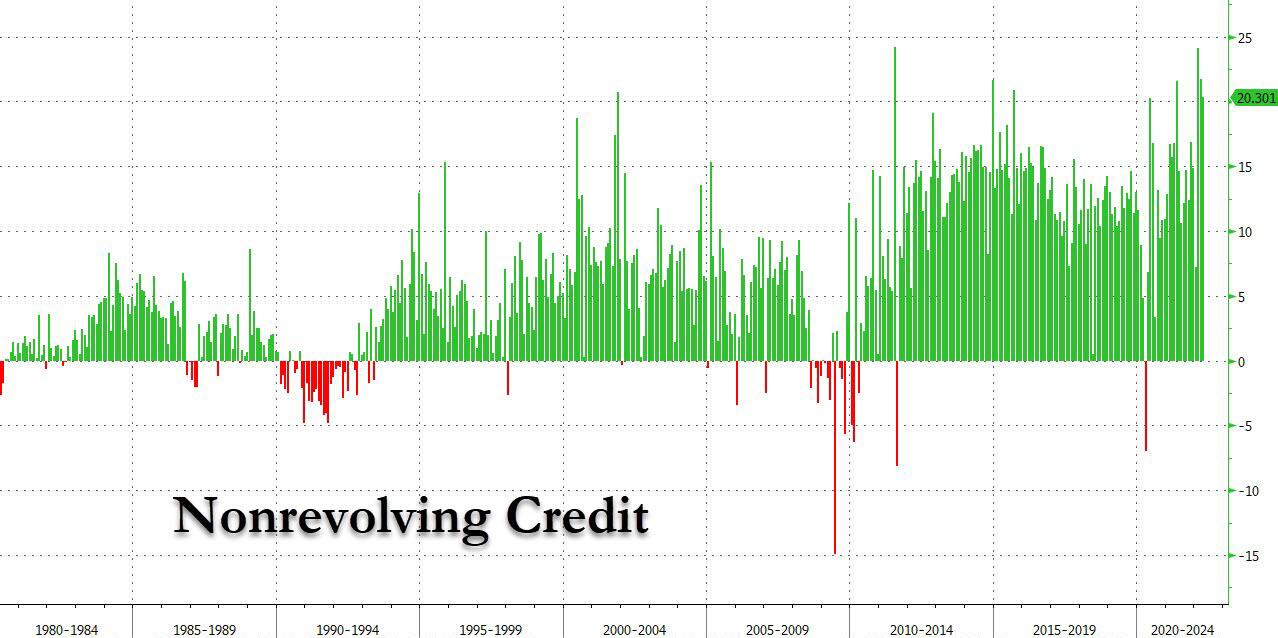
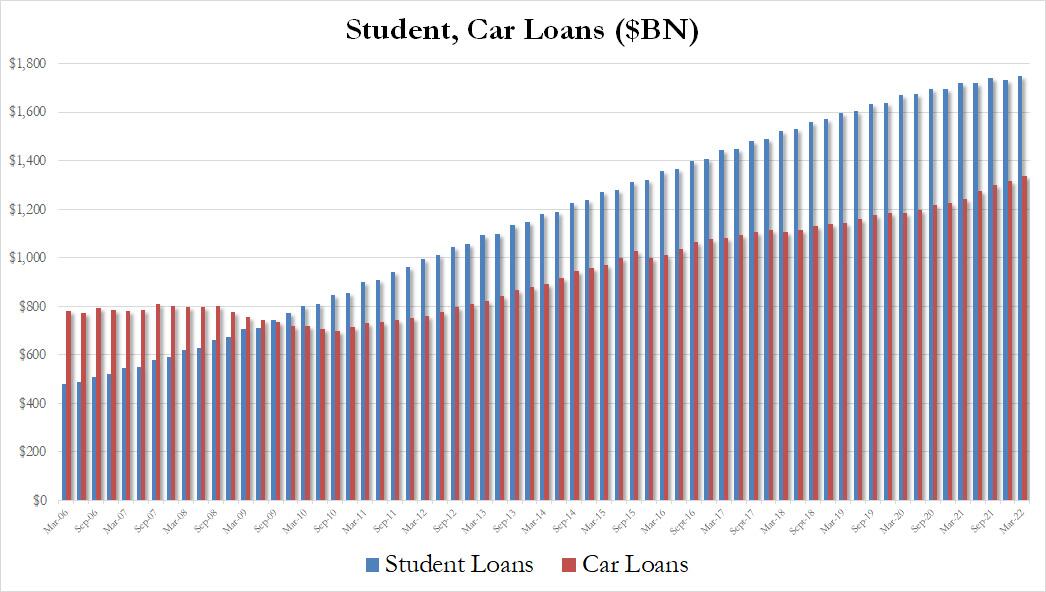
And while non-revolving credit (student and car loans) rose by a relatively pedestrian 21.1 billion (which was still the 6th highest on record)…
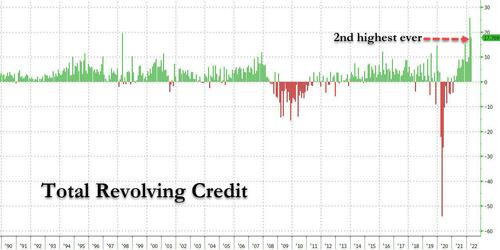
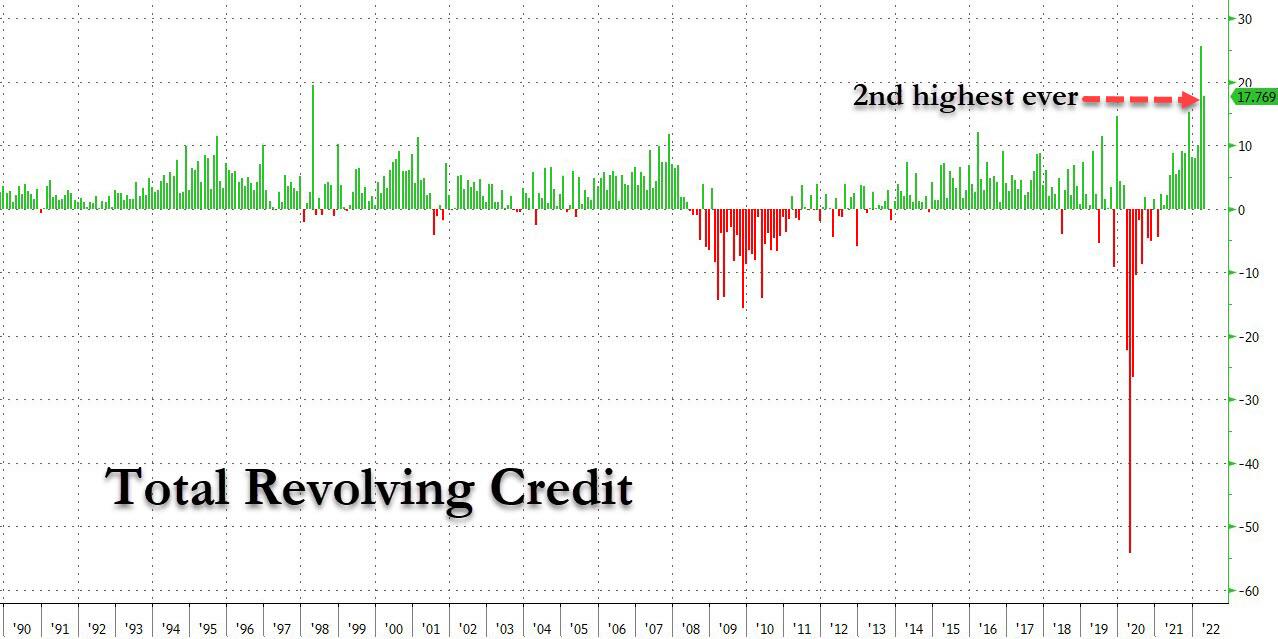
… the stunner for the third month in a row was revolving, or credit card debt, which remained shockingly high, rising by the second highest on record at $17.8 billion, and down from only the highest print on record, March’s downward revised $25.6 billion (from $31.4 billion)…
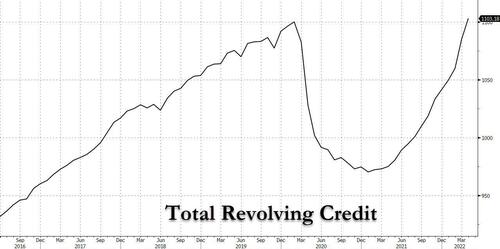
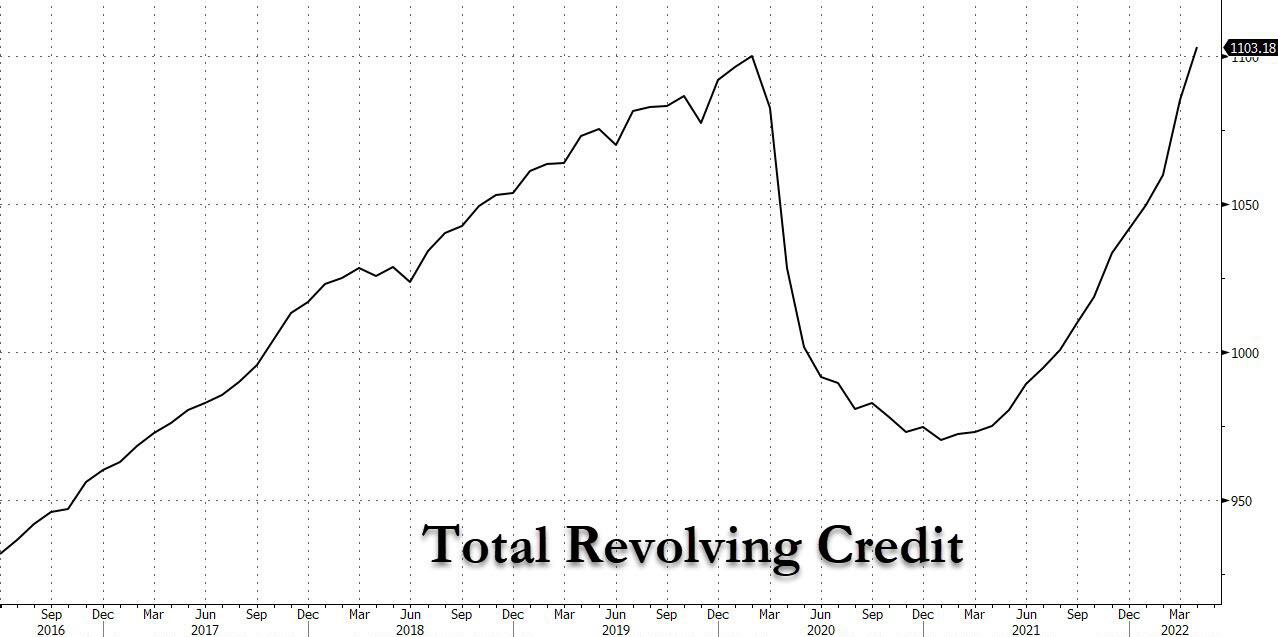
… and sending total revolving consumer credit back to new all time highs at just over $1.1 trillion, erasing all the post-covid credit card deleveraging just in time for those credit card APRs to start moving much higher, first slowly and then very fast.
As an aside, and while not at all surprising, both auto and student loans hit a new all time high at the end of the first quarter.
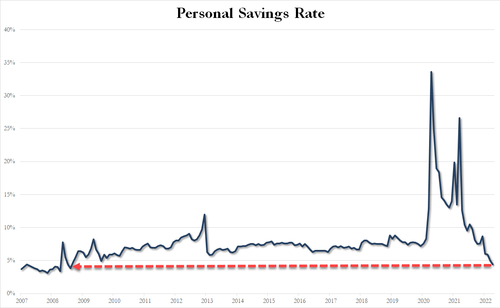
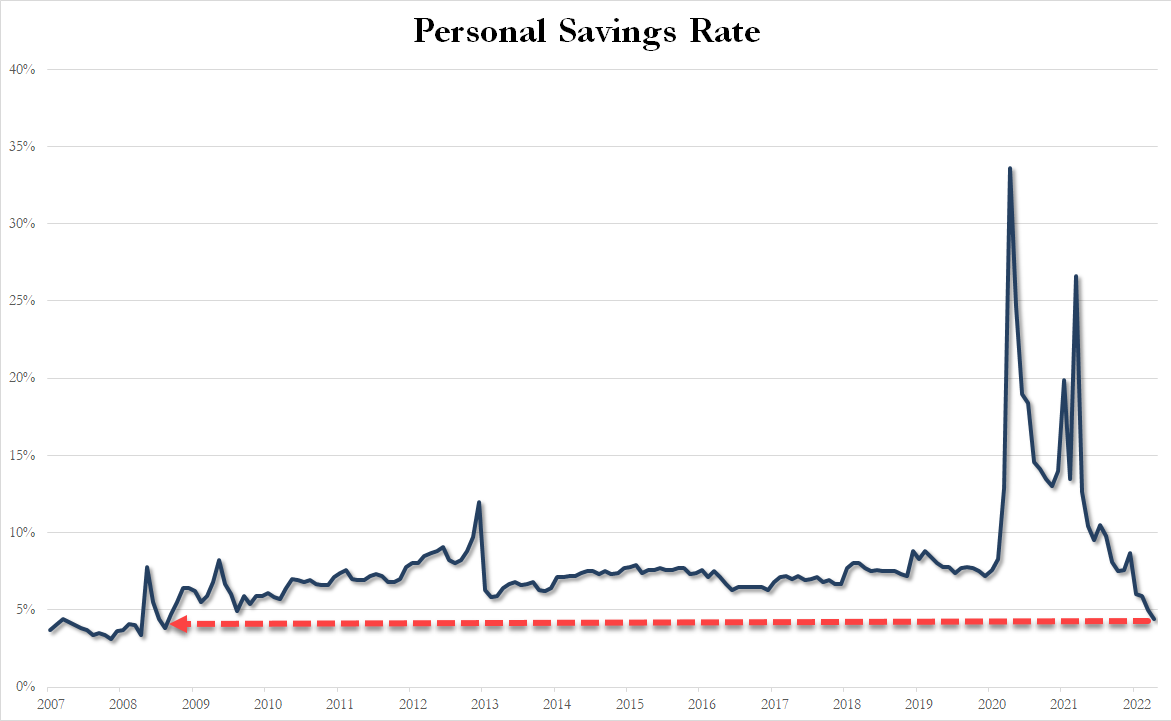
While this unprecedented rush to buy everything on credit at a time when there were no notable Hallmark holidays should not come as much of a surprise, after all we have repeatedly shown that for the middle class any “excess savings” are now gone, long gone with the personal savings rate plunging to the lowest since just before Lehman…
… the fact is that most economists – such as those at Goldman Sachs – had previously anticipated that continued spending of savings by consumers is what will keep the US economy levitating in 2022. Unfortunately, as the consumer credit numbers of the past three months demonstrate all too clearly, any savings that US middle class households may have stored away courtesy of stimmies, are long gone.
The implications are profound: any model that projected that US spending will be fueled by “savings” can now be trashed. And since this is most of them, the consequences are dire as they confirm – once again – that the Fed is tapering, QTing and hiking right into a consumer-driven recession which was not visible until new precisely because of all the credit-card fueled spending, which according to Deutsche Bank will begin in late 2023 and which according to Morgan Stanley can start in as little as 3 months. Today’s data suggests that Morgan Stanley is right.
Lira states, and I agree with him, that Russia will win the war in the Ukraine, take the south and east to likely create a new country and leave the rest of the cadaver for Poland, Hungary, Romania, Lithuania and others to feast on.
But then what?
The U.S. controlled NATO will still be there. It is practically guaranteed that the U.S. will use it to push for revenge for the loss of Ukraine. This will be done by a steady buildup of troops and long range missile capabilities along Russia’s Nordic and Baltic borders and additional naval threats in the northern Arctic as well as the southern Black Sea. Some ten years from now the U.S. would be able to again try to wage a big (proxy) war against Russia. Then with a decent chance to win.
No negotiations or peace agreements will prevent that. The U.S. is famously non-agreement-capable (недоговороспособны). It has broken ALL promises and agreements it has ever made with Russia.
Dozens of U.S. and European luminaries had promised to Russia that NATO would expand ‘not one inch’ towards Russia. Look where its borders are now. The U.S. and the EU have confiscated huge amounts of Russian state owned money [Note: over $300 billion]. They have even taken, in contradiction to their own constitutions, the properties of private Russian citizens just because those persons happen to be Russian.
In 2014 Germany and France signed on to guarantee elections for a peaceful regime change in Kiev. A day later the fascists stormed the Ukrainian parliament and those guarantees turned out to be totally worthless. The U.S. simply said fuck the EU. It does not give shit about European interests. Germany and France later negotiated and signed the Minsk-1 and Minsk-2 agreements. They continued to feed billions of EU money into Ukraine even as the Ukrainian government, controlled by the U.S., did nothing to fulfill them. Yes, they were that stupid.
The U.S. has installed ‘missile defense’ systems in Poland and Romania which are in fact designed to lob Intermediate Range Ballistic Missiles (IRBM) onto Moscow. These are a serious danger to Russia.
Even after Ukraine is finished, NATO and its EU proxies will continue to be a danger to Russia. Both have proven to be unable to keep promises. Russia in consequence will have to rearrange them.
Russia could do that by force. But there will be no march towards Riga, Warsaw, Berlin or Paris. (Remember that Russia has been there and done that which every time has led to major changes in Europe.)
Russia has announced its strategic aims. In December 2021 Russia set forth two agreements which the U.S. and NATO. They included demands for a future arrangement in Europe that would guarantee indivisible security for all. On January 21 2022 the Russian Foreign Minister Sergei Lavrov was to meet Secretary of State Anthony Blinken in Geneva to talk about Russia’s proposals. Just minutes before that meeting the Foreign Ministry of Russia held a news conference to answer media questions:
Question: What will Russia’s demand that NATO return to the 1997 framework mean for Bulgaria and Romania? Will they have to leave NATO, remove US bases from their territory, or something else?
Answer: You mentioned one of the cornerstones of Russia’s initiatives. It was deliberately set forth with utmost clarity to avoid any ambiguity. We are talking about the withdrawal of foreign forces, equipment, and weapons, as well as taking other steps to return to the set-up we had in 1997 in non-NATO countries. This includes Bulgaria and Romania.
MOSCOW (Reuters) – The security guarantees that Russia seeks from the West include provisions requiring NATO forces to leave Romania and Bulgaria, the Russian foreign ministry said on Friday.
Moscow has demanded legally binding guarantees from NATO that the bloc will stop its expansion and return to its 1997 borders.
Replying to a question about what that would mean for Bulgaria and Romania, which joined NATO after 1997, the ministry said Russia wanted all foreign troops, weapons and other military hardware withdrawn from those countries.
After more than 20 years of watching Lavrov and Putin everyone should know that they do not publicly set out aims if they have no way to achieve them. They always have well thought out plans before announcing their goals.
So how can Russia actually achieve a retreat of NATO back to its 1997 borders?
Sanctions. The U.S. has used its economic and military powers to sanction this or that country that did not do as it was told to do by Washington. Unless enacted by the UN Security Council such sanctions have no basis in international law. Despite that the U.S. even used secondary sanctions. It threatened sanctions against Europe, and everyone else, as it ordered them to not deal with Iran or Venezuela.
The US is thinking about “allowing” Europe and Venezuela to trade together. Think about what this story tells us about global power relations and who is in charge.
The US could allow Eni and Repsol to ship Venezuelan oil to Europe as soon as July to make up for Russian crude, Reuters reported trib.al/fQ10QlX
Russia can do similar. But as it always follows international law, it will have to do it in a slightly different way.
Russia is a superpower in that it produces all kinds of raw materials the world, and especially the ‘west’, needs. Europe, and especially Germany, is depending on natural gas and oil from Russia. Energy prices in Germany will at least triple if it is completely cut off from Russian supplies.
German industry leader have loudly announced that they will have to close shop if the current European policies of restricting Russian energy supplies continues. The chemical giants BASF and Bayer will have to move to some other country. Volkswagen, Mercedes, BMW will have to stop all production in Europe. Steel production would fall to zero. Lack of fertilizer would lead to dependency on foreign agriculture.
Mass unemployment would follow. Millions will be in the street to protest against rolling blackouts, freezing apartments and hyperinflation.
Russia can achieve this at any time. It simply has to stop supplying gas and oil to Europe.
Despite six European ‘sanction packages’ against Russia there has yet to be a reciprocal response from Russia. It may still hope that European leaders will recognized the deadly game the U.S. is playing with them.
Unfortunately the leaders of Europe are dumb and compromised. The ‘olive green’ German Minister for Economic Destruction Robert Habeck still dreams of bringing Russia’s economy to its knees even as the ruble rises and Germany’s economy is falling apart. Chancellor Olaf Scholz was never the brightest bulb in the room. He is deeply compromised through his involvement in the Wireguard scandal. He was the Minister of Finance when reports of the company’s billion dollar fraud were suppressed by his ministry. And don’t get me going about Ursula van der Leyen who has been proven to be corrupt and incompetent ever since she took her first public office. U.S. secret services will know of many other crimes these people have been involved in.
The current ideological leaders of Europe will have to be replaced by clean ones who follow the German tradition of Realpolitik:
Realpolitik (German: [ʁeˈaːlpoliˌtiːk]; from German real ‘realistic, practical, actual’, and Politik ‘politics’), refers to enacting or engaging in diplomatic or political policies based primarily on considerations of given circumstances and factors, rather than strictly binding itself to explicit ideological notions or moral and ethical premises. In this respect, it shares aspects of its philosophical approach with those of realism and pragmatism. It is often simply referred to as “pragmatism” in politics, e.g. “pursuing pragmatic policies” or “realistic policies”.
Only with new and decent leaders will Europe come to its senses.
Russia can help to achieve that while at the same time solving its NATO problem.
It can publicly declare that:
THERE WILL BE NO FURTHER RUSSIAN SUPPLIES OF ANY KIND TO EUROPE UNTIL IT BREAKS WITH WASHINGTON.
What would follow?
Millions of discussions under candlelight would be held in freezing and hungry European households. Political opinions would change. Governments would be replaced with more pragmatic ones.
France and Germany would either have to leave NATO or become impoverished and irrelevant. U.S. troops on European grounds would be asked to leave or be attacked and thrown out by an enraged public. Germany would prohibit the U.S. military from using its airspace. The U.S would lose its grip over the continent.
That can’t happen? Well, Gonzalo Lira disagrees and so do I. In early February, before the Russian intervention in Ukraine, I had warned of the consequences of current ‘western’ policies:
The U.S. strategy to ‘fix’ Russia in Europe by imposing ‘crushing sanctions’ on it to then attack China is failing. That is because it was completely misconceived.
Russia is the most autarkic country in the world. It produces nearly everything it needs and has highly desirable products that are in global demand and are especially needed in Europe. Russia also has huge financial reserves. A sanctions strategy against Russia can not work.
The U.S. and its proxies in the EU and elsewhere have put up very harsh sanctions on Russia to damage its economy.
The final intent of this economic war is regime change in Russia.
The likely consequence will be regime change in many other countries. … All energy consumption in the U.S. and EU will now come at a premium price. This will push the EU and the U.S. into a recession. As Russia will increase the prices for exports of goods in which it has market power – gas, oil, wheat, potassium, titanium, aluminum, palladium, neon etc – the rise in inflation all around the world will become significant. … [Russia and China] have spent more brain time on the issue than the U.S. has.
The Europeans should have acknowledged that instead of helping the U.S. to keep up its self-image of a unipolar power.
It will take some time for the new economic realities to settle in. They will likely change the current view of Europe’s real strategic interests.
Europe is fortunate in that Russia, even before re-entering the Ukraine, has offered a very decent alternative to U.S. hegemony in Europe:
A man who has Putin’s ear, Professor Sergey Karaganov who is the honorary chairman of Russia’s Council on Foreign and Defense Policy, has written an op-ed that points to an alternative.
The piece was requested by and supposed to be published in the Financial Times, which means that it is directed at the European leadership. But the FThas now rejected it for unstated reasons. It was then published in the Russia in Global Affairs journal and has now been re-published by RT. … [Karaganov] states:
The security system in Europe, built largely by the West after the 1990s, without a peace treaty having been signed after the end of the previous Cold War, is dangerously unsustainable.
There are a few ways to solve the narrow Ukrainian problem, such as its return to permanent neutrality, or legal guarantees from several key NATO countries not to ever vote for further expansion of the bloc. Diplomats, I assume, have a few others up their sleeves. We do not want to humiliate Brussels by insisting on repudiating its erroneous plea for the open-ended expansion of NATO. We all know the end of the Versailles humiliation. And, of course, the implementation of the Minsk agreements.
But the task is wider: to build a viable system on the ruins of the present. And without resorting to arms, of course. Probably in the wider Greater Eurasian framework. Russia needs a safe and friendly Western flank in the competition of the future. Europe without Russia or even against it has been rapidly losing its international clout. That was predicted by many people in the 1990s, when Russia offered to integrate with, not in, the continent’s systems. We are too big and proud to be absorbed. Our pitch was rejected then, but there is always a chance it won’t be this time.
That last paragraph is the gist of Russia’s real strategic aims. They require to destroy the current system of U.S. hegemony over Europe. Europe will have to be de-NATO-sized. Regime changes in European countries will probably be necessary to see to that.
Russia’s leaders now have a once in a century chance to achieve those aims. They will be condemned by their compatriots if the refrain from doing so. The U.S. has no way to prevent or counter a Russian sales boycott and its consequences.
When will European politicians, or those behind them, finally wake up to those facts?
Update (11:45 UTC):
A soundbite from a press conference Lavrov is currently holding:
FM #Lavrov: To all appearances, no one is going to even reform #NATO. They are going to turn this “defensive alliance” into a global alliance claiming global military dominance. This is a dangerous path that is definitely doomed to failure.