Back in March I had warned that Lies Do Not Win Wars. Here is another practical example.
After allegedly having ‘run out of missiles’ and, more importantly, patience, the leadership of the Russian Federation decided to de-electrify Ukrainian cities with a ‘barrage of missile strikes’.
President Vladimir Putin said on Thursday that Russia had barely got started in Ukraine and dared the West to try to defeat it on the battlefield, while insisting that Moscow was still open to the idea of peace talks. … “Today we hear that they want to defeat us on the battlefield. What can you say, let them try,” he said.
“We have heard many times that the West wants to fight us to the last Ukrainian. This is a tragedy for the Ukrainian people, but it seems that everything is heading towards this.” … “Everyone should know that, by and large, we haven’t started anything yet in earnest,” he added. “At the same time, we don’t reject peace talks. But those who reject them should know that the further it goes, the harder it will be for them to negotiate with us.”
UN: Ukraine nuclear power plant loses external power link – ABC News – Oct 8, 2022 The U.N. nuclear watchdog says that Ukraine’s Zaporizhzhia nuclear power plant, the biggest in Europe, has lost its last remaining external power source as a result of renewed shelling and is now relying on emergency diesel generators
KYIV, Ukraine—Russia carried out waves of strikes on several Ukrainian cities including the capital in the broadest and most intense onslaught since the start of the invasion, after President Vladimir Putin accused Ukraine of a “terrorist attack” on a critical bridge connecting Russia’s mainland to the occupied Crimean Peninsula.
Ukrainian President Volodymyr Zelensky said Russia had carried out dozens of strikes using missiles as well as Iranian-made drones to target civilian and power infrastructure. “They want panic and chaos,” he said. “They want to destroy our energy system.”
Kyrylo Tymoshenko, deputy head of the president’s office, said on social media Monday that, “Ukraine is under missile attack. There is information about strikes in many cities of our country.”
General Valeriy Zaluzhnyi, Commander-in-Chief of the Ukrainian Armed Forces, said on Twitter that Russia had launched 75 missiles at Ukraine but that “41 of them were neutralized by our air defence.”
Zelenskyy later emerged onto a street in Kyiv to record a selfie video with a message to his people and the world, denouncing Russia for the barrage of missiles which he said had targeted Ukraine’s energy infrastructure, and its civilians.
Kiev, Lviv, Karkov, Dnipropetrovsk, Krivoy Rog all report damage to their electricity infrastructure.
Ukrainian troops on the front line began to lose contact with Starlink satellites. In some places, the situation is “catastrophic” and even reaches panic. Almost all of our official media began to write about this, citing material from the popular Western newspaper Financial Times. As the authors point out, the connection to the network “fell” in several regions at once: Kharkiv, Zaporozhye, Kherson, as well as in a number of territories of the DPR and LPR. And it’s been going on for more than a day now.
Equipment vendors have suggested that everything that is happening is the result of Starlink’s protective measures due to unauthorized access attempts. However, officials from Elon Musk’s company have so far refrained from commenting.
Meanwhile, in our media and telegram channels, a different, and very logical, version is put forward: the Russian military decided to use the Tirada-2S satellite communications electronic jamming system (REPS) in combat conditions. There is no reliable information about this, but it can be considered as an option.
Source: teranews.net
The thing is pretty secret
Not only is there little information about the Tirada-2S system, it is almost non-existent. There are no reliable photos in the public domain. All allegedly real shots end up caught in the lens by Krasukhas and other electronic warfare equipment.
It is known that the creation of this product officially began in 2001, when the requirements for a complex capable of jamming the communication channels of satellites with their ground-based receivers (terminals) and transceivers located on aircraft – mainly long-range drones were determined. It was assumed that the future “Tirada” will be made in two versions: mobile on a wheeled chassis and stationary.
Source: anna-news.info
Of course, scientists already had at their disposal developments on the previous generation of such a system – Tirada-1D, which they tried to translate into metal back in the Soviet years. However, according to officials, the new complex has little in common with the old one. From here it becomes clear why its development lasted so long: in addition to limited financial injections, there were difficulties with the creation and achievement of the element base of the product.
Models with very vague descriptions of the capabilities of the machine have repeatedly flashed at closed and open shows to the general public, including at the International Air Show MAKS-2013. However, only 16 years later – in 2017 – the leadership of the 46th Central Research Institute of the Ministry of Defense of the Russian Federation, where they developed the Tirada, announced the imminent completion of the entire development program on this topic. Here, as they say, there was little left to do – to adopt.
Model of the complex “Tirada-2S” at MAKS-2013. Source: arsenal-info.ru
In August 2018, on the sidelines of the ARMY-2018 forum, a contract was officially signed for the production of Tirada-2S for the needs of the Ministry of Defense. The general contractor was the Elektropribor plant in the city of Vladimir. Initially, it was assumed that the first complexes would leave the plant’s workshops by the end of 2018, but already in October it was reported that Tirada-2S was at the state testing stage.
In 2019, it was planned to begin deliveries of the complex to the troops of the Central Military District.
Jamming communication
The higher the secrecy, the more myths. “Tirada-2S” fully corresponds to this statement. At one time, many assumptions were put forward about why this system was needed at all. It comes to the point that she is credited with the possibility of the physical destruction of the satellite in the literal sense of its “burning out”. In fact, most likely, we are talking about jamming satellite communications. Considering that this complex was developed primarily to counter the US Army, whose doctrine is largely based on total digitalization and space communications and intelligence systems, such a “jammer” is needed no less than some representative of the Zhitel electronic warfare.
Subtleties and nuances in electronic warfare – a wagon and a small cart. In particular, this applies to secure communication channels between the satellite and the transceiver terminal, which can be located both on the ground and in the air – for example, on an unmanned aerial vehicle. The variability of actions here is wide: you can influence both the satellite and the terminal itself. “Tirada-2S”, based on open data, just works on satellites.
A satellite, of course, is far from a passive thing. In the course of its work, it both receives a signal from the terminals and sends it back. Otherwise, no Starlink and other systems would simply not work. And once there is activity, it can be detected. And this is much easier than finding the same ground terminals – at least the horizon does not interfere in any way.
Starlink terminal plate. Source: telegra.ph
To detect enemy communication systems, Tirada-2S is equipped with special direction-finding equipment that detects the area in which the satellite signal operates, and the on-board computer, after processing the incoming data, gives its location in the sky. By the way, perhaps in the functionality of the machine there is the possibility of receiving data from stationary radar stations, which provide more accurate data on the location of spacecraft.
After identifying the target in automatic mode, it is suppressed. It consists in setting up directional interference – powerful radiation that affects the satellite’s transceiver. Nothing there, of course, is burned out like in a microwave, but a dense “veil” completely deprives the satellite of the opportunity to receive a signal from the Earth. As a result, the interaction of the spacecraft with ground and air based stations is completely lost. Not only “Starlink” products can be cut off here, but also quite combat ones – reconnaissance and military communications satellites.
Some military experts point out that military satellites will be more vulnerable, because in the face of opposition from Tirada-2S, their automated systems will try to overcome interference, which will cause increased battery drain and a high load on the onboard power system. Whether there is confirmation of this is not yet very clear, but it should be borne in mind.
Is there any application logic?
Above, we have already said that there is a logic to the use of Tirada-2C. The Starlink system is, in principle, one of the potential targets for our troops. Despite the fact that the official version of the transfer of the terminals of this satellite communication to Ukraine was generally limited to “humanitarian” considerations of providing access to the Internet for the population of both the areas affected by the hostilities and those very far from the frontline zone, they are not used for peaceful purposes at all.
In fact, “Starlink” Internet access is actively used in military affairs. Moreover, it is so active that for the units of the armed forces of Ukraine this channel of space communications is almost the main one for ensuring sustainable interaction, reconnaissance and navigation. This is confirmed by the Starlink reports for August of this year, in which most of the TOTAL line is occupied by the traffic of government agencies and military formations. It accounts for about 90% of all gigabytes that have passed through satellites from the territory of Ukraine.
Yes, Starlink equipment suppliers in Ukraine have already expressed their assumption that the disconnection occurred due to blocking unauthorized access, which, apparently, refers to the use of trophy terminals by our troops. The situation is, to put it mildly, very strange. The Armed Forces of Ukraine are on the offensive, and at the most critical moment they are deprived of communications, so much so that, according to statements from their side, the situation on the ground is “catastrophic”.
To blame everything on the insult of Elon Musk, who has recently been hit by an avalanche of criticism because of his proposals to resolve the conflict in Ukraine? Even so, the problems with the satellites, judging by the sources, began before his publication on Twitter. However, Musk could recognize our referendums and turn off Starlink in the territories we acquired or declare them a “gray” zone.
Yes, reports from the “secret” battlefields are not available to us, so we cannot understand the true cause of the events taking place, but the use of “Tirada-2C” cannot be ruled out, and we would not want to.Author:
Russia gears up for electronic warfare in space (part 1)
by Bart Hendrickx Monday, October 26, 2020
Russia is building up an impressive capability to conduct electronic warfare against foreign satellites. At the center of this effort is the development of a variety of mobile ground-based systems to interfere with the operations of both communications and radar reconnaissance satellites. There is also evidence for plans to perform electronic warfare from space using nuclear-powered satellites. Aside from that, work is underway at various locations in Russia to construct ground-based infrastructure to obtain signals intelligence on foreign satellites and apparently also to protect Russia’s own fleet of satellites against electronic attack from outside.
Electronic warfare is probably perceived by Russia as a relatively inexpensive, asymmetric response to Western military technological development.
Electronic warfare (EW) is traditionally divided into electronic attack (the offensive use of electromagnetic energy against the enemy’s combat capability), electronic protection (the defense against the enemy’s electronic attack systems) and electronic warfare support (the gathering of intelligence on the enemy’s electronic systems). A fourth element added to that in a recent Russian definition of electronic warfare is the development of countermeasures against foreign technical reconnaissance systems, which clearly has been elevated in importance in recent years.[1] One example of that is Peresvet, a truck-mounted laser system probably designed to dazzle or blind sensors of optical reconnaissance satellites trying to follow the movements of mobile ICBM units.[2] While Peresvet, by some definitions of the term, is considered an electronic warfare system, this article will focus only on electronic warfare in the radio part of the electromagnetic spectrum.
Electronic warfare has gained tremendous significance in Russia’s military doctrine over the past decade or so. Its status within the Russian armed forces rose to a new level in 2009 with the establishment of the Electronic Warfare Troops and the formation of a headquarters for the EW commander within the General Staff. This has enhanced coordination within the EW domain, improved the integration with other branches of the armed forces, and facilitated the procurement of new EW technology. Since then, Russia has consistently invested in EW modernization and fielded a variety of new EW systems to augment the capabilities of all service branches. Some of them have been tested on the battlefield in Eastern Ukraine and Syria.
Electronic warfare is probably perceived by Russia as a relatively inexpensive, asymmetric response to Western military technological development. While suppressing enemy command and control systems is a key objective of Russia’s EW program, an equally important goal is to protect the country’s own military personnel, equipment, and infrastructure, such as through the introduction of improved emission control capabilities that reduce the risk of spreading information that leads to detection.[3]
With space-based communication, reconnaissance, and navigation systems playing an ever-increasing role in ensuring the success of military operations, satellites have become a key target for Russia’s EW systems. EW counterspace systems have several obvious advantages over traditional kinetic ASAT systems. They generate no space debris, their effects on a satellite are completely reversible, and they can be narrowly targeted to affect just one of a satellite’s many capabilities.[4]
Tirada-2 and Bylina-MM: jamming communications satellites
Some Russian EW systems are aimed at jamming and spoofing communications user terminals and GPS receivers within a local area (“downlink jamming”). Other types of jammers, however, are designed to interfere with the satellites themselves, affecting services for all users in the satellite reception area (“uplink jamming”). Russia has at least two EW systems specifically intended for uplink jamming of communications satellites. The best known of these is called Tirada-2 (“tirade”), which seems to have had a predecessor in the Soviet days called Tirada-1D. The space-related role of Tirada-2 has been confirmed by several official sources. It was termed a “complex for suppression of space communications” in one in a series of yearbooks on Russia’s electronic warfare program, which are among the few primary sources of information on the program.[5] In late 2017, a Russian military official appearing before a parliamentary defense committee described it as a “mobile complex for the radio-electronic destruction of communications satellites.”[6] In early 2018, an anonymous source within Russia’s military industrial complex told the Interfax news agency that Tirada-2 was capable of “disabling communications satellites”, adding it was a “multimillion [ruble] project.”[7]
There are at least two accounts of EW units testing jammers against operational communications satellites, although it is not known if these were Russian or foreign satellites.
The wording used in these statements would suggest that, if necessary, Tirada-2 could be used to inflict permanent damage to onboard satellite communications systems, although it is impossible to verify whether this is really the case. One observer writing for the military weekly “Zvezda” claimed that Tirada-2 can completely overwhelm electronic protection systems of satellites, forcing them to spend all their electrical power on trying to counter the jamming signals and thus robbing them of the ability to relay signals to the ground. He underlined that Tirada-2 is not merely an upgrade of its Soviet-era predecessor, but a totally new electronic warfare system.[8]
As can be determined from several court documents, Tirada-2 officially got underway on December 19, 2001, with a contract awarded by the Ministry of Defense to the Vladimir Design Bureau of Radio Communications (VKBR) (Vladimir is a town some 200 kilometers east of Moscow). Among its subcontractors are the Vladimir Radio Equipment Factory (which seems to be in charge of serial production), the Radio Research and Development Institute (NIIR), NPP Istok, the Moscow Radiotechnical Scientific Research Institute (MNIRTI), and NPO PM-Razvitiye (a daughter company of ISS Reshetnev, a manufacturer of communications and navigation satellites.) Publicly available official documents mention systems called Tirada-2S, Tirada-2.2, Tirada-2.3 (also referred to as RB-371A), and Tirada-2.4, which seem to be different iterations of the same system. All four systems were under development before 2010. The NIIR institute was awarded a contract for Tirada-2.2, 2.3, and 2.4 by VKBR on January 1, 2007.[9]
The different versions of Tirada-2 may be designed to cover different parts of the radio spectrum. It is known from a handful of online sources that some EW units specialize in satellites operating in the “decimeter band” (corresponding to ultra high frequency or UHF, the frequency range between 300 megahertz and 3 gigahertz) and others in satellites using the “centimeter band” (corresponding to super high frequency (SHF), the frequency range between 3 and 30 gigahertz). The “S” in Tirada-2S may stand for the Russian word for “centimeter”. Some annual reports of the Vladimir Radio Equipment Factory mention work to adjust equipment of Tirada-2S at frequencies “up to 14 GHz,” which is in the centimeter band.
There are at least two accounts of EW units testing jammers against operational communications satellites, although it is not known if these were Russian or foreign satellites. These units are referred to in some sources as REB-K units (“REB” being the Russian acronym for electronic warfare and “K” standing for “space”). In one of the tests, conducted during the Vostok-2010 military exercise, a mobile EW complex moved to the required location after having received coordinates from a control center in Moscow, calculated the azimuth and elevation of a satellite operating in the centimeter band and successfully jammed its communication systems.[10] Another REB-K unit received two orders to jam communications satellites operating in the decimeter band in the course of the Vostok-2014 exercise and the success of both operations was confirmed by what are called “representatives from outside organizations.”[11] Presumably, such tests are routinely conducted during military exercises. Neither of these tests, however, can be positively linked to Tirada-2.
Having started at the beginning of the century, Tirada-2 has clearly suffered numerous delays, as is borne out by a few rare court documents and company annual reports published online. At least some of the delays may have been caused by Western-imposed economic sanctions, which have forced many companies in Russia’s defense and space industry to switch from imported to domestically built electronic components. Problems resulting from this “import substitution policy” have at least to some extent also affected Tirada-2. As part of this policy, the Vladimir Radio Equipment Factory received an order from the prime contractor (VKBR) in 2015 to build a “high-voltage power module” needed for the serial production of Tirada-2S, but its development apparently ran into trouble and was halted in 2018.[12]
Despite all the delays, indications are that Tirada-2 has reached at least some level of operational capability. In December 2018, the Ministry of Defense published a statement on its website saying that the system would enter service in Russia’s Central Military District the following year and once again underlined its ability to “completely disable communications satellites.”[13]
The three other versions of Tirada-2 may follow suit soon. During a military exhibition in August 2018, it was publicly announced that the Ministry of Defense had placed an order with the Vladimir Radio Equipment Factory for the delivery of Tirada-2.3 complexes beginning later that year. Procurement documents show that as part of this order, the factory had awarded a contract to the NIIR institute on May 30, 2018. NIIR subsequently teamed up with NPP Istok to develop a “transmitting device” for Tirada-2.3, which incorporates components such as traveling-wave tubes, microwave amplifiers, and signal spectrum transformation systems.[14] NIIR received a contract for similar work on Tirada-2.2 and 2.4 on November 11, 2019, under two separate government contracts awarded to the Vladimir Radio Equipment Factory on October 31, 2019.[15]
In April 2019, the Special Monitoring Mission to Ukraine of the Organization for Security and Co-operation in Europe (OSCE) reported that one of its unmanned aerial vehicles had spotted a Tirada-2S truck in the Donbas region in Eastern Ukraine the month before. However, subsequent analysis by the Digital Forensic Research Lab indicated that the vehicle seen in the imagery more likely was another EW system called R-934BMV.[16] This conclusion is supported by the fact that one contract which can be linked to Tirada-2.2 calls for the delivery of a KAMAZ-6350 four-axle truck and a ChMZAP-8335 trailer.[17] Neither of these is seen in the OSCE imagery.
OSCE drone image of what was believed to be a Tirada-2 deployed in Ukraine. Subsequent analysis has called this identification into doubt. (credit: OSCE)
Another picture of what is claimed to be an element of Tirada-2 was taken at the MAKS aerospace show in Moscow in 2013. It shows a model of a KAMAZ-6350 truck that was apparently identified in the display as being part of Tirada-2S and may be the system’s command post. It is not uncommon for mobile EW units to consist of several vehicles, one carrying the actual jamming equipment and others being used for supporting tasks such as command and control and power generation.
Model of what appears to be the command post of the Tirada-2S satellite jamming system. (credit: A.V. Karpenko)
Another ground-based mobile EW system that appears to be specifically designed to jam satellite communication channels is called Bylina-MM (“bylina” is a word used to denote a traditional Russian oral epic poem.) Its existence was revealed in yearbooks on Russia’s EW program published in 2014 and 2015. Articles contributed by the Moscow-based MNIRTI institute identified it as an EW system targeting satellites operating in the “millimeter band,” which corresponds to extremely high frequency (EHF), the band in the electromagnetic spectrum from 30 to 300 gigahertz.
Indications are that Bylina-MM is part of a much larger EW project.
According to the articles, work on Bylina-MM had benefited from theoretical studies conducted jointly with the Institute of Applied Physics (IPF) under research projects called Tirada-EB (2008–2010), Trakt-F (2010–2012) and Vakuum-10 (2011–2013). Tiradа-2 was mentioned alongside Bylina-MM as a project where the results of this research had been applied, suggesting that it is at least partially intended to interfere with satellites operating in this particular frequency range as well. Among MNIRTI’s contributions to the project had been the development of gyrotron traveling wave-tube amplifiers and waveguide transmission lines, which made it possible to develop Russia’s “first automated system to jam satellite communication channels in the millimeter band.” Considering the fact that EHF technology is rapidly evolving, MNIRTI was already working together with other organizations on a next-generation EW system to follow in the footsteps of Bylina-MM.[18]
Further confirmation of Bylina-MM’s space-related role comes in an undated presentation of MNIRTI summing up the results of its joint work with the Institute of Applied Physics under the Trakt-F research project. Here it is described as a system to “suppress the on-board transponders of the millimeter band communications satellites Milstar, GBS, Skynet, Sicral, Italsat and Sakura,” used by “leading foreign countries” and NATO.[19]
Although the MNIRTI presentation seems to date back to early last decade, at least two of the satellite types mentioned here cannot possibly have been targets for Bylina-MM. Italsat and Sakura were Italian and Japanese military communications satellites launched between the 1970s and 1990s that ended their active lifetimes a long time ago. Sicral 1 and 1B are Italian military communications satellites (also used by NATO) launched in 2001 and 2009 (a follow-up satellite, Sicral 2, launched in 2015 does not operate in the EHF band.) Skynet is the name of several generations of satellites providing strategic communication services to the British Armed Forces and NATO. The latest of these was orbited in 2012. GBS (Global Broadcast Service) is not a satellite, but a system that uses direct broadcast satellite technology to transmit video and large data files to US and allied forces. It uses communication payloads on the UHF Follow-On (UFO) and Wideband Global Satcom (WGS) satellites.
Milstar is the name of a series of US Air Force communications satellites launched between 1994 and 2003, four of which are still operational. Their antennas use very narrow beams that provide less opportunity for enemy detection and penetration and can change their gain patterns when a jamming signal is detected. Milstar was succeeded by the Advanced Extremely High Frequency (AEHF) satellites, launched between 2010 and 2020. These incorporate frequency-hopping technology as well as phased array antennas that can adapt their radiation patterns in order to block out potential sources of jamming.
)
US Milstar satellites are one of several targets for Bylina-MM. (credit: US Air Force
Annual reports of NPO PM-Razvitiye have described Bylina-MM as a series of “ground-based mobile automated stations operating in the Ka and V/Ka frequency bands.”[20] The Ka and V bands use frequencies in the 26.5–40 gigahertz and 40–75 gigahertz ranges respectively. The Ka-band is the preferred band for high-performance geostationary communications satellites and is also being increasingly used by low-Earth orbit satellite constellations such as SpaceX’s Starlink. One of the few known applications of the V-band in space communications so far has been the use of 60 gigahertz for crosslink communications between Milstar satellites, a possible sign that these have been a target for interference by Bylina-MM.
Indications are that Bylina-MM is part of a much larger EW project. In recent years, the name Bylina (without “MM”) has been linked by several sources to a highly automated mobile command and control system that uses artificial intelligence to select and recognize targets (not only satellites), determines how to suppress these, and subsequently issues the relevant orders to EW units in the field. The 2017 edition of the EW yearbook identified this system as RB-109A and said its development had been included in the technical specifications for the Bylina project. RB-109A was said to consist of five trucks that maintain contact with the “situation center” of the Electronic Warfare Troops (also known as RB-108S) using satellite communication channels. Unlike earlier command and control systems, RB-109A is a standardized system that can work in conjunction with a wide range of EW complexes aimed at targets on the ground, in the air, or in space. It had undergone successful tests in 2016 together with several EW complexes, including Tirada-2S and what was called Bylina-KV-KRET.[21]
KRET (Concern Radio-Electronic Technologies), which is under the Rostec State Corporation, is the largest holding in Russia’s radio-electronic industry and incorporates some of the country’s leading manufacturers of electronic warfare systems. Asked about KRET’s role in Bylina in an interview in July 2017, the holding’s first deputy director said it had developed “a principally new complex” which could be used for reconnaissance and “for control of jamming stations in the shortwave band.”[22] This apparently was a reference to Bylina-KV-KRET (“KV” is the Russian abbreviation for “shortwave”), but its exact purpose remains unclear.
To confuse matters even more, the Ministry of Defense released a statement in September 2017 in which it used the name Bylina to refer to the automated command system itself and said it was being tested for the first time during the Zapad-2017 military exercises in Russia and Belarus.[23] In April 2017, the Izvestiya newspaper had already referred to RB-109A and Bylina as one and the same thing, reporting that the first Bylina would enter service in 2018 and that all EW units would be equipped with Bylina by 2025.[24]
Whatever the name Bylina exactly stands for, a court document published in 2013 identifies the project’s prime contractor as the Central Scientific Research Institute of Economics, Informatics and Control Systems (TsNII EISU), which received a contract for Bylina from the Ministry of Defense on November 3, 2011, and subsequently subcontracted work on Bylina-MM to MNIRTI on January 10, 2012.[25] The roots of the project may go back further than that because it is also mentioned in the 2010 annual report of a company called VNII Etalon. Other industrial partners involved in Bylina since at least 2011 are the Scientific and Technical Center for Electronic Warfare (NTTs REB) and NPO PM-Razvitiye.
TsNII EISU, which also operates under the wings of the Rostec State Corporation (but is not part of the KRET holding), is a major IT supplier for the Ministry of Defense. An article published on its website acknowledges its role in creating an “automatized electronic warfare control system” (without mentioning the name Bylina.)[26] At least two contracts signed by the company in 2016 can be traced back to the 2011 government contract for Bylina and deal with the testing of software, among other things for the RB-108S EW situation center.[27]
Russia may also be working on an aerial EW capability against orbiting satellites.
In summary, the name Bylina has been used for a command and control system supporting a wide variety of EW complexes, but also refers to at least two EW systems operating in different parts of the radio spectrum (Bylina-KV and Bylina-MM), with the latter being specifically aimed at communications satellites. No pictures of Bylina-MM have ever been released and it is not known if the system has been operationally deployed. The latest openly available reference to Bylina-MM is in the 2018 annual report of NPO PM-Razvitiye, which, as in previous years, continued to supply antennas for the system. Russian press reports do suggest that TsNII EISU has been in serious financial trouble for some time and is on the verge of bankruptcy. It is not clear what, if any, effect this will have on the project.
The MNIRTI institute may be involved in yet another space-related electronic warfare project. In 2016, the Izvestiya newspaper quoted an anonymous source within the Ministry of Defense as saying that MNIRTI along with a company called AO NIIMA Progress was working on a satellite communications jamming system called KRBSS, which stands for “Electronic Warfare Complex to Counter Satellite Systems in Low Circular Orbits”. This was reportedly designed to target LEO satellite constellations such as Iridium, Globalstar, and OneWeb and would primarily be deployed in the Arctic region. The jamming equipment, using a set of phased array antennas, was supposed to be mounted on two trucks and would be capable of simultaneously monitoring and jamming signals from dozens of satellites. At a later stage, it could also be placed aboard ships, aircraft, helicopters, and drones. Elements of the system had reportedly already been tested and performed better than anticipated. Izvestiya’s source did not disclose when KRBSS would enter service, saying only that it would do so in several stages. So far, the existence of KRBSS has not been confirmed by other sources.[28]
Russia may also be working on an aerial EW capability against orbiting satellites. In July 2018, the RIA news agency reported on plans for the development of an aircraft called Porubshchik-2 that could be used for the electronic suppression of targets on land, sea, in the air, and in space. It would be the successor of another EW aircraft called Il-22PP/Porubshchik, a modified version of the Soviet-era Il-20 electronic reconnaissance airplane, three of which were delivered to the Russian army in 2016. Porubshchik-2’s more capable EW payload would require a heavier platform, possibly the Il-276 transport plane. According to RIA Novosti’s source, the preliminary design of the new aircraft had been completed. There has been no independent confirmation of this report and it also unknown what kind of satellites Porubshchik-2 would jam. [29]
Krasukha-4 and Divnomorye: countering radar reconnaissance satellites
Other targets for Russian EW complexes are radar reconnaissance satellites that can make high-resolution images even at night and through cloud cover. Two radar jammers currently being used are called Krasukha-2 (also known as Krasukha-2O, 1L269, 1RL269, and RB-261A) and Krasukha-4 (also designated Krasukha-S4, 1L257, 1RL257, and RB-271A.) “Krasukha” is the Russian word for a poisonous plant called “belladonna” or “deadly nightshade”. Both were designed and built by companies belonging to the KRET holding. While the two systems seem to be mainly aimed at jamming airborne radar systems, Krasukha-4 is also widely reported to have the ability to interfere with observations of radar reconnaissance satellites. An old version of KRET’s website described it as a “mobile electronic warfare system to suppress spy satellites, ground-based radars and AWACS airborne systems,” adding that it can “fully cover an object from radar detection at 150–300 km” by creating “powerful jamming at fundamental radar frequencies.” In May 2015, the Interfax-AVN news agency quoted an anonymous military official as saying that Krasukha-4 was being successfully used against US radar reconnaissance satellites of the Lacrosse type, which in his words were “mainly intended to observe the deployment sites of Topol and Yars mobile ICBM complexes,” adding they could “search for those satellites and ensure the necessary jamming.”[30]
When a Krasukha-4 was put on display at a military exhibition in Yekaterinburg later that same year, military officials told reporters that it was used to “disguise ground-based and airborne objects from air-based and space-based reconnaissance through the electronic suppression of air-based and space-based radar systems.” It was said to be capable of suppressing one radar satellite or one E-8 Joint STARS reconnaissance aircraft at a time or 11 tactical aircraft simultaneously. The “coverage zone” for satellites was given as 15–25 kilometers, apparently meaning that Krasukha-4 would have to be deployed within that distance from the object it is trying to disguise from overflying radar reconnaissance satellites.[31] If those objects are mobile ICBM complexes, as suggested by the Interfax report, Krasukha-4 would perform a complementary role to the Perevet laser complexes, which are most likely intended to dazzle optical reconnaissance satellites trying to image road-mobile ICBMs.
A Krasukha-4 unit consists of two KAMAZ-6350 trucks, one carrying the radar jamming equipment and the other acting as a command post. Both Krasukha-2 and Krasukha-4 are believed to work in conjunction with EW complexes called Moskva-1 (1L267), which are equipped among other things with electronic intelligence hardware that provides targeting data for Krasukha.
Krasukha-4 command post (left) and EW system. (credit: A.V. Karpenko)
The history of the Krasukha project goes back to the 1990s. Government contracts for Krasukha-4 and Krasuhka-2 were awarded on July 25, 1994, and December 1, 1997, but they weren’t declared ready for serial manufacture until early 2011. While the prime contractor for both elements of Krasukha is VNII Gradient in Rostov-na-Donu, serial production was assigned to NPO Kvant (Krasukha-2) and the Bryansk Electromechanical Factory (BEMZ) (Krasukha-4) in May 2011.[32] In late 2018, VNII Gradient and BEMZ signed a contract for the modernization of Krasukha-4.[33] Krasukha-2 is also being upgraded, with press reports in July this year claiming that it now can also be used against satellites. It now reportedly consists of just a single truck rather than the three used by its predecessor.[34]
Divnomorye was said to be capable of jamming radars and “other on-board radio-electronic systems” of aircraft, helicopters, and drones and, in addition to that, would also be used against “spy satellites.”
In December 2013, the director of KRET Nikolai Kolesov revealed that his holding was working on a new electronic warfare system called Divnomorye, which was expected to be ready for deployment by early 2016 (the name is apparently derived from that of a Black Sea resort in southern Russia). He described it as an improved version of the Moskva-1 complex that could be used both for electronic intelligence and as a command post and said that one of its objectives would be to take part in the country’s “space defense.”[35] Annual reports published by KRET have called Divnomorye a system for “the electronic suppression of airborne and space-based assets”. At the MAKS 2017 aerospace show in July 2017, another KRET official said that the new complex (which he didn’t mention by name) would eventually replace both Krasukha-2 and Krasukha-4, although these were still to be “significantly modernized”. He confirmed that it would target both air-based and space-based systems, adding that tests of the new complex had already begun.[36]
In May 2018, the Izvestiya newspaper quoted unnamed sources within the Ministry of Defense as saying that Divnomorye was expected to begin operational deployment later in the year. It was said to be capable of jamming radars and “other on-board radio-electronic systems” of aircraft (such as the Е-3 AWACS, Е-2 Hawkeye, and Е-8 JSTAR), helicopters, and drones and, in addition to that, would also be used against “spy satellites.” Its range was given as “several hundred kilometers” and it was expected to combine the electronic reconnaissance and electronic attack functions of Moskva-1, Krasukha-2, and Krasukha-4. All the equipment could reportedly be mounted on a single truck and be readied for use within a matter of minutes, making Divnomorye “highly mobile” and “virtually invulnerable.” It was described as a completely automated system capable of independently detecting and identifying targets and determining which electronic countermeasures to use.[37]
Analysis of openly available documents shows that the Divnomorye project started on December 20, 2012, with a government contract awarded to KRET, which in turn assigned work on the new EW complex to VNII Gradient on April 30, 2013. In fact, VNII Gradient would appear to be the de facto prime contractor for the project. Major subcontractors include TsNII EISU, NPTs Sapsan, and the Kaluga Radiotechnical Scientific Research Institute (KNIRTI). Designations seen in the documents are Divnomorye-U, U-S, U-R, U-KIZ, T, T-P, M, MU, MR, and MUSP, but it is not known what these exactly stand for.
VNII Gradient’s chief designer for Divnomorye is identified in procurement documents as Vladimir N. Vernigora, who was one of several KRET officials to be awarded a prestigious state prize in 2017 for their contributions to the development of electronic warfare systems to attack air-based and space-based radar systems.[38] One contract for Divnomorye signed in early 2018 called for “refining a program to calculate satellite trajectories,” another clear sign of its space-related role.[39]
There are no positively identified pictures of Divnomorye. Some having the name Divnomorye in the caption actually show Krasukha-2. Some of the available documentation is for the procurement of KAMAZ-6350 trucks, the same type used by Tirada-2 and Krasukha-4.[40] Earlier this year, an anonymous source tweeted a hitherto unseen image of an EW complex using the KAMAZ-6350 chassis, saying it was intended for “interfering with radio-relay and satellite communications and countering the orbital constellation of the likely enemy”. However, it is not clear if this is Divnomorye, Tirada-2, or something else.
Unidentified satellite jamming truck using the KAMAZ-6350 chassis. (source)
References
Article published in the 2017 edition of a yearbook on the Russian electronic warfare program.
So, please check out Serge, and consider his point of view and we approach Season 2 of Special Military Operation
*********************************
With the sole possible exception of the great Sun Tzu and his “Art of War”, no military theorist has had such an enduring philosophical impact as the Prussian General Carl Philipp Gottfried von Clausewitz. A participant in the Napoleonic Wars, Clausewitz in his later years dedicated himself to the work that would become his iconic achievement – a dense tome titled simply “Vom Kriege” – On War. The book is a meditation on both military strategy and the socio-political phenomenon of war, which is heavily laced with philosophical rumination. Though On War has had an enduring and indelible impact on the study of military arts, the book itself is at times a rather difficult thing to read – a fact that stems from the great tragedy that Clausewitz was never actually able to finish it. He died in 1831 at the age of only 51 with his manuscript in an unedited disorder; and it fell upon his wife to attempt to organize and publish his papers.✓
Clausewitz, more than anything, is famous for his aphorisms – “Everything is very simple in war, but the simplest thing is difficult” – and his vocabulary of war, which includes terms such as “friction” and “culmination.” Among all his eminently quotable passages, however, one is perhaps the most famous: his claim that “War is a mere continuation of politics by other means.”
It is on this claim that I wish to fixate for the moment, but first, it may be worthwhile to read the entirety of Clausewitz’s passage on the subject:
“War is the mere continuation of politics by other means. We see, therefore, that War is not merely a political act, but also a real political instrument, a continuation of political commerce, a carrying out of the same by other means. All beyond this which is strictly peculiar to War relates merely to the peculiar nature of the means which it uses. That the tendencies and views of policy shall not be incompatible with these means, the Art of War in general and the Commander in each particular case may demand, and this claim is truly not a trifling one. But however powerfully this may react on political views in particular cases, still it must always be regarded as only a modification of them; for the political view is the object, War is the means, and the means must always include the object in our conception.”
On War, Volume 1, Chapter 1, Section 24
Once we cut through Clausewitz’s dense and verbose style, the claim here is relatively simple: war-making always exists in reference to some greater political goal, and it exists on the political spectrum. Politics lies at every point along the axis: war is begun in response to some political need, it is maintained and continued as an act of political will, and it ultimately hopes to achieve political aims. War cannot be separated from politics – indeed, it is the political aspect that makes it war. We may even go further and state that war in the absence of the political superstructure ceases to be war, and instead becomes raw, animalistic violence. It is the political dimension that makes war recognizably distinct from other forms of violence.
Let us contemplate Russia’s war-making in Ukraine in these terms.
Putin the Bureaucrat
It is often the case that the most consequential men in the world are poorly understood in their time – power enshrouds and distorts the great man. This was certainly the case of Stalin and Mao, and it is equally true of both Vladimir Putin and Xi Jinping. Putin in particular is viewed in the west as a Hitlerian demagogue who rules with extrajudicial terror and militarism. This could hardly be farther from the truth.
Almost every aspect of the western caricature of Putin is deeply misguided – though this recent profile by Sean McMeekin comes much closer than most. To begin with, Putin is not a demagogue – he is not a naturally charismatic man, and though he has over time greatly improved his skills as a retail politician, and he is capable of giving impactful speeches when needed, he is not someone who relishes the podium. Unlike Donald Trump, Barack Obama, or even – God forbid – Adolf Hitler, Putin is simply not a natural crowd pleaser. In Russia itself, his imagine is that of a fairly boring but level headed career political servant, rather than a charismatic populist. His enduring popularity in Russia is far more linked to his stabilization of the Russian economy and pension system than it is to pictures of him riding a horse shirtless.
Trust the plan, even when the plan is slow moving and boring
Furthermore, Putin – contrary to the view that he wields unlimited extralegal authority – is rather a stickler for proceduralism. Russia’s government structure expressly empowers a very strong presidency (this was an absolute necessity in the wake of total state collapse in the early 1990’s), but within these parameters Putin is not viewed as a particularly exciting personality prone to radical or explosive decision making. Western critics may claim that there is no rule of law in Russia, but at the very least, Putin governs by law, with bureaucratic mechanisms and procedures forming the superstructure within which he acts.
This was made vividly apparent in recent days. With Ukraine advancing on multiple fronts, a fresh cycle of doom and triumph was set in motion: pro-Ukrainian figures exult in the apparent collapse of the Russian army, while many in the Russian camp bemoan leadership which they conclude must be criminally incompetent. With all of this underway on the military side, Putin has calmly ushered the annexation process through its legal mechanisms – first holding referendums, then signing treaties on entry in the Russian Federation with the four former Ukrainian oblasts, which were then sent to the State Duma for ratification, followed by the Federation Council, followed again by signature and verification by Putin. As Ukraine throws its summer accumulations into the fight, Putin appears to be mired in paperwork and procedure. The treaties were even reviewed by the Russian constitutional court, and deadlines were set to end the Ukrainian hryvnia as legal tender and replace it with the ruble.
This is a strange spectacle. Putin is plodding his way through the boring legalities of annexation, seemingly deaf to the chorus which is shouting at him that his war is on the verge of total failure. The implacable calm radiating – at least publicly – from the Kremlin seems at odds with events at the front.
So, what really is going on here? Is Putin truly so detached from events on the ground that he is unaware that his army is being defeated? Is he planning to use nuclear weapons in a fit of rage? Or could this be, as Clausewitz says, the mere continuation of politics by other means?
Expeditionary War
Of all the phantasmagorical claims that have been made about the Russo-Ukrainian War, few are as difficult to believe as the claim that Russia intended to conquer Ukraine with fewer than 200,000 men. Indeed, a central truth of the war that observers simply must come to grasps with is the fact that the Russian army has been badly outnumbered from day one, despite Russia having an enormous demographic advantage over Ukraine itself. On paper, Russia has committed an expeditionary force of less than 200,000 men, though of course that full amount has not been on the frontline in active combat lately.
The light force deployment is related to Russia’s rather unique service model, which has combined “contract soldiers” – the professional core of the army – with a reservist pool that is generated with an annual conscription wave. Russia consequentially has a two-tiered military model, with a world class professional ready force and a large pool of reserve cadres that can be dipped into, augmented with auxiliary forces like BARS (volunteers), Chechens, and LNR-DNR militia.
The nation’s sons – bearers of vitality and sinew of the state
This two-tiered, mixed service model reflects, in some ways, the geostrategic schizophrenia that plagued post-Soviet Russia. Russia is an enormous country with potentially colossal, continent spanning security commitments, which inherited a Soviet legacy of mass. No country has ever demonstrated a capacity for wartime mobilization on a scale to match the USSR. The transition from a Soviet mobilization scheme to a smaller, leaner, professional ready force was part and parcel of Russia’s neoliberal austerity regime throughout much of the Putin years.
It is important to understand that military mobilization, as such, is also a form of political mobilization. The ready contract force required a fairly low level of political consensus and buy-in from the bulk of the Russian population. This Russian contract force can still accomplish a great deal, militarily speaking – it can destroy Ukrainian military installations, wreak havoc with artillery, bash its way into urban agglomerations in the Donbas, and destroy much of Ukraine’s indiginous war-making potential. It cannot, however, wage a multi-year continental war against an enemy which outnumbers it by at least four to one, and which is sustained with intelligence, command and control, and material which are beyond its immediate reach – especially if the rules of engagement prevent it from striking the enemy’s vital arteries.
More force deployment is needed. Russia must transcend the neoliberal austerity army. It has the material capacity to mobilize the needed forces – it has many millions in its reservist pool, enormous inventories of equipment, and indigenous production capacity undergirded by the natural resources and production potential of the Eurasian bloc that has closed ranks around it. But remember – military mobilization is also political mobilization.
The Soviet Union was able to mobilize tens of millions of young men to blunt, swamp, and eventually annihilate the German land army because it wielded two powerful political instruments. The first was the awesome and far reaching power of the Communist Party, with its ubiquitous organs. The second was the truth – German invaders had come with genocidal intent (Hitler at one point mused that Siberia could be turned into a Slav reservation for the survivors, which could be bombed periodically to remind them who was in charge).
Putin lacks a coercive organ as powerful as the Communist Party, which had both astonishing material power and a compelling ideology which promised to bring about an accelerated path to non-capitalist modernity. Indeed, no country today has a political apparatus like that splendid communist machine, save perhaps China and North Korea. So, in the absence of a direct lever to create political – and hence military – mobilization, Russia must find an alternative route to creating a political consensus to wage a higher form of war.
This has now been accomplished, courtesy of western Russophobia and Ukraine’s penchant for violence. A subtle, but profound transformation of the Russian socio-political body is underway.
Creating Consensus
Putin and those around him conceived of the Russo-Ukrainian War in existential terms from the very beginning. It is unlikely, however, that most Russians understood this. Instead, they likely viewed the war the same way Americans viewed the wars in Iraq and Afghanistan – as justified military enterprises that were nevertheless merely a technocratic task for the professional military; hardly a matter of life and death for the nation. I highly doubt that any American ever believed that the fate of the nation hinged on the war in Afghanistan (Americans have not fought an existential war since 1865), and judging by the recruitment crisis plaguing the American military, it does not seem like anyone perceives a genuine foreign existential threat.
What has happened in the months since February 24 is rather remarkable. The existential war for the Russian nation has been incarnated and made real for Russian citizens. Sanctions and anti-Russian propaganda – demonizing the entire nation as “orcs” – has rallied even initially skeptical Russians behind the war, and Putin’s approval rating has soared. A core western assumption, that Russians would turn on the government, has reversed. Videos showing the torture of Russian POWs by frothing Ukrainians, of Ukrainian soldiers calling Russian mothers to mockingly tell them their sons are dead, of Russian children killed by shelling in Donetsk, have served to validate Putin’s implicit claim that Ukraine is a demon possessed state that must be exorcised with high explosives. Amidst all of this – helpfully, from the perspective of Alexander Dugin and his neophytes – American pseudo-intellectual “Blue Checks” have publicly drooled over the prospect of “decolonizing and demilitarizing” Russia, which plainly entails the dismemberment of the Russian state and the partitioning of its territory. The government of Ukraine (in now deleted tweets) publicly claimed that Russians are prone to barbarism because they are a mongrel race with Asiatic blood mixing.
Simultaneously, Putin has moved towards – and ultimately achieved – his project of formal annexation of Ukraine’s old eastern rim. This has also legally transformed the war into an existential struggle. Further Ukrainian advances in the east are now, in the eyes of the Russian state, an assault on sovereign Russian territory and an attempt to destroy the integrity of the Russian state. Recent polling shows that a supermajority of Russians support defending these new territories at any cost.
All domains now align. Putin and company conceived of this war from the beginning as an existential struggle for Russia, to eject an anti-Russian puppet state from its doorstep and defeat a hostile incursion into Russian civilizational space. Public opinion is now increasingly in agreement with this (surveys show that Russian distrust of NATO and “western values” have skyrocketed), and the legal framework post-annexation recognizes this as well. The ideological, political, and legal domains are now united in the view that Russia is fighting for its very existence in Ukraine. The unification of the technical, ideological, political, and legal dimensions was, just moments ago, described by the head of Russia’s communist party, Gennady Zyuganov:
“So, the President signed decrees on the admission of the DPR, LPR, Zaporozhye and Kherson regions into Russia. Bridges are burned . What was clear from the moral and statist points of view has now become a legal fact: on our land there is an enemy, he kills and maims the citizens of Russia. The country demands the most decisive action to protect compatriots. Time does not wait.”
A political consensus for higher mobilization and greater intensity has been achieved. Now all that remains is the implementation of this consensus in the material world of fist and boot, bullet and shell, blood and iron.
A Brief History of Military Force Generation
One of the peculiarities of European history is the truly shocking extent to which the Romans were far ahead of their time in the sphere of military mobilization. Rome conquered the world largely because it had a truly exceptional mobilization capacity, for centuries consistently generating high levels of mass military participation from the male population of Italy. Caesar brought more than 60,000 men to the Battle of Alesia when he conquered Gaul – a force generation that would not be matched for centuries in the post-Roman world.
After the fall of the Western Roman Empire, state capacity in Europe deteriorated rapidly. Royal authority in both France and Germany was curtailed as the aristocracy and urban authorities grew in power. Despite the stereotype of despotic monarchy, political power in the middle ages was highly fragmented, and taxation and mobilization were highly localized. The Roman capacity to mobilize large armies that were centrally controlled and financed was lost, and warfare became the domain of a narrow fighting class – the petty gentry, or knights.
Consequentially, medieval European armies were shockingly small. At pivotal English-French battles like Agincourt and Crecy, English armies numbered less than 10,000, and the French no more than 30,000. The world historical Battle of Hastings – which sealed the Norman conquest of Britain – pitted two armies of fewer than 10,000 men against each other. The Battle of Grunwald – in which a Polish-Lithuanian coalition defeated the Teutonic Knights – was one of the largest battles in Medieval Europe and still featured two armies that numbered at most 30,000.
European mobilization powers and state capacity were shockingly low in this era compared to other states around the world. Chinese armies routinely numbered in the low hundreds of thousands, and the Mongols, even with significantly lower bureaucratic sophistication, could field 80,000 men.
The situation began to shift radically as intensified military competition – in particular the savage 30 years’ war – forced European states to at last begin a shift back towards centralized state capacity. The model of military mobilization shifted at last from the servitor system – where a small, self-funded military class provided military service – to the fiscal military state, where armies were raised, funded, directed, and sustained through the fiscal-bureaucratic systems of centralized governments.
Through the early modern period, military service models acquired a unique admixture of conscription, professional service, and the servitor system. The aristocracy continued to provide military service in the emerging officer corps, while conscription and impressment were used to fill out the ranks. Notably, however, conscripts were inducted into very long terms of service. This reflected the political needs of monarchy in the age of absolutism. The army was not a forum for popular political participation in the regime – it was an instrument for the regime to defend itself from both foreign enemies and peasant jacqueries. Therefore, conscripts were not rotated back into society. It was necessary to turn the army into a distinct social class with some element of remoteness from the population at large – this was a professional military institution that served as an internal bulwark of the regime.
The rise of nationalistic regimes and mass politics allowed the scale of armies to increase much further. Governments in the late 19th century now had less to fear from their own populations than did the absolute monarchies of the past – this changed the nature of military service and at last returned Europe to the system that the Romans had in millennia past. Military service was now a form of mass political participation – this allowed for conscripts to be called up, trained, and rotated back into society – the reserve cadre system that characterized armies in both of the world wars.
In sum, the cycle of military mobilization systems in Europe is a mirror of the political system. Armies were very small during the era where there was little to no mass political participation with the regime. Rome fielded large armies because there was significant political buy-in and a cohesive identity in the form of Roman citizenship. This allowed Rome to generate high military participation, even in the Republican era where the Roman state was very small and bureaucratically sparse. Medieval Europe had fragmented political authority and an extremely low sense of cohesive political identity, and consequently its armies were shockingly small. Armies began to grow in size again as the sense of national identity and participation grew, and it is no coincidence that the largest war in history – the Nazi-Soviet War – was fought between two regimes that had totalizing ideologies that generated an extremely high level of political participation.
That brings us to today. In the 21st century, with its interconnectedness and crushing availability of both information and misinformation, the process of generating mass political – and hence military – participation is much more nuanced. No country wields a totalizing utopian vision, and it is inarguable that the sense of national cohesion is significantly lower now than it was one hundred years ago.
Putin, very simply, could not have conducted a large scale mobilization at the onset of the war. He possessed neither a coercive mechanism nor the manifest threat to generate mass political support. Few Russians would have believed that there was some existential threat lurking in the shadow – they needed to be shown, and the west has not disappointed. Likewise, few Russians would likely have supported the obliteration of Ukrainian infrastructure and urban utilities in the opening days of the war. But now, the only vocal criticism of Putin within Russia is on the side of further escalation. The problem with Putin, from the Russian perspective, is that he has not gone far enough. In other words – mass politics have already moved ahead of the government, making mobilization and escalation politically trivial. Above all, we must remember that Clausewitz’s maxim remains true. The military situation is merely a subset of the political situation, and military mobilization is also political mobilization – a manifestation of society’s political participation in the state.
Time and Space
Ukraine’s offensive phase continues on multiple fronts. They are pushing into northern Lugansk, and after weeks of banging their heads against a wall in Kherson, they have finally made territorial progress. Yet, just today, Putin said that it is necessary to conduct medical examinations of the children in the newly admitted oblasts and rebuild school playgrounds. What is going on? Is he totally detached from events at the front?
There are really only two ways to interpret what is happening. One is the western spin: the Russian army is defeated and depleted and is being driven from the field. Putin is deranged, his commanders are incompetent, and Russia’s only card left to play is to throw drunk, untrained conscripts into the meat grinder.
The other is the interpretation that I have advocated, that Russia is massing for a winter escalation and offensive, and is currently engaged in a calculated trade wherein they give up space in exchange for time and Ukrainian casualties. Russia continues to retreat where positions are either operationally compromised or faced with overwhelming Ukrainian numbers, but they are very careful to extract forces out of operational danger. In Lyman, where Ukraine threatened to encircle the garrison, Russia committed mobile reserves to unblock the village and secure the withdrawal of the garrison. Ukraine’s “encirclement” evaporated, and the Ukrainian interior ministry was bizarrely compelled to tweet (and then delete) video of destroyed civilian vehicles as “proof” that the Russian forces had been annihilated.
Russia will likely continue to pull back over the coming weeks, withdrawing units intact under their artillery and air umbrella, grinding down Ukrainian heavy equipment stocks and wearing away their manpower. Meanwhile, new equipment continues to congregate in Belgorod, Zaporizhia, and Crimea. My expectation remains the same: episodic Russian withdrawal until the front stabilizes roughly at the end of October, followed by an operational pause until the ground freezes, followed by escalation and a winter offensive by Russia once they have finished amassing sufficient units.
There is an eerie calm radiating from the Kremlin. Mobilization is underway – 200,000 men are currently undergoing refresher training at ranges around Russia. Trainloads of military equipment continue to flood across the Kerch bridge, but Ukraine’s offensive plods on with no Russian reinforcements to be seen at the front. The disconnect between the Kremlin’s stoicism and the deterioration of the front are striking. Perhaps Putin and the entire Russian general staff really are criminally incompetent – perhaps the Russian reserves really are nothing but a bunch of drunks. Perhaps there is no plan.
Or perhaps, Russia’s sons will answer the call of the motherland again, as they did in 1709, in 1812, and in 1941.
As the wolves once more prowl at the door, the old bear rises again to fight.
Today is Vladimir Putin’s birthday, and well wishers everywhere are wishing him many happy returns. In Poland those well wishers will be singing, Sto lat, sto lat, niech żyje …! May you live for a hundred years! Well, probably not too many Poles, or if they do it will be privately. Nor will the ruling elite in the collective West be wishing Putin any happy returns. They want him gone ASAP.
Today at The Duran there’s a fascinating video featuring the two Alexes appearing on Ania K’s Youtube channel. The video so far—I’ve only listened to the first half—begins with a rather masterful overview of geopolitics following WW2, leading up to the present, by Alexander Mercouris. I’ll embed the video here—there’s a lot of food for thought:
Ania K. is Polish, and I believe she lives in Szczecin, the former German Baltic and Hanseatic port of Stettin. She’s been listening to the drumbeat of nuclear hysteria, and fears that the US will stage a false flag tactical nuclear event in Poland. The point would be to blame Russia and usher in a general nuclear conflagration that would render the Polish landscape a smooth, glass-like surface. Or something like that.
Anyway, Ania’s concerns lead to this interesting exchange with Alex Christoforou. The nuclear false flag concern pops up at the end of this excerpt that I’ve transcribed (with minor editing). What I find interesting is AC’s take on both the nuclear hysteria that’s being ginned up as well as the drumbeat that Russia is losing, is facing military collapse, most of its young men are scrambling to flee abroad, and so forth. All of that fits in with an Alexander Mercouris monologue from this morning, in which he reiterates—using Ukrainian troop deployment numbers—that the so-called Ukrainian offensives are intended first and foremost as PR exercises. He does this by pointing out that by far the greatest concentration of Ukrainian troops—something like thirty thousand—are in the Donbass fortress city of Bakhmut. That’s where the real fighting is going on, and the Kherson and Kharkov “offensives” are mainly intended to paint Putin’s war management in a bad light—partly for Western consumption but very much for Russian consumption. It’s intended to encourage a Kremlin coup.
So, keep that angle in mind as you read this transcript, which begins around the 14 minute mark on the video:
Q: The collective West–what steps will it take and what tools will it use to remove Putin, to create regime change in Russia?
A: Well, they won’t do anything directly. The last ditch plan–I call it the Hail Mary for those familiar with American football terms–is to create the narrative, to create the dynamics so that someone, anybody, in the Kremlin removes Putin. Yesterday I read a variety of articles from collective West outlets that were actually starting to float names, including the Wagner Group head, Prigozhin. They actually floated him out, as a possible successor to Putin!
You see, the collective West is not so concerned with who succeeds Putin–they just want Putin out. Once they get Putin out, whoever succeeds Putin, they can deal with that person afterwards. They don’t have a plan past Putin. Their plan for now is, the only way we can win in Ukraine, the only way we can prevent this collapse, the only way we can save ourselves and keep ourselves is power is if we can remove Putin.
They’re so obsessed with Putin, he’s like the magic pill that’s gonna solve all of their problems. Getting rid of Putin is gonna solve their energy problems, their gas, their oil, their resources, their security, their power, their money, their fiat, their globalist process–this is gonna solve everything, if they can get rid of this one individual. And his whole team, because Bolton also wrote an article the other day in which he said, not only does Putin have to go, but his entire Kremlin administration.
So they just wanna create the dynamics. They wanna create panic, they wanna create the narrative that Russia is getting demolished by the Zelensky war machine, everything is collapsing in Ukraine on the ground, the Russian economy is in tatters–as Ursula (von der Leyen) said, the economy is in tatters, it’s falling apart, the massive failure of mobilization, millions of Russians are fleeing toward Georgia and Armenia and all of these places and Putin has no other option left.
Biden said it yesterday in a speech in New York City. He said, Putin has no other option left but to resort to tactical nuclear weapons. Biden said it. He said we’re facing Armageddon, we’re facing another Cuban Missile Crisis. These are Biden’s words: We’re trying to find an off ramp. Biden is saying, We’re trying to find an off ramp for Putin. This is the US saying we’re trying to help Putin out, and what’s that off ramp? They’re trying to find a way to get Putin out of office, and they’re trying to paint the picture to the collective West that Putin is in complete disarray. The only option left for him is to hit that nuclear button. They’re hoping that all of this will somehow lead to someone somewhere in the Kremlin will say, We’ve gotta remove this guy! That’s their hope.
Q: So do you think they’re gonna stage the event, using Poland …?
A: Honestly, I think that’s all about building the narrative [referring to the US providing anti-radiation meds to Poland].
As a side note, I suspect that the point about hyping nuclear hysteria in Poland is to convince the Polish public that they have no choice—no off ramp from their bad decision to wage war by proxy against Russia. If the Polish public begins to waver, the US war effort will simply fall apart, because Poland is the route for virtually all arms transfers to Ukraine.
The dynamic I see at work in the collective West is that the ruling elite realizes that, in Putin, they’ve more than met their match. They’ve thrown all their genius strategery at him, and he has batted it all away like the martial arts master he is. Nothing has deflected him from his campaign. That campaign started years ago with preparations for Western sanctions. Those sanctions have boomeranged and have brought much of the West to its knees—with much worse to follow—while Russia is largely unscathed. And now, with Ukraine in an increasingly dire military position, Putin is gearing up for a much more aggressive defense of the Russian Federation. Thus the full court press to try to encourage a Kremlin coup, because Putin is kicking the collective Western ruling class’ butt.
I suspect a fair amount of this has to do with the globalist elites—having insulted, ridiculed, and demonized Putin for twenty years—having come to believe not only their own press clippings but also their own propaganda. Russia watcher Gilbert Doctorow addresses that, in a way, in a recent essay, in which he laments Putin’s low key and tolerant, almost selfless, approach:
Three years ago, I published an essay under a ‘fake news’ heading urging Vladimir Putin to put aside ‘Mr. Nice Guy’ behavior and rhetoric with respect to Russia’s supposed ‘partners’ in the West and to slam his shoe on the table in the crude manner of Soviet ruler Nikita Khrushchev at the United Nations in 1956.
I very much regretted that Putin repeatedly turned the other cheek when his country was treated unceremoniously or when he was personally insulted by hack politicians in the United States including Joe Biden. Nikita Khrushchev was never called a ‘thug’ or a war criminal; Putin has been so described in mainstream media. I insisted that it was much better for nations and statesmen to be feared than to be liked. Indeed, the future of the world depends on mutual respect born of fear, not brotherly love, as 70 years of Mutually Assured Destruction demonstrated.
Hold two words Doctorow uses in mind: “statesmen” and “fear” We’ll address each in turn. And so, the question arises:
Might Christopher Caldwell be right? Would a more dispassionate analysis lead to the conclusion that Putin is “the preeminent statesman of our times”? I encourage one and all to reread Caldwell’s address at Hillsdale College, as well as Pat Buchanan’s commentary on it, which focus on big picture issues, on “the vision thing” that separates Putin from the progressive globalist West:
Yet if we were to use traditional measures for understanding leaders, which involve the defense of borders and national flourishing, Putin would count as the pre-eminent statesman of our time.
He stands against the Western progressive vision of what mankind’s future ought to be.
However, rather than quote either of those two well known observers of the world stage, who both address the question of why the Western ruling elites so loathe Putin, I want to offer an excerpt from Big Serge’s recent substack which explains why those ruling elites also fear Putin—which is what’s behind the flip to trying to induce a Kremlin coup. Big Serge is concerned to explain Putin’s “plan” in Clausewitzian terms, but along the way he describes what has elite Western knickers in a tight bunch: Putin’s sheer—seemingly colorless at times—competence. His determinedly methodical approach based on an intelligent understanding of the threats that Russia faces. They see this and they fear, because they see they are in over their heads:
It is often the case that the most consequential men in the world are poorly understood in their time – power enshrouds and distorts the great man. This was certainly the case of Stalin and Mao, and it is equally true of both Vladimir Putin and Xi Jinping. Putin in particular is viewed in the west as a Hitlerian demagogue who rules with extrajudicial terror and militarism. This could hardly be farther from the truth.
Almost every aspect of the western caricature of Putin is deeply misguided – though this recent profile by Sean McMeekin comes much closer than most. To begin with, Putin is not a demagogue – he is not a naturally charismatic man, and though he has over time greatly improved his skills as a retail politician, and he is capable of giving impactful speeches when needed, he is not someone who relishes the podium. Unlike Donald Trump, Barack Obama, or even – God forbid – Adolf Hitler, Putin is simply not a natural crowd pleaser. In Russia itself, his imagine is that of a fairly boring but level headed career political servant, rather than a charismatic populist. His enduring popularity in Russia is far more linked to his stabilization of the Russian economy and pension system than it is to pictures of him riding a horse shirtless.
Trust the plan, even when the plan is slow moving and boring
Furthermore, Putin – contrary to the view that he wields unlimited extralegal authority – is rather a stickler for proceduralism. Russia’s government structure expressly empowers a very strong presidency (this was an absolute necessity in the wake of total state collapse in the early 1990’s), but within these parameters Putin is not viewed as a particularly exciting personality prone to radical or explosive decision making. Western critics may claim that there is no rule of law in Russia, but at the very least, Putin governs by law, with bureaucratic mechanisms and procedures forming the superstructure within which he acts.
Again, there’s much more at the link—and this happens to be a particularly fine essay.
and this looks more and more like the laptop class who has embraced the modern version of “tune in and drop out” as they morph into cyber bohemians (cy-bos) who espouse whatever platitudes seem handy to justify a layabout existence of playing “fall guys” online and slowly grinding their NFT portfolios to dust while living on uber-eats and triple organic free trade coffee.
they feel fine with ideas like “soft quitting” where they just stop working and you keep paying them and work from home has blown this into the stratosphere as unaccountable labors from bed in your jam-jams have sung a siren song of slackerdom.
whether this is more pronounced or merely more overt (or what mix of the two) is certainly a source for lively debate, but the bursting of this issue into the unapologetic foreground of “porn on the coffee table and we’re not ashamed” expression has become pretty undeniable.
generation “i don’t wanna work” has arrived, put their feet up on the desk, and are daring you to say something about it.
and even the previously staunch defenders of this cohort seem to be having some second thoughts…
my one quibble here is that i’m not sure this is, in fact, at all weird.
in many ways, it’s precisely what you’d expect and what we were already seeing, it just took a catalyst to enhance expression and drag it all out in the open.
the millennials and Z’s have been notoriously difficult to hire, retain, manage, work with, and extract work product from since the jump. i know, i know every society in all of history speaks of the “damn kids today and their weak work ethic blahditty blah blah,” but this one really does feel pretty different and nearly everyone i know (quite a lot of people who run quite a lot of companies as it turns out) is saying the same thing.
people like hiring those from older gens because they will show up, work hard, and expect to be held to getting results and millennials (gen Y) and zoomers (gen Z) want to talk about their feelings and fulfillment and how doing the books for the auditor does not really advance the personal narrative of me and can we maybe get someone else to do it i have a pilates class in 15 and if i miss it it will be a hate crime.
it’s a really striking dichotomy and while clearly this is a very broad generalization (and i know some extremely smart, motivated, put-together YZ’s) but it holds with enough frequency to be a noticeable overall trend. at the group level, you just do not mistake gen YZ for a boomer or a gen X. the variance on norms and behaviors is stark.
some of it flat out approaches speciation.
and so we come, as so many things do, to incentives.
there is an old expression of which my father is fond: “what makes johnny run?”
the answer is generally “fear of what will happen if he doesn’t.”
to get jonathan jogging, you need motivation.
and this is why it may be instructive to examine the differences in the younger generations.
2 key differences between gens Y, Z, and the rest of us:
YZ were raised by rich parents. yeah, i know, not all of them, but we’re talking about averages and middles of bell curves and compared to any past generation they were rich as croesus, especially once we start climbing into the “laptop class.” they were raised in plenty, security, and largesse and this is a challenge for them because, as generation 3 of the “shirtsleeves to shirtsleeves in 3 generations” cycle, they are generally the ones who blow it and reduce that which their boomer grandparents (imbued with the thrift and determination of their own depression era parents) made and passed on/enabled their gen X offspring with. and boomers are sitting on a PILE. their wealth was estimated at $71 trillion back in march of 2022. and this has led to factors like “half of US households supporting an adult child.” the cy-bos were not raised with financial fear and this has rendered them entitled rather than driven.
in addition, they were raised in “everyone gets a prize day” culture. is it shocking that they still want participation trophies? honestly, it would be surprising if they didn’t and this second issue finds a pernicious, amplifying conjunction with the first because if you have no need to strive because your parents can carry you, your only real motivator is pride or shame. you seek to achieve because achievement is valued and/or makes you feel good. you seek to avoid failure because it makes you feel bad and/or carries stigma. but “everyone gets a trophy” culture effaces this. there are no real laurels nor any real defeat. it’s all just sort of meaningless mediocrity. you were raised to expect the same prize win or lose and markers of status in achievement have been removed both from play and perception. worse, attainment has been vilified by the ascription of “group privilege” and failure excused by the soft bigotry of “low expectations cuz -ism” ideologies. so just what are you playing for?
and so we find the grand confluence of torpor.
without worry, pride, or shame, what on earth is going to motivate you? (some might argue beneficence, but if you’re going to argue that this is a defining characteristic of humanity, please allow a certain internet cat to invite you to examine your own species a tad more closely… that’s not a large scale societal driver.)
is it any wonder that these generations have become a human lint trap for self-abnegating ideologies like woke or collectivism to inject some sort of hairshirt meaning to otherwise listless lives?
perhaps it is not woke and socialist flirtation that made the generation but the generation’s circumstances that made woke socialism (as the two so often combine) so hip by providing fertile soil for such idle ideologies of privilege.
faced with such false input, can any act surprised to find endemic reality denial in the place of pragmatism, myopic obsession about whether your avocado toast is committing gender microaggressions in the place where career focus might otherwise be, and the relentless erection of reasons that i cannot work here or there or anywhere “cuz oppression, cruelty, personal drama, or infirmity” so frequently supplanting drive and can do attitude?
is the embrace of ideas like “universal basic income” and “free school and free housing” and “structural everythingism” so odd in this light?
karl max himself was a famous sponger off the vast textile mill wealth of the engels paterfamilias. this whole trend is literally the origin story of marxism.
honestly, how else was this ball ever likely to bounce?
we landed here from incentives. we could afford it and we eliminated the stigma of it.
sponging off others or off the state just does not carry the blot on one’s escutcheon it once did.
now it’s just another “lifestyle choice.”
interestingly, this is not just a US phenomenon, it’s global.
the UK has its “failed fledglings” living at home and increasingly saying things like “don’t stigmatize me for failing to launch” while spending their early 30’s in a childhood bedroom posting on facebook support groups for flightless birds.
italy calls it bamboccioni (big babies) and germany calls it “living at hotel mama.” the aussies call it “boomerang children.”
the israelis have gone so far as to declare it a syndrome and name it “entitled dependence”
and it’s not just the west. anyplace with rich boomers has this.
the chinese call it “tang ping” which means “lying flat.” it calls itself a “counterculture” movement, but this seems more justification than legitimate issue.
japan has its hikiomori shut ins (once only teens, now many living at home in the 40’s in a seemingly permanent lifestyle) and their “parasite singles” trend.
but you do not see it in poor countries without a burgeoning upper middle and lower upper class (or where middle class has pulled so far away from subsistence levels). that seems to be the required soil to sprout such dilettante progeny. you will not find this in sub-saharran africa, but it’s been endemic in places like saudi arabia for ages where nearly everyone is a religious studies major, gets guaranteed income, and cannot make toast much less run a refinery.
there is a very definitive class barrier here.
might these just be the bored self-justifications of rich brats?
throughout history, the children of the wealthy have been notorious layabouts and faux revolutionary phonies. sure, not all of them, but it’s really quite a lot and as wealth has spread so too has generational torpor and when combined with “prizes for everybody” and a safety/nanny culture that nerfed all the edges of childhood and engendered dependence upon authority by not letting kids fight and argue and learn to solve their own problems and make their own way, you get kids that fail to launch and are not really sure what to do about it (assuming they feel a need to do anything) because they lack not just the need to stand on their own but the drive and the tools to do so anyway.
i told you that they needed to play with lawn darts…
(lawn darts is my favorite thing i’ve ever written on substack, if you read one past issue, read that one)
and so you get kids and young adults without need, motivation, or the life skills to overcome adversity who wind up staring longingly at mom’s couch as a memory of an easier, pleasant time.
then you remove the taint from this and add in indulgent parents and the trap gets awfully seductive and spawning grievance ideologies as to why you were intersectionally or generationally or just generically excluded from the opportunity that some cargo cult like “get a college degree and secure your future” promised you follows fast and the “maserati marxists of media” are here to help you rationalize it.
dropping out requires a backstory and a justification set and “it was all out of my control” makes for a good one when lying to oneself and one’s peers and if everyone agrees to go along with your story if you’ll go along with theirs, pretty soon you can all be down at the coffee commune bagging on “corporate drones” over $9 lattes paid for with a credit card whose bill does not come to you and feeling pretty darn good about what virtuous folks you all are for grappling so bravely with such adversity as “i don’t think these napkins are 100% recycled pulp product!” and swooning that “if we had universal basic income, everyone could do this!”
all the littlest things become the big things because there are no big things to really worry about. you were raised to snuggle into a nanny culture, and here it is, safe, paid for, and free from hardship, hard choices and hard work.
who needs it?
this is better. it’s just wasting away again in avocadoville.
and i fear that the only cure for this is going to be the real, no joke hard times that this generation is so sure it has faced but has, in comparison to their forebears, rarely even sniffed.
and this is going to make for ever more performative histrionics in explication of these failures to launch.
“the mass of men lead lives of quiet desperation” once whined henry david thoreau in an antediluvian augury of modernity. it is only a shame this this apposite assessment was so inaccurate in one of its primary presumptions: there is nothing quiet about this and the loud life of desperation is now all the rage.
i suspect it will get louder before it subsides.
when you have been raised to respond to difficulty by complaining ever more volubly until authority fixes it all impasse is experienced as injustice.
alas, this is a severely self-defeating belief set and a hard thing to take into the hard times than make hard men.
many in “generation jam-jams” (children and parents alike) are in for some tough sledding and some rough introspection. it’s certainly not the first generation this ever happened to nor is it likely to be the last, but that will not make it fun for either the rising youth or the parents that need to start letting them fall that they may one day learn to run unaided.
but it’s coming.
necessity is a cruel teacher and having not been allowed to take a beating as a kid means they will have to learn as adults. and that will be unfun. but it may also end well.
as old generations recede the new find ways to flourish. it’s happened before. and perhaps it will again.
Are Retail Investors Done? Biggest Liquidation Since 2020 As Retail Is Now ‘Selling The Rally’
BY TYLER DURDEN
THURSDAY, OCT 06, 2022 – 03:39 PM
When it comes to the stock purchasing (and selling) habits of institutional and retail investors, even as the former had aggressively unwound their exposure throughout 2022 with both gross and net leverage at multi-year lows, retail investors showed remarkable stoicism, patience and resiliency. But all that changed in recent weeks, and according to JPMorgan’s Peng Cheng, retail traders have now capitulated, not only selling stocks for the second week in a row, but in a stark reversal from their momentum-chasing ways, retail investors sold both the Monday and Tuesday rallies.
Specifically, in the past week they net sold – $1.1B (1.9-SD below 12M average), and more notably they sold the rally on both Monday (SPX +2.59%) and Tuesday (+3.06%). Curiously, they remain buyers in ETFs (+$1.4B) and net bought S&P 500 (+0.7z leverage adjusted) but sold Russell 2000 ETFs (- 2.0z).
Retail traders net sold -$2.4B of single stocks. Large cap tech names including AAPL (-$470MM), META (-$134MM), and GOOG (-$128MM), in particular, suffered from heavy selling.
As both retail and gross flows and social media posts show, we are well beyond peak retail enthusiasm and we can now conclude that the distribution phase where institutions sell to retail – which defined markets for much of the past two years – is truly over.
Even more notable is that as the chart below shows, the last two weeks represented the worst selling in single stocks since March 2020 (on the other hand, inflows into ETFs, although showing signs of slowdown, remained positive).
Some more details broken down by industry group and thematic:
Large-cap: At the industry group level, volumes were slightly higher, driven by Autos and Consumer Services, partially offset by Tech Hardware. Looking at Large-cap single-stock, retail pared down exposure again this past week (-$2.0B) across most industry groups. We again observed some of the strongest retail selling across Technology, especially Tech Hardware (e.g. AAPL, CSCO). This was partially offset by buying within Autos (e.g. TSLA, RIVN, QS).
Thematic: Retail investors again shed exposure this past week across themes, though Green / EV Infrastructure (JPAMIGRN) and Long Rising Oil Beneficiaries (JPAMNRGY) were marginal bright spots. We observed heavier selling across Domestic (JPAMDOME) and Covid-19 Domestic Recovery (JPAMCRDB). On the wage side, we also saw Retail cut exposure to US Wage Growth Sensitive Basket (JPAMWAGG)
Bearish sentiment was also evident in the options market. According to JPM, retail traders sold -$1.0B of delta and bought $520MM of gamma this past week. They supplied -$1.3B of delta on SPX/SPY, QQQ, and IWM, mostly via put option buying.
Finally, just to make things “interesting”, here is the latest confirmation that anyone trying to make even a little sense of the market is destined for catastrophic failure: as noted above, JPM said that “retail investors sold the rally on both Monday and Tuesday.”
Well, one look at VandaTrack’s latest weekly research shows that “retail investors have been chasing the last two days rebound by buying US$ 860 mn worth of US securities on Monday and US$ 960 mn on Tuesday. A considerable amount given that they are usually contrarian and reduce their purchases during rallies. We expect this trend to continue and foresee a slowdown in inflows if the rebound will fade; however, we could see a ramp up in purchases if the rally gains traction.”
And while retail investors may have bought… or sold… stock in during the latest meltup, depending on whose “research” one reads, one thing is clear: the recent sell-off in retail favorites such as AAPL and TSLA has had a large impact on retail portfolios’ performance and as of yesterday, the average retail portfolio’s relative drawdown is again close to -32% and has started to underperform the S&P 500 again.
As Vanda notes, “additional losses will be both financially and psychologically hard to handle for the average retail trader”, and the greater the eventual drawdown, the less likely retail will be to rush into the next dip and buy it.
The Federal Reserve has been attacking inflation. The problem is that after printing trillions of dollars, they’re ill-equipped to succeed at their task. Partly, this is because all that cash has to go somewhere and partly this is because their mandate does not extend into ensuring that global energy production expands. While Owners’ Equivalent Rent and wages have remained elevated, those are often seen as the “good” sort of inflation—or at least the benign sort. Meanwhile, all other forms of inflation tend to be characterized as “bad” and frequently the “bad” inflation is caused by elevated energy prices, which then increase the costs of producing and transporting everything else. Therefore, despite the Fed ignoring the inflation they caused for well over a year, when oil cleared $100 a barrel, the Fed finally felt that they had no choice but to do something.
The problem is that the only ways to reduce the price of oil are to produce more of it or consume less of it. It’s hard to produce more when the President and many of his powerful oligarch buddies are aggressively intervening to ensure that it’s difficult to expand or finance production. Meanwhile, no one wants to invest when there are constant threats of excess profits taxes, carbon taxes, expropriation and price caps. Since the obvious solution has been made so impossible, the Fed has been forced to embark on a plan to reduce global energy consumption.
How do you reduce oil consumption?? Well, it seems that their plan is to create a global depression. So, after a decade of paying lip-service to “inclusive economics” and “closing the wealth gap,” the Fed has been forced to pivot and destroy the finances of the world’s poor, in the hopes that they’ll consume less oil. For the past half-year, this plan has unfolded with the usual crescendo of mini-temblors as global growth screeches to a halt and over-leveraged institutions find themselves on the wrong side of asset depreciation. The Fed is now well on its way towards creating an economic crisis that will reduce global energy consumption—consequences be damned.
Naturally, most global citizens do not want a lower standard of living so that US consumers can continue their orgy of excess. In fact, many global citizens owe their current standard of living due to elevated energy prices. Hence, after watching Biden liquidate the Strategic Petroleum Reserve in order to improve his polling numbers, while watching the Fed directly target their standard of living and that of their customers, OPEC has had enough. They’re going to do something about the Fed and its war on oil. OPEC has finally launched a counterattack. Last month, they agreed to cut output by 100,000 bbl/d. It was meant as a warning that went unheeded. Tomorrow, they’re going to Blitzkrieg the Fed.
No one knows how big the cuts will be and frankly, it doesn’t matter how large they are. Instead, the message is clear—the Fed can crash global GDP in their fight against oil, but OPEC wields a much larger stick and will cut production even faster. In fact, OPEC will DO WHATEVER IT TAKES if the Fed continues on this path. OPEC has drawn a line under the price of oil and told the Fed that it’s wasting its time. OPEC controls the price of oil and oil is the world’s Central Banker, not the Fed.
On Monday morning, the market heard that message loud and clear. The Fed is trapped, oil is going higher, and the Fed is powerless to contain it. Why would the Fed continue trying to blow up the world’s financial markets if oil will not bend to their will??
Let’s look at a country like India that imports almost all of its energy. The Federal Reserve has effectively been saying, “they’re a poor country, we’ll break them and then global oil consumption will decline and US citizens will have cheaper oil.” Meanwhile, OPEC is saying, “India is a large and growing customer of ours. We’ll defend them against the Fed. Sure, they’ll pay more for their oil, but that’s much better than having the Fed detonate their currency, banking system and economy.” The battle lines are now drawn and OPEC is taking the mantle from the Fed. The market is loving it.
The Fed tends to be the last ones to realize anything when it comes to economics and the markets, so they likely haven’t internalized what OPEC just told them. However, the stock market understood it instantly, having one of the largest 2-day rallies in years. We’re getting much closer to The Pause. The Fed still needs to break something before they can declare victory and reduce rates, but The Pause is near—maybe not near in terms of price, but certainly in terms of when they pause. OPEC’s counterattack has changed the calculus and the Fed is now on the backfoot. If you can’t win at something, why try?? Especially if you’re going to leave casualties all over the financial markets.
On the topic of OPEC, here’s some quick math. Global supply and demand are roughly in balance today. Add in 1.5 million bbl/d of global SPR releases that will end soon, add in 2 million bbl/d of reduced demand from Chinese covid lock-downs that appear to be ending, add in 1 million bbl/d that Russian oil will decline by in 2023 (at a minimum), add in the 1 million bbl/d that global demand seems to expand by each year and assume that global supply somehow grows by 1 million bbl/d (though it isn’t clear where that growth would be coming from) and you have a 4.5 million bbl/d swing in 2023. Now add in whatever OPEC chooses and you realize that there’s an imminent and exponential crisis for the consumers of oil.
Of course, the Fed could destroy enough global GDP to erase 4.5 million bbl/d of global oil demand and stop the price from exploding, but OPEC just told them that they’ll DO WHATEVER IT TAKES. Do you think the Fed continues its war on GDP when they now know they’ll fail to contain the price of oil??
In 2023, energy will be the only thing that matters to investors. Everything else, including the Fed will be a side-show. Who’s ready for the insanity wave?? Ever since Monday, I’ve been maxing it all out in energy. I’ve been ripping right-tails all over the screen. Oil is going to wreck all the other CUSIPS. The S&P is partying this week because the Fed is cornered by OPEC, but that’s only because speculators don’t realize what this means for the price of oil.
We just had a half-year pause in my oil thesis, now it’s about to resume with the sort of vigor that comes from a good long nap. Hope you’re ready…
Disclosure: Funds that I control have an obscene amount of energy exposure. Equities, options, futures, futures options, ETFs, you name it, we probably have it…
“On the 1MC, sound collision alarm, sound collision alarm”
White House Panics As Gasoline Prices Rebound, Mulls Export Ban, Blasts OPEC+ “Hostile Acts”
BY TYLER DURDEN
WEDNESDAY, OCT 05, 2022 – 07:44 AM
OPEC+ could be on the verge of one of the largest production cuts in two years, a move White House officials would undoubtedly have a ‘panic attack’ as they attempt to dissuade the 23 crude-producing countries and its allies, such as Russia, from making the cuts.
OPEC+ is considering cutting 2 million barrels a day, and on the smaller side, a reduction of 1-1.5 million barrels a day, delegates said. Such a move would be a blow to Washington as the Biden administration has scrambled to unleash record amounts of crude from the strategic petroleum reserve to tame soaring crude prices this summer.
“Higher oil prices, if driven by sizeable production cuts, would likely irritate the Biden administration ahead of US midterm elections,” Citi strategists wrote in a note.
Citi strategists appear correct: CNN obtained some of the draft talking points circulated by the White House to the Treasury Department this week and called the prospect of a production cut a “total disaster” and “hostile act.”
“There could be further political reactions from the US, including additional releases of strategic stocks,” the strategists added. They said the Biden administration could also push forward with an anti-trust bill targeting OPEC.
But that’s not all. According to Bloomberg, White House officials are discussing possible export bans on gasoline, diesel, and other refined petroleum with the Energy Department.
People familiar with discussions said administration officials are discussing export bans of refined products with top oil industry leaders as the risk of an OPEC+ reduction could catapult fuel pump prices higher ahead of the midterm elections in November.
And given the resurgence in crude and wholesale gasoline prices, regular pump prices are set to soar again…
Another person said the Energy Department is analyzing the economics of an export ban. Bloomberg said both people familiar with talks asked not to be identified because discussions are still private.
Despite Biden’s SPR drain, hitting levels not seen since 1984, the export ban could be the most controversial move yet by the desperate administration to tame pump prices ahead of the midterm elections next month.
Biden’s political emptying of the SPR has left it with a record low of just 22 days of supply…
Top oil execs and industry experts have blasted the proposed export ban, saying it could backfire and result in even higher gasoline, diesel, and jet fuel prices, while throwing energy markets into turmoil in Europe ahead of winter.
In a letter to the Energy Department, Exxon’s CEO Darren Woods wrote last week that “continuing current Gulf Coast exports is essential to efficiently rebalance markets—particularly with diverted Russian supplies.”
On Tuesday, the American Petroleum Institute warned any attempt to ban exports will disrupt not just global markets but harm US national security and geopolitical standing. API continued:
Banning or limiting the export of refined products would likely decrease inventory levels, reduce domestic refining capacity, put upward pressure on consumer fuel prices, and alienate US allies during a time of war. For these reasons, we urge the Biden administration to take this option off the table and focus instead on working with us on policies that will strengthen US energy security and protect consumers.
API outlined the major points from a July study via the American Council for Capital Formation about the economic impacts of a potential export ban of refined products:
1. An export ban could result in the shuttering of an estimated 1.3 million barrels per day of US refining capacity (7% of US total) due to trapped refinery production in the Gulf Coast. The loss of this capacity would likely strand a surplus of crude oil in the Central United States, halting important upstream energy production.
2. An export ban could result in higher product prices for US fuel consumers, with more than two-thirds likely to experience price increases of more than 15 cents per gallon for gasoline and 45 cents per gallon for distillates.
3. An export ban could cause a net loss to US GDP of more than $44 billion in 2023.
4. An export ban could eliminate 85,000 jobs this year and 35,000 job losses during 2023.
“There simply is not sufficient pipeline connectivity or the range of economic shipping alternatives that would be required to transport significantly more fuel to the East Coast from refineries in the Gulf, API continued, adding, “Banning exports of fuel from the United States will not eliminate this challenge or make it easier and more affordable to supply American-refined fuel to the East Coast. Instead, by cutting into global fuel supplies, it would likely raise the cost of fuel imported into the East Coast from the global market.”
CS stock is down over 5% in pre-market trading (ADRs) to a new record low…
Market cap to $11 billion.
Per ZeroHedge:
And CS credit risk has spiked to record highs this morning, topping 280bps at one point – basically disallowing the company from any investment banking business. This is higher than the bank’s credit risk traded at the peak of the Lehman crisis…
While the credit default swap levels are still far from distressed and are part of a broad market selloff, they signify deteriorating perceptions of creditworthiness for the scandal-hit bank in the current environment. There is now a roughly 23% chance the bank defaults on its bonds within 5 years.
The relationship between debt risk, equity price (lower price, less asset value to cover debt, higher credit risk), and equity risk (higher equity risk, higher asset risk, higher credit risk) is a complex one – but one that nevertheless is tradable, by so-called capital structure arbitrageurs. The chart above shows a simple ‘implied spread’ derived from the the company’s equity price and volatility. As can be seen, it is well below the current spread trading in professional markets.
This means one or more of these three things: the credit risk premium in the market is too high, the equity price is too high, and/or the equity volatility is too low.
Take your pick.
We note that during a carefully worded and defensive segment this morning on CNBC, they cited sources as saying Credit Suisse liquidity position is strong.
Additionally, several market participants (and freshly minted experts in CDS that seemed to suddenly appear on Reddit) sough to dismiss the moves. However, we do note that infamous credit arbitrageur Boaz Weinstein did speak up too, suggesting there was scaremongery afoot…



 Source: teranews.net

 Starlink terminal plate. Source: telegra.ph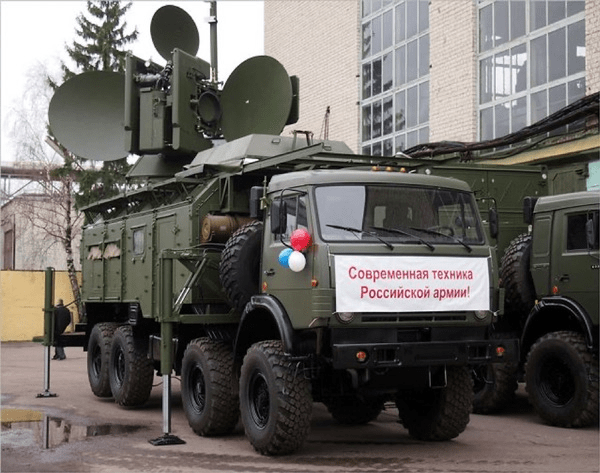
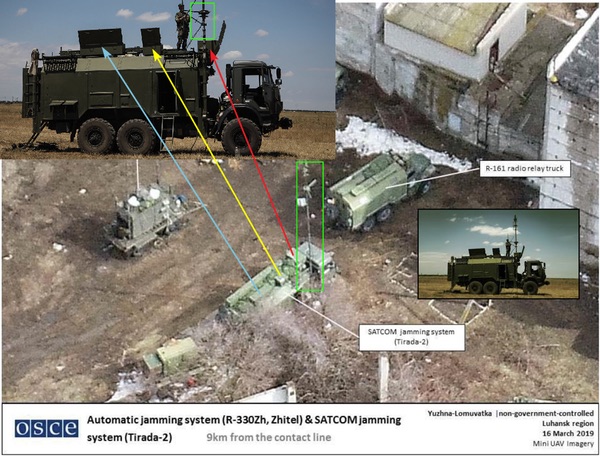
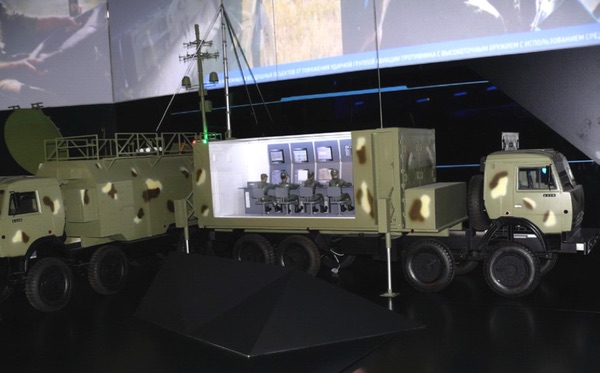
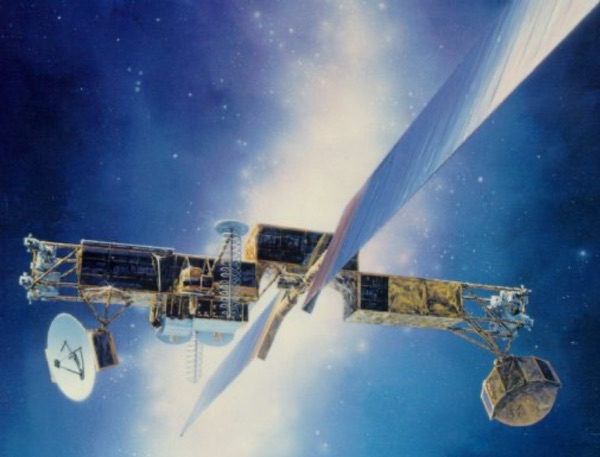 )
)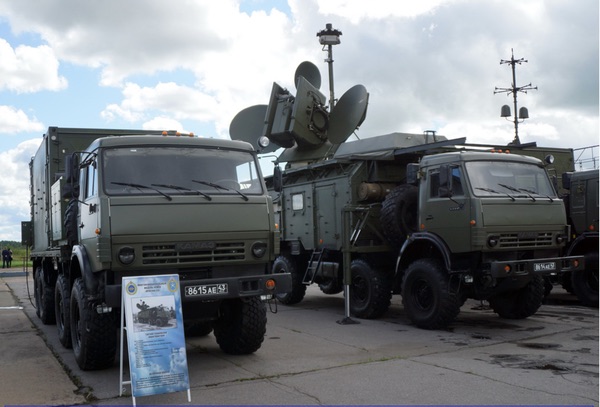
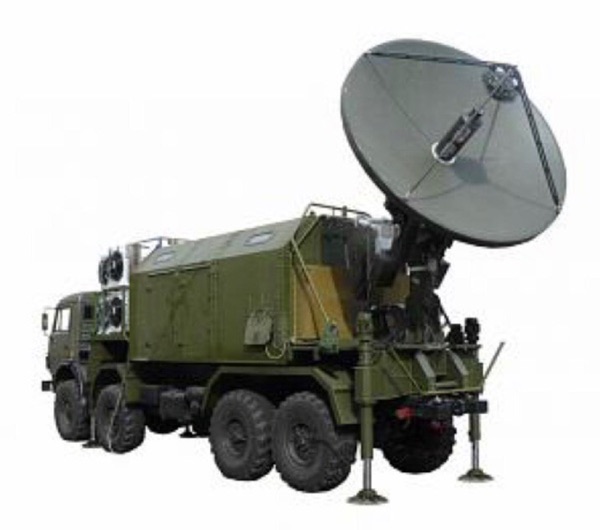


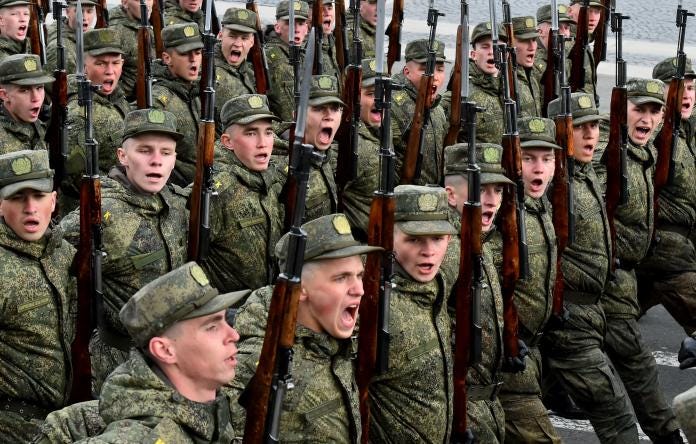
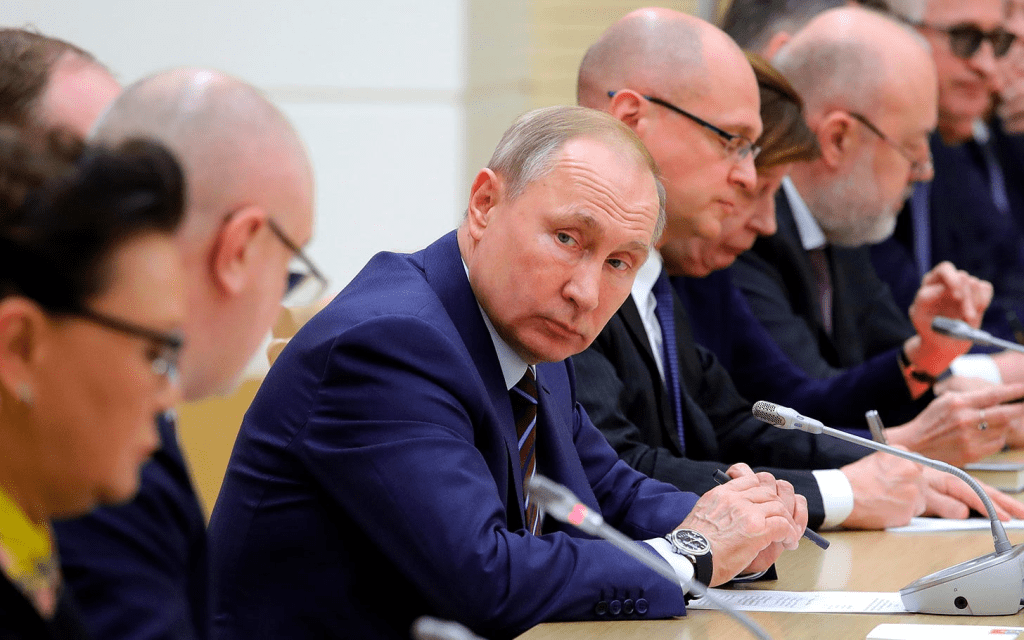








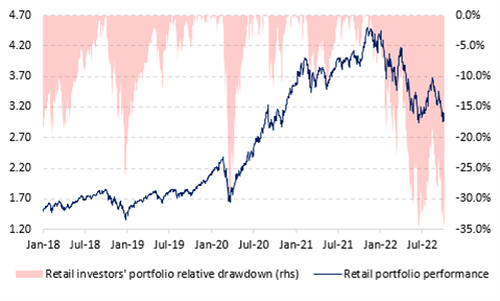


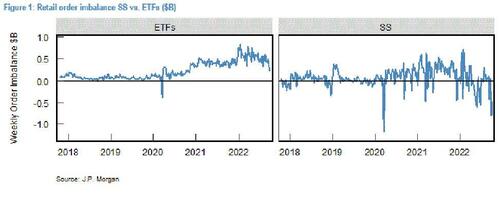
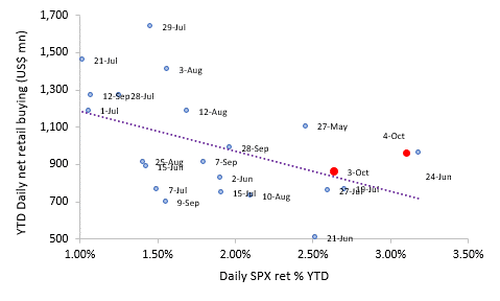
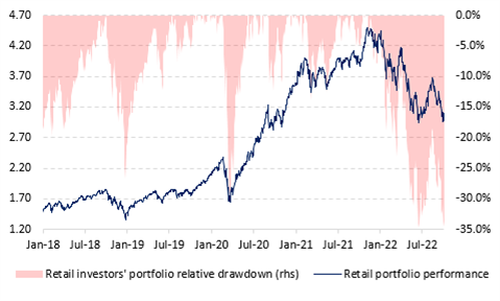





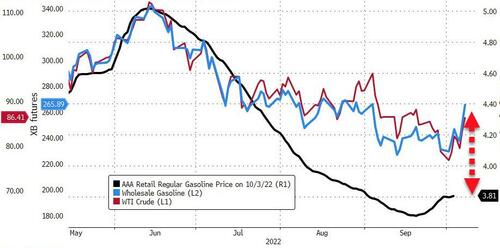
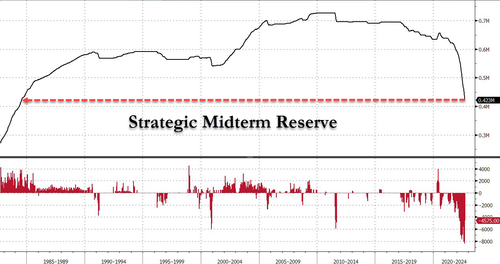
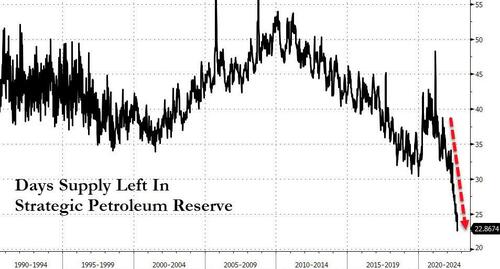
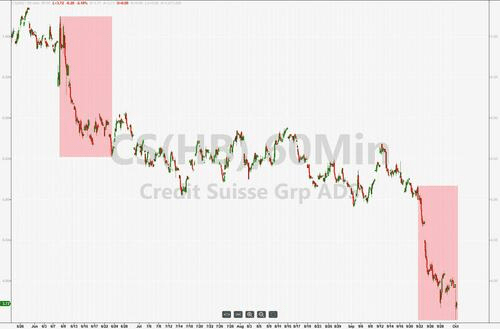
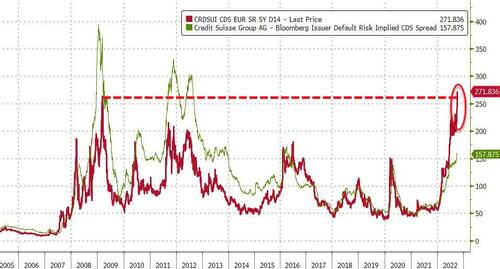

 Econophysics2020