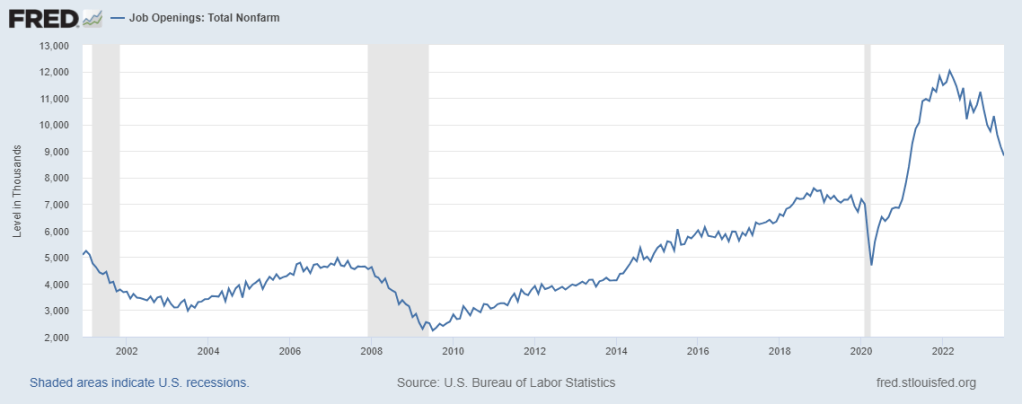
Tonight I’m gonna party like it’s 1929:
Tonight I’m gonna party like it’s 1929:
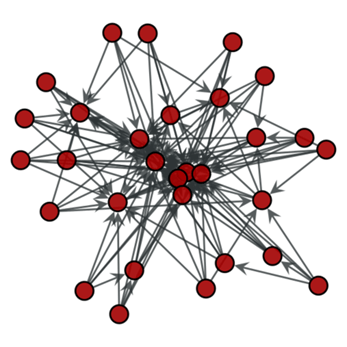
The proportional rate of growth of a firm (or entrenched army) is independent of its absolute size. It gives rise to a firm size distribution that is log-normal or power law.
The result is efficient, mature, multi-layered, and resilient network.
Against this redundant structure comes the Zhou Regime’s pet – the AFU – ordered to just blow through it.
Here is Big Serge to explain how it is all breaking down – literally: https://bigserge.substack.com/p/escaping-attrition-ukraine-rolls
********

AUG 29, 2023
It has been a while since I published anything long-form commenting on the ongoing Russo-Ukrainian War, and I confess that writing this article gave me a modicum of trouble. Ukraine’s much anticipated grand summer counteroffensive has now been underway for about eighty days with little to show for it. The summer has seen fierce fighting in a variety of sectors (to be enumerated below), but the contact line has shifted very little. I have been reluctant to publish a discussion of the Ukrainian campaign simply because they have continued to hold assets in reserve, and I did not want to post a premature commentary that went to press right before the Ukrainians showed some new trick or revealed a hidden ace up their sleeve. Sure enough, I wrote the bulk of this article last week, right before Ukraine launched yet another major attempt to force a breach in the Orikhiv sector.
At this point, however, the appearance of some of Ukraine’s last remaining premier brigades, which had previously been held in reserve, confirms that the axes of Ukraine’s attack are concretized. Only time will tell if these precious reserves manage to achieve a breach in the Russian lines, but enough time has passed that we can sketch out what exactly Ukraine has been trying to do, why, and why it has failed to this point.
Part of the problem with narrating the war in Ukraine is the positional and attritional nature of the fighting. People continue to look for bold operational maneuver to break the deadlock, but the reality seems to be that for now some combination of capability and reticence has turned this war into a positional struggle with a plodding offensive pace, which far more resembles the first world war than the second.
Ukraine had aspirations of breaking open this grinding front and reopening mobile operations – escaping the attritional struggle and driving on operationally meaningful targets – but these efforts have so far come to naught. For all the lofty boasts of demonstrating the superior art of maneuver, Ukraine still finds itself trapped in a siege, painfully trying to break open a calcified Russian position without success.
Ukraine may not be interested in a war of attrition, but attrition is certainly interested in Ukraine.
For those that have been following the war closely, what follows will probably not be new information, but I think it is worth thinking holistically about Ukraine’s war and the factors that drive their strategic decision making.
For Ukraine, the conduct of the war is shaped by a variety of disturbing strategic asymmetries.
Some of these are obvious, like Russia’s much larger population and military industrial plant, or the fact that Russia’s war economy is indigenous, while Ukraine is entirely reliant on western deliveries of equipment and munitions. Russia can autonomously ramp up armaments production and there are abundant signs from the battlefield that the Russian war economy is beginning to find its groove, with new systems like the Lancet present in increasing abundance, and western sources now admitting that Russia has successfully serialized a domestic version of the Iranian Shahed Drone. Furthermore, Russia has the asymmetrical capacity to strike Ukrainian rear areas to an extent that Ukraine cannot reciprocate, even if they are given the dreaded ATACMs (these will give Ukraine the range to strike operational depth targets in the theater, but they can’t hit facilities in Moscow and Tula the way Russian missiles can strike anywhere in Ukraine).
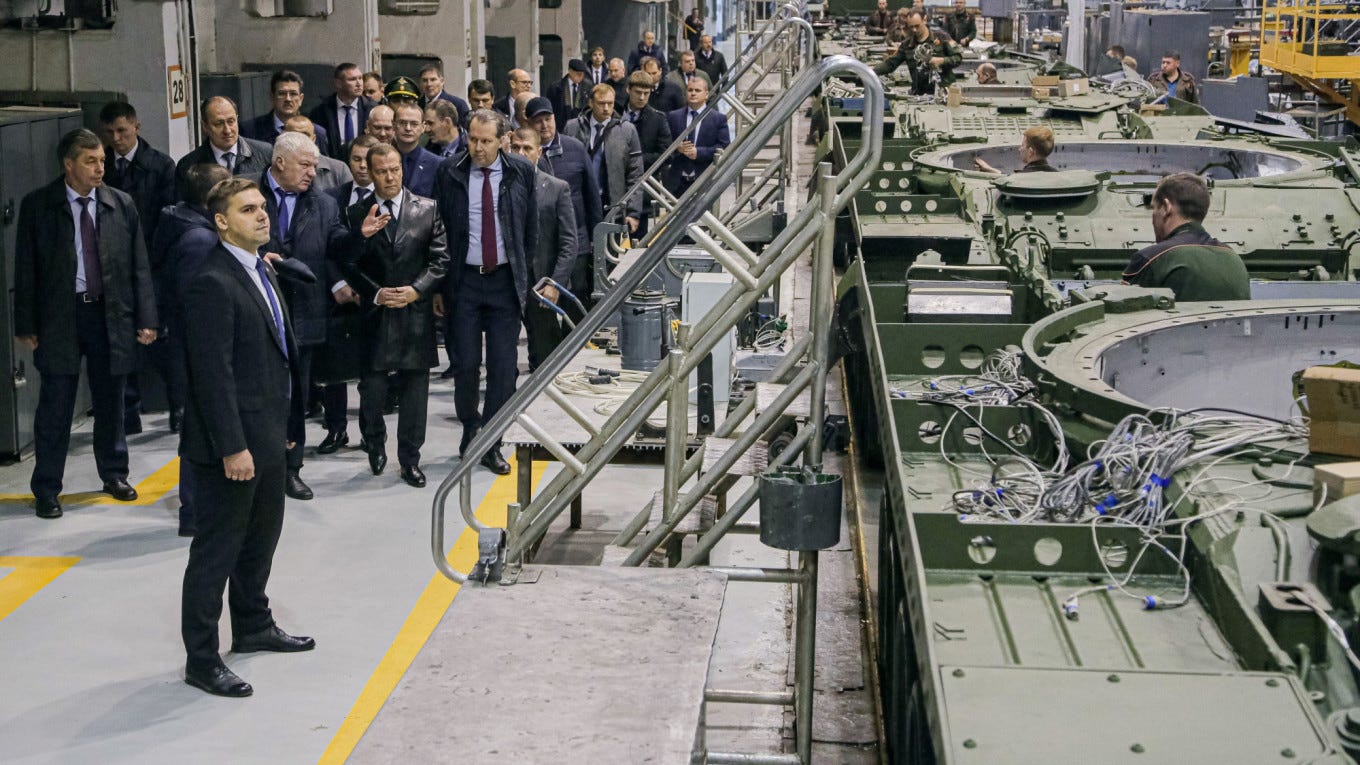
With significant Russian asymmetries in population size, industrial capacity, strike capability, and – let us be blunt – sovereignty and decision-making freedom, an attritional-positional struggle is simply bad math for Ukraine, and yet that is precisely the sort of war in which it has become trapped.
What is important for us to understand, however, is that the strategic asymmetry goes beyond physical capacities like population base, industrial plant, and missile technology, and extends into the realm of strategic objectives and timelines.
Russia’s war has been deliberately framed in a fairly open-ended way, with goals largely tied to the idea of “demilitarizing” Ukraine. In fact, Russia’s territorial objectives remain rather nebulous beyond the 4 annexed oblasts (though it is safe to say that Moscow would like to acquire far more than just these). All that to say, Putin’s government has deliberately framed the war as a military-technical enterprise focused on destroying the Ukrainian armed forces, and has shown itself to be perfectly free to give up territory in the name of operational prudentia.
In contrast, Ukraine has maximalist goals that are explicitly territorial in nature. The Zelensky government has been open about the fact that it aims – however fanciful this may be – to restore the entirety of its 1991 territories, including not just the four mainland oblasts but also Crimea.
The confluence of these two factors – Ukrainian territorial maximalism combined with asymmetrical Russian advantages in a positional-attritional struggle – forces Ukraine to seek a way to break open the front and restore a state of operational fluidity. Remaining locked in a positional struggle is unworkable for Kiev, partially because Russia’s material advantages will inevitably shine through (in a fight between two big guys swinging big bats at each other, bet on the bigger guy with the bigger bat), and partially because a positional war (which amounts essentially to a massive siege) is simply not an efficient way to retake territory.
This leaves Ukraine with no choice but to unfreeze the front and try to restore mobile operations, with an eye towards creating some asymmetry of their own. The only feasible way to accomplish this is to launch an offensive aimed at severing critical lines of Russian communication and supply. Contrary to some suggestions that were popular this spring, a large Ukrainian offensive against Bakhmut or Donetsk simply did not fit the bill.
Frankly, there are only two suitable operational targets for Ukraine. One is Starobils’k – the beating heart at the center of Russia’s Lugansk front. Capturing or screening Svatove and then Starobils’k would create a genuine operational catastrophe for Russia in the north, with cascading effects all the way down to Bakhmut. The second possible target was the land bridge to Crimea, which could be cut by a thrust across lower Zaporizhia towards the Azov coast.
It was probably inevitable that Ukraine would select the Azov option, for a few reasons. The land bridge to Crimea is a more self-contained battlespace – an offensive in Lugansk would occur under the shadow of the Belgorod and Voronezh regions of Russia, making it relatively more difficult to put significant Russian forces out of supply. Perhaps even more significant, however, is Kiev’s complete obsession with Crimea and the Kerch Bridge – targets that hold hypnotic sway in a way that Starobils’k never could.
Again, this may sound like fairly intuitive review, but it’s worth contemplating how and why Ukraine ended up launching an offensive that was widely telegraphed and expected. There was no strategic surprise whatsoever – a definitely real video of GUR chief Budanov smirking didn’t fool anyone. The Russian armed forces certainly weren’t fooled, as they spent months saturating the front with minefields, trenches, firing emplacements, and obstacles. Everyone knew that Ukraine was going to attack toward the Azov Coast, specifically with an eye towards Tokmak and Melitopol, and that’s exactly what they did. A frontal attack against a prepared defense without the element of surprise is generally considered a poor choice, but here is Ukraine not only attempting such an attack but even launching it against a backdrop of global celebration and phantasmagorical expectations.

It’s impossible to make sense of this without understanding the way that Ukraine is shackled by a particular interpretation of the war to this point. Ukraine and its supporters point to two successes in 2022 where Ukraine was able to retake a substantial swathe of territory, in Kharkov and Kherson oblasts. The problem is that neither of these situations is portable to Zaporizhia.
In the case of the Kharkov offensive, Ukraine identified a sector of the Russian front that had been hollowed out and was defended only by a thin screening force. They were able to stage a force and achieve a measure of strategic surprise, due to the thick forests and general paucity of Russian ISR in the area. This is not to mitigate the scale of Ukraine’s success there; it was certainly the best uses of forces available to them and they did exploit a weak section of front. This success is hardly relevant to circumstances in the south today; mobilization has ameliorated Russia’s force generation problems so that they now longer have to make hard choices about what to defend, and the heavily fortified Zaporizhia frontline is nothing like the thinly held front in Kharkov.
The second case study – the Kherson counteroffensive – is even less germane. In this case, Ukrainian leadership is rewriting history in record time. The AFU banged its head on Russian defenses in Kherson for months throughout the summer and autumn last year and took atrocious losses. An entire grouping of AFU brigades was mauled in Kherson without achieving a breakthrough, and this even with Russian forces in a uniquely difficult operational disposition where they had their backs to a river. Kherson was only abandoned months later due to concerns that the Kakhovka dam might fail or be sabotaged (for those keeping score, it did in fact end up failing), and due to Russia’s need at the time to economize forces.
Again, this can easily be misconstrued as arguing that Russia’s withdrawal from Kherson did not matter. Obviously, abandoning a hard-earned bridgehead is a major setback, and retaking west-bank Kherson was a boon for Kiev. But we need to be honest about why it happened, and it plainly did not happen because of Ukraine’s summer counteroffensive – to underscore this, recall that Ukrainian officials openly wondered if the Russian withdrawal was a trick or a trap. The question is simply whether Ukraine’s Kherson offensive is predictive of future offensive success. It is not.
So, we have one case where Ukraine identified a lightly defended section of front and ran through it, and another where Russian troops abandoned a bridgehead due to logistical and force allocation concerns. Neither is particularly relevant to the situation on the Azov coast, and in fact an honest reflection of the AFU’s Kherson Counteroffensive might have given Ukraine second thoughts about a frontal assault on prepared Russian defenses.
Instead, Kharkov and Kherson have both been presented as proof positive that Ukraine can shatter Russian defenses in a straight up fight – in fact, we still have no examples from this war of the AFU defeating strongly held Russian positions, particularly post-mobilization when Russia finally began to resolve its manpower deficiencies. But Ukraine is caught in the grip of its own particular story about this war, which has imparted unearned confidence in its ability to conduct offensive operations. Tragically for mobilized Ukrainian Mykolas, this has dovetailed with a second swagger-producing mythology.
A major selling point for the Ukrainian counteroffensive has been the assessed superiority of the AFU’s big-ticket donations from the west – the main battle tanks and infantry fighting vehicles. Since the first deliveries were announced, there has been no shortage of boasting about the many superior qualities of western models like the Leopards and Challengers. The suggestion has essentially been that skilled Ukrainian tankers are only waiting to be unleashed once they get behind the wheel of superlative western builds. My personal favorite motif has been the practice of dismissing Russian tanks as “Soviet Era” – neglecting to note that the Abrams (designed 1975) and the Leopard 2 (1979) are also Cold War models.

It must be stated, again, that there is nothing wrong with western tanks. The Abrams and the Leopard are fine vehicles, but confidence in their game-changing capabilities stems from a mistaken assumption about the role of armor. It must be appreciated that tanks always have been and always will be mass-consumption items. Tanks blow up. They are disabled. They break down and are captured. Tank forces attrit – much faster than people expect. Given that the brigades prepared for Ukraine’s assault on the Zapo line were significantly understrength in vehicles, it was simply irrational to expect them to have an oversized impact. This is not to say that tanks aren’t important – armor remains critical to modern combat – but in a peer conflict one should always expect to lose armor at a steady clip, especially when the enemy retains fires superiority.
One can see, then how a measure of hubris can easily creep in to Ukrainian thinking, fueled by a healthy dose of desperation and strategic need. Reasoning from a distorted understanding of its successes in Kharkov and Kherson, emboldened by their shiny new toys, and guided by an overriding strategic animus that requires them to unlock the front somehow, the idea of a frontal attack without strategic surprise against a prepared defense really could seem like a good idea. Add in the good old fashioned trope about Russian incompetence and disorder, and you have all the recipes for an imprudent roll of the dice by Ukraine.
So now we come to the operational minutia. For a variety of reasons, Ukraine has chosen to attempt a frontal assault on Russia’s fortified Zaporizhia front, with the intention of breaching towards the sea of Azov. How can this be accomplished?
We had a few clues early on, accruing from a variety of geographic features and alleged intelligence leaks. In May, the Dreizin Report published what was purported to be a Russian synthesis of Ukraine’s OPORD (Operational Order). An OPORD functions as a broad sketch of an operation’s intended progression, and the document shared by Dreizin was billed as a summary of Russia’s expectation for Ukraine’s offensive (that is, it is not a leak of Ukraine’s internal planning documents, but a leak of Russia’s best guess at Ukraine’s plans).
In any case, in a vacuum it was anybody’s guess as to whether Dreizin’s OPORD was authentic, but we’ve subsequently been able to cross-check it. This is because of the other, even more infamous leak from earlier this spring, which included the Pentagon’s combat power build plan for Ukraine.
NATO was very generous and built Ukraine a mechanized strike package from scratch. However, because this mechanized force was cobbled together with a variety of different systems from all corners of the NATO Cinematic Universe, Ukraine formations are uniquely identifiable by their particular combination of vehicles and equipment. So, for example, the presence of Strykers, Marders, and Challengers indicates the presence of the 82nd Brigade in the field, and so forth.
Thus, despite Ukrainian pretensions of operational security, it’s actually been trivially easy for observers to know which Ukrainian formations are in the field. There have been a few deviations from the script – for example, the 47th Brigade was supposed to field the Frankenstein Slovenian M55 tanks, but in the end the decision was made to send the underpowered M55’s to the northern front and the 47th was deployed with a contingent of Leopard Tanks originally operated by the 33rd Brigade. But these are minor details, and on the whole we’ve had a good sense of when and where specific AFU formations get on the field.
Based on identifiable units, the Dreizin OPORD looks very close to what we actually saw at the onset of the Ukrainian offensive. The Dreizin OPORD called for an assault by the 47th and 65th Brigades on the Russian lines south or Orikhiv, in the sector bounded by Nesterianka and Novoprokopivka. Directly in the middle of this sector is the town of Robotyne, and sure enough that’s where the first big AFU assault came overnight on June 7-8, spearheaded by the 47th Brigade.
Now, from this point it becomes difficult to evaluate the Dreizin OPORD simply because Ukraine’s attack became instantaneously derailed, but one thing we can say is that Dreizin’s source was correct about the order that Ukrainian units would be introduced into battle. Based on this, we can flesh out the OPORD and feel pretty safe wagering that this is what the Ukrainians were hoping to achieve:
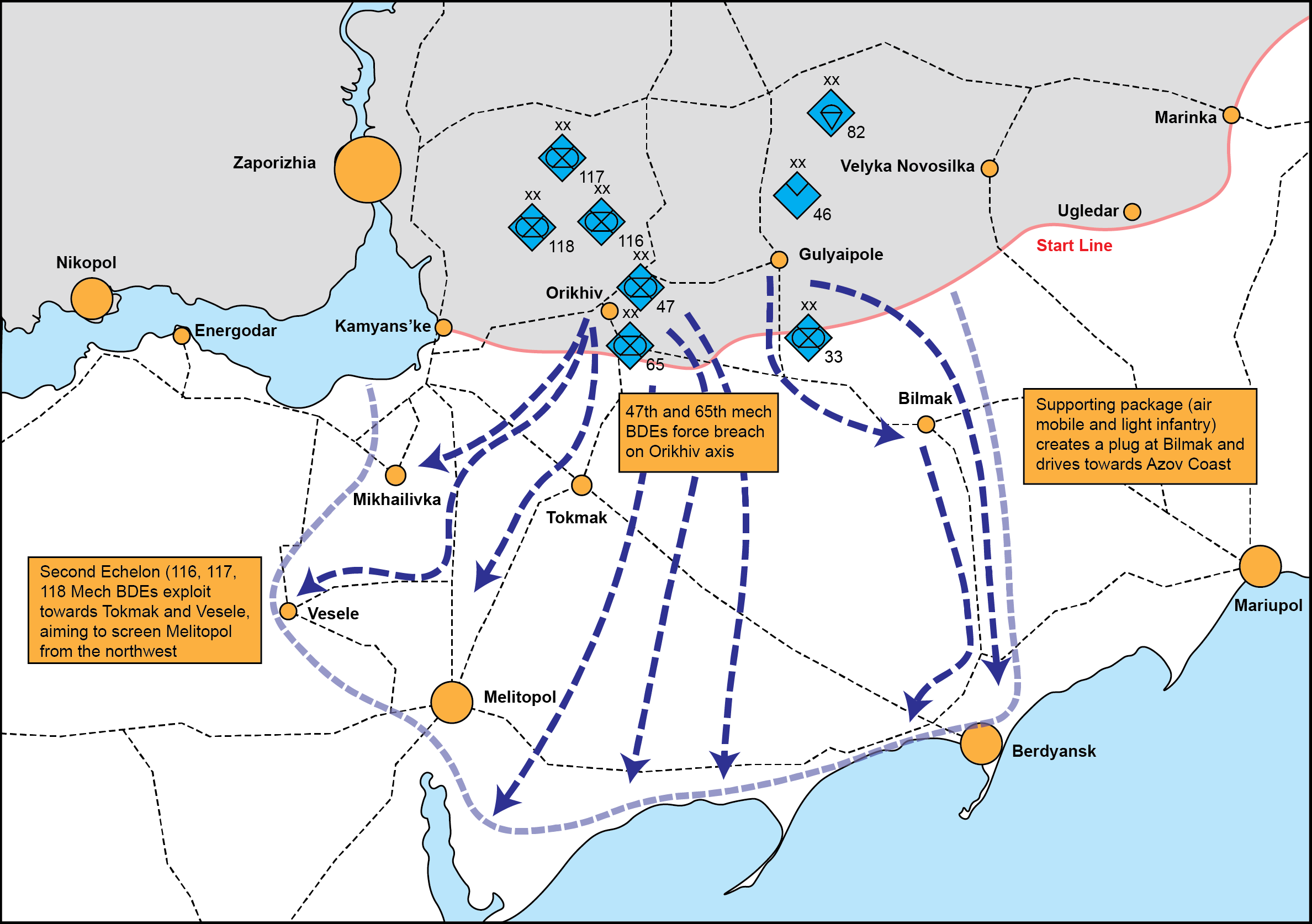
The intention seems to have been to force a breach in the Russian line using a concentrated armored assault by the 47th and 65th Brigades, after which a follow on force of the 116th, 117th, and 118th would begin the exploitation phase, driving for the Azov Coast and the towns of Mikhailivka and Vesele to the west. The objective was clearly not to get bogged down in urban fighting attempting to capture places like Tokmak, Berdyansk, or Melitopol, but to bypass them and cut them off by taking up blocking positions on the main roads.
Simultaneously, a lesser – but no less critical – thrust would come out of the Gulyaipole area and drive along the Bilmak axis. This would have the effect of both screening the main advance to the west and wedging the Russian front open, splintering the integrity of the Russian forces caught in the middle. Overall, this is a fairly sensible, if ambitious and uncreative plan. In many ways, this was really the only option.
So what went wrong? Well, conceptually it’s easy. There is no breach. The bulk of the maneuver scheme is dedicated to exploitation – reaching such and such a line, taking up this blocking position, masking that city, and so forth. But what happens when there’s no breach at all? How can such a catastrophe occur, and how can the operation be salvaged when it comes untracked in the opening phase?
Indeed, this is precisely what has happened. Ukraine finds itself stuck on the edge of Russia’s outermost screening line, spending substantial resources trying to capture the small village of Robotyne, and/or bypass it to the east by infiltrating the gap between it and the neighboring village of Verbove. So instead of that rapid breach and turning maneuver towards Melitopol, we get something like this:
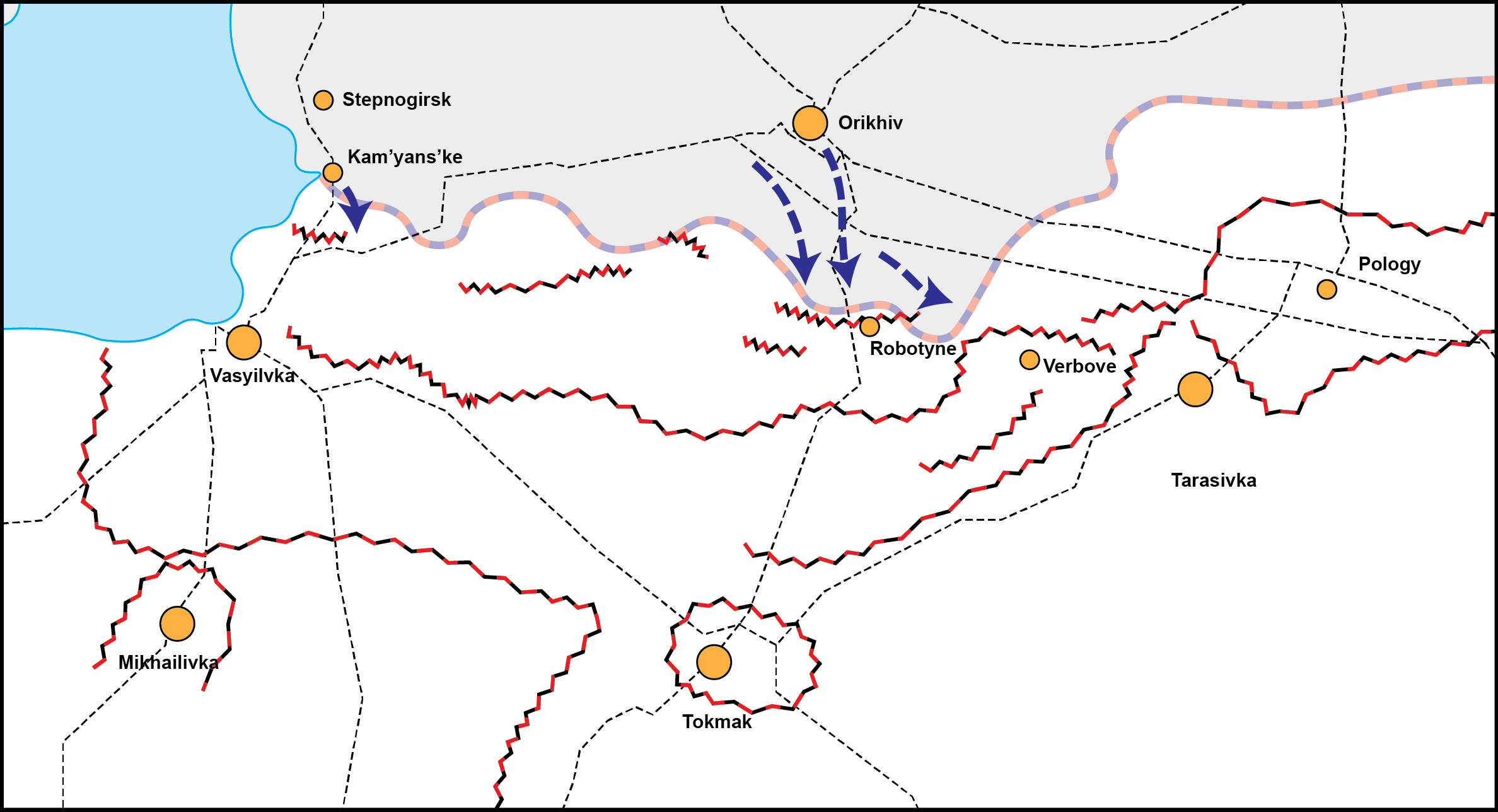
We could be generous and say that Robotyne is the last village before the Ukrainian attack reaches the main Russian defensive belt, but we’d be lying – they will also have to clear the larger town of Novoprokopivka, two kilometers to the south. Just for reference, here’s a closer look at the mapped Russian defenses in the battlespace, based on the excellent work of Brady Africk.
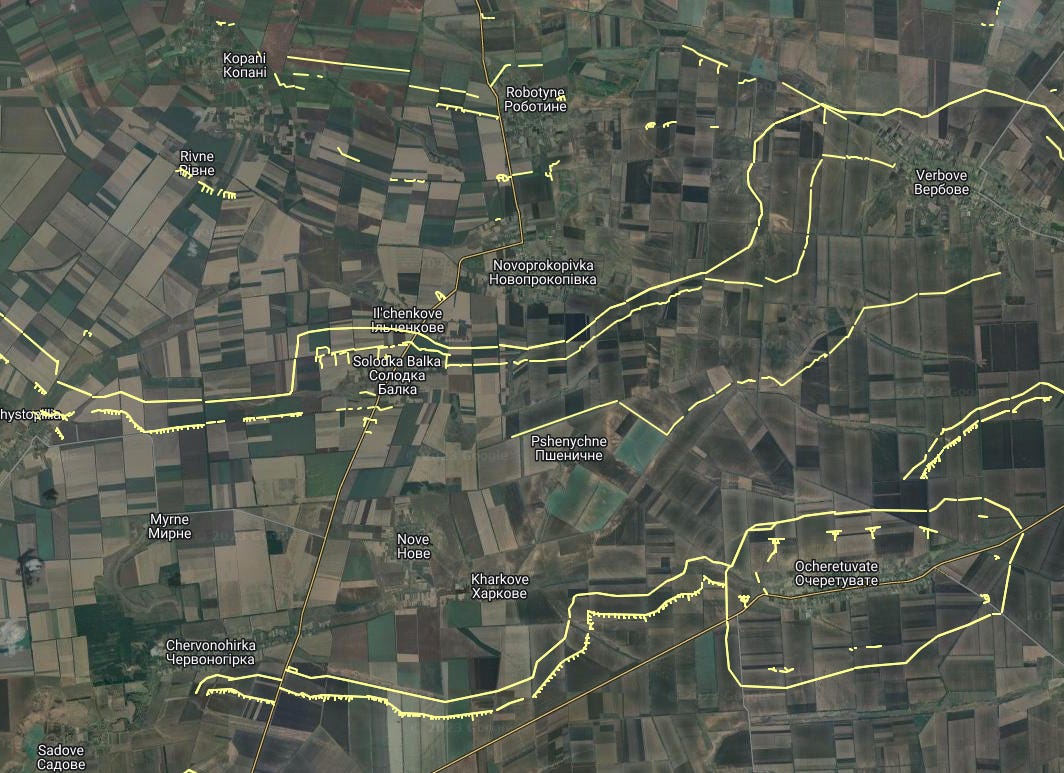
The discussion about these emplacements can get a little muddled, simply because it’s not always clear what is meant by that popular phrase “first line of defense.” Clearly there are some defensive works around and in Robotyne, and the Russians chose to fight for the village, so in some sense Robotyne is part of the “first line” – but it is more proper to speak of it as part of what we would call a “screening line”. The first line of continuous fortifications across the front is several kilometers further south, and this is the belt that Ukraine has yet to even reach, let alone breach.
As of this moment, it appears that Russian troops have lost total control of Robotyne but continue to hold the southern half of the village, while Ukrainian troops in the northern half of the village remain subject to heavy Russian shelling. We should probably at this point consider the village to be continuously contested and a feature of the gray zone.
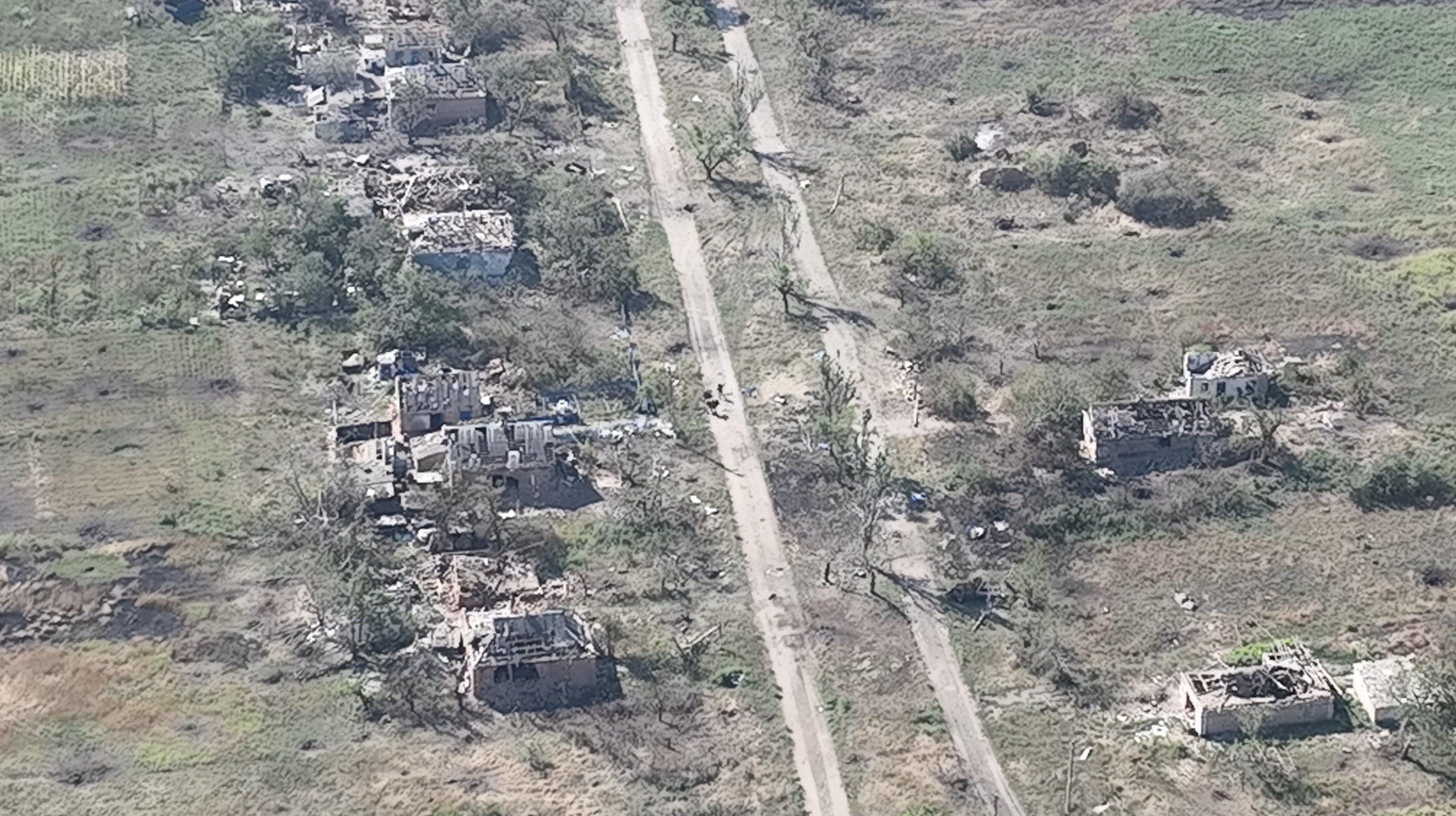
Now, a quick note about Robotyne itself and why both sides are so determined to fight for it. It seems rather odd on the surface, given that the Russian preference in 2022 was to make tactical withdrawals under their fires umbrella. This time though, they are fiercely counterattacking to contest Robotyne. The value of the village lies not only in its location on the T-0408 Highway, but also its excellent perch on top of a ridge. Both Robotyne and Novoprokopivka lie on a ridge of elevated ground which is as much as 70 meters higher than the low-lying plain to the east.
What this means is fairly simple; if the AFU presses forward in attempts to bypass the Robotyne-Novoprokopivka position by pushing into the gap between Robotyne and Verbove, it will be vulnerable to fire on the flanks (particularly by ATGMs) by Russian troops on the high ground. We already have seen footage of this, with Ukrainian vehicles being taken in the flank by fire from Robotyne. I am highly skeptical that Ukraine can even attempt an earnest assault on the first defensive belt until they have captured both Robotyne and Novoprokopivka.
This would all be a tough nut to crack under ideal circumstances, with a variety of engineering problems to mediate, obstacles designed to funnel the attacker into firing lanes, perpendicular trenches to allow enfilade fire on advancing Ukrainian columns, and robust defenses on all the major roadways. But these are not the best of circumstances. This is a tired force that has exhausted much of its indigenous combat power, which is attempting to organize the attack using a piecemeal and understrength assault package.
Several factors conspired against the Ukrainian offensive, and synergistically they have created a bona fide military catastrophe for Kiev. Let us enumerate them.
At this point, we need to acknowledge something that everybody missed about Russia’s defense. I previously expressed high confidence that Ukraine’s forces would be unable to breach the Russian defenses, but I mistakenly believed that the Russian defense would function according to the classic Soviet defense-in-depth principles (elucidated in great detail by the writings of David Glantz, for example).
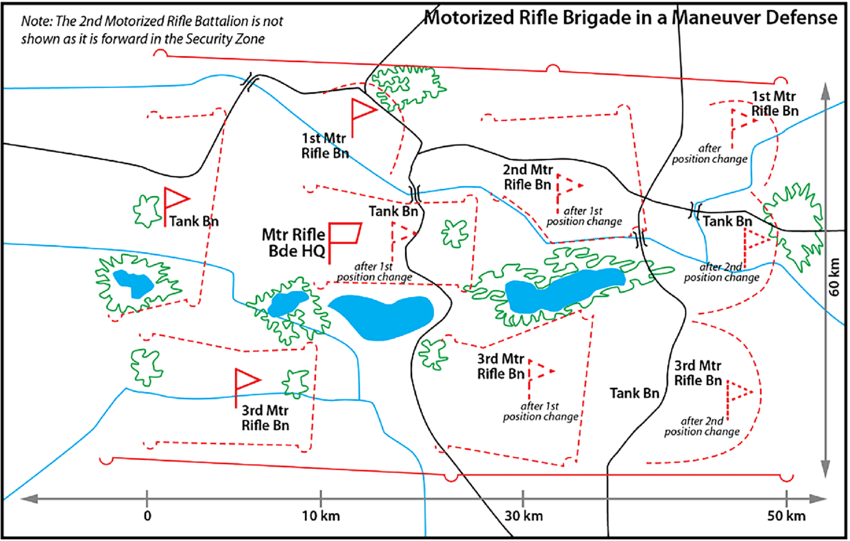
Such a defense, put simply, is open to the idea that the enemy will breach the first or even second lines of defense. The purpose of the multilayered (or “echeloned” in the classic terminology) defense is to ensure that the enemy force gets stuck as it tries to break through. It may penetrate the first layer, but as it goes it is continually chewed up by the subsequent belts. The classic example is the Battle of Kursk, where powerful German panzers broke into the Soviet defensive belts but subsequently became stuck as they were ground down. You can think of this as being analogically similar to a Kevlar vest, which uses a web of fibers to stop projectiles: rather than bouncing off, the bullet is caught and its energy is absorbed by the layered fibers.
I was actually quite open to the idea that Ukraine would generate some penetration, but I anticipated them getting stuck in the subsequent belts and sputtering out.
What was missing from this picture – and this is a credit to Russian planning – was an unseen defensive belt forward of the proper trenches and fortifications. This forward belt consisted of extremely dense minefields and strongly held forward positions in the screening line, which the Russians evidently intended to fight for fiercely. Rather than breaking through the first belt and getting stuck in the interstitial areas, the Ukrainians have been repeatedly mauled in the security zone, and the Russians have consistently counterattacked to knock them back when they do manage to get footholds.
In other words, while we expected Russia to fight a defense in depth that absorbed the Ukrainian spearheads and shredded them in the heart of the defense, the Russians have actually shown a strong commitment to defending their forwardmost positions, of which Robotyne is the most famous.
On paper, Robotyne was expected to function as part of a so-called “crumple zone”, or “security zone” – a sort of lightly held buffer that puts the enemy through pre-registered fires before they bump into the first belt of continuous and strongly held defenses. Indeed, a variety of aerial and satellite surveys of the area taken before Ukraine went on the attack showed Robotyne laying well forward of the first solid and continuous Russian fortification belt.
What was missed, it seemed, was the extent to which the Russian defenders had mined the areas on the approach to Robotyne and were committed to defending within the security zone. The scale of the mining certainly seems to have surprised the Ukrainians, and creates a strain on Ukraine’s limited combat engineering capabilities. Even more importantly, the dense mines have created predictable avenues of approach for the Ukrainian forces, which force them to repeatedly run through the same gauntlet of fires and Russian standoff weaponry.
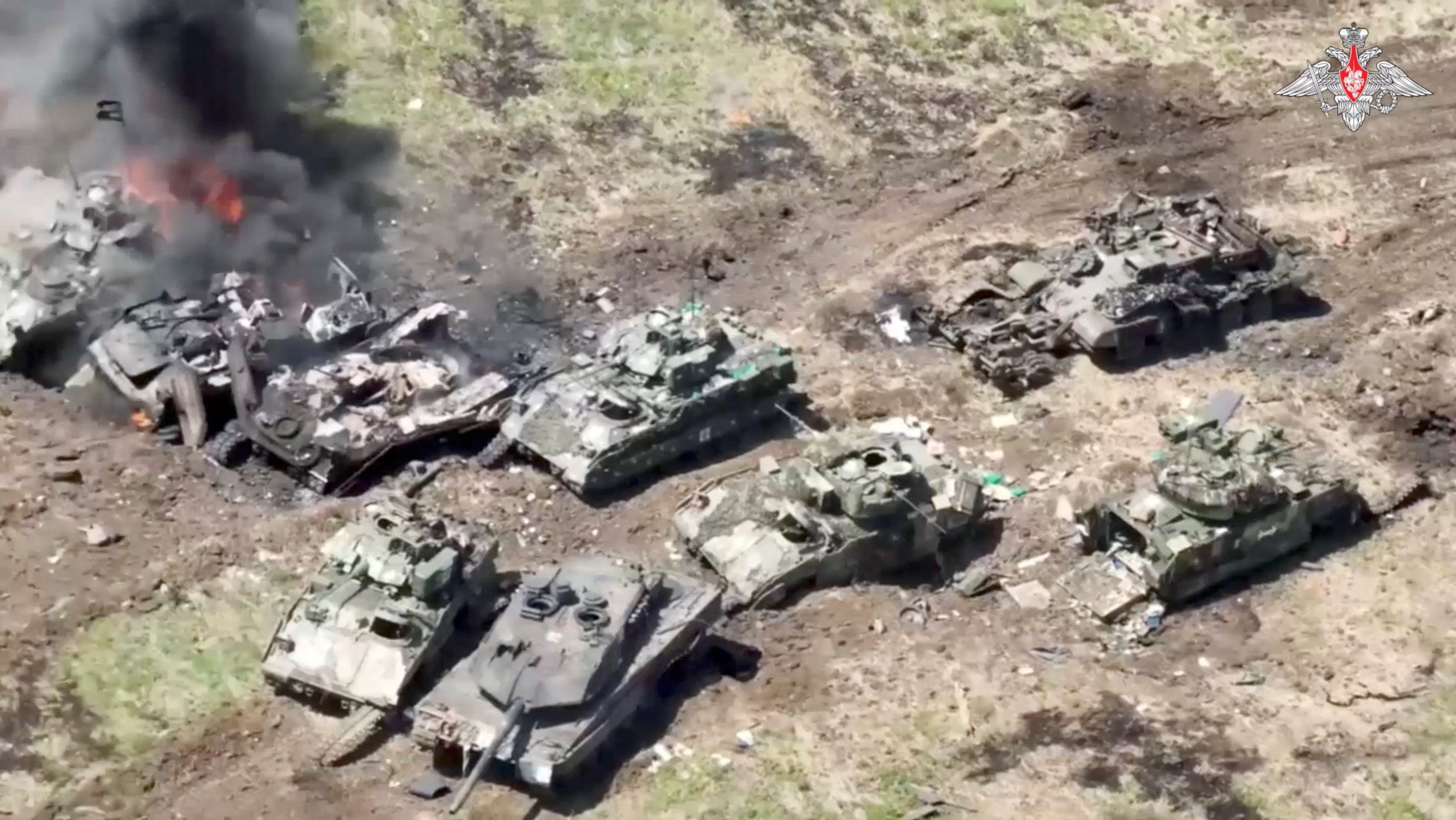
The signature image of the first great assaults on the Zapo Line has been columns of unsupported maneuver assets, being raked with Russian fires, both ground based (rocketry, ATGMs, and tube artillery) and from air platforms like the Ka-52 Alligator attack helicopter. One of the more startling aspects of these scenes was the way Ukrainian forces would come under heavy fire while still in their marching columns, taking losses before they ever deployed into firing lines to begin their assault proper.
There are myriad reasons for this. One is the now blasé issue of Ukrainian munition shortages. Consider the following items of interest. In the runup to Ukraine’s counteroffensive, Russia waged a heavy counter-preparatory air campaign that knocked out large AFU ammunition dumps. Ukraine’s initial assaults collapse in the face of heavy and unsuppressed Russian fires. The United States decides to transfer cluster munitions to Ukraine because, in the words of the president, “they’re running out of ammunition.” Add in the degradation of Ukrainian air defense, which allows Russian helicopters to operate with great effect along the contact line, and you have a recipe for disaster. Lacking the tubes to suppress Russian fires or the air defense to chase away Russian aircraft, the AFU opened their offensive by disastrously pushing forward unsupported maneuver elements into a hail of fire.
It’s crucial to understand that the Russian toolbox is fundamentally different than it was during the battle for Kherson last year, due to the rapidly expanding production of a variety of Russian standoff weapons – most notably the Lancet and the UMPK glide modifications for gravity bombs.
The Lancet in particular has been a star performer – there are claims that the trusty little loitering munition is responsible for nearly half of Russia’s artillery kills – and has filled a crucial capability gap that troubled the Russian army episodically throughout the first year of the war. Contrary to some western assessments that Russia simply could not manufacture drones in sufficient quantities, production of the Lancet has been successfully ramped up in a short period of time, and mass production of other systems like the Geran are coming online as well.

The proliferation of the Lancet and similar systems means, in a nutshell, that nothing within 30km of the contact line is safe, and this in turn disrupts the AFU’s deployment of critical support assets like air defense and engineering, magnifying their vulnerability to Russian mines and fires. In fact, we’ve increasingly seen Ukrainian artillery use decline in the Robotyne area due to the threat of lancets (they seem to be transferring tubes to other fronts), and the AFU is favoring the use of HIMARS in the suppressive role.
Because the AFU failed to breach the Robotyne sector on their first attempt, they’ve been forced to continually move up additional units and resources to hammer on the position. This has particular implications, both in the sense that AFU forces must continually traverse the same lines of approach to contact, and in the fact that they are using the same rear area to assemble and stage their assault forces.
This makes the burden on Russian ISR (Intelligence, Surveillance, Reconnaissance) significantly easier, since the AFU has no effective way to disperse or hide the assets that they are bringing forward to the assault. Staged Ukrainian forces and material have been hid repeatedly in the villages immediately behind Orikhiv, like Tavriiske and Omeln’yk, and Russia is able to strike rear area infrastructure like ammunition depots because – to put it simply – there are only so many places these these assets can be staged when you are repeatedly assaulting the same 20km wide sector of front.
We recently had Ukrainian Deputy Minister of Defense Hanna Malair complaining that the 82nd Brigade – newly deployed to the Orikhiv sector – had been hit with a series of Russian airstrikes in its staging areas. According to her, this was because of poor OPSEC revealing the brigade’s location to the Russians. But this really makes very little sense; the entire area of operations around Orikhiv is perhaps 25km deep (from Kopani to Tavriiske) and 20 km wide (from Kopani to Verbove). This is a small area that has seen a huge amount of military traffic along the same roads throughout the summer. The idea that Russia needs insider information to know that they ought to surveil and attack targets in this area is absurd.
It actually takes significantly less damage to “destroy” an operational level unit than people think. A unit can become a combat scratch off at 30% losses (with some variance depending on how those are allocated). This is because when people hear the term “destruction”, they think that means total losses. Sometimes that’s how the word is used in colloquial conversation, but what matters for officers trying to manage an operation is whether or not a formation is combat capable of the tasks being asked of it – and those capabilities can vanish much more quickly than people realize.
This is particularly the case for the Ukrainian mech package, for a variety of reasons. For one, as we discussed in previous articles, these brigades started the fight well understrength (remember, for example, that the Ukrainian 82nd Brigade has only 90 Stryker AFVs, while an American Strkyer Brigade is supposed to have 300). Additionally, the cobbled together nature of these brigades – and the total lack of indigenous sustainment systems like repair and maintenance – means that the Ukrainians will naturally have to cannibalize these vehicles. They’ve already started designating “donor” vehicles that are written off completely to be stripped down for parts. The nexus of these two facts is that Ukraine’s mechanized brigades are understrength on vehicles to begin with, and will have an abysmally poor recovery rate, with hidden attrition behind the scenes due to cannibalization.
What this means is that when we heard admissions by mid-July that Ukraine had already lost 20% of its maneuver assets, there is an associated catastrophic decline in combat capability. The lead brigades – which chewed through 50% or more of their maneuver vehicles – can no longer shoulder combat tasks appropriate for a brigade, and the Ukrainians are forced to feed in their second echelon units prematurely.
At this point, partial elements of at least ten different brigades have been deployed in the Robotyne sector, with the 82nd likely to join them soon. Given that the NATO combat power build plan only included 9 NATO trained brigades, plus a few reconstituted Ukrainian formations, it’s safe to say that blooding all of them over a 71 day fight just to break into the screening line was not in the plan.
I’ve seen a variety of analysts and writers lately arguing that the insertion of additional Ukrainian units into the Robotyne sector signals the next phase of the operation.
This is nonsense. Ukraine is still mired in the first phase. What has happened is instead that the attrition of their first echelon brigades has forced them to commit their second (and third) wave to complete the tasks of the opening phase. The initial attack, led by the 47th Brigade, was intended to create a breach in the Russian screening line around Robotyne and advance to the main Russian belt further to the south. They failed, and the additional brigades earmarked for exploitation – the 116th, 117th, 118th, 82nd, 33rd, and more – are now being systematically fed in to keep the pressure on.
These brigades have not been destroyed, of course, simply because they are not being committed in their entirety, but rather as subunits. Nevertheless, at this point Ukrainian losses make up the better part of a whole brigade, distributed around the broader package, and over 300 maneuver elements (tanks, IFVs, APCs, etc) have been scratched off.
We need to say this very explicitly. Ukraine has not moved on to the next phase of their operation. They are stuck in the first phase, and have been forced to prematurely commit portions of the second echelon that was earmarked for later action. They are slowly but surely burning through the entire operational grouping, and so far they have not breached Russia’s screening line. The great counteroffensive is turning into a military catastrophe.

Now, this does not mean that the operation has failed, simply because it is still ongoing. History teaches us that it is unwise to make definitive pronouncements. Luck and human factors (bravery and intelligence, cowardice and stupidity) always have something to say. However, the trajectory is undeniably towards abject failure at the current moment.
So far, the AFU has shown some adaptability. In particular, we’ve recently seen them shift away from pushing forward unsupported columns of mechanized assets – instead they’ve been leaning on small dismounted units, trying to slowly push forward into the space between Robotyne and Verbove. The move towards dispersal is intended to reduce loss rates, but it also reduces the probability of a dramatic breakthrough even further and marks the temporary abandonment of decisive breaching action in favor of – once again – creeping positional warfare.
We would be remiss if we failed to note that there have been meaningful Russian losses in all of this. We know that the Russian forces in the Robotyne sector have required rotation and reinforcement, including with elite VDV and Naval Infantry units. Russia has taken counterbattery losses, it has lost vehicles in counterattacking action, and men have been killed holding their trenches. The initial assault groups that the Ukrainians threw in had a lot of combat power, and the fighting was very bloody for both sides. It’s not a one-sided shooting gallery, but a high intensity war.
But therein is the crux of the matter – Ukraine seems unable to escape the attritional and positional war that it finds itself in. It sounds all well and good to proclaim a return to “maneuver” warfare, but if there is an inability to breach enemy defenses, this is only an empty boast, and the nature of the struggle remains attritional. When the question becomes “will we breach before we run out of combat power”, you are not maneuvering. You are attriting.
In my series of articles on military history, we’ve looked at a variety of cases where armies tried desperately to unlock the front and restore a state of operational maneuver, but when there is no technical capacity to do so, these intentions do not matter one bit. Nobody wants to be trapped on the wrong side of attritional mathematics, but sometimes what you want does not matter at all. Sometimes attrition is imposed on you.
In the absence of the capabilities required to successfully breach Russia’s prodigious defenses – more ranged fires, more air defense, more ISR, more EW, more combat engineering, more more more – Ukraine is trapped in a rock fight. Two fighters are swinging bats at each other, and Russia is a bigger man with a bigger bat.
Amid a clear misfire and growing strategic disappointment, two new suggestions have increasingly crept into the conversation – “copes”, if you will, that are utilized as a narrative comfort to explain why the Ukrainian operation is actually going just fine (despite nearly universal acknowledgment in the west that the results have been lackluster at best). I would like to briefly address each of these in turn.
You frequently see it argued that all the AFU has to do is break open the Russian screening line, and the remainder of the defenses will fall like dominos. The general thrust of this argument is that the Russians lack reserves and that the subsequent defensive lines are not adequately manned – just break open the first line, and the rest will fall apart.
This is probably a comforting thing to tell oneself, but it’s rather irrational. We could talk, for example, about Russia’s doctrinal schema for defense in depth, which prescribes liberal allocation of reserves at all depths of the defensive system, but it’s probably more fruitful to point at more immediate evidence.
Let us simply consider Russia’s behavior over the last six months. They have spent a tremendous amount of effort constructing echeloned defenses – are we really to believe that they did all this only to waste all their combat power fighting in front of these defenses? Nor is there any evidence that Russia is having trouble supplying the front with manpower at the present moment. We’ve seen continued rotations and redeployments amid an overall process of military enlargement in Russia. Indeed, of the two belligerents, it is Ukraine that seems to be scraping the barrel for manpower.
This is the more fantastical story, and it represents a radical ad-hoc shift of the goalposts. The argument is that Ukraine doesn’t actually need to advance to the sea and physically cut the land bridge, all it has to do is get the Russian supply routes within firing range to cut off Russian troops. This theory has been advance liberally on Twitter X and by personalities like Peter Zeihan (a man who knows nothing about military affairs).
There are many problems with this line of thought, most of which stem from an inflated notion of “fire control.” To put it simply, being “in range” of artillery fire does not imply effective area denial or severed supply lines. If that were the case, Ukraine would be unable to attack out of Orikhiv at all, since the entire axis of approach is within Russian firing range. In Bakhmut, the AFU continued to fight long after their main supply routes came under Russian shelling.
The simple fact is that most military tasks are conducted within range of at least some of the enemy’s ranged fires, and the idea that Russia will collapse if the AFU manages to put a shell on the Azov coastal highway is fairly ridiculous. In fact, Russia’s main rail line is already within range of Ukrainian HIMARS, and the Ukrainians have successfully launched strikes on coastal cities like Berdyansk. Meanwhile, Russia strikes at Ukrainian sustainment infrastructure with regularity – yet neither army has collapsed yet. This is because ranged fires are a tool to improve attritional calculus and further operational goals – they do not magically win wars just by tagging the enemy’s supply roads.
Let’s be charitable though, and indulge this line of thinking. Suppose the Ukrainians managed to advance – not all the way to the coast, but far enough to bring Russia’s main supply routes within range of artillery. What would they do? Wheel up a battery of howitzers, park them at the very front line, and begin firing nonstop at the road? What do you think would happen to those howitzers? Counterbattery systems would surely set upon them. The idea that you can just haul up a big gun and start taking potshots at Russian supply trucks is really quite childish. Putting enemy forces out of supply has always required physically blocking transit, and that’s what Ukraine will have to do if they want to cut Russia’s land bridge.
I am cognizant of the fact that I would be raked over the coals if I failed to discuss a secondary area of Ukrainian effort, farther to the east in Donestk oblast. Here, the Ukrainians have worked their way a good distance up the highway out of the town of Velyka Novosilka capturing several settlements.
The problem with this “other” Ukrainian attack is that it is, in a word, inconsequential. This axis of advance is operationally sterile in a very fundamental way, as it involves pushing groups up a narrow corridor of road that doesn’t lead anywhere important. As in the Robotyne sector, the AFU is still quite some distance from any of the serious Russian fortifications, and to make matters worse the road and settlements on this axis lay along a small river. Rivers, as we know, flow along the floor of the terrain, which means the roadway sits at the bottom of a wadis/embakement/glacis, choose your terminology. In fact, the road network as such consists of nothing except a single-lane roadway on either side of the river.
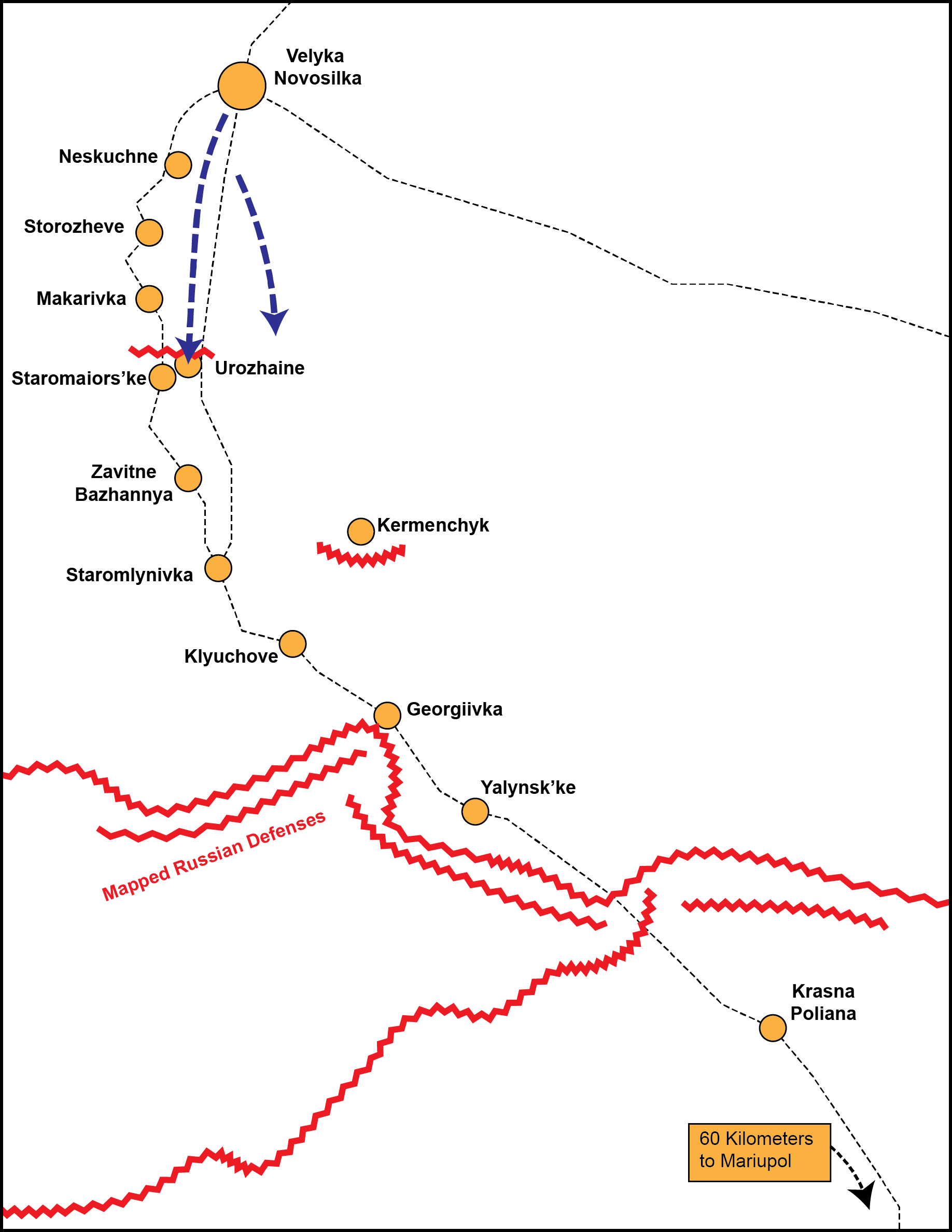
My reading of this axis is essentially that it was intended as a feint to create some semblance of operational confusion, but when the primary effort on the Orikhiv axis turned into a colossal misfire, the decision was made to continue to press here simply for narrative purposes. Ultimately, this is simply not an axis of advance that can exert a meaningful influence on the wider war. The forces deployed here are relatively miniscule in the grand scope of things, and they aren’t going anywhere important. Certainly, a thin, needlelike penetration is not going to drive more than 80 kilometers down a single lane road to the sea and win the war.
One of the surest signs that Ukraine’s counteroffensive has taken a cataclysmic turn is the way Kiev and Washington have already begun to blame each other, conducting a postmortem while the body is still warm. Zelensky has blamed the west for being too slow to deliver the requisite equipment and ammunition, arguing that unacceptable delays allowed the Russians to improve their defenses. This strikes me as rather obscene and ungrateful. NATO built Ukraine a new army from scratch in a process that already required greatly truncating the training times.
On the other hand, western experts have begun to blame Ukraine for supposedly being unable to adopt “combined arms warfare”. This is really a very nonsensical attempt to use jargon (incorrectly) to explain away problems. Combined arms simply means the integration and simultaneous use of various arms like armor, infantry, artillery, and air assets. Claiming that Ukraine and Russia are somehow cognitively or institutionally incapable of this is extremely silly. The Red Army had a complex and extremely thorough doctrine of combined arms operation. One professor at the US Arms School of Advanced Military Studies said: “The single most coherent core of theoretical writings on operational art is still found among the Soviet writers.” The idea that combined arms is some foreign and novel concept to Soviet officers (a caste that includes the Russian and Ukrainian high command) is ridiculous.
This issue is not some sort of Ukrainian doctrinal obstinacy, but a combination of structural factors rooted in the insufficiency of Ukrainian combat power and the changing face of warfare.
It’s frankly a little silly to say that Ukraine needs to learn about “combined arms” when they are very simply lacking important capabilities that would make a successful maneuver campaign possible – namely, adequate ranged fires, a functioning air force (and no, F-16’s will not fix this), engineering, and electronic warfare. The issue very fundamentally is not one of doctrinal flexibility, but of capability. By way of analogy, this is a bit like sending a boxer out to fight with a broken arm, and then critiquing his technique. The problem is not his technique – the problem is that he’s injured and materially weaker than his opponent. So too, the problem for Ukraine is not that they are incapable of coordinating arms, the problem is that their arms are shattered.
Secondly – and this, I admit, is rather shocking to me – western observers do not seem open to the possibility that the accuracy of modern ranged fires (be it Lancet drones, guided artillery shells, or GMLRS rockets) combined with the density of ISR systems may simply make it impossible to conduct sweeping mobile operations, except in very specific circumstances. When the enemy has the capacity to surveil staging areas, strike rear area infrastructure with cruise missiles and drones, precisely saturate approach lines with artillery fire, and soak the earth in mines, how exactly can it be possible to maneuver?
Combined arms and maneuver are predicated on the ability to rapidly concentrate enormous fighting power and attack with great violence at narrow points. This is probably impossible given the density of Russian surveillance, firepower, and the many obstacles they have put up to deny Ukrainian freedom of movement and scleroticize their activity. The main examples of maneuver in recent western memory – the campaigns in Iraq – have only tenuous relevance to circumstances in Zaporizhia.
Ultimately, we have returned to a war of mass – particularly massed ISR assets and fires. The only way Ukraine can maneuver the way they want is to break open the front, and they can only do this with more of everything – more mine clearing equipment, more shells and tubes, more rocketry, more armor. Only mass can crack open a suitable breach in the Russian lines. Otherwise, they are stuck in a positional creep through the dense Russian defenses, and criticizing them for being unable to grasp some sort of magical western notion of “combined arms” is the strangest sort of finger pointing.
So, whence goes the war from here? Well, the obvious question to ask is whether we believe Ukraine will ever have a more potent assault package than the one they started the summer with. The answer clearly seems to be no. It was like pulling teeth to scrape together these understrength brigades – the idea that, following on a defeat in the Battle of Zaporizhia, NATO will somehow put together a more powerful package seems like a stretch. More to the point, we have American officials saying fairly explicitly that this was the best mechanized package Ukraine was going to get.
It does not seem controversial to say that this was Ukraine’s best shot at some sort of genuine operational victory, which at this point seems to be slowly trickling away into modest but materially costly tactical advances. The ultimate implication of this is that Ukraine is unable to escape a war of industrial attrition, which is precisely the sort of war that it cannot win, due to all the asymmetries that we mentioned earlier.
In particular, however, Ukraine cannot win a positional-attritional war because of its own maximalist definition of “winning.” Since Kiev has insisted that it will not give up until it returns its 1991 borders, an inability to dislodge Russian forces poses a particularly nasty problem – Kiev will either need to admit defeat and acknowledge Russian control over the annexed areas, or it will continue to fight obstinately until it is a failed state with nothing left in the tank.
Trapped in a bat fight, with attempts to unlock the front with maneuver coming to naught, what Ukraine needs most is a much bigger bat. The alternative is a totalizing strategic disaster.
“Be all that you can be”

It’s coming up on another presidential election year — so time to spin up another pandemic?
Tale as old as time, death as old as rhyme: When the rich play God, it’s the poor who die.
Indeed, let’s reprise a Dan Sirotkin, a damaged soul, and replay his thoughts regarding CoVid-19 1.0: https://harvard2thebighouse.substack.com/p/understanding-covid-19-and-seasonal
**********

APR 1, 2021
What happens when dangerous and unproven scientific research techniques meet the military-industrial complex? Are modern research scientists still controlled by any code of ethics at all?
Is the COVID-19 Pandemic an inevitable product of the “Publish-or-Perish” mentality that’s turning both academia and popular journalism into factory farms whose primary goal is monetization – not the public good?
Answering these questions will reveal the ties that bind together the histories of mysterious military illnesses, the emergence of HIV, the source of the 1918 Spanish Flu Pandemic, anal swabs, COVID-19’s origins, Original Antigenic Sin, both the SARS and MERS Outbreaks, the 2009 Swine Flu Pandemic, as well as experimental but profitable vaccination protocols – all to the fates of those who would put fame and fortune over human life and academic ethics.
SPOILER ALERT: SARS-CoV-2 is a circulating vaccine-derived-coronavirus (cVDCV) borne from work originally done at UNC, the only institution on earth that’s publicly been attempting to design a live-attenuated vaccine for SARS, where they also pioneered engineering the SARS-like chimeric coronaviruses that would be needed as templates for attenuation, and did their best to ignore or circumvent restrictions on gain-of-function research – obfuscation that’s still ongoing as they refuse to disclose genomic details relating to lab accidents that occurred during the above publicly-funded research.
Notorious researchers from the Wuhan Institute of Virology were associated with this controversial work on coronaviruses, and attempted to continue it with an experimental oral live-attenuated SARS-like vaccination program for the Chinese Military without accounting for the quantum nature of the underlying quasispecies behavior – once they realized what was going on and deattenuation was already occurring out-of-control after the Wuhan Military Games, they reopened contact with Dr. Charles Lieber due to his work on virus-distinguishing nanowires, eventually leading to his arrest and the beginning of the largest and most coordinated cover-up in world history.
Carried-out by the pharmaceutical and defense entities involved in this research, both of which want attention pulled away from serial passage and experimental vaccine work, as do the billionaire class that wants to use gain-of-function research for unrestricted tinkering into the human genome at the Broad Institute.
Tale as old as time, death as old as rhyme: When the rich play God, it’s the poor who die.

Few things are more terrifying than being an exhausted fat kid about three-quarters of the way into your first 5k cross-country race when it’s being hosted at Fort Detrick, and you spent the previous night reading about the possibility of Ebola-infected monkeys escaping from military research facilities just like this one – potentially setting off a global pandemic as depicted in The Hot Zone.
So as the last few hundred yards go into a gully stretching past fencing that’s ominously topped with several rows of concertina wire, and your left calf starts cramping right as something rustles angrily towards you in the overgrowth behind the fence, you realize that you can in fact keep going after you think you feel the hot hungry breathe of a pandemically diseased lab monkey growing closer – ready to bite you and start an infection that results in blood violently fountaining out of your mouth and anus like some kind of terrible reverse-hemorrhagic Chinese-fingercuffs, uncontrollably spraying nearby runners with the disease and seeding a global pandemic and the death of millions.
Even for a fat kid, that’d be a heavy burden to bear, and so you keep running until you reach the finish line, glancing over your shoulder as you collapse into the grass to make sure no Ebola-crazed simians are after you. But the good news about finishing a cross-country race in last place is it means no one else is coming – definitely no escaped monkeys, and so it seems safe to forget about escaped lab animals and pandemics, at least for a little while.
Most kids of the past couple generations growing up with a parent involved with scientific research were probably more aware than most of their friends about the plight of lab animals, since at some point watching The Secrets of NIMH probably got you thinking about the suffering that can be shared by all intelligent creatures. But then a few years later, the Teenage Mutant Ninja Turtles likely put a lighter spin on the whole idea, and you don’t worry about technological progress so much. And then maybe later on down the road there was some exposure to factory farming, a different side of the same industrialized hyper-populated coin, and some dabbling in vegetarianism until the smell at the National Capitol Barbeque just became too much.
However at some point you realize that modern civilization doesn’t happen without humans bending Nature to our will as much as we possibly can, in a way that’s a defining characteristic of civilization itself, and you go about your life. Luckily for many of us, we were born into an era of modern medicine that’s demonstrated mankind’s inherent superiority over whatever Nature can throw at us, starting with plant domestication and animal husbandry forming the underpinnings of civilization itself, and continuing until today where farm animals are packed into once unimaginable densities, and laboratory animals are getting shanghaied into sprouting entire human organs to and having our genes spliced directly into them so they can be used for vaccines and other medical wonders.
But it turns out, under the wrong conditions, some the same principles which make the established childhood vaccination protocols so important and so safe can begin to rub up against the hubris of our modernity, and start to smolder. And when it begins to sense enough smoke, a very ancient miasma begins to unfurl from its slumber, soon noticing the burning hunger that’s been building since the last time we woke it up with our collective drive for domination and plunder.
The science underpinning modern medicine would’ve seemed like magic just a few generations ago, and even understanding the mechanisms behind many phenomena – it still often does. And yet modern science seems to have forgotten about one of the older lessons in magic, which was likely rooted in a fundamental understanding of the natural order of things: Nothing comes without its price.
Then in the latter part of 2019, a stark reminder of this natural balance would appear in Wuhan, China and soon spread to the rest of the world in the first recorded pandemic created by a coronavirus in human history. But to understand what it’s trying to tell us, it’s important to try and hear what it was trying to say the first few times around.
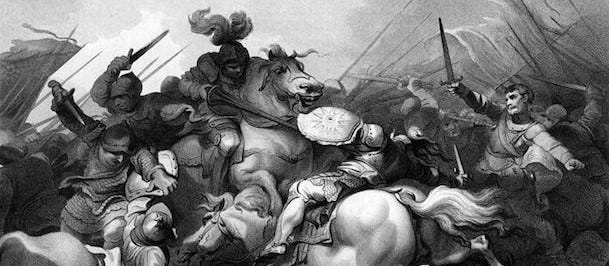
Although the speech this quote immediately elicits occurred a few decades before the War of the Roses, Shakespeare’s appropriation of it ensured that it would’ve been running through the souls of the soldiers fighting there just as it was during the Battle of Agincourt a few decades later. And although these words were addressed to English troops, these conflicts documented for the first time that there was a much more influential and mysterious band of brothers on the battlefield besides the ones doing the fighting – as the emergence of a bizarre illness was used by one of the English Lords as a reason to pull out of the battle shortly before it began, almost certainly changing the tide of the entire war, and all of our shared history.
1485 marked a temporary end to the successional struggle for England’s crown, but also the start of a series of five mysterious endemics that came to collectively be known as the English Sweat, which seemed to be heavily correlated with previous periods of heavy rainfall followed by intense human activity. By 1604 it had become such a ubiquitous force across England that the Bard mentioned it intentionally in another play, this time as a central force of social decay: “…what with the war, what with the sweat, what with the gallows, and what with poverty.”
Part of the terror it inspired was due to its lethality, it would typically kill its victims within 24 hours – chills, tremors, fever, a rash, sweating, then the Reaper – and its mortality rate is generally agreed upon to have been somewhere between 30% and 50%. The second horrifying factor was its apparent genocidal intent – for reasons that have never been explained at all until now, the English Sweat got its nationality not only because that’s where it began, but because as many historical observers inquisitively noted: It only ever appeared to kill the English, every other nationality appeared to be spared while on English soil.
And since its outbreaks often began in direct correlation to war, other nations would call it “Military Fever” when it sparked up on their soil, the moniker it took as one of its more continental strains killed Mozart. This martial connection was an inescapable one to make, as this first outbreak followed the victorious army back to London, where it burnt across the public throngs gathered in the thousands around their barracks to celebrate the victory.
Then, during its 1508 occurrence, it would demonstrate an important demographic flashpoint as its embers would float across the English Channel and land at the Pas-de-Calais. Yet even here across the Channel and on French land, it would still only kill the English. Burning white-hot when it appeared, the English Sweat appeared in intervals of roughly either 10 or 20 years, not targeting the young and vulnerable or old and infirm like most diseases, but instead the “middle-aged, professionally active section of the population,” or those gathered in close quarters like the military and monks.
The English Sweat is the first modern record of a paradoxical immunological puzzle being linked to a military setting, but it certainly wasn’t the first disease, and wouldn’t be the last riddle.
1.1 War is a disease.
Human influenza can be traced with reasonable certainty back to the Trojan War over 3,000 years ago, the first time it appears to enter the historical record with any reliability. A millennium or so later around the time of the Late Bronze Age Collapse, smallpox would leave its scars on a mummified Pharaoh, and other diseases suspected to be tularemia and the plague would also ravage those ancient battlefields.
Once the Roman Empire emerged, its armies too eventually fell victim, along with the empire itself, to wave after wave of diseases. One of the most lethal, the Antonine Plague, was thought to have started during the siege of a Mesopotamian city and then spread across the entire Empire – likely smallpox or one of its close relatives helping bring another Empire into an early grave.
And over 500 years after the English Sweat emerged, the world’s militaries would still be battling disease as much as each other, and in 1954 the U.S. Navy and Marines would begin their influenza vaccination programs since the inescapably packed conditions of ocean-bound naval vessels made for giant Petri dishes, mimicking the conditions found on commercial farms – making an airborne pathogen like influenza the primary concern since by the 20th century, modern militaries and societies have largely learned to remove intermediate animal vectors like mice.
So in 1996 when the military noticed that the USS Arkansas suffered a serious outbreak of influenza that affected at least 42% of her crew despite the fact that 95% had been properly vaccinated prior to departure, scientists were left largely scratching their heads. All of their analysis seemed to indicate that the vaccine should have covered the strains that were circulating, and so there didn’t seem to be any answer as to why so many seamen got so sick.
However in the decades to come it’s the exact same puzzle that would be faced on densely packed poultry farms where influenza transmission is also inescapable, and its an answer that will unlock the origins of both the 1918 Spanish Flu as well as the COVID-19 Pandemic with a combination that involves the inevitable consequences of a world that grows continually more densely packed with humanity, and the never-ending push to develop new and improved experimental vaccines for profit and plunder.
Microbiology first took the world by storm in 1880 when Louis Pasteur demonstrated that it was microbes – invisible to the naked eye – which were responsible not only for the sickness and disease which haunted the poor and unfortunate, something no one really worried about too much, but also led to the destruction of silk and wine farms.
Now that luxury items were demonstrated to be targeted by microbes in addition to the poor, the world took notice – since now dollar signs could be placed on the science. Not for the first time, and certainly not the last.
Although it became a bit of a long road, Pasteur had stumbled across the theory of attenuation after he used some of the chicken cholera that he’d been using to basically just Mengele chickens to death with, which had been laying out exposed to the elements, to dose some chickens with, and then went on summer vacation. Returning to his lab, the chickens exposed to the weakened virus were the only leftover poultry, so by default he chose them for the first round of testing his full-strength strain of cholera against, and noticed that not only did they survive – they hardly even got sick.
Realizing that leaving the cholera out in the elements had effectively weakened it and allowed the chickens exposed to its weakened form to develop resistance to it without killing them, Pasteur coined the term “attenuation” to describe a lesser version of the process that took his name, of totally sterilizing something – Pasteurization. So it was attenuation, originally of the cholera bacteria, that allowed for bespoke live-attenuated vaccines (LAVs) to first be designed against bacteria and then against viruses. Prior to this, variolation could only offer protection against a virus if a safe close cousin was hosted by livestock like with cowpox and smallpox, but mastering attenuating LAVs opened the door to creating extremely effective vaccines for every single virus out there.
So although the scientific world took a fair amount of convincing, Pasteur eventually demonstrated the efficacy of his chicken cholera LAV, and would eventually devise an ingenious LAV against the rabies virus that was sent through rabbit cells to weaken it down, that could even be used post-exposure on both dogs and humans. Rabies was likely the easiest target to attenuate down into a LAV because it presents to often in its highly-pathogenic and zoonotic state, as the virus drives its host to the horribly hallmark of foamy madness that makes this highly-pathogenic state – which displays the full range of epitopes the immune system would need to learn to target – so easy to identify and get samples from. Other LAVs were either created from viruses that also naturally presented in their highly-pathogenic state, like the highly lethal strain of Yellow Fever used for its LAV, or would use multiple strains to mimic this state and present the full range of epitopes that way, the strategy taken against Polio.
And as fate would have, the very first life that revolutionary live-attenuated vaccine saved was of a little boy who would grow up to be the man who would refuse the Nazis entrance into Pasteur’s crypt, committing suicide fifty-five years after the scientist had saved his young life, in an attempt to keep his genius out of Nazi hands. But unfortunately for undesirables everywhere, the Nazis wouldn’t need Pasteur’s ideas to inflict levels of suffering that only the organization and mechanization of the industrial world could make possible, and during World War II the Japanese would use another pathogen Pasteur had devised a vaccine against – anthrax which the Japanese military first tested on POWs – to kill enemy troops for the first time, as the Chinese became the first victims of the modern age of intentionally-isolated biological warfare.
But back in 16th century England, it wouldn’t be until 1551, the start of its last endemic, that the English Sweat appears to have dissipated from history. The best guess scientists have come up with for its entire mysterious existence is that it was caused by a rodent-borne RNA virus known as a hantavirus that causes hemorrhagic fever, since rodents would’ve been expected to proliferate after heavy rainfall, can transmit hantaviruses through their wastes or bites, and the clinical presentations largely line up. However this is very much a guess, since nothing about hantaviruses – or any pathogen as they’re currently understood – can yet explain why only the English were targeted, nor the way isolated pockets of the diseases would flare up independently from each other, and then each endemic would burn with apparently random intensities of sickness and death, with no apparent pattern of transmission across time or location.
Although it would flare up at population centers, there was no evidence of anything resembling the steady and mostly linear transmission of a pathogen that would be expected from typical immunological modeling – especially not how it could possibly drift from England across the Channel at the Pas-de-Calais, and decide to only kill the Englishmen gathered there. Unfortunately, since genomic sequencing was still a few hundred years away, it’s unlikely we’ll ever know for certain where the English Sweat came from, or where it went.
However there’s a chance that if we stare hard enough into this historical miasma, we’ll be able to hear our future squeaking back at us.

Although it was once considered eradicated, in recent years an increasing number of cases of poliomyelitis – polio’s terrible paralytic curse – have emerged in the developing world after remnants of the three highly attenuated Oral Polio Vaccine (OPV) live-attenuated virus strains used to inoculate children managed to escape into the population, circulating and mutating and deattenuating enough to eventually establish active human infections.
This novel global phenomenon would’ve been anticipated by the late U.S. Army Major Dr. Albert Sabin, who served in the Pacific Theater and designed the OPV-LAV protocol in the 1950s to compliment the inactivated vaccine which didn’t quite seem to be enough to fully eradicate the slippery disease. Dr. Sabin would’ve been well-aware of the risks involved with attempting to design a LAV against RNA viruses like Polio, since back in 1935 an experimental polio LAV had deattenuated back to full neurovirulence, and killed five of the several thousand children inoculated with it in Philadelphia.
So several years later in the 1950s, Sabin was careful to make sure the three strains he chose for his viral swarm would be unable to reassemble themselves to fully-virulent polio after it’d been attenuated down into a LAV – since the risks of improperly designing an experimental LAVs had been readily apparent for years, even all the way back then.
Even before today’s age of bespoke genetic engineering, live-attenuated vaccines were seen as extremely delicate and immunologically volatile. The slow unpredictable specter of deattenuation had already shown itself in that orphanage, however history would demonstrate that it wouldn’t be anywhere near enough horror to prevent the envelope from being pushed until the friction lit it on fire. In a few more decades, the profound and intense risks around attempting to splice the genes from an animal virus into Sabin’s perfectly-good OPV-LAV vaccine would trigger the Asilomar Conference, at which point the scientific community thought they had things under control – but more about that in just a few moments.
So to be fair, it took nearly three-quarters of a century after its initial design and implementation, until 2017, for Sabin’s OPV-LAV to deattenuate enough to create more new cases of polomyetis than natural polio, and even then it was only handfuls of each. In the meantime, untold millions were saved from debilitating paralysis, and the disease has been all-but eradicated except in these small pockets of deattenuated vaccine-derived polio virus (VDPV). Sabin’s protocol was invented to complement the existing approach which used an inactivated strain attenuated past the point of death, which provided broad protection but not as effectively as Sabin’s interwoven three live-but-neutralized-strains in the oral OPV protocol that took his name. His LAV was meant to be the last nail in Polio’s coffin: It provided a more effective vaccine to protect troops from a disease that thrived in crowded military conditions, and the public health community with the last tool they’d need to eradiate the virus.
In theory.
However the paradoxical phenomenon of paralytic polomyetis reassembling itself within vaccinated populations has exploded since 2017, and by 2019 there were 176 cases of polomyetis derived from the OPV strain worldwide when only 33 had been seen the year prior, and outbreaks of poliomyelitis have recently been seen in Egypt, the Dominican Republic, Haiti, the Philippines, and Madagascar.
2.1 – Memories of virulence gone past.
This paradoxical ability, for attenuated viral strains to deattenuate back into their original fully-virulent parent strain – much like the T-1000 was able to mercurially reassemble itself in the sequel to The Terminator – can be explained by examining polio and other RNA viruses not as discrete linear genotypes transmitted on by discrete strains, but instead as quasispecies mutant swarms of virions which carry distinct but complimentary sets of alleles, which work in concert in real-time to establish and expand infections. One of the first empirical changes that comes once you consider an RNA virus as a quasispecies swarm is that at any point in time, all the extant variants’ genomes form a collective probability cloud that serves as the smallest selective unit, as opposed to using individual virions or any single extant genome in a population, the classical approach.
This quasispecies viral swarming is an amorphous behavior that describes the search for fitness that occurs as each successive generation of the swarm produces wider spectra of mutations, with the term “quasispecies” specifically describing “distributions of non-identical but related genomes subjected to a continuous process of genetic variation, competition, and selection, and which act as a unit of selection.” Each of these distributions can be considered as overlapping clouds of allelic statistical possibilities, each of which represents the spectrum of mutations that can be expected to emerge within a set number of generations – so their ratios will be constantly changing over successive generations and in different settings.
This type of effect has just begun to be explored within the classical model, by quantifying the antigenic waves that shimmer across the surface of quasispecies mutant swarms as they shift between the host populations, and using these measurements to indirectly measure the quasispecies swarm itself. These antigenic waves have been observed to shift between populations of viruses and host during the search for adaptation, and after intense mathematical analysis this model concludes that if an antigenic wave is transmitting itself to many different hosts all at once and spitting-off multiple “lineage speciations,” so the overall complexity of the quasispecies swarm is increasing, it’s likely to continually build on itself until either transmission stops or new variants fail to emerge.
However this field is in its infancy, and besides without fully sampling a COVID-19 infection to get a completely representative sample of its quasispecies infective swarm, it will be impossible to accurately calculate anything at all.
The linear model of virology that’s been classically used presents the illusion of control, it entirely ignores the reality that the process of sampling a virus from a live host and then isolating it within a Petri dish so it can be studied and quantified is an extremely rough and loose process. And there is evidence that today’s commonly used metagenomic tools are in fact missing many of the extant viral strains, since “the large proportion of low-frequency variants and their dynamic change in frequency (e.g., by comparing sequential samples from a virus replicating in cell culture or in a live host organism) currently being revealed by ultra-deep sequencing portray a level of complexity not contemplated in the concept of genetic polymorphism of population genetics, at least as classically formulated.”
So hopefully scientists trained in the classical model can be honest about the reality that the tools they’ve always used are incredibly rough and might well be missing some of the nuance going on. Unless each and every scientist out there can confidently state that nothing about how this pandemic has unfolded has surprised them.
2.2 – “We don’t need no water…”
With viruses replicating continually once a successful infection has set in and begun to smolder, the most-fit variant for a given tissue will predominate in that exact tissue when a sample is taken only from it. However, although only one variant will appear in the smoky quasispecies mutant swarm infecting this tissue-type, the smoldering infection will be continually throwing off new variants which represent different points in the possible mutational spectrum – some of which will be better adapted to neighboring tissues, and others acting as accelerants for the predominate variant, and intensifying its virulence.
Granted, the temperatures involved are in far different ranges, but a recent pre-print demonstrates that SARS-CoV-2’s various strains’ spike-proteins’ ability to infect different types of cell tissue changes depending on the temperature, with far different virulence at about 91-degrees Fahrenheit than at about 99 degrees depending on the strain involved. And further adding to the novel coronavirus’s potential for immunological conflagration, is the the fact it’s able to replicate 10-times more efficiently than SARS-CoV in the average temperature encountered in our upper respiratory tracts.
The idea of different variants acting as accelerants isn’t commonly used, but it fits the language humans have historically used: Infections sparking up out of nowhere, and burning through populations, and diseases appearing suddenly from sinister gaseous miasmatic vapors. And it fits the picture presented by the overall biochemistry: Successful viral entry into a cell requires the same underlying chemical principles of entropy and heat exchange as sparking and maintaining a fire, where just like a fire: a viral infection will begin destroying its host to make more of itself. Also demonstrating that it works via immunological conflagration, SARS-CoV-2 appears to prefer to begin its infection in the relatively hospitable nasal cavities that can host infections at low temperatures, before different variants are produced which allow it to invade tissue deeper in the body which require variants able to infect and biochemically burn at hotter temperatures.
And just like one gas acting as an accelerant for another’s combustion can be modeled mathematically by looking at their relative binding tendencies to different elements and how they react at different concentrations, the mathematical inevitability of quasispecies mutant swarms fully exploring their mutational spectrum and finding variants to fuel their spread isn’t any different. It’s only the language that varies, as the literature currently describes the positive selection from quasispecies mutant variants resulting in “hitchhiking” between mutations on variants in the same swarm, the exact same concept as different variants and their mutations acting as accelerates for each other during gaseous chemical combustion.
So if this model was accurate, we’d expect the first notable beneficial mutation – D614G – to fit within it pretty well. And it turns out, this variant’s adaptive advantage in fact comes from handling the body’s chemical temperature more effectively, allowing quasispecies clouds hosting it to create a “hotter” infection.
Or in a more classical sense, quasispecies mutant swarms likely depend on a sort of accidentally eusocial viral altruism to prosper. Variants don’t exist in a vacuum, they work with their close cousins to most-effectively invade new tissue-types, and so “internal interactions of cooperation or interference can be established in what has been called the social behavior of viral populations.”
As one study revealed, although its usually possible to identify a majority consensus sequences from a sample of hosts infected by COVID-19, the sample had a broad median variant count of 23, with nearly 250 different variants found in total. And considering that about half of the observed mutations thought to have a significant impact on gene expression and samples differing throughout the day even in the same organ system, as well as the fact that barely 2% of the minority variants were found to overlap at all between any two hosts – the inherently nebulous quasispecies mutant swarming nature of SARS-CoV-2 begins to coalesce even more.
Finally, although it’s hasn’t been studied as much yet, this more combustion-based model turns the current models of viral fevers on its head – instead of fevers emerging as the body’s attempt to fight off the virus, fevers may be viruses’ way of allowing for infections to spread into different tissue types deeper in the body. And so although they may appear to reduce the ability of the first infecting low-temperature variant to occupy the nasal tissue where it usually lands, as this is happening variants which can infect warmer tissue are pushing their way deeper into the fevered body.
And with any virus, but especially with coronaviruses, it’s important to keep in mind that hidden within their large genomes are entire suites of accessory genes which only appear functional while actually living inside their hosts, in vivo, and whose function won’t be observable within the virtual environment in lab Petri dishes, in vitro: “the coronavirus group-specific genes are not essential for growth in cell culture but function in virus-host interactions.”
Incidentally, another paper attempting to immunize against that highly-airborne coronavirus goes on to explain that when an experimental spike-protein only vaccine was tried against a highly-airborne feline coronavirus – immunoglobulin was thrown out of wack and 80% of the kittens it was administered to died inside a month. But don’t worry, Big Pharma has crossed its collective fingers and is hoping really, really hard that this exact same phenomenon doesn’t occur at some point down the road within human populations vaccinated with a spike-protein only vaccine against our novel highly-airborne coronavirus.
But this effect can’t be expected to appear immediately with SARS-CoV-2, since like all deattenuating LAVs it won’t reach full virulence until it’s fully reconstituted itself back to its original full-strength form – an enigmatic process that’s explained below, and which is still ongoing as transmission events occur in their millions all across the Earth.
So although SARS-CoV-2 may not seem terribly virulent in its initial chronic stage yet, you should probably keep in mind that attenuating the LAV for Yellow Fever took hundreds of passages through five different types of cells – including those from monkeys, mice, and chickens – in a process invented about 100 years ago. Meaning this novel coronavirus likely has a very long way to go before it can reconstitute itself back to its original strongest viral swarm, since it almost certainly went through an even more extensive attenuation process involving cutting-edge modern virological technology developed over the intervening century.
And it’s worth taking a moment to point out that the Yellow Fever virus used for this attenuation wasn’t exactly a naturally occurring virus, it was the result of sending the highly-pathogenic “Asibi” Yellow Fever virus – with a 95% kill rate in monkeys – through serial passage, until a chimeric recombinant virus now called 17D, which presumably expresses a wide range of genes, was produced – ideal since those genes would provide the necessary signaling-flags for our immune system to target after it’s attenuated down into a LAV. Which is very close to what Ralph Baric was doing serially passaging SARS-like viruses at UNC to see which genes got swapped around, but more about that soon. And in the case of Sabin’s first LAV for Polio, that version of OPV required three different strains to get all of the necessary epitopes, or immunology signaling-flags, which accomplishes the same affect as an artificial chimera expressing all of those epitopes at once would.
Within their hosts in vivo, examining RNA viruses as quasispecies mutant swarms reveals that “viral types and subtypes are just the ‘tip of the iceberg’ of a more profound and fundamental phenomenon: the continuous dynamics of mutant generation, competition, selection and random events which push viral quasispecies towards diversification.” However the complete nature of a quasispecies mutant swarm will never be revealed inside of the petri dish, or any lab at all unless ethics rules are adjusted, since without a population of live hosts to transmit between, an RNA virus will never use the variant potential of its entire genome and reveal the full extent of its quasispecies swarming abilities.
So long as an RNA virus is able to find new hosts to infect and so can continue replicating, its quasispecies mutant swarm won’t attenuate upon continual replication and new host introduction, and its mutational cloud will continue to grow in diversity as the swarm grows in variant-derived complexity. And as these quasispecies mutant swarms get larger, by definition they also become more variegated, and eventually more virulent once transmission begins.
2.3 – Time for life to spark.
Avian influenzas don’t magically attenuate over time on crowded industrial poultry farms, they’re now ubiquitous and growing more virulent there because the population densities involved mean that the quasispecies swarms of the avian influenzas infecting them have an unlimited supply of hosts and so never stop mutating toward highly pathogenic states, where a 50% fatality rate can be a best-case scenario. In a sense there’s an immunological pressure that slowly begins to build after population densities become unnaturally high, until it explodes with the emergence of a highly pathogenic strain that burns through an entire farm, generally killing at least half the flock and sometimes all of it.
The passage of time is a critical concept in quasispecies viral swarming behavior, as with enough generations a single viral genome of every major class of RNA virus has been shown to eventually give rise to a distribution of possible mutants which represent variation that is not immediately apparent from its genome. Whereas genomes made from DNA carry much of the code for the variation that exists in a given population even though each and every individual does not express it in a given lifetime.
RNA viruses replicate constantly inside of their hosts and do not have episodic sexual exchanges like most DNA-based organisms, underlying the fundamental need to approach RNA viruses from the ongoing and amorphous quasispecies perspective which views their evolution as the shifting spectrum formed from ratios of alleles in competition and cooperation, more than the largely polarized expectations of the discrete haplotypes found with DNA heredity. In a broad sense, the behavior of a mutant cloud of 100 variants with a relatively narrow spectrum attempting to infect human tissue over the course of a day, would roughly represent the genetic activity of a tribe of several hundred people attempting to survive in their environment over the course of dozens of generations.
And in a sense, the process of mammalian fertilization can be seen as a short term and accentuated mutant swarm. Although only one gamete is required to fertilize the egg, it does not complete its journey alone and needs its motile brethren to deal with host immune defenses and act as cannon fodder. So although quasispecies swarms always have multiple extant variants inside any one host at a given time, and mammalian zygotes host just one DNA-based genome, a mammalian father producing multiple offspring is also diffusing his genome into a swarm of variants – the winner is just declared one generation at a time.
This fundamentally amorphous nature of RNA virus genomes means that the quasispecies approach invalidates the idea of a singular “wild type” isolate genome with one immutable nucleotide sequence described as the contagion at any one moment in time. Because under this approach, every RNA virus is by definition a swarming ever-changing mutant cloud of quasispecies virions, in part because “RNA viruses, whether replicating in changing or static environments, keep a sustained level of genetic heterogeneity that maintains their capacity to respond to constraints.” This results in a quantum uncertainty around exactly which section of the cloud is being observed at any one moment, a cloud which will be different the next time you sample it regardless of how representative you think the sample you first sampled was.
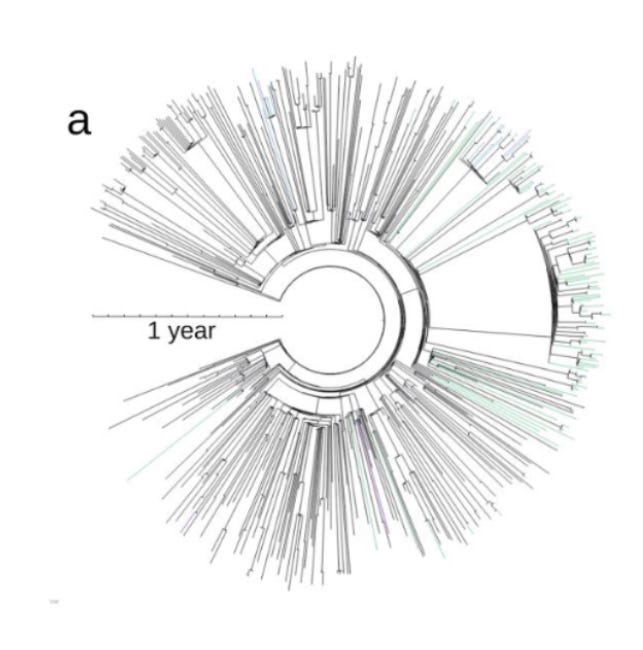
This more statistical and fundamentally quantum approach to exploring the evolution of RNA viruses was suggested by Francis Crick to Dr. Manfred Eigen over an otherwise uneventful breakfast in 1971, and seemed promising given the results already obtained by Sol Spiegelman and colleagues from serial transfer experiments of RNA taken from a virus that infects bacteria in a closed system, which demonstrated Darwinian behavior in vitro. Eigen applied a statistical framework to Darwin’s expectations, and formulated an origin of life that used the replication and adaptability of self-organizing macromolecules to argue that they may have served as something akin to proto-RNA.
With an apparent drive towards complexity and the ability to self-replicate, RNA viruses form quasispecies clouds or swarms which evolve towards a composition and a mutation rate that leads to the ratio of variants with various levels of fitness for adaptation to its host population, values that are subject to change as the living and variable ecosystem of individuals they are being hosted in itself changes. These early findings were reinforced about half a century later, when in 2021 nuanced experimentation on molecules composed of just a few repeating units, whose behavior was expected to mimic the chemical precursors of RNA and DNA, displayed the ability to undergo a quasi-selective process involving the selection of more stable and ordered elementary structures based on even the most miniscule selective pressures, accompanied by the overall reduction in randomness which would be expected from complexifying life.
It’s not proof, but the fundamentally quantum behavior underlying quasispecies mutant swarms likely helped spark life itself. And this wouldn’t be the first-time quantum effects showed up in fundamental biological processes, as they’ve been identified as playing roles in a vast array of fundamental processes: photosynthesis, tadpole maturation, human smell, and avian navigation, and are beginning to show flickers within neurobiology as well as Sir Roger Penrose has proposed that human consciousness emerges from neural-anatomical structures with ability to host quantum behavior.
And so it shouldn’t come as a surprise to find a fundamental framework from physics making its way into some fundamental biology as well, as our understanding of the forces in play becomes more granular and the math more precise.
2.4 – The price of Original Sin.
Although quasispecies theory is framed within a world of infinite possible generations, this approach to viral population genomics examines a virus not as any one discrete immutable genome, but instead as nebulous and mercurial quantum clouds of variants looking to find the highest shared fitness among a given population of hosts, variants which are able to swarm together in search of the highest collective fitness, looking to burn hotter than the host can defend itself against in a perpetual immunological arms-race.
And as masterfully captured in the case of the OPV-LAV strains which are able to deattenuate back to fully virulent polio like the T-1000 merging from thousands of shattered bits back into a whole, RNA viruses also seem to carry a “memory” of this past peak fitness state which doesn’t fade with time, a memory they are able to use as a selective shortcut when looking for the most adaptive mutations back to their original state.
This apparent memory of past viral fitness, the ability for an RNA virus to reassemble itself into its fully virulent original full-strength viral V-1000 form, may have evolved as a counterbalance to Original Antigenic Sin, a form of defensive host immune memory which causes many vertebral immune systems to produce bespoke ancestral antibodies tailored to mount an immune defense against the original example of any given class of virus, even when a different species within the same class infects it.
The best example of this is the mercurial H1N1 influenza variant behind the 1918 Spanish Flu pandemic, which effectively formed the V-1000 godfather that gave birth to the 1957, 1968, and 2009 H1N1 pandemics that began in different regions of the world. Oddly, even though it is the most contemporary outbreak and is separated from the original H1N1 strain by nearly a century, the 2009 H1N1 strain is the only one that targets the same blood-based receptor signified by H1, as opposed to H2 or H3. As Original Antigenic Sin would predict:
“When the 2009 pandemic virus emerged in humans with a swine H1 HA gene descended from, and still closely related antigenically to, the 1918 pandemic virus, extensive cross-protection between the 2009 and 1918 pandemic viruses was demonstrated in experimental animals (12–16). Interestingly, 1918 virus-specific [antibody-producing] B-cell clones could also still be recovered from very elderly survivors 90 years after their exposure to that virus but before their exposure to the 2009 pandemic virus.”
And so, Original Antigenic Sin may be evolutionarily entangled with the quasispecies memory which appears to allow RNA viruses to return to full virulence much more quickly than they should statistically be able to, in the sense that they each may have evolved to counterbalance each other as organisms and their communities increased in complexity.
RNA viruses have demonstrated this V-1000 ability not just after vaccine attenuation, but following bottleneck events as well – so if a minority population of the quasispecies mutant swarm is separated from the rest of the population when their shared host population is itself bottlenecked, and this subset of the quasispecies cloud doesn’t contain any examples of the original V-1000 fittest full-strength variant, quasispecies memory would allow this refugee cloud to quickly produce V-1000 variants. While Original Antigenic Sin would help protect older members of the host population who had been exposed to the V-1000 strain years ago, but who would face fresh exposure once this refugee swarm made its way back to full V-1000 strength.
Viral quasispecies have been observed to exhibit this sort of complimentary swarming behavior and the accompanying memory, which appears to allow an RNA virus to search for and find deattenuating mutations within cell cultures as variants are passaged across the full populational spectrum: Within individual hosts as different organ systems make better homes for discrete variants, across local populations of a few individuals, and nearly simultaneously across geographically disparate populations of hosts as well.
This scalable, fractal nature of this phenomenon was definitively illustrated during the 2017 influenza season by a study which observed the temporally parallel evolution of the exact same set of mutations among the variants competing within individual immunocompromised patients, fighting for selection among clusters of hosts, and emerging simultaneously across the entire globe as well. Additionally, no matter which scale is used, quasispecies behavior follows the Wright-Fisher expectations of selection-mutation equilibrium when allele frequencies are calculated – meaning they within the expected probability curves even when counted across generations – and should be considered a viable approach for examining the behavior of any RNA virus.
And the underlying fractal nature of the COVID-19 pandemic is starting to be explored as well, as researchers have noted the self-similarity underlying fractal patterns being shared by infections across different cities, and started to use the power-laws underlying fractal kinetics to anticipate more of the seemingly isolated and unpredictable outbreaks, which are really just the result of the quasispecies swarms beginning to coalesce within populations where infections have been smoldering for days or weeks already – the nature of COVID-19’s ability to spread asymptomatically by definition means that apparently isolated clusters of infections will emerge with fractal tendencies instead of the linear ones classical virology typically assumes.
So instead of the classical model’s assumptions of outbreaks progressing roughly linearly as one distinct variant outcompetes the last and then jumps from host to host, what’s really happening is something closer to the edges of the an ever-mutating Mandelbrot Set pushing up through the surface of a vast ocean of hosts – pandemics are a kaleidoscopic of variants emerging in disparate regions as the swarm explores new combinations of possibilities, not the linear progression of variant from one host to the next.
With the seasonal flu claiming roughly one-quarter to a half-million lives worldwide each and every year, creating one of the most predictable strains on public health efforts across the entire planet, and with SARS-CoV-2’s pandemic killing at least two-million in its first year in the course of infecting at least one-hundred million more and counting, while leaving many of those it doesn’t kill with nebulous constellations of insidious long-term side-effects – there may be no two viruses whose effects are so historically constant and immediately salient, but so unpredictably modeled and explained. Additionally, the 1918 Spanish Flu Pandemic stands as the single deadliest immunological event in recorded human history, claiming some 50 million victims, and drawing eerie parallels to today, when again an unusual airborne RNA virus has again emerged without any definitive source and created another global pandemic that has ebbed, but shown no sign of receding just yet.
And so, examining all RNA viruses, but especially the potentially pandemic seasonal influenza as well as SARS-CoV-2 and the COVID-19 Pandemic it’s causing within the quasispecies framework presents possible explanations for a litany of paradoxical and mercurial behaviors from each virus: The inexplicable appearance and sudden disappearance of the 1918 pandemic influenza, where the 2009 Swine Flu likely started, SARS-CoV-2’s burgeoning ability to evade our immune systems and vaccines, failures of influenza vaccine trials in naval settings as well as the failure of the FluMist vaccine which functioned more efficiently than an ATM for the researchers involved than anything else, the novel coronavirus’s emergent pattern of convergent epistatic mutations across continents, the near disappearance of the seasonal flu across much of the world in 2020, and other more subtle peculiarities demonstrated by each virus.

Beyond all that, the reason you probably haven’t heard of quasispecies mutants swarms before is tied directly into the start of COVID-19’s ongoing pandemic, as well as the fact that every legacy media outlet on earth seems to simply be acting as stenographers for either one group of scientists who have been huffily insisting that a laboratory origin is a conspiracy theory, and as a public relations team for another group of “scientists” who are pretending to be indignant about the lack of a real investigation from the WHO – when the WHO’s been transparently serving as a mouthpiece of the CCP since January 2020 – while actively sidelining the seminal peer reviewed literature, and trying to make the scientists behind it disappear.
Which certainly has nothing to do the interest every intelligence nation on earth has on this virus, especially the French who helped design and build the Wuhan Institute of Virology and the Americans who pioneered the technology at the University of North Carolina under the supervision of Dr. Ralph Baric.
Because obviously pharmaceutical companies and the defense industry are very open about what they’re doing, and wouldn’t do things like influence photogenic and charismatic junior scientists to spin things a certain way while behaving with no regard for academic ethics, or recruit narcissistic media personalities to act like they understand science they have no fundamental grasp of or degrees in, all while cosplaying as a low-rent Iron-Man.
You’d think if Science was the goal, then if the scientist who was the literal architect of the database which every other scientist on the entire planet has spent the past 20 years using to compare the most minute difference between genomes – that if Science was the goal and he’d also been the lead author of the first peer-reviewed paper to examine a possible laboratory-engineered origin of SARS-CoV-2, then you’d have heard his name just once in the legacy media, right?
Rent a room down the rabbit-hole?

Instead of viewing an infection as primarily caused by a singular genome or a discrete haplotype that is reliably reproduced and inherited, using quasispecies behavior to analyze RNA viruses means starting from the observation that they’re ubiquitously composed of mutant swarms of variants, which respond to host immune defenses nearly in real-time by intermittently producing virions with slightly altered genomes in each and every generation. Then a minority of those variants are quickly able to find the first immunological weaknesses, prove to be adaptive, and reach fixation if they provide enough of an advantage either in the current tissue-type, or in a neighboring one – often by complimenting the variants around them in ways that are impossible to anticipate until they happen.
At any given time following the moment that an infection’s first successful embers take hold within a tissue, every host will always be hosting multiple variants of any given strain of any given RNA virus – and so it’s highly imprecise and profoundly counterproductive to refer to any single host as being infected by just one variant’s genome, or even to the existence of a set “wild type” at any point in time in any given population. Depending on which organ is being sampled, and even what time of day it is – the composition of the quasispecies swarm is a shifting cloud of amorphous variability.
Even time itself clearly influences COVID-19 infections, as scientists have noted that infections appear to be twice as virulent around 2pm compared to the lowest times of day. One genome will often be in the majority within any major organ system across an entire population of relatively healthy non-immunocompromised hosts, so nations which only or primarily use nasal samples will erroneously conclude that one variant exists across an entire population, when dozens of other variants are hidden as minorities in other organ systems.
Sampling only noses will only reveal the dominate variant in nasal tissue, which will be shared across hosts in a population, even though multiple other variants will likely be present in other organ systems but not presenting in the nasal cavities. At any given time, the average host will have different slightly-altered variants of the same strain infecting each of their different organ systems, and so sampling nasal, pulmonary, intestinal, and fecal samples predictably demonstrates that after any meaningful amount of time each host will always be infected by multiple variants, especially once the infection spreads past the first type of tissue it infected.
This becomes the most apparent in immunocompromised patients who are also stricken with influenza, or those stricken with COVID-19 – both highly contagious respiratory RNA viruses with pandemic potential. In the case of COVID-19, although the popular press has presented the narrative that immunocompromised patients infected by the novel coronavirus are themselves creating new variants, a more granular analysis of their cases as well as those of immunocompromised influenza patients, makes it clear that because immunocompromised patients are mounting a weaker defense, each organ system is less able to constrain a mutant swarm to only produce the type of variant best suited for it – resulting in immunocompromised patients presenting as representative kaleidoscopes of the extant variants in a population. Curiously, the persistence of OPV live-vaccine strains in immunocompromised patients is also well-documented, where they produce the same kaleidoscope of variants and can use the same Terminator-like effect to reassemble themselves into a V-1000 form, what are called highly-diverged immunodeficient vaccine-derived polio viruses (iVDPVs).
And in crowded institutional settings like orphanages, these vaccine-derived V-1000 viruses are beginning to present the troubling problem of blocking the efficacy of existing vaccinations and innate immunity across the entire population. The emergence of these extraordinarily immune-evasive VDPVs are a stark reminder that a LAV going-wrong is just about the worst-case scenario as far as genetic experimentation goes. And strangely, the actual variola virus used for the production of the first viral LAV, which was attenuated to combat smallpox, has been lost to history just like the original “Asibi” Yellow Fever virus and its 17D derivative used to make the Yellow Fever LAV.
The practice of variolation, rubbing tissue from livestock infected with a virus related to smallpox onto humans to effectively vaccinate them, had been in practice throughout Asia for hundreds of years before it was finally industrialized for mass consumption by “The Father of Immunology,” Edward Jenner, in 1786.
Although the process or variolation, the earliest version of formal controlled vaccination, is usually explained by using cowpox’s close relationship to smallpox allowing it to accidently inoculate dairymaids against the later deadly disease, Jenner didn’t actually use cowpox to derive his live-attenuated vaccine.
We have no idea what he used.
3.1 – “We must rebuild us. We have the technology.”
The virus he did use is casually referred to as Variola in the literature, however no one actually knows precisely what it was. It wasn’t actually smallpox, it wasn’t cowpox, but it was over 99% similar to a bovine virus that also likely would’ve provided immunity against smallpox. However it’s important to note that even from the start, the creation of a live-attenuated virus will lead to strains whose ability to reassemble themselves into an original V-1000 form likely won’t be quite perfect, and in the case of iVDPVs the deattenuated strains appear more virulent and drug-resistant, and have the ability to interfere with existing immunity.
Healthy patients are able to mostly keep variants segregated within the organ systems they are most suited to, meaning that only pulling nasal samples from everyone can create the illusion that only one variant is circulating within a population, since the variant best suited for that tissue will generally be the most prevalent in that one tissue. On the other hand, immunocompromised patients are unable to enforce these barriers and the ratios of different variants created by them, and display all of the extant variants which due to less-effective immune systems, are able not only to spread between organ systems, but to replicate more evenly in each of them as well.
This can make it seem as if immunocompromised patients are producing new variants, when in fact all that is happening is that the ratios between variants are much more evenly represented among their organ systems, and so each variant more likely to show up in the sampling done of immunocompromised patients, which may often be more precise as well. Meaning immunocompromised patients only appear to host more variants, when in reality all that is likely happening is that the nature of their weakened immune systems makes it harder to keep variants segregated into each organ system, and so widespread testing of healthy individuals and their organ systems would reveal the same range of segregated variants that is in fact extant in the rest of the population, but which remains cryptic in everyone except in immunocompromised patients, whose organ systems are unable to keep variants segregated to each organ system.
Immunocompromised patients’ inability to keep variants segregated in their best-suited organ systems likely also plays a role in their relapses, as the quasispecies mutant swarm can get greatly reduced in overall numbers with treatment, but as soon as weakness is sensed it will begin reconstituting itself. And especially bad news for immunocompromised patients is that diverse quasispecies mutant swarms allow can allow viruses to pass through the blood-brain barrier and replicate inside the brain itself.
So immunocompromised patients are not necessarily producing more variants, however they can reliably serve as something of a fractal Rosetta Stones about the composition of the mutant cloud in the rest of the community, since their inability to constrain the infection leads to variants which will usually only thrive in one type of organ system in a healthy host being able to reproduce and thrive in many different organ systems. This was definitively shown in 2017 which used an immunosuppressed influenza patient and their community to demonstrate that the patient held a rough approximation of all the diversity found around him, with each variant roughly keeping to its best-fit organ system. And in the case of an airborne virus, becoming airborne in the first places appears to hinge on finding the proper mutations which allow it to colonize pulmonary tissue, where virions can be aspirated via coughing and sometimes even by just regular tidal breathing.
Due to the inherent complexity of balancing all of the competing and complimentary biological processes which they interact with, mutant swarms are by definition difficult to define exactly at any one moment in time, and so several variables must be considered at once when quantifying them. The five factors that regulating the formation of effective quasispecies mutant swarms in RNA viruses are: “the average number of mutations per genome, virus population size, genome length, mutations needed for a phenotypic change, and virus fecundity.” And with virus population size, genome length, and virus fecundity all being some of the highest ever recorded in history for our novel coronavirus, three separate doors have been opened wide – allowing SARS-CoV-2 to establish extraordinarily robust quasispecies mutant swarms all across the globe.
Additionally, despite the fact that SARS-CoV-2 began with an extremely efficient proofreading enzyme and a much lower mutation rate than polio and many other coronaviruses, the mutation rate regulated by that proofreading enzyme should be only one of five factors which should be considered when assessing quasispecies mutant swarming behavior.
Beyond that, it appears that some of SARS-CoV-2’s non-structural proteins may quickly accumulate the in-frame deletions which by definition would not be caught by the proofreading enzyme at all, allowing it to cryptically mutate beyond the immune system’s surveillance. Or as the mayor of one Italian city racked by the virus described its behavior in general terms: “This is the demonstration that the virus has a sort of intelligence. We can put up all the barriers in the world and imagine that they work, but in the end, it adapts and penetrates them.”
And alarmingly, many signs point to the possibility that this not-so-friendly neighborhood novel coronavirus has already formed the robust and epigenetic quasispecies mutant swarms which can allow variants isolated by bottlenecks as well as attenuated vaccine variants to remember past fitness states learned while part of an earlier swarm, since some kind of convergent evolution already appears to be occurring and “the same COVID-19 mutations are appearing in different places.”
This allows a hasty return to the peak virulence of their original V-1000 form through exposure to repeated hosts, since enough replication events will lead to a swarm of complimentary variants. This ability to learn and obtain a “memory” of a past fitter variant has been explored the most fully with OPV reverting back to virulent Polio by Dr. Adi Stern and his team at Tel Aviv University, but it has also emerged in Foot-and-Mouth Disease Virus (FMDV), and hepatitis C.
This paradoxical phenomenon seems to allow quasispecies mutant swarms to find the most adaptive variants far more quickly than they should be able to statistically, and allows them to quickly remember how to neutralize host defenses, creating more virulent infections and viral mutant swarms which are much more dangerous – an interaction that has been playing out on poultry farms and during military vaccine trials for decades.
This apparent ability to have learned the most adaptive ratio of variants for a mutant swarm to effectively infect a host population and return to it is one of the hallmarks of quasispecies mutant swarms, however the complete failure of the FluMist live-attenuated virus nasal vaccine at the community level, paradoxical results obtained from some military vaccine trials, and the difficulties of properly vaccinating poultry farms reflect another nebulous ability of quasispecies mutant swarms that relies on the effects of quasispecies memory.
And it is one that, when combined with all of the implications of quasispecies viral memory, provides the best explanation for the origins and fates of both the 1918 Spanish Flu Pandemic as well as our current COVID-19 Pandemic.

In ancient China, there was a tradition of developing a special poison called Gu by throwing as many venomous creatures as you could find into a jar and sealing them in, letting them kill each other in a knock-off zoonotic Thunderdome until only one was left. Also known as a “golden silkworm,” the lone surviving creature was then thought to host a “demonic poison” since every other creature’s venom was thought to be concentrated within it. According to Chinese folklore, this golden-silkworm could then mutate itself into any number of other animals – retaining its lethal ability no matter what form it took.
So it turns out that the concept of manipulating nature in an attempt to create unpredictable and unnaturally powerful weapons is nothing new. However, this ancient practice took a modern turn about 50 years ago, creating a threat to humanity that may have just reemerged from its container once more.
Back in 1977, a very peculiar epidemic began to sweep across Russia. Once scientists had isolated it, they discovered it was a rather unique strain of what’s come to be known as the H1N1 Swine Flu, a mutated variant of the virus that had caused the 1918 Spanish Flu Pandemic. That pandemic was caused by a flu with genes of avian origin, so it’s odd that this H1N1 variant was named a “Swine Flu,” right?
But since as the 1918 Pandemic was occurring scientists noticed it could jump into and kill pigs, they figured pigs had something to do with its origins, understandably since genomic sequencing wasn’t exactly readily available back then. Additionally, this particular variant of the H1N1 Swine Flu had something quite distinctive about its genome. And since it was so unique, going forward the H1N1 family will now be called the H1N1 Longpig Flu, which will make perfect sense in just a little bit.
At the time, the Soviet Union was employing tens of thousands of scientists designing every possible flavor of biological weapon, an expansive weapons program with a spotty safety record – pathogens were known to leak out of Soviet labs almost regularly. And Soviet scientists were reported to bring dead research animals home for dinner, meat was far from readily available in the USSR at that time, which parallels the reports of scientists in Wuhan smuggling dead lab animals out to sell for a few extra bucks on the street.
And as far as lab leaks go, China’s labs have leaked the SARS virus four times just in recent years. Even more specifically, a delegation from the State Department visited Wuhan’s Institute of Virology in early 2018 and asked for more resources for the lab since “the new lab has a serious shortage of appropriately trained technicians and investigators needed to safely operate this high-containment laboratory,” going on to emphasize how grave the consequences would be if a lethal virus managed to escape that lab.
So it’s probably important to consider that the original highly-pathogenic virus which SARS-CoV-2 was attenuated down from won’t be anything like any known or natural virus at all. Unlike rabies and Yellow Fever which can be isolated from wild animals in their highly-pathogenic state as they cause obvious illness, the process of forcing SARS-CoV-2’s original ancestor into a highly-pathogenic state – possible using a method close to the apocryphal golden silkworm involving feeding an endless supply of mammalian hosts to the virus to mimic the population density of poultry farms – would’ve created an entirely novel coronavirus unlike anything the world has ever seen.
And the very start of that process would like something like the experiments done at UNC, splicing difference viruses together to see what your new coronavirus chimeras might do.
4.1 – “Always keep the muzzle pointed in a safe direction.”
Lab leaks are nothing new for high-level virology labs across the world, and provide an avenue for COVID-19’s entrance onto the world stage that is just as viable as a natural zoonotic transmission – it isn’t and has never been a conspiracy theory. And leaks tend not to happen entirely randomly, the odds they occur are roughly paired with the pace of research into specific types of viruses.
For example, earlier in the 70’s before the Soviet H1N1 Longpig Flu leak, “the swine flu scare… [had] prompted the international community to reexamine their stocks of the latest previously circulating H1N1 strains to attempt to develop a vaccine,” which was seen to have increased the odds that someone, somewhere would make a mistake and leak an altered strain of the virus out of their lab. This increased pace of research mirrors recent times, when scientists have been investigating and trying to understand the supposedly impending threat posed by coronaviruses for years, capturing as many unique strains from the wild as they could, and mixing and matching their genomes in the lab.
In the years that followed the 1977 engineered leak, genetic analysis looking to determine where this particular strain of H1N1 Longpig Flu came from found something rather odd: It was very similar to strains of H1N1 that hadn’t been in circulation for decades, and seemed to be the product of “sequential passage in an animal reservoir,” which was determined since its genome seemed to be the combination of two strains, one of which hadn’t been in circulation for decades – making recombination in a laboratory the only plausible explanation beyond time travel. Curiously, although it seems to do almost everything else, COVID-19’s genome doesn’t appear to time-travel either, however it appears so distant from any related coronavirus that it’s been placed in its own clade, an isolated branch way out on its own in the viral family tree – meaning it’s the lone example of its kind, and doesn’t clump together with all the other known coronaviruses.
An increased pace of research into the H1N1 Longpig Flu back in the 1970s increased the odds that a mistake would happen until one eventually did, and a “leak” occurred. So maybe it’s worth keeping in mind that our current pandemic was preceded by years of research into coronaviruses everywhere from the University of North Carolina to the Wuhan Institute of Virology’s Disease Engineering Technical Research Center, and its related facilities.
And these capabilities have been further accelerated a massive push by the Chinese military to expand their biotechnological capabilities as well specific events like by a massive international conference meant to study a potential pandemic caused by a hyper-virulent strain of coronavirus, Johns Hopkins’ Event 201. This international conference was funded primarily by the World Economic Forum as well as the Bill and Melinda Gates Foundation, and occurred in October 2019, just weeks before the nominal assumed start of COVID-19’s outbreak.
Leading up to 1977, an increased pace of research into strains of the flu was seen to increase the odds that an accidental leak would occur until one did – so shouldn’t the same logic should be applied to the start of our pandemic today?
Why is almost everyone today assuming that the increased pace of research means scientists anticipated this outbreak, instead of causing it? Wouldn’t an increased pace of research also increase the odds that a leak of a lab-modified coronavirus would occur, just like an increased pace of research precipitated the emergence of the engineered H1N1 Longpig Flu back in 1977?
4.2 – Nothing to see here.
The historical precedent of mysterious vaccine-like illnesses is that they are often linked to novel military-related vaccine programs, and their leaks are regularly covered up. For instance, the 1977 H1N1 Soviet Longpig Flu variant had been demonstrated as engineered, almost certainly by serial passage, by a paper in 1981, after every possible government denied any involvement at all for years.
And yet this paper remained hidden within the literature for 20 years, when after several months “arguing like two Jews over the last Torah,”
1 Sirotkin & Sirotkin linked that paper definitively demonstrating an engineered origin to the modern discussion of gain-of-function engineering during the COVID-19 Pandemic, which is ongoing at the time of this writing.
Hopefully at the time of your reading right now it isn’t like a decade later, and this sucker’s still going strong. Man. Luckily, if there was any possibly at all for something as dystopian as that, surely everyone who had any information at all would be coming forward to help explain what’s going on. And that seems pretty much impossible, the virological community has circled their wagons and assured us that the idea of a lab being involved is either extraordinarily rare, or a conspiracy theory. Likewise, the academic intelligentsia has finally mustered the courage for some literary bukkake aimed at the WHO’s face, with an insipid letter pointing out well after one-hundred million infected and nearly three-million dead and a year has passed that a legitimate investigation needs to occur. Way to go, tigers – Team America World Police would be proud.
But Le Monde is the only newspaper or legacy media outlet on earth that has reported about or linked to the first and only peer reviewed paper which outlines how gain-of-function research may have played a role in the creation of both the virus itself and how it got subsequently got out of the lab. It highlights serial passage and its historical links to vaccine development and the mink’s close-cousin the ferret, and wasn’t written by any academic or research institution, or any of the scientists or institutions that’ve been involved with and profited from gain-of-function research for potential weapons or vaccine development. It was written by an ex-con and his dad and submitted in April of 2020, early enough to start a meaningful discussion that of course this thing might plausibly have escaped from a lab.
And it’s not like the link between ferrets and gain-of-function work is any secret, or hard to find if you’re a journalist even halfway trying to look:
“Although different animal models are used in vaccine studies, the most appropriate model for studying SARS is ferret since it develops the typical clinical signs, viral replication patterns and lung pathology compatible with that of SARS pathogenesis in humans.”
Because if the general public was aware that was legitimately on the table, it’s been demonstrated that public health measures would’ve been more easily followed. Plus there’s the common sense observation that it’s one thing to tell people to wear a mask because of some nebulous natural illness that doesn’t make most people all that sick, and quite another to tell them to wear a mask because this virus may effectively have been weaponized and we have no way at all to predict what its long-term effects might be or when it will take a turn for neurovirulence.
Wonder why that discussion never happened? A paper gets peer-reviewed and published, and then it’s almost like it doesn’t exist at all to the legacy media, or to the academic world which happily sidelines its existence and authors?
Take a moment to read just a snippet of his dad’s resume below, and compare that to the background of every talking head you currently see still on television having been demonstrably wrong for the past year and counting – almost all of whom have collected many thousands if not millions of dollars from some combination of the defense industry, the WHO, or pharmaceutical companies. Who would you trust?
My father contracted for a few months with one pharmaceutical company decades ago because his government salary didn’t seem like it’d be able to put two kids through college, other than that he has been a simple civil servant since he left the University of Tennessee after his second asshole kid broke his wife’s tailbone on the way out.
So why do you have no idea who this guy is, but see a regular parade of people telling you how okay it’s all about to be – all with completely public and often incredibly lucrative conflicts of interest, ever-present in the media, getting the science totally wrong and endangering you with their idiocy while they’re doing it? Why haven’t you heard from this guy?
“A 40 year PhD in Microbiology and designer of dbSNP, with nearly 20 years of molecular wet-work who’d previously taught molecular virology at the University of Tennessee and worked within the Theoretical Biology Division of the Los Alamos National Laboratory. At the time of his retirement from government service, he had more years working for GenBank than any other staff member – with his 28 years of service on the world’s premiere DNA sequencing database making him one of the most experienced scientists on the planet when it comes to managing and analyzing genomic sequences.”

Unlike SARS-CoV-2, whose only encounter with humanity lead to an immediate global pandemic, small polio endemics have been plaguing humanity for millennia. However it has never established anything beyond endemic infections of less than 100,000 hosts at a time, and often far less than that. Far more profligate, SARS-CoV-2 instantaneously created a pandemic the moment it touched humanity, infecting over 100 million hosts in its first year by flashing across a world that is interconnected with international travel that has ebbed but not stopped throughout our pandemic. And although the functional impact of many mutations is still being determined, SARS-CoV-2 has already created a half-dozen distinct variants displaying difference vaccine sensitivities, transmissibility, and lethality – a number that only grows as surveillance is widened.
The nature of our interconnected planet as well as SARS-CoV-2’s ability for asymptomatic airborne transmission has created the possibility for quasispecies mutant swarms, previously most closely studied infecting local endemic populations of hosts, to begin occurring on a much wider pandemic scale as they burn across humanity – as there is nothing to stop a variant in Buenos Aires from simultaneously emerging in Moscow, as several already have made that enigmatic genetic chorus across the globe.
The phenomenon of quasispecies viral swarming memory was starkly illustrated in vitro by Dr. Adi Stern from Tel Aviv University in 2017 using polio’s attenuated oral vaccine, OPV, as it worked its way back towards creating VDPVs.
The polio virus’s tendency for its once-virulent live-attenuated vaccine strains to find an accelerated evolutionary pathway back to virulence appears to be shared by other viruses and their LAVs as well, and in OPV’s case it appears that the first requirement is for three “gatekeeper” mutations to occur, which cause an increased replication rate in the variants carrying them. Curiously, although the experiments took place in tissue cultures lacking all the natural immunological pressure of a host’s full immune system and also the chance to recombine with endogenous viruses, four of the seven fitness-enhancing mutations were still found after passage through tissue culture:
“Interestingly, we discovered that the combinations of mutants were fitter than the sum of each mutant’s effect on its own, suggesting a synergistic epistatic interaction between all three mutations.”
And ever more noticeably, these gatekeeping mutations clearly violated the norms of expected evolutionary behavior, which makes intuitive sense when you consider that the process of attenuating a virus down through passaging is highly unnatural, so the return trip back to its original state would be equally unnatural on the way back :
“While past studies have assumed that parallel substitutions typically represent the fixation of positively selected mutations, the huge number of substitutions observed in parallel linages seems improbable and challenges this assumption. Instead we propose that several factors… lead to an unusual large number of parallel substitutions, which are not necessarily under positive selection.”
After these gatekeeper mutations have emerged and the reverting virus effectively passes through them, the next step usually involved recombination with an endogenous human hepatitis virus, however a functionally equivalent set of mutations conferred by recombination also emerged without any apparent recombination in some of the samples. Finally, a third wave of less predictable mutations would epistatically work together to slowly bring the once-attenuated OPV strain back to full virulence, where it could now establish the paralytic effects of poliomyelitis.
And, much like COVID-19 has established infections in immunocompromised patients which appear to pump out an unusually high number of variants, polio exhibits this exact same propensity, as do HIV and influenza, and many other classes of RNA virus – although this orderly gatekeeping has only been directly observed with reverting OPV so far.
In parallel to strains of SARS-CoV-2 from disparate parts of the world all exhibiting the same convergent and epistatic mutations despite having no apparent interaction with each other, OPV has done the same thing not just across geographic distance but across many years as well – in Egypt an OPV strain introduced in 1983 appears to have taken five years of circulation before it began to cryptically create active cases.
However with the COVID-19 Pandemic, it’s only taken about a year for scientists to notice that “the sequential increment of concurrent mutations from early lineages to descendent lineages as the pandemic unfolds still remains as an enigma,” in a study which also noted the appearance of epistatic gatekeeping mutations, as well as what appears to be a similar hierarchy of mutational development as deattenuating OPV. After a year of transmission, the authors noticed what appears to be a five-tiered hierarchy of evolution. Or as the Director of the UK’s Covid-19 Genomics Consortium observed, “Lots of mutations have just lit up almost at the same time, which is really fascinating.”
However perhaps this is due to bottlenecking in general and is simply a result of attempting to return to full V-1000 virulence in the form of a VDCV because of a natural environmental bottleneck, and not due to having originated in live-attenuated vaccine program?
How would we be able to tell the difference? But it sure would be weird if the exact same mutations all started to appear across several different species almost simultaneously, because that’s certainly not something the flu or any other human virus on earth has ever been observed to do.
Which is exactly what eventually began to happen, as not only does COVID-19 also display these coordinated, simultaneous, epistatic mutations across many different regions of the globe within human populations, these exact same mutations are also appearing in lab mice as well as on mink farms. There is absolutely nothing even vaguely approaching a natural parallel to this phenomenon, viruses do not use the same mutations to adapt to three different species simultaneously – different species require different mutations to establish active sustainable infections within a population, which is why diseases don’t just jump instantly and randomly between species, even ones living near each other.
So the fact that the exact same mutations which appeared in the UK and South Africa in humans, also appeared within the laboratory as SARS-CoV-2 was passaged through laboratory mice, is entirely unprecedented. And in mice, not only did repeated serial passaging make the same epistatic mutations that were seen in humans in the UK and South Africa appear, these mutations gave COVID-19 the ability to transmit through the air between the mice.
This kind of “gain-of-function” from serial passaging is a very direct sign of laboratory engineering, there is no natural way for the same mutations that cause a virus to become airborne between mice. would also show up simultaneously in a human population as well as mink, or the population of any other discrete species. Different species require different mutations for a virus to adapt to it and establish active infections, that is why zoonosis is such a big deal.

Although primarily a threat to poultry, Newcastle Disease has also been observed to reassemble itself and form active infections from attenuated vaccine strains, although this has been researched far less since it primarily infects chickens and poses no threat to human life. And classically, Marek’s disease has proved impossible to vaccinate against, as the attempts have all been “leaky,” and lead to a quasispecies swarm that’s one of the most virulent on earth – killing its hosts faster than Ebola kills humans, in just 10 days.
Another airborne viral disease, this one a coronavirus that also primary infects poultry named Infectious Bronchitis Virus (IBV), provides one of the best templates for transitioning from the classical view of “wild type” viruses to quasispecies swarms, as between any two strains of IBV, “only a few” amino-acid differences in their spike-proteins may lead to the establishment of a separate serotype, another obvious class of variants within the swarm that will need a vaccine that’s at least adjusted if not replaced entirely.
5.1 Symphisian swarms.
And as COVID-19 quasispecies mutant swarm builds in complexity and new variants continue to emerge, perhaps scientists should keep in mind that when trying to vaccinate a poultry farm for IBV, another airborne respiratory coronavirus passing between crowded hosts, that often 10% of chickens fail to develop any protective immune response at all and that a less than 5% change in a strain’s spike-protein can lead to poor cross-protection. And this is with incredibly effective vaccines that target the virus’s entire genome, not just the spike-protein like our current experimental wave of mRNA vaccines.
So isn’t it strange that there’s no discussion at all about the issues controlling incredibly transmissible viruses on factory farms, even if they don’t threaten human life? After all, avian influenza infects most of the commercial poultry farms on earth at one time or another.
Now that’s an RNA virus that poses a threat to human life, as its quasispecies mutant swarms are regularly able to produce the highly pathogenic variants which jump into farm-workers, despite the fact that poultry farms have spent decades running ubiquitous vaccination programs for their flocks which are carefully monitored and adjusted in the attempt to suppress the emergence of highly pathogenic variants. Poultry farms are under no illusion that they can ever come close to eradicating avian influenza on their farms given the extreme population densities involved, so their vaccine programs are designed to suppress the formation of the fittest highly pathogenic variants and test enough to catch and isolate the chickens which are inevitably infected with them.
Jam enough prospective hosts together in an industrial setting, add an airborne RNA virus that doesn’t create instant mortality in healthy hosts, set the conditions so that the virus spreads no matter what like on a chicken farm when the countless chickens just can’t help themselves from running around to keep on pecking their way up the order, and you don’t get herd immunity. You get a quasispecies mutant swarm that spreads and grows in virulence continually, requiring continual surveillance and ongoing vaccination programs not to eradicate it – just to prevent its most lethal strains from forming. Strains which are evolutionary chomping at their bits to become more lethal and escape, as “one of the first observations derived from passaging viruses sequentially in cell culture was that when a virus was allowed to replicate at high multiplicity of infection (MOI) (high viral inoculum), the whole population tended to increase its fitness in an exponential manner.”
The additional bad news is that IBV arguably models SARS-CoV-2 far better than avian influenza, since both are within the same family of coronaviridae, and our COVID-19 Pandemic quickly seems to be spitting off the same sort of antibody-evading variants that IBV does as its quasispecies mutant swarms grow, offering the same issues with vaccines – not to mention ones which only target the spike-protein as the mRNA vaccines currently do, since they don’t offer complete protection. After all, much like the military, “the poultry industry prefers to use live vaccines rather than inactivated ones. The former are cheaper to make and buy, and easier/cheaper to apply.”
And so in the case of COVID-19, its unusual asymptomatic spread made isolating infectious individuals impossible except in the most diligent nations, and so that element of ideal vaccination programs has been impossible for most of the world. But, luckily for humanity, a massive semi-collaborative international effort occurred to produce vaccines, including a brand new class of mRNA vaccine that skipped the final stage of animal testing because it was just so gosh-darn awesome. And so humans responded to a crisis the way we almost always do, applying our ingenuity to push back against yet another threat from nature, determined to impose our indomitable will one more time.
Because certainly, humans are smarter than chickens on poultry farms running around infecting and shitting all over each other, and humanity won’t end up in the same Sisyphean immunological cycle of never-ending illness and death. Weird that poultry farms made Soylent Green come true, and they’re actually fed each other’s carcasses.
Wonder if there’s a message there.

Wall Street on Parade: https://wallstreetonparade.com/2023/08/mega-banks-take-down-stock-prices-after-a-fitch-warning-about-a-possible-downgrade-to-jpmorgan-chase-and-its-peers/
Yesterday, the Dow Jones Industrial Average took a tumble of 361 points by the closing bell. Numerous headlines attributed the big decline to a weakening economy in China. But the actual trigger for angst among traders was a headline at 5:30 a.m. EDT yesterday at CNBC. The headline read: “Fitch warns it may be forced to downgrade dozens of banks, including JPMorgan Chase.”
JPMorgan Chase is not just the biggest bank in the United States in terms of assets and deposits. It is the biggest bank in terms of its derivative exposure. According to the federal regulator of national banks (those operating across state lines), the Office of the Comptroller of the Currency (OCC), as of March 31, 2023, JPMorgan Chase Bank had assets of $3.2 trillion and derivative exposure of more than $59 trillion notional (face amount).
The OCC report also makes the following frightening statement:
“A small group of large financial institutions continues to dominate trading and derivatives activity in the U.S. commercial banking system. During the first quarter of 2023, four large commercial banks represented 89.0 percent of the total banking industry notional amounts and 66.5 percent of industry net current credit exposure (NCCE)”
And now Fitch is sending a message to the market that it may have to downgrade those big four banks. What could possibly go wrong?
The four commercial banks the OCC is referring to are JPMorgan Chase, Goldman Sachs Bank USA, Citigroup’s Citibank, and Bank of America.
But if you look at the OCC’s breakdown of derivative exposure at the bank holding company level, a fifth bank emerges – Morgan Stanley – which somehow manages to remain below the radar on its derivatives – until things blow up.
These five bank holding companies hold $238 trillion of the total of $285 trillion in derivatives held by the top 25 bank holding companies with exposure to derivatives, according to the latest OCC report. To express that another way, 84 percent of the danger of derivatives blowing up as they did in 2008 is concentrated at just five U.S. banks out of the 4,096 federally-insured commercial banks in the U.S.
Unfortunately, the bad news doesn’t end there. Back in 2010 when the Dodd-Frank financial reform legislation was passed, banks were supposed to do two important things with their dangerous exposure to derivatives. They were required to “push out” the derivatives to another unit of the bank holding company, other than the federally-insured bank, so that this unit could be wound down if the derivatives blew it up. Citigroup was able to get this Dodd-Frank reform repealed in a sneaky maneuver in 2014.
Dodd-Frank also was heralded as forcing the mega banks to move these dodgy derivatives to being centrally-cleared in order to bring stability and transparency to this dangerous market. Instead, the latest report from the OCC notes that “In the first quarter of 2023, 40.5 percent of banks’ derivative holdings were centrally cleared…” meaning that 59.5 percent of derivatives are still an opaque black hole, also known as OTC (over-the-counter) derivatives.
It is assumed by savvy derivative traders that if a counterparty to a derivatives contract gets a credit downgrade, that counterparty may well have to cough up more collateral on its open derivative trades. Just how much additional collateral the bank might have to post raises the specter of liquidity issues. But since the terms of these private derivative contracts are opaque to the market, nobody, including regulators, can readily assess what the full impact of a credit downgrade would be.
One way to get a little market color is to see how the mega derivative banks traded on the day the Fitch news came out. The chart above shows that the two mega banks taking the biggest tumble yesterday were, indeed, two of the five with the largest exposure to derivatives: Bank of America (ticker BAC), closed down 3.20 percent, and JPMorgan Chase (JPM), closed down 2.55 percent.
Back on June 27, when Fitch lowered the credit rating on the operating environment (OE) for U.S. banks by one notch (from AA to AA-) it warned that if it had to take the rating down further in the future it might have to cut the credit rating on some banks as well. It wrote at the time:
“We do not expect the lower OE score to negatively impact the ratings of U.S. banks, although it reduces ratings headroom. As indicated in a previous report published in February 2023, whereas a one-notch downgrade of the OE score would not necessarily result in bank issuer rating actions, a multi-notch downgrade would revise Fitch’s financial performance benchmarks for banks and would lead to lower financial profile scores, all else equal.”
The last time Fitch took a rating action on JPMorgan Chase was on September 19, 2022. Its long-term issuer default rating was affirmed at AA- and its Derivative Counterparty Rating was also affirmed at AA-.
Unfortunately, the banking industry environment has dramatically deteriorated since the fall of 2022, as has negative news surrounding JPMorgan Chase.
In the span of seven weeks this spring, running from March 10 to May 1, the second, third, and fourth largest bank failures in U.S. history occurred. In order of size, those were: First Republic Bank (May 1), Silicon Valley Bank (March 10) and Signature Bank (March 12). (The largest bank failure in U.S. history, Washington Mutual, occurred in 2008 during the financial crisis.)
Doing significant reputational damage to JPMorgan Chase since its last Fitch rating action in September of 2022 is the fact that three federal lawsuits have been filed against the bank alleging that it played a key role in perpetuating the sex trafficking operation of the late Jeffrey Epstein, over the span of the more than 14 years that it kept him as a client, by funneling to him more than $5 million in hard cash (sometimes as much as $40,000 to $80,000 a month), when it knew or should have known that he was using that money to pay off victims, accomplices and recruiters of underage sex slaves. The bank also held accounts for some of his victims and accomplices and transferred millions of dollars from Epstein into these accounts. None of these transactions resulted in the bank filing the legally-mandated Suspicious Activity Reports (SARs) to law enforcement, despite the fact that dozens of internal emails at the bank have turned up during discovery showing that numerous compliance and money-laundering personnel at the bank were aware of Epstein’s revolting history of sex with minors.
The three lawsuits, one filed by Epstein victims, one by the Attorney General of the U.S. Virgin Islands where Epstein owned his own island and compound, and one by two pension funds on behalf of JPMorgan Chase shareholders, have been making headlines for months and raising serious governance issues about the largest federally-insured bank in the United States. The bank has already admitted to an unprecedented five criminal felony counts since 2014 – raising the question as to just how accurate that AA- rating is from Fitch.
The official report from the Financial Crisis Inquiry Commission, following an in-depth investigation of the 2008 financial collapse, had this to say about the role of derivatives:
“OTC derivatives contributed to the crisis in three significant ways. First, one type of derivative—credit default swaps (CDS)—fueled the mortgage securitization pipeline. CDS were sold to investors to protect against the default or decline in value of mortgage-related securities backed by risky loans…
“Second, CDS were essential to the creation of synthetic CDOs. These synthetic CDOs were merely bets on the performance of real mortgage-related securities. They amplified the losses from the collapse of the housing bubble by allowing multiple bets on the same securities and helped spread them throughout the financial system…
“Finally, when the housing bubble popped and crisis followed, derivatives were in the center of the storm. AIG, which had not been required to put aside capital reserves as a cushion for the protection it was selling, was bailed out when it could not meet its obligations. The government ultimately committed more than $180 billion because of concerns that AIG’s collapse would trigger cascading losses throughout the global financial system. In addition, the existence of millions of derivatives contracts of all types between systemically important financial institutions—unseen and unknown in this unregulated market—added to uncertainty and escalated panic, helping to precipitate government assistance to those institutions.”
It is nothing short of a national disgrace that Congress and the U.S. Department of Justice have done so little since 2008 to rein in the dangerous — and unconscionable — activities of the mega banks on Wall Street.
*********
A lot going on these days. Consider S&P walked away from ESG last week. Meanwhile, yields build.
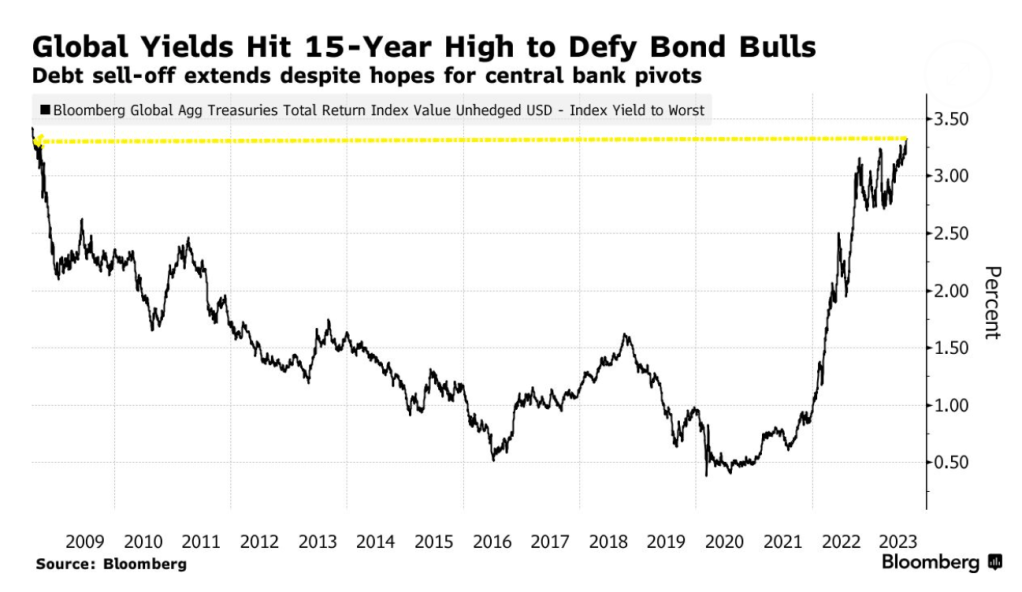
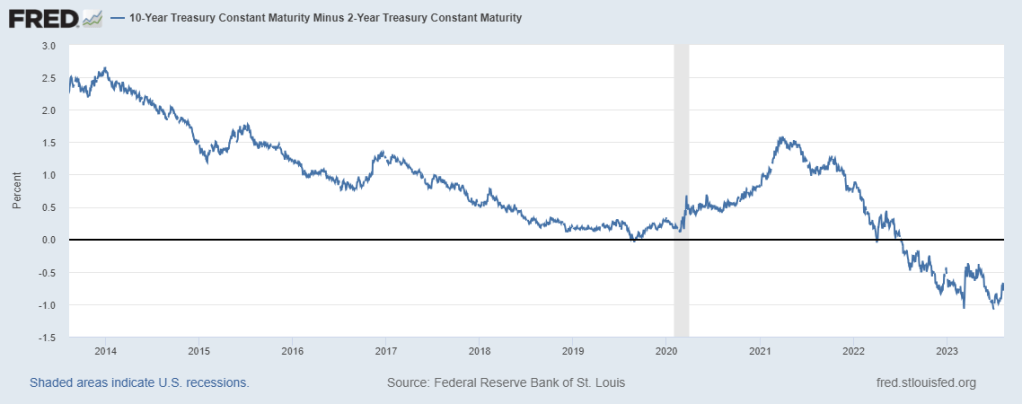
Clear enough?
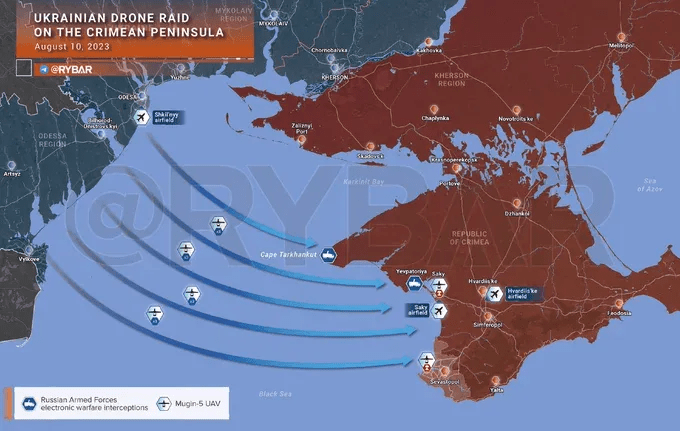
Mark Wauck provides a nice update on the US air assault on Russia. Before turning to that, let’s remember the RMS Lusitania.
RMS Lusitania (named after the Roman province in Western Europe corresponding to modern Portugal) was a British ocean liner that was launched by the Cunard Line in 1906 and held the Blue Riband appellation for the fastest Atlantic crossing in 1908. It was briefly the world’s largest passenger ship until the completion of the Mauretania three months later. She was sunk on her 202nd trans-Atlantic crossing, on 7 May 1915, by a German U-boat 11 miles (18 km) off the western coast of Ireland, killing 1,198 passengers and crew.[2]
The sinking occurred about two years before the United States declaration of war on Germany. Although the Lusitania‘s sinking was a major factor in building American support for a war, war was eventually declared only after the Imperial German Government resumed the use of unrestricted submarine warfare against American shipping in an attempt to break the Transatlantic supply chain from the US to Britain, as well as after the Zimmermann Telegram.
On the afternoon of 7 May, a German U-boat torpedoed Lusitania 11 miles (18 km) off the southern coast of Ireland inside the declared war zone. A second internal explosion caused her to sink in 18 minutes, killing 1,198 passengers and crew. The German government justified treating Lusitania as a naval vessel because she was carrying 173 tons of war munitions and ammunition, making her a legitimate military target, and they argued that British merchant ships had violated the cruiser rules from the very beginning of the war. The internationally recognised cruiser rules were obsolete by 1915; it had become more dangerous for submarines to surface and give warning with the introduction of Q-ships in 1915 by the Royal Navy, which were armed with concealed deck guns.
The Germans argued that Lusitania was regularly transporting “war munitions”; she operated under the control of the Admiralty; she could be converted into an armed auxiliary cruiser to join the war; her identity had been disguised; and she flew no flags. They claimed that she was a non-neutral vessel in a declared war zone, with orders to evade capture and ram challenging submarines.
Something to think about.
Like when US MQ-9A Reaper drones operating over the Black Sea start getting taken out.
Here’s Mark’s update for August 10 2023: https://meaninginhistory.substack.com/p/ukraine-update-81023
Before we get to developments on the ground, so to speak, here’s a brief account of the air assault on Crimea by the United States. The Russian account makes a major point of emphasizing how this assault on Russian territory was extensively directed by the US. A time will come when the US will want to come to sort of understanding with Russia, and this won’t help:
Ukrainian drone raid on Crimea Early in the morning, after a comprehensive reconnaissance by the US Air Force and NATO Air Force, Ukrainian formations again attacked the Crimean peninsula with Mugin-5 PRO drones launched from the Odessa region. As a result of the joint work of units of the 31st air defense division and the electronic warfare calculations of the Russian Armed Forces Armed Forces, 12 targets were shot down: ten were suppressed by electronic warfare at Cape Tarkhankut and Evpatoria, one was shot down by the Tor air defense system over Khersones, and the other on the way to the Novofedorovsky airfield over Sakami by the Pantsir air defense missile system. Unlike previous attacks, the AFU slightly changed tactics: this time the UAVs were launched in small groups from several points, starting from the Shkolny airfield and ending with the jump base in Vilkovo.
The attack was again preceded by active reconnaissance in the Black Sea area. In the southwest and south of Crimea, the French Atlantique 2 base patrol aircraft, as well as three US Air Force MQ-9A Reaper drones, operated. Despite the repulsed raid, the attacks are highly likely to continue. According to some reports, a large batch of drones has been delivered to the Odessa region, which they plan to use in combination with unmanned boats.
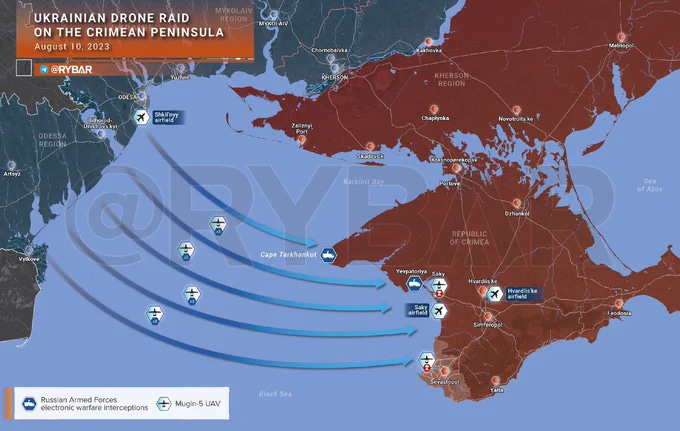
Turning to the ground war, briefly, what we’ve been seeing for a week or more is that the Russian forces continue to conduct an “active defense” in the Zaporozhye and Bakhmut regions:
The Department of Defense defines active defense as: “The employment of limited offensive action and counterattacks to deny a contested area or position to the enemy.”
The goal, as usual, is to inflict heavy casualties on the Ukrainians. That strategy is now being widely acknowledged in the collective West to be highly successful. A report on CNN, to offer just one example, referred to “staggering losses” for the Ukrainians.
Global Thinker
@talkrealopinion
The Washington Post and CNN are now repeating Russian talking point that Ukraine isn’t winning.
Hopefully the FBI conducts serious investigation to find out how this Russian propaganda made it to US media.
9:53 AM · Aug 10, 2023
However, at the same time, the Russian side has taken advantage of the continued Ukrainian attempts to launch an offensive. Russian forces are advancing in the Kharkov oblast toward the town of Kupyansk, which has strategic value for further advances. What follows are some updates on that activity.
This first account is based on Ukrainian sources. Other reports indicate that the Ukrainians are planning on withdrawing from the entire area east of the Oskol river:
The Russians have created a fist for a breakthrough in the Kupyansk direction, – Syrsky, commander of the Ground Forces of the Armed Forces of Ukraine, reports. “The goal of the enemy is to break through the defenses of our troops and go to Kupyansk. The fighting is now very intense. Separate positions changed hands several times these days,” he said.
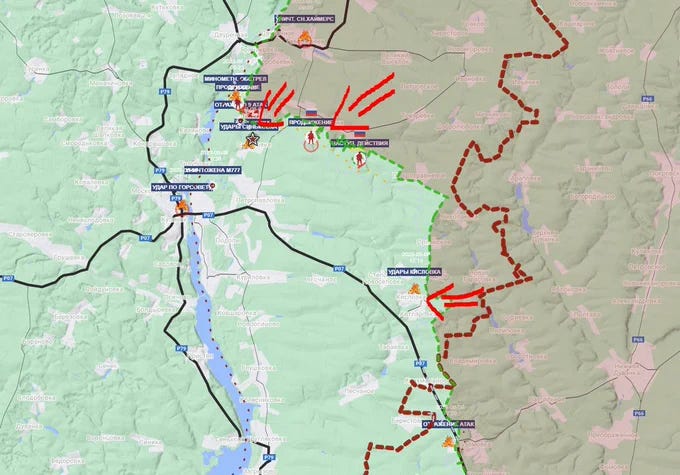
The Ukrainians have announced evacuations from numerous villages to the west of Kupyansk, as shown on this map:
A Map showing the Settlements in the Kupiansk District of the Kharkiv Region which have been placed under a Mandatory Evacuation Order by the Ukrainian Government.
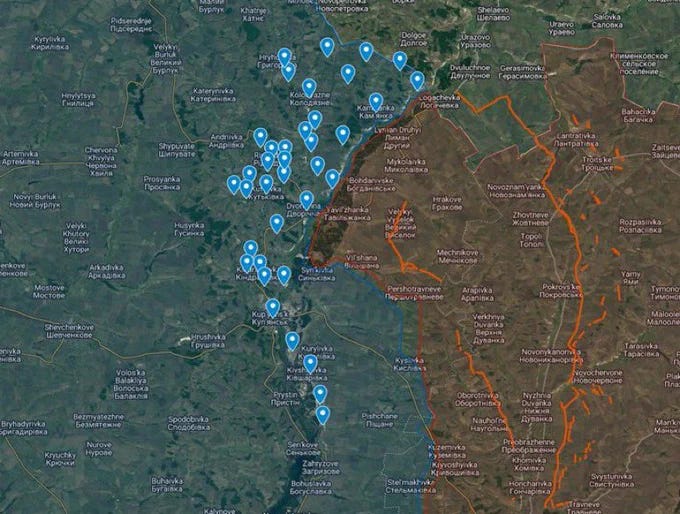
Russian forces continue pushing forward. Russian reports state that the momentum is increasing and that Ukrainian morale is low, with increasing surrenders. Ukraine is being forced to shift reserves to the area:
The Russian offensive in the north in the Kharkov region is gaining momentum. The Ukrainian general Syrskyj speaks of a huge group of Russians breaking through the front here.
Slightly southwesterly, the Russian units are already close to Kislovka, a center of concentration of Ukrainian armed forces. Ten Ukrainian bases were captured here yesterday.
As of yesterday, the Ukrainians stopped trying to attack the Russian bridgehead on the Zherebets River. Another Russian offensive is to be expected in the near future. The whole front section from Kupyansk to Svato is in motion, the Russians are increasing the pressure, the Ukrainians are giving way. The Russian artillery and air force are very active in the whole area up to the river Oskol. The Ukrainians are slowly withdrawing, still holding the front, although there have already been cases of panicked desertion. Thus, the units of the 101st Territorial Defense fled from the front.
Finally …
We appear to have documentary confirmation that the US did, in fact, pressure Pakistan to remove its elected president, Imran Khan, for the sin of trying to maintain neutrality in the US war on Russia. Pakistani officials in DC were told that if the vote of no confidence against Khan were successful (wink, wink), “all would be forgiven.” The US and EU would once again smile on Pakistan. Because, democracy!
After a year of denials, evidence finally emerges showing US officials *did* in fact pressure Pakistan to oust Imran Khan because he met with Putin the day of the Ukraine invasion. This was done at the express direction of the White House, the cable claims https://theintercept.com/2023/08/09/imran-khan-pakistan-cypher-ukraine-russia/…
Here are some key excerpts from the leaked Pakistani “cypher”:
I asked Don if the reason for a strong U.S. reaction was Pakistan’s abstention in the voting in the UNGA. He categorically replied in the negative and said that it was due to the Prime Minister’s visit to Moscow. He said that “I think if the no-confidence vote against the Prime Minister succeeds, all will be forgiven in Washington because the Russia visit is being looked at as a decision by the Prime Minister. Otherwise, I think it will be tough going ahead.” He paused and then said “I cannot tell how this will be seen by Europe but I suspect their reaction will be similar.” He then said that “honestly I think isolation of the Prime Minister will become very strong from Europe and the United States.
This revelation will undoubtedly be intensely embarrassing for Pakistan, since it tends to portray this nuclear armed nation as a puppet of the US.

SIMPLICIUS THE THINKER: https://simplicius76.substack.com/p/sitrep-8523-projecting-the-intermediate

AUG 5, 2023
There aren’t a whole lot of significant battlefield updates just yet, so I wanted to take this time to project what the medium-term future will look like based on Ukraine and the West’s signaled plans for the next 6 months and more.
But first, let’s summarize roughly where things stand, particularly vis a vis the grand summer ‘offensive’ so that we’re all on the same page as to where the conflict currently stands narratively.
Early this year, Ukraine began to outfit two separate ‘army corps’ of maneuver brigades specifically for the coming ‘counter-offensive’. These were the 9th Corps and the 10th Corps. The 9th Corps was meant to be the—mostly—NATO-armed and trained one which was famously revealed in the Pentagon leaks. It consisted of the 9 named maneuver brigades, which were the 116th, 47th, 33rd, 21st, 32nd, 37th, 118th, 117th, and the 82nd air assault.
Out of these, the 47th was said to be the most elite, cobbled from all ‘volunteers’ who signed up specifically from other units and were trained in the UK and were armed with 99 x M2A2 Bradleys as well as American M109 Paladins for artillery.
The role of the two army corps was that the 9th was meant to be the breakthrough brigade which reached the first ‘main line of defense’, the notorious ones with dragon teeth that Russia spent months constructing. Upon reaching this line, the 10th Corps was meant to be the ‘breakthrough’ force which then took over for the 9th, pouring in another fresh 9-12 brigades through the gap to create an unstoppable opening.
💥💬💥Yaakov Kedmi on why Western instructors have taught the Ukrainian armed forces nothing:
“Neither the British nor the French, no one has ever trained and tried to break through echeloned defence systems. They don’t know how to do it, they’ve never done it. So it is unlikely that they can teach it. Yes, there are certain units in the American army – armoured units. But much more organised, with professional soldiers.
The American armoured division practised how to break through an echeloned defence line. But they’ve never done that in any war, not even in World War II. They fight differently. So there’s nothing to teach them.
To break through Russia’s echeloned defence, you have to throw at least one division into the breach and after a while replace it with another. Because it will be all destroyed in the first stages of the breakthrough, having advanced in just one or two lines. Further on it needs more and more! They can’t do it. Firstly, they don’t have that much force. Secondly, any attempt to concentrate large formations before attacking makes them an excellent target for artillery and air attacks.
Western armies are not ready for the kind of war, the kind of military actions that are being waged in Ukraine today and will be waged tomorrow. They are not ready for modern serious military operations by large army formations against the Russian army.”
The 9th experienced catastrophic losses from the start of the offensive on June 4th onward, as we all know. There are rumors that entire brigades were wiped out—for instance, this odd headline about the 32nd (one of the 9 from 9th Corps) which apparently was ‘mysteriously’ shipped out to a dead frontline:
Or this one, which details how several of the 9th Corps brigades seemed to be completely missing in action:

What was interesting is that, as per the 32nd brigade above, yesterday some new documents were leaked online which appeared to show that the 32nd was remanded due to mass desertion/mutiny and refusal to follow orders:
Furthermore, there were reports online from alleged loved ones and relations of the soldiers from the 32nd that an entire battalion was completely ‘destroyed’:
According to captured documents and confirmed by social media messages from distraught loved ones, an entire battalion of the 32nd Separate Rifle Brigade of the Ukrainian Army has been wiped out. 🪦🇺🇦
So the 9th Corps was not able to reach Russia’s first line of defense and the brigades had appeared to be too degraded to go on any further, many of them withdrawn to refit/reconstitute in the rear. The 10th Corps was then injected prematurely to take over, which is what this new ‘second phase’ has been all about since the end of July.
Keep in mind, no one actually knows for certain regarding the 10th Corps, but the above has been the main narrative not only of NYTimes reporters who first broke the story but Rob Lee and Kofman who’ve now certified this narrative of the 10th Corps’ take over.
Some context: Ukraine had, according to the Pentagon leaks, about 34 maneuver brigades, with another 27 TDF (Territorial Defense Forces) brigades likely capable of mostly holding trenches and without much heavy weaponry or armor, and 9 artillery brigades total left in the war. This is 61 total infantry/armor brigades which are meant to hold a frontline 1,300km long. This averages to 1300/61 = 21km per brigade. Note that in Soviet doctrine a brigade should hold something like no more than 2-3km at most and an entire division should hold 10km. Not to mention that Ukrainian brigades are at most 4000 men when they should be 5000, most are 3000 and apparently, even according to MSM articles covering them, some are 2000.
Some will ask, how is it possible that Russia is not overwhelming the AFU with such thin lines and battered brigades. Recall that Russia is only fighting this war with a percentage of its armed forces. The Russian army has classically had anywhere between 50-65% contract with 50-35% conscripts, and as you know, the MOD is not allowing conscripts to fight here. That means Russia is only using about ~60% of its total bayonet strength while Ukraine is using everyone—all Ukrainian troops are conscripts force-mobilized straight from the street.
Not to mention there are still hundreds of thousands (official number 340k) of ‘National Guard’ that Russia is not utilizing while Ukraine uses its full national guard, police force, and everything in between as frontline assault. Russia has typically only used small specialized Rosgvardia ‘special forces’ like FSVNG rather than the regular national guard itself. Thus, Russia is fighting this entire war as an exclusively contracted, professional military force while leaving hundreds of thousands of troops not committed. Ukraine on the other hand is committing everything imaginable.
This segues into the next section. For those who’ve followed my recent reports you’ll note I’ve been keeping track of Russia’s ongoing ‘stealth mobilization’. In June, Putin had the roundtable with reporters where he answered about a potential future mobilization—I’ll repost his response here again:
Vladimir Putin:
Is additional mobilization needed? I don’t follow this closely, but some public figures say that we urgently need to raise another million, two million. It depends on what we want. At the end of the Great Patriotic War, we had almost 5 million in the armed forces.
It depends on the purpose. Our troops were at Kiev. Do we need to go back or not? I am asking a rhetorical question, it is clear that you have no answer to it. I can only answer it myself. But depending on what goals we set for ourselves, we must decide on the issue of mobilization. Well, there is no such need today.
We have started work since January of this year – we have recruited over 150,000 contract servicemen. And together with volunteers – 156 thousand. And our mobilization was 300 thousand. Under these conditions, the Ministry of Defense reports that, of course, there is no need for mobilization today.
Firstly, note that he says at the moment there’s no need for mobilization, leaving the door open for the future. This is because Russia has been conducting the stealth mobilization which, a month later in July, Shoigu said saw 1,336 signups per day in Russia, which is just over 40k a month. Shoigu famously said “This is enough to complete a regiment per day.”
Shoigu had also previously stated:
“In fact, by the end of June, we will complete the formation of a reserve army and in the near future we will complete the formation of an army corps. Five regiments have also been formed by more than 60%. In this case, I am talking about personnel and equipment,” the head of the military department emphasized. .
Such data inspire confidence in the resilience of our defense in the NVO zone, especially against the backdrop of off-scale losses of the Armed Forces of Ukraine. In addition, the following phrase flashed in the minister’s speech: “Preparations are underway for further offensive actions … On our part as well.“
The reason for refreshing your memory with the above, is to contextualize the new update below. Medvedev has now released a new video where he confirms that from January 1 to August 3, Russia has now recruited a total 231,000 contract servicemen. Watch the end of the video:
He further allegedly said that 400k by the end of the year is the goal. Now, keep in mind, Russia potentially lost 30-50k men with Wagner’s departure, not to mention Shoigu’s new reserve army and army corps, which could swallow as much as 120k of those men. In fact, I recall he specifically said last month—though I can’t find the quote at the moment—that out of the 160k+ recruited at the time, 40k would be sent to the front while the remaining would go to these reserve armies. This likely breaks down as ~30k for the new reserve corps of three divisions or so, with another 90k for the new field army of 3 army corps.
So, with the new 231k signups that Medvedev announced, how many men are the actual net positive? 30-50k lost from Wagner’s removal plus 120k for the reserves = 150-180k, subtract from 231k and we’re left with about 50-80k net troops for now. However, if Russia achieves the 400k figure by the end of the year, that will begin to turn into a game-changing amount.
But, here’s the wrinkle. In light of this, Ukraine plans to desperately try to match Russia as reports now claim the following:
In Ukraine, a large-scale mobilization may be announced in winter.
The “big mobilization” in Ukraine, which was announced by the deputy of the Rada Dubinsky, is, apparently, general raids on everyone who can still hold weapons, and no longer with campaigns in certain cities and districts, but on a large scale, everywhere and constantly.
Supplies of equipment from the West do not allow maintaining the required level of armament of existing units. If the number of these units increases, it will most likely mean the appearance of several dozen more TrO brigades, where for 3-4 thousand people in a brigade there will be a maximum of a tank company, a howitzer battery and a mortar division. Such brigades will not be capable of anything other than “meat assaults” or sitting in a blind defense.
A certain number of units with more or less normal equipment, of course, will remain — and will probably work as fire brigades.
The other side of the issue is the command of such units. You can recruit tens of thousands of conscripts aged 40-55. It is more difficult to understand who will control these troops on the battlefield. The shortage of junior and senior command staff began long before the start of the AFU offensive, and this problem has not yet been solved. (Older than the Edda)
This is supported by recent statements like from this Ukrainian veteran, who says that the entire male population of Ukraine should prepare for eventual mobilization. He foresees that 90% of males will eventually fight (and likely die, we can infer):
Recall that time is running out for the AFU this year. Many experts believe August and September to be the last real viable months before the second mini-Rasputitsa comes, with similar rain and mud conditions as in early spring. Zelensky fears losing the last vestige of support from the West and in fact, there are some rumors that certain key countries—namely Germany—have already curtailed their support in anticipation of a foregone conclusion. For instance, despite being the 2nd biggest overall supplier to Kiev, Germany has delayed certain critical shipments, like the new Leopard 1s, as well as many other promised items:
🚨Germany continues to delay promised weapons to Ukraine in the amount of 2.4 billion euros. So far, Kyiv has received practically none.
The list of planned deliveries includes 110 Leopard-1 tanks, 20 Marder infantry fighting vehicles, 18 Gepard tanks, 4 Iris-T anti-aircraft guns and 26,350 artillery ammunition.
Reconnaissance drones, radars, tankers and trucks were also promised.
But so far, neither Marder, nor Iris-T, nor trucks have been delivered to Ukraine. Kyiv received only 10 Leopard-1s, one air surveillance radar, 12 Gepards and 850 artillery rounds, as well as 8 ambulances.
Also Germany supplied 11,000 rations, three unmanned drone sensors and five metal bridges for the Beaver bridge-laying armored vehicle.

So now, Zelensky is escalating in order to draw Russia into over-reacting, which would re-engage NATO’s flagging interest. Not only has Kiev stepped up outright acts of terror, like hitting Moscow office buildings with drones:

And yesterday’s hit on a Russian civilian oil tanker by a Ukrainian naval drone.
But now, there are rumors Zelensky intends to escalate his terror war to new heights. It’s believed the Moscow drone strikes were just probing attacks to test Russian defenses, and that a large-scale raid is being planned within weeks:
⚡️Kiev is preparing a massive drone raid on Moscow⚡️
⚡️⚡️⚡️The Wall Street Journal warns of a large-scale attack by Ukrainian UAVs on the Russian capital.
The authors report that thanks to the latest attacks on Moscow, the APU probed the weaknesses of the capital’s air defense in order to send dozens of drones there in the future.⚡️⚡️⚡️
The publication is confident that the city will be attacked in several directions at once. The red date of possible sabotage is considered to be August 24 (the imaginary Independence Day of Ukraine), which is confirmed by the threatening cartoon that recently spread across social networks.⚡️⚡️😡
The goal of this would be obvious: to force Russia into somehow over-reacting with an uncharacteristically rash use of force which could highlight Russia’s “brutality” and wring sympathy and further support for Ukraine from Western nations. For instance, one of the goals would be to get Russia to respond in a ‘tit-for-tat’ attack on civilian buildings in Kiev which would be hyper-focused by Western MSM while completely sweeping under the rug Kiev’s own attacks on Russian civilian targets. This would then be used in a new PR campaign to drum up more weapons aid from the West, with Zelensky using it as an example of why Kiev needs tons of new Patriot missiles and things of that nature.
Obviously, this is pure desperation. It’s the reason that I hardly even cover the drone attacks on the ships, skyscrapers, etc.—because they are utterly irrelevant and barely worth mentioning, having no appreciable effect on the battlefield dynamics/developments whatsoever. They are merely signs of utmost desperation, the frenzied clawing of a dying animal as it foams at the mouth after having been run over.
There’s also a second dimension to it. It represents the unruly actions of a disobedient child thrashing out against their parents. Ukraine wants the grain deal back on as it’s losing huge amounts of money from the deal’s termination. Thus, by escalating past the West’s own delimited ‘red lines’—for instance, about striking Russian territory, etc.—Ukraine is ‘rebelling’ against their own masters in order to force them into action, ideally to coerce them into putting more pressure on Russia to get back to the table regarding the grain deal.
To summarize, here’s what the advisor to the former president of Ukraine had to say about Zelensky’s outlook:
💥💥💥Ukrainian President Volodymyr Zelenskyy faces civil war if he continues to illegally hold power in the country. A former adviser to Leonid Kuchma, Oleh Soskin, said this on YouTube.
“If martial law is not cancelled and elections are held, this power will be considered illegitimate. And since illegitimate, it is outlawed, and any Ukrainian within the framework of the fifth article of the constitution can destroy the rebels,” he said.
Earlier, Soskin said that the decision announced on 26 July to extend martial law shows Zelenskyy’s fear of losing the election.
The expert also noted that the failed policy of the Ukrainian president was the reason why many spheres of the state, including the economic and military ones, were almost completely destroyed.
“The Kiev regime has no popular support. As soon as the external supports fall away, everything will collapse at once,” the politician said.
In short, Ukraine faces flagging support from the West and is forced to resort to increasingly escalatory ‘gimmicks’ like mass terror drone attacks on Moscow in the same vein as the terminal phase of the Wehrmacht in WW2 vindictively launching V1/V2 rockets at London. This is nothing more than a dying animal, thrashing out its last gasps.
Meanwhile, Russia is on track for 400k new servicemen by the end of this year, with production of all kinds continually ramping up. By next spring, I believe what we’ll see is the slow envelopment of the AFU from every direction. It likely won’t be a massive big arrow campaign but a continual collapse on every single front where the AFU has completely exhausted all combat potential, particularly of the offensive variety, and is desperately trying to hold ground. The dam will slowly break in multiple directions and their positions will be overrun everywhere. Next year will likely look like early 1945 Germany.
Keep in mind, I’ve been on record before stating this conflict could likely go for 3-5 or even 10 years. But we’ve gotten a lot more new data over the last few months, and intelligent analysis requires constant honest re-appraisal in the face of new information. As it stands right now, barring some unforeseen circumstances, I see it happening as described above. The war could still last another year or two past that, but only with a dogged defense and constant retreating on the AFU’s behalf, for instance west of the Dnieper, which would cause Russia to have to take a long hiatus in re-orienting its troops, etc.—but essentially the result will have been decided by that point.
The major, insoluble problem for Kiev is particularly the fact that Russia’s drone production is set for an exponential explosion:
⚡️⚡️⚡️Rising militarist in the use of “Lancets” at the front:
According to Western data, the scale of the use of the “Lancet” stray ammunition is growing. The number of their launches reaches at least 20-25 units per day. For the first time, the use of “Lancets” against trenches, positions and groups of infantry is observed.
At least 50-60 FPV drones and 20-30 lancets are used every day, and dozens of helicopters with 40 or 60 mm bombs drop them into trenches and fixed targets, especially in Donbass and Kherson.
If infantry and sapper posts are also among the targets, then the number of Lancets sent to the front has increased, and the units have been given freedom of action in terms of their use.
If the new Lancet models come forward more actively, in the coming months we can see a rapid increase to 50 and possibly 100 launches per day as there is a dramatic increase in production and its usage could increase several times⚡️⚡️⚡️
Many sources are saying that in the next few months, Ukraine will drown in Lancets. And there are new models coming which have thermobaric warheads for taking out troops rather than HEAT-style anti-armor warheads now most often used. That means Lancets will soon be taking out trenches and troop deployments along the entire front. We’re certainly seeing a flood of daily videos showing almost nothing but successful Lancet hits. The bottleneck will likely soon be—if it isn’t already—the operators themselves.
On top of which, British intel claims a new Geran drone factory is nearing completion in Tatarstan and it will be pumping out massive numbers of drones. Ukraine will be drowning in drone swarm attacks on a daily basis.
According to British intelligence, Russia has finished a Geran 2 drone factory to 80%.
It’s capacity will allow the production of up to 5,000 suicide drones a year.
— Source ResidentUA

Recall earlier reports from Western MSM that Russia is already building and acquiring 45-50k smaller surveillance and FPV drones per month.
This hugely plays into something I’ve written about before, which is that Russia is primarily using its Geran drones to completely deplete the highly expensive Western air defense systems. Recall, I had stated that there is nothing of note to really hit in Kiev. It’s not like Ukraine stages troops there. Russia simply sends swarms of Gerans to make Ukrainian air defense expend itself so that they have to take AD missiles from other frontlines, thus completely depleting the AD where it matters most.
Ukrainians report that drones over Ukraine are once again using “strange” tactics. Ukrainian monitoring channels report oddities in the use of Geranj-2 drones.
Some of them are circling above the alleged duty zones of the air defense system of the Armed Forces of Ukraine, and the other part of the drones is at a considerable distance from the targets and waiting for AD to be activated.
Now, there’s been confirmation of this in the form of a very informative thread from this Western reporter who interviewed a Lt. Colonel in the Ukrainian air defense command. The shocking revelation he made was that the city of Kiev was very close to being entirely evacuated last December, due to the strength of Russia’s missile barrage—that’s all 2+ million people. The exchange is published in this article:
https://www.thetimes.co.uk/article/a601271e-32c8-11ee-b04c-88a034803f06
Ignore the fantasy about shooting down Kinzhal missiles, this is merely a fatuous lie meant to butter up Western officials into handing over more Patriots. The real telling information comes after:
“You can’t plan a war with an annual production of 150-160 Patriot missiles. We fired those in a month,” he said, sounding the alarm that his men were running out of ammunition. “If we wait until autumn, until mid-October, they will hit the energy infrastructure again. This is a certainty. This winter will be even more difficult than the previous one.”
What he correctly reveals is that the U.S.’s annual production capacity for Patriot missiles is a mere 150+. Kiev fires more than that in a single month. The U.S. is estimated to only have probably around 3000-5000 total Patriot missiles, in terms of the ammunition. That may sound high but around 2-3k of them are loaded into U.S.’s own 500-1000 active launchers.
Then came the bombshell:
He disclosed that in December Ukrainian authorities had been on the brink of ordering the complete evacuation of Kyiv due to the intensity of Russian airstrikes. “Not many people know this, but Kyiv was on the verge of evacuation,” he said. “There was one battle that, in my opinion, determined the fate of Kyiv and the Russian campaign to destroy our energy sector, when 49 cruise missiles were launched at Kyiv.”
In a desperate 15 minutes on December 16, Ukraine fired dozens of missiles from its Soviet-era S-300, American Nasams and German Iris-T systems to save the city from total blackout in freezing temperatures.
“If we had allowed this strike to succeed, Kyiv would have had to be evacuated. And it is very difficult to evacuate two and a half million people,” the colonel said.
The point of this is to illustrate that this coming winter will be particularly difficult for Ukraine as Russian missile and drone production has ramped up a lot since last year, not to mention the ensuing next year as well. If they were close to evacuating Kiev last December, what will the situation be this coming December?
This is all part of the slow collapse I outlined—as Russia gets stronger by the month. It will be a completely different ball game by next year and Ukraine will be hanging on by a thread, depleted to the bone not only in armored vehicles and artillery but the crucial AD system missiles.
And as of this writing, a massive new round of strikes is being carried out on Ukrainian targets, particularly the Starokonstantinov airfield in western Ukraine where the Storm Shadow-launching Su-24M planes are said to be housed. This is a particularly large strike with upwards of 15 Tu-95s airborne reported, as well as Kinzhal-carrying Mig-31Ks. In almost every strike now, Russian Kh-101 missiles are reported to take extremely circuitous routes, where they ‘cruise around’ the country, changing directions frequently and completely throwing off Ukrainian monitoring systems and defenses.
Starokonstantinov flew to the military airfield around 19:00. Explosions were heard about 8. Something is on fire.
Meanwhile, retired Ukrainian general Serhiy Krivonos believes Russia is on the verge of a major offensive in the next few months which could “take Kiev”:
“Before Kiev in 12 hours“: the ex-general of the Armed Forces of Ukraine warns of the impending offensive of the Russian army “In the coming months, the Armed Forces of Ukraine are waiting for the “worst scenarios,” said Major General of the Armed Forces of Ukraine, retired Serhiy Krivonos. In his opinion, Kiev clearly underestimates the power of the Russian army, which will lead to terrible consequences, including the lightning capture of the capital. The ex-officer is confident that after the failure of the counteroffensive, the RF Armed Forces will strike at Ukraine and are capable of capturing Kiev in 12 hours. OstashkoNews
I don’t know where he got the 12 hours timeline, but many do believe that Russia is gearing up for its own offensive in the near future. For instance, analyst Yuri Podolyaka again voiced his opinion that Russia will launch an offensive before Rasputitsa. Personally, I don’t necessarily see that happening as, given the above longer term prospects for the AFU, I don’t see a big current urgency for Russia to have to ‘rush’ into a series of offensives this year.
It’s possible but only for opportunistic reasons. When you’re playing ‘active defense’, as Russia likes to employ, you have to always be prepared to exploit an enemy’s weaknesses in a given area. So if Russian commanders smell blood on a particular front, then it’s possible. But as of now, it seems most logical to wait out one more winter to allow the aerospace forces to degrade Ukraine economically, militarily, morale-wise, etc., before attacking a much weaker foe in a much more favorable light next year.
In the interim of this winter, though, I could see a lot of intrigues playing out in the void left by Ukraine’s exhausted combat potential. This will include the Poland-Belarus-Wagner vector.
Armed Forces of Ukraine cannot win, faced with intractable problems at the front near Artyomovsk, — Wall Street Journal
▪️Success in the Ukrainian counter-offensive is in doubt due to the fatigue of the soldiers of the Armed Forces of Ukraine in the Artyomovsk direction and serious losses.
▪️Currently, Russian troops use a lot more drones than before. In addition, the communication system has become more advanced, which prevents the APU from intercepting messages.
💬”There are fierce battles, we need more soldiers and weapons. We are tired,” says the Ukrainian doctor.
Earlier, I had mentioned possible ‘unforeseen circumstances’ potentially occurring. As others have stated, Poland is due for their own elections later this year and any major actions on their part are unlikely before then. In fact, several reports ago if you’ll recall, I said that a ‘big’ sudden action is unlikely at all. I explained that the framework for Polish takeover of west Ukraine would be more in line with a hybrid one, like that of Turkey in Idlib and north Syria, etc.
Putin has confirmed my thoughts in a new statement. Watch the end of the video where he explains how Polish units may be brought into western Ukraine under the guise of some ‘internal forces’ or national guard in relation to ‘ensuring security’:
Like I said in the earlier report, this would be akin to Russia’s own ‘little green men’ takeover of Crimea. And since Belarus has now upped the rhetoric and delivered its own threats to Poland in regard to this, it makes it even more likely that Poland would opt for the more subtle and hybrid-style eventual takeover. But I don’t see this option being activated until further down the line, perhaps next year at the earliest when the Kiev regime finally begins to crack to the point where Poland sees an opportunity to exploit a politically neutered and desperate administration.
Even Medvedev now blithely says that west Ukraine will ‘fall to Poland’ in the future:
Colonel MacGregor even has an interesting theory, which is that Poland may use the guise of creating an ‘enclave’ in Ukraine for the purpose of repatriating the Ukrainian refugees as a way to get in the door and effect exactly this type of ‘stealth’ take over I described above, and which Putin hinted at:
Now, that situation is developing as Polish officials have begun to use Wagner’s deployment on their border as an excuse to condition the public for potential future escalations.
🇵🇱🤡⚔️🏴 PMC “Wagner” has already tried to enter the territory of Poland from Belarus, said Deputy Minister of Internal Affairs of Poland Paweł Jabłoński on CNN.
According to him, “the threat from Belarus is very real” and Warsaw is considering various steps, including the complete closure of the border.
“We are considering any steps that will be necessary to protect our territory, protect our citizens, including the complete isolation of Belarus, the complete closure of the border. We expect new attacks on our border, possibly new attempts to violate our airspace,” stated Jabłoński.
Earlier, the Polish opposition accused the country’s authorities of inflating the threat from the “Wagnerites” for election purposes.
Days ago, a Belarusian helicopter was even claimed by Poland to have crossed the Polish border, sparking another round of alarmism and a new deployment of more Polish troops on the Belarusian border.
Meanwhile, Zelensky continues attempting to hatch desperate plans to drag Poland and thereby NATO into the conflict:
💥🤡💥Ukro media:
“The president’s office considers it possible to drag Warsaw into the war in Ukraine if there is a provocation or strikes by unknown UAVs against the Polish military.”
Looks like “unknown UAVs” are already on the launch pads….
💥🤡💥
The SBU even stated that they believe Russia is in fact using Wagner to secretly spur Belarus into the conflict by using Wagner agents to instigate a falseflag in the country which can be blamed on Ukraine. This could be the SBU’s own telegraphing of a planned provocation where they may attempt to attack Belarus in a bid to get them to enter the war, which itself would be a double bid to get Poland to respond to the ‘threat of Belarus’ and likewise enter the war.
Recall that Lukashenko issued a threat to Poland as their presence on Belarus’s southern border can be considered a national security threat. But likewise, we can infer that Poland could consider Belarus’s presence on its own southeastern border to be a similar threat. Thus, the SBU could perhaps be dreaming of coaxing Belarus into a trap in order to activate Poland, and then NATO.
Not that I believe the above scenario is likely, but just outlining the possibilities, given these new developments and rumors.
And as a last update to add to the growing list of problems, Ukraine’s F-16 wunderwaffe hopes have been dashed as well due to Ukraine’s lack of English-speaking pilots:
Politico writes: The weak level of English among Ukrainian pilots proved to be a stumbling block for the start of their training on F-16 fighters, as a result of which language courses to be held in the UK will begin earlier than the training program. At the moment, only 8 pilots are ready to train for the fighter.

In short, there’s nothing good or optimistic coming up in the slightest for the AFU. The Russian army only continues to grow stronger, larger, more advanced, more experienced while Ukraine grows in the opposite direction, with arms shipments declining and no more ‘wunderwaffe’ on the horizon to save them.
In almost every conceivable direction, Russia is solving problems on a daily basis and improving, increasing its sophistication; just as a quick mention of a few of the key ones:
🇷🇺Tank complex for suppression of FVP drones “Triton” from the PPSh Laboratory
According to the developer, the product is designed to suppress the control channels and data transmission of FPV drones in the 868\915\1300\2400 MHz bands (4 suppression bands)
Management is carried out by means of the portable panel for the maximum safety of the operator. Both autonomous operation from the built-in battery and power supply from the on-board network of the vehicle are possible.
Potentially, with the help of such systems it will be possible to protect armored vehicles from one the most deadly threats on the battlefield.
Not to mention the increasing use of Chinese jammers on Russian tanks for the same purpose:

By the way, the servicemen began to solve the problem with the vulnerability of armor to FPV drones on their own and at the grassroots level.
So, the enemy has already published a photo of one of the Chinese jammers, which some of our tank crews handicraftly install on their equipment.
Such systems allow you to create a dome of interference around the tank, which does not allow FPV drones to freely fly up to it. However, such jammers have holes in the zone of protection and are not fully integrated into the on-board network of the tank, so the army needs a serial industrial design installed on each tank directly from the factory.
Military Informant
This includes a new development for ‘hibernating drones’:

It’s said these FPV drones can be placed in forward positions and ‘hibernated’ for weeks at a time. Then when an enemy offensive begins, they can be raised instantaneously, greatly reducing flight time, to strike right at the area where the enemy armor is passing. This way there is very little forewarning or chance to react.
Kuzyakin explained that the hibernation tool minimizes the time to prepare the device for an attack. “Flying time is saved. A few seconds pass between turning on the drone and attacking, which leaves no chance of launching countermeasure systems. One FPV pilot can place, and then ‘wake up’ and sequentially use up to 15 ‘sleeping drones,’” he said.
The drone or drones are placed on “commanding heights and building rooftops or other high-rise structures as prepositions for drone attacks.” “When the time comes to launch the attack, the drone would not need to traverse the distance to the target, as it would already be positioned. This device enables reducing attack preparation time to the minimal amount possible – just a few seconds pass between drone reactivation and the attack, leaving the adversary no chance to launch anti-drone systems,” the report added.
Not to mention that British intel complains that Russia continues to receive the newest batches of upgraded Ka-52Ms which can now fire the Izdel. 305 LMUR TV-guided missile.

This adds a huge ‘fire and forget’ capability to Russia’s attack choppers.
David Wu, ex-Wall Street and IMF strategist, Ph.D. in economics from Columbia University summarizes the coming situation very aptly:
Now, to move onto a few last disparate items.
One of the other biggest adjacently related developments is the brewing situation in Niger. I’ll summarize the developments quickly for now:
There is a claim that Nigerien ‘junta’ general Mody is requesting the immediate help and deployment of Wagner forces, via Mali backchannels:

Normally, this would perhaps be uncorroborated rumor, however today footage appeared to show a Russian military heavy transport plane landing in the Niger capital of Niamey, with claims that Wagner forces are arriving:

The Nigerian senate has vetoed the deployment of military against Niger, but I’m not sure how much this matters given that ECOWAS countries continue to take an aggressive posture and threaten a military intervention. More and more, the sides are taking shape. Senegal has now voiced full backing for military intervention while Algeria said that this would be a threat to its own national security and implied backing Niger militarily.
“Waving military intervention in Niger is a direct threat to Algeria, and we completely and categorically reject it,” the head of state stressed. “Problems should be solved peacefully,” he continued, speaking about the events taking place in Niger.
“There has been a coup [in Niger]. And we have confirmed that we stand for constitutional legality. And it is necessary to return to this legality. We are ready to help them,” Tebboune added.
Meanwhile, the American permanent representative to the UN has reportedly stated that any Wagner involvement or attack in Niger would be “considered an attack by the Russian Federation.”
Clearly, this situation represents a new potential flashpoint which can erupt at any moment. Here’s a good new Grayzone/Klarenberg article on the corrupt Nigerian president, ECOWAS chairman, and U.S. toady who’s leading the push for military intervention in Niger.
No matter what happens, Africans are waking up and it’s the beginning of the end for Western colonialism and free-rides:
Next:
New techniques for estimating Ukrainian losses continue to be innovated. This one studies the expansion of new Ukrainian cemeteries from space:


There’s no telling how accurate it is so take it with a big grain of salt, but it’s an interesting addition to the mental calculus. Certainly, even the top pro-Ukrainian accounts have recently lamented the unprecedented losses, which have been so large over the past few months even they’re unable to sweep them under the rug with the usual techniques:
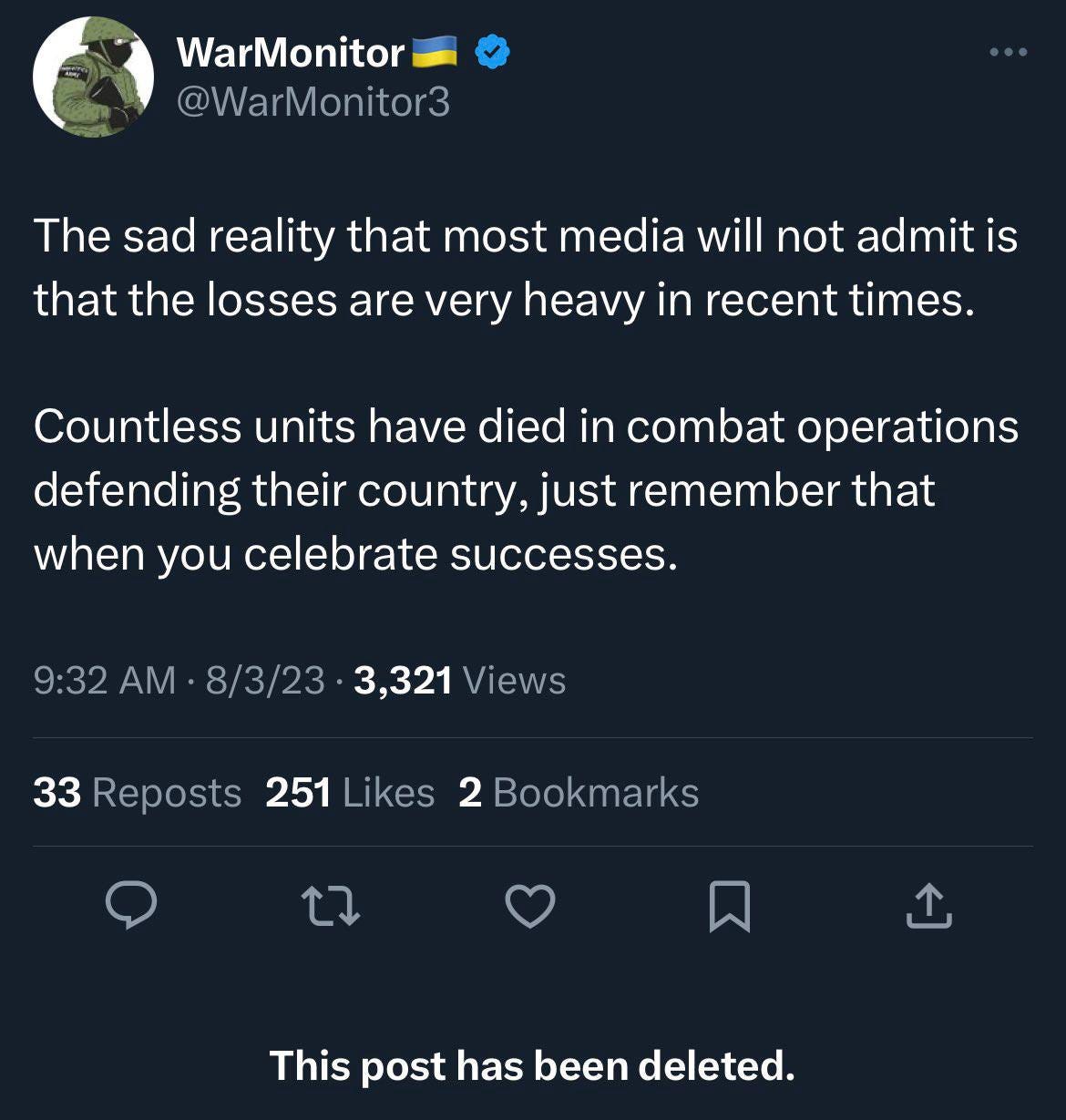
The other big news which really puts a stamp on all my outlooks for the future is that the new Worldbank estimates have come in, and Russia has now officially once again moved into #5th place in the world’s top economies per GDP PPP, supplanting Germany for the spot:

You can get the official figures here: https://data.worldbank.org/indicator/NY.GDP.MKTP.PP.CD
The most startling thing is that Russia is only a hair behind Japan. Recall my article on this topic, where I outlined how Russia is the most sanctioned country on the planet and yet still manages to be close to edging out even Japan for the #4 spot. This latest news confirms my findings. I invite all to revisit this article:
·
APR 2
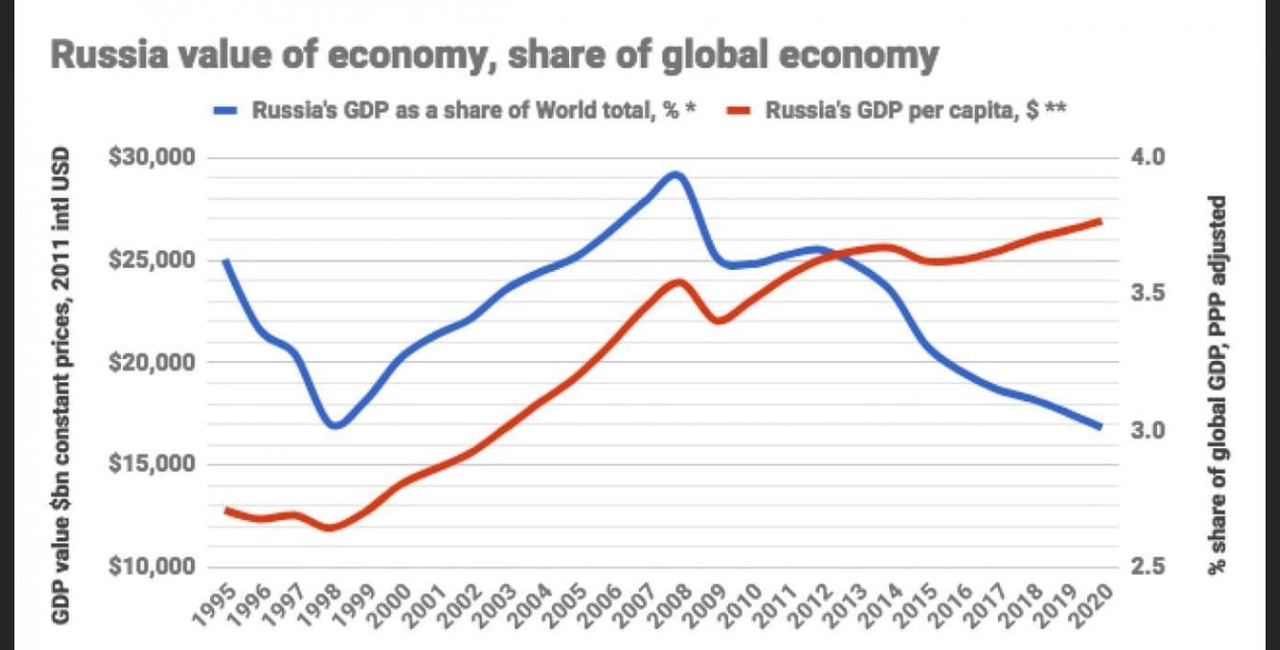
Imagine if the West played fair and Russia was not under the largest economic terrorism attack of any other country in the world? I said it in the article above and I’ll say it again, if that were the case, Russia would likely be the #3 economy on earth after China/U.S., and it will return to that position in the future. It will likely surpass Japan in the next 3-5 years on that list. The end of this war will shatter a lot of illusions and the West will come to respect and be in awe of the military and economic powerhouse that is Russia.
Next:
A Ukrainian post that highlights some of the major ongoing refusals in the military and how drastic it’s gotten:
❗️UKRAINIAN POST❗️
‼️ ABOUT THE COUNTER-OFFENSIVE ‼️
I wondered for a long time why our offensive was not getting anywhere. The main reason, of course, is that our leadership, who knows why, trumpeted about it in all directions. Strange, huh?! No wonder we received such a warm welcome.
But that is not the only problem. The trouble is that our defenders, and I’m not talking specifically about the 93rd separate motorized brigade, would much rather be chilling at home during the offensive.
Let me explain! 👇🏻
Ever since the ATO [Anti-Terrorist Operation] and JFO [Joint Forces Operation] kickbacks to commanders for not going into battle and staying home have become standard practice. The same story continues today, only in a more sophisticated form.
Today, for a tank to be disabled by the crew itself, you need to pay the commander $1,500 and he will turn a blind eye, and the combat vehicle, together with the crew, will go to the rear for repairs. How do you like that?!
I am not saying this out of nowhere. My friend at a repair base near Bakhmut told me that in just a few days of July, four tanks and six armored personnel carriers arrived for repairs. After analyzing the breakdowns, the lads found out that two tanks and one of the armored vehicles were put out of action on purpose. That is, the breakdown was intentional and it was obvious that the crew was responsible for it.
It all makes sense! The guys are simply afraid for their lives, especially when the command sends them into battle in under-equipped vehicles.
This is the next point of our “successful” counteroffensive.👇🏻
The truth is that incompetence, corruption and simply disregard for people lead to a considerable number of non-combat losses.
From the same source, I learned that at least 3 tanks burned out from the inside due to the fact that the fire extinguishing system lacked a special reagent, which we happen to have plenty of in our warehouses.
I honestly don’t know which of the above was the decisive factor, but I do know that we won’t win the war this way.
One more thing! 👇🏻
To all of the above, add more kickbacks for “bonuses” and “sick leaves”. It’s no surprise that such a large number of AWOL soldiers is due to these same schemes. The guys give half of their money allowance to the commanders, and get to sit it out at home. My hypothesis is confirmed by the fact that a very large percentage of AWOL reports are not sent by commanders to the DBR [State Bureau of Investigation] and other bodies. No wonder a whole AWOL commission paid a visit to our 93rd brigade.
UPD: While these fighters, experienced in terms of “dodging”, are sitting at home, the command is recruiting raw and inexperienced lads and sending them into battle. But I am sure that the 30 percent of them that remain after the first battle also become EXPERIENCED (. That’s some vicious circle.
@HolodniyYar
Next:
Both General Teplinsky and Seliverstov of the VDV have now appeared in new videos honoring the paratroopers during Paratroopers Day, which celebrates the August 2, 1930 founding of the Russian Airborne.
Here is Seliverstov:
And Teplinsky:
Recall that these are the two Generals said to have been “purged by Putin” by a bunch of cranks and amateurish 2D blogger-grifters to push some laughable narrative. Now, like every other ‘purged’ figure, they are seen still at their duty and commanding their forces. Consider that narrative fully debunked and dispelled.
And speaking of people said to have been purged, Shoigu has now visited the ‘Center Group’ frontline to meet with General Mordvichev—incidentally, also said to have been ‘killed’ and now miraculously resurrected. Shoigu not only awarded troops with special custom pistols (MP-443 Grach 9x19MM according to one source) but also inspected the captured Swedish CV-90 IFV and its uniquely huge 40mm Bofors rounds:
In the 2nd video above, he quips whether they caught any Leopards then says to the effect of, “Well the other guys are destroying so many of them you may not see any here.”
Meanwhile, the U.S.’s own recruitment is going so poorly that Military.com has urgently called for a new limited draft in order to replenish the armed forces:

Most amusing of all is, after making fun of Russia’s ‘dual’ conscript/contract system for so long, now they’re proposing it for the U.S.
But after two decades of war — both of which ended unsuccessfully — and low unemployment, many experts believe the all-volunteer force has reached a breaking point. And American confidence in its military is at a low.
The fastest and most effective way to resolve this recruiting crisis is to change how we recruit.
Instead of an “either an all-volunteer force or a fully conscripted force” model, I propose a both-and solution.
We should have our military recruiters sign up new troops for 11 months out of the year, and then have the Selective Service draft the delta between the military’s needs and the total number recruited.
Meanwhile, here’s what the latest class of U.S. Marine Corps recruits looks like:

Cue the laughter.
Russia is supposed to be afraid of that? Have you seen what Russian troops look like in the war?
Next:
As many have likely heard by now, it appears that Gonzalo Lira never made it across the Hungarian border, and was in fact stopped by Ukrainian services and has now ‘disappeared’, perhaps for good.

For those who continue to complain that Gonzalo messed up by posting videos while on the run—recall that he set the video on a timed delay for release 6 hours after recording it. By the time the video actually hit the web, he was supposed to have been long across the border. He wasn’t posting the video while still in Ukraine.
I’ll leave you with this aerial shot of the Kakhovka dam area to give an idea how the reservoir is looking these days, although keep in mind this is a bit upriver of the ZNPP plant:
And a closeup view of another of many destroyed M2 Bradleys:
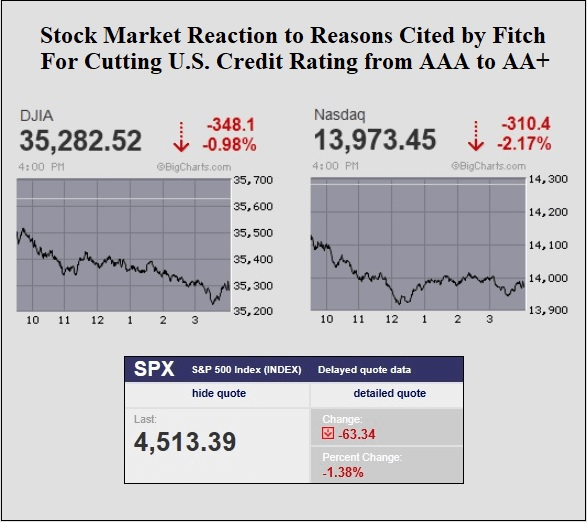
Wall Street on Parade: wallstreetonparade.com/2023/08/the-fitch-downgrade-of-u-s-debt-what-you-need-to-know/
The Fitch Downgrade of U.S. Debt: What You Need to Know
At 5:13 p.m. ET on Tuesday, after the stock market closed, Fitch downgraded the U.S. credit rating from AAA to AA+. Fitch is now the second of the three major credit rating agencies to have taken the historic step of removing the triple-A rating from the U.S. S&P made its first-ever downgrade to the U.S. credit rating on August 5, 2011, also from AAA to AA+, and has kept it there ever since. Moody’s is now the only member of the Big Three credit rating agencies that has maintained a triple-A rating on the U.S.
As the chart above indicates, the stock market responded negatively to this development yesterday, particularly over the fact that it came at a time when the U.S. Treasury is boosting the amount of debt it is issuing.
Yesterday, the U.S. Treasury announced its plans to increase its debt issuance, writing as follows:
“Based on projected intermediate- to long-term borrowing needs, Treasury intends to gradually increase coupon auction sizes beginning with the August to October 2023 quarter. While these changes will make substantial progress towards aligning auction sizes with intermediate- to long-term borrowing needs, further gradual increases will likely be necessary in future quarters….”
In line with that view, the Treasury boosted its auction set for next week from $96 billion to $103 billion, consisting of $42 billion in a 3-year Treasury note; $38 billion in a 10-year Treasury note; and $23 billion in a 30-year Treasury bond.
Yields on both the 10-year note and 30-yield bond saw increases in their yields yesterday, meaning their prices were declining. (Bond prices move inversely to their yields.) The yield on the 10-year was trading in the range of 4.05 percent in the early morning yesterday, then moved up to 4.12 by late afternoon. It has continued to move higher this morning, yielding 4.15 percent at 7 a.m. The yield on the 30-year bond was trading in the range of 4.10 early yesterday morning, then moved sharply up at the day progressed, reaching a yield of 4.20 by 11 a.m. This morning, at 7 a.m., the 30-year is yielding 4.25 percent.
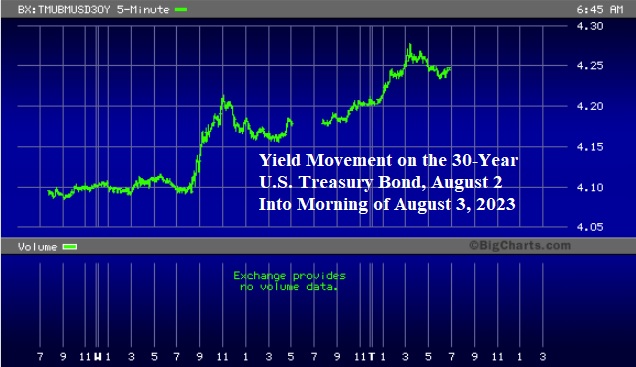
When S&P downgraded the U.S. credit rating in 2011, it cited as one factor the growing U.S. debt as a percent of GDP. It said it anticipated U.S. debt reaching “an estimated 74% of GDP by the end of 2011 to 79% in 2015 and 85% in 2021,” while noting that these ratios were “high in relation to those of peer credits….”
Those ratios look positively Goldilocks compared to today. One of the points made by Fitch in its ratings downgrade on Tuesday was this:
“Lower deficits and high nominal GDP growth reduced the debt-to-GDP ratio over the last two years from the pandemic high of 122.3% in 2020; however, at 112.9% this year it is still well above the pre-pandemic 2019 level of 100.1%. The GG [General Government] debt-to-GDP ratio is projected to rise over the forecast period, reaching 118.4% by 2025. The debt ratio is over two-and-a-half times higher than the ‘AAA’ median of 39.3% of GDP and ‘AA’ median of 44.7% of GDP. Fitch’s longer-term projections forecast additional debt/GDP rises, increasing the vulnerability of the U.S. fiscal position to future economic shocks.”
But what is causing the most discussion behind the scenes, both domestically and abroad, are the concerns Fitch enumerated on the ability of the U.S. to govern itself. Fitch raised the following governance issues:
“In Fitch’s view, there has been a steady deterioration in standards of governance over the last 20 years, including on fiscal and debt matters, notwithstanding the June bipartisan agreement to suspend the debt limit until January 2025. The repeated debt-limit political standoffs and last-minute resolutions have eroded confidence in fiscal management. In addition, the government lacks a medium-term fiscal framework, unlike most peers, and has a complex budgeting process….”
Debt-limit standoffs are, unfortunately, not the only political standoffs. It’s difficult for ratings agencies, or the rest of the world for that matter, to forget that it was just over 2-1/2 years ago that the seat of government, the U.S. Capitol, faced a bloody insurrection — by American citizens. Photographs of that out-of-control scene made the front pages of newspapers around the world, as we chronicled here.
One comment from Fitch on U.S. governance on Tuesday seemed far too generous. It said that according to the World Bank Governance Indicators (WBGI), the “U.S. has a high WBGI ranking at 79, reflecting its well-established rights for participation in the political process, strong institutional capacity, effective rule of law and a low level of corruption.”
A “low level of corruption.” Let that sink in slowly for a few minutes. The immediate past president of the United States, Donald Trump, has now been indicted for the third time. The largest bank in the United States, JPMorgan Chase, (which has already been charged by the Justice Department with five criminal felony counts since 2014 and admitted to all of them), is in the midst of a federal lawsuit in Manhattan where the Attorney General of the U.S. Virgin Islands has produced hundreds of documents, internal emails, and transaction reports showing that the bank actively participated in the child sex trafficking operation of Jeffrey Epstein for more than a decade, with its tentacles reaching men in high places in the U.S. And the investigation of insider trading at the central bank of the United States, the worst scandal in the 110 year history of the Federal Reserve, is being stonewalled by the Fed’s Inspector General. The criminal division of the U.S. Department of Justice has yet to weigh in on either the JPMorgan case or the Fed’s trading scandal, despite both being of critical national importance.
There is a website where one can look at the front pages of newspapers across America on any given day to gauge the concerns of our fellow citizens. Yesterday, we checked small and medium size newspapers across the country to see if any newspaper reported the Fitch downgrade of the U.S. credit rating on its front page. Of the two dozen newspapers we sampled, we couldn’t find any mention of the credit downgrade.
The Star Ledger in Newark, New Jersey found room to mention on its front page that the New York Mets had traded Justin Verlander to the Houston Astros, but not a peep about the U.S. losing another AAA rating from a Big Three credit agency.
The Detroit News didn’t think its front page needed the Fitch news but it did make room to tell its readers that Michael Lorenzen was being traded by the Tigers to the Phillies.
What was making front page news across America yesterday was Trump’s indictment. The Atlanta Journal-Constitution ran a bold font, all-caps headline: “TRUMP FACES FOUR FELONY COUNTS.” Directly below that was a picture of carefree elementary school children heading into school for the first day of classes. (Schools open in August in some parts of the United States.)
PBS summarized the escalating corruption charges around Trump like this: “Special counsel Jack Smith, who indicted Trump in the election case, has also charged Trump in federal court with the illegal retention of top secret documents. In New York, Trump faces criminal charges in a hush money case and a civil trial over his business practices. And in Georgia, a county district attorney is expected to announce charging decisions in August over efforts by Trump and his allies to overturn his 2020 election loss in the state.”
It’s important to remember that Trump came to power because the two major political parties gave U.S. voters the following two choices in 2016: elect Hillary Clinton as President despite the fact that she had outsourced Top Secret documents during her time as Secretary of State, from the safety of government controls to a private server in the basement of her New York home that lacked any government protections. Or, voters could elect Donald Trump, who had taken his businesses into bankruptcy six times and had been charged with serial sexual assaults by women, while admitting on camera to grabbing them in their genital area and getting away with it.
But, hey, it’s good to know that the World Bank thinks the U.S. has “a low level of corruption.”
Trying to Understand the World: https://aurelien2022.substack.com/p/the-end-of-power-projection?nthPub=681
One of the benefits of military experience is your distate for military movies and politicians pitching the latest war.
I didn’t have to watch a John Mearsheimer video to know how the US Proxy War on Russia would play out.
We’re in it for the TV news soundbite and maybe some trashy moves thereafter. The Gulf Wars were ideal.
With Russia, our plan seemed to be we announce sanctions on Monday, oligarchs lose dough on Tuesday, and regime change happens in Moscow on Wednesday. Such was the plan
In contrart, Russia plays the long game. They hate their oligarchs – go ahead, make my day. They’re not in it for the land – they have plenty of that. They’re in it to remove the threat.
Rather than Hollywood shock and awe to effect regime change, the Х-47М2 Кинжал are intended to simply obliterate point targets. On the battlefield, it’s lots of light infantry, heavy artillery, armor when appropriate, drones. and time.
Shock and awe is for TV consumption, and as an air and sea power, something we can do quiite well. We don’t do land war except when overruning Tier 2 players while under the protection air superiority.
And in the current era, we only have enough sea power to protect the homeland.
Nothing wrong with that. Can be cheaper, too if we focus on that. Probably means a safer world too.
**********
JUL 26, 2023
In a lot of history’s conflicts, the combatants come from adjacent countries, or even different parts of the same one, and they fight to settle ownership of territory, borders, access to strategic materials or communications, or even who will control some third political entity. But there is another kind of warfare, which we might call expeditionary warfare or power projection, which aims at preparing forces, projecting them some distance, having them perform a military operation, and extracting and recovering them, hopefully intact or largely so. It is, in fact, this latter model which has been common among western powers since 1945, and the norm for the last thirty years, and much of modern western weaponry, tactics and training have been designed around it. But there are several reasons to think that this type of warfare is rapidly becoming obsolete and impossible, with political ramifications that we have hardly begun to think about. Here’s why.
Fighting requires contact with the enemy, either directly or, more frequently these days, remotely. Historically, armies did not always have to move very far to make contact, and when they did, it was generally on foot. Whilst the fighting could extend over considerable distances (Napoleon’s campaign in Russia, for example) and armies could move back and forth over large areas, fundamentally, each had a national capital and a logistic capacity and lines of communication to fall back on. Even the herculean struggle between Germany and the Soviet Union between 1941 and 1945 was fought continuously from the centre of Poland as far as Moscow, and then back to Berlin.
But there have also been occasions, and even entire campaigns, that have been fought at a distance. Here, some technology is used to move troops and equipment a long way from home, in order to attack forces you were not originally in contact with. Sometimes, entire wars are in effect expeditionary: the Crimean and Boer Wars, for example, or more recently the wars in Korea, Vietnam and Iraq.
Traditional wars of conquest were not generally expeditionary, because the soldiers set out from a secure base, and in most cases just marched or rode in one direction until they met an enemy to fight, or a city to sack, and, if successful, continued on to the next. Alexander the Great’s soldiers simply marched as far as India. The Arab conquests mostly involved light cavalry and infantry sweeping progressively through the Middle East and Africa as far as the Maghreb. Even then, there were exceptions: the disastrous attempted expedition to Sicily by the Athenians in 415-13 BC is one early example of expeditionary warfare. On the other hand, some expeditions were both large-scale and successful: the First Crusade involved the movement of perhaps 100,000 people, including non-combatants, by land and sea across the whole width of Europe, followed by battles which (temporarily) expelled the Arab invaders from the Holy Land.
These last two examples demonstrate the most fundamental requirement for expeditionary warfare: technologies for transporting combatants to where you want them, and then sustaining them while they are there. The earliest and most obvious technology is, of course, the horse, which enabled longer-distance expeditions to be mounted from early on, though not usually at large scale. But the most important early technology for power projection, especially to meet threats on the borders, was actually the humble paved road. Both the Achaemenid (Persian) and the Roman Empires emphasised the building of good roads, which enabled them quickly to move forces to where they were needed, and return them quickly when the fighting was over. Even today, as we have seen in Ukraine, control of metalled roads is critical for forces to be moved around quickly. Subsequently, railway systems were constructed to facilitate not only deployment of troops around the country itself but, as with Prussia, quickly positioning them for offensive strikes into enemy countries. (Even today, the vast majority of military transport on land is by rail.)
But true expeditionary warfare, from the Athenians onwards, requires the ability to cross long distances, through areas which you do not necessarily control in peacetime. The classic method of doing this has always been by ship. This could be done on a massive scale: some 350,000 British troops served in the Boer War, virtually all transported by ships, that also kept them supplied with logistics. In the Second World War, millions of troops were deployed around the world that way. As late as the Gulf Wars, whilst personnel often deployed by air, anything heavy had to go by ship as well. In such a situation, control of the medium you are passing through is obviously essential. The attempted Spanish invasion of England in 1588, for example, was unsuccessful, because the Armada, sent from Spain could not defeat the English fleet, control the Channel and so permit the transport of Spanish troops from the Low Countries. The Germans faced the same problem in 1940 with the added complication of the need to have air superiority.
One reason why the Persians and the Romans built good roads was to improve communications. Your ability to react to threats on the frontier, or take advantage of opportunities, largely depended on the speed with which information could be passed to the capital. Likewise, it was important to know what your forces were doing, and what success they were having, in case it was necessary to send reinforcements to rescue the situation or take advantage of an opportunity. By contrast, expeditionary forces sent by sea were effectively out of contact with their national capitals for weeks or months, so Nelson, for example, would have departed with only very general instructions.The position was revolutionised with the laying of submarine cables from the 1850s, and British expeditionary operations became much easier with the completion of the network linking all its major colonies before the First World War. These days, commanders and political leaders can micro-manage individual operations from the comfort of their offices: you may recall the photographs of Hilary Clinton watching live the killing of Osama Bin Laden, a rictus of glee and excitement on her face.
And finally, of course, the force you send has to be capable of doing its job, and armed with suitable weapons to defeat the enemy. With the galloping increase in the importance of military technology over the last 150 years, this element has become critical: in the two Gulf Wars, massive and complex heavy armoured forces had to be transported across long distances, and aircraft and their logistics moved to forward air bases.
In theory, western armies after 1945 were equipped and trained for an anticipated titanic armoured clash with the Warsaw Pact in central Europe. Although there would have been flanking operations by both sides, the assumption was that the main event would be an apocalyptic armoured confrontation between forces which had been in position for decades, and which had substantial and reliable logistic backup. The reality was somewhat different. Where western militaries were actually engaged in active operations, it tended to be at a distance: everything from colonial wars to UN operations to counter-insurgency, to expeditionary wars such as Vietnam. Mass armoured warfare was theoretically taught in most countries, but it was not practiced: now, it is not even taught because the West has no large armoured formations above Brigade level to deploy. And since the end of the Cold War, the West (and its entire modern generation of military leaders) have grown up with the experience, and the permanent assumption, of a permissive environment into which to operate, adequate communications and logistics, and overwhelming superiority in combat power.
It is true that reality has not always matched this rosy picture. Both Gulf Wars revealed logistic problems, and the second showed that the reliance on civilian contractors, increasing all the time, could be dangerous unless complete security could be assured. Afghanistan was also tricky in places: there was no sea-coast, and the main airport in Kabul could not take large aircraft. The Coca Cola for US troops came by lorry across the frontiers from Pakistan, and ironically the drivers often had to pay the Taliban for permission to pass through check-points. Not all weapons performed as advertised, and in many cases highly-sophisticated and expensive weapons were used in place of simpler and cheaper ones, because it was all that was available.
Nonetheless, after the Libyan adventure of 2011, western leaders came to take for granted the ability to intervene effectively anywhere in the world, without casualties or repercussions, against ascriptive enemies who in practice could not resist seriously. The Russian involvement in Syria after 2015 did, in fact, bring a little more realism to this attitude, but in general western technology and western militaries were simply assumed to be superior to anything that might be encountered anywhere in the world. Two things happened (or to be more precise became known) in recent years, that put this cosy judgement in question.
First, projecting power requires platforms, in the sense that defending against projected power doesn’t, necessarily. This may sound obvious, but in fact a lot of western writing has confused the picture by assuming that western weapons (combat aircraft, aircraft carriers) would be engaged in a series of duels with the equivalent equipment of the other side, and the western equipment would win. But of course attack and defence don’t necessarily work like that. More normally, two sides use asymmetric tactics, because they have different objectives. In Kosovo in 1999 for example, the West’s objective was to force Serbia to hand over control of Kosovo, and thus bring down the current Serbian government. They tried to do that through air and missile bombardment, because a land campaign would have been too difficult and costly. But the Serbs, as well as using air defence missiles, put into action plans honed over forty years to hide and protect their equipment and command and control: most of the targets struck by western aircraft and missiles were dummies, and it was only Russian political pressure on Serbia that eventually saved NATO.
But the projecting power (the aggressor if you will) always needs platforms to launch weapons. Now a platform can be many things, from a soldier on horseback to an aircraft carrier, but usually a platform is employed to put some distance been the aggressor and possible retaliation. The defender, on the other hand, has simply to survive the weapons and, if possible destroy the platforms. In addition, because the attacker is often less motivated than the defender, it is not necessary to defeat all the platforms: just enough damage needs to be done, or threatened, to make aggression unattractive and for the aggressor to return home. The current classic example of this is North Korea. When did you last hear even the most hawkish neoconservative talk about attacking North Korea? Probably never, because, whilst the country’s conventional forces are largely obsolescent, they do include thousands of well-protected long-range artillery pieces and rockets, most of which would survive an attack by the West, and could be then used to wipe out the major cities of Korea and Japan. Quite what the status of the nuclear weapon programme is, I doubt if more than a handful of people know, but there is enough uncertainty about it to make the West think twice about aggression. There is thus no need for North Korea to invest in sophisticated modern weapons and platforms, even if it had the resources, in order to ensure its security.
All this creates conceptual problems for the West in its force projection plans. Western procurement policy over the last fifty years has steadily moved in the direction of smaller and smaller numbers of increasingly powerful systems, costing much more than their predecessors, produced much more slowly, and expected to be in service for a very long time. The original basis for this was the Cold War, where any fighting was expected to be short and brutal, probably finishing with the use of nuclear weapons. Not able to match the numbers of Warsaw Pact platforms, the West instead went for quality, on the assumption that it would lose all or most of its weapons, but would nonetheless “prevail.”
Even in those days, though, this logic was questionable. Soviet doctrine then, like Russian doctrine now, emphasised quantity over quality: it was better to have very large numbers of “good enough” weapons than a small number of complex and sophisticated ones. (Indeed, as good Marxists, the Red Army considered that an increase in quantity could actually have a qualitative effect.) At the end of the day, reasoned the Soviets, if you have a thousand obsolescent tanks left, but your opponent has no tanks left at all, you have won. In any event, it was simply not feasible for western democracies to run a wartime economy in peacetime for forty years as the Soviet Union did, even had the desire been there. So in practice, from the 1970s onwards, the West produced smaller and smaller numbers of more and more sophisticated weapons, and expected them to be more and more versatile and capable of different missions. Combat aircraft were the classic example: the Tornado aircraft of the 1980s was produced in two quite different variants (Air Defence and Interdiction/Strike) using the same airframe. And significantly, it was a tri-national collaborative project, in an attempt to spread the cost.
Nobody really spent much time thinking about what the aftermath of a war with the Warsaw Pact would actually be like, and certainly not its military aspects. Even assuming a NATO victory, or at least anything less than a WP victory, there would be other things to worry about. A stock of equipment and armaments all destroyed and used up would be one of the less pressing problems after a nuclear war. Of course, countries that once embraced this logic cannot easily escape from it. It is a logic which leads to smaller and smaller forces, fewer and fewer installations, more and more sophisticated equipment and, in turn, less and less flexibility across your forces. This is fair enough if you are planning for a single, apocalyptic battle, but less obvious if you are planning for decades of small operations around the world. What the West has, and has had for some time now, is a single-shot military. One serious campaign, whether finally won or lost, would disarm the West for a decade.
So far, this has not mattered, because equipment losses in operations around the world have been very limited. For the most part, the targets have not been able to shoot back effectively. But for reasons we will go into in a moment, this may be about to change.
As well as the fragility of western forces and the difficulty of replacing them, the second complicating factor is the consequences of the assumptions against which they were designed. Now here, we have to bear in mind timescales. The West is currently using a generation of tanks originally designed in the 1980s for the above-mentioned apocalyptic battle with the Warsaw Pact, although upgrades and new variants have been produced since. Now it’s fair enough to criticise, but at least that generation—Leopard 2s, Challenger 2s, M-1s— was produced according to a coherent military requirement of some kind. The basic principles of high firepower, relatively low mobility and as much protection as possible were logical enough for tanks that were fighting a defensive battle and falling back on their lines of supply. But after the end of the Cold War, there was literally no military logic to guide the upgrade and development of existing tanks, and still less the production of new ones. Who were we going to fight? Where and for what purpose? How were we going to get there? So in practice, given the inertia of defence programmes and the length of time for which equipment is intended to stay in service, things have continued as they were, with new variants and upgrades of tanks essentially designed for a short vicious war in Europe, except in much smaller numbers and with much less sustainability. And over there, the Russians have all the time continued to plan and prepare for the kind of war which is happening now, which explains why NATO is scared to death to fight them.
The situation with combat aircraft is actually worse, because the aircraft currently in service with western air forces were designed at the end of the Cold War, (and in some cases even earlier) against a level of threat that was anticipated to develop perhaps 10-15 years in the future. The sheer cost and sophistication of such aircraft has meant that they can only be produced in small numbers, but also that, when military missions arrive, these aircraft have to be used because there is nothing else. Thus, in conflicts such as those in Afghanistan and Mali, enormously sophisticated and complex aircraft, requiring hours of maintenance between flights at modern airbases, were used at long range to drop bombs on militia groups armed with automatic weapons. But at least the militia groups couldn’t shoot back.
And of course naval forces have followed the same logic: countries around the world have invested in aircraft carriers, because they are the basic tool of force-projection. A carrier is not just a floating airfield, it’s also a floating command and control centre, a floating barracks, a floating helicopter park, and many other things. Yet carriers are immensely costly, and getting costlier, and even the richest nations can only afford to buy small numbers of them. That said, any projection of your forces outside home waters, and outside the range of shore-based aircraft, absolutely requires some form of carrier capability, even if only for humanitarian evacuations, as in Lebanon in 2006.
We also need to understand the assumptions behind the high specification of much military equipment still in use today. In particular, much of it was designed on the assumption that it would need to be better than the equivalent Soviet equipment expected to be fielded in ten or twenty years’ time. So Main Battle Tanks were designed to defeat their expected Soviet equivalents, aircraft were designed to shoot down their Soviet equivalents in air superiority contests, and so forth. Of course, obvious changes in the threat, such as the profusion of man-portable anti-air and anti-tank missiles had to be taken into account to some extent, but western equipment was overwhelmingly designed using its Soviet equivalents as a reference, thus implicitly assuming that the Soviet Union would fight much as we would.
There are always exceptions of course; Britain and France developed light, portable equipment for operations out of area or counter-insurgency, and more recently the US has followed. But precisely because these equipments are light and portable, they are not suited to any serious conflict, let alone a conflict with a peer enemy, or to one armed with modern weapons. For the last thirty, years the dominance of western air power has been such that when western light forces encounter opposition, they have been able to call on aircraft to blow it away. But this is in the process of changing.
Nonetheless, most serious western weaponry traces its origin to assumptions about what Soviet equipment in the 2010s would look like, and how to defeat it. This could have some curious results. The most obvious example is the manned fighter aircraft, which has been a cult object in western air forces for a century or more. Fighter aircraft were popularly visualised as engaging each other in one-on-one duels like knights of old. Actually, this didn’t make sense, although it goes back to the use of primitive fighters in “patrols” in World War I, which sounded good but achieved nothing except dead pilots. In theory, these patrols established “air superiority,” but in practice this was never achievable and, had it been possible, technology at the time was too primitive to take advantage of it. Roll forward to the next war, and we realise that the images of Spitfires and Hurricanes tangling with Messerschmitts in 1940 is misleading: the British were not after the fighter escorts, they were trying to shoot down the bombers. But the image of the high-technology “knight in the sky” is an extremely persistent one.
In the Cold War, even air defence using manned aircraft was questionable. It was assumed, rightly or wrongly, that in the early days of a conventional war the Soviet Union would try to attack targets in Europe with manned bombers, and that western aircraft would try to penetrate the fighter screen around them and destroy them. But what was clear, even if it was seldom articulated, was that there could be no question of the West having air superiority over the battlefield itself, not because of aircraft but because of missiles. It’s worth backing up here a second. Control of air space is only an enabler: by itself it doesn’t win battles. In Normandy in 1944, the Allies had undisputed command of the air, and they used it to provide massive support to their ground forces, which nonetheless still took months to break through the German defences. Without getting into the technical vocabulary, air superiority means that you can be sure that you can conduct air operations against an enemy, albeit with the possibility of losses, whereas the enemy is largely inhibited from conducting operations against you. This is what the Russians have had in Ukraine for some time, but note that this superiority does not always have to be the result of duels in the sky. For the German in France in 1940, it had much more to do with command and control and with the deployment of light anti-aircraft systems well forward. Individually, French aircraft were at least as good as those of the Luftwaffe.
In Ukraine, the Russians are making use of their traditional skills with artillery to achieve air superiority through missiles and radars. This would probably have been true even in the Cold War, since there was no sign that the Soviet Union was anticipating fighter duels over the battlefield, or anywhere much else. But it’s important to understand what this means today: highly expensive and sophisticated fighter aircraft looking vainly for a target to fight, while being vulnerable to long range missile attack. Much military technology resembles the children’s’ game of scissors-stone-paper: no individual weapon or technology is dominant under all circumstances. If the enemy does not want to play air combat between aircraft, your shiny new fighter is just a target for missiles: you thought it was the scissors that would cut the paper but in practice it’s the scissors that are blunted by the stone. (Much the same was true of main battle tanks. Throughout the Cold War, there was a fixation with tank-on-tank action, and whether western tanks were “better” than Soviet ones, although in any real conflict the situation would have been much more complicated than that.)
This is a very fundamental point, but I see no sign that it has been grasped. Its most important consequence is that the primary method of air control, and by extension dominance of the ground battle, is by missiles and drones, as we see today in Ukraine. This makes the side which is conducting defence at the tactical/operational level dominant, and makes an attacker vulnerable. It isn’t just a question of relative technologies, it’s also a question of costs and numbers. Even very sophisticated missiles are in absolute terms relatively cheap, and relatively quick to build. Moreover, any aircraft is in the end nothing more than a platform for weapons and sensors, and it is the weapons that do the damage. Thus, a new generation aircraft capable of launching two long range missiles would have to survive perhaps thirty to fifty missions before it had launched enough missiles to justify its unit cost as a platform. This is, to put it mildly, not typical of modern air warfare, and it’s likely that aircraft and pilot would be gone at the end of two to three missions, with no guarantee that the missiles would even strike their target. Moreover, new aircraft take months to build and new pilots take years to train, whereas missiles take only a few days. What this suggests is that we are now seeing the development of a new type of warfare, in which missiles and drones will both provide a cheap method of precision strike, and also be able to control large areas of terrain.
But it isn’t just a question of numbers, either, it’s also a question of politics. Back in the Cold War, as I have pointed out, war games assumed a single, apocalyptic battle, after which there would be nothing left of anything. Equipment would have been destroyed and forces annihilated, but it was hoped that nonetheless, the West would have “won.” But significant losses of major platforms in expeditionary wars of choice are simply not feasible politically. Forty years ago, UK public opinion, perhaps more robust than it is now, was still shaken by the loss of a number of frigates, destroyers and aircraft in the Falklands War.
Most western societies have come to believe in recent years that their armed forces are all-powerful and effectively invulnerable, except for attacks by mines and bombs. The loss of even a squadron or two of high-performance aircraft in a hypothetical small clash with Russia or China would be a political shock that the average western government would probably not survive, unless a population could somehow be convinced that the very survival of the nation was at stake, which seems unlikely. And of course the financial and industrial consequences would be severe as well, not to mention the strategic cost of having lost part of an air force. Major air warfare against either of these nations is unthinkable politically, especially since the western aircraft involved would perish at the hands of missile operators, not as a result of knightly combat in the sky. Even the United States would effectively be disarmed after a significant clash with either nation, and would take between a decade and a generation to reconstitute its forces, assuming that were indeed possible. No nation today can afford such an outcome.
Which brings us to the last point: surface combatants, and especially aircraft carriers. Carriers are often dismissed as outdated and vulnerable, which makes it all the more curious that so many nations are investing in them. The real point about carriers, though, is power projection: there is no other way in which a nation can project any kind of serious power beyond shore-based air cover, and to give up carriers is to publicly give up any ambition to do so. Military forces serve many political purposes in addition to their combat functions, of course, and one of those is demonstrating that you are a serious player in the strategic area. That is why nations newly acquiring blue-water navies, like South Africa and South Korea, made a point of arranging ship deployments and port visits, to heighten their political profile. The capacity to take part in anti-piracy or embargo operations can have political benefits as well.
The problem comes when these deployments are into a hostile environment. We still tend to think of the carrier battles of the Second World War as the norm: fleets that never saw each other fighting largely with aircraft, targeting each others’ carriers. But not only has technology changed, with a preponderance now of long-range anti-shipping missiles, there is also no reason to suppose that a putative naval enemy (presumably China) would agree to fight that way. To take the well-worn example of an invasion or a blockade of Taiwan, the Chinese Navy would almost certainly wait in home waters for the West to come to it, and seek to win largely with missiles. Thus, whilst naval experts may well be right that the US would “win” a fleet to fleet contest on the high seas, there is no reason to suppose that the Chinese would oblige them with such a scenario. And “winning” is extremely relative as a concept. For example, it is hard to see the American public being prepared to tolerate the loss of a single aircraft carrier to “defend” Taiwan, let alone two or three. History suggests that bring prepared to go to war is one thing, but a willingness to tolerate significant casualties is quite another. A large part of today’s collective western political ego anyway comes from a sense of impunity and invulnerability. But such feelings are brittle (not to mention unrealistic anyway) and the political consequences of the end of such a delusion are likely to be profound.
So we may be at a turning point not simply in the technical aspects of warfare, but more importantly in the politics of the use of force abroad. For more than a generation now, western policy has assumed that such use would be essentially casualty-free, and especially that major platforms would not be at risk. After all, would NATO have attacked Libya in 2011 if in the news every day there had been reports of another aircraft shot down? I rather think not. The spread of relatively cheap and simple but effective air defence systems around the world, which seems virtually certain now, will change the power projection equation fundamentally, as will the wider use of anti-shipping missiles and missiles for attacking ground targets, like the Iskander. How would the air war in Yemen have gone, for example, if a Russian anti-aircraft destroyer had just happened to be on a deployment in the region?
Now of course war games will continue to show that a western attack on small counties will “succeed”, and that copious use of air power will eventually establish air superiority and enable other weapon systems to be hunted down and destroyed. But that’s not really the point: western public opinion may accept punishment beatings of small countries, but not actual wars where western forces suffer significant losses. The consequences of this are wide-ranging enough to need a separate essay, but I think we can already see a future in which the West decides it’s more prudent to stay at home, and let the locals sort out their own problems. Not everybody will feel that’s a bad thing.

 Econophysics2020