US Downgrade

Wall Street on Parade: wallstreetonparade.com/2023/08/the-fitch-downgrade-of-u-s-debt-what-you-need-to-know/

The Fitch Downgrade of U.S. Debt: What You Need to Know

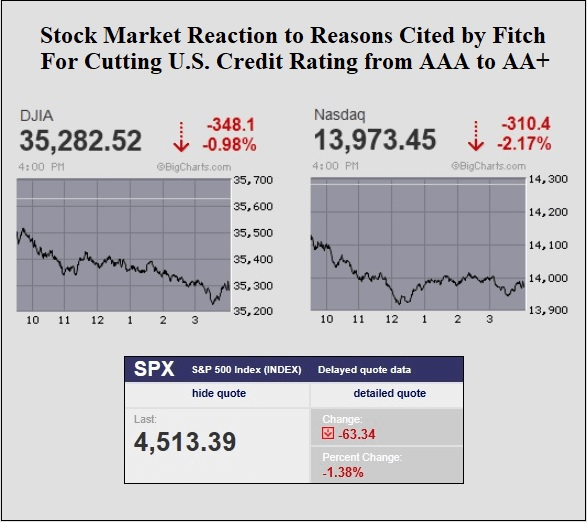
At 5:13 p.m. ET on Tuesday, after the stock market closed, Fitch downgraded the U.S. credit rating from AAA to AA+. Fitch is now the second of the three major credit rating agencies to have taken the historic step of removing the triple-A rating from the U.S. S&P made its first-ever downgrade to the U.S. credit rating on August 5, 2011, also from AAA to AA+, and has kept it there ever since. Moody’s is now the only member of the Big Three credit rating agencies that has maintained a triple-A rating on the U.S.

As the chart above indicates, the stock market responded negatively to this development yesterday, particularly over the fact that it came at a time when the U.S. Treasury is boosting the amount of debt it is issuing.

Yesterday, the U.S. Treasury announced its plans to increase its debt issuance, writing as follows:

“Based on projected intermediate- to long-term borrowing needs, Treasury intends to gradually increase coupon auction sizes beginning with the August to October 2023 quarter. While these changes will make substantial progress towards aligning auction sizes with intermediate- to long-term borrowing needs, further gradual increases will likely be necessary in future quarters….”

In line with that view, the Treasury boosted its auction set for next week from $96 billion to $103 billion, consisting of $42 billion in a 3-year Treasury note; $38 billion in a 10-year Treasury note; and $23 billion in a 30-year Treasury bond.

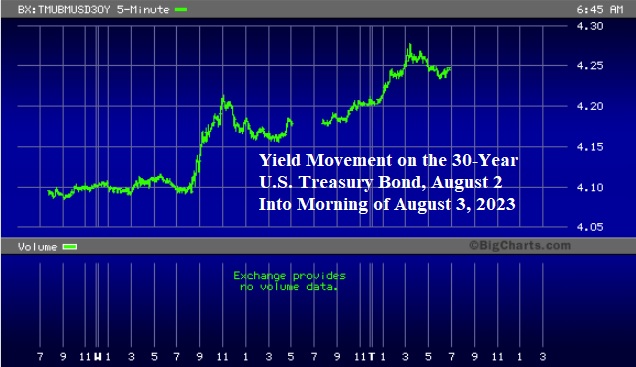
Yields on both the 10-year note and 30-yield bond saw increases in their yields yesterday, meaning their prices were declining. (Bond prices move inversely to their yields.) The yield on the 10-year was trading in the range of 4.05 percent in the early morning yesterday, then moved up to 4.12 by late afternoon. It has continued to move higher this morning, yielding 4.15 percent at 7 a.m. The yield on the 30-year bond was trading in the range of 4.10 early yesterday morning, then moved sharply up at the day progressed, reaching a yield of 4.20 by 11 a.m. This morning, at 7 a.m., the 30-year is yielding 4.25 percent.

When S&P downgraded the U.S. credit rating in 2011, it cited as one factor the growing U.S. debt as a percent of GDP. It said it anticipated U.S. debt reaching “an estimated 74% of GDP by the end of 2011 to 79% in 2015 and 85% in 2021,” while noting that these ratios were “high in relation to those of peer credits….”

Those ratios look positively Goldilocks compared to today. One of the points made by Fitch in its ratings downgrade on Tuesday was this:

“Lower deficits and high nominal GDP growth reduced the debt-to-GDP ratio over the last two years from the pandemic high of 122.3% in 2020; however, at 112.9% this year it is still well above the pre-pandemic 2019 level of 100.1%. The GG [General Government] debt-to-GDP ratio is projected to rise over the forecast period, reaching 118.4% by 2025. The debt ratio is over two-and-a-half times higher than the ‘AAA’ median of 39.3% of GDP and ‘AA’ median of 44.7% of GDP. Fitch’s longer-term projections forecast additional debt/GDP rises, increasing the vulnerability of the U.S. fiscal position to future economic shocks.”

But what is causing the most discussion behind the scenes, both domestically and abroad, are the concerns Fitch enumerated on the ability of the U.S. to govern itself. Fitch raised the following governance issues:

“In Fitch’s view, there has been a steady deterioration in standards of governance over the last 20 years, including on fiscal and debt matters, notwithstanding the June bipartisan agreement to suspend the debt limit until January 2025. The repeated debt-limit political standoffs and last-minute resolutions have eroded confidence in fiscal management. In addition, the government lacks a medium-term fiscal framework, unlike most peers, and has a complex budgeting process….”

Debt-limit standoffs are, unfortunately, not the only political standoffs. It’s difficult for ratings agencies, or the rest of the world for that matter, to forget that it was just over 2-1/2 years ago that the seat of government, the U.S. Capitol, faced a bloody insurrection — by American citizens. Photographs of that out-of-control scene made the front pages of newspapers around the world, as we chronicled here.

One comment from Fitch on U.S. governance on Tuesday seemed far too generous. It said that according to the World Bank Governance Indicators (WBGI), the “U.S. has a high WBGI ranking at 79, reflecting its well-established rights for participation in the political process, strong institutional capacity, effective rule of law and a low level of corruption.”

A “low level of corruption.” Let that sink in slowly for a few minutes. The immediate past president of the United States, Donald Trump, has now been indicted for the third time. The largest bank in the United States, JPMorgan Chase, (which has already been charged by the Justice Department with five criminal felony counts since 2014 and admitted to all of them), is in the midst of a federal lawsuit in Manhattan where the Attorney General of the U.S. Virgin Islands has produced hundreds of documents, internal emails, and transaction reports showing that the bank actively participated in the child sex trafficking operation of Jeffrey Epstein for more than a decade, with its tentacles reaching men in high places in the U.S. And the investigation of insider trading at the central bank of the United States, the worst scandal in the 110 year history of the Federal Reserve, is being stonewalled by the Fed’s Inspector General. The criminal division of the U.S. Department of Justice has yet to weigh in on either the JPMorgan case or the Fed’s trading scandal, despite both being of critical national importance.

There is a website where one can look at the front pages of newspapers across America on any given day to gauge the concerns of our fellow citizens. Yesterday, we checked small and medium size newspapers across the country to see if any newspaper reported the Fitch downgrade of the U.S. credit rating on its front page. Of the two dozen newspapers we sampled, we couldn’t find any mention of the credit downgrade.

The Star Ledger in Newark, New Jersey found room to mention on its front page that the New York Mets had traded Justin Verlander to the Houston Astros, but not a peep about the U.S. losing another AAA rating from a Big Three credit agency.

The Detroit News didn’t think its front page needed the Fitch news but it did make room to tell its readers that Michael Lorenzen was being traded by the Tigers to the Phillies.

What was making front page news across America yesterday was Trump’s indictment. The Atlanta Journal-Constitution ran a bold font, all-caps headline: “TRUMP FACES FOUR FELONY COUNTS.” Directly below that was a picture of carefree elementary school children heading into school for the first day of classes. (Schools open in August in some parts of the United States.)

PBS summarized the escalating corruption charges around Trump like this: “Special counsel Jack Smith, who indicted Trump in the election case, has also charged Trump in federal court with the illegal retention of top secret documents. In New York, Trump faces criminal charges in a hush money case and a civil trial over his business practices. And in Georgia, a county district attorney is expected to announce charging decisions in August over efforts by Trump and his allies to overturn his 2020 election loss in the state.”

It’s important to remember that Trump came to power because the two major political parties gave U.S. voters the following two choices in 2016: elect Hillary Clinton as President despite the fact that she had outsourced Top Secret documents during her time as Secretary of State, from the safety of government controls to a private server in the basement of her New York home that lacked any government protections. Or, voters could elect Donald Trump, who had taken his businesses into bankruptcy six times and had been charged with serial sexual assaults by women, while admitting on camera to grabbing them in their genital area and getting away with it.

But, hey, it’s good to know that the World Bank thinks the U.S. has “a low level of corruption.”

The End of Power Projection?

Trying to Understand the World: https://aurelien2022.substack.com/p/the-end-of-power-projection?nthPub=681

One of the benefits of military experience is your distate for military movies and politicians pitching the latest war.

I didn’t have to watch a John Mearsheimer video to know how the US Proxy War on Russia would play out.

We’re in it for the TV news soundbite and maybe some trashy moves thereafter. The Gulf Wars were ideal.

With Russia, our plan seemed to be we announce sanctions on Monday, oligarchs lose dough on Tuesday, and regime change happens in Moscow on Wednesday. Such was the plan

In contrart, Russia plays the long game. They hate their oligarchs – go ahead, make my day. They’re not in it for the land – they have plenty of that. They’re in it to remove the threat.

Rather than Hollywood shock and awe to effect regime change, the Х-47М2 Кинжал are intended to simply obliterate point targets. On the battlefield, it’s lots of light infantry, heavy artillery, armor when appropriate, drones. and time.

Shock and awe is for TV consumption, and as an air and sea power, something we can do quiite well. We don’t do land war except when overruning Tier 2 players while under the protection air superiority.

And in the current era, we only have enough sea power to protect the homeland.

Nothing wrong with that. Can be cheaper, too if we focus on that. Probably means a safer world too.

**********

The End of Power Projection?

We can’t get there from here, anymore.

AURELIEN

JUL 26, 2023

In a lot of history’s conflicts, the combatants come from adjacent countries, or even different parts of the same one, and they fight to settle ownership of territory, borders, access to strategic materials or communications, or even who will control some third political entity. But there is another kind of warfare, which we might call expeditionary warfare or power projection, which aims at preparing forces, projecting them some distance, having them perform a military operation, and extracting and recovering them, hopefully intact or largely so. It is, in fact, this latter model which has been common among western powers since 1945, and the norm for the last thirty years, and much of modern western weaponry, tactics and training have been designed around it. But there are several reasons to think that this type of warfare is rapidly becoming obsolete and impossible, with political ramifications that we have hardly begun to think about. Here’s why.

Fighting requires contact with the enemy, either directly or, more frequently these days, remotely. Historically, armies did not always have to move very far to make contact, and when they did, it was generally on foot. Whilst the fighting could extend over considerable distances (Napoleon’s campaign in Russia, for example) and armies could move back and forth over large areas, fundamentally, each had a national capital and a logistic capacity and lines of communication to fall back on. Even the herculean struggle between Germany and the Soviet Union between 1941 and 1945 was fought continuously from the centre of Poland as far as Moscow, and then back to Berlin.

But there have also been occasions, and even entire campaigns, that have been fought at a distance. Here, some technology is used to move troops and equipment a long way from home, in order to attack forces you were not originally in contact with. Sometimes, entire wars are in effect expeditionary: the Crimean and Boer Wars, for example, or more recently the wars in Korea, Vietnam and Iraq.

Traditional wars of conquest were not generally expeditionary, because the soldiers set out from a secure base, and in most cases just marched or rode in one direction until they met an enemy to fight, or a city to sack, and, if successful, continued on to the next. Alexander the Great’s soldiers simply marched as far as India. The Arab conquests mostly involved light cavalry and infantry sweeping progressively through the Middle East and Africa as far as the Maghreb. Even then, there were exceptions: the disastrous attempted expedition to Sicily by the Athenians in 415-13 BC is one early example of expeditionary warfare. On the other hand, some expeditions were both large-scale and successful: the First Crusade involved the movement of perhaps 100,000 people, including non-combatants, by land and sea across the whole width of Europe, followed by battles which (temporarily) expelled the Arab invaders from the Holy Land.

These last two examples demonstrate the most fundamental requirement for expeditionary warfare: technologies for transporting combatants to where you want them, and then sustaining them while they are there. The earliest and most obvious technology is, of course, the horse, which enabled longer-distance expeditions to be mounted from early on, though not usually at large scale. But the most important early technology for power projection, especially to meet threats on the borders, was actually the humble paved road. Both the Achaemenid (Persian) and the Roman Empires emphasised the building of good roads, which enabled them quickly to move forces to where they  were needed, and return them quickly when the fighting was over. Even today, as we have seen in Ukraine, control of metalled roads is critical for forces to be moved around quickly. Subsequently, railway systems were constructed to facilitate not only deployment of troops around the country itself but, as with Prussia, quickly positioning them for offensive strikes into enemy countries. (Even today, the vast majority of military transport on land is by rail.)

But true expeditionary warfare, from the Athenians onwards, requires the ability to cross long distances, through areas which you do not necessarily control in peacetime. The classic method of doing this has always been by ship. This could be done on a massive scale: some 350,000 British troops served in the Boer War, virtually all transported by ships, that also kept them supplied with logistics. In the Second World War, millions of troops were deployed around the world that way. As late as the Gulf Wars, whilst personnel often deployed by air, anything heavy had to go by ship as well. In such a situation, control of the medium you are passing through is obviously essential. The attempted Spanish invasion of England in 1588, for example, was unsuccessful, because the Armada, sent from Spain could not defeat the English fleet, control the Channel and so permit the transport of Spanish troops from the Low Countries. The Germans faced the same problem in 1940 with the added complication of the need to have air superiority.

One reason why the Persians and the Romans built good roads was to improve communications. Your ability to react to threats on the frontier, or take advantage of opportunities, largely depended on the speed with which information could be passed to the capital. Likewise, it was important to know what your forces were doing, and what success they were having, in case it was necessary to send reinforcements to rescue the situation or take advantage of an opportunity. By contrast, expeditionary forces sent by sea were effectively out of contact with their national capitals for weeks or months, so Nelson, for example, would have departed with only very general instructions.The position was revolutionised with the laying of submarine cables from the 1850s, and British expeditionary operations became much easier with the completion of the network linking all its major colonies before the First World War. These days, commanders and political leaders can micro-manage individual operations from the comfort of their offices: you may recall the photographs of Hilary Clinton watching live the killing of Osama Bin Laden, a rictus of glee and excitement on her face.

And finally, of course, the force you send has to be capable of doing its job, and armed with suitable weapons to defeat the enemy. With the galloping increase in the importance of military technology over the last 150 years, this element has become critical: in the two Gulf Wars, massive and complex heavy armoured forces had to be transported across long distances, and aircraft and their logistics moved to forward air bases.

In theory, western armies after 1945 were equipped and trained for an anticipated titanic armoured clash with the Warsaw Pact in central Europe. Although there would have been flanking operations by both sides, the assumption was that the main event would be an apocalyptic armoured confrontation between forces which had been in position for decades, and which had substantial  and reliable logistic backup. The reality was somewhat different. Where western militaries were actually engaged in active operations, it tended to be at a distance: everything from colonial wars to UN operations to counter-insurgency, to expeditionary wars such as Vietnam. Mass armoured warfare was theoretically taught in most countries, but it was not practiced: now, it is not even taught because the West has no large armoured formations above Brigade level to deploy. And since the end of the Cold War, the West (and its entire modern generation of military leaders) have grown up with the experience, and the permanent assumption, of a permissive environment into which to operate, adequate communications and logistics, and overwhelming superiority in combat power.

It is true that reality has not always matched this rosy picture. Both Gulf Wars revealed logistic problems, and the second showed that the reliance on civilian contractors, increasing all the time, could be dangerous unless complete security could be assured. Afghanistan was also tricky in places: there was no sea-coast, and the main airport in Kabul could not take large aircraft. The Coca Cola for US troops came by lorry across the frontiers from Pakistan, and ironically the drivers often had to pay the Taliban for permission to pass through check-points. Not all weapons performed as advertised, and in many cases highly-sophisticated and expensive weapons were used in place of simpler and cheaper ones, because it was all that was available.

Nonetheless, after the Libyan adventure of 2011, western leaders came to take for granted the ability to intervene effectively anywhere in the world, without casualties or repercussions, against ascriptive enemies who in practice could not resist seriously. The Russian involvement in Syria after 2015 did, in fact, bring a little more realism to this attitude, but in general western technology and western militaries were simply assumed to be superior to anything that might be encountered anywhere in the world. Two things happened (or to be more precise became known) in recent years, that put this cosy judgement in question.

First, projecting power requires platforms, in the sense that defending against projected power doesn’t, necessarily. This may sound obvious, but in fact a lot of western writing has confused the picture by assuming that western weapons (combat aircraft, aircraft carriers) would be engaged in a series of duels with the equivalent equipment of the other side, and the western equipment would win. But of course attack and defence don’t necessarily work like that. More normally, two sides use asymmetric tactics, because they have different objectives. In Kosovo in 1999 for example, the West’s objective was to force Serbia to hand over control of Kosovo, and thus bring down the current Serbian government. They tried to do that through air and missile bombardment, because a land campaign would have been too difficult and costly. But the Serbs, as well as using air defence missiles, put into action plans honed over forty years to hide and protect their equipment and command and control: most of the targets struck by western aircraft and missiles were dummies, and it was only Russian political pressure on Serbia that eventually saved NATO.

But the projecting power (the aggressor if you will) always needs platforms to launch weapons. Now a platform can be many things, from a soldier on horseback to an aircraft carrier, but usually a platform is employed to put some distance been the aggressor and possible retaliation. The defender, on the other hand, has simply to survive the weapons and, if possible destroy the platforms. In addition, because the attacker is often less motivated than the defender, it is not necessary to defeat all the platforms: just enough damage needs to be done, or threatened, to make aggression unattractive and for the aggressor to return home. The current classic example of this is North Korea. When did you last hear even the most hawkish neoconservative talk about attacking North Korea? Probably never, because, whilst the country’s conventional forces are largely obsolescent, they do include thousands of well-protected long-range artillery pieces and rockets, most of which would survive an attack by the West, and could be then used to wipe out the major cities of Korea and Japan. Quite what the status of the nuclear weapon programme is, I doubt if more than a handful of people know, but there is enough uncertainty about it to make the West think twice about aggression. There is thus no need for North Korea to invest in sophisticated modern weapons and platforms, even if it had the resources, in order to ensure its security.

All this creates conceptual problems for the West in its force projection plans. Western procurement policy over the last fifty years has steadily moved in the direction of smaller and smaller numbers of increasingly powerful systems, costing much more than their predecessors, produced much more slowly, and expected to be in service for a very long time. The original basis for this was the Cold War, where any fighting was expected to be short and brutal, probably finishing with the use of nuclear weapons. Not able to match the numbers of Warsaw Pact platforms, the West instead went for quality, on the assumption that it would lose all or most of its weapons, but would nonetheless “prevail.”

Even in those days, though, this logic was questionable. Soviet doctrine then, like Russian doctrine now, emphasised quantity over quality: it was better to have very large numbers of “good enough” weapons than a small number of complex and sophisticated ones. (Indeed, as good Marxists, the Red Army considered that an increase in quantity could actually have a qualitative effect.) At the end of the day, reasoned the Soviets, if you have a thousand obsolescent tanks left, but your opponent has no tanks left at all, you have won. In any event, it was simply not feasible for western democracies to run a wartime economy in peacetime for forty years as the Soviet Union did, even had the desire been there. So in practice, from the 1970s onwards, the West produced smaller and smaller numbers of more and more sophisticated weapons, and expected them to be more and more versatile and capable of different missions. Combat aircraft were the classic example: the Tornado aircraft of the 1980s was produced in two quite different variants (Air Defence and Interdiction/Strike) using the same airframe. And significantly, it was a tri-national collaborative project, in an attempt to spread the cost.

Nobody really spent much time thinking about what the aftermath of a war with the Warsaw Pact would actually be like, and certainly not its military aspects. Even assuming a NATO victory, or at least anything less than a WP victory, there would be other things to worry about. A stock of equipment and armaments all destroyed and used up would be one of the less pressing problems after a nuclear war. Of course, countries that once embraced this logic cannot easily escape from it. It is a logic which leads to smaller and smaller forces, fewer and fewer installations, more and more sophisticated equipment and, in turn, less and less flexibility across your forces. This is fair enough if you are planning for a single, apocalyptic battle, but less obvious if you are planning for decades of small operations around the world. What the West has, and has had for some time now, is a single-shot military. One serious campaign, whether finally won or lost, would disarm the West for a decade.

So far, this has not mattered, because equipment losses in operations around the world have been very limited. For the most part, the targets have not been able to shoot back effectively. But for reasons we will go into in a moment, this may be about to change.

As well as the fragility of western forces and the difficulty of replacing them, the second complicating factor is the consequences of the assumptions against which they were designed. Now here, we have to bear in mind timescales. The West is currently using a generation of tanks originally designed in the 1980s for the above-mentioned apocalyptic battle with the Warsaw Pact, although upgrades and new variants have been produced since. Now it’s fair enough to criticise, but at least that generation—Leopard 2s, Challenger 2s, M-1s— was produced according to a coherent military requirement of some kind. The basic principles of high firepower, relatively low mobility and as much protection as possible were logical enough for tanks that were fighting a defensive battle and falling back on their lines of supply. But after the end of the Cold War, there was literally no military logic to guide the upgrade and development of existing tanks, and still less the production of new ones. Who were we going to fight? Where and for what purpose? How were we going to get there? So in practice, given the inertia of defence programmes and the length of time for which equipment is intended to stay in service, things have continued as they were, with new variants and upgrades of tanks essentially designed for a short vicious war in Europe, except in much smaller numbers and with much less sustainability. And over there, the Russians have all the time continued to plan and prepare for the kind of war which is happening now, which explains why NATO is scared to death to fight them.

The situation with combat aircraft is actually worse, because the aircraft currently in service with western air forces were designed at the end of the Cold War, (and in some cases even earlier) against a level of threat that was anticipated to develop perhaps 10-15 years in the future. The sheer cost and sophistication of such aircraft has meant that they can only be produced in small numbers, but also that, when military missions arrive, these aircraft have to be used because there is nothing else. Thus, in conflicts such as those in Afghanistan and Mali, enormously sophisticated and complex aircraft, requiring hours of maintenance between flights at modern airbases, were used at long range to drop bombs on militia groups armed with automatic weapons. But at least the militia groups couldn’t shoot back.

And of course naval forces have followed the same logic: countries around the world have invested in aircraft carriers, because they are the basic tool of force-projection. A carrier is not just a floating airfield, it’s also a floating command and control centre, a floating barracks, a floating helicopter park, and many other things. Yet carriers are immensely costly, and getting costlier,  and even the richest nations can only afford to buy small numbers of them. That said, any projection of your forces outside home waters, and outside the range of shore-based aircraft, absolutely requires some form of carrier capability, even if only for humanitarian evacuations, as in Lebanon in 2006.

We also need to understand the assumptions behind the high specification of much military equipment still in use today. In particular, much of it was designed on the assumption that it would need to be better than the equivalent Soviet equipment expected to be fielded in ten or twenty years’ time. So Main Battle Tanks were designed to defeat their expected Soviet equivalents, aircraft were designed to shoot down their Soviet equivalents in air superiority contests, and so forth. Of course, obvious changes in the threat, such as the profusion of man-portable anti-air and anti-tank missiles had to be taken into account to some extent, but western equipment was overwhelmingly designed using its Soviet equivalents as a reference, thus implicitly assuming that the Soviet Union would fight much as we would.

There are always exceptions of course; Britain and France developed light, portable equipment for operations out of area or counter-insurgency, and more recently the US has followed. But precisely because these equipments are light and portable, they are not suited to any serious conflict, let alone a conflict with a peer enemy, or to one armed with modern weapons. For the last thirty, years the dominance of western air power has been such that when western light forces encounter opposition, they have been able to call on aircraft to blow it away. But this is in the process of changing.

Nonetheless, most serious western weaponry traces its origin to assumptions about what Soviet equipment in the 2010s would look like, and how to defeat it. This could have some curious results. The most obvious example is the manned fighter aircraft, which has been a cult object in western air forces for a century or more. Fighter aircraft were popularly visualised as engaging each other in one-on-one duels like knights of old. Actually, this didn’t make sense, although it goes back to the use of primitive fighters in “patrols” in World War I, which sounded good but achieved nothing except dead pilots. In theory, these patrols established “air superiority,” but in practice this was never achievable and, had it been possible, technology at the time was too primitive to take advantage of it. Roll forward to the next war, and we realise that the images of Spitfires and Hurricanes tangling with Messerschmitts in 1940 is misleading: the British were not after the fighter escorts, they were trying to shoot down the bombers. But the image of the high-technology “knight in the sky” is an extremely persistent one.

In the Cold War, even air defence using manned aircraft was questionable. It was assumed, rightly or wrongly, that in the early days of a conventional war the Soviet Union would try to attack targets in Europe with manned bombers, and that western aircraft would try to penetrate the fighter screen around them and destroy them. But what was clear, even if it was seldom articulated, was that there could be no question of the West having air superiority over the battlefield itself, not because of aircraft but because of missiles. It’s worth backing up here a second. Control of air space is only an enabler: by itself it doesn’t win battles. In Normandy in 1944, the Allies had undisputed command of the air, and they used it to provide massive support to their ground forces, which nonetheless still took months to break through the German defences. Without getting into the technical vocabulary, air superiority means that you can be sure that you can conduct air operations against an enemy, albeit with the possibility of losses, whereas the enemy is largely inhibited from conducting operations against you. This is what the Russians have had in Ukraine for some time, but note that this superiority does not always have to be the result of duels in the sky. For the German in France in 1940, it had much more to do with command and control and with the deployment of light anti-aircraft systems well forward. Individually, French aircraft were at least as good as those of the Luftwaffe.

In Ukraine, the Russians are making use of their traditional skills with artillery to achieve air superiority through missiles and radars. This would probably have been true even in the Cold War, since there was no sign that the Soviet Union was anticipating fighter duels over the battlefield, or anywhere much else. But it’s important to understand what this means today: highly expensive and sophisticated fighter aircraft looking vainly for a target to fight, while being vulnerable to long range missile attack. Much military technology resembles the children’s’ game of scissors-stone-paper: no individual weapon or technology is dominant under all circumstances. If the enemy does not want to play air combat between aircraft, your shiny new fighter is just a target for missiles: you thought it was the scissors that would cut the paper but in practice it’s the scissors that are blunted by the stone. (Much the same was true of main battle tanks. Throughout the Cold War, there was a fixation with tank-on-tank action, and whether western tanks were “better” than Soviet ones, although in any real conflict the situation would have been much more complicated than that.)

This is a very fundamental point, but I see no sign that it has been grasped. Its most important consequence is that the primary method of air control, and by extension dominance of the ground battle, is by missiles and drones, as we see today in Ukraine. This makes the side which is conducting defence at the tactical/operational level dominant, and makes an attacker vulnerable. It isn’t just a question of relative technologies, it’s also a question of costs and numbers. Even very sophisticated missiles are in absolute terms relatively cheap, and relatively quick to build. Moreover, any aircraft is in the end nothing more than a platform for weapons and sensors, and it is the weapons that do the damage. Thus, a new generation aircraft capable of launching two long range missiles would have to survive perhaps thirty to fifty missions before it had launched enough missiles to justify its unit cost as a platform. This is, to put it mildly, not typical of modern air warfare, and it’s likely that aircraft and pilot would be gone at the end of two to three missions, with no guarantee that the missiles would even strike their target. Moreover, new aircraft take months to build and new pilots take years to train, whereas missiles take only a few days. What this suggests is that we are now seeing the development of a new type of warfare, in which missiles and drones will both provide a cheap method of precision strike, and also be able to control large areas of terrain.

But it isn’t just a question of numbers, either, it’s also a question of politics. Back in the Cold War, as I have pointed out, war games assumed a single, apocalyptic battle, after which there would be nothing left of anything. Equipment would have been destroyed and forces annihilated, but it was hoped that nonetheless, the West would have “won.” But significant losses of major platforms in expeditionary wars of choice are simply not feasible politically. Forty years ago, UK public opinion, perhaps more robust than it is now, was still shaken by the loss of a number of frigates, destroyers and aircraft in the Falklands War.

Most western societies have come to believe  in recent years that their armed forces are all-powerful and effectively invulnerable, except for attacks by mines and bombs. The loss of even a squadron or two of high-performance aircraft in a hypothetical small clash with Russia or China would be a political shock that the average western government would probably not survive, unless a population could somehow be convinced that the very survival of the nation was at stake, which seems unlikely. And of course the financial and industrial consequences would be severe as well, not to mention the strategic cost of having lost part of an air force. Major air warfare against either of these nations is unthinkable politically, especially since the western aircraft involved would perish at the hands of missile operators, not as a result of knightly combat in the sky. Even the United States would effectively be disarmed after a significant clash with either nation, and would take between a decade and a generation to reconstitute its forces, assuming that were indeed possible. No nation today can afford such an outcome.

Which brings us to the last point: surface combatants, and especially aircraft carriers. Carriers are often dismissed as outdated and vulnerable, which makes it all the more curious that  so many nations are investing in them. The real point about carriers, though, is power projection: there is no other way in which a nation can project any kind of serious power beyond shore-based air cover, and to give up carriers is to publicly give up any ambition to do so. Military forces serve many political purposes in addition to their combat functions, of course, and one of those is demonstrating that you are a serious player in the strategic area. That is why nations newly acquiring  blue-water navies, like South Africa and South Korea, made a point of arranging ship deployments and port visits, to heighten their political profile. The capacity to take part in anti-piracy or embargo operations can have political benefits as well.

The problem comes when these deployments are into a hostile environment. We still tend to think of the carrier battles of the Second World War as the norm: fleets that never saw each other fighting largely with aircraft, targeting each others’ carriers. But not only has technology changed, with a preponderance now of long-range anti-shipping missiles, there is also no reason to suppose that a putative naval enemy (presumably China) would agree to fight that way. To take the well-worn example of an invasion or a blockade of Taiwan, the Chinese Navy would almost certainly wait in home waters for the West to come to it, and seek to win largely with missiles. Thus, whilst naval experts may well be right that the US would “win” a fleet to fleet contest on the high seas, there is no reason to suppose that the Chinese would oblige them with such a scenario. And “winning” is extremely relative as a concept. For example, it is hard to see the American public being prepared to tolerate the loss of a single aircraft carrier to “defend” Taiwan, let alone two or three. History suggests that bring prepared to go to war is one thing, but a willingness to tolerate significant casualties is quite another. A large part of today’s collective western political ego anyway comes from a sense of impunity and invulnerability. But such feelings are brittle (not to mention unrealistic anyway) and the political consequences of the end of such a delusion are likely to be profound.

So we may be at a turning point not simply in the technical aspects of warfare, but more importantly in the politics of the use of force abroad. For more than a generation now, western policy has assumed that such use would be essentially casualty-free, and especially that major platforms would not be at risk. After all, would NATO have attacked Libya in 2011 if in the news every day there had been reports of another aircraft shot down? I rather think not. The spread of relatively cheap and simple but effective air defence systems around the world, which seems virtually certain now, will change the power projection equation fundamentally, as will the wider use of anti-shipping missiles and missiles for attacking ground targets, like the Iskander. How would the air war in Yemen have gone, for example, if a Russian anti-aircraft destroyer had just happened to be on a deployment in the region?

Now of course war games will continue to show that a western attack on small counties will “succeed”, and that copious use of air power will eventually establish air superiority and enable other weapon systems to be hunted down and destroyed. But that’s not really the point: western public opinion may accept punishment beatings of small countries, but not actual wars where western forces suffer significant losses. The consequences of this are wide-ranging enough to need a separate essay, but I think we can already see a future in which the West decides it’s more prudent to stay at home, and let the locals sort out their own problems. Not everybody will feel that’s a bad thing.

Putin’s Warning

Transcript, A Son of the American Revolution: https://sonar21.com/putin-issues-stark-warning-to-poland-and-nato/

Putin held a video conference on Thursday with members of Russia’s Security Council. I hope folks in the West pay attention to what he said, which is why I’m presenting the entirety of his remarks following a presentation by the Director of the Foreign Intelligence Service. Based on public source information and Russia collected intelligence, Russia believes that Poland is planning to seize Ukrainian territory west of the Dnieper River as Ukraine’s much ballyhooed counter offensive collapses.

Let me give you Putin’s bottomline up front:

Regarding the policy of the Ukrainian regime, it is none of our business. If they want to relinquish or sell off something in order to pay their bosses, as traitors usually do, that’s their business. We will not interfere.

But Belarus is part of the Union State, and launching an aggression against Belarus would mean launching an aggression against the Russian Federation. We will respond to that with all the resources available to us.

Vladimir Putin is not a weak, spineless creature like Barack Obama or Joe Biden. He does not make idle threats and does not succumb to emotion.

So let us start with the briefing by Sergei Naryshkin, Russia’s Intelligence Chief:

Director of the Foreign Intelligence Service Sergei Naryshkin: Mr President, colleagues.

According to information provided to the service by several sources, officials in Warsaw are gradually coming to an understanding that no kind of Western assistance to Kiev can support Ukraine in reaching the goals of this assistance. Moreover, they are beginning to understand that Ukraine will be defeated in only the matter of time.

In this regard, the Polish authorities are getting more intent on taking the western parts of Ukraine under control by deploying their troops there. There are plans to present this measure as the fulfillment of allied obligations within the Polish-Lithuanian-Ukrainian security initiative, the so-called Lublin Triangle.

We see that plans also call for significantly increasing the number of personnel of the combined Lithuanian-Polish-Ukrainian brigade, which operates under the auspices of this so-called Lublin Triangle.

If Russia sees Poland starting to mass troops on Ukraine’s border (and do not forget that the United States has deployed at least two armored brigades in Poland), this certainly will capture the attention of the Kremlin leadership. Putin responded at length to Naryshkin’s briefing. This does not read like prepared remarks. He appears to be speaking extemporaneously and draw some very bright red lines for NATO.

Vladimir Putin: Yes. We should elaborate on what Mr Naryshkin has just said. This information has already appeared in the European media, in particular, the French.

I believe it would be suitable in this context to also remind everyone about several history lessons from the 20th century.

It is clear today that the Western curators of the Kiev regime are certainly disappointed with the results of the counteroffensive that the current Ukrainian authorities announced in previous months. There are no results, at least for now. The colossal resources that were pumped into the Kiev regime, the supply of Western weapons, such as tanks, artillery, armoured vehicles and missiles, and the deployment of thousands of foreign mercenaries and advisers, who were most actively used in attempts to break through the front of our army, are not helping.

Meanwhile, the commanders of the special military operation are acting professionally. Our soldiers, officers and units are fulfilling their duty to the Motherland courageously, steadfastly and heroically. At the same time, the whole world sees that the vaunted Western, supposedly invulnerable, military equipment is on fire, and is often even inferior to some of the Soviet-made weapons in terms of its tactical and technical characteristics.

Yes, of course, more Western weapons can be supplied and thrown into battle. This, of course, causes us some damage and prolongs the conflict. But, firstly, NATO arsenals and stockpiles of old Soviet weapons in some countries are already largely depleted. And secondly, the West does not have the production capacities to quickly replenish the consumption of reserves of equipment and ammunition. Additional, large resources and time are needed.

The main thing is that formations of the Armed Forces of Ukraine suffered huge losses as a result of self-destructive attacks: tens of thousands of people.

And, despite the constant raids and the incessant waves of total mobilisation in Ukrainian cities and villages, it is increasingly difficult for the current regime to send new soldiers to the front. The country’s mobilisation resource is being depleted.

People in Ukraine are asking a legitimate question more often: for what, for the sake of whose selfish interests, are their relatives and friends dying. Gradually, slowly, but clarity comes.

We can see the public opinion changing in Europe, too. Both the Europeans and European elites see that support for Ukraine is, in fact, a dead end, an empty, endless waste of money and effort, and in fact, serving someone else’s interests, which are far from European: the interests of the overseas global hegemon, which benefits from the weakening of Europe. The endless prolongation of the Ukrainian conflict is also beneficial to it.

Judging by the actual state of affairs, this is exactly what today’s US ruling elites are doing. Anyways, this is the logic they follow. It is largely questionable whether such a policy is in line with the American people’s true, vital interests; this is a rhetorical question, and it is up to them to decide.

However, massive efforts are being taken to stoke the fire of war – including by exploiting the ambitions of certain East European leaders, who have long turned their hatred for Russia and Russophobia into their key export commodity and a tool of their domestic policy. And now they want to capitalise on the Ukrainian tragedy.

In this regard, I cannot refrain from commenting on what has just been said and on media reports that have come out about plans to establish some sort of the so-called Polish-Lithuanian-Ukrainian unit. This is not about a group of mercenaries – there are plenty of them there and they are being destroyed – but about a well-organised, equipped regular military unit to be used for operations in Ukraine, including to allegedly ensure the security of today’s Western Ukraine – actually, to call things by their true name, for the subsequent occupation of these territories. The outlook is clear: in the event Polish forces enter, say, Lvov or other Ukrainian territories, they will stay there, and they will stay there for good.

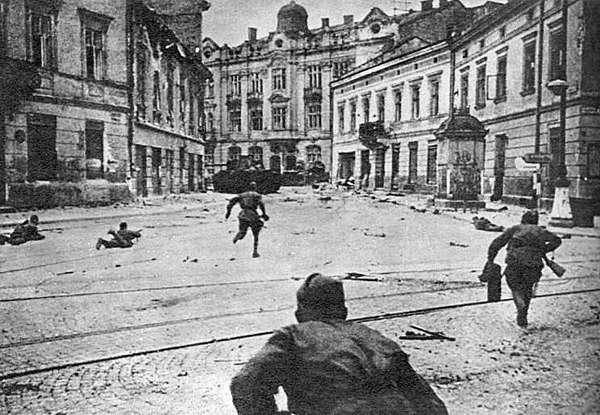
And we will actually see nothing new. Just to remind you, following WWI, after the defeat of Germany and its allies, Polish units occupied Lvov and adjacent territories that had been part of Austria-Hungary.

With its actions incited by the West, Poland took advantage of the tragedy of the Civil War in Russia and annexed certain historical Russian provinces. In dire straits, our country had to sign the Treaty of Riga in 1921 and recognise the annexation of its territories.

Even earlier, back in 1920, Poland captured part of Lithuania – the Vilnius region, a territory surrounding the present-day Vilnius. So they claimed that they fought together with the Lithuanians against so-called Russian imperialism, but then immediately snatched a piece of land from their neighbour as soon as the opportunity presented itself.

As is well known, Poland also took part in the partition of Czechoslovakia following the Munich Agreement with Adolf Hitler in 1938, by fully occupying Cieszyn Silesia.

In the 1920-1930s, Poland’s Eastern Borderlands (Kresy) – a territory that comprises present-day Western Ukraine, Western Belarus and part of Lithuania – witnessed a tough policy of Polonisation and assimilation of local residents, with efforts to suppress local culture and Orthodoxy.

I would also like to remind you what Poland’s aggressive policy led to. It led to the national tragedy of 1939, when Poland’s Western allies threw it to the German wolf, the German miliary machine. Poland actually lost its independence and statehood, which were only restored thanks in a large measure to the Soviet Union. It was also thanks to the Soviet Union and thanks to Stalin’s position that Poland acquired substantial territory in the west, German territory. It is a fact that Poland’s western lands are a gift from Stalin.

Have our Warsaw friends forgotten this? We will remind them.

Today we see that the regime in Kiev is ready to go to any length to save its treacherous hide and to prolong its existence. They do not care for the people of Ukraine or Ukrainian sovereignty or national interests.

They are ready to sell anything, including people and land, just like their ideological forefathers led by Petlyura, who signed the so-called secret conventions with Poland in 1920 under which they ceded Galicia and Western Volhynia to Poland in return for military support. Traitors like them are ready now to open the gate to their foreign handlers and to sell Ukraine again.

As for the Polish leaders, they probably hope to form a coalition under the NATO umbrella in order to directly intervene in the conflict in Ukraine and to bite off as much as possible, to “regain,” as they see it, their historical territories, that is, modern-day Western Ukraine. It is also common knowledge that they dream about Belarusian land.

Regarding the policy of the Ukrainian regime, it is none of our business. If they want to relinquish or sell off something in order to pay their bosses, as traitors usually do, that’s their business. We will not interfere.

But Belarus is part of the Union State, and launching an aggression against Belarus would mean launching an aggression against the Russian Federation. We will respond to that with all the resources available to us.

The Polish authorities, who are nurturing their revanchist ambitions, hide the truth from their people. The truth is that the Ukrainian cannon fodder is no longer enough for the West. That is why it is planning to use other expendables – Poles, Lithuanians and everyone else they do not care about.

I can tell you that this is an extremely dangerous game, and the authors of such plans should think about the consequences.

NATO may be playing a dangerous game, but Russia ain’t playing. Putin is not engaged in rhetorical hyperbole when he states, “We will respond to that with all the resources available to us.” The potential for the war in Ukraine to escalate dramatically remains high. It does not appear that there is any leader of the NATO members who can talk some sense to Poland’s President Duda. Are the people of Poland ready for World War III?

The Bell Tolls for Fiat

Alasdair Macleod: https://www.goldmoney.com/research/the-bell-tolls-for-fiat

The importance of Russia’s announcement that a new gold-backed trade currency is on the BRICS meeting agenda for August 22—24 in Johannesburg seems to have gone completely over everyone’s heads, with mainstream media not even reporting it. 

This is a mistake. China and Russia know that if they are to succeed in removing the dollar from their sphere of influence, they have to come up with a better alternative. They also know they have to consolidate their trade partners into a formidable bloc, so plans are afoot to consolidate BRICS, the Shanghai Cooperation Organisation, and the Eurasian Economic Union along with those nations who wish to join in. It will be a super-group embracing most of Asia (including the Middle East), Africa, and Latin America.

The groundwork for the new currency has been laid by Sergei Glazyev and is considerably more advanced than generally realised.

This article explains why Russia and China are now prepared to fully back Glazyev’s expanded project. For Russia, it is also now imperative to destabilise the dollar as a deliberate escalation of the financial war against America and NATO. China’s priority is no longer to protect her export trade, but to ensure that her African and Latin American suppliers are not destabilised by higher dollar interest rates. [Emphasis added]

Introduction

“The BRICS’s introduction of a gold-backed currency, which is supported by 41 countries with large and influential economies, will weaken the dollar and the euro and will benefit countries such as Iran, while Iranians in possession of gold will experience a wealth increase,” Mousavi added [the head of the South Asia Department at Iran’s Foreign Ministry]. The Russian government confirmed a day earlier that Brazil, Russia, India, China, and South Africa would introduce a new trading currency backed by gold. 

Iran’s MEHR News Agency[i]

The quote above encapsulates why a new gold-backed currency is desired: it will undermine fiat currencies which have been no friends to oil producers and benefit individuals who own gold making it popular on the streets. RT, the Russian government-financed English broadcasting service had confirmed on last Friday the intention to introduce a new gold-backed currency for BRICS members. The announcement was completely missed by mainstream media, partly because RT and other Russian news sources are censored in many countries in Europe including the UK, and any news out of Russia is disbelieved anyway.  [Emphasis added]

Reactions from those who saw it, even among gold bugs, vary from the opinion that neither China nor Russia could make a gold backed currency stick, to it taking years in the planning and implementation so is irrelevant to today’s markets. But there are good reasons to believe that this complacency will turn out to be wrong, and that events are likely to evolve considerably more rapidly than expected. 

The problem for capital markets is that they are dominated by Keynesians, automatically programmed to believe gold is bad and fiat is good. As a stockbroker in London, when President Nixon suspended the Bretton Woods Agreement, I recall there was a similar level of confusion over those implications. And now, 52 years after putting the world on a fiat dollar standard, the majority of the world has had enough of dollar hegemony, has found safety in numbers, and is going back onto a gold standard. Like all life, the pure fiat era is ephemeral after all, defined by its birth and death. Macroeconomics will have to be rewritten.

The move away from fiat has been evolving for a considerable time, with de-dollarisation the ultimate objective of the Asian hegemons. Those tracking developments in gold bullion markets in recent decades have noted the drift of bullion from west to east, and the rise in gold mine output in China and more recently in Russia. Central banks, predominantly in Asia, have been accumulating bullion reserves and adding to declared and undeclared state funds in record quantities. Ultimately, this activity can only be to use gold to secure currency values as the dollar dies or is done away with. 

A sudden turn of events occurred when the western alliance imposed sanctions against Russia following her attack on Ukraine. They set off a train of actions that has unified Asia and many of its supplier nations into a rebellion against American hegemony, stoked up by Putin and led by Saudi Arabia and the Gulf Cooperation Council. And since the western alliance turned its back on fossil fuels, the low-cost producers throughout Asia have banded together representing nearly half global oil output, and a third of natural gas. As a cartel, OPEC is now just an appendix to the Asian mega-energy producers. 

The new cartel is dominated by President Putin, whose degree from Leningrad University was in energy economics and well qualified to be energy ringmaster. Not only has he demonstrated an understanding of the importance of controlling global energy supplies, but he also has a clear understanding of the importance of monetary gold. 

Since the western alliance’s sanctions, the signals coming out of Moscow have been clear: Sergei Glazyev, who is Putin’s point-man for macroeconomic policy has been waving the gold flag since then in plain sight. As a board member of the Eurasian Economic Union Commission (EAEU) since 2019, he was tasked by Putin to design a trade settlement currency for the EAEU. The initial statement through a news agency in Bishkek in early March 2022 reported that it was to be based on the currencies of the member states and a basket of undefined commodities. According to Glazyev, his brief was to create a Eurasian monetary and financial system to the exclusion of foreign currencies, particularly the dollar and euro. 

The intention was also to remove exchange controls for cross- border settlements within the Eurasian membership, replacing the dollar as the commonly used settlement medium between them. A week later, in an article for Goldmoney[ii] I concluded that as stated the new currency would not work, and the only logical solution was to do away with the currency basket proposal and use gold backing solely to represent commodities. That way, it would be easy for other nations in the Shanghai Cooperation Organisation (SCO) to join in, which was the ultimate objective from the outset.

In July 2022, Glazyev was behind a move to beef up the Moscow gold exchange, the official line being that having been sanctioned from the London market Russian miners needed a more effective local market. But working in conjunction with the Shanghai Gold Exchange this was an important signal about the way Galzyev’s monetary thinking was developing. Confirmation came on 27 December last year, when he wrote an article for Vedomosti, a Moscow business paper, describing why the rouble needed to return to a gold standard. That article was co-written by his deputy on the EAEU committee designing the new trade currency and was a thinly veiled indication of the committee’s view. [Emphasis added]

Therefore, you did not have to be particularly astute to discern the trail of clues presented to us. We could assume with justification that gold was intended to be the sheet-anchor for this new currency probably from the outset, but some political hoops had to be jumped through to convince the EAEU member states that it was the solution. 

The impracticality of basing a new trade currency on anything else other than gold had been established. It now turns out that this project is almost certainly a Trojan horse for something far larger. It was obvious that other members of the Shanghai Cooperation Organisation should be able to join in, and now it turns out that the invitation is being extended to members of the BRICS club as well. But that’s not all. The entire membership of the SCO, its dialog partners, and associate members will be attending the BRICS conference in Johannesburg on 22—24 August. I am assuming that the original list of 36 nations, which according to most recent reports has expanded to 41, includes the members of the EAEU who were not on the original list — at the time of writing this is yet to be confirmed.

That being the case, the BRICS currency project is not a cold start and not something to be planned for a distant future. The groundwork has already been prepared by Glazyev and the structure can be rapidly assembled once the necessary resolution is adopted. It is even possible that the necessary institution(s) exist waiting to be deployed.

It is also beginning to look like there will be another proposal on the Johannesburg agenda, to merge the SCO, the EAEU and BRICS into a supersized trading block. In terms of both combined population and GDP on a purchasing power parity basis, it is already in excess of half the world, dwarfing the western alliance which kowtows to America.

The US Treasury would almost certainly have known about the BRIC proposals when the agenda was first circulated, which probably explains why at short notice Janet Yellen, US Treasury Secretary flew to Beijing. From her department’s point of view, if the new currency proposal was to be adopted its financing of the budget deficit would be adversely affected, not to mention the threat to the dollar’s hegemony. The principal card up her sleeve was to threaten greater sanctions against China’s exports, not just to America, but to her allies as well, but we don’t know if it was actually discussed in these terms.

The Chinese view

For too long and too often China has been threatened over access to markets by the Americans. We can be sure that ahead of the BRICS currency proposal the Chinese have gamed this possible threat being acted upon and come up with their own conclusions about its economic consequences. Russia’s experience, which harmed the sanctioning countries considerably more than the sanctioned, will have been fed into these calculations. One suspects that other than signalling to the Chinese and Russians that there is an increasing level of alarm in Washington, Yellen’s mission will have achieved little. And an important factor for the Chinese attitude is their experience of the US’s attempts to destabilise Hong Kong, which led to it being taken directly under Beijing’s control. It is therefore important to understand China’s analysis of America’s objectives and methods in order to define her own position.

In April 2015, Qiao Liang, the People’s Liberation Army Major-General in charge of intelligence strategy gave a speech at a book study forum of the Chinese Communist Party’s Central Committee.[iii] Qiao commenced by stating the obvious, that the U.S. enforces the dollar as the global currency to preserve its hegemony over the world. And he concluded that the U.S. would try everything, including war, to maintain the dollar’s dominance in global trading. But what he then went on to say is extremely relevant to the current situation. He described US’s actions with respect to foreign national debts. 

Qiao made the case that both the Latin American crisis in 1978—1982, and the Asian crisis in 1996—1998 were engineered by America. By reducing dollar interest rates to below their natural level they would weaken the dollar and encourage an investment boom in the targeted jurisdictions, funded by dollar credit. They then increased interest rates and strengthened the dollar to create a financial crisis. These events did, indeed, happen, but perhaps driven by the cycle of bank credit, as much as by foreign policy. [Emphasis added]

The relevance of Qiao’s analysis is that today, the same conditions appear to be targeted not against China, which does not borrow dollars, but at the dollar indebted nations around the world with which China trades — the BRICS nations. Informed by Qiao’s analysis, it must appear to China that America’s persistent strategy is to continue to raise interest rates even after the inflation dragon is slain, and by bankrupting them the US will attempt to bring the nations seeking to join BRICS back under her control. [Emphasis added]

That being the case, China will have weighed up the consequences for her export trade against the likely sanctions America and her allies could threaten and decided that the real threat is against the emerging economies in Africa, Latin America, and elsewhere which have received substantial Chinese investment. In financial terms, it is therefore imperative that this threat be addressed in a pre-emptive attack on the dollar, which can only be achieved by exposing the dollar’s weakness as a fiat currency. At least since the Lehman crisis, China and more recently Russia have had the power to do this.

Furthermore, the New Development Bank, which is headquartered in Shanghai, will be able to provide credit either in yuan or the new BRICS currency at lower interest rates to offset the undoubted strains imposed on BRICS members as a result of rising US interest rates. Therefore, China is fully prepared to counter what General Qiao Liang described as the American strategy of “harvesting” assets in foreign countries. [Emphasis added]

It is important to understand what China believes and motivates her, not whether Qiao is right or wrong. But given that his view is inculcated in the Chinese government, China is ready with Russia to mount an attack on America’s fiat currency by returning to a gold standard for trade, and ultimately for their own currencies.

The Russian view

It should be clear that the current plans for a trade currency originated in Russia, and not China. Indeed, until now China will have been reluctant to destabilise the currencies of the western alliance, because of her export interests. But not only has the relationship with America deteriorated over Taiwan, not only is it clear (in China’s view) that America plans to bankrupt the BRICS members and all those seeking to migrate away from the dollar’s hegemony by raising interest rates, but it is now also clear that neither Russia nor America can back down over Ukraine. Consequently, unless China and Russia together take the initiative, shortly Russia will be directly at war with America and her NATO allies and China will almost certainly be dragged into the conflict over Taiwan. World War 3 must be forestalled.

It is clear that NATO, under the thumb of America, is determined to defeat Russia, remove Putin, and gain control of its massive natural resources. The proxy war being fought in the Ukraine appears to be failing with Zelensky’s summer offensive having ground to a halt. And following the Wagner debacle, Russia is now in a strong position to counterattack. This has led to President Biden being prepared to send the Ukrainians cluster bombs, increasing the urgency for a Russian counter-offensive.

Furthermore, with Ukraine’s summer offensive failing, NATO’s theatre of operational strategy is moving to Poland and the Baltics (Biden was in Vilnius this week for a NATO summit), with Poland particularly becoming a client state of America through NATO. The build-up of military personnel and missiles in Poland will become increasingly obvious in the coming weeks and is already anticipated by Moscow. We await Putin’s reaction, but he is unlikely to just sit on his hands and let NATO build its forces in Poland and the Baltics. [Emphasis added]

Compromise is out of the question, because it is plain to Putin that America cannot back down. Imagine the consequences for Biden, who started his presidency with the withdrawal from Afghanistan if he ends it with a withdrawal from Eastern Europe. Furthermore, the neo-cons are firmly in charge of policy, determined to defeat Putin, add Russian territory to their sphere of influence, and leave China isolated. 

Putin’s terms for peace would be unacceptable to America because he insists on protecting Russia’s borders, which means that all missiles and American bases be removed from Eastern and Central Europe. For Moscow, this raises the question as to whether Russia should simply secure its current position or take Ukraine, which can then be set up as a buffer state. A Russian attack is bound to drive up energy, cereal, and fertiliser prices, worsening price inflation in western alliance countries and causing division with America and Britain, but to the benefit of Russia’s finances which are coming under pressure. Additionally, a successful attack on their currencies’ credibility would undermine the alliance’s military capability, so the dollar should be attacked financially as well.

No one can be sure whether destroying the dollar would avert a nuclear war, but there is little doubt that so long as America can finance its aggression that events are drifting in that direction. From Putin’s viewpoint, undermining the dollar must now be a priority, perhaps combining it with taking Kiev now that Zelensky’s summer thrust has failed.

An advantage of a financial war is that it need not be declared, therefore there is no official victor, and no need for a post-war reconciliation.

Designing a gold-backed trade currency

A new trade currency has the advantage that it will not ever be used as a means of funding government deficits. And given that its role is limited to cross-border trade settlement and and dealing in physical commodities it has to be institutionally acceptable and does not have to appeal to public confidence. Much of the credit will be self-extinguishing. It is additional to national currencies, leaving individual nations to manage their own currency policies, which is why such a currency can enjoy widespread support. It is not to be used as a medium for capital investment.

As the groundwork appears to have been already established by Sergei Glazyev, it could be ready to use as soon as it is approved in August. Besides a strict and simple set of rules, all it needs are two things: the establishment of an issuing entity, and physical gold. The first can be done in a flash, if it is not already established, and the gold will be allocated from the reserves of participating central banks. This is almost certainly why central banks of many of the putative membership of BRICS have been adding bullion to their reserves. They must be extremely thankful for actors in the western financial establishment who trade paper gold in ignorance of this outcome. [Emphasis added]

The bulleted list that follows is a brief outline of how a new trade settlement currency based on gold can be quickly established to replace the fiat dollar in all transactions between member nations, updated from an earlier Goldmoney article on this topic.[iv] It will be interesting to see how its elements compare with Glazyev’s proposition.

It is designed to be politically acceptable to all involved, as well as a long-term practical solution to facilitate the Russian Chinese axis’s ambitions for an Asian industrial revolution, encompassing Africa and Latin America, free from interference by America and her allies. The essential elements are as follows:

  • The announcement of the creation of a new issuing central bank (NICB, not to be confused with the existing New Central Bank in Shanghai, whole purpose is to fund investment in the BRICS members) and a new gold-based currency on the lines below is the first step. 
  • The NICB is established with the sole function of issuing a new digital currency backed by physical gold. It will be designed to be a fully trusted gold substitute, independent of existing fiat currency values.
  • The new currency will only be redeemable for gold between the NICB and participating central banks. They will be free also to add to their NICB currency reserves by submitting additional gold to the NICB at any time.
  • The NICB’s eligible participants will be the central banks of participating nations, broadly limited to member nations, associates, and dialog partners of the EAEU, SCO, and BRICS, and additionally nations applying for membership of any of these organisations on an approved list. 
  • The NICB’s currency is issued to approved national central banks against their provision of a minimum 40% gold backing for it. For example, currency representing one million gold grammes secures an allocation of 2,500,000 currency units denominated in gold grammes. The gold does not have to be delivered to a central storage point but can be earmarked[v] from within a central bank’s gold reserves, on condition that it is securely stored in vaults on a list approved by the NICB. This list is likely to exclude gold stored at central banks of the western alliance and must not be leased or swapped. 
  • A participating central bank records the new currency units allocated to it as an asset on its balance sheet, balanced by an increase in its liabilities as equity. A participating central bank’s balance sheet is thereby strengthened.
  • A participating central bank can offer credit and take in deposits tied to the new currency’s value, to and from the commercial banks in in its national network. Note that the new currency is available exclusively to participating central banks, upon which they can base their own credit dealings with commercial banks.
  • Commercial banks trading in member nations and elsewhere will be free to create and deal in credit denominated in the NICB’s new currency. They will have no credit relationship with the NICB, but their regulating central bank will. 
  • Commercial banks whose central bank does not have access to the NICB currency can clear through wholesale credit markets and will be always free to acquire physical gold in the markets, should they wish to back credit created in the new currency with gold itself. 
  • All taxes and restrictions on gold ownership must be fully rescinded by participating nations, recognising its historic and legal status as money.
  • An efficient central clearing system for commercial banks dealing in credit based on the new currency will be established.
  • Asian commodity exchanges in the expanded BRICS will price all products in the new NICB currency as well as in dollars. Intra-BRIC imports and exports will similarly be priced. This will ensure that physical markets and their derivatives are insulated from a fiat currency collapse, a likely consequence of gold’s return to its true monetary status.

The purpose of the new currency is to provide the basis for trade finance and other cross border financial settlements on a sound money basis. The expansion of credit based upon it will grow strictly in line with economic activity and therefore will not be inflationary, undermining its purchasing power. Last week, in an article for Goldmoney I explained why when tied convincingly to gold, commercial bank credit grows on a non-inflationary basis when distortions from the lending cycle are removed. This is the key to understanding why a new trade currency constructed on these lines will endure.[vi]

It is also likely to lead to participating nations placing a greater emphasis on their own currencies’ stability while providing a safe haven from the consequences for the dollar following its introduction. Once the new currency is established, it will be in Russia’s interests to put the rouble back on its own gold standard, and China may follow with the renminbi.

All empirical evidence informs us that when gold becomes the means by which credit is valued, credit’s own value becomes tied to that of gold and is not dependent on stability in the quantity of credit. Operating as a gold substitute imparts pricing certainty to trade and investment and leads to stable, low interest rates giving the necessary conditions for maximising economic development in emerging economies.

Constructed on the lines above, it should be simple and quick to establish. It must be free from attack by members of the western alliance trying to preserve their own fiat currency systems. And the 40% gold backing rhymes with the basic requirement for a metallic monetary standard set by Sir Isaac Newton, when he was Master of the Royal Mint. 

For participating central banks, the replacement of gold in their reserves for allocations of the new currency would represent a significant increase in their balance sheet equity. As confidence in the scheme builds, it could be argued that only minimal gold reserves need to be retained by participating central banks, with the balance swapped for the new currency. For example, the Reserve Bank of India officially possesses 787.4 tonnes of gold. Converted into the new gold currency, its value in reserves is uplifted to 1,968.5 tonnes equivalent, added to its equity capital. 

The impact on gold

Throughout history, money has been gold, and the rest credit. When you detach credit from gold, there are consequences. Pricing goods and services in credit diverges from pricing them in gold. It is really that simple.

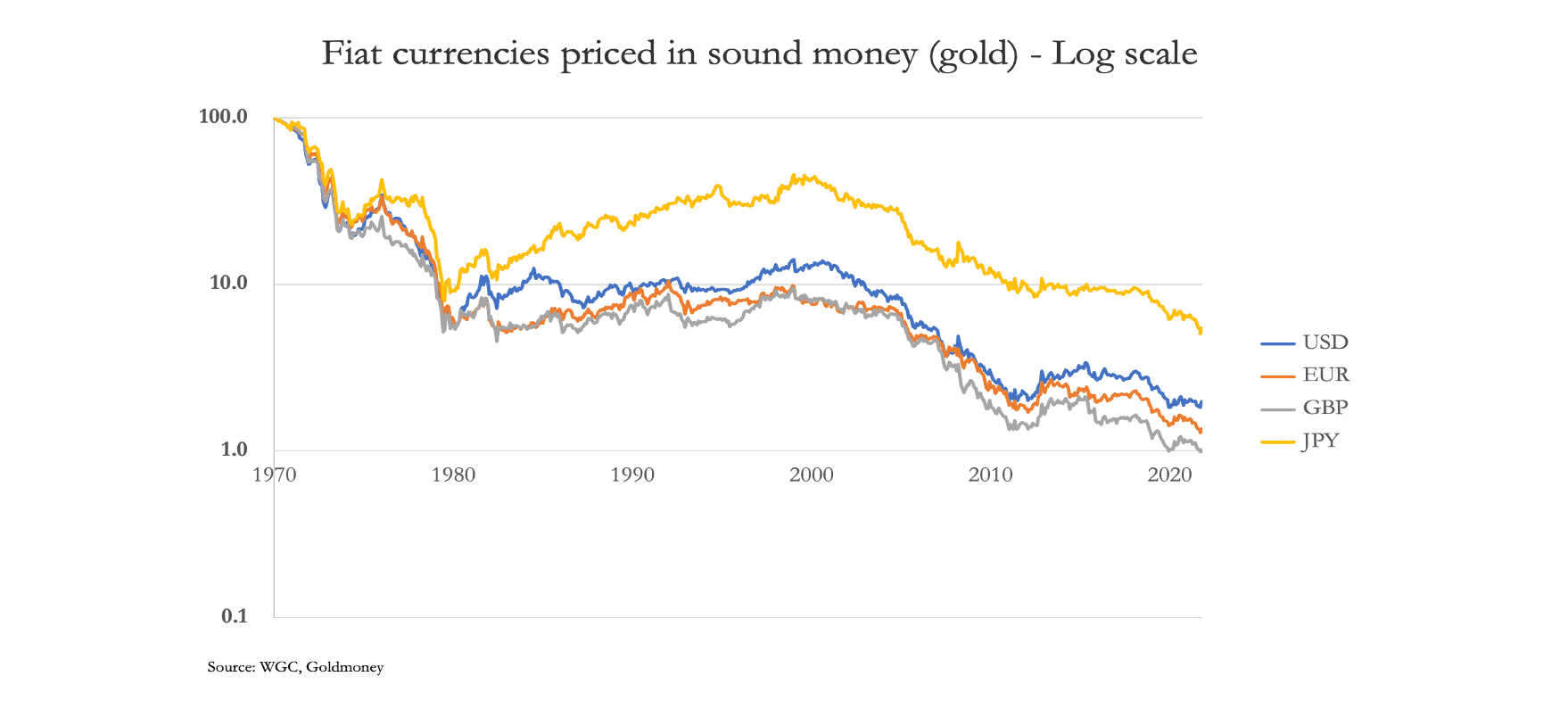
It is widely assumed that fluctuations in prices have nothing to do with the medium of exchange, and for individual transactions it is certainly true that both buyer and seller will share this view. But over time, with official policies aiming for a 2% fall in purchasing power for the dollar and other major currencies it is not true that price fluctuations are entirely due to changes in the demand/supply balance for commodities and other manufacturing inputs. In fact, since the end of Bretton Woods, measured in real money which is gold, the loss of purchasing power has been considerably in excess of the 2% annual target. The chart below puts it directly in a gold versus fiat context.

Graphical user interface, chart

Description automatically generated

Since the suspension of Bretton Woods, the dollar has lost 98% of its value relative to gold. The other major fiat currencies have been similarly impoverishing for their users and savers, and only now is the final act in their destruction looming due to the introduction of a new BRICS gold-backed currency. 

Through the medium of gold, participating central banks will exchange their reserve dollars for the new NICB currency. Immediately, this rejection of the dollar by a large number of central banks will devalue it further, followed by foreign non-government entities seeking to reduce their exposure. Initially, this will be seen as a run on the dollar into gold, similar to that which followed the suspension of Bretton Woods on 15 August 1971. The market was similarly nonplussed then as it appears to be today, with the London morning fix on Monday 17 August at $43, slightly down on the previous week. It wasn’t until 19 November that the morning fix exceeded $43 again for the first time. It took two whole months for the implications to sink in. But when they did, the price rose to $197.50 on 27 December 1974.

The lesson for us in this Keynesian world is that two months of static prices following the suspension of Bretton Woods is proof that gold was poorly understood in financial markets, and still is today. Derivative markets, particularly the London forward market and Comex futures for the last forty years have lost sight of gold being money and assumed it is a trading counter which plays on irrational fears of instability of the modern currency system. But with the return of gold as the anchor for credit values for the Asian hegemons and their sphere of influence, those fears will suddenly become rational.

The wider consequences of a BRICS currency gold standard

We can assume that the consequences of Asian trade settlements backed with gold will have been carefully considered by the Asian superpowers, particularly by the Russians who have faced weaponised dollars.

Besides bringing stability to export values there are other advantages to reintroducing gold into currency systems. Interest rate stability at lower rates is an obvious benefit. Currently, the Bank of Russia’s key interest rate is 7.5% and price inflation has collapsed to 2.3% (April). The yield on Russia’s 10-year OFZ bond is still 11.3%. If the rouble becomes a credible gold substitute, price inflation, interest rates, and bond yields can be expected to decline and maintain levels that reflect gold’s long-term stability, particularly in more normal times when the Russian government runs decent budget surpluses. And assuming that credit expansion by Russia’s commercial banks is not cyclically excessive, there is no reason to expect otherwise than that financial stability for the currency and the Russian economy would continue in the long-term. Coupled with low taxes (Russia’s income tax is a flat 13%) this stability can be expected foster genuine economic progress and the accumulation of personal wealth for the Russian people. It would be a far better outcome than the current situation and it would secure Putin’s legacy.

However, a move towards gold backing for their currencies by the Asian hegemons can be expected to undermine the purchasing power of western fiat currencies. International capital will abandon ephemeral fiat currencies for real values in commodities, with nations rebuilding stockpiles of energy, metals, and other raw materials instead of accumulating fiat paper. Precious metals, specifically gold, will be sought and its price can be expected to reflect the demise of fiat currencies.

The consequences for wholesale and consumer prices in the western nations would rapidly become obvious, with central banks forced to revise their expectations for price inflation sharply higher. Bond yields can be expected to rise further, undermining all financial and property values. As this negative outlook clarifies, measured against gold fiat currencies will likely enter a substantial relative decline. [Emphasis added]

The consequences of the emergence of gold backing for currencies in Asia on the currencies and economies of the western alliance are bound to differ in their detail for the currencies in the western alliance.

The reliance on inward foreign investment has protected the dollar from continual trade deficits and played a key role in funding US Government debt since the end of Bretton Woods. It has allowed the US Government to run budget deficits more or less continually. The ending of the fifty-two years of a fiat regime changes all that. The US Government will face significant funding hurdles against foreign liquidation of Treasuries. Bond yields and funding costs for the government are bound to rise significantly.

The consequences for the EU and the eurozone would be both politically and economically divisive. If it were not for political constraints, Germany would naturally drift towards cooperation with the sound money regimes emerging to her east, particularly as the finances of the Mediterranean club deteriorate. With rising bond yields, the entire euro system comprised of the ECB and its national central banks would need to be recapitalised, being already deeply in negative equity. The eurozone’s global systemically important banks (G-SIBs) are extremely highly leveraged and unlikely to survive the combination of falling asset values and bad debts that would be the certain consequences of the euro’s declining purchasing power. Having been assembled at the behest of a political committee and now managed by a political cabal, the euro is at risk of losing all market credibility.

The consequences for the UK pound will also be significant. In a similar debt trap to that of the US Government, the British have the further disadvantage of an economy suffering under increasing taxes. Furthermore, with London being the international financial centre, the UK will be at the epicentre of a fiat currency crisis. For the size of her economy, the UK has little in the way of gold reserves, hampering any future escape from the fiat currency trap.

The major governments aligned both economically and intellectually with the fiat dollar will be left at a comparative disadvantage by a BRICS gold-backed currency, possibly followed by Russia and China adopting gold standards. Interest rates, which are escaping from central bank control, will rise due to two factors: there is the credit crunch from the turn of the bank credit cycle, and the deteriorating outlook for fiat currency purchasing powers. It is the worst of both worlds. Furthermore, economists in governments and central banks would be reluctant to abandon their embedded economic and monetary policies. And will be slow to react.

The only salvation will be for western governments to jettison Keynesian macroeconomics entirely and revert to classical economic theories. The false assumptions that have built up over the fiat currency era will have to be overturned. Crises of this sort nearly always emanate in the foreign exchanges because it is foreign holders of currencies who are the first to recognise a currency’s weakness. Usually, it involves a specific currency. But this time, it will affect all the major currencies in the western alliance.


[i] Official Iranian news release. See https://en.mehrnews.com/news/203015/BRICS-currency-to-benefit-Iran-undermine-US-dollar-euro

[ii] See https://www.goldmoney.com/research/designing-a-new-currency-is-impractical

[iii] See http://chinascope.org/archives/6458

[iv] See https://www.goldmoney.com/research/cbd-cs-the-good-the-bad-the-ugly under the sub-heading, The Good.

[v] Earmarking is the technical term whereby one central bank acts as custodian for another central bank’s bullion.

[vi] See https://www.goldmoney.com/research/the-real-determinants-of-currency-value

Deposit Bleedout

Shouldn’t be a surprise we’ve seen this kind of deposit bleedout continue as the FFR rose.

Interesting is the spillover into credit balances. Higher interest rates have driven down decline loan applications.

Check out the net interet margins – tracking the trend.

Which gets us to my favorite graph

All of this by way of introduction to Wall Street on Parade: https://wallstreetonparade.com/2023/07/jpmorgan-chase-has-bled-230-6-billion-in-deposits-since-q1-2022-with-declines-in-5-of-the-last-6-quarters/

JPMorgan Chase Has Bled $230.6 Billion in Deposits Since Q1 2022, With Declines in 5 of the Last 6 Quarters

JPMorgan Chase Deposits -- Q1 2022 through Q1 2023

By Pam Martens and Russ Martens: July 20, 2023 ~

The data in the chart above comes directly from what the biggest bank in the United States, JPMorgan Chase, reported on its 10-Q filing with the Securities and Exchange Commission (SEC) for the quarter ending March 31, 2023. Despite all those mainstream media headlines and news stories about the biggest banks in the U.S. being the deposit beneficiaries of the banking panic earlier this year, the cold, hard facts on the ground are the following: at the end of the first quarter of this year, JPMorgan Chase had seen deposit outflows in four out of the past five quarters. Mainstream media conveniently forgot to mention that.

The only quarter in which JPMorgan Chase saw an inflow of deposits was the first quarter of this year, when three banks blew up: Silvergate Bank, Silicon Valley Bank and Signature Bank. That increase was a mere pittance compared to the huge outflows of deposits it had already suffered in 2022.

Now we are getting an even clearer picture of the downward trend in deposits at JPMorgan Chase thanks to the 8-K filing that the bank made with the SEC on July 14. Had it not been for that sweetheart deal that the FDIC cooked up with JPMorgan Chase in the second quarter of this year, allowing it to buy the good stuff it wanted from the failed First Republic Bank, while regulators ate the bulk of the bad stuff, JPMorgan Chase would have had another decline in deposits in the second quarter.

According to the 8-K filing, First Republic added $68.351 billion to JPMorgan’s deposits for the period ending June 30, 2023. Without those deposits, JPMorgan Chase’s deposits would have stood at $2.33 trillion as of June 30, representing a quarter-over-quarter decline in deposits of $46.64 billion. That would have brought the outflow of deposits since the end of the first quarter of 2022 to a whopping $230.6 billion, and showing that the bank lost deposits in five of the last six quarters.

The bank’s so-called fortress balance sheet is starting to look like there are termites gnawing at the timbers. (See also: JPMorgan Chase Transferred $347 Billion in Debt Securities Over the Last 3 Years to Inflate Its Capital Using a Controversial Maneuver.)

JPMorgan Chase getting the greenlight from federal regulators to purchase the failed First Republic Bank was a demonstration of regulatory capture at its worst. Despite JPMorgan Chase having admitted to five felony counts brought by the U.S. Department of Justice since 2014; despite it having an organized crime style rap sheet; and despite it being currently scandalized around the globe for functioning as the cash conduit for Jeffrey Epstein’s sex-trafficking of school-age girls for more than a decade, this is the sweetheart deal the bank got from the FDIC to take over First Republic: the FDIC would eat 80 percent of any losses on single-family residential mortgages for 7 years and 80 percent of any losses on commercial loans, including commercial real estate, for five years. The FDIC also provided JPMorgan Chase with a $50 billion, five-year fixed-rate loan at an undisclosed interest rate.

The Lvov Target

Soviet 3rd Guards Army assaulting Lvov, 13 July – 29 August 1944

John Helmer provides some interesting perspectives from the Russian point of view.

Putin’s War ran from February 2022 into March 2022. Putin’s invasion was about to end when the US-UK doubled down.

This is now Biden’s War. Russia will soon finish it on its own terms

Having crushed the Ukrainian assaults over the last month, and with Ukraine all but out of manpower, ammunition and equipment, the war is entering a voltile stage: Russia claims its inevitable victory.

Will the US-UK go all-in by design or impulse to double-down?

DC is certainly on auto-pilot to a confrontation. And if it comes to such a confrontation, one should assume Russia’s gloves come off in space, Europe and major US staging areas elsewhere.

Russia has been clear about is final red line: F-16s (flown by anyone) — and any other nuclear-capable delivery platform. With radar contacts on inbound F-16s, Russia won’t wait to see what the payload is. If the radar bogey is nuclear-capable and in the air, it’s a nuclear threat and there is no sanctuary from which aircraft may operate.

The US is incapable of covering that bet.

We shipped our ammos stocks to Ukraine.

40% of our fast attack submarines are queued up for deferred maintenance — twice the normal fraction.

Carrier strike groups cannot enter the Black Sea, and would be destroyed if one tried.

The ground troops of the Immediate Response Force is built around a Brigade Combat Team of the 82nd Airborne Division — a single battalion to be airborne deployed on 18 hours notice followed by additional battalions within a period of days.

Maybe enough to hold Lvov with Polish armor. But not a pretty picture to contemplate.

Here’s Helmer to share a Российская перспектива

John Helmer: https://johnhelmer.net/the-nato-ultimatum-to-ukraine-invitation-to-win-by-winter-or-die/#more-88341

**************************

For all its public talk, NATO has agreed on a secret six-month plan for Ukraine. It’s a case of do or die by December. [Emphasis added]

Either the Ukrainian forces, firing everything the NATO allies can give them — from US cluster munitions to Franco-English Storm Shadow missiles and German Leopard tanks — will gain territory and advantage over the Russians; or else the Kiev regime will be destroyed and must fall back on Lvov while NATO beats its own retreat westward from the Polish and Romanian borders — its military capabilities defeated but its Article Five intact.

This is hardly a secret. “Whatever is achieved by the end of this year will be the baseline for negotiation”, the Czech President Petr Pavel, former Czech and NATO army general, announced on the first day of the summit meetings in Vilnius.  There is no more than a six-month window of opportunity, Pavel added, which will “more or less close by the end of this year”. After that, “we will see another decline of willingness to massively support Ukraine with more weapons.”

The difference between the Czech’s “more or less” was explained to Ukrainian President Vladimir Zelensky by Henry  Kissinger on the telephone. But the telephone was rigged, and Kissinger was talking instead to the Stavka in Moscow, in the guise of the pranksters Vovan and Lexus.

After justifying himself at length for initially opposing NATO membership of the Ukraine, and then mispronouncing the word “anomalous”, Kissinger acknowledged there is a problem for the Biden Administration to combat European government opposition to NATO membership for the Ukraine. The Ukrainians must fight against that, too, he implied. So long as the US is backing Zelensky,  it is necessary for the Ukrainian offensive to demonstrate small territorial advantages; abandon more ambitious ones (like Crimea); and only then agree to ceasefire talks.  Although Kissinger told Zelensky he had been speaking with US “military people”, he gave no hint that they had warned him the Ukrainians are facing defeat on the battlefield, and the loss of both territory and European support.  

The Russian General Staff calculation is different.

At the current rate of battlefield casualties – announced by the Defense Ministry counting conservatively — by December 31 the Ukrainian army will lose between 75,000 and 100,000 dead, and up to 300,000 wounded and out of combat. In parallel, the destruction of NATO weapons will accelerate faster than the NATO states can resupply and deliver them, or replacement parts to keep the surviving stock going at the front. By the time Russia’s General Winter takes control of the battlefield, there will be too few Ukrainian fighting men left, and insufficient weapons and ammunition, to resist the start of the Russian offensive. A demilitarized zone of mines and cluster bomblets will have taken shape over several hundred kilometres west of the surrendering Odessa, Nikolaev, and Kharkov; they will abandon Kiev when Kiev abandons them. [Emphasis added]

The Russian target then will be to drive what remains of the Ukrainian regime, its flags, tattoos, money, and stay-behind terrorism plans, into an enclave around Lvov. The NATO window, as General Pavel called it, will have been opened, but then will be closed to keep NATO itself from catching cold. [Emphasis added]

One of the unreported outcomes of the  Wagner mutiny, and of the June 29 meeting in Moscow between President Vladimir Putin and Yevgeny Prigozhin, is Putin’s commitment to fight for nothing short of the Ukraine’s rout to Lvov, and the NATO retreat westward in the footsteps of the Grande Armée and the Wehrmacht. This too is incomprehensible at NATO headquarters. [Emphasis added]

The text of the 22-page, 90-paragraph agreement by the NATO allies declares at the penultimate, 89th paragraph that “NATO remains the strongest Alliance in history. As in the past, we will stand the test of time in safeguarding the freedom and security of our Allies and contributing to peace and security.”  To make this point less than wishful thinking, the earlier paragraphs keep the Ukraine out of the NATO alliance but with a verbal promise which makes the indefinite future tense appear to be the present tense.

“Ukraine’s future is in NATO. We reaffirm the commitment we made at the 2008 Summit in Bucharest  that Ukraine will become a member of NATO, and today we recognise that Ukraine’s path to full Euro-Atlantic integration has moved beyond the need for the Membership Action Plan.”

To get from the present to the future, the communiqué promises interoperability with NATO weapons management, and joint command-and-control for warfighting against Russia (China too). “Allies will continue to support and review Ukraine’s progress on interoperability as well as additional democratic and security sector reforms that are required. NATO Foreign Ministers will regularly assess progress through the adapted Annual National Programme. The Alliance will support Ukraine in making these reforms on its path towards future membership.”

“We have decided to establish the NATO-Ukraine Council, a new joint body where Allies and Ukraine sit as equal members to advance political dialogue, engagement, cooperation, and Ukraine’s Euro-Atlantic aspirations for membership in NATO. It will provide for joint consultations, decision-making, and activities [sic], and will also serve as a crisis consultation mechanism between NATO and Ukraine.”

The impact is pushing the NATO allies to withdraw back over the Vistula and Oder Rivers  towards Berlin and Paris with this admission: “We will be in a position to extend an invitation to Ukraine to join the Alliance when Allies agree and conditions are met.” They don’t agree now. The conditions will not be met, cannot be met, if and when – after the coming winter — the capitulation of the Ukrainian armed forces will have been conceded, and the retreat to Lvov begun, leaving the demilitarized zone (DMZ) and Novorossiya to the east.

French General Staff officers have been conceding this retreat by camouflaging it as “not a French war, perhaps an American one”.  According to another retired French general, Jean-Bernard Pinatel, “I absolutely do not believe in the success of the Ukrainian counteroffensive…the biggest disadvantage Ukraine faces is [not] so much the amount of military equipment, which by the way is not always of high quality, because the West supplies Kiev with outdated equipment. Ukraine’s greatest vulnerability is its people, or rather a lack of them. Its best fighters have long been dead.”   [Emphasis added]

Retired German generals have been saying in public the same things on behalf of active service general staff officers in Berlin who remain under the gag of German government. Read them – retired Major General Harald Kujat here;   Vice Admiral Kai-Achim Schonbach;   and retired Brigadier General Erich Vad.  In order to make war on Russia, French President Emmanuel Macron and German Chancellor Olaf Scholtz are not only gagging their military leaders but also avoiding accountability and voting by the Assemblée National and the Bundestag.  

On the front, the current daily casualty rate for Ukrainian forces, men and weapons, since July 1 looks like this:

UKRAINIAN LOSSES OF MEN AND ARMS IN THE FIRST WEEK OF JULY

Source: http://smoothiex12.blogspot.com/

If the daily loss of men averages 500 per day, and the rate of Ukrainian offensive operations continues, then by December 31, the Ukrainian losses will have totalled another 75,000 men. If the rate of attacks is escalated, and the number of killed in action (KIA) averages 715, as it did in the first week of this month, the total losses will reach 107,000. At that point the strategic reserves of men will have been exhausted. [Emphasis added]

The losses of tanks, other armoured vehicles, artillery and rocket launchers are also increasing at a faster rate than NATO can repair or replace. The new summit communiqué promises “to further step up political and practical support to Ukraine as it continues to defend its independence, sovereignty, and territorial integrity within its internationally recognised borders, and will continue our support for as long as it takes.” For as long as it takes is short because the time is running out for the Kiev regime; and its replacement in Lvov will have neither the space, the range, nor the manpower to recover the territory it has lost. [Emphasis added]

STRATEGIC RESERVES OF UKRAINE’S WEAPONS & NATO REPLENISHMENT,

KEY: magenta=available at the beginning of the Special Military Operation, February 24, 2022; light blue=delivered since then by NATO and other western states; blue=promised for delivery by NATO and other states.
Source https://t.me/readovkanews/62281  -- July 10, 2023

The Russian assessment, openly published this week,   is that “by the end of the year, Kiev will not have a strategic armoured reserve — the volume of foreign supplies to Ukraine is on the decline. It’s no secret that the combat capability of the Armed Forces of Ukraine [AFU] is based on the supply of shells and equipment from abroad. We have already analysed the schedule of what has been received, the costs and the losses of these operations, and we can see the culmination of these efforts [on the battlefield].  Enemy losses are heavy, and there is nothing to replace them with because deliveries cannot be made instantly.” [Emphasis added]

“About four to five months elapse between the period of active announcements of deliveries and the actual fact of the transfer of weapons to Kiev. Right now we are destroying tank columns whose armoured vehicles were promised for transfer at the very beginning of 2023. The nuance is that no additional deliveries were announced in the second quarter. Perhaps something will be announced at the NATO summit in Vilnius, but the arrival of tanks and infantry fighting vehicles will not happen before the beginning of 2024. In the event of failure of the Ukrainian counteroffensive, the Russian army will have an additional head-start.”

“If at least the 471 tanks promised by the West have already arrived in Ukraine, then only 286 are additionally expected, some of which will arrive no earlier than 2024. The situation is similar with infantry fighting vehicles and howitzers — more than two-thirds of the total planned deliveries have already been implemented, so there are practically no reserves left. Despite the fact that both what has already been delivered and what is expected to be delivered are inferior in quantity to the old Soviet equipment in service with Ukraine (we have not even taken into account the vehicles which can be cannibalized for parts or upgraded). The prospects are obvious — on the horizon of the next six months, the AFU will have no sources with which to replenish the thinned-out units. The balance of forces at the front may significantly shift in our favour.” [Emphasis]

An American veteran with NATO service in Afghanistan adds:  “Given NATO’s inability to make up for the Ukrainian materiel losses at the front, the bottom-of-the-barrel conscript base, and increasing Russian military proficiency across the board, we could very well see the  move to establish a DMZ before the Fall is out.”

“From the volume of reports I read regarding Russian strikes on Ukrainian logistics hubs, storage and marshalling areas, I am amazed by how they are managing to maintain the current tempo of operations. This being said, the Ukrainians and their handlers seem to be doing a good job of keeping much information regarding shortages or disruptions quiet for public consumption.  Yes, we get the word about the need for more of this or that weapons system, or ammunition, but reading reports from both sides, the shells, missiles, rockets,  etc.,  continue to fly from the Ukrainian side at the Russian defence line with regularity – also with walking-dead lack of quality that seems to be limitless.”

“A clue to the effectiveness of Russian interdiction is the inability of the Ukrainians to concentrate powerful forces at any point to achieve a breakthrough. The concentration at Artemovsk [Bakhmut] provides some clues. There are more than sixty thousand Ukrainians and foreign legionnaires concentrated on that front. The composition is heavily mechanised and well-supported by artillery. They are constantly in action, constantly on the attack. And yet despite their being very menacing and able to bleed outnumbered Russian defenders, they’ve not achieved much while expending huge resources.”

“Looking at other sectors of the line, such as Zaporozhye and South Donbass, it appears that the attacks, while violent, don’t have the same level of strength or stamina. The Russians are confident enough to give ground, shell their abandoned trenches, force the Ukrainians to retreat or face slaughter, and repeat the process time and time again. The Ukrainians just don’t have the resources to suppress the Russians, press the attack, and make real gains. There are several reasons to explain this.  Ammunition, fuel, spares, even food, may all be in shorter supply than anyone is reporting. Logistic routes and transportation may be compromised to the point where only segments of the front can be adequately supplied at any one time – a large part of this situation may be due to the lingering effects of the electric war. Russian strikes on the NATO command-and-control centres may be undermining the Ukrainian/NATO capacity to coordinate supply trains. This is a very under-reported aspect of the war.”

From New York the century-old Henry Kissinger has confirmed to the fake Zelensky that the  Biden Administration wants the Ukrainian forces to demonstrate enough gains against the Russians to retain European country support, and not to risk ceasefire talks until the battlefield gains are in place; otherwise the Europeans will stop their support, and refuse to allow Ukraine’s admission into NATO.

Left: Vovan & Lexus: Right, Henry Kissinger displaying  pictures of Eleanor Roosevelt (rear left), Richard Nixon (centre),   and Nelson Rockefeller (right).  

“Europe”, said Kissinger, “has organised itself to defeat Russia and it would be anamalous [sic] if Finland and Sweden go into NATO but Ukraine, which has sacrificed so much, is not admitted into NATO… Ukraine will be a major country after the war, and after it is rebuilt, it should be in NATO…. We had a Bilderberg meeting…and it was very strange that the European countries that are fighting [Russia] — technically they are supporting you –at that meeting were not in favour of [Ukraine] going into NATO. I was… It will be difficult to engineer membership in NATO.”    

Between ceasefire negotiations and final peace negotiations, Kissinger said , “you [Zelensky] understand that after a ceasefire it will be very difficult to start the war again with total allied support… I believe the trend in America now is towards a ceasefire… I believe you will be able to conduct your current offensive with full support. I believe our people believe that you will not have total success, that you will regain some territory but not everything. That’s what I was told by military people.

Bank Bleed-out

Wall Street On Parade: https://wallstreetonparade.com/2023/07/large-banks-have-bled-921-billion-in-deposits-since-april-2022-the-fastest-pace-in-40-years-and-a-much-larger-decline-than-small-banks/

Large Banks Have Bled $921 Billion in Deposits Since April 2022 — the Fastest Pace in 40 Years — and a Much Larger Decline than Small Banks

You may recall reading a burst of headlines during the banking crisis in March of this year about depositors fleeing small banks for the perceived comfort of the largest banks. Unfortunately, those headlines were never put in context or updated to reflect a broader picture.

In fact, using deposit data that is updated weekly from the Federal Reserve’s own H.8 releases, it becomes crystal clear that the large banks are bleeding deposits at the fastest pace in 40 years.

As the Federal Reserve data in the chart above indicates, deposits at the largest 25 commercial banks in the U.S. peaked at $11,679,758,700,000 on April 13, 2022. The most recent H.8 release shows that the deposits of the 25 largest banks as of June 21 stood at $10,758,977,000,000. That’s a percentage decline of 7.88 percent or $920,781,700.

The Fed’s H.8 data defines small domestically-chartered banks as all other commercial banks outside of the 25 largest. As of March 31, that would be 4,071 “small” banks, although more than two dozen of those had between $40 billion to $150 billion in consolidated assets as of March 31.

Deposits at the smaller banks didn’t peak until December 14, 2022, reaching $5,413,667,700,000. The most current reading on June 21 was $5,170,296,000,000, a decline of 4.5 percent from the peak versus the 7.88 percent decline at the 25 largest banks. In actual dollar terms, those 4,071 banks shed just $243.37 billion versus the $920.78 billion at the 25 largest banks.

It should be noted that the Fed’s initial H.8 weekly releases are static. That data is not updated at the H.8 web page, whereas the St. Louis Fed’s FRED H.8 data is updated for charting purposes. We used non-seasonally adjusted numbers, which we feel are more reliable given the unprecedented nature of this year’s banking crisis where three of the four largest banking failures in U.S. history have occurred.

To make your own charts, you will find the Fed’s updated large commercial bank deposit data here and the small commercial bank deposit data here. (Place your cursor on the various points of the chart for a date and dollar level reading.)

One of the most striking examples of distorted reporting on deposits by the financial press came on April 28 when a Bloomberg column by John Authers was syndicated to the Washington Post. Authers included this misleading narrative about the four largest U.S. banks: JPMorgan Chase, Bank of America, Wells Fargo and Citigroup’s Citibank.

“This summary from the Canadian firm Palos Management explains neatly why the bigger banks are still OK:

“The first quarter’s performance of the big four was consistent with a broad consensus that the big banks have capitalized on massive depositor inflows, clearly related to the well-documented liquidity stresses facing their smaller, regionally based brethren. This should come as no surprise. The panic-fueled depositor exodus from the smaller banks to the larger ‘too big to fail’ banks is simply a rational decision. Protection of capital rules.”

As we reported on May 8, the actual reality is this: Deposits at JPMorgan Chase, Bank of America and Wells Fargo Shrank by $465 Billion Y-O-Y; More than Twice the Total of 4,000 Small Banks. Using deposit data from the banks’ own regulatory filings, we reported as follows:

“The deposit losses at JPMorgan Chase, Bank of America and Wells Fargo are more than twice what the 4,000 small banks lost in total during the same period. Their combined loss in deposits was just $210 billion…

“Bank of America and Wells Fargo not only lost those large deposit sums on a year-over-year basis, but both banks saw deposits fall during the past five quarters, including the quarter ending March 31, 2023 when headlines were declaring that they were seeing big inflows of deposits as a result of the banking crisis. JPMorgan Chase lost deposits in each of the quarters in 2022 and then saw a small increase in deposits in the first quarter of this year – likely from all of those misleading headlines. (This information is easily obtained from the financial statements the firms file publicly with the SEC.)”

On May 21, the Wall Street Journal ran a big article (paywall) on how the banking crisis has “only made JPMorgan stronger.” Reporter David Benoit writes as follows about JPMorgan Chase’s purchase of the collapsed bank, First Republic:

“Yet JPMorgan’s show of strength, for many, exposed a weakness in the U.S. financial system. The bank and its largest rivals have become so big, their reach so extensive, that the government would almost surely step in to prevent their failure. That implicit guarantee encourages people and businesses to move their money to them in times of stress creating a feedback loop that makes big banks bigger at the expense of their smaller peers.”

JPMorgan Chase’s purchase of the failed First Republic was not a “show of strength,” but a revolting demonstration of regulatory capture at its worst. Despite JPMorgan Chase having admitted to five felony counts brought by the U.S. Department of Justice since 2014; despite it signing a non-prosecution agreement and three deferred prosecution agreements over the same time span with the Justice Department; and despite it being currently scandalized around the globe for functioning as the cash conduit for Jeffrey Epstein’s sex-trafficking of school-age girls for more than a decade, this is the sweetheart deal the bank got from the FDIC to take over First Republic: the FDIC would eat 80 percent of any losses on single-family residential mortgages for 7 years and 80 percent of any losses on commercial loans, including commercial real estate, for five years. The FDIC also provided JPMorgan Chase with a $50 billion, five-year fixed-rate loan at an undisclosed interest rate.

Declaration of Independence

Declaration of Independence: https://www.archives.gov/founding-docs/declaration-transcript

“The history of the present King of Great Britain is a history of repeated injuries and usurpations, all having in direct object the establishment of an absolute Tyranny over these States. To prove this, let Facts be submitted to a candid world.

  • He has refused his Assent to Laws, the most wholesome and necessary for the public good.
  • He has forbidden his Governors to pass Laws of immediate and pressing importance, unless suspended in their operation till his Assent should be obtained; and when so suspended, he has utterly neglected to attend to them.
  • He has refused to pass other Laws for the accommodation of large districts of people, unless those people would relinquish the right of Representation in the Legislature, a right inestimable to them and formidable to tyrants only.
  • ….
  • He has made Judges dependent on his Will alone, for the tenure of their offices, and the amount and payment of their salaries.
  • He has erected a multitude of New Offices, and sent hither swarms of Officers to harrass our people, and eat out their substance.
  • He has kept among us, in times of peace, Standing Armies without the Consent of our legislatures.
  • He has affected to render the Military independent of and superior to the Civil power.
  • He has combined with others to subject us to a jurisdiction foreign to our constitution, and unacknowledged by our laws; giving his Assent to their Acts of pretended Legislation:
    • For Quartering large bodies of armed troops among us:
    • For protecting them, by a mock Trial, from punishment for any Murders which they should commit on the Inhabitants of these States:
    • For cutting off our Trade with all parts of the world:
    • For imposing Taxes on us without our Consent:
    • For depriving us in many cases, of the benefits of Trial by Jury:
    • For transporting us beyond Seas to be tried for pretended offences
    • For abolishing the free System of English Laws in a neighbouring Province, establishing therein an Arbitrary government, and enlarging its Boundaries so as to render it at once an example and fit instrument for introducing the same absolute rule into these Colonies:
    • For taking away our Charters, abolishing our most valuable Laws, and altering fundamentally the Forms of our Governments:
    • For suspending our own Legislatures, and declaring themselves invested with power to legislate for us in all cases whatsoever.
  • He has abdicated Government here, by declaring us out of his Protection and waging War against us.
  • He has plundered our seas, ravaged our Coasts, burnt our towns, and destroyed the lives of our people.
  • He is at this time transporting large Armies of foreign Mercenaries to compleat the works of death, desolation and tyranny, already begun with circumstances of Cruelty & perfidy scarcely paralleled in the most barbarous ages, and totally unworthy the Head of a civilized nation.
  • He has constrained our fellow Citizens taken Captive on the high Seas to bear Arms against their Country, to become the executioners of their friends and Brethren, or to fall themselves by their Hands.
  • He has excited domestic insurrections amongst us, and has endeavoured to bring on the inhabitants of our frontiers, the merciless Indian Savages, whose known rule of warfare, is an undistinguished destruction of all ages, sexes and conditions.

“In every stage of these Oppressions We have Petitioned for Redress in the most humble terms: Our repeated Petitions have been answered only by repeated injury. A Prince whose character is thus marked by every act which may define a Tyrant, is unfit to be the ruler of a free people.”

Well, That Didn’t Go as Expected — Or Did It?

So now what?

Well, it’s axiomatic in modern warfare you won’t get far with a combined arms offensive without combined arms.

Mechanized infantry with 3-5x superiority? Essential.

Mobile artillery? Definitely.

Combat engineers to clear mines and obstructions, and bridge crossings? Yes, yes, of course.

Overwhelming firepower? That too.

ISR? Yup.

Air superiority so nothing flies unless it’s yours?

Uhmm, well, that seems to be the missing ingredient.

Also experienced troops with leadership capable of coordinating multi-brigade operations.

As junior officers, we were taught the MOSS MOUSE acronymand exercises reinforced these principles so it’s a “fast brain” reaction to any war or battle plan – applies to business, too:

  • Mass – Mass the effects of overwhelming combat power at the decisive place and time. Synchronizing all the elements of combat power where they will have decisive effect on an enemy force in a short period of time is to achieve mass. Massing effects, rather than concentrating forces, can enable numerically inferior forces to achieve decisive results, while limiting exposure to enemy fire.
  • Objective – Direct every military operation toward a clearly defined, decisive and attainable objective. The ultimate military purpose of war is the destruction of the enemy’s ability to fight and will to fight.
  • Surprise – Strike the enemy at a time or place or in a manner for which he is unprepared. Surprise can decisively shift the balance of combat power. By seeking surprise, forces can achieve success well out of proportion to the effort expended. Surprise can be in tempo, size of force, direction or location of main effort, and timing. Deception can aid the probability of achieving surprise.
  • Simplicity – Prepare clear, uncomplicated plans and concise orders to ensure thorough understanding. Everything in war is very simple, but the simple thing is difficult. To the uninitiated, military operations are not difficult. Simplicity contributes to successful operations. Simple plans and clear, concise orders minimize misunderstanding and confusion. Other factors being equal, parsimony is to be preferred.
  • Maneuver – Place the enemy in a position of disadvantage through the flexible application of combat power. Maneuver is the movement of forces in relation to the enemy to gain positional advantage. Effective maneuver keeps the enemy off balance and protects the force. It is used to exploit successes, to preserve freedom of action, and to reduce vulnerability. It continually poses new problems for the enemy by rendering his actions ineffective, eventually leading to defeat.
  • Offensive – Seize, retain, and exploit the initiative. Offensive action is the most effective and decisive way to attain a clearly defined common objective. Offensive operations are the means by which a military force seizes and holds the initiative while maintaining freedom of action and achieving decisive results. This is fundamentally true across all levels of war.
  • Unity of Command – For every objective, seek unity of command and unity of effort. At all levels of war, employment of military forces in a manner that masses combat power toward a common objective requires unity of command and unity of effort. Unity of command means that all the forces are under one responsible commander. It requires a single commander with the requisite authority to direct all forces in pursuit of a unified purpose. BTW, ever see a matrix organization succeed at anything?
  • Security – Never permit the enemy to acquire unexpected advantage. Security enhances freedom of action by reducing vulnerability to hostile acts, influence, or surprise. Security results from the measures taken by a commander to protect his forces. Knowledge and understanding of enemy strategy, tactics, doctrine, and staff planning improve the detailed planning of adequate security measures.
  • Economy of Force – Employ all combat power available in the most effective way possible; allocate minimum essential combat power to secondary efforts. Economy of force is the judicious employment and distribution of forces. No part of the force should ever be left without purpose. The allocation of available combat power to such tasks as limited attacks, defense, delays, deception, or even retrograde operations is measured in order to achieve mass elsewhere at the decisive point and time on the battlefield.

Think through the MOSS MOUSE gaps in the AFU’s Summer Offensive. Quite a few made this foray doomed from the start.

Here’s Simplicius’s SITREP: https://simplicius76.substack.com/p/sitrep-63023-winds-gather-before

SITREP 6/30/23: Winds Gather Before the NATO Summit

SIMPLICIUS THE THINKER

Well, there’s been a bit of a lull like a post-manic-high comedown after the events of Prigozhin’s Revolt. Partly, it’s owed to what Western press is claiming to be bad weather on the frontlines this week, which has hampered further Ukrainian attempts to make renewed advances. They’ve made them in spurts which have been mostly rebuffed with large losses, as usual.

In hindsight, so far most of my predictions about the ‘offensive’ were quite accurate. A couple months ago, once I felt comfortable with my feeling for the AFU’s true troop dispositions and conditions, I said that most likely there will be no true offensive at all, nor will they achieve any kind of breakthrough whatsoever. This was while other Russian-sphere personalities understandably conditioned their audience for at least major breakthroughs up to the second or third echelons. I ended up concluding that there will be no real offensive because they will call it off after being destroyed and claim that it was all just ‘probing’ all along.

Now, as expected, they’re shifting the narrative to one of needing an airforce. Not only did I post Arestovich’s interview recently, where he ridiculed NATO’s hypocrisy for expecting Ukraine to make huge advancements without air cover, counter to NATO’s own doctrines, but now a new interview with the resurfaced Zaluzhny echoes the same sentiments:

The Commander-in-Chief of the Armed Forces of Ukraine, Zaluzhny, complained in an interview with The Washington Post, saying that Western partners are driving them forward for meat assaults, without giving aviation and supplies:

“…Western allies expect quick successes, although they themselves would never start without air superiority – while Ukraine has not received modern fighters.”

But since obtaining fighter jets is not realistic in the near term future, the dialogue continues shifting to one of negotiations. German broadcaster ARD stated that a secret international meeting on Ukraine was held in Copenhagen days ago, on June 24th, where diplomats of various Western countries met with BRICs representatives in an effort to figure out a way to convince Russia on how to settle the conflict peacefully. ARD concludes that official negotiations on resolving the conflict could occur as early as July:

Official negotiations on resolving the conflict in Ukraine could take place as early as July, ARD TV channel reported.

According to him, an international meeting on Ukraine was held in Copenhagen on June 24 “in the strictest secrecy” with the participation of diplomats from Western countries, as well as representatives of Brazil, India, China and South Africa.

The TV channel noted that the West’s goal was to enlist the support of these BRICS countries, which still remain neutral in the situation around Ukraine. The talks were held at the initiative of Kiev⚡️⚡️⚡️

Official negotiations to resolve the Ukrainian conflict will begin next month, according to the German TV channel ARD.

Particular attention in this context is paid to the participation of the BRICS countries, which have so far remained neutral in relation to the situation in Ukraine. It is reported that one of the main goals of the West at this meeting was to obtain support from these countries.

According to the ARD TV channel, the negotiations were initiated by Kiev. This gives some hope for progress in resolving the Ukrainian issue, because official negotiations between the parties may take place as early as July.

At the moment, the details of the upcoming negotiations and the specific timing of their holding remain unknown. However, apparently, both sides are demonstrating a readiness for a productive dialogue and a desire to find ways to resolve the contradictions that exist between them.

It’s impossible to know how true this is, however it does align with my previous predictions so I give it a fairly high confidence. Right now, the stage we’re at is the dawning of the harsh realities on Western publics and their administrators. They have already begun to see the futility of Ukraine’s attempt to win back territory and likewise, they see the growing threat of a major nuclear catastrophe.

Not that I agree with it, but just to give a sample from the other side, here’s what Ukrainian dissident Leonid Vershinin says about the above. He claims that Moscow is holding secret negotiations and is willing to give the ZNPP away as another ‘goodwill gesture’. However, he says such an agreement was not reached, and thus Ukraine is ready to attack the ZNPP:

“In early May, I do not remember the exact day, I actually wrote that I would write rarely until June 22, and so it happened. I wrote seldom, and I simply threw the most interesting things I agreed with into my cart, seeing no point in repeating the obvious over and over again. Now I’ll explain.

The thing is that about a month and a half ago people I trust told me that there are very close negotiations at the very top between Moscow and its partners and Moscow is ready for the broadest concessions, while the partners demand as a good will gesture to cede the ZPP to Kiev promising that in this case Kiev will look upon the return of Energodar as a “victory” and will change from anger to mercy and will agree to talk. According to their data, the deadline was defined as June 22nd. And in case if the Muscovites refuse from this goodwill gesture, the West will “volunteer” the second wave of the “counterattack” – all the forces of “Ukraine”, aiming at the Crimean strait and Energodar, and in parallel organizing blows to the Kherson Region and the border regions of Russia. By now, I believe, it is clear that no agreement was reached, and the coming two weeks before the NATO summit will be, shall we say, not easy.

Just by my feeling, I may predict the main events on June 26-29, but I cannot predict their outcome, although I believe in Russian army. If it is not betrayed at the very top, it will stand. But I am afraid that if it does hold out, the Muscovites will use it to make a disastrous bargain.

But recall, there are two opposing camps in the West—the hardliners and the ‘sane’ crowd. The hardliners will continue pushing for escalation because their masters at the top of the elite pyramid will never allow Russia to secure any type of decisive victory, no matter how many people die, because for them it is existential. With Russia’s victory will come the eventual collapse of the entire Western order, which means the hundreds of years old banking cabal that has ruled the globe with an iron fist. Those ancient families at the top cannot allow Russia to win.

However, contrary to conspiracy theorists, these elites are not ‘all powerful’. They can be thwarted and their voices overwhelmed by the outcries of the ‘sane’ guard. I don’t mean that in some schmaltzy tinfoil QAnon “the Whitehats/Forces of Light will overcome evil!” type of way, but rather in a realpolitik, logical one. The ‘bad guys’ are somewhat hampered by the fact they have to play along and can’t go fully ‘mask off’ in revealing their true intentions. Thus, when backed into certain ideological corners, where going against the grain exposes their truly evil agenda, they can be made—at least temporarily—to back off and regroup.

Unfortunately, for now, the hardliners, at least within Ukraine, are still pushing for total escalation. The Zaporozhye nuclear falseflag scenario is still rolling along, stronger than ever with a spate of new developments.

Firstly, there are said to be nuclear drills now conducted in Nikopol by the Ukrainian regime, right on the other side of Energodar and the ZNPP area:

Not to mention that Polish officials now too are handing out radiation safety flyers, in clear preparation for ‘something’:

And the following report:

💥💥💥Some Ukrainian telegram channels received information that servicemen from the 124th and 126th brigades of the Teroboron Defense Brigade, as well as the 406th Independent Artillery Brigade of the AFU conducted radiochemical and biological protection exercises on the territory of the right-bank part of the Kherson region.💥💥💥

Ukrainian health minister Viktor Lyashko went on TV to gentle the Ukrainians’ concerns by telling them that Kiev would not be affected by a ZNPP nuclear disaster, but still cautioning them to be careful and follow guidelines:

Not to mention it was announced that new radiation detectors were installed around Kiev to monitor the potential situation—as if that’s not foreboding at all.

Additional sensors have been installed in Kiev to measure the level of radiation. Two new devices were installed in Goloseevsky and Svyatoshinsky districts, said Alexander Vozniy, director of the Department of Environmental Protection of the Kiev City State Administration. Thus, seven sensors are currently operating in Kiev, which transmit information about the level of radiation in real time to the Kiev Digital application.

These evacuations were reportedly ordered in the Nikopol area opposite the ZNPP on the basis of a radiological event:

Original documents.

Zelensky also had a telephone call with Canada’s Trudeau where he warned him about Russia’s impending attack:

☢️🇺🇦📞🇨🇦Zelensky discussed the situation around the Zaporozhye NPP with Canadaian Prime Minister Trudeau

“I had the first of a series of important telephone conversations with Canadian Prime Minister Justin Trudeau… I drew the Prime Minister’s attention to the threatening situation that … was created at the Zaporozhye NPP … Ukraine’s partners should demonstrate a principled reaction, in particular, at the Vilnius NATO summit,” Zelensky wrote in his telegram channel.

For its part, though, the U.S. has stated they have not yet seen any such signs that Russia intends to attack the ZNPP:

The United States does not see any evidence that there is a threat of undermining the Zaporozhye NPP by the forces of the Russian Federation, as Kiev claims. This was announced on Monday at a briefing by the coordinator for strategic communications at the White House National Security Council, John Kirby.

“We have not seen any signs that this threat [of undermining the NPP by Russian forces] is imminent, but we are watching it very closely,” he said.

Kirby also said that the United States has the ability to monitor the radiation situation near the NPP, but did not inform about the current state of the radiation background. At the same time, on June 23, he also said that “the United States is not currently recording an increase in radiation levels in the area of the Zaporozhye NPP.”

This could be their attempt to defuse and/or distance themselves from the situation in the similar way they tried to do with the Nordstream attacks. But it could also be a signal to Ukraine that “we don’t have your back, don’t do this”. As I wrote about before, I believe that Ukraine could be going rogue on this plan and in fact using it to ‘blackmail’ the U.S./EU/NATO into the arms supplies and security guarantees it wants by holding the nuclear dagger over them like a sword of Damocles, with the threat that “if you don’t give us what we want, we’ll force you into WW3 against Russia.”

With that said, don’t be fooled by my statement that U.S./Ukraine are necessarily at odds in this. It’s much more complicated than that. You see, there are many different factions within the U.S. itself, much of whom operate in complete isolation and with independence away from the overt top level and ostensible ‘governing’ bodies. The CIA and all the various compartmentalized SCIF groups within the U.S. government, which represent the ‘deep state’ in the truest sense of the word, are likely in on such plans, either facilitating, coordinating, or outright designing them, without the approval or oversight of the top level superficial governance apparatuses.

Perhaps this is what was discussed in the recent trip?

It’s the same way that 9/11 was carried out and ISIS was created—by such groups buried deep within the folds of the U.S. intelligence state in total secrecy and seclusion away from the top level officials.

And as my readers will recall my warning about Western MSM enablers shilling for the regime and helping them to cover for the upcoming nuclear falseflag. We’ve finally seen our first true effort in this vein, as Sky News made up a fraudulent report to condition the masses that Russia has a flimsy hold on the ZNPP, and its troops are already starting to retreat from it—which is completely false:

Sky News

Russian forces starting to leave Europe’s biggest nuclear power plant, says Ukraine

Russian forces are starting to leave the Zaporizhzhia nuclear power plant, according to Ukraine’s main department of intelligence for the defence ministry.

Moscow’s troops have occupied the facility since March last year, and Ukraine has recently carried out nuclear disaster response drills in anticipation of a potential attack.

Concerns have been raised about the security of the plant throughout the war, with both sides blaming each other for attacks on its building.

A number of workers have been instructed to leave the plant by 5 July, Kyiv’s main intelligence directorate said in a Telegram post.

“According to the latest data, the occupation contingent is gradually leaving the territory of the Zaporizhzhia nuclear power plant. One of the first to leave the plant were three Rosatom employees who were in charge of the Russians’ actions.

“Ukrainian employees who signed a contract with Rosatom were also advised to evacuate. According to the instructions received, they should leave by July 5.”

It also emphasised that the number of military patrols are “gradually decreasing” around the plant

You’ll recall how I explained that such tactics would be used by the Western press to sell a distorted narrative of Russia’s increasing “desperation” as their grasp on the power plant weakens, which will set up the obvious conclusion of Putin’s “desperate strike” to destroy the plant he can’t have in a bid of “if I can’t have it no one can”.

As can be seen, they’re already laying that conditioning ground work.

‼️☢️The enemy is preparing a nuclear provocation: the Ministry of Health of Ukraine began to prepare the population for a possible accident at the Zaporozhye nuclear power plant.

The Ministry of Health clarifies that the information concerns residents of the 50-kilometer zone around the ZNPP. Prepare a first aid kit with the following contents:

▪️Potassium iodide – reduces the negative effect of radioactive iodine on the thyroid gland;

▪️Aluminum-antacid sorbents – to accelerate the neutralization and removal of radionuclides from the body;

▪️ Sodium alginate – creates a protective barrier on the surface of the liquid contents of the stomach and prevents the absorption of hazardous substances by the body;

▪️Mask – to reduce the ingress of hazardous substances into the body.

It’s gotten to the point that Russia’s permanent UN representative has filed an urgent appeal to the UN, stating that Russia under no circumstances intends to destroy the plant. Read it to get an idea of the serious tone:

One other bit of good news is that the IAEA has also issued a de-escalatory statement stating that they have seen no such signs of Russia “mining” the ZNPP:

🇺🇳☢️🇺🇦🇷🇺The IAEA( International Atomic Energy Agency) experts have not yet recorded signs of mining of the Zaporizhia NPP – head of the IAEA Raphael Grossi.

Experts of the International Atomic Energy Agency (IAEA) as of today have not recorded any signs of mining of the Zaporozhye NPP. This is stated in the message of the agency’s director General Rafael Grossi, published on Friday on the organization’s website.

“The IAEA experts have not yet found any visible signs of mines or other explosives currently installed at the Zaporizhia nuclear Power Plant <…>, but they still need additional access to conduct further such inspections at the facility,” Grossi said.

According to him, the agency’s experts over the past week also did not record any shelling or explosions in the area of the station.

some ukrainian news saying russia already retreating from znpp area

And here’s the updated view of the reservoir from the Ukrainian side:

These developments converge with the ever-tightening pressure on Ukraine to generate some results before the offensive season is wrapped up this year. According to some, there are upwards of 4 months remaining, though it may be much sooner as October could bring another mini-Rasputitsa that will begin hampering all offensive operations.

As can be seen by the selection of MSM headlines above, the implausibility of Ukraine’s victory is now becoming fairly accepted in Western circles.

🇺🇦🇵🇱 “Ukrainians have 3-4 more months to demonstrate progress in the counteroffensive,” – Polish MEP Witold Waszczykowski.

“If after 3-4 months the counteroffensive fails, Europe will start pushing you to freeze the conflict and start negotiations with Russia, as it was in 2015. This is my pessimistic thought … Most European countries, such as Germany and France, do not need Ukraine. They need Russia to return to the world economy. They need Russian gas,” Waszczykowski said.

But the flipside to that coin, is that Russia, too, has only a few months left this year to make any dent or ‘decisive’ blow that may really drive the final nail into the coffin and make Ukraine or the West consider peace. Don’t get me wrong, I believe that during winter, Russia has a far larger arsenal of capabilities that will continue gravely damaging Ukraine. Rasputitsa and winter simply mean immobility—which is crippling for Ukraine but not for Russian strike complexes. So even through the winter I expect Russia to lean more on their long range strike capabilities and continue pummeling Ukrainian infrastructure. In fact, Ukraine has already signaled fear of just that, and are making preparations:

💥💥Ukraine is preparing for possible energy strikes as early as the fall. This was reported by Vadym Skibitskyy, a representative of the Ukrainian Defense Ministry’s State Control Department.

“In the first such campaign, they did not achieve their result, because our power supply system (thanks to the USSR), power generation has withstood. We, in fact, survived the winter normally.

But we are getting ready for it. That is why all measures are being taken to strengthen our air defense system and get new air defense systems. This was also the goal of the Ramstein conference,” Skibitsky says.💥💥

So, they expect that in the fall, Russia will again resume major decapitation attacks on their power infrastructure to stress the system over the winter. But apart from long range strikes, if Russia intends to make any major territorial inroads, it also has passingly little time left for the year.

Personally, I don’t believe Russia intends to make any major big arrow offensives anytime soon. Not only because it finds it profitable to destroy Ukraine’s counter-offensive attempts, but also because of the numbers I crunched in previous reports, which to me shows that Russia does not have enough troops to go “all out” in major blitzkrieg attacks, particularly if it’s true that Shoigu plans to use the 150k+ newly mobilized troops as a reserve army.

Thus, for now I’m expecting Russia to keep the status quo and continue their strategy of constant overwhelming pressure on all frontlines, rather than seeking one major breakthrough. This is heavily stressing the AFU’s logistical systems and for now appears to be an acceptable strategy to Russian command.

Next year, perhaps, is when I can see Russia finally putting pedal to the metal and launching large offensives because as I’ve outlined previously, by then is when I expect they may have stealth-mobilized enough new troops to have real second echelon break-through reserves.

Russian state Duma deputy Konstantin Zatulin said yesterday that another mobilization could be required in the future:

🇷🇺⚔️🇺🇦 “Defeating Ukraine will require new mobilization,” – State Duma deputy Konstantin Zatulin

“I do not exclude at all that some more efforts, some more mobilizations will be required. I am not at all convinced that we will cope with the forces that we have today, and no more sacrifices will need to be made on our part,” – Zatulin stated.

I don’t disagree with the sentiment. Perhaps Russia could choose to do one this fall again, which would give them the winter months to train the troops to be ready for next year’s offensives. Personally, I doubt it will happen as Russia likely won’t mobilize unless the situation turns dire in some way, but it’s not out of the realm of possibility.

For now, I think Russian command is satisfied with the types of massive losses they’re inflicting on the AFU. And Prigozhin’s feckless lies about Russian shortcomings gave people a temporary psychosis, resulting in a warped perception of the current battlefield realities where Russia is effecting such massive attrition on the AFU that they had to launch a whole new country-wide rules-relaxed mobilization.

That all being said, there is a growing storm on the horizon. There continue to be new developments regarding NATO’s buildup of Poland and other Russian-hating ex-Warsaw Pact/USSR orbit states. Let’s run down a few of the latest.

First, here’s a persistent rumor around on Twitter, though this one is extremely low confidence as I tried to dig into it and found no real attribution. But it has cropped up in several iterations over the past couple weeks:

Take it with a large grain of salt. However, even if the above specific rumor is fake, there are some more high confidence goings on. For instance:

🇵🇱🔝 Poland is actively building a powerful tank force in the Belarusian/Kaliningrad direction, becoming the country with the strongest land army in Europe.

• Currently, their first echelon includes 366 Abrams, 230 Leopards, and up to 180 K2GF tanks, with a total of 1000 K2GF tanks contracted.

•In the Polish army, a tank battalion consists of 58 tanks, and a motorized infantry battalion has 58 infantry fighting vehicles. To create strike formations, Poland forms brigades of four battalions.

•The 19th brigade of the 18th Polish Motorized Division was the first to transition to this new structure. As a result, the Polish divisions now have 348 tanks each.

Today, the shock divisions in the eastern direction in Poland have six tank battalions each, increasing the number of tanks near the Belarusian and Kaliningrad borders to almost 1000. Under international treaties, Poland is allowed up to 1,730 tanks, but these contracts are rapidly being nullified. Hence, it won’t be difficult for Poland to build up a second echelon of strike forces in the east to another 1,000 tanks. Stay tuned for their next move!

This thread details the massive, unprecedented militarization that Poland plans to enact:

Poland’s military transformation is mind-boggling:

– Military expenses as a % of GDP: 2,4% in 2022
– 4% in 2023 probably 5% in 2024 (~$40bn)
– Personnel: from 110K to 250K professional soldiers
– Ordered equipment: $85bn!

Keep in mind, though, this is highly idealistic. Some have correctly speculated that Poland may not achieve even a fraction of that; we’ll see.

But for now, reports continue unabated. Russian military expert and editor of a national defense magazine believes the following:

NEWSFLASH #Pologne Journalist and military analyst Igor Korochenko announced that “Poland plans to occupy #Kaliningrad and Belarus . For this, an army of 500,000 men is being prepared.”

“The Belarusian and Russian general staffs have precise information that Poland has drawn up an operational plan for the conduct of the war. It provides, according to various scenarios, the occupation of the Kaliningrad region and the Republic of Belarus. They plan to do this after deploying their group of 500,000 men,” noted I. Korochenko.

Good! This declaration will certainly lead the Wagnerians to return to this new theater of military operations on the Belarusian side. If this materializes then the Russian Army will have to launch its big offensive and start by cutting Ukraine in two, and in fact blocking all NATO-Ukrainian supply lines on the #Zaporozhye front. In the process, Odesa will be annexed. Ideally, if this scenario really takes shape then the Russian Army should logically settle on the Ukrainian-Polish border side with the support of Belarusian military troops supported by the Russian air force

In light of such rumors, the decision to deploy Wagner to Belarus begins to look increasingly strategic.

The fact is, the deep state masterminds who sit atop the pyramid I referenced earlier are most definitely designing a ‘long term package’ for Russia, which will include the contingencies of tying off one conflict into the next as part of the RAND-style strategy of unrelenting pressure like a boot on the neck, to stifle Russia’s potential growth. They will take the current Ukraine conflict to its limits and when Ukraine is wrung out like a used washcloth they will initiate the provocations from the countries which are planned to be the next vectors of war against Russia.

Of course, it’s not certain it will come to that. I believe there’s still good chance Russia will defuse these plans, but make no mistakes about the fact that these plans are being engineered every day, piece by piece. Kaliningrad in particular is a pressure point which can be thumbed at any time into forcing Russia to react whichever way the ‘designers’ want. But that doesn’t mean Russia will sit idle. For now, these moves remain as distant threats to pressure Russia into relaxing its maximalist goals, as if to say: “Give up now or this is what you’ll face down the line.”

It’s one of the reasons that some Russian hardliners are increasingly advocating for Russia to use its nukes before they lose all deterrence potential. You’ll recall that last time I posted the Karaganov-penned article making waves, where he advocated for using nukes. Now he’s written a new follow up article where he cuts the dithering and makes it even more clear: if things continue escalating, Russia should consider nuking not Ukraine, but Europe.

There’s one small tidbit that makes me mistrust his intentions:

Karaganov has been a member of the Trilateral Commission since 1998, and served on the International Advisory Board of the Council on Foreign Relations. He has also been Deputy Director of the Institute of Europe at the USSR (now Russian) Academy of Sciences since 1983.

Anyway, my last note on these developments is that, in the absence of military potential, Ukraine will likely go into the “turtling up” mode I forecasted earlier. Some expect them to make another large new offensive foray soon, as the weather clears up, and we continue to hear loud Western proclamations about how “only a tiny fraction” of Ukraine’s new NATO-trained offensive potential has been squandered thus far since the start of June. And I do expect them to make another big try or two, but ultimately it will have to boil down into static, positional warfare as they reconstitute their battered brigades.

Yuri Podolyaka believes they are now regrouping to launch one more major try by the time of the big NATO summit in Vilnius in the middle of July:

In the beginning or middle of next week, on the eve of the NATO summit, the Armed Forces of Ukraine will try to break through our defenses. Now there is a reconnaissance battle, regrouping. 10 corps moved from the Orekhovsky direction presumably to Kamenskoye, they are trying to confuse us where the main attack will be. As soon as the soil dries out, they will go.

Other sources have stated July 5 will be the date of another large offensive push. The objective is to make at least one major capture by the time of the NATO summit as a negotiating chip, so that Ukraine can show the summit attendees that they are still worth fighting for, and worth funding to the tune of hundreds of billions.

But the West is now in a major quandary, and can’t for the life of them figure out how to strategically guide Ukraine to victory. A slew of new articles and official statements confirm this. From NYTimes, which decries Russia’s unfair usage of defensive forest belts and minefields:

This tongue-in-cheek report from New Resistance humorously captures the spirit of the kvetching:

💢 FLORESBERG – “Trees” : The New York Times uncovers the reason for the failed Ukrainian counteroffensive:

The latest Russian hide-in-trees technology escalates the conflict to Vietnam levels of madness and confusion in the heat of battle.

While Ukrainian sappers are neutralizing mines, they face intensive artillery, tank and even helicopter shelling on them, all made possible by the cynical and criminal use of trees.

“Hiding behind trees certainly stretches any interpretation of the rules of war, of fair engagement, beyond anything we’ve seen before”, said retired US Commander General Benjamin Hodges.

A Biden administration working group plans to make a report to the UN on Thursday.

While this new Forbes article expresses disbelief at the scale of the failures:

Read the above article if you want a good rundown of how the failed offensive went. It includes such gems as the admission that the West’s fabled and “superior” mine ploughs are infact subpar:

But the British-made plows on the Leopard 2Rs and Wisent clearly missed more than a few mines. Three Leopard 2Rs and a Wisent struck mines, as did several M-2s. Trapped and under fire, the battlegroup fell apart. Crews bailed out of their disabled vehicles, dragging their dead and wounded with them. A rescue force riding in M-2s scooped up many of the survivors.

NATO planners are essentially out of ideas. Their thinktanks are now churning overtime in trying to figure out how to overcome Russia’s famed defense-in-depth.

This new piece, for instance, proclaims the end of offensive assaults, lamenting that ‘NATO doctrine has run into reality’:

💥🇺🇸🇺🇦 “Ukraine’s vaunted counter-offensive failed.”

American Greatness columnist Christopher Roach writes that the loss of the Armed Forces of Ukraine during offensive attempts will be an “important lesson” for the United States.

He noted that the Ukrainians “not too skillfully” use Western equipment, and the command constantly makes tactical mistakes.

According to Roach, the alliance has little experience in conducting this kind of hostilities, the crews of tanks and armored vehicles trained to NATO standards do not maneuver well, so the Ukrainian forces “can hardly advance.”

In fact, a new Washington Post article states that Ukraine has little time left before stalemate occurs:

If Ukrainian forces are no more successful in the weeks ahead than they have been so far, Ukraine will not recapture all of its territory for 16 years.

And Seymour Hersh said he was told it would take 117 years for Ukraine to win back their territory at the current pace:

Though Mark Milley still contends that it will take a few more weeks:

“The UAF counteroffensive is slower than predicted by “computer calculations or different people,” said Mark Milley, head of the US Committee of Staff “I told you it would take 6 to 10 weeks, it would be very difficult and very long and very, very bloody,” he recalled.”

Keep in mind it’s already 4 weeks in, so I guess there’s not much time left.

The point is to say that NATO is completely stumped. Weened on their ‘Air-Land Battle’ doctrine privileging airpower and deep strikes to the rear, they have no clue how to fight this kind of war. This is why it’s inevitable that Ukraine will soon turtle up and resume more of the political and psychological aspects of the hybrid/4gw side of the warfare. This will of course mostly revolve around new terror attacks and falseflags like the planned ZNPP strike.

One other new vector I’ll mention is the Sumy direction. There is much news revolving around AFU troop concentrations there, as well as Russian counter-build-ups. After having been rebuffed in the Belgorod region, which is now protected by an increasingly sizable force, Ukraine will try a new incursion in the Kursk region, farther northwest. They have even begun evacuating villages in preparation for this.

Rybar reports:

The statement of the commander of the joint Forces of the Armed Forces of Ukraine on the evacuation of residents of the border areas of the Sumy region is another clear indication of the plans to activate the Armed Forces of Ukraine in this area. At the beginning of the week, Ukrainian formations were deployed in the area of Seredina-Buda, Znob-Novgorodsky and Krasnopol, along with armored vehicles and artillery. The enemy constantly conducts reconnaissance by drones, and its DRGs operate near the border.
At the moment, it looks as if the Ukrainian Armed Forces intend to launch a diversionary strike in the Kursk region before the next phase of their offensive. Most likely, the Ukrainian command will again use the GUR militants operating under the legend of Vyrusya from the so-called “Russian Volunteer Corps”. (Rybar)

And there have been interesting rumors from Russia’s side, like one pointing to Russia’s first ever usage of the S-70 Ohotnik stealth UCAV strike drone.

Channel “Legitimate”:

Our source reports that the Russians recently tested some kind of heavy attack/reconnaissance stealth drone.

He was observed in the Sumy direction.

At the moment, there is no understanding of what kind of UAV it was, but according to the versions that are circulating, it could be the S-70 “hunter” UAV or a “modified copy” of the Shahed 171 Simorgh.

It has long been known that the Russians are also conducting significant tests of new weapons in the context of the Ukrainian crisis.

As well as:

🇹🇷🇷🇺 Turkish media announced that tonight for the first time a Russian heavy drone S-70 “Ohotnik” was used, which hit a target in the Kiev zone with a high-precision bomb

▪️According to those allegations, there was a strong explosion in the city tonight without an air danger alert being sounded. Turkish media mention that the Russians used this aircraft in a reconnaissance mission over the Sumy region in the past few days to test Ukrainian air defense equipment that did not detect the “Ohotnik”:

📌It is a drone that is made according to the aerodynamic concept of “flying wing” and is invisible to enemy radars (applied “stealth” technology).

* Official Moscow has not yet confirmed this information

Here’s the S-70 for those unfamiliar:

To do some housekeeping on other news, I’ll mention some of the other updates of lesser urgency. By the way, there remains a lot to potentially say on the Wagner/Prigozhin saga, but perhaps I’ll save it for next time.

For now, the largest news was Russia’s successful strike on a Kramatorsk mercenary gathering, reportedly with Iskander missiles, which gave the targets no time to react or be forewarned by their precious CIA ISR.

Russian MOD’s official figures included two Generals, as well as 20+ mercenaries:

⚡️Russian Defense Ministry:

Two generals, up to 50 officers and up to 20 mercenaries and advisers were eliminated in Kramatorsk as a result of the strike on the temporary deployment point of the AFU

The ministry also reported that the losses of the AFU during the day amounted to up to 530 servicemen killed and wounded in the Donetsk direction (SMO Zone).

There were many American flags witnessed on helmets, including various patches from American units like the Rangers and Screaming Eagles. The most interesting was this:

It’s claimed to be the patch for the 1st Battalion of the American 1st AD regiment of Okinawa, which implies that American specialists are manning the NATO air defenses in Ukraine. Though it could be the ‘instructors’.

I don’t know about the patch heraldry itself, but the Primus Inter Pares motto does line up with the real battalion.

Speaking of Iskanders, another development is that Ukraine has continued entrenching under the Antonovsky bridge on the Russian side:

However, Russian forces let them build up there for a while, as it was hard to uproot them from under the bridge span where they were hiding by the shore. But once they had built up to somewhere around 50-100 people, Russian units ordered a pinpoint Iskander strike, which hit exactly on target:

Once again, they had no forewarning. Here’s the aftermath:

An important adjacent thing to note: recall that Ukraine spent months battering the Soviet-built Antonovsky bridge with HIMARs, striking it perhaps hundreds of times, only to make small holes in it. This shows us that a purported Iskander strike can mostly take down the entire span, or at least half of it in a single strike. This is important to note as per potential future decisions to take out all the bridges on the Dnieper. We now have our first inklings of how much firepower it could take. My earliest readers will recall I once calculated it to be upwards of 200-400 cruise missiles and maybe even much more, but it appears that Iskanders can do it much more expediently.

Also, as some might have seen recently, a new video was released showing the full bore devastation and horror of AFU’s failed Zaporozhye assault on the Orekhov direction. It’s one of the more graphic videos of the war thus far, but it’s extremely enlightening in terms of how Russia’s now-famous minefields truly wreaked havoc on the elite 47th brigade. Warning, it’s brutal but shows the intractable horror of mine warfare and how even their precious M2 Bradleys couldn’t help them: Video Link.

A last point, there was one report that Putin’s popularity has ironically skyrocketed after the events of last week. No one seems to know why precisely, given that Western commentators and 5th columnist shills claim that Putin “lost power” and was gravely weakened. I myself put forth the idea that he could theoretically be weakened only if things transpired under the surface in a certain way. Unfortunately, we’re not yet privy to what exactly transpired, and what the deals were with Prigozhin, but one new report claimed that Putin’s popularity had risen to 90%.

And though it’s unsourced, it’s quite easy to believe when watching the new footage of Putin’s visit to Derbent, Dagestan for Eid several days ago:

How many Western leaders can garner such a reception, and in their country’s hinterlands to boot? A place the CIA invested a lot of money in trying to gin up hatred and division against Russia and its leader.

Certainly not Trudeau, these were his two most recent receptions: Video 1Video 2.

This 2001 Time cover was prophetic:

And this new interesting poll result dovetails with that:

🇷🇺 Poll Russian Field: if Vladimir Putin announces an attack on Kyiv tomorrow:

64% of Russians will support him
39% will definitely support him
25% will rather support him.

And if the President of the Russian Federation signs a peace agreement tomorrow and stops the NWO:

73% will support him
47% will definitely support him
and 26% will rather support him.

Though the above poll was conducted by a pro-Ukrainian group, the results are nonetheless interesting. It also stated that 74% of the population considers the course of the SMO thus far to be ‘successful’.

On the other hand, here is a new Ukrainian poll:

Ukrainian Foreign Minister Dmytro Kuleba said that Kiev is ready to continue the military conflict with Russia for many years. The Minister of Foreign Affairs of Ukraine noted that a survey was conducted, according to which 58 percent of Ukrainians expressed their readiness to resist Russia for years.

“Ukrainians have understood that war is an existential issue,” Kuleba said, adding that he works every day to end the conflict as soon as possible. He also refused to make predictions about the end of hostilities.

Well, if those results have any merit, it seems the populations of both sides are in for the long haul. So dig in, this could take a while.