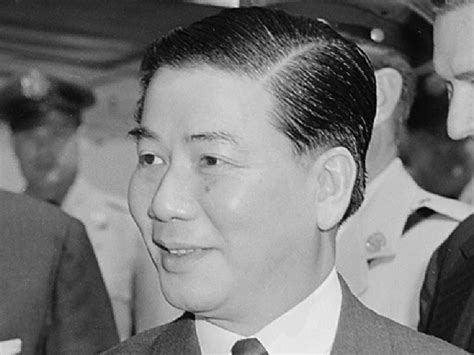
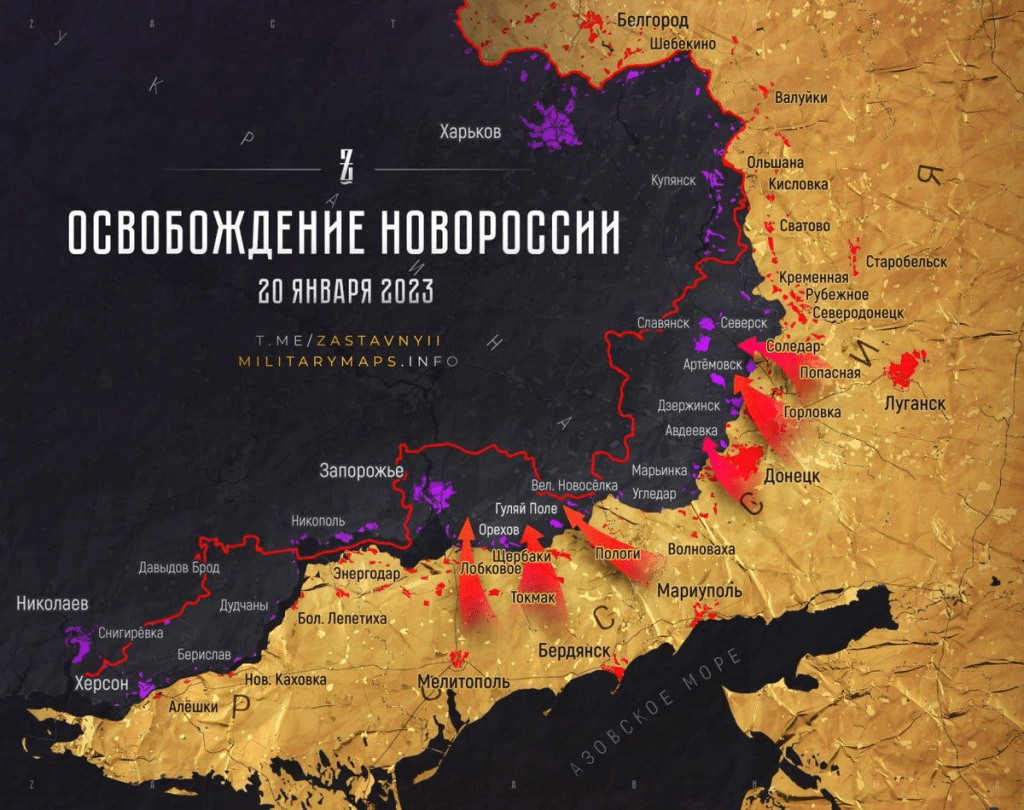
David Ignatius (lead image, left) has been a career-long mouthpiece for the US State Department. He has just been called in by the current Secretary of State Antony Blinken (right) to convey an urgent new message to President Vladimir Putin, the Security Council, and the General Staff in Moscow.
For the first time since the special military operation began last year, the war party in Washington is offering terms of concession to Russia’s security objectives explicitly and directly, without the Ukrainians in the way.
The terms Blinken has told Ignatius to print appeared in the January 25 edition of the Washington Post. The paywall can be avoided by reading on.
The territorial concessions Blinken is tabling include Crimea, the Donbass, and the Zaporozhye, Kherson “land bridge that connects Crimea and Russia”. West of the Dnieper River, north around Kharkov, and south around Odessa and Nikolaev, Blinken has tabled for the first time US acceptance of “a demilitarized status” for the Ukraine. Also, US agreement to restrict the deployment of HIMARS, US and NATO infantry fighting vehicles, and the Abrams and Leopard tanks to a point in western Ukraine from which they can “manoeuvre…as a deterrent against future Russian attacks.”
This is an offer for a tradeoff – partition through a demilitarized zone (DMZ) in the east of the Ukraine in exchange for a halt to the planned Russian offensive destroying the fortifications, rail hubs, troop cantonments, and airfields in the west, between the Polish and Romanian borders, Kiev and Lvov, and an outcome Blinken proposes for both sides to call “a just and durable peace that upholds Ukraine’s territorial integrity”.
Also in the proposed Blinken deal there is the offer of a direct US-Russian agreement on “an eventual postwar military balance”; “no World War III”; and no Ukrainian membership of NATO with “security guarantees similar to NATO’s Article 5.”
Blinken has also told the Washington Post to announce the US will respect “Putin’s tripwire for nuclear escalation”, and accept the Russian “reserve force includ[ing] strategic bombers, certain precision-guided weapons and, of course, tactical and strategic nuclear weapons.”
President Putin has offered a hint of the Russian reply he discussed with the Stavka and the Security Council last week.
Putin told a meeting with university students on Wednesday, hours after Blinken’s publication. “I think that people like you,” the president said, “most clearly and most accurately understand the need for what Russia is now doing to support our citizens in these territories, including Lugansk, Donetsk, the Donbass area as a whole, and Kherson and Zaporozhye. The goal, as I have explained many times, is primarily to protect the people and Russia from the threats that they are trying to create for us in our own historical territories that are adjacent to us. We cannot allow this. So, it is extremely important when young people like you defend the interests of their small and large Motherland with arms in their hands and do so consciously.”
Read on, very carefully, understanding that nothing a US official says, least of all through the mouths of Blinken, Ignatius, and the Washington Post is trusted by the Russians; and understanding that what Putin and the Stavka say they mean by Russia’s “adjacent historical territories” and the “small and large Motherland” has been quite clear.
Follow what Blinken told Ignatius to print, before Putin issued his reply. The propaganda terms have been highlighted in bold to mean the opposite — the public positions from which Blinken is trying to retreat and keep face.
January 25, 2023 Blinken ponders the post-Ukraine-war order By David Ignatius
The Biden administration, convinced that Vladimir Putin has failed in his attempt to erase Ukraine, has begun planning for an eventual postwar military balance that will help Kyiv deter any repetition of Russia’s brutal invasion.
Secretary of State Antony Blinken outlined his strategy for the Ukrainian endgame and postwar deterrence during an interview on Monday at the State Department. The conversation offered an unusual exploration of some of the trickiest issues surrounding resolution of a Ukraine conflict that has threatened the global order.
Blinken explicitly commended Germany’s military backing for Ukraine at a time when Berlin is getting hammered by some other NATO allies for not providing Leopard tanks quickly to Kyiv. “Nobody would have predicted the extent of Germany’s military support” when the war began, Blinken said. “This is a sea change we should recognize.”
He also underlined President Biden’s determination to avoid direct military conflict with Russia, even as U.S. weapons help pulverize Putin’s invasion force. “Biden has always been emphatic that one of his requirements in Ukraine is that there be no World War III,” Blinken said.
Russia’s colossal failure to achieve its military goals, Blinken believes, should now spur the United States and its allies to begin thinking about the shape of postwar Ukraine — and how to create a just and durable peace that upholds Ukraine’s territorial integrity and allows it to deter and, if necessary, defend against any future aggression. In other words, Russia should not be able to rest, regroup and reattack.
Blinken’s deterrence framework is somewhat different from last year’s discussions with Kyiv about security guarantees similar to NATO’s Article 5. Rather than such a formal treaty pledge, some U.S. officials increasingly believe the key is to give Ukraine the tools it needs to defend itself. Security will be ensured by potent weapons systems — especially armor and air defense — along with a strong, noncorrupt economy and membership in the European Union.
The Pentagon’s current stress on providing Kyiv with weapons and training for maneuver warfare reflects this long-term goal of deterrence. “The importance of maneuver weapons isn’t just to give Ukraine strength now to regain territory but as a deterrent against future Russian attacks,” explained a State Department official familiar with Blinken’s thinking. “Maneuver is the future.”
The conversation with Blinken offered some hints about the intense discussions that have gone on for months within the administration about how the war in Ukraine can be ended and future peace maintained. The administration’s standard formula is that all decisions must ultimately be made by Ukraine, and Blinken reiterated that line. He also backs Ukraine’s desire for significant battlefield gains this year. But the State Department, Pentagon and National Security Council are also thinking ahead.
Crimea is a particular point of discussion. There is a widespread view in Washington and Kyiv that regaining Crimea by military force may be impossible. Any Ukrainian military advances this year in Zaporizhzhia oblast, the land bridge that connects Crimea and Russia, could threaten Russian control. But an all-out Ukrainian campaign to seize the Crimean Peninsula is unrealistic, many U.S. and Ukrainian officials believe. That’s partly because Putin has indicated that an assault on Crimea would be a tripwire for nuclear escalation.
The administration shares Ukraine’s insistence that Crimea, which was seized by Russia in 2014, must eventually be returned. But in the short run, what’s crucial for Kyiv is that Crimea no longer serve as a base for attacks against Ukraine. One formula that interests me would be a demilitarized status, with questions of final political control deferred. Ukrainian officials told me last year that they had discussed such possibilities with the administration.
As Blinken weighs options in Ukraine, he has been less worried about escalation risks than some observers. That’s partly because he believes Russia is checked by NATO’s overwhelming power. “Putin continues to hold some things in reserve because of his misplaced fear that NATO might attack Russia,” explained the official familiar with Blinken’s thinking. This Russian reserve force includes strategic bombers, certain precision-guided weapons and, of course, tactical and strategic nuclear weapons.
Blinken’s refusal to criticize Germany on the issue of releasing Leopard tanks illustrates what has been more than a year of alliance management to keep the pro-Ukraine coalition from fracturing. Blinken has logged hundreds of hours — on the phone, in video meetings and in trips abroad — to keep this coalition intact.
This cohesiveness will become even more important as the Ukraine war moves toward an endgame. This year, Ukraine and its allies will keep fighting to expel Russian invaders. But as in the final years of World War II, planning has already begun for the postwar order — and construction of a system of military and political alliances that can restore and maintain the peace that Russia shattered.
Click to follow Putin’s remarks in the official Kremlin translation.
Highlighted in bold type in Blinken’s text is the phrase, “a strong, noncorrupt economy and membership in the European Union”. This is Blinken’s message to the Kremlin that the US wants to preserve Ukraine’s agricultural economy, its grain export ports, and the trade terms agreed with the European Union before the war. It is also Blinken’s acknowledgement that Vladimir Zelensky’s move early this week to force the resignations and dismissals of senior officials means the US is calling the shots in Kiev and Lvov.
Nothing is revealed in Blinken’s offer “for the Ukrainian endgame and postwar deterrence” of how, and who on the US and Russian sides, to negotiate directly on the particulars. Instead, there is the hint that if the Russians agree to trust the Americans and delay the planned offensive, and if they allow the rail lines to remain open between Poland and Lvov, the Americans will reciprocate by keeping the Abrams and Leopard tank deliveries in verifiable laagers west of Kiev.
As Russian officials have been making clear for months, no US terms of agreement can be trusted on paper, and nothing at all which Blinken says. A well-informed independent military analyst comments on the Russian options:
“The best response is continue the special military operation, destroy the Ukrainian military in their present pockets, complete de-electrification and destruction of the logistics, then either take everything east of the Dnieper or establish a de facto DMZ, including Kharkov. Blinken and the others cannot be trusted to follow through if they think they have a chance to stall for time. The Ukrainian Nazis are conspicuously absent from this proposal – and they remain to be dealt with. We know there will be no end to trouble if the Russian de-nazification objective against them stops now.”
The decline of a currency’s world reserve status is often a long process rife with denials. There are numerous economic “experts” out there that have been dismissing any and all warnings of dollar collapse for years. They just don’t get it, or they don’t want to get it. The idea that the US currency could ever be dethroned as the defacto global trade mechanism is impossible in their minds.
One of the key pillars keeping the dollar in place as the world reserve is its petro-status, and this factor is often held up as the reason why the Greenback cannot fail. The other argument is that the dollar is backed by the full force of the US military, and the US military is backed by the US Treasury and the Federal Reserve – In other words, the dollar is backed by…the dollar; it’s a very circular and naive position.
These sentiments are not only pervasive among mainstream economists, they are also all over the place within the alternative media. I suspect the main hang-up for liberty movement analysts is the notion that the globalist establishment would ever allow the dollar or the US economy to fail. Isn’t the dollar system their “golden goose”?
The answer is no, it is NOT their golden goose. The dollar is just another stepping stone towards their goal of a one-world economy and a one-world currency. They have killed the world reserve status of other currencies in the past, why wouldn’t they do the same to the dollar?
Globalist white papers and essays specifically outline the need for a diminished role for the US currency as well as a decline in the American economy in order to make way for Central Bank Digital Currencies (CBDCs) and a new global currency system controlled by the IMF. I warned about this years go, and my position has always been that the derailment of the dollar would likely start with the end of its petro status.
In 2017 I published an article titled ‘Saudi Coup Signals War And The New World Order Reset’. I noted at the time that the sudden power shift over to crown prince Mohammed Bin Salman indicated a change in Saudi Arabia’s relationship to the US. I stated that:
“To understand how drastic this coup has been, consider this — for decades Saudi Kings maintained political balance by doling out vital power positions to separate, carefully chosen successors. Positions such as Defense Minister, the Interior Ministry and the head of the National Guard. Today, Mohammed Bin Salman controls all three positions. Foreign policy, defense matters, oil and economic decisions and social changes are now all in the hands of one man.”
The rise of MBS was backed by the Public Investment Fund (PIF), a fund comprised of trillions of dollars supplied by globalists within Carlyle Group (Bush family, etc.), Goldman Sachs, Blackstone and Blackrock. MBS garnered the favor of the globalists for one specific reason – He openly supported their “Vision For 2030”, a plan for the dismantling of “fossil fuel” based energy and the implementation of carbon controls. Yes, that’s right, the head of Saudi Arabia is backing the eventual end of oil based energy, and part of that includes the end of the dollar as the petro currency.
In exchange for their cooperation, the Saudis are being given access to ESG-like funding as well as access to AI advancements and the so-called “digital economy.” It sounds crazy, but there is much talk of AI developments to cure numerous health problems and extend lifespan. With those kinds of promises, it’s not surprising that Saudi elites would be willing to dump the dollar and even oil.
In 2017 I noted that:
“I believe the next phase of the global economic reset will begin in part with the breaking of petrodollar dominance. An important element of my analysis on the strategic shift away from the petrodollar has been the symbiosis between the U.S. and Saudi Arabia. Saudi Arabia has been the single most important key to the dollar remaining as the petrocurrency from the very beginning.”
I believed that the threat to petro status would ultimately be spurred on by a proxy war between East and West:
“World economic war is the real name of the game here, as the globalists play puppeteers to East and West. It is a geopolitical crisis they will have created to engineer public support for a solution they predetermined.”
Back then I thought that such a proxy war would be initiated in the Middle East, possibly in Iran. However, it’s clear that Ukraine is the powderkeg the globalists have chosen, at least for now, with Taiwan being the next shoe to drop.
In the years since I made these predictions the relationship between Saudi Arabia, Russia and China has grown very close. Arms deals and energy deals are becoming a mainstay of trade and this has led to a quiet but steady distancing of the Saudis from the dollar. This past week, the dominoes were set in motion for dollar collapse when Saudi Arabia announced at Davos that they are now willing to trade oil in alternative currencies.
In response, Xi Jinping pledged to ramp up efforts to promote the use of the Chinese yuan in energy deals. This falls in line with another article I wrote in 2017 titled ‘The Economic End Game Continues,’ in which I described how conflict with Eastern nations (China and Russia) would be exploited to create a catalyst for the end of the dollar’s petro status.
The importance of the Saudi announcement cannot be overstated; this is the beginning of the end of the dollar. The dollar’s world reserve status is largely dependent on its petro-status. Without one, you cannot have the other. This is almost the exact same dynamic that led to the implosion of the British Sterling decades ago as the global petro currency which resulted in the rise of the dollar to take its place.
This time, though, it will not be a single foreign currency that takes on the role of world reserve, it will be a basket currency system controlled by the IMF called Special Drawing Rights, along with a single global digital currency that is yet to be named but is now under development.
The consequences of the loss of reserve status will be devastating to the US economy. It is the only glue holding our system together – The ability to defer inflation by exporting it overseas is a superpower only the US enjoys. The Fed can print money perpetually if it wants to in order to fund the government or prop up US markets, as long as foreign central banks and corporate banks are willing to absorb dollars as a tool for global trade. If the dollar is no longer the primary international trade mechanism, the trillions upon trillions of dollars the Fed has created from thin air over the years will all come flooding back to the US through various avenues, and hyperinflation (or hyperstagflation) will be the result.
This dynamic is already in play, as foreign holders of US debt and dollars have been dumping them at record pace since 2017. The process continues at a time when the Federal Reserve is cutting it’s balance sheet and raising interest rates, which means there is no longer a buyer of last resort.
This may be why multiple foreign central banks have renewed their purchases of gold reserves and are once again stockpiling precious metals. They seem to be well aware of what is about to happen to the dollar, while the American public is kept in the dark.
The effects of the decline of the dollar may not be immediately felt, or become obvious for another year or two. What will happen is consistent inflation on top of the high prices we are already dealing with. Meaning, the Federal Reserve will continue to hold interest rates higher and prices will barely budge or they may climb in spite of monetary tightening. Even in the face of a major recessionary contraction, which I predict will be triggered starting in April, prices will STILL remain higher.
All the while the mainstream media and government economists will say they have “no idea” why inflation is so persistent, and that “nobody could have seen this coming.” Some of us saw it coming, but only because we accept the reality that the dollar’s days are numbered.
By the summer of 1963, there were growing doubts about the ability of the Diem government to prosecute the war against the Vietcong. With the war turning badly, the CIA overthrew Diem, then President of the Republic of Vietnam, and installed a military government in his place.
3 weeks later, some say a CIA “Dirty Tricks” team participated in the Kennedy assassination.
Hold that thought a moment.
Right, so there’s a big purge going on in Kiev today—and ongoing purge that will ripple through the Ukro-Nazi regime for a few days. It began under the heading of an anti-corruption drive. An anti-corruption drive in Ukraine is something like a classified documents security crackdown in the US (h/t GT640Z)—a traditional way of removing officials who are viewed, for one reason or another, as a nuisance:
Here’s Babylon Bee with breaking news reporting on “nuisance removal””
Batch Of Classified Documents Found On Walmart Clearance Shelf
SMYRNA, DE — Biden is once again embroiled in scandal after yet another box of his classified documents was found on the clearance shelf of a local Walmart.
The top secret documents were seen next to a $1 clearance bin filled with DVDs of Alexandria Ocasio-Cortez’s documentary on the Green New Deal.
“The investigation into President Biden’s misplacement of classified documents has reached a tipping point in which our agency is unable to cover for him by blaming Trump,” said FBI spokesman Herf Derfler while agents hauled off boxes of classified documents from the location.
“We’re poring over security footage,” continued Derfler, “While we cannot divulge much, we are seeing video evidence that Hunter Biden frequented this location to make random purchases of pseudoephedrine, ether, paint thinner, ammonia, drain cleaner, and batteries. Totally random buys.”
At publishing time, President Biden had made a visit to the local Walmart to assure citizens that the investigation of classified documents was over, then donned a Walmart vest and began greeting customers entering the store.
Hilarious.
Anyway, back to the present in Vietnam, err, Ukraine and Meaning in History
**********
The purge began within days of CIA Director Burns’ crash visit to Kiev, supposedly to brief Zelensky on Russia’s planned moves. The reality is that many of the purged officials constitute Zelensky’s inner circle of advisers. Presumably Burns went to Kiev to inform Zelensky that the US was taking over direct direction, and to brief Zelensky on what his new role would be. Interestingly, the last I heard of Zelensky’s whereabouts he was in Boca Raton. Maybe he’s back in Kiev today, but he was out of country for a while.
What it actually looks like is the US’s traditional reaction to foreign wars going badly—take control of the proxy government via some sort of coup. In retrospect, we probably could have seen see this one coming. The US recently ordered Zelensky to withdraw Ukrainian forces from Bakhmut—a “death pit” created by Russia for the Ukrainian forces. That order was supported by the Ukrainian military chief, General Zaluzhny, and Zelensky’s refusal to follow orders followed a pattern of such behavior. My speculation is that Zelensky was following the advice of his inner circle of advisers in defying US orders and the US Deep State got fed up.
At this stage, going full Diem on Zelensky isn’t really an option. Instead, as the two Alexes—Mercouris and Christoforou—suggest, the US is moving to isolate Zelensky from his former advisers and to ring him round with officials who will follow orders and will make sure Zelensky does, too. The new in-crowd will probably include Zaluzhny. Here’s their hour long discussion:
Here’s the core of what they’re saying:
Mercouris: [5:20] Whatever explanation there is for all these moves, … one way or another it does suggest growing instability in Kiev. … in the early 60s in Saigon, as the Americans got more and more involved we saw some signs of instability there, eventually leading to a coup against the president of the country, President Diem. There’s beginning to be a feel something like that about this in Ukraine now. Purge–massive purge, I think purge is not the wrong word–of the entire military, political, security structure of Ukraine going on in the middle of a war. When the news from the battlefields is turning bad, and when the Americans are incredibly heavily involved, something is going on, something BIG is clearly going on, and it suggests growing instability in Kiev.
Christoforou: Yeah, the excuse they gave for Burns visit was that they wanted to brief Zelensky on Russia’s next military moves, which is absolutely ridiculous. …
Mercouris: Absolutely. It’s nonsense. …
Christoforou: So the question is, what’s going on? When stuff like this happens, does this mean that they’re trying to consolidate control around Zelensky, or are they looking to remove control from around Zelensky and perhaps fill it with some sort of new government? …
Mercouris: I don’t think this is a good look for Zelensky. [The people who were sacked] were people who were very close to him. … It looks to me like somebody is trying to tighten control of the Ukrainian government because they feel that things are going badly wrong … [Goes on to speculate that Zelensky will ultimately be purged, like Diem.]
There’s lots more interesting discussion, including Boris Johnson’s recent visit and the somewhat mysterious recent helicopter crash which removed the top security leadership. Mercouris states that there are theories that the UK is supportive of Zelensky, not so much of Zaluzhny—so, a difference between the US and the UK.
Obviously we’ll need to see how this plays out. It doesn’t bode well for Ukraine. Purges in the middle of a war? Rarely a good idea, no matter what, and especially when the purge is directed by a foreign power.
But here’s what interests me more particularly. This is all going on at a time when Zhou is under sustained fire—from sources unknown. Liz Peek was speculating on who’s behind Garage Gate—the great new parlor game in DC—but it seems that nobody has any really good theory. My view remains that, the way this is going, suggests coordination among several influential players. We started with improper storage of classified docs. That was followed by more discoveries over a period of days. We’re now moving into the discovery of possible connections between those docs and the activities of the Biden Family Criminal Enterprise. Influential senators are cutting loose from Zhou, and the drip, drip, drip continues.
Readers will recall that my original theory was that the Deep State, understanding that the Ukraine proxy war against Russia is an existential crisis for the US, with ramifications around the world—especially for the hegemony of King Dollar, on which the American Empire’s dominance rests. That war on Russia was supposed to be over in weeks, leaving Russia—and Putin, most particularly—utterly crushed. A waste of space POTUS like Zhou might have been serviceable in that scenario, but we all know that that’s not what has transpired. Russia is going from strength to strength—militarily, politically, and above all economically. Saudi Arabia chose the Davos Forum as the venue to, basically, announce the end of the petro-dollar. My view was that the Deep State decided that they couldn’t address this metastasizing crisis with Zhou in the Oval Office. At some point, in a world war, from a constitutional standpoint, you cannot do without an effective CinC.
I still believe that something like this is driving the move to remove Zhou. If so, that’s not necessarily good news—depending on who’s behind it. If the civilian national security structure—the Neocons—are driving the move against Zhou, that could presage a doubling down of US involvement in Ukraine against Russia. That’s what unfolding events in Kiev suggest. How will the uniformed US military react? We don’t really know.
Later in the Duran video, Mercouris points out that all the tanks being talked up won’t be ready for deployment until summer—but Ukraine faces an operational crisis in the war RIGHT NOW. This is undoubtedly true, and lends credence to my theory—whoever is the moving force behind it all. Now, today MoA discusses some of this:
**********
Ukraine SitRep – No Southern Push Yet, Kiev Government Trouble, Tanks And Escalation
Last week, following two days of heavy fighting along the southern front in Ukraine, I concluded that the expected push from the south into the back of the Ukrainian forces at the Donetzk frontline, was finally happening.
I was wrong. I, and other analysts following the war, had been deceived by the sudden rush of news from that frontline. It said that Russian forces made progress in a large number of towns. But nearly as soon as I had published my peace that news died down. In the following days nothing happened but the usual exchange of artillery fire and minor local clashes.
I am not sure what happened. But the Ukrainian army also seemed to have believed that something big was coming as it had rushed an additional mechanized brigade to that line.
While the big one has not happened yet there are several probing attacks in the area with some successes around Vuhledar.
Dima of the Military Summary channel noted (vid) a Russian report which said that two Ukrainian officers had crossed the southern frontline and surrendered to Russian forces. He speculates that the whole fluff up in the news was created as a diversion to allow for a secure extraction of those officers. We have no evidence for that but it may well have happened that way.
It is interesting that this was followed by additional government turmoil in Kiev as another senior advisor of president Zelensky, the deputy head of his office Kyrylo Tymoshenko, resigned. Additionally several deputy ministers and oblast governors were fired:
Deputy Defence Minister Vyacheslav Shapovalov also resigned, following reports he oversaw the purchase of military food supplies at inflated prices from a relatively unknown firm. The department called this a “technical mistake” and claimed no money had changed hands.
The defence minister himself – Oleksii Reznikov – has been under scrutiny for the same reason.
A host of other top officials were dismissed on Tuesday, including:
Deputy Prosecutor General Oleskiy Symonenko
Deputy Minister for Development of Communities and Territories Ivan Lukerya
Deputy Minister for Development of Communities and Territories Vyacheslav Negoda
Deputy Minister for Social Policy Vitaliy Muzychenko
And the regional governors of Dnipropetrovsk, Zaporizhzhia, Kyiv, Sumy and Kherson
I urge people to be careful with corruption allegations in Ukraine. These often come from the extralegal National Anti-Corruption Bureau of Ukraine (NABU). The bureau was setup in 2014, after the Maidan coup. It was created and controlled by the U.S. embassy. NABU was used in various power plays to remove people who the embassy disliked.
In 2020 the supreme court of Ukraine ruled that NABU was outside of the law and should not have the investigative powers it assumed. This came after NABU had investigated several supreme court judges in anti-corruption cases. That fight between two camps of power in Ukraine led to a constitutional crisis.
A year later Zelensky fired the leading supreme court judge who had written the opinion on NABU. The judge appealed the decision and the court took his side. The conflict remains unresolved. The judge fled to Austria where he is now threatened with arrest under a Ukrainian warrant.
There are many of such little reported power plays in Kiev with Zelensky moving more and more into a dictatorial role. Over time his position will become very lonely.
But in the east the battle continues and Ukraine keeps losing the war. The Telegram channel Intel Slava Z notes:
Prigozhin on the objectives of the actions of PMC “Wagner” in the Artemovsk region.
“The task of taking Bakhmut is to destroy the Ukrainian army in the vicinity of the city and prevent any offensive actions in any direction of the front. All of their combat-ready units of the Armed Forces of Ukraine are sent to Bakhmut. And PMC “Wagner” destroys them, opening up operational opportunities in other areas”
I count the equivalent of some 27 brigade size formations in that area. The usual size of a brigade is some 3,000 to 4,000 men with hundreds of all kinds of vehicles. If all brigades had their full strength that force would count as 97,500 men. In a recent interview the Ukrainian military commander Zaluzhny said that his army has 200,000 men trained to fight with 500,000 more having other functions or currently being trained. The forces which are currently getting mauled in the Bakhmut area constitute 50% of Ukraine’s battle ready forces.
Russian forces took control of the city of Bakhmut almost a year ago after Moscow opened a phase of the war that focused on territories in the Donbas, the far eastern corner of Ukraine comprised of the Luhansk and Donetsk oblasts.
Recent successes by Ukrainian fighters in the Bakhmut area have prompted Moscow to send in reinforcements, said the senior U.S. military official who spoke on condition of anonymity. U.S. and Ukrainian officials have said Ukrainian troops are presently in control of Bakhmut, though Moscow claimed this week that its forces have taken control of a nearby salt-mining town, Soledar.
“Ukraine forces continue to successfully hold and defend Bakhmut,” the U.S. military official said, adding the new Russian troops are being “rushed” to the battlefield “ill trained” and “ill equipped.”
To read such nonsense in the Stars and Stripes, a newspaper for the U.S. military, is quite revealing. Can these people even read a map?
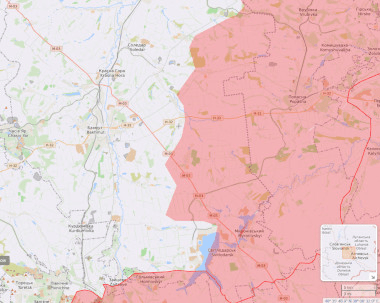
Bakhmut has never been under the Russian forces control. This was the situation near Bakhmut 6 months ago. The Russian held territory is red.
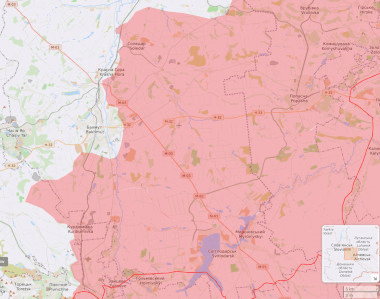
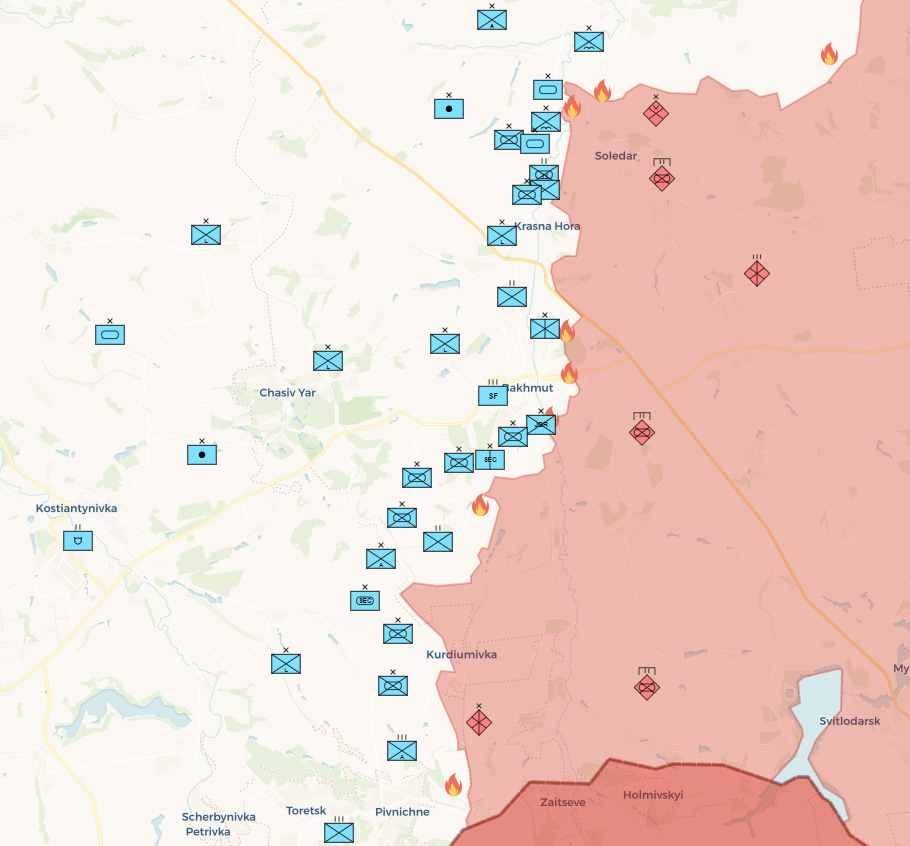
This is the current situation around Bakhmut. The city is nearly encircled. All major roads leading in and out are under Russian artillery control.\
It is a big meat grinder. The German intelligence service BND says that the Ukrainian forces lose hundreds of soldiers per day in that city alone. The Russian defense ministry does not report on Bakhmut as that is Wagner’s territory. But it daily reports if additional hundreds of losses on the Ukrainian side.
In a useless attempt to stop the steady drain of Ukrainian forces the ‘west’ is moving additional weapons into Ukraine. The U.S. wants to unlock the transfer of tanks by other countries to Ukraine by delivering parts of its own tank reserves:
The Biden administration is leaning toward sending a significant number of Abrams M1 tanks to Ukraine and an announcement of the deliveries could come this week, U.S. officials said.
The announcement would be part of a broader diplomatic understanding with Germany in which Berlin would agree to send a smaller number of its own Leopard 2 tanks and would also approve the delivery of more of the German-made tanks by Poland and other nations. It would settle a trans-Atlantic disagreement over the tanks that had threatened to open fissures as the war drags into the end of its first year.
The White House declined to comment. … The shift in the U.S. position follows a call on Jan. 17 between President Biden and German Chancellor Olaf Scholz in which Mr. Biden agreed to look into providing the Abrams tanks against the judgment of the Pentagon. A senior German official said that the issue had been the subject of intense negotiation between Washington and Berlin for more than a week and appeared to be on the way to resolution. … Previously, the Pentagon had ruled out providing the tanks to Ukraine, saying they were too complicated for the Ukrainians to maintain and operate. But White House and State Department officials were described as being more open to providing Abrams to break the diplomatic logjam holding up Leopard deliveries.
U.S. Joint Chiefs Chair Milley and Defense Secretary Austin have been against any tank delivery. They are afraid of the consequences of this steady mission creep. The Biden administration steadily blows through each of its own red lines. Biden had started out by declaring that the U.S. would only deliver defensive weapons. Then came HIMARS and other longer range weapons that hit targets in Russia. Delivering tanks was a red line. What will come next? Fighter planes that have no chance to defeat superior Russian air defenses?
They military are not alone in their fear. The Science and Security Board Bulletin of the Atomic Scientists moved the hands of its Doomsday Clock:
The Clock now stands at 90 seconds to midnight—the closest to global catastrophe it has ever been.
Biden is in a bind. He started a war that he is not allowed to lose because losing in Ukraine will come with the loss of U.S. financial hegemony:
The Biden Team cannot withdraw its fantastical narrative of Russia’s imminent humiliation; they have bet the House on it. Yet it has become an existential issue for the U.S. precisely because of this egregious initial miscalculation that has been subsequently levered-up into a preposterous narrative of a floundering, at any moment ‘collapsing’ Russia. … This evolving New Order existentially threatens dollar hegemony – the U.S. created its hegemony through demanding that oil (and other commodities) be priced in dollars, and by facilitating a frenetic financialisation of asset markets in the U.S. It is this demand for dollars which alone has allowed the U.S. to fund its government deficit (and its defence budget) for nothing. … Team Biden thus has painted the U.S. into a tight Ukraine ‘corner’. But at this stage – realistically – what can the White House do? It cannot withdraw the narrative of Russia’s ‘coming humiliation’ and defeat. They cannot let the narrative go because it has become an existential component to save what it can of the ‘Ponzi’. To admit that Russia ‘has won’ would be akin to saying that the ‘Ponzi’ will have to ‘close the fund’ to further withdrawals (just as Nixon did in 1971, when he shut withdrawals from the Gold window).
Commentator Yves Smith has provocatively argued, ‘What if Russia decisively wins – yet the western press is directed to not notice?’ Presumably, in such a situation, the economic confrontation between the West and New Global Order states must escalate into a wider, longer war.
The U.S. government is hostage to its financial hegemony in a way that is rarely fully understood.
As is usual, the article is fairly lengthy, but I want to quote several especially telling passages. What Crooke is talking about is America’s existential crisis—which is also, please note, a crisis of identity. If I’m correct, then what’s driving events both in DC and Kiev, is the realization on the part of the Neocons that they’ve screwed up—egregiously. But they’re fighting against that realization.
Washington dares not – indeed cannot – yield on dollar primacy, the ultimate signifier for ‘American decline’. And so the U.S. government is hostage to its financial hegemony in a way that is rarely fully understood.
The Biden Team cannot withdraw its fantastical narrative of Russia’s imminent humiliation; they have bet the House on it. Yet it has become an existential issue for the U.S. precisely because of this egregious initial miscalculation that has been subsequently levered-up into a preposterous narrative of a floundering, at any moment ‘collapsing’ Russia.
Yes, that’s the worldview of the smarty pants Neocons. Simplistic. Betraying the triumph of ideology over insight into reality—the hallmark of the modern West. The triumph of Will over Reason: we want it to be true, so it must be true.
So why does this ‘failed expectation’ constitute such a world-shaking moment for our era? It is because the West fears that its miscalculation might well lead to the collapse of its dollar hegemony. But the fear extends well beyond that too – (bad as ‘that’ would be from the U.S. perspective).
Note that Crooke states the “the West fears … collapse of ITS dollar hegemony.” This dollar crisis is an existential crisis for the entire West, and NOT just the US, because King Dollar—until very recently—included a US beholden to the “offshore dollar” that is central to Tom Luongo’s Theory of Everything. That’s all changing, too, if Luongo is right—but the existential crisis in Ukraine is happening RIGHT NOW.
[Arch Neocon] Robert Kagan has outlined how external forward motion and the U.S.’ ‘global mission’ is the lifeblood of American internal polity – more than any equivocating nationalism, Professor Paul suggests. From the founding of the country, the U.S. has been an expansionary republican empire; without this forward motion, civic bonds of domestic unity come into question.If Americans are not united for expansionary republican greatness, by what purpose Professor Paul asks, are all these fissiparous races, creeds, and cultures in America, bound together? (Woke culture has proved no solution, being divisive rather than any pole around which unity can be built).
The point here is that Russian Resilience, at a single stroke, shattered the plate-glass floor to western convictions about its ability to ‘manage the world’. After the several western debacles centred on regime-change by military shock-and-awe, even hardened neo-cons – by 2006 – had conceded that a weaponised financial system was the only means to ‘secure the Empire’.
King Dollar weaponized—The key to Global Empire. There you have it. But please reread what Crooke is writing about the fragile unity of American society.
‘War – is the ultimate test – and Great Revealer’ (per Todd).
…
Here, we return to the ‘Egregious Miscalculation’. This evolving New Order existentially threatens dollar hegemony – the U.S. created its hegemony through demanding that oil (and other commodities) be priced in dollars, and by facilitating a frenetic financialisation of asset markets in the U.S. It is this demand for dollars which alone has allowed the U.S. to fund its government deficit (and its defence budget) for nothing.
In this respect, this highly financialised dollar paradigm possesses qualities reminiscent of a sophisticated Ponzi scheme: It pulls in ‘new investors’, attracted by zero-cost credit leverage and the promise of ‘assured’ returns (assets pumped ever upwards by Fed liquidity). But the lure of ‘assured returns’ is tacitly underwritten by the inflation of one asset ‘bubble’ after another, in a regular sequence of bubbles – inflated at zero cost – before being finally ‘dumped’. The process then, is ‘rinsed and repeated’ ad seriatim.
Here is the point: Like a true Ponzi, this system relies on constant, and ever more, ‘new’ money coming into the scheme, to offset ‘payments out’ (financing U.S. government expenditure). Which is to say, U.S. hegemony now depends on constant overseas dollar expansion.
And, as with any pure Ponzi, once ‘money in’ falters, or redemptions spike, the scheme collapses.
…
Washington [the Neocons] clearly made a stratospherically bad error in thinking that sanctions – and the assumed collapse of Russia – would be a ‘slam dunk’ outcome; one so self-evident that it required no rigorous ‘thinking through’.
Team Biden thus has painted the U.S. into a tight Ukraine ‘corner’. But at this stage – realistically – what can the White House do? It cannot withdraw the narrative of Russia’s ‘coming humiliation’ and defeat. They cannot let the narrative go because it has become an existential component to save what it can of the ‘Ponzi’.
There’s lots more at the link. However, note that, according to Luongo’s Theory of Everything, the Fed and the NY Guys are consciously aiding this process of unwinding the Ponzi. Remember, Powell has openly stated that he is open to multiple reserve currencies. What they understand is that the US does, in fact, possess the resources to come through a drastic economic restructuring and find itself on a firmer foundation. We can hope. Hope is based on reason. There are reasons to believe that this is possible, but the human factor is the real problem.
**********
Recall Kennedy was gunned down 3 weeks after the CIA overthrew Diem. Legend has it Kennedy resisted escalating in Vietnam and overthrowing Diem which caught up with him in Dallas.
LBJ stepped in and
And on that note, here’s a little Country Joe for you.
For those unfamiliar with military operation, Big Serge offers a nice primer most commissioned officers learn early in their careers. This one is set in the current Russo-Ukrainian War and the Russian “attrition strategy”.
This is pretty basic stuff and obvious to just about every former military officer I’ve spoken with. Yet, it is lost on millions.
The Minsk Agreement gave Ukraine 8 years to build up defenses from which they launched attacks on Russian nationals and would serve as a bastion for threatening Russia with tactical weapons. That’s the reality – stripped of any moral comments
As Russians With Attitude observes: “And those defensive lines are ~20km deep… Turns out it wasn’t a great idea to give them eight years to build all of this.”
Indeed.
For those of you who’ve been there, you know what I’m saying. For everyone else, enjoy your red pill.
Emphasis added in bold
**********
Since Russia’s surprise decision to voluntarily withdraw from west bank Kherson in the first week of November, there has been little in the way of dramatic changes to the frontlines in Ukraine. In part, this reflects the predictable late autumn weather in Eastern Europe, which leaves battlefields waterlogged and clogged with mud and greatly inhibits mobility. For hundreds of years, November has been a bad month for attempting to move armies any sort of significant distance, and like clockwork we started to see videos of vehicles stuck in the mud in Ukraine.
The return of static positional warfare, however, also reflects the synergistic effect of increasing Ukrainian exhaustion along with a Russian commitment to patiently attriting and denuding Ukraine’s remaining combat capability. They have found an ideal place to achieve this in the Donbas.
It has gradually become apparent that Russia is committed to a positional attritional war, as this maximizes the asymmetry of their advantage in ranged fires. There is an ongoing degradation of Ukraine’s warmaking ability which is allowing Russia to patiently maintain the current tempo, while it organizes its newly mobilized forces for offensive action in the coming year, setting the stage for cascading and unsustainable Ukrainian losses.
In Ernest Hemingway’s novel, The Sun Also Rises, a formerly wealthy, now down on his luck character is asked how he went bankrupt. “Two ways”, he replies, “gradually and then suddenly.” Someday we may ask how Ukraine lost the war and receive much the same answer.
Verdun Redux
It is safe to say that western regime media has set a very low standard for reporting on the war in Ukraine, given the extent to which the mainstream narrative is disconnected from reality. Even given these low standards, the way the ongoing battle in Bakhmut is being presented to the population is truly ludicrous. The Bakhmut axis is being spun to western audiences as a perfect synthesis of all the tropes of Russian failure: in a nutshell, Russia is suffering horrible casualties as it struggles to capture a small town with negligible operational importance. British officials, in particular, have been highly vocal in recent weeks insisting that Bakhmut has little to no operational value.
The truth is the literal opposite of this story: Bakhmut is an operationally critical keystone position in the Ukrainian defense, and Russia has transformed it into a death pit which compels the Ukrainians to sacrifice exorbitant numbers of men in order to hold the position as long as possible. In fact, the insistence that Bakhmut is not operationally significant is mildly insulting to the audience, both because a quick glance at a map clearly shows it at the heart of the regional road network, and because Ukraine has thrown a huge number of units into the front there.
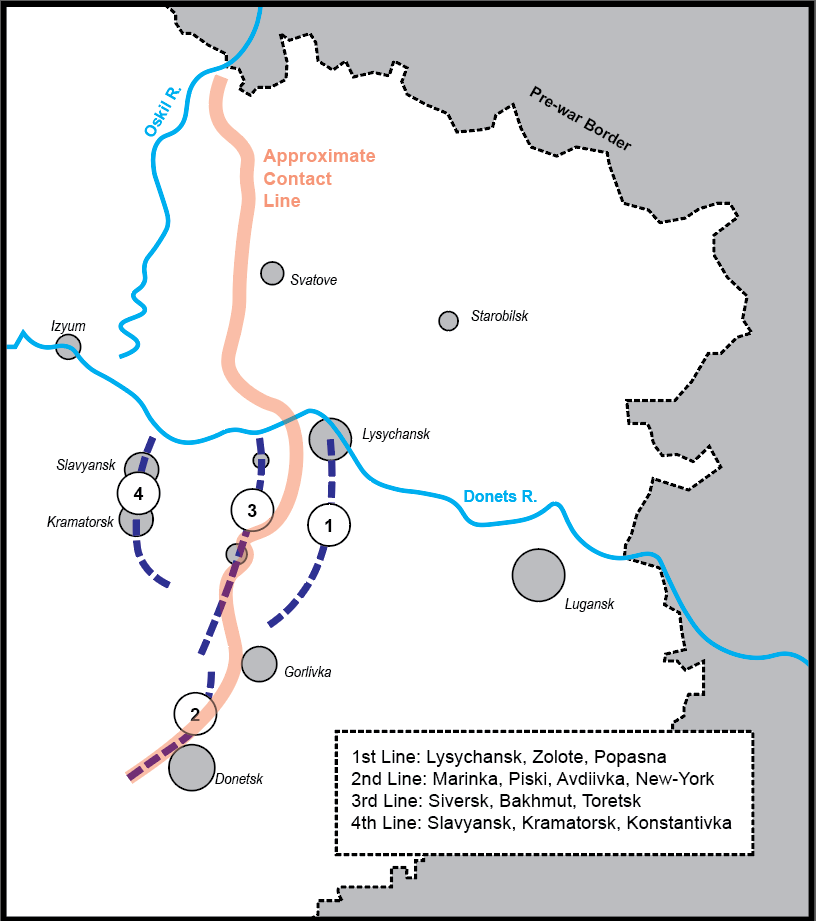
Let’s take a step back and consider Bakhmut in the context of Ukraine’s overall position in the east. Ukraine began the war with four operable defensive lines in the Donbas, built up over the last 8 years both as part and parcel of the simmering war with the LNR and DNR, but also in preparation for potential war with Russia. These lines are structured around urban agglomerations with road and rail links between each other, and can be roughly enumerated as follows:
Ukraine Defensive Lines in the East (Map by me)
The Donbas is a particularly accommodating place to construct formidable defenses. It is highly urbanized and industrial (Donetsk was the most urban oblast in Ukraine prior to 2014, with over 90% of the population living in urban areas), with cities and towns dominated by the typically robust Soviet buildings, along with prolific industrial complexes. Ukraine has spent much of the last decade improving these positions, and the frontline settlements are riddled with trenches and firing positions that are clearly visible on satellite imagery. A recent video from the Avdiivka axis demonstrates the extent of Ukrainian fortifications.
So, let’s review the state of these defensive belts. The first belt, which ran roughly from Severodonetsk and Lysychansk to Popasna, was broken in the summer by Russian forces. Russia achieved a major breakthrough at Popasna and was able to begin the full rollup of this line, with Lysychansk falling at the beginning of July.
At this point, the frontline sits directly on what I have labeled as the 2nd and 3rd Ukrainian defensive belts, and both of these belts are now heavily bleeding.
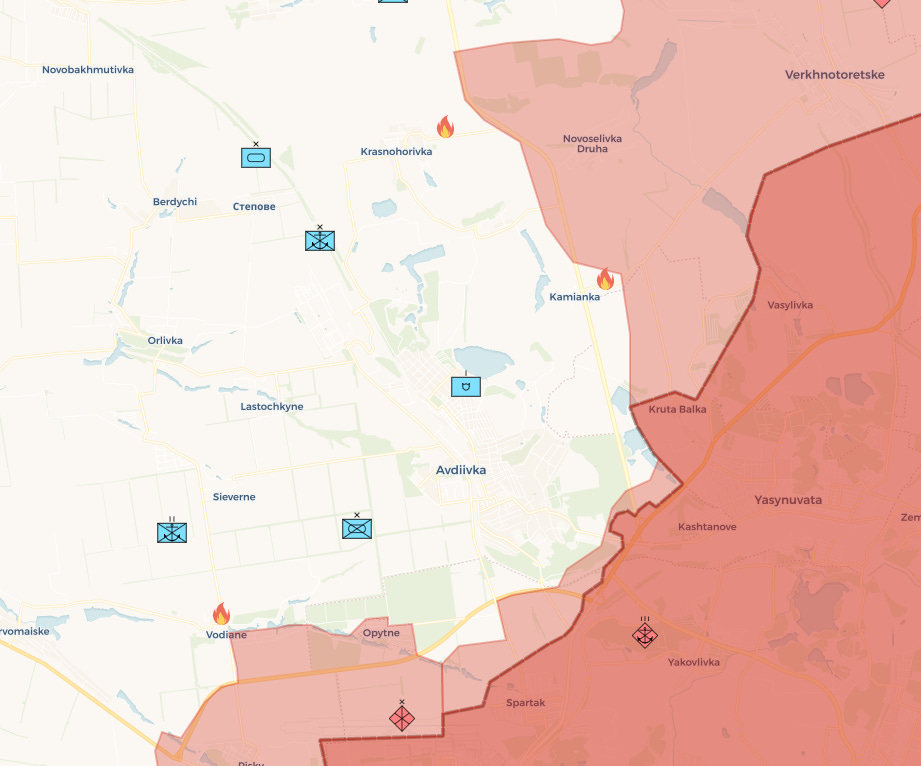
The capture of Soledar by Wagner forces has severed the connection between Bakhmut and Siversk, while around Donetsk, the heavily fortified suburb of Marinka has been almost completely cleared of Ukrainian troops, and the infamous keystone Ukrainian position in Avdiivka (the place from which they shell Donetsk city’s civilian population) is being flanked from both directions.
The frontline around Avdiivka (map courtesy of MilitaryLand)
These positions are absolutely critical for Ukraine to hold. The loss of Bakhmut will mean the collapse of the last defensive line standing in the way of Slavyansk and Kramatorsk, which means Ukraine’s eastern position will rapidly contract to its fourth (and weakest) defensive belt.
The Slavyansk agglomeration is a far worse position for Ukraine to defend than the other belts, for several reasons. First and foremost, as the belt farthest to the west (and thus the farthest from the February 2022 start lines), it is the least improved and least fortified of the belts. Secondly, lots of the, shall we just say “good stuff” around Slavyansk is to the east of the city, including both the dominating high ground and the major highways.
All this to say, Ukraine has been very anxious to hold the Bakhmut line, as this is a vastly preferable position to hold, and accordingly they have been pouring units into the sector. The absurd levels of Ukrainian force commitment in this area have been well noted, but just as a quick refresher, publicly available Ukrainian sources locate at least 34 brigade or equivalent units that have been deployed in the Bakhmut area. Many of these were deployed months ago and are already shattered, but over the full span of the ongoing battle this represents an astonishing commitment.
Ukrainian units around Bakhmut (Map courtesy of MilitaryLand)
Russian forces, primarily Wagner PMC and LNR units, have been slowly but surely collapsing this Ukrainian stronghold by making liberal use of artillery. In November, now former Zelensky advisor Oleksiy Arestovych admitted that Russian artillery on the Bakhmut axis enjoyed roughly a 9 to 1 tube advantage, which is turning Bakhmut into a death pit.
The battle is being presented in the west as one where Russians – usually stereotyped as convict soldiers employed by Wagner – launch frontal assaults on Ukrainian defenses and take horrible casualties attempting to overwhelm the defense with pure numbers. The opposite is much closer to the truth. Russia is moving slowly because it irons out Ukrainian defenses with artillery, then pushes forward cautiously into these pulverized defenses.
Ukraine, meanwhile, continues to funnel units in to more or less refill the trenches with fresh defenders. A Wall Street Journal piece about the battle, while trying to present a story of Russian incompetence, accidentally included an admission from a Ukrainian commander on the ground who said: “So far, the exchange rate of trading our lives for theirs favors the Russians. If this goes on like this, we could run out.”
The comparisons have been liberally made (and I cannot take credit for them) to one of the most infamous battles of World War One – the bloody catastrophe at Verdun. While it does not do to exaggerate the predictive value of military history (in the sense that a thorough knowledge of the first world war does not allow one to predict events in Ukraine), I am, however, a great fan of history as analogy, and the German scheme at Verdun is a useful analogy for what’s happening in Bakhmut.
The Battle of Verdun was conceived by the German high command as a way to cripple the French army by drawing them into a preconfigured meatgrinder. The notion was to attack and seize crucial defensive high ground – ground so important that France would be forced to counterattack and attempt to recapture it. The Germans hoped that France would commit their strategic reserves to this counterattack so that they could be destroyed. While Verdun failed to completely sap French combat power, it did become one of the most bloody battles in world history. A German coin commemorating the battle depicted a skeleton pumping blood out of the earth – a chilling but apt visual metaphor.
“The World Blood Pump” – commemorating the meatgrinder at Verdun
Something similar has indeed occurred in Bakhmut, in the sense that Russia is pressing on one of the most sensitive points on the front line, drawing Ukrainian units in to be killed. A few months ago, on the heels of Russia’s withdrawal from west bank Kherson, the Ukrainians talked ecstatically of continuing their offensive efforts with a strike southward in Zaparozhia to cut the land bridge to Crimea, along with continued efforts to break through into northern Lugansk. Instead, forces from both of these axes have been redirected to Bakhmut, to the point where this axis is actively draining Ukrainian combat strength in other areas. Ukrainian sources, previously full of optimism, now unequivocally agree that there will be no Ukrainian offensives in the near future. As we speak, Ukraine continues to funnel forces into the Bakhmut axis.
At the present moment, Ukraine’s position around Bakhmut has badly deteriorated, with Russian forces (largely Wagner infantry supported by Russian army artillery) making substantial progress on both of the city’s flanks. On the northern flank, the capture of Soledar pushed Russian lines to within spitting distance of the north-south highways, while the near simultaneous capture of Klishchiivka on the southern flank has propelled the frontlines to the dootstep of Chasiv Yar (firmly in Bakhmut’s operational rear).
The contact line around Bakhmut, Jauary 20, 2023 (Map by me)
The Ukrainians are not presently encircled, but the continued creep of Russian positions ever closer to the remaining highways is easily discernable. Currently, Russian forces have positions within two miles of all the remaining highways. Even more importantly, Russia now controls the high ground to both the north and south of Bakhmut (the city itself sits in a depression surrounded by hills) giving Russia fire control over much of the battle space.
I am currently anticipating that Russia will clear the Bakhmut-Siversk defensive line by late March. Meanwhile, the denuding of Ukrainian forces on other axes raises the prospect of decisive Russian offensives elsewhere.
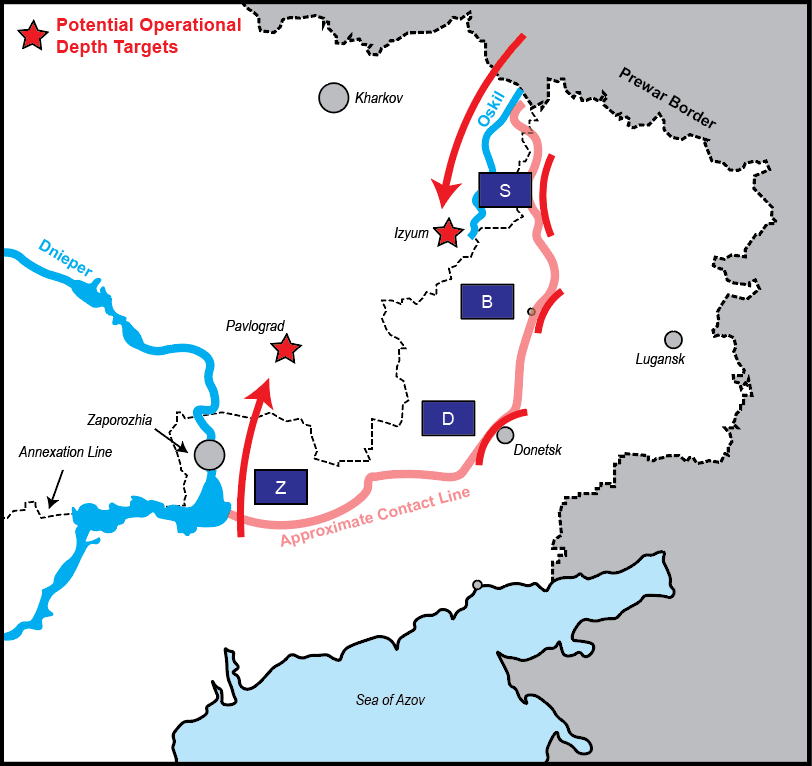
At the moment, the front roughly consists of four main axes (the plural of axis, not the bladed implement), with substantial agglomerations of Ukrainian troops. These consist, from south to north, of the Zaporozhia, Donetsk, Bakhmut, and Svatove Axes (see map below). The effort to reinforce the Bakhmut sector has noticeably diluted Ukranian strength on these other sectors. On the Zaporozhia front, for example, there are potentially as few as five Ukrainian brigades on the line at the moment.
At the moment, the majority of Russian combat power is uncommitted, and both western and Ukrainian sources are (belatedly) becoming increasingly alarmed about the prospect for a Russian offensive in the coming weeks. Currently, the entire Ukrainian position in the east is vulnerable because it is, in effect, an enormous salient, vulnerable to attack from three directions.
Two operational depth objectives in particular have the potential to shatter Ukrainian logistics and sustainment. These are, respectively, Izyum in the north and Pavlograd in the South. A Russian thrust down the west bank of the Oskil river towards Izyum would simultaneously threaten to cut off and destroy the Ukrainian grouping on the Svatove axis (S on the map) and sever the vital M03 highway from Kharkov. Reaching Pavlograd, on the other hand, would completely isolate the Ukrainian forces around Donetsk and sever much of Ukraine’s transit across the Dneiper.
The Big Serge Plan (Map by me)
Both Izyum and Pavlograd are roughly 70 miles from the start lines of a prospective Russian offensive, and thus offer a very tempting combination – being both operationally significant and in relatively manageable reach. Beginning yesterday, we started to see Russian advances on the Zaporozhia axis. While these consist, at the moment, mainly of reconnaissance in force pushing into the “grey zone” (that ambiguous interstitial frontage), RUMoD did claim several settlements taken, which could presage a genuine offensive push in this direction. The key tell would be a Russian assault on Orikhiv, which is a large town with a genuine Ukrainian garrison in it. A Russian attack here would indicate that something more than a probing attack is underway.
It is difficult sometimes to parse out the difference between what we predict will happen and what we want to happen. This, certainly, is what I would choose if I was in charge of Russian planning – a drive south along the west bank of the Oskil river on the Kupyansk-Izyum axis, and a simultanious attack northward past Zaporozhia towards Pavlograd. In this case, I believe simply screening Zaporozhia in the short term is preferable to getting bogged down in an urban battle there.
Whether Russia will actually attempt this, we do not know. Russian operational security is much better than either Ukraine’s or their proxy forces (Wagner and the LNR/DNR Milita), so we know significantly less about Russia’s deployments than we do about Ukraine’s. Regardless, we know that Russia enjoys a strong preponderance of combat power right know, and there are juicy operational targets within range.
Please Sir, I Want Some More
The bird’s eye view of this conflict reveals a fascinating meta-structure to the war. In the above section, I argue for a view of the front structured around Russia progressively breaking through sequential Ukrainian defensive belts. I think that a similar sort of progressive narrative structure applies to the force generation aspect of this war, with Russia destroying a sequence of Ukrainian armies.
Let me be a bit more concrete. While the Ukrainian military exists at least partially as a continuous institution, its combat power has been destroyed and rebuilt multiple times at this point through western assistance. Multiple phases – life cycles, if you will – can be identified:
In the opening months of the war, the extant Ukrainian army was mostly wiped out. The Russians destroyed much of Ukraine’s indigenous supplies of heavy weaponry and shattered many cadres at the core of Ukraine’s professional army.
In the wake of this initial shattering, Ukrainian combat strength was shored up by transferring virtually all of the Soviet vintage weaponry in the stockpiles of former Warsaw Pact countries. This transferred Soviet vehicles and ammunition, compatible with existing Ukrainian capabilities, from countries like Poland and the Czech Republic, and was mostly complete by the end of spring, 2022. In early June, for example, western sources were admitting that Soviet stockpiles were drained.
With Warsaw Pact stockpiles exhausted, NATO began replacing destroyed Ukrainian capabilities with western equivalents in a process that began during the summer. Of particular note were howitzers like the American M777 and the French Caesar.
Russia has essentially fought multiple iterations of the Ukrainian Army – destroying the pre-war force in the opening months, then fighting units that were refilled from Warsaw Pact stockpiles, and is now degrading a force which is largely reliant on western systems.
This led to General Zaluzhny’s now-famous interview with the economist in which he asked for many hundreds of Main Battle Tanks, Infantry Fighting Vehicles, and artillery pieces. In effect, he asked for yet another army, as the Russians seem to keep destroying the ones he has.
I want to note a few particular areas where Ukraine’s capabilities are clearly degraded beyond acceptable levels, and observe how this relates to NATO’s effort to sustain the Ukrainian war-making effort.
First, artillery.
Russia has been prioritizing counterbattery action for many weeks now, and seems to be having great success hunting and destroying Ukrainian artillery.
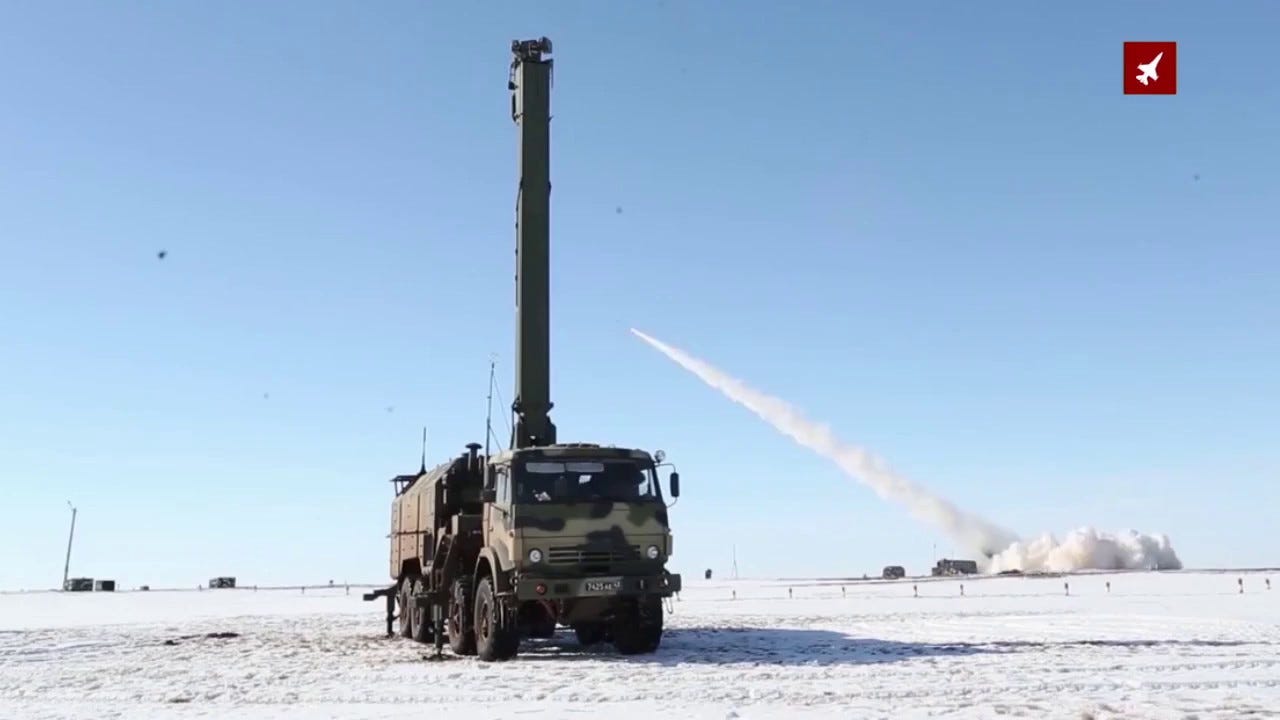
It seems that this partially coincides with the deployment of new “Penicillin” counterbattery detection systems. This is a rather neat new tool in the Russian arsenal. Counterbattery warfare generally consists of a dangerous tango of guns and radar systems. Counterbattery radar is tasked with detecting and locating the enemy’s guns, so they can be destroyed by one’s own tubes – the game is roughly analogous to enemy teams of snipers (the artillery) and spotters (the radar) attempting to hunt each other – and of course, it makes good sense to shoot the other side’s radar systems as well, to blind them, as it were.
The Penicillin system offers potent new capabilities to Russia’s counterbattery campaign because it detects enemy artillery batteries not with radar, but with acoustic locating. It sends up a listening boom which, in coordination with a few ground componants, is able to locate enemy guns through seismic and acoustic detection. The advantage of this system is that, unlike a counterbattery radar, which emits radio waves that give away its position, the Penicillin system is passive – it simply sits still and listens, which means it does not offer an easy way for the enemy to locate it. As a result, in the counterbattery war, Ukraine currently lacks a good way to blind (or rather, deafen) the Russians. Furthermore, Russian counterbattery abilities have been augmented by increased use of the Lancet drone against heavy weapons.
The Penicillin acoustic boom listens for the sound of enemy guns
All that to say, Russia has been destroying quite a bit of Ukrainian artillery lately. the Russian Ministry of Defense has made a point of highlighting counterbattery success. Now, I know at this point you’re thinking, “why would you trust the Russian Ministry of Defense?” Fair enough – let’s trust but verify.
On January 20, NATO convened a meeting at Ramstein Airbase in Germany, against a backdrop of a massive new aid package being put together for Ukraine. This aid package contains, lo and behold, a huge amount of artillery pieces. By my count, the aid announced this week includes nearly 200 artillery tubes. Multiple countries, including Denmark and Estonia, are sending Ukraine literally all of their howitzers. Call me crazy, but I seriously doubt that several countries would just spontaneously decide, at the exact same time, to send Ukraine their entire inventory of artillery pieces were Ukraine not facing crisis levels of artillery losses.
Let’s review the evidence here, and see if we can make a reasonable conclusion:
Ukrainian officials admit that their artillery is outgunned by 9 to 1 in critical sectors of the front.
Russia deploys a cutting edge counterbattery system and increased numbers of Lancet drones.
The Russian MoD claims that they have been hunting and destroying Ukrainian artillery systems in large numbers.
NATO has hurried to put together a massive package of artillery systems for Ukraine.
The United States is raiding critical forward-deployed stockpiles to supply Ukraine with shells.
I personally think it is reasonable, given all of this, to assume that Ukraine’s artillery arm has been largely shattered, and NATO is attempting to rebuild it yet again.
My kingdom for a tank
The main point of contention in recent weeks has been whether or not NATO will give Ukraine Main Battle Tanks. Zaluzhny hinted at a badly depleted Ukrainian tank park in his interview with the Economist, in which he pleaded for hundreds of MBTs. NATO has attempted to provide a stopgap solution by giving Ukraine various armored vehicles like the Bradley IFV and the Stryker, which do restore some mobility, but we must unequivocally say that these are in no way substitutes for MBTs, and they fall far short in both protection and firepower. Attempting to use Bradleys, for example, in the MBT role is not going to work.
Good Morning
Thus far, it appears that Ukraine is going to receive a small handful of Challenger tanks from Britain, but there is also talk of donating Leopards (German make), Abrams (American), and Leclercs (French). As usual, the battlefield impact of Ukraine receiving tanks is being both greatly overstated (by both Ukrainian shills and pessimistic Russians) and understated (by Russian triumphalists). I suggest a middle ground.
The number of tanks that can be reasonably given to Ukraine is relatively low, simply because of the training and sustainment burden. All of these tanks use different ammunition, special parts, and require specialized training. They are not the sort of systems that can simply be driven off the lot and directly into combat by untrained crew. The ideal solution for Ukraine would be to receive only Leopard A24s, as these might be available in decent numbers (perhaps a couple hundred), and at least they would be standardized.
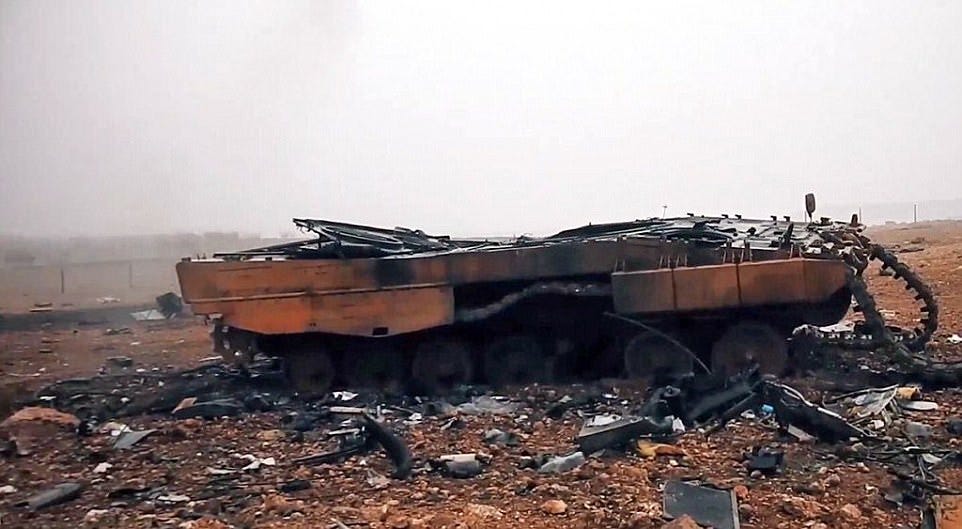
A burned out Turkish Leopard in Syria
We should also note, of course, that these western tanks are not likely to be game changers on the battlefield. The Leopard already showed its limitations in Syria under Turkish operation. Note the following quote from this 2018 article:
“Given that the tanks are widely operated by NATO members – including Canada, the Netherlands, Denmark, Greece and Norway – it is particularly embarrassing to see them so easily destroyed by Syrian terrorists when they are expected to match the Russian Army.”
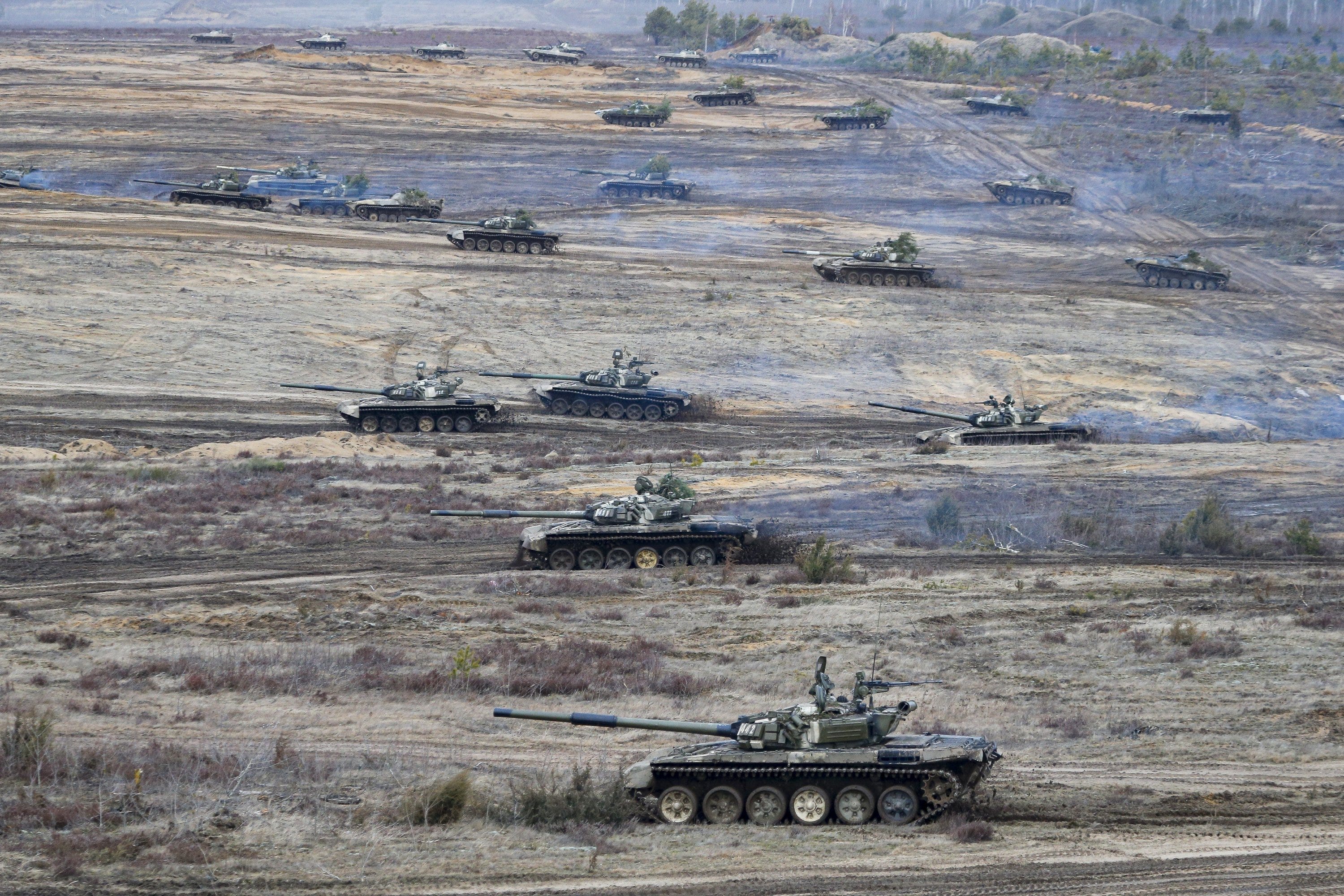
Ultimately, the Leopard is a fairly mundane MBT designed in the 1970’s outclassed by the Russian T-90. It’s not a terrible piece of equipment, but it’s hardly a battlefield terror. They will take losses and be attrited just like Ukraine’s prewar tank park was. However, that doesn’t change the fact that a Ukrainian army with a few companies of leopards will be more potent than one without them.
I think it’s fair to say that the following three statements are all true:
Receiving a mixed bag of western tanks will create a difficult training, maintenance, and sustainment burden for Ukraine.
Western tanks like the Leopard have limited combat value and will be destroyed like any other tank.
Western tanks will raise the combat power of the Ukrainian army as long as they are in the field.
Now, with that being said, at this point it does not appear that NATO wants to give Ukraine main battle tanks. At first it was suggested that tanks from storage could be dusted off and given to Kiev, but the manufacturer has stated that these vehicles are not in working order and would not be ready for combat until 2024. That leaves only the possibility of dipping directly into NATO’s own tank parks, which thus far they are reticent to do.
Why? My suggestion would simply be that NATO does not believe in Ukrainian victory. Ukraine cannot even dream of dislodging Russia from its position without an adequate tank force, and so the reticence to hand over tanks suggests that NATO thinks that this is only a dream anyway. Instead, they continue to prioritize weaponry that sustains Ukraine’s ability to fight a static defense (hence, the hundreds of artillery pieces) without indulging in flights of fancy about a great Ukrainian armored thrust into Crimea.
However, given the intense war fever that has built up in the west, it’s possible that political momentum imposes the choice upon us. It is possible that we have reached the point where the tail wags the dog, that NATO is trapped in its own rhetoric of unequivocal support until Ukraine wins a total victory, and we may yet see Leopard 2A4s burning on the steppe.
Summary: The Death of a State
Ukraine’s military is extremely degraded, having taking exorbitant losses in both men and heavy weaponry. I believe Ukrainian KIA are approaching 150,000 at this point, and it is clear that their inventories of both artillery tubes, shells, and armored vehicles are largely exhausted.
I expect the Bakhmut-Siversk defensive line to be cleared before April, after which Russia will push towards the final (and weakest) defensive belt around Slavyansk. Meanwhile, Russia has significant combat power in reserve, which can be used to reopen the northern front on the west bank of the Oskil and restart offensive operations in Zaporozhia, placing Ukrainian logistics in critical danger.
This war will be fought to its conclusion on the battlefield and end in a favorable decision for Russia.
Coda: A Note about Coups
Feel free to ignore this segment, as it’s a little more nebulous and not concretely related to events in Ukraine or Russia.
We’ve seen lots of fun rumors about coups in both countries – Putin has foot cancer and his government will collapse, Zelensky is going to be replaced with Zaluzhny, on and on it goes. Patriots in control and all that good stuff.
In any case, I thought I would just generally write about why coups and revolutions never seem to lead to nice and cuddly democratic regimes, but instead almost always lead to political control passing to the military and security services.
The answer, you might think, is simply that these men have the guns and the power to access the important rooms where decisions are made, but it is not only that. It also relates to a concept in game theory called Schelling points.
A Schelling point (named after the gentleman that introduced the concept, an economist named Thomas Schelling) refers to the solution that parties choose given a state of uncertainty and no ability to communicate. One of the classic examples to illustrate the concept is a coordination game. Suppose that you and another person are each shown four squares – three are blue and one is red. You are each asked to choose a square. If you both select the same square, you receive a monetary prize – but you are unable to talk to one another about your choices. How do you choose? Well, most people rationally choose the red square, simply because it is conspicuous – it stands out, and you therefore presume that your partner will also choose this square. The red square isn’t better, per se, it’s just obvious.
In a state of political turmoil, or even anarchy, the system works itself towards Schelling points – obvious figures and institutions that radiate authority, and are therefore the conspicuous choice to assume power and issue commands.
The Bolsheviks, for example, understood this very well. Immediately after declaring their new government in 1917, they dispatched commissars to the various office buildings in Saint Petersburg where the Tsarist bureaucracies were headquartered. Trotsky famously turned up at the foreign affairs ministry building one morning and simply announced that he was the new Foreign Minister. The employees laughed at him – who was he? how did he presume to be in charge? – but for Trotsky the point was to insinuate himself on a Schelling point. In the state of anarchy that began to spread in Russia, people naturally look for some obvious focal point of authority, and the Bolsheviks had cleverly positioned themselves as such by claiming control over the bureaucratic offices and titles. On the other side of the civil conflict, political opposition to the Bolsheviks clustered around Tsarist army officers, because they too were Schelling points, in that they already had titles and position within an existing hierarchy.
All of this is to say that in the event of a coup or state collapse, new governments are virtually never formed sui generis – they always arise from preexisting institutions and hierarchies. Why, when the Soviet Union fell, did political authority devolve to the Republics? Because these Republics were Schelling points – branches that one can grab for safety in a chaotic river.
I simply say this because I am tired of phantasmagorical stories about liquidation of the regime in Russia and even territorial dissolution. The fall of Putin’s government will not and cannot lead to an acquiescent, western-adjacent regime, because there are no institutions of real power in Russia that are thus disposed. Power would fall to the security services, because they are Schelling points, and that’s where power goes.
Having grown up in Joey Gallo’s neighborhood (https://en.wikipedia.org/wiki/Joe_Gallo), within mortar range of Carlo Gambino’s “casa”, you get a sense of a sanctioned hit.
You know that happy feeling when things are going your way? Everything is turning up roses? You got a nice buzz going? Well, if you feel that way then you certainly are not a member of Ukraine’s ruling elite. Some genuine chaos unfolding in Kiev in the wake of Russia’s victory in Soledar.
Let us commence with the news that someone (or a group of someones) assassinated Ukraine’s top three intelligence officials — the Minister of Internal Affairs of Ukraine Denis Monastyrsky, his first deputy Yevgeny Enin and the State Secretary of the Ministry of Internal Affairs Yuriy Lubkovich. Wait a minute (some will say) we do not know if this was a mechanical failure or pilot error. True, no final conclusions, yet. But an eyewitness interviewed by one of the Kiev media claimed:
that the helicopter with the leadership of the Ministry of Internal Affairs of Ukraine on board was spinning and burning in the air before the collision.https://t.me/c/1840140143/126
If that witness is giving an accurate account then it is highly unlikely that the mid-air fireball was caused by pilot error or a mechanical malfunction. This sure sounds like a surface-to-air missile, like a U.S. supplied Stinger that popped up on the black market. Here is one of the rumors floating around Ukraine. It emerged shortly after the chopper crashed into a kindergarten courtesy of someone with the nom de plume, Hacker DPR Joker:
I will tell you all, my loyal followers, what happened today in Brovary. The Minister of Internal Affairs of Ukraine had long been aware that the leadership of the Ministry of Defense was trading Western arms, which came to Ukraine in the form of aid, for the benefit of third countries, and that this process was overseen directly by the head of the GUR, Budanov. By the way, this information has already surfaced somewhere.
The leadership of the Interior Ministry wanted their share and began collecting data through their structural units, which are associated with intelligence and surveillance. As a result, they managed to obtain evidence and began blackmailing. The military bosses promised a share to the police leadership, and the first tranche was paid. But it was pointless and unprofitable to pay any further.
In addition, the insolence of the minister of the Ministry of Internal Affairs, who had his head in the wrong place, was putting the military leadership under strain. And now the day had come when the kids from the GUR were able to demonstrate their skills. But that is not all. The sanction for this was given personally by Yermak, who is also in on the secret from the supreme narcissistic clown, Zelensky.
[Comment: Hacker DPR Joker is not just on Telegram. “Hacker DPR Joker” confirmed to RIA Novosti the hacking of the DELTA command and control system of the Ukrainian troops: “It was not easy, but there are no absolutely secure systems.”
" According to him, "absolutely all" plans of the Ukrainian command were disclosed – information about them was transferred "to the right place." The program itself, Joker noted, was created by Ukrainian and American specialists according to NATO standards. pic.twitter.com/lo8qw7x30P
The key point for Hacker DPR Joker is that the head of Internal Affairs, Monastyrsky, was independent of the President, the military and the intelligence service (i.e., SBU). Because Monastyrsky is in charge of Ukraine’s national police, he and his subordinates were in a position to collect dirt on the illegal activities of Zelensky or the military and could use that as “leverage” (aka blackmail) to extract money or concessions.
That is at least one possibility that should be considered. What strikes me is that you had the equivalent of the FBI Director, the FBI Deputy Director and the Attorney General all on board the same aircraft. Why? What was their destination and why were all three on the same helo? Normal security procedures would keep the three men apart to avoid this very scenario. I cannot rule out the possibility that a Russian Spetznaz team carried out a hit. Regardless of who did it, this has created enormous turmoil within Zelensky’s government.
At a minimum, this is going to sharpen suspicions among the police, the military and the intelligence service. Warm, fuzzy feelings do not abound.
Oleksii Arestovych
Preceding all of this was the forcible removal of Oleksii Arestovych, a former Ukrainian intelligence officer who, until this past weekend, was directing strategic communications for Zelensky. Mr. Arestovych made the mistake of telling the truth about a missile strike on an apartment building in Dnepropetrovsk. According to Arestovych, it is an errant Ukrainian missile. He said it was not Russian. Whoops!! That is verbotten. Not only was he fired (he reportedly tried to resign), but his name popped up today on the Ukrainian hit list reserved for enemies of Ukraine. That’s right. After a year of faithfully telling lies for Zelensky, he says something truthful and next thing you know he has a target for execution on his back.
Not a lot of good news in Ukraine other than the United States and Europe are promising to send more weapons to a beleaguered Ukrainian army. I actually think the Russians are more delighted by this than Ukraine. Reminds me of a scene from Game of Thrones when Tyrion Lannister thanks mutineers for an unexpected gift:
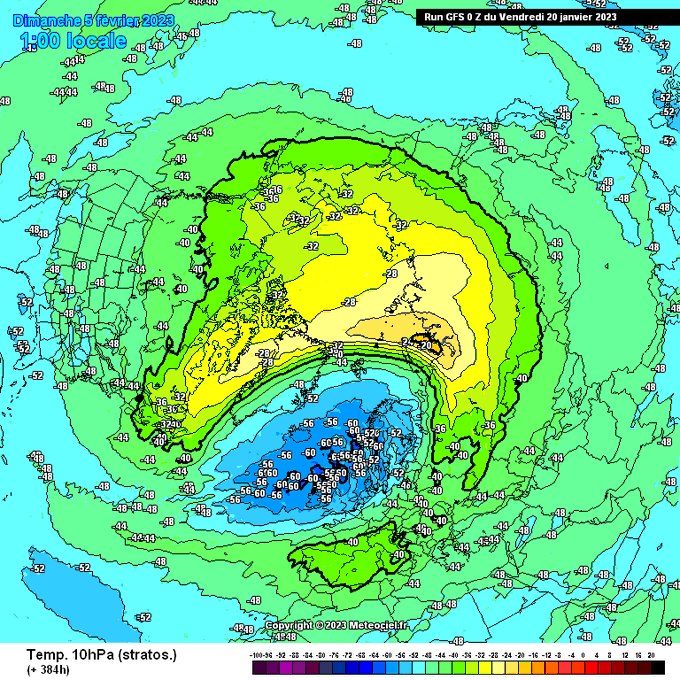
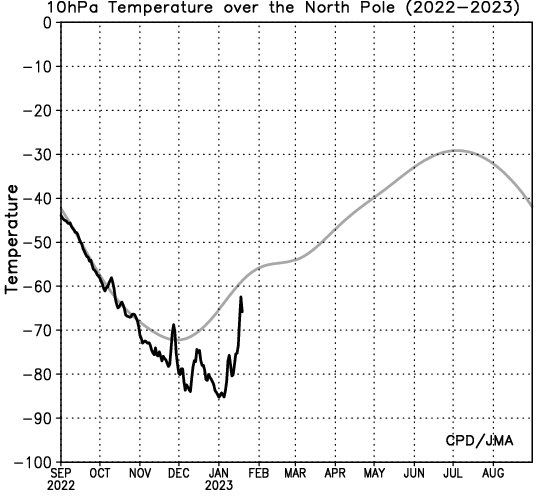
Oh, and about the weather in Europe, by Jan 28 Europe plunges into a deep freeze, -20C and snow chaos.
(e) Whoever having unauthorized possession of, access to, or control over any document, writing, code book, signal book, sketch, photograph, photographic negative, blueprint, plan, map, model, instrument, appliance, or note relating to the national defense, or information relating to the national defense which information the possessor has reason to believe could be used to the injury of the United States or to the advantage of any foreign nation, willfully communicates, delivers, transmits or causes to be communicated, delivered, or transmitted, or attempts to communicate, deliver, transmit or cause to be communicated, delivered, or transmitted the same to any person not entitled to receive it, or willfully retains the same and fails to deliver it to the officer or employee of the United States entitled to receive it; or
(f) Whoever, being entrusted with or having lawful possession or control of any document, writing, code book, signal book, sketch, photograph, photographic negative, blueprint, plan, map, model, instrument, appliance, note, or information, relating to the national defense, (1) through gross negligence permits the same to be removed from its proper place of custody or delivered to anyone in violation of his trust, or to be lost, stolen, abstracted, or destroyed, or (2) having knowledge that the same has been illegally removed from its proper place of custody or delivered to anyone in violation of its trust, or lost, or stolen, abstracted, or destroyed, and fails to make prompt report of such loss, theft, abstraction, or destruction to his superior officer-
Shall be fined under this title or imprisoned not more than ten years, or both.
I was a commissioned officer in the US Navy and held a security clearance associated with my training and assignments as an engineering officer in naval nuclear propulsion.
We all knew the law. I knew another commissioned officer who mishandled classified information and was convicted by a court marial for his mistake.
After he left office, Joe Biden obviously violated paragraph (f) of the Espionage Act.
Hunter Biden obviously violated paragraph (e) of the Espionage Act.
The governing law for the safeguarding of classified materials can be found at 32 CFR Part 117, the National Industrial Security Program, aka the NISPOM. The NISPOM is the security bible for the security officers of defense contractors who deal with classified documents and customers.
What I see of media reporting and the White House narrative is cowardly and criminal.
They are purposely skewing the facts. They are using propaganda to create the illusion that a simple accident or the mishandling of documents occurred.
The mere fact is classified materials are not mere documents.
The documents were not properly secured, as required by the NISPOM – prima facie evidence of a major crime.
In this case, the documents were essentially in the possession of Hunter Biden, the person who was reportedly living in the house, and who is not authorized to receive, possess, or transmit classified information.
Any investigator would call that for what it obviously is: a probable safe house used to traffic classified materials, and for a long time.
Maybe there is an ulterior reason for Joe Biden to constantly return to Delaware or wherever his homes are located.
There is only one purpose for removing classified information from a safe or a SCIF (Sensitive Compartmented Information Facility) without the proper authority — to conduct espionage.
Removal is stealing and stolen documents are necessary to engage in that crime. Bradley Manning and Reality Winter are cases in point, that if you remove classified documents from a SCIF without authorization, you will be charged with violating the Espionage Act.
This basic lesson seems to have eluded the national security section of the FBI.
If you or I had a single page of TS/SCI classified material, out of its container, out of a SCIF, we’d be locked up for espionage in a microsecond.
That the FBI has chosen not to do anything speaks volumes. They are compromised and by taking no action they are actually facilitating espionage. It must be great having the FBI run cover for a criminal enterprise.
We should not be surprised. Hillary Clinton was caught violating the Espionage Act and everyone knew it, but FBI Director James Comey exonerated her.
Bradley Manning and Reality Winter thought they would receive the same ‘punishment’ Hillary received, but were mistaken.
As POTUS, Donald Trump had the absolute authority to declassify documents and keep copies of declassified documents for future use, such as for presidential libraries (see https://supreme.justia.com/cases/federal/us/484/518/)
Joe Biden has no excuse having any TS/SCI classified material, out of its container, out of a SCIF, unsecured in a garage, in the possession of someone not authorized to receive classified documents.
There are many ways to conduct espionage, and President Biden has been caught in flagrante delicto trafficking classified documents.
Hunter also claimed that said house was owned by him, but the tax and deed records say otherwise. That, however, is Hunter’s problem — not Joe’s. Joe’s tax return not only shows the property tax paid on the house it also deducts mortgage interest. It’s his house both by deed and by who’s covering the mandatory bills.
Joe’s tax returns from the subject year shows business income from pass-throughs (two S corps) which is perfectly legal. The tax returns do not show income in that classification from other sources; ergo, said “rental” has to be inside one of those two corporations or there is a serious felony involved, because that would be $600,000 of undeclared (and untaxed) income. Line 17 of Schedule 1 shows this and ties back from Schedule E, as it must. The other “business income or loss” from Schedule C is inconsequential in amount.
But this leads to a very serious question: There’s nothing wrong with an S corp owning property but does it not have to be titled into the corporation? It wasn’t; at all times material the house was owned by Jill and Joe Biden in their personal capacity. It was not in a trust of some sort nor was it retitled into an S-corp as there’s no record of either. That seems rather hinky but perhaps not. In any event rental property is very different than a personal residence in that with rental property there’s depreciation and all other manner of things you can deduct that isn’t true for a personal residence — but if you convert it back to a personal residence that gets recaptured which is something I’ve warned other people to be careful of.
So let’s see the records on those two S-Corps that the Bidens declared and paid taxes on during that year. Is the rental income from Hunter in there, and if so, how does the S-Corp, which I remind as a corporation must keep formal books of account and not lie in any material respect account for income from an asset it does not own?
If the rental income isn’t in those two S-Corps then either it never existed or Joe and Jill ripped off the government and committed tax fraud on the $600,000 paid by Hunter to Joe that is not declared anywhere in their state or federal tax returns.
In any event someone is hiding something in there. Whether this is more confabulation of a drug-addled Hunter or was disclosure of “10% for the big guy” kicked back to his father under the table and either improperly buried in an S-Corp “profit” that never owned the asset in question and thus can’t do that or Joe and Jill got $600,000 worth of undeclared income and didn’t pay taxes on it is now the question that demands an answer. After all tax cheating in that sort of size is serious business, felony-level serious, and is one of the few plausible explanations for what those documents disclose.
I’m not a CPA or Enrolled Agent; I paid both when I ran corporations, but I have run an S-Corp, an LLC and a C-Corp and signed tax returns listing income from all three over the years. I know what the law is in this regard because I respected and properly followed same.
If I pulled something like this and attempted to claim 10x the reasonable and expected rate of rental income on a single house by running it through an S-corp I’d have federal and state tax people along with law enforcement crawling so far up my rectum I’d be able to taste it.