Initial translation – will update when the Tass publishes the official transcript
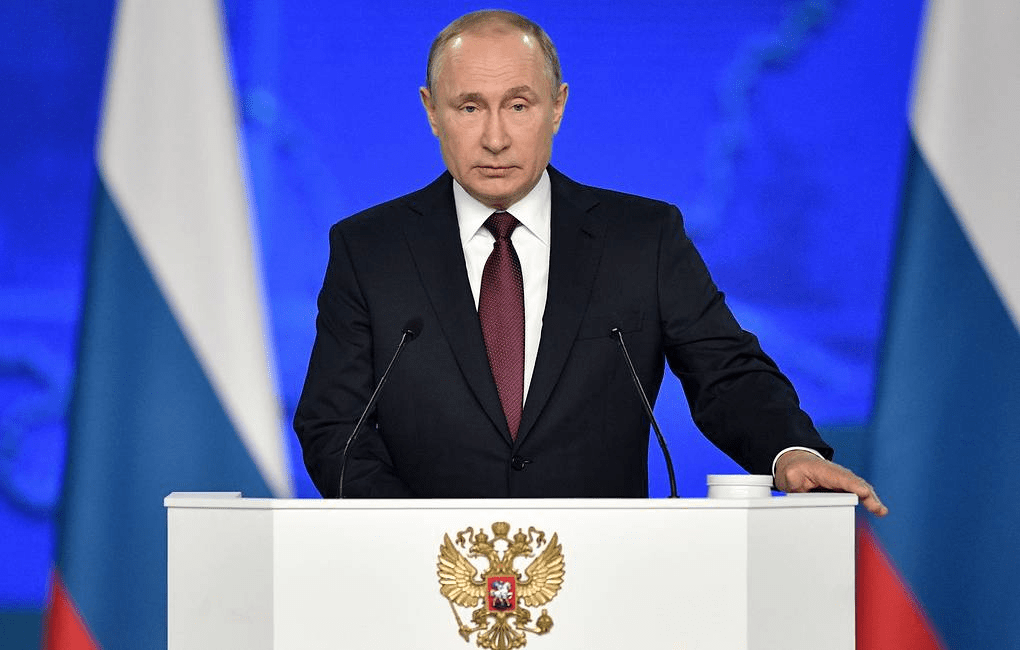
“I am speaking at a difficult, milestone time for the country, at a time of cardinal irreversible changes in the world.
Putin: Since 2014, Donbass has been fighting for the right to live on its own land, to speak its native language under constant shelling. He believed and expected that Russia would come to the rescue
.Putin: The Western rulers’ claim of peace, as we can see, was a hoax. The West increasingly encouraged the Ukrainian regime to carry out terrorist actions in the Donbass. The United States deployed its bases near the borders with Russia. They prepared Ukraine, enslaved by them, for a big war. They admit it openly.
We defend not only our positions. In the modern world there should be no division into “civilized” countries and all the rest. We were ready for a constructive dialogue with the West. But in response they received a hypocritical reaction – the expansion of NATO, missile defense systems, the deployment of military contingents. Neither side has hundreds of military bases around the world like the US does. The whole planet is covered.
In December 2021, we sent the West a security guarantee agreement, but all positions were refused. The incoming information said that by February everything was ready for another punitive action in the Donbass, against which Kyiv threw artillery, planes, and tanks.
They started the war, and we use force to stop it.
The next target after the Donbass was an attack on the Crimea and Sevastopol. They are now talking about it openly. We protect our home, and the goal of the West is unlimited power. The West spends $150 billion on the war, and $60 billion on supporting poor countries.
Endless accusations against Russia were heard at the Munich Conference. The feeling that this was done so that everyone would forget what the West has been doing in recent decades. And they plunged entire regions into chaos, released gin and bottles. Because trillions of dollars are at stake under the guise of democracy.
In the 1930s, the West opened the way for the Nazis to power in Germany. In our time, they made Anti-Russia out of Ukraine. The project is not new. It goes back to the 19th century. It was cultivated in Austria-Hungary, Poland in order to tear the historical regions away from our country. Nothing new. Everyone repeats. The West accelerated this project by supporting the anti-state anti-constitutional coup in 2014 in Kyiv. Russophobia was planted with ideologies.
The Armed Forces of Ukraine use Nazi symbols, do not hide whose heirs they are. The West doesn’t give a damn who to bet on in the fight against Russia. The main thing is to fight against us. So, you can use at least terrorists, at least neo-nazis, at least a bald trait. And in the 1930s and now the idea is the same: to kindle a hotbed of war in the East.
The people of Ukraine have become a hostage of the occupational pro-Western regime, which has been plundering its state for decades. Nobody cares about people. They are prepared for slaughter, turned into consumables. Sad, scary to talk about it, but true. The responsibility for the escalation lies with the West and the Kiev regime, for which its own people are a stranger.
The more long-range systems fall back on Ukraine, the further we will be forced to push the threat away from our borders.
The elites of the West want to turn a local conflict into a global confrontation. It is about the existence of our country. But they understand that it is impossible to defeat Russia on the battlefield. Hence the information attacks, lies, distortion of historical facts, attacks on the Russian Orthodox Church, culture.
I would like to tell the West – look at the main books of world religions. It says that the family is the union of a man and a woman. But even these sacred values are questioned. The British Church is considering the idea of a gender-neutral God. Forgive me Lord, they don’t know what they’re doing. The elites of the West are going crazy, leading people to disaster. And we will protect our children from degradation and degeneration.
The West is trying to undermine our society. But traitors will be held accountable. We will not arrange a witch hunt for those who have abandoned their homeland. Let them live with it. The main thing is that the citizens of Russia gave them a moral assessment. We are proud that the Russians understood our actions in Donbas and supported us. This is a manifestation of patriotism, a feeling that is historically inherent in our people.
I want to thank our people for their courage and determination. Thank the fighters, volunteers, patriots. I would like to apologize for not being able to name everyone during the speech. When I was preparing the performance, I wrote a long list of heroic units, then took them out, because it was impossible to name them all. I was afraid not to name someone.
Low bow to the families of those who defend Donbass, doctors, builders, rural workers, teachers, cultural figures, volunteers, journalists. Especially those who work on the front lines. I thank the military priests, civil servants and entrepreneurs who fulfill their professional civil and human duty.
Special words of gratitude to the residents of the DPR, LPR, Kherson and Zaporozhye regions. You yourself made your choice in conditions when there were military actions nearby. But you decided to be with Russia, with your Motherland.
Special words of gratitude to the residents of the DPR, LPR, Kherson and Zaporozhye regions. You yourself made your choice in conditions when there were military actions nearby. But you decided to be with Russia, with your Motherland.
We will implement infrastructure projects in new regions of Russia. Build roads, as they did in the Crimea, which now has a land connection with Russia. We will do everything so that the long-awaited peace returns to our land, the safety of people is ensured. For this, for their ancestors, for the future of children and grandchildren, for the reunification of peoples, fighters, our heroes, fight. I ask you to honor the memory of the soldiers who gave their lives for this, the civilians who died at the hands of neo-Nazis and punishers…
I understand how hard it is for the families of the fallen soldiers. Our duty is to support them. Help them raise their children, give them education and a profession. The family of each member of the NWO should be surrounded by care and honor. Their needs must be addressed immediately.
Every fighter should have the opportunity to visit family.
The programs for the development of the armed forces should be based on real combat experience. He is priceless. Officers and sergeants who have shown themselves to be competent commanders will be sent to military educational institutions as a priority. and should be in demand both in the army and in civilian life. The Motherland will appreciate their contribution to the defense of the Fatherland.
We will strengthen guarantees for labor collectives. I propose launching a special program to create preferential rental housing for defense industry workers. The rental rate will be lower than the market rate, as part of the payment will be taken over by the government. We will start building such housing, primarily in defense cities.
The West has also deployed an economic front against us. But the organizers of the sanctions are punishing themselves. Provoke rising prices, closure of enterprises, energy crisis. And they say that the Russians are to blame. They tried to break ties with Russian companies, disconnect them from financial communication channels, disconnect them from the markets. This is the theft of our foreign exchange reserves. Attempts to collapse the ruble and provoke destructive inflation. Their goal is to make our citizens suffer. Such humanists.
In March, a program to support the economy for 1 trillion rubles was adopted. We were predicted an economic downturn of up to 10%. But GDP fell by 2.2%. Despite the fact that in February-March they predicted a collapse for us. Russian business has rebuilt logistics, changed partners to reliable ones. Settlements in rubles doubled and amounted to a third of all. and with the currencies of friendly countries – more than half. We will continue to form a stable, secure system of settlements independent of the Western system and currencies.
Defense is a priority. But we are not going to destroy the country’s economy. Thus, the basic sectors of the economy increased their performance. The delivery of housing has exceeded 100 million square meters. Agriculture showed a two-fold growth, for which we bow to them.
We have every opportunity to make a breakthrough in other areas as well. We have achieved a reduction in unemployment. Before the pandemic, we had 4.7% unemployment, and now it is 3.7%.
You have reached a new level of economic development – the production of goods with high added value. This year, a solid demand for domestic producers is forecast. Our companies are ready to occupy the niches vacated after the withdrawal of Western companies.
I draw your attention to the fact that the meaning of our work is not to adapt to current conditions, but to bring the economy to new frontiers. Now everything is changing very quickly. This is a time of opportunity.
We will build new logistics links. Build roads to the East, develop a dig. We will pay special attention to the international North-South corridor. This will open up opportunities for cooperation with India, Iran, the countries of Southeast Asia. Our plans include building up the capabilities of the Trans-Siberian Railway, the Northern Sea Route. The infrastructure of the regions will receive a powerful impetus. In 2024, at least 85% of regional roads will be brought to a standard condition. We will continue the free gasification program and expand it to social facilities. For citizens, such a program will operate on an ongoing basis.
We have been investing trillions of rubles in housing and communal services for 10 years.
We will expand the preferential industrial mortgage program. In industrial clusters, the tax burden has been reduced. They receive long-term orders and subsidies.
I ask the government to lend a shoulder to business, provide support measures, including tax incentives.
Starting this year, companies can reduce income tax payments if they purchase domestic IT products. I propose extending the exemption for the purchase of domestic high-tech products.
There will be new sources of investment financing. Banks work stably and steadily. Last year, the volume of loans to the industrial sector grew by 14%. This is more than in 2021 without any SVO. Development is underway. The banking sector worked with a profit of 203 billion rubles. This is also an indicator of Russia’s financial stability. Inflation for the quarter will approach the target of 4%, while in some EU countries up to 17%.
Loans for the real sector should become more accessible. Long-term savings are sources of financing loans. I ask the government to launch a state program to attract savings and guarantee the safety of citizens’ finances.
Separate solutions are needed for high-tech business. For them, we will provide for the placement of shares on the domestic market. The most important element of economic sovereignty is private business. He knows how to adapt to changing conditions.
It is necessary to revise the norms of criminal legislation regarding economic crimes. We need to move towards decriminalization. We need government measures to deoffshorize. Business must operate in Russian jurisdiction – this is a basic principle.
After the collapse of the USSR, its planned system in conditions of chaos, the country created a market economy. Western countries serve as an example. It would seem to just copy. But something happened – our national economy became oriented towards the West. as a source of raw materials. The reasons are also clear – the new emerging Russian business was aimed at making a profit. Fast and easy. Therefore, more complex sectors of the economy developed poorly. It took years, massive changes and investments to break the trend. And there is a result.
Technologies and equipment were bought in the West. And instead of buying domestic, the money was spent on estates, yachts, foreign real estate. Especially at first. And where there is wealth, there are children, their education, their life and future. Recent events have shown that a safe haven abroad is an illusion. The West robbed, took away even legally earned money.
None of the ordinary citizens of the country felt sorry for those who lost their capital in foreign banks, who lost their yachts and palaces. And in conversations in the kitchen, they probably remembered both the privatization of the 1990s and the ostentatious luxury of the new elites.
The West has provoked conflicts, used means of economic deterrence all these years. And big business is responsible for the strategic enterprises of thousands of teams. This means that when the leaders and owners of such a business are dependent on the West, it is a danger to the country. Such a situation cannot be tolerated.
Everyone has their own choice. You can stay in your arrested castle with arrested accounts. But you have to understand that they are second class there. But there is another choice: to be with your Motherland, to work for compatriots. Open new businesses, change the life around you. We have many such real entrepreneurs-fighters. Behind them is the future of domestic business. The sources of well-being and the future should be only here, in Russia. Then we will create a solid economy.
The capital earned here must remain here. It is pointless to run and humiliate yourself before the West, begging for your money. Do not try for the past, try to sue something. We need to change our lives and work. Especially since you are strong people, I am addressing business representatives. Launch new projects, earn money and invest in Russia. Help schools and universities, science and healthcare, culture and sports. So multiply capitals, and earn the gratitude of people. And the state will support you. Let’s take this as a guide to business.
This civilization was passed down to us by our ancestors. And we must save and pass on. We will develop relations with friends, but first of all we will rely on our own potential, traditions and values. Our people have always been distinguished by generosity and mercy. Russia knows how to be friends. Always came to the rescue. For example, in the case of earthquakes in Syria and Turkey. The people are the source of power. Rights are inviolable and guaranteed by the Constitution. Despite the threats, we will not retreat from them.
Presidential elections in 2023 and 2024 will be held strictly in accordance with the law.
I would like to quote Stolypin: “In the matter of defending Russia, we must all unite, coordinate efforts, duties and rights to maintain one historical supreme right – the right of Russia to be strong.”
Among the volunteers there are deputies, representatives of authorities of all levels and all parties. Public associations help with the collection of goods in the NWO. Once again, kudos to you all.
The education system and culture are important to reinforce our values. The Presidential Grants Fund and other tools will support all forms of creative research. It is necessary to awaken the best human qualities in society. The development of the cultural sphere will become one of the priorities for restoring peaceful life in the Donbass.
We must improve the quality of education in schools and universities so that young people can learn more about the history of Russia. We have a young bright generation that is ready to participate in the development of the country. For such active people, the competitions “Leaders of Russia”, “Leaders of Revival” open the doors. The winners and finalists of the competitions volunteered to help establish a peaceful life. Act professionally and courageously.
Those who were born and raised in the Donbass, who fought for it, should become the backbone of the development of the territory. Russia is counting on you.
We need to give scientists more freedom to be creative. Fundamental science should work for the following areas: transport, energy, housing and communal services, medicine, agriculture, industry.
In December, I met with young scientists. Their problem is housing. I instruct the government to determine the reserves for expanding the relevant program. The prestige of secondary education has grown. The demand for college graduates has grown tremendously. We must significantly expand the project of professionalism, within the framework of which educational clusters are being created together with enterprises. The goal is to train 1 million specialists for the electronics, robotics, nuclear and other industries in 5 years. Key to the sovereignty and competitiveness of Russia.
There are changes in higher education. I propose to return to the country’s traditional basic training of specialists in higher education. The term of study can be from 4 to 6 years within the same specialty and the university may have different programs depending on the profession, industry and market demand. If the profession requires additional training, then a person can pursue education in the magistracy and postgraduate studies. Postgraduate studies will be separated into a separate structure of education. The transition to the new system should be smooth.
Those students who are studying now can continue their education in existing programs. I ask the ONF to take control of all changes in higher education.
Spending on supporting families in Russia has increased significantly in recent years. It is the fastest growing section of the budget. Since February 1, mother’s capital has been indexed by 11.9%. Residents of new regions also have the right to this. I propose to provide maternity capital to Donbass families whose children have been born since 2007, when the program began to operate in Russia. We also extended the program to residents of Crimea and Sevastopol.
The minimum wage last year was raised twice by 20%. We will continue to raise it, at a rate higher than inflation. From January 1 next year, I offer an additional increase of 10%. The minimum wage will increase by 18.5% and will amount to more than 19 thousand rubles.
Since last year, families with 2 or more children have been exempted from taxes when selling a home and buying a larger one. I propose to increase the size of the social tax deduction for the education of children. It is necessary to raise not only the amount of the deduction, but also to increase the demand for it so that it is provided proactively – quickly and remotely.
Funds for national projects, which are reserved for 2024, the regions will be able to receive now through interest-free budget loans, and in April next year they will be automatically repaid. We do not need storming and the pursuit of volumes. There must be a high return. This is especially true for the modernization of primary health care.
We launched a school renovation program. 3500 schools will be updated in a year. Most of them are in rural areas. Starting in 2025, federal funds for the repair of schools and kindergartens will be allocated on a regular basis to prevent situations when buildings are in an emergency. This year we will introduce 400 new schools.
We are additionally allocating 250 billion rubles for the development of transport, utilities and other infrastructure. I instruct the government to allocate an additional 50 billion rubles. They will be used to upgrade the transport system in the regions. I ask you to pay special attention to small towns and rural areas.
We have extended the Clean Air program. We will continue the landfill elimination program. We will continue the improvement of Lake Baikal, the Volga, and expand it to the Volga, Neva and other rivers. A draft law on the development of tourism in specially protected natural areas has been prepared. It determines what can be built and what cannot. I ask the State Duma to expedite consideration of the bill.
In early February, NATO demanded a return to the implementation of the strategic offensive nuclear arms treaty, including inspections of our facilities. This is a theater of the absurd. The West is directly involved in the attempts of the Kyiv regime to strike at our strategic aviation. And now they also want to inspect our defense facilities. This sounds like bullshit. The West does not allow us to conduct the same inspections. NATO’s goal is to defeat Russia and at the same time they want to visit our facilities? Do they want to poke their nose at our new ground-based centers?
NATO actually made an application to become a party to the Strategic Nuclear Arms Treaty. This question is long overdue. After all, NATO consists of the nuclear countries of the United States, France, Great Britain. They develop, improve and are directed against us.
The US has withdrawn from the ABM treaty. Our relationship has deteriorated. And this is the merit of the United States, which began to revise the results of the Second World War, to build a world where there is only one owner – the United States. Planned a series of wars around the world to break the architecture of world relations. After the collapse of the USSR, they are striving to fix their dominance.
It is unacceptable that the United States is rebuilding the world order exclusively for itself. And now ultimatums are being put forward through NATO: “Follow our demands, and we will do what we want.” This is either the height of hypocrisy and cynicism, or stupidity. Don’t call them idiots.
Russia suspends participation in the strategic offensive arms treaty. It doesn’t exit, it stops. But to return the discussion, we must understand what NATO is counting on.
The expiration date of nuclear weapons in the United States. And individuals in Washington are working on new types of nuclear weapons. We must be prepared to test new types of weapons if the US does. Not the first. No one should be under the illusion that global nuclear parity can be destroyed.
Cohesion manifested itself from the first days of the NWO. Hundreds of thousands of volunteers came to the military registration and enlistment offices to fight for truth and justice. They fight shoulder to shoulder. All of them are for the Victory, for comrades-in-arms, for the Motherland
A small, globe-trotting balloon declared “missing in action” by an Illinois-based hobbyist club on Feb. 15 has emerged as a candidate to explain one of the three mystery objects shot down by four heat-seeking missiles launched by U.S. Air Force fighters since Feb. 10.
The club—the Northern Illinois Bottlecap Balloon Brigade (NIBBB)—is not pointing fingers yet.
But the circumstantial evidence is at least intriguing. The club’s silver-coated, party-style, “pico balloon” reported its last position on Feb. 10 at 38,910 ft. off the west coast of Alaska, and a popular forecasting tool—the HYSPLIT model provided by the National Oceanic and Atmospheric Administration (NOAA)—projected the cylindrically shaped object would be floating high over the central part of the Yukon Territory on Feb. 11. That is the same day a Lockheed Martin F-22 shot down an unidentified object of a similar description and altitude in the same general area.
There are suspicions among other prominent members of the small, pico-ballooning enthusiasts’ community, which combines ham radio and high-altitude ballooning into a single, relatively affordable hobby.
“I tried contacting our military and the FBI—and just got the runaround—to try to enlighten them on what a lot of these things probably are. And they’re going to look not too intelligent to be shooting them down,” says Ron Meadows, the founder of Scientific Balloon Solutions (SBS), a Silicon Valley company that makes purpose-built pico balloons for hobbyists, educators and scientists.
The descriptions of all three unidentified objects shot down Feb. 10-12 match the shapes, altitudes and payloads of the small pico balloons, which can usually be purchased for $12-180 each, depending on the type.
“I’m guessing probably they were pico balloons,” said Tom Medlin, a retired FedEx engineer and co-host of the Amateur Radio Roundtable show. Medlin has three pico balloons in flight in the Northern and Southern hemispheres.
Aviation Week contacted a host of government agencies, including the FBI, North American Aerospace Defense Command (NORAD), the National Security Council (NSC) and the Office of the Secretary of Defense for comment about the possibility of pico balloons. The NSC did not respond to repeated requests. The FBI and OSD did not acknowledge that harmless pico balloons are being considered as possible identities for the mystery objects shot down by the Air Force.
“I have no update for you from NORAD on these objects,” a NORAD spokesman says.
On Feb. 15, NSC spokesman John Kirby told reporters all three objects “could just be balloons tied to some commercial or benign purpose,” but he did not mention the possibility of pico balloons.
Launching high-altitude, circumnavigational pico balloons has emerged only within the past decade. Meadows and his son Lee discovered it was possible to calculate the amount of helium gas necessary to make a common latex balloon neutrally buoyant at altitudes above 43,000 ft. The balloons carry an 11-gram tracker on a tether, along with HF and VHF/UHF antennas to update their positions to ham radio receivers around the world. At any given moment, several dozen such balloons are aloft, with some circling the globe several times before they malfunction or fail for other reasons. The launch teams seldom recover their balloons.
The balloons can come in several forms. Some enthusiasts still use common, Mylar party balloons, with a set of published calculations to determine the amount of gas to inject. But the round-shaped Mylar balloons often are unable to ascend higher than 20,000-30,000 ft., so some pico balloonists have upgraded to different materials.
Medlin says he uses a foil balloon sold by Japanese company Yokohama for $12. The material has proven to be resilient for long periods at high altitude, he says, even if the manufacturer never intended the balloon to be used for that purpose. An alternative is Meadows’ SBS, which makes a series of balloons designed specially for circumnavigational flights.
The pico-ballooning community is nervous about the negative attention by some members of Congress and the White House, who have called the objects shot down at altitudes of 20,000-40,000 ft. dangerous to civil aviation.
“We did assess that their altitudes were considerably lower than the Chinese high-altitude balloon and did pose a threat to civilian commercial air traffic,” Kirby says. “And while we have no specific reason to suspect that they were conducting surveillance of any kind, we couldn’t rule that out.”
In fact, the pico balloons weigh less than 6 lb. and therefore are exempt from most FAA airspace restrictions, Meadows and Medlin said. Three countries—North Korea, Yemen and the UK—restrict transmissions from balloons in their airspace, so the community has integrated geofencing software into the tracking devices. The balloons still overfly the countries, but do not transmit their positions over their airspace.
The community is also nervous that their balloons could be shot down next. Medlin says one of his balloons—call sign W5KUB-112—is projected by HYSPLIT to enter U.S. airspace on Feb. 17. It already circumnavigated the globe several times, but its trajectory last carried the object over China before it will enter either Mexican or U.S. airspace.
“I hope,” Medlin said, “that in the next few days when that happens we’re not real trigger-happy and start shooting down everything.”
What Is a Pico Balloon?
Pico balloons are typically about 3 ft. in diameter on the ground before they are launched. As they ascend to altitudes of 20,000-50,000 ft., the super-pressure balloon envelope expands by about 2-3 times in size and achieves neutral buoyancy, allowing them to float at a roughly consistent altitude. Wind currents then push them through the atmosphere, with some balloons capable of circling the world several times before they pop or fall.
The balloon owners keep track of them through HF and VHF/UHF radio links. A small GPS tracking device is attached to the balloon by a tether. The balloon broadcasts its position using the WSPR protocol on HF and the ASPR standard for line-of-sight on VHF/UHF. Most pico balloons lack the lifting power to carry batteries, so the tracking coordinates usually are broadcast in daylight hours, with tiny attached solar arrays sending power to the transmitter.
**********
So, what does it cost to take-down one of Northern Illinois Bottlecap Balloon Brigade (NIBBB) balloons?
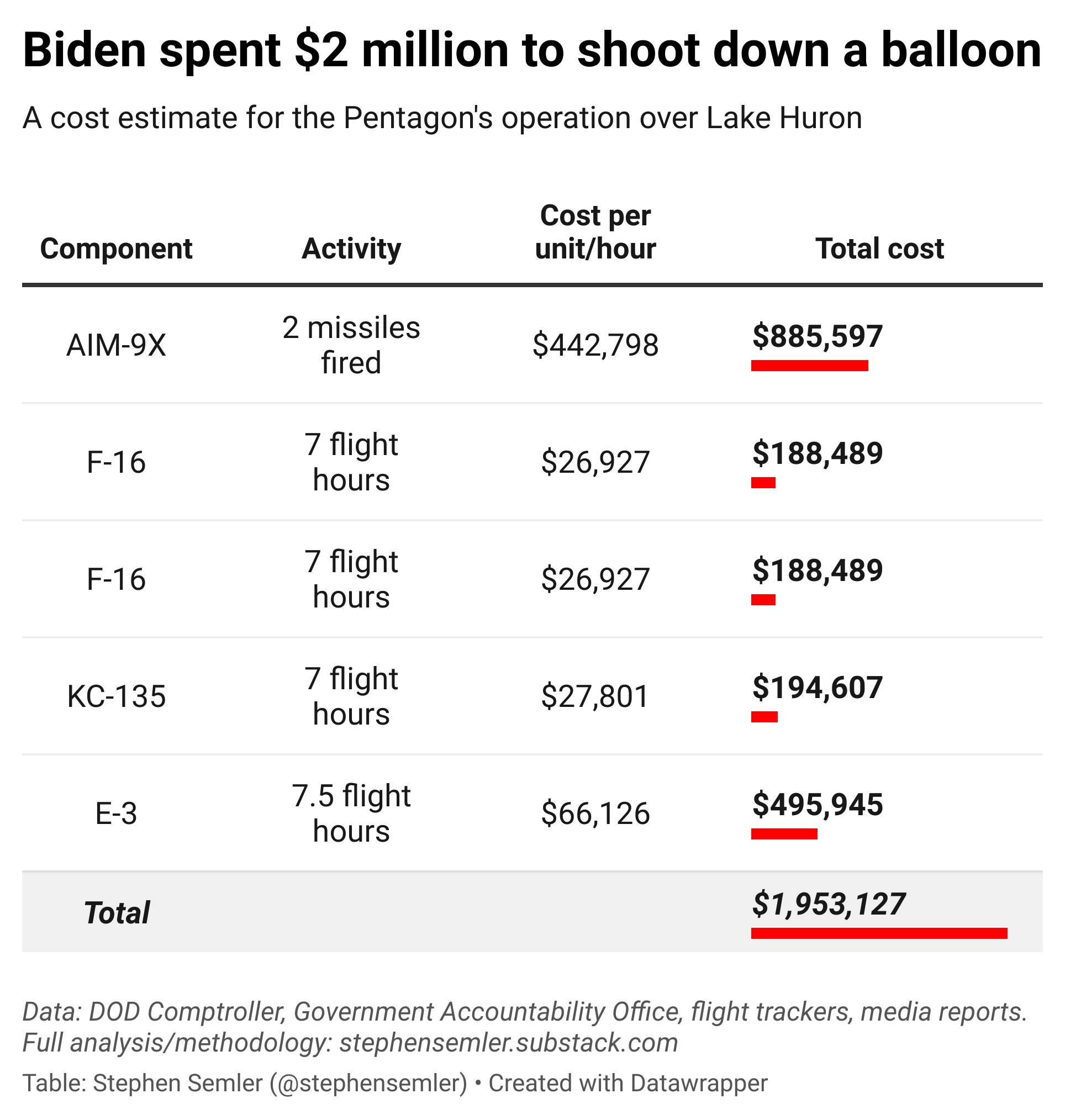
Citing intelligence community reports, Joe Biden said the three things shot down during the last week or so were “most likely balloons.” So how much did it cost to destroy these objects that may only be $12-180 each? As a case study, I considered the Pentagon’s operation over Lake Huron on February 12. According to my analysis of government documents, flight tracking data, and media reports, I estimate that it cost $1,953,127 to shoot down what was “most likely” a balloon. Methodology section is below, and feedback is welcome on this preliminary (and very conservative) estimate.
^Alt text for screen readers: Biden spent $2 million to shoot down a balloon: A cost estimate for the Pentagon’s operation over Lake Huron. This table has four columns: the component used in the Lake Huron operation, the activity it performed, the cost per unit or hour, and the total cost. I’ll go down the chart row by row: AIM-9X, 2 missiles fired, $442,798 per unit, $885,597 total cost. There are two rows for the F-16 showing these data: 7 flight hours, $26,927 per flight hour, $188,489 total cost. KC-135, 7 flight hours, $27,801 per hour, $194,607 total. E-3, 7.5 hours, $66,126 per hour, $495,945 total. All told, $1,953,127 in total. Data via DOD Comptroller, Government Accountability Office, flight trackers, media reports.
Methodology
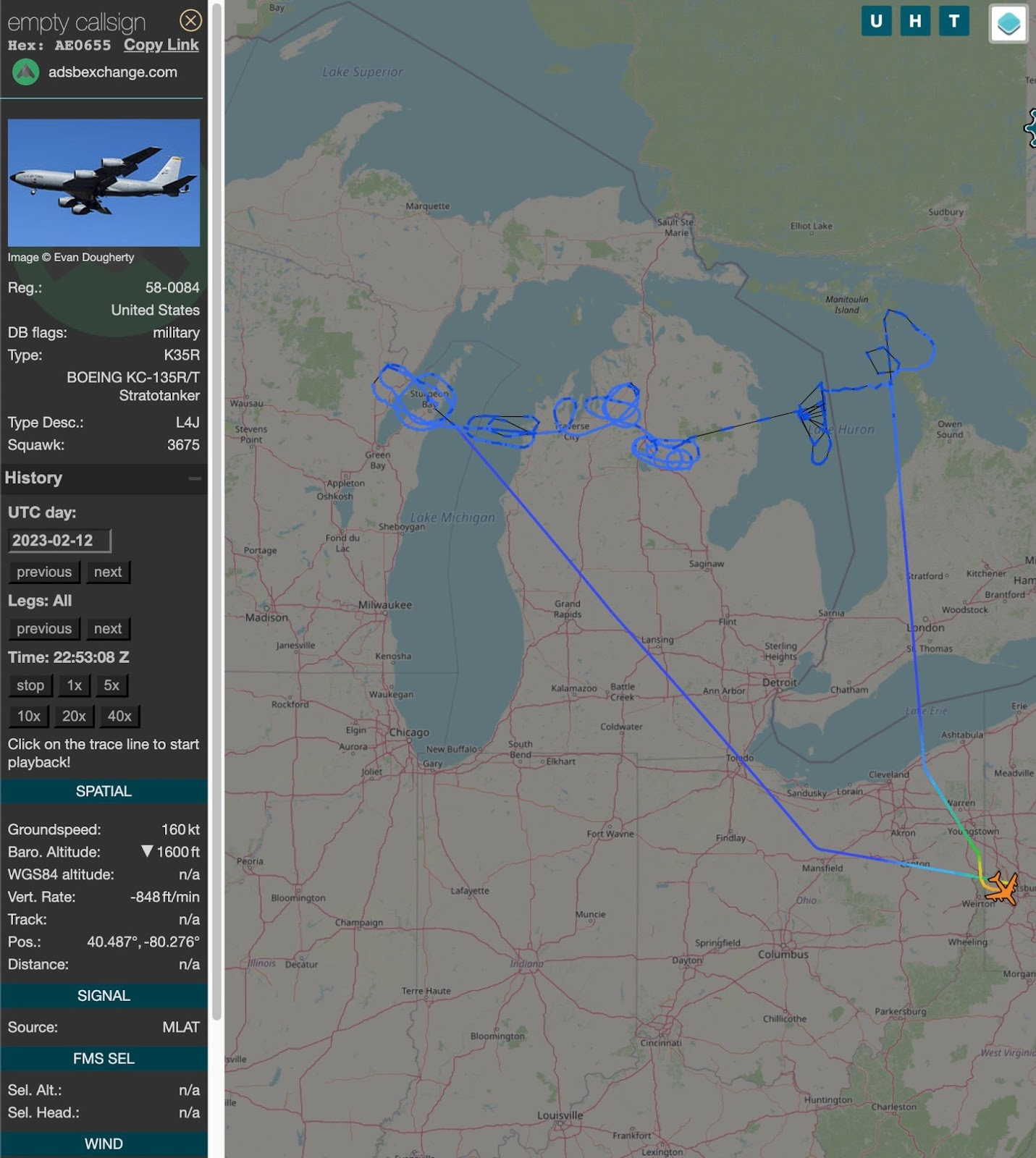
To calculate the unit cost of the AIM-9x missiles, I looked at the Air Force’s FY2022 procurement figures from the DOD Comptroller and divided the total purchase value by the quantity of missiles purchased. I referred to the Government Accountability Office for the cost per flying hour for each aircraft. To get the number and type of missiles and aircraft involved in the operation, I relied on mediareports and statements from DOD officials. To calculate flight times, I used mediareports to ascertain the takeoff and landing times for the F-16s, but I analyzed flight tracking data to get the takeoff and landing times for the support aircraft, the KC-135 and E-3.
**********
And, of course, with all the Progressive saber-rattling coming out of the Zhou Regime, once again, we reprise our song of the week.
There’s been an increasing realization and acknowledgement from all sides, that the current conflict has shaken the foundations of a lot of doctrinal military theory, and the very understandings of how strategy and tactics are employed in a modern ISR-dense (C4ISR) and observation/integration/network-centric-dominated battlefield.
This war may very well be the first truly 4GW and 5GW conflict. For those not familiar with the concept of generational warfare, you can get up to speed here: https://en.wikipedia.org/wiki/Generations_of_warfare
An evolution is taking place in real time before our very eyes, with both sides working furiously to adapt, breaking new ground along the way, oftentimes with deadly miscalculation.
One common theme around which a lot of discussion has revolved recently has been the idea that maneuvering large groupings of mechanized forces has become nearly obsolete. This has garnered growing attention in light of Russia’s looming ‘major offensive’ escalation, which will, as most presume, bring vast amounts of new forces and armored groupings into theater.
In Ukraine, we’ve seen from both sides the absolute risk and folly in sending a sizable armored column to assault, particularly over open ground. The preponderance of highly accurate modern guided munitions and ubiquitous fire-correcting drones, as well as x-ray-like full-spectrum battlefield-perception abilities in every conceivable band—from radar to IR to signal emissions detection (phone, wifi, starlink, radio, radar, etc)—turns the modern theater of war into something resembling a real-time-strategy video game, in the tradition of C&C: Red Alert.
The battlefield is strewn with modern precision munitions of every variety, which have ironically reverted maneuver warfare back to a locked-in, positional WW1 style framework. Everything from self-sensing mines like PTKM-1R to smart-cluster-munitions like the RBK-500 carrying Motiv-3M SPBE’s dropped from artillery systems which explode above armored vehicles and auto-target their soft roofs—have all been implemented thus far in the conflict (on both sides, in the case of AFU: via German PhZ-2000 firing smart munitions, and German M270’s firing AT-2’s, and another). Artillery shells on both sides—Krasnopol and Excalibur variety—accurately guided by drones and satellites and endless electronic systems of every possible extraction.
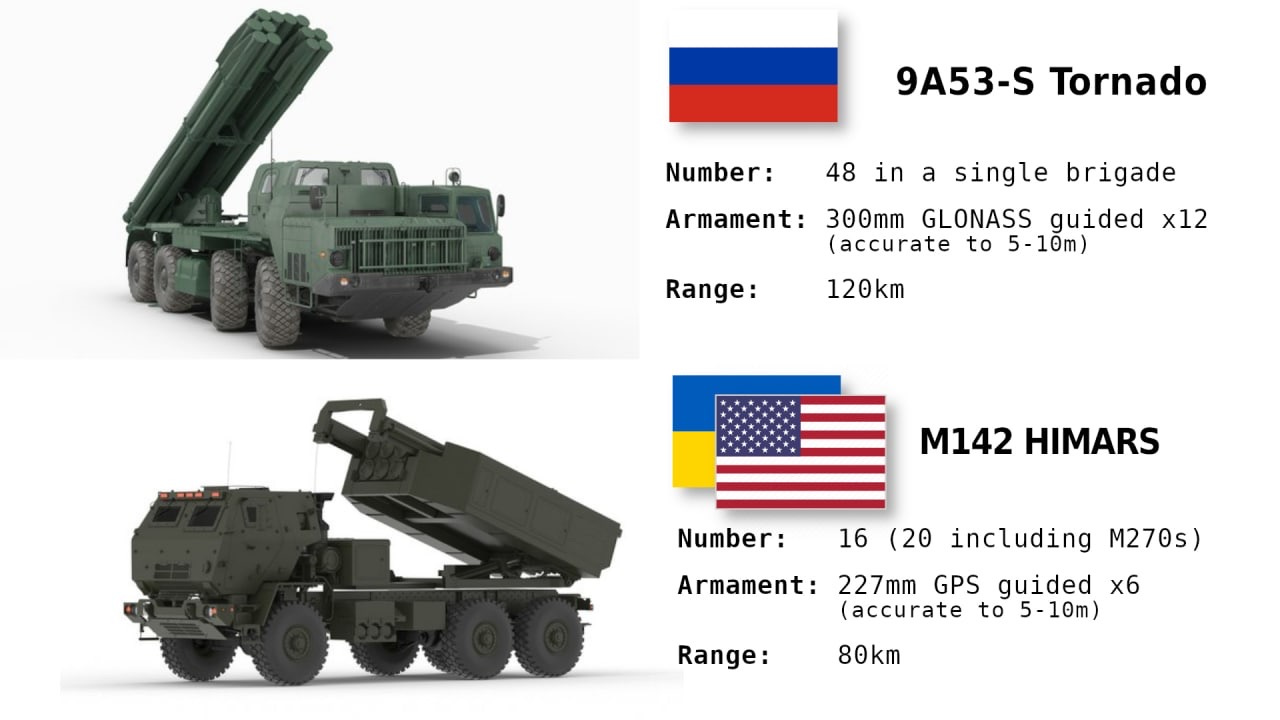
There are two ways of examining this, the microcosmic tactical-view scale, which deals with the unit tactics, and the operational macro sense. We’ll delve a bit into both. In the operational one, the advent and proliferation of longer range precision systems likewise greatly inhibit the ability of a maneuver force to prosecute an offensive in that supply lines (dumps, HQ’s, etc.) are all within easy reach of HIMARS and Smerch style guided precision munitions.
Some, like Strelkov, have recently rhapsodized on the notion that Russia is ‘completely unable to move forward’ in any significant operational sense, and is locked into a stalemate, because as soon as its forces create a push, the supply/logistics nodes feeding that advance are immediately targeted by things like HIMARs, loitering drones, GPS-guided artillery, etc., which grinds the offensive to a halt for lack of supplies.
Many have used this reasoning to rationalize Russia’s purported ‘failures’ in places like the Kherson front, though that is patent fallacy—as the pullback in Kherson had everything to do with the imminent threat of catastrophic river flooding from the potential destruction of the Nova Khakovka dam, not Russian forces’ inability to cope. In fact, several high profile AFU accounts have penned long, ‘scholarly’ twitter threads espousing just how well Russia adapted to the HIMARs threat on its rear depots in the Kherson region by distributing ammo concentrations. But of course, it’s easier to adapt when you’re only set on defending—but the topic of this discussion is one of attack: maneuvering forces pushing an advance in the signal heavy, ‘naked’ modern environment.
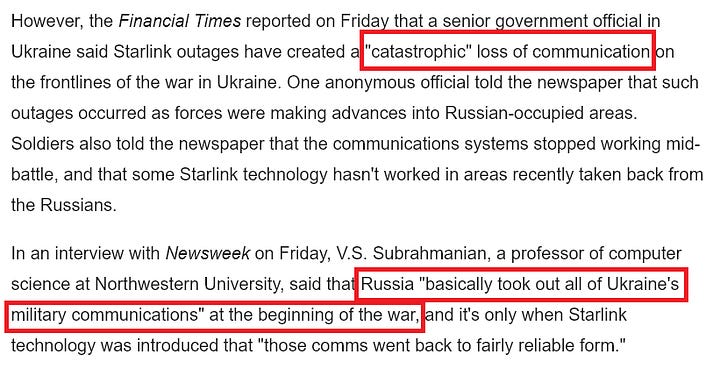
The totality of the NATO and ‘Five Eyes’ infrastructure is being utilized 24/7 as a sort of vast rear-end cloud-service and mega-processing/computational-cycle capacity for Ukraine’s frontline forces. Hundreds of satellites, including dozens of imaging ones with 5cm/pixel resolution, skim every inch and quarter of Russian territory, searching for actionable hidden targets. The data is then processed and collated by thousands of fulltime NATO/Five Eyes analysts working in distribution centers all over the world, then fed directly to the Ukrainian crews by way of Starlink and other datalinks, which Ukraine can then sub-distribute via their innovative ‘Nettle’ integrated system to feed those targets to a variety of sector artillery and other systems.
We’ve got a glimpse of this months ago when documents were leaked which demonstrated the exact work-flow by which this NATO/Five Eyes superstructure identifies and transmits the positions of every imaginable Russian unit, down to the barest granularity. It showed papers typed up by the army of analysts poring over the satellite cluster footage, which have endless lists of high-value Russian targets, catalogued, categorized, etc., with their exact coordinates and associated reference photos.
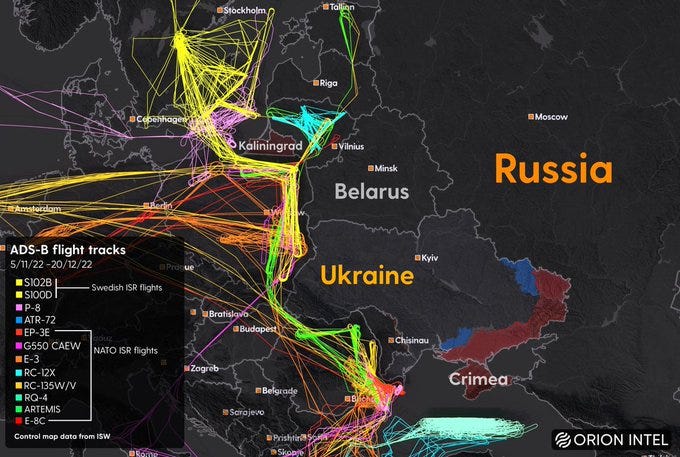
And of course this is not to even mention the fleet of AWACs that collect radar data around the clock from the Polish and Romanian airspace, RQ-4 Global Hawks, with their SAR radars that photograph Crimea daily from the Black Sea, the OTH shortwave radars likely doing early warning detection on Russia’s airforce flights from thousands of kilometers away, and more. In fact, it’s even been suggested that U.S. forces use seismic sensor data to track large Russian force movements. The Soviets themselves capably used this tactic against the Mujahideen in Afghanistan.
We saw in Kherson and many other places, anytime the AFU launched a wide offensive with large, visible mechanized column pushes, they were instantly spotted, tracked, and decimated from long range. But recently in Ugledar, it appeared that Russian Marines fared no better under similar circumstances.
Their mechanized columns too could not cross that dreaded no-man’s land of frozen farm fields before getting ID’d. Granted, it appeared that mines played the biggest role in that, as some intrepid readers have pointed out. However, I must counter with the point that the only reason they even hit the mines to begin with, is because they were under orders to do a mad dash across the fields, from cover to the next position in the dachas section of lower Ugledar, for the very reason that lingering and taking their time negotiating the minefields would have exposed them to enemy ISR and immediate risks from the air in the form of drone-corrected strikes, etc. If it weren’t for that ubiquitous observational threat, they could have leisurely crept along with a mine-trawl, or called up a slow-working UR-77 mine clearer.
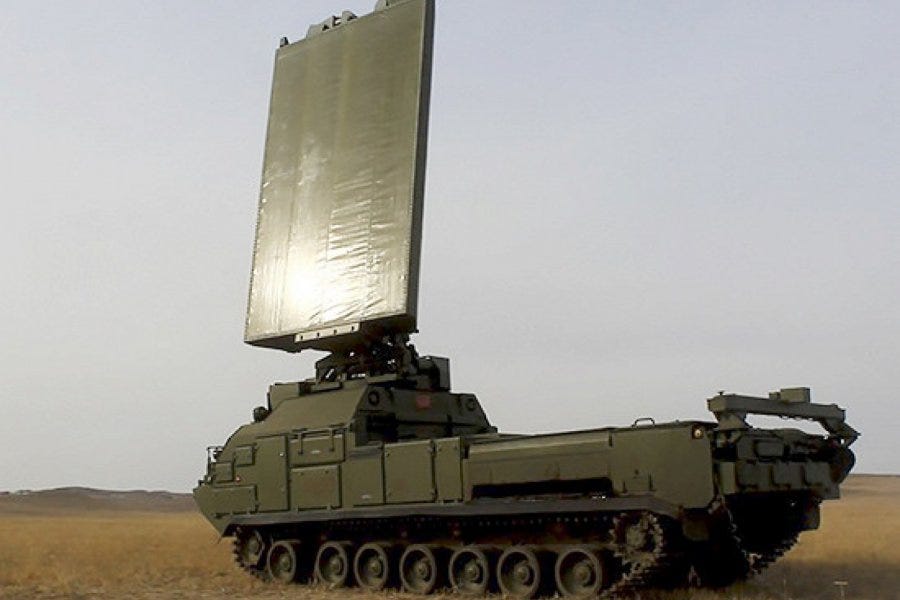
To tangentially expand on, briefly, how one is theoretically supposed to deal with such threats, and why it doesn’t quite work as well in practice as in theory, first let’s examine how, to counter artillery, we know you need your own drone-ISR systems, and preferably augmented by counter-battery radars which can place the vector and distance of the enemy shot for you to retaliate.
But as seen in this Patrick Lancaster video, a Russian soldier gave a frank answer in describing the complexity, difficulty, and irregularity of dealing with these issues. He states that they used Russia’s most powerful ‘Zoopark’ counterbattery radar, but the system is SO ironically powerful that it becomes an immediate target for anti-radiation sources that can home in on it like an IR missile to a burning flame.
So then they moved the system farther behind the lines, but the AFU’s artillery discipline is such that they still manage to scoot-n-shoot their guns away from danger by the time one can use the system to locate them and respond. Now, to be clear: this is not a blanket characterization of how ALL such scenarios/systems work. We have an abundance of evidence of the same Russian Zooparks (and others) working fantastically to obliterate AFU’s positions with counter-battery fire. But it’s just an illustration of the difficulty and unpredictability of these things. If you get a really good enemy crew, with strong discipline, they can negate such systems.
This to a large extent explains the type of perplexing, small-unit warfare we’ve been witnessing up to this point. Wagner themselves described their most successful tactics in Bakhmut: it consists of small groups of men, 8 or so max, operating independently, storming forward to intentionally close in within 50-150 meters of the AFU positions, so as to prevent the enemy’s rear artillery from firing, for fear that they will hit their own men. They call it, “riding the shoulders of the enemy”. But the key detail is a religious devotion to staying separated in small, isolated fire teams.
This partly explains Russia’s decision to lean on smaller, detached BTG’s in this conflict. And why in so many seemingly bewildering videos, we see such small assault groups or lone tanks operating so often on the frontlines. In today’s highly network-centric, integrated, signal and observational-overload battlefield, it’s simply near-suicide to clump up together into large groups.
II.
So the big question is: how can Russia actually push forward, break through enemy lines, and successfully conquer territory en masse under such conditions? Is Strelkov right, and Russia is doomed to incremental positional hacky sack?
It’s a very broad topic, as there are many facets to covering the feasible ‘solutions’ to this dire dilemma. Let’s delve into the ones already being used effectively, and those likely to be used in the coming escalations.
1. Atmospherics And Smoke Screens
Firstly, to get the simplest tactics out of the way, let us mention a few chief limitations of all these whiz-bang omnipresent ISR systems. The first of which is environmental/atmospheric conditions. In short: drones and satellites really hate clouds, and even with the advent of ‘remote sensing’ and SAR satellites, they can’t really penetrate cloud-layers as well as the MIC salesmen would claim—at least not at the granularity of seeing individual units and combat groupings.
Fact is, when there’s heavy cloud cover and/or fog, drones can become utterly useless, and same goes for satellites. If one were really up to the task, one could use serious weather modification capabilities like cloud-seeding, to create a perma-overcast conditions to blind one’s enemy. Unfortunately, it would blind you as well.
Several times recently, there’s been reports of Russian offensives (in both Kremennaya and Ugledar) grinding to a halt because there was severe cloud cover that greatly diminished their CAS and negated their air superiority. But, conversely, there were other times they considered it an advantage in some fronts, and pushed in specifically when there was cloud cover and the AFU’s drones were blinded.
The less-drastic compromise can be using a variety of smoke-generating systems to conceal your movements, of which Russia itself not only has many, but has even used a lesser version in the very theater we discussed above, when the Marines pumped smoke from their BMP-3’s to advance.
Of course, this is just a small-scale, temporary measure against more localized ISR, but it was worth mentioning to get it out of the way.
2. Satellites and Kesslerization?
The most effectively practical method to defeat the most potent form of Ukraine’s observational abilities would be simply to shoot down the satellites. Russia has threatened to do so already several months ago.
However, the U.S. replied that it would react in kind. Although, Russia was specifically naming the group of commercial satellites like Maxar, rather than U.S. military satellites. Today, Russia even repeated the threat after NATO announced a new program to radically boost space recon cooperation into a new fleet of highly centralized and coordinated military/civilian satellite constellations aimed at total domination of the C4ISR domain.
But could/would Russia actually shoot down the satellites? We know they can if they wanted to: they demonstrated it last year as a show of force, and if you watch to the end of the linked video, the U.S. generals were quite worried about the fact.
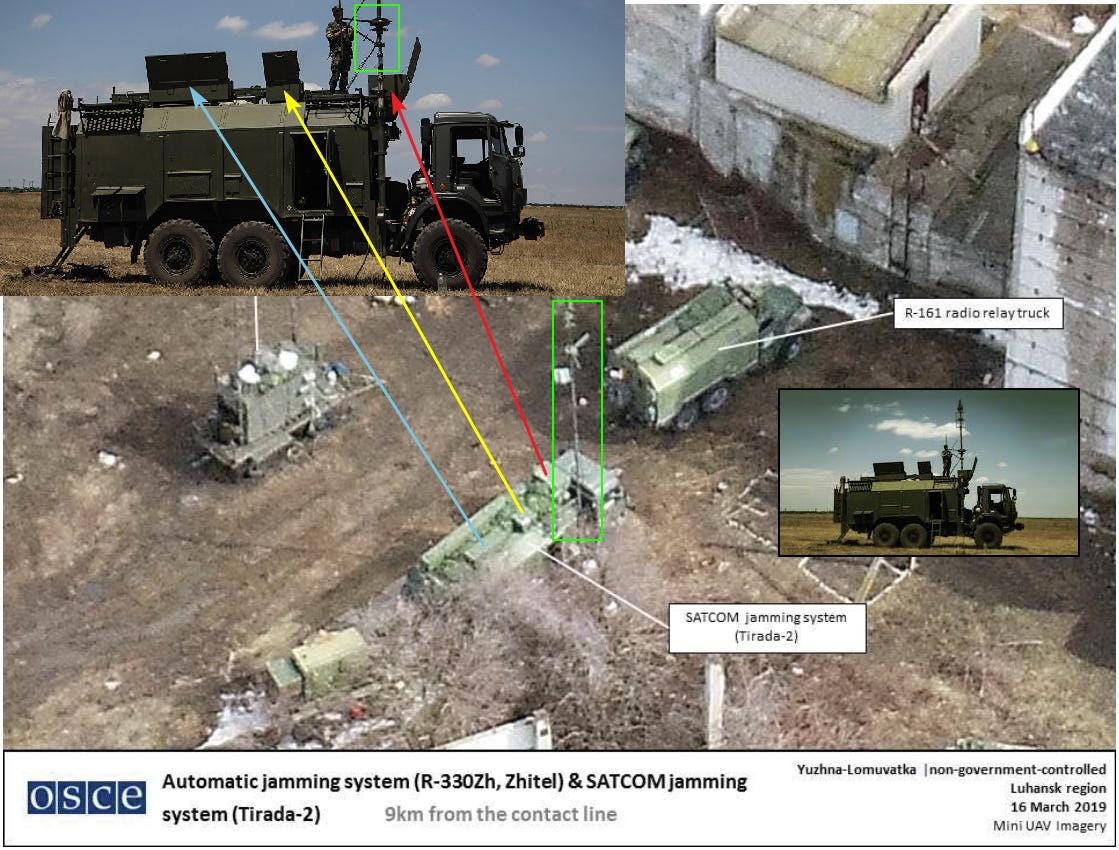
Some have asked: why doesn’t Russia jam/blind these satellites with the vaunted and newfangled Murmansk and Zhitel (among others) systems that they brag so much about? The problem is, those systems jam signals like radars, GPS, etc. But the chief types of satellites that are the true thorn in Russia’s side are the electro-optical, i.e. “photo” satellites. How can you jam a telescope-like satellite with a powerful zoom camera that is taking pictures of your facilities and troop movements? You can’t “jam” a camera lens.
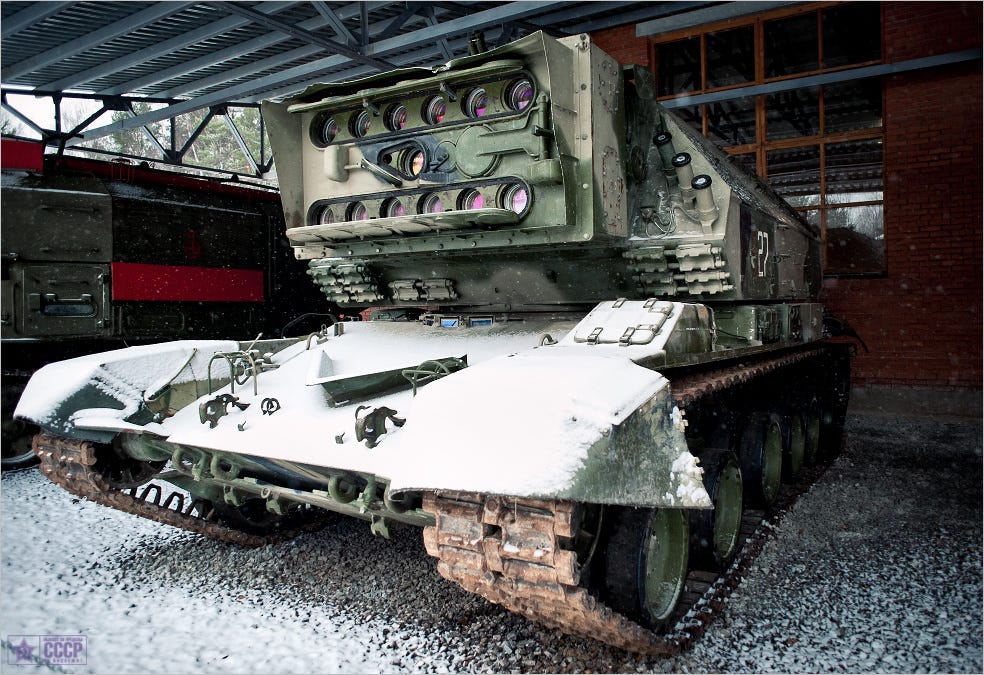
The only possible countermeasure for those is blinding them with a laser. And there’s long been a string of reports that claim everything from Russia having already blinded U.S. satellites, to Russia threatening to do so and testing it, to Russia currently building the capabilities to do so.
While it’s true that Putin triumphantly announced Russia’s new ‘Peresvet’ laser last year, most lasers of this sort—including the U.S. navy tested ones—have a fairly short range of only a few kilometers at most. Satellites, of course, travel hundreds or even thousands of kilometers up. However some reports claimed that the Peresvet can blind satellites at 1500km range.
And reports from earlier last year claimed that Russia even fielded a new type of laser called ‘Zadira’, which is allegedly even more powerful than the Peresvet, and are already using and/or testing it in Ukraine.
And the Soviets had a laser called Terra-3 which was said to have glitched out the Challenger space shuttle. Per wiki:
Shuttle attack rumor
Terra-3 is the topic of a widespread claim that the IR laser was used to target the Space Shuttle Challenger during its 6th orbital mission on 10 October 1984 (STS-41-G). According to reports by Steven Zaloga, the Shuttle was briefly illuminated and caused “malfunctions on the space shuttle and distress to the crew,” causing the United States to file a diplomatic protest about the incident.[6] This claim appears to have started with former Soviet officials, notably Boris Kononenko.[7] The crew members and “knowledgeable members of the US intelligence community” have denied that the shuttle was illuminated by the Terra-3.[8]
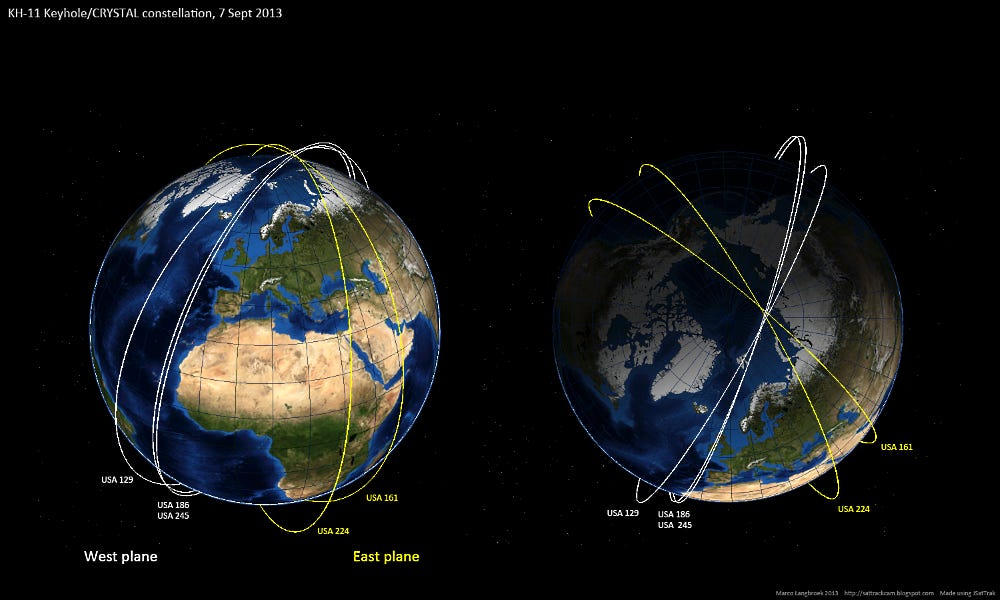
So can Russia’s lasers really blind satellites? No one knows for certain, though likely they can. However, the most advanced U.S. Keyhole opto-electrical satellites most likely have counter-measures against this, i.e. simple remote-controlled panels that close over the lens to prevent the sensor from getting fried. The laser at that range likely does not have the power to outright burn up the entire satellite, but rather fry the delicate imaging CMOS sensor behind the lens.
Also, it is likely far more difficult to do this than it appears. Firstly, to do any damage, most laser weapon systems have to keep the laser trained onto the target for a certain period of time. In short range tests, 5-10 seconds usually ‘burned’ the target up. However to damage a sensor 300-500km away (the orbit of most Keyhole satellites), the laser would likely have to accurately ‘track’ the satellite across the entire sky. But satellites move extremely fast, and the laser would have to basically thread a needle by keeping the beam on the sensor as the satellite flies across the sky. This would take much greater abilities of digital tracking, automation, fire-control systems than most people think.
Sure, commercial and prosumer telescopes have abilities to track stars across the slowly moving sky, and presumably a similar tech can be employed but it’s worth mentioning how technical and difficult this is.
Secondly: between the U.S. and “partners”, they have many such imaging satellites, yet Russia probably has a very low amount of these prototype laser systems. It would be very difficult to blind all the satellites in a timely manner. With that said, we don’t know for certain—Russia could have more of them than we think—and it could always blind one or two as a warning, forcing the shutdown of the rest.
The most trusty and dependable method in the end is the good ol’ Nudol Missile.
The intrepid readers will say, the U.S. claims they would ‘respond’ if Russia took out their satellite(s). But, there’s one very interesting angle to this scenario that few have foreseen.
Sure, the U.S. can retaliate and take out Russia’s satellites after Russia takes out all the U.S. ones. But guess who that leaves as the sole dominant space-hegemon and satellite power in the world?
That’s right. This guy—who will become not only the happiest, but the most dominant player in space with a sudden massive and historical strategic advantage over the American adversary. Russia and the U.S. would both be sent back to the stone age, satellite-wise, but China would now enjoy virtual, de facto space hegemony. Do you think U.S. cares to risk such an unthinkable option? Not very likely.
In short, the U.S. goading Russia into a satellite war is like a guy with a Bugatti threatening to ram someone’s ‘92 Toyota Tercel in a roadrage incident. They have far more to lose. That’s not to disparage Russia’s space capabilities, but rather to highlight that U.S. will be the really big loser in this case. The Toyota guy can get a new bumper for $125 while the other guy will have $100k+ in damages.
So it’s for this reason that I believe U.S. really doesn’t want Russia to up the ante and give Russia reason to start taking out satellites.
3. Asymmetrical, Hybrid Warfare, And Light Assault
The next way to minimize the dominance of an enemy’s modern 4GW/5GW capabilities is by using a lot of asymmetrical warfare tactics. By simple point of necessity alone, the AFU has already been doing this. Russia has too, but Ukraine has pushed the envelope further and faster in some areas, in terms of asymmetrically circumventing the signal dominance of the battlefield.
Things like 3D printing drone bomblets, maskirovka of every variety (feints, dummy props like scarecrows and blowup tanks to fool recon), unconventional/hybrid force usage—the eschewing of large, slow armor groupings and instead utilization of insurgent-style ‘ISIS technicals’ to trade safety for space and time.
The Kharkov assault was a somewhat successful example of this (I say somewhat because, while objectives were achieved, they took heavy losses—which exposes the downside). The AFU chose a balls-to-the-wall, safety-last strategy which banked on surprising and overloading recon OODA loops by crossing large swaths of territory very quickly on fast moving, light vehicles, and creating mass panic, overreaction, and disorientation on the receiving side.
Of course, this doesn’t work everywhere. In Kharkov it relied on heavy forested areas where cover could conceal the movements. Not to mention the 5:1 or 8:1 (according to some sources) numerical advantage over what was effectively an Allied volunteer garrison; but it’s an example in one place and time.
Russia, too, used the ‘light assault’ with hybrid warfare (activation of partisans in conjunction with Kherson assault, etc.) fairly effectively early on, but with the same downsides, as there were much more casualties than usual. And going forward, this is not the strongest strategy of choice.
4. Stretching Your Enemy To The Breaking Point
Here’s where we start getting to the real meat and potatoes of what Russia will likely employ. A related strategy they can use operationally on a much grander scale, and which I believe we could likely see very soon in the coming offensive, is the intentional stretching of the front to the breaking point, exploiting the AFU’s weaknesses of manpower and troop quality. But most importantly, apropos the current topic, it would put a huge logistical strain on that back-end NATO C4ISR server-farm.
If Russia opens multiple new broad fronts, it exponentially increases the raw man-hours, processing power, etc., needed to keep track of everything and relay it to the AFU. Those aforementioned, vast churning computational-cycles of NATO’s backend would be strained to the limit to keep track of such broad distributions of forces and possibilities. Further, it would stretch and diffuse the key Ukrainian guided systems, like HIMARs, which they have relatively few of, thus further nullifying the ISR edge, as NATO’s target data is useless if the systems they’re sending the targets to aren’t effectively positioned, or are diluted all over the country.
For clarity, imagine that most of the war takes place on one near front. The AFU can concentrate all their precision systems like HIMARs, M270’s, etc., there, and use them in concentrated fire on a relatively smaller area, where NATO surveillance can also much more effectively and efficiently keep track of Russian rear areas, C3, supply, logistics, etc.
But spread over multiple broad fronts, Ukraine would have no choice but to dilute its most powerful precision units, spreading them hundreds/thousands kilometers apart. With that said, the risky extreme of this, as we discussed in Part 2, would be Russia utilizing fronts which are TOO broad and far apart, thereby passing a point of diminishing returns in benefits. But this only really applies to the distant extremes, like a front in west Ukraine, Volyn province. Though now, there’s been some slight indications—albeit it could be the usual maskirovka feints—that Russia could still choose that dreaded first vector from my Part 2 report. Not only have Russian drones been spotted mysteriously buzzing the Zhytomir region (west of Kiev) of Ukraine for the first time since the start of the SMO, but there’s been ‘strange activity’ in far west Belarus, with reports witnessing ‘Wagner troops’ (or troops that “looked like Wagner) in Baranovichi, Belarus, near the Polish/Ukrainian/Belarus border. This has compelled Ukraine to station 20,000 troops there in preparation for a possible Russian assault from that vector, as per the reputable Ukrainian ‘Resident’ channel:
Ukrainian TG-channel “Resident” shares an insider: The General Staff is concentrating 20,000 troops of the Armed Forces of Ukraine in Zhytomyr to repel a possible Russian strike from Belarus.
Zhytomyr would be in line with the ‘Macgregor Axis’ of our previous Part 2 forecasts. Such an axis could very well accomplish what we mentioned above—the stretching and straining of Ukrainian/NATO intel/recon capabilities, which would give large Russian forces more headroom in advancing under these digital-dominated conditions. In short, it splits enemy resources in these domains, puts greater strain on satellite (and other SIGINT, ELINT, etc.) resources, requiring satellites to orbit in wider, unpredictable, less coordinated orbits, which degrades and increases NATO’s own reaction times and OODA loops.
5. EW Bruteforce
It’s also possible to brute-force and overpower your enemy’s electronic infrastructure with the large-scale deployment of powerful EW systems. But one issue most overlook, is that powerful jammers also jam your own devices.
Specifically in the sphere of drone warfare. If you have one of these standard battlefields we see so often, wide, expansive fields with a no man’s land in the middle, drones from both sides hovering above and correcting artillery fire—and you position a powerful Krasukha system behind your artillery and start flooding the skies above that field with jamming signal, you’ll FUBAR your own drones as well as the enemies.
This has already been mentioned several times in interviews with Russian soldiers, where they bemoan the annoyance of not being able to use their anti-drone guns or EW systems in some circumstances as it interferes with their own drones as well.
Now, if you had your own natively-made drones with custom secret bands that your military engineers designed to be specifically immune to the jamming bands, it could be a different story. But unfortunately, that’s the problem with both sides relying on the same Chinese DJI products, rather than constructing indigenous devices.
With that said, the actual effect that Russian EW is having on this war is greatly underestimated and understated. Because of Russia’s supreme OPSEC, and the vast amounts of drone footage we see, most assume that Russian tech is sitting it out, or is ‘underwhelming’. But in fact, if you pay attention to the reports and interviews as fastidiously as I do, you’d see that Ukrainian forces constantly complain about the sheer EW dominance prevailing against them. Hell, our last report was about this very fact. And there have been many reports of entire frontlines blacked out by Russian EW:
But there is even much more beyond that. A large portion, and dare I say majority, of AFU drone-related videos we see are against DPR/LPR or volunteer forces. Against actual Russian brigades, their drones are almost completely nullified, barring the one point of weakness when Russian units are advancing and happen to over-extend past their EW coverage.
6. Refining The Reconnaissance-Strike-Complex
The other more straightforward and logical method is ironically the most systematic and difficult: one way to defeat the enemy in modern conditions is to simply be much better trained, more efficient, and in general have a tighter, stricter, faster and more accurate armed forces.
Specifically, this is in reference to things like the aforementioned OODA loop, which is encompassed in the famous Russian conceptual doctrine of the Reconnaissance Strike Complex (RSC) and Reconnaissance Fire Complex (RFC). In essence, these doctrines have to do with refining the process and ‘workflow’ of integrating and streamlining the various systems and trainable procedures involved in acquiring a target and effectively relaying the data to gun crews in short time. Russia has said to have gotten its RSC capabilities down to as little as 10 seconds, up to 2-3 minutes for some systems.
Thus, the more one can systemically enforce a high standard in all your formations, and the tighter they can operate, lowering reaction times in these types of decision loops, the more you can outpace an enemy’s own loops and thus negate a large part of their multi-domain 5GW / C4ISR capabilities.
That may sound like a techno-babble-word-salad, but to simplify it: if NATO has all these powerful satellite recon and ELINT capabilities, they can be partly negated if Russia’s better training allows them to make decisions faster on acquiring-targeting-engaging a target. If NATO warns the AFU, for instance, that a large Russian force (or contingent of aircraft) is moving in on a particular sector, this spoiled ‘element of surprise’ can be partly negated if Russia’s RSC / OODA loops are so well-honed that they out-perform the AFU’s own capabilities to relay needed info at the tactical level, even in spite of the Ukrainian force’s general knowledge of the Russian advance. In essence, if you KNOW an enemy is across the field from you because someone with a satellite tells you, but that enemy’s recon-to-strike loops are much faster than yours, then it will matter little, as he will still beat you to the punch.
But as mentioned at the start, this is the most difficult option by far, because it relies on a ‘no shortcuts’, hard-work and elbow grease mentality of simply refining the entirety of your armed forces to an extremely high capability level, rather than relying on ‘gimmicks’ like surprise attacks or maskirovka to muddy the enemy’s battlefield perception.
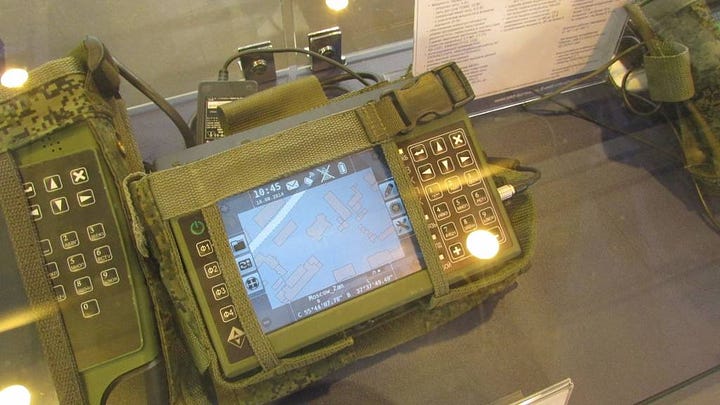
But doing so also requires a parallel effort in modernizing your forces such that the technological backbones and infrastructure can effectively support the increased load of these standards. One way Russia has done this in recent years, is by steadily introducing ‘network-centric’ systems to digitally integrate their battlefields in such a way where the interoperability of systems and units can allow them to disperse targeting data in a timely and streamlined fashion. Russia has begun to use systems like the Strelets-M (Sagittarius-M) and Andromeda-D battlefield management systems (part of the Ratnik program) which, in layman’s terms, gives soldiers a console with a digital map, allowing them to input enemy positions with the touch of a finger, and instantly send those positions to a variety of fire units to engage the enemy.
Like U.S.’s Link-16 system, this allows a Russian ground soldier to even pass targeting data up to a frontline bomber like Su-34, if it’s equipped with a corresponding system. Only several weeks ago, we got one of our first glimpses of a Russian artillery unit officer using such a console: https://www.bitchute.com/video/WII88BHXBghz/
The system has already been successfully fielded in Syria, where Russian soldiers fed targeting data to Su-24M bombers, with a reported “100% accuracy”.
So ultimately, the question is—does Russia have the advantage here, which can nullify NATO’s abilities? We have heard some reports (mostly from militarily adjacent figures, like DPR soldiers, filtered through doomers like Strelkov) and complaints about some serious deficiencies in Russia’s OODA loops when it comes to artillery target relay.
One such complaint described how an AFU unit was fording a river, and they relayed the target data to Russian artillery somewhere in the rear. But the decision-making process had to go through so many chains of command and authorizations that by the time the shells started flying, the AFU units were long gone.
But it’s always easy to hand-select small incidents that happen to agree with one’s narrative. There may be some localized issues with certain units as there are with any large fighting force. But there is no evidence to suggest that the problem is endemic to all combat units. The fact is, you do not kill your near-peer opponent at unprecedented 10:1 ratios, giving them hundreds of thousands of casualties, if your decision strike chains are that unserviceable.
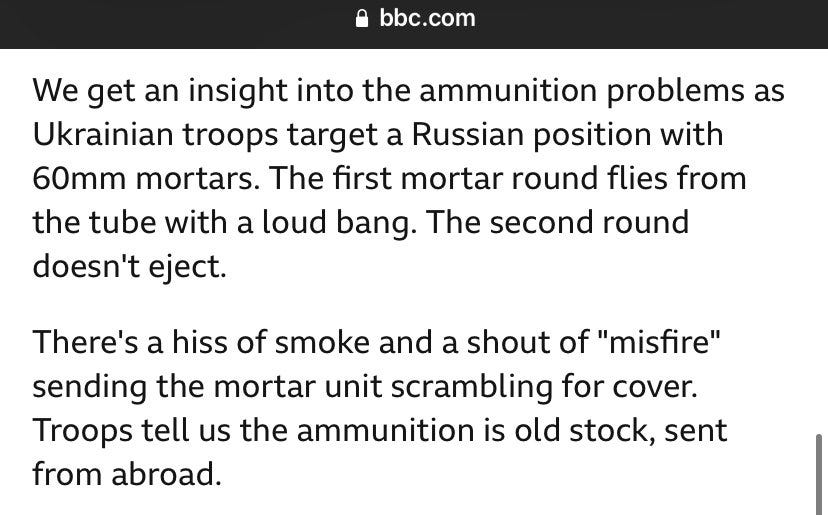
The truth is, the West’s militaries are not artillery forces. Ukraine has been praised as combining the best of the West’s capabilities, including their most modern, advanced, and capable systems (PhZ2000’s, Krabs, Archers, Danas, Caesars, M109’s, M777’s, Zuzana’s, etc.) and smart-munitions, with the superior Soviet artillery doctrines to create an alchemized force of unprecedented combat potential. And by ‘unprecedented’, I mean literally better than the American military. Don’t take my word for it, read this famous twitter thread from ex-DoD expert Trent Telenko who exults in the AFU’s unrivaled and revolutionary networking/integration synthesis which makes their artillery force far superior even to that of the U.S. army. Here’s an excerpt:
“It is a true distributed software environment that reduced request for fire to trigger pull from 20 minutes to 30 seconds. By comparison, the US Army did that call to trigger pull in 5 minutes in WW2, 15 minutes in Vietnam and one hour currently. No, that isn’t a typo. The increased US Army time ‘from call to trigger pull’ has to do with trying to prevent friendly fire plus the inclusion of JAG officers in Division artillery fire control centers doing rules of engagement/collateral damage vetting of calls for fire. In 2006, when US Army Special Forces task force hunting high value targets was given direct access to an MLRS battery with GMLRS rockets – without a JAG officer poisoned chain of command – got it back down to Vietnam 15-minute levels in Iraq, thanks to the Blue Force Tracker. This didn’t last long with the Obama Administration thanks to Taliban high value targets using their own kids as human shields followed by cellphone photos of dead kids. Then everything went back to the JAG officer game & the Special Forces started buying loitering drones.”
So, what’s the point? That this unrivaled capability in the hands of a Ukrainian force that not only has the single greatest, most modern artillery howitzers, the most accurate, and best-ranged munitions, but also the most powerful combined force of all NATO/Five-Eyes’ ISR and satellite recon—THIS historical force of nature, is getting its clock cleaned by Russian artillery forces. Sure, the AFU masterfully get in their punches too here and there. But as a totality, Russian artillery forces, utilizing Russia’s own revolutionary Reconnaissance-Fire-Complex capabilities are roundly wiping the floor with the Ukrainians in the artillery war.
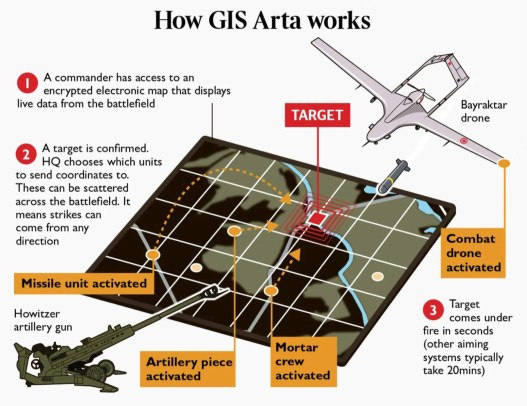
Sure, the naysayers will say it’s because Russia has much more ammo to expend—but hey if those newfangled Western systems and whizbang GIS Art capabilities were so great, shouldn’t the accuracy and time-to-kill capabilities overmatch the Russian ammo advantage?
In short, Russian RCS/RFC has proved its mettle by devastating the AFU army so badly, they literally ordered a whole second army.
7. Economies Of Scale
Thus far, in many ways Russia has employed the method of atomization and ambiguity to most success, simply owing to necessity. They already had an inordinately small force which had no choice but to operate like a ‘ghost’, appearing many places at once, and utilizing Sun Tzu strictures to seem much larger and more omni-present than it really was.
This, in turn, worked in their favor to some extents, because having an already small force pretty much precluded them from ‘clumping up’ in a way that would benefit the ISR-heavy NATO snoopers.
But now, with the expected force of 300-500k (or more) new mobiks joining the fray, there’ll be no choice but to move around large, juicy formations which present ‘target-rich environments’ for that NATO all seeing eye. And this is where the method of distribution can work. By extending the forces to vastly broad new frontlines, they can put a major strain on NATO’s capabilities.
Also, there’s something to be said for the concept of ‘economies of scale’. That is, there’s a certain benefit gained from scaling up one’s forces, where certain redundancies and parallelizations of systems begin to work in tandem in such a way as to become ‘more than the sum of their parts’, conferring additional benefits.
An example is this: up to now, Russia’s airpower has been characterized by many as ‘anemic’, which most don’t realize was due to the small number of forces Russia has actually committed to the conflict thus far. This has reciprocal effects on the function of the entirety of the frontline forces in a given theater. Think of a battle as a sort of eco-system—you’ve seen the famous videos where wolves are introduced into a wildlife preserve, causing a chain reaction of events; whereby the wolf eats the deer which eat the grass, which saps the water from the stream, stifling the breeding of fish. So by introducing a wolf, a miraculous, compounded and seemingly paradoxical chain of events occur, eventually leading to the revitalization of the river and fish habitat.
Russia’s coming escalation includes an increase in troop numbers of all branches, including the airforce. We’ve seen the reports how 400 jets and 300 helicopters are now allegedly stationed outside Ukraine, ready for action.
Similarly, by the force of scale—by increasing the air support to a given frontline, Russia will precipitate a chain reaction in the eco-system. There’ll be more ‘wild weasels’ for SEAD missions, AFU AD systems will be consequently far more pressured and less active, which in turn will compound the active participation of even MORE airpower, in the manner of frontline bombers and attack choppers—now able to more freely operate. This domino effect will cause an increase in the effectiveness of assault units advancing at the enemy, which will keep them from being “static” and stuck in stalemate-y, positional and attritional battles—which will therefore negate a lot of NATO ISR reliant on static targets whose coordinates they can feed to artillery systems. In short, it will avalanche into a more fluid battlefield which hampers and strains ISR systems, particularly satellite recon.
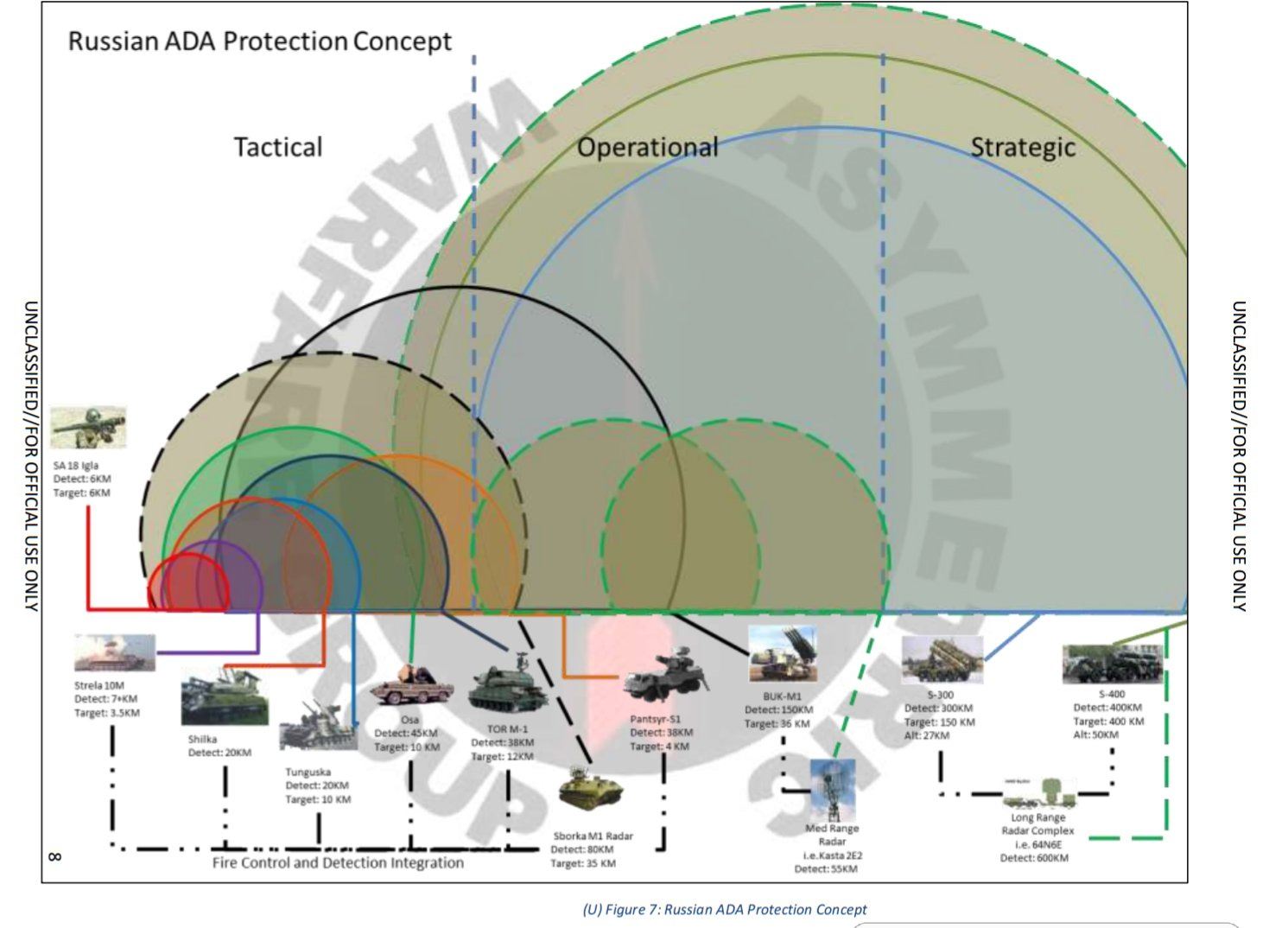
Similarly, the ‘economy of scale’ concept pertains to the increase of Russian AD systems in each sector. As discussed briefly in Part 2, a more ‘densely’ integrated and layered AD system can have compounding effects due to how all the various disparate parts mutually overlay each other like neurons making multiplicative connections to each other.
This will further compound Russia’s ability to intercept strikes at the ‘rear lines’, which is precisely what the biggest (and only) strength of NATO’s ISR capabilities has been. One must understand, due to Russia’s very lean use of force to now, it meant the drastic under-powering and under-utilization of AD systems. But with the coming troop increase, many more missile brigades will be brought in, and will have an additive effect, like standing waves or cymatics systems, where overlapping frequencies become much stronger together.
Many people sat goggly-eyed months ago, watching the perplexing display of the Antonovsky bridge being hammered by HIMARs, often without even the barest Russian effort to intercept the missiles. Most don’t realize that Russia’s small force usage was the culprit. Stretched so thin, even the missile brigades operated anemically, such that hardly a single Pantsir unit could be found to cover the bridge, at least up until the end, when more were moved in.
So, as per the opening question: this is how Russia can advance a large army in spite of NATO’s ISR overmatch. By drastically increasing the troop numbers, which correspondingly increases the AD brigades, Russian AD will generate compounding efficacy by the expanded, overlapping layered integration, which will in turn hamper the AFU’s attacks on rear lines and ammo depots, and thus allow Russian forces to keep supply lines intact and more consistently advance.
Of course, NATO will try to nullify this by up-scaling the delivery of precision systems to Ukraine, to match force for force and attempt to overwhelm those AD systems. To wit, their newest package aimed to send another 18 HIMARs systems (on top of the ~20 Ukraine already has); but it’s unclear if/when they will get those as there appeared some indications it won’t actually come any time soon.
8. Classic Soviet Doctrine Still King
The last operational-scale strategy we’ll mention, which works in nullifying the reach and overwatch of NATO’s ISR systems is to some extent what Russia has already been successfully doing.
In short: engaging in a long range artillery war—though ‘artillery’ is an oversimplification, and is meant to represent all long range systems from shell to tube artillery, to ground and air-launched missiles, etc.
Now this may sound contradictory, as previously we mentioned that movement and maneuver warfare on a broad-front scale can negate many aspects of the modern hybridization and digitalization of the battlefield. But, lacking the ability to open broad fronts, the alternative is posturing your forces in such a way that the critical rear areas are all out of reach of the enemy’s longest range systems, in this case HIMARs. And then simply using the vast ‘artillery’ overmatch to grind the enemy down via a slow, attritional war.
This method relies on having a certain quantitative and qualitative superiority in long-range fires, which Russia does have. Not only does Russia have way more long-range units in general, but obviously much more ammo for them, AND far greater range.
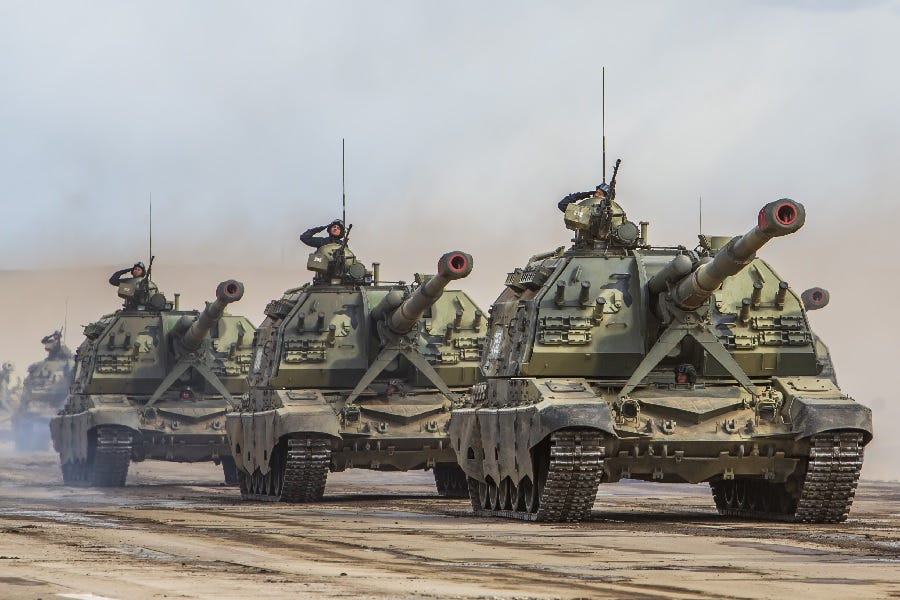
Often, West supporters claim Ukraine’s Western artillery is ‘superior in range’ to that of Russian and legacy-Soviet systems. It’s true only to the extent that some of the most modern Western systems supplied, like M777, Caesar, etc., can shoot advanced RAP and base-bleed ammo giving a range edge of about 30-40km to typical artillery munitions which may peak around 25km. And while Russia does employ many older systems, from the 2S1 Gvozdikas, 2S4 Akatsiya’s, the standard 2S19 Msta-S, and various towed howitzers like D-20 and 30, which all have lower ranges, Russia also employs a raft of other systems that equal or outrange the Western ones. For instance 2A65’s Msta-B, 2S7M Malkas, 2S5 Giatsint-S, 2S19-M2 upgraded Msta-s, and a host of tube artillery from Bm-21 Grads, Bm-27 Uragans, Bm-30 Smerch’s etc.
The point being that, with the extended range superiority, it allows Russian systems to be further back behind the contact line, which means the critical supply arteries feeding these systems can likewise be placed even further back and still retain the regularity of resupply. If your 2S7M Malka, for instance, can fire over 50km, that means it can be 50km behind the frontline. And its primary ammo dump can be another 20-30km behind it. That means the ammo is now 70-80km from the frontline. A HIMARs has a max reach of 90km, however it can’t fire from right on the contact line, it has to be at least 10-20km behind the line to be safe from various shorter range frontline systems, like loitering drones. So, moving back 10-20km, the HIMARs is now upwards of 90-100km from that critical ammo supply feeding the Malka, which is now out of reach.
This is just one example of how having that qualitative range superiority can nullify ISR. NATO’s satellites will spot and transmit the coordinates of that ammo dump, but the AFU can’t do anything about it because its systems can’t reach it. Meanwhile Ukraine’s critical frontline/battalion ammo dumps might have to be only 50-60km from the contact line, and Russia’s systems can hit them. If the AFU moves them much farther back, then suddenly the gap between their operating frontline units and the essential munitions feeding them becomes too large and inefficient, critically slowing their resupply and eroding their combat effectiveness.
Thus, by forcing Ukraine into this attritional long-range fires war, Russia is nullifying the West’s recon capabilities, but only so long as it maintains that qualitative edge in the range of their systems. If Ukraine, for instance, were to begin getting supplied en masse with much longer range systems, like the much-hyped GLSDB’s, then it could theoretically begin to nullify that advantage, and NATO’s ISR overmatch would suddenly again be able to dictate an operational initiative.
Some might argue, such a tactic wouldn’t work against the U.S. Russia is lucky that Ukraine doesn’t have many more long range systems. But if Russia fought the U.S., both sides would immediately Kesslerize each other’s satellites, instantly nullifying all “guided munitions” which require satellite-GPS to function. And guess which country will function better in a classic war scenario?
III.
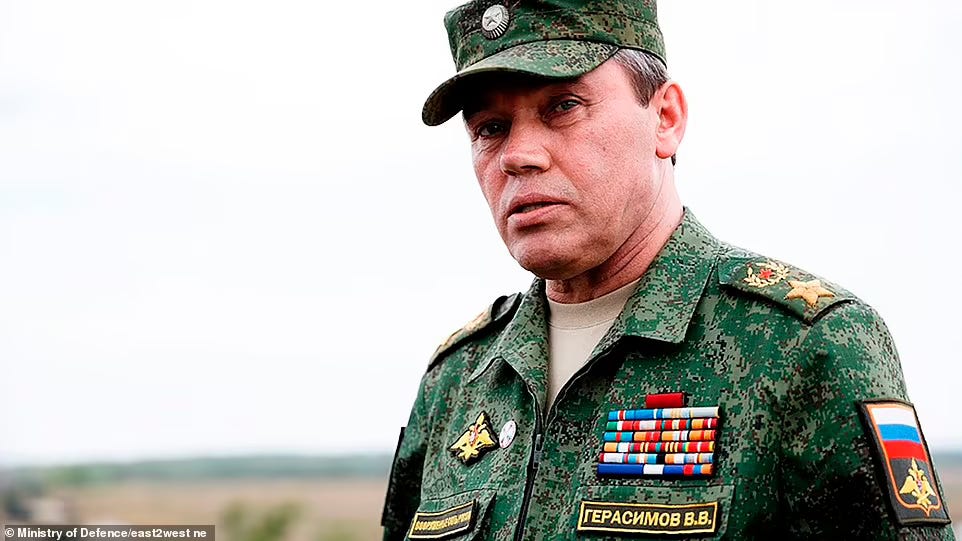
A last important thing to consider, apropos of the original question, of how well can Russia function in the coming offensive, against the vast overreach of NATO’s All-Seeing-Eye: is who will be leading the operation? Recently, as we all know, Russia appointed Valery Gerasimov to the post of Supreme Commander of the entire war, signaling a portentous shift in the gravity with which the Kremlin now regards the conflict.
This mirthless and taciturn man has been the subject of a lot of speculation in the West, where he at times strikes a sort of mythical figure. Though this is partly owing to his quiet and enigmatic demeanor—shying from the limelight unlike so many American generals enamored with goosestepping and pandering in front of the flashing lights, flapping their gums on CNN for corporate baksheesh.
No, Gerasimov is invariably seen sitting and listening, in quiet observation of those around him. In many old reels of Chechen War footage from the 90’s, one can likewise catch glimpses of him lurking over the shoulders of his more loquacious superiors, alertly appraising their every spoken word.
We discussed here the various doctrines and strategies of fighting in a modern hybrid, next generational war scenario. Gerasimov is the man who practically ‘wrote the book’ on this topic. His famed ‘Gerasimov Doctrine’ has long been held as a sort of apotheosis of Russia’s understanding of the evolution and philosophy of modern war-fighting.
Though there’s much controversy surrounding the actual content of the doctrine itself, and though nothing inside of it is particularly ‘revolutionary’ in thought—it is simply an attempt to understand and distill modern 5GW warfare through the lens of America’s usage of it to foment crises like the Arab Spring—it nevertheless exists as proof that at least the Russian forces are now in the capable hands of someone who intimately understands the intricacies and nuance of fighting such a complex modern war.
Gerasimov’s Views on Future Warfare
The doctrine calls for a 4:1 ratio of non-military to military action.Gerasimov emphasizes “the importance of controlling the information space and the real-time coordination of all aspects of a campaign, in addition to the use of targeted strikes deep in enemy territory and the destruction of critical civilian as well as military infrastructure.” Also he proposes to cloak regular military units in “the disguise of peacekeeper or crisis-management forces.”[1]
Interestingly, the ‘Doctrine’ came about at a time (2013) when Russia was just preparing to engage in its first truly ‘hybrid war’ scenarios in both Syria and Ukraine. And thus it outlined sets of parameters for maximizing effectiveness in these asymmetric and ‘irregular’ style conflicts—how to best leverage small forces with a variety of clandestine actions, from cyberspace, political, partisan, indirect/irregular/paramilitary forces, asymmetric techniques, etc.
However, lesser known is the fact that in 2019, as the Ukrainian crisis was slow-marching toward its inevitable powder-keg moment, Gerasimov, clearly reading the tea leaves, was said to have updated a sort of informal v2.0 of his ‘Doctrine’, which once more re-emphasized the importance of preparing for a more classical, direct military confrontation of bruteforce armies.
In this new address, he stressed the particular importance of preparing ‘precision weaponry’ well in advance of conflict, noting that to attemptmanufacturing such weapons only once conflict has already broken out, is a failed strategy that would never work. Simple as this concept may seem, it seems Russia has taken it to heart and prepared well, per his guidelines. NATO, on the other hand, have failed to take heed.
Gerasimov is therefore a man who knows how to read which way the wind is blowing, the patterns and trends of modern warfare, and the nuances of the current crisis. It’s only fitting, then, that the coming, climactic phase will be led by him—a commander who’s become synonymous with leveraging these asymmetrical and irregular tactics to victory. And so, we can remain hopeful that Russia will exercise the finer points presented here, and many others, in the coming days.
Ultimately, we can expect to see Russia utilize both the broad-front tactic to stretch and stress the West’s capabilities, and in select theaters, where the front remains more fixed, Russia will continue utilizing its own Recon-Fire-Complex and RSC from long range to throttle and nullify the West’s ISR capabilities.
Stocks & Bonds Puke After Fed’s Mester Drops ‘Hawk Bomb’
BY TYLER DURDEN
THURSDAY, FEB 16, 2023 – 09:10 AM
After hot PPI, Cleveland Fed President Loretta Mester rubbed salt in the wounds of the market this morning when said she saw a compelling case for rolling out another 50 basis point hike earlier this month and the US central bank has to be prepared to move interest rates higher if inflation remains stubbornly high.
“At this juncture, the incoming data have not changed my view that we will need to bring the fed funds rate above 5% and hold it there for some time,” Mester said Thursday in remarks prepared for an event organized by the Global Interdependence Center and the University of South Florida Sarasota-Manatee.
“Indeed, at our meeting two weeks ago, setting aside what financial market participants expected us to do, I saw a compelling economic case for a 50 basis-point increase, which would have brought the top of the target range to 5%.”
Additionally, as Bloomberg reports, Mester said inflation risks remain tilted to the upside because of the war between Russia and Ukraine, which adds more uncertainty for food and energy prices. China’s reopening could also increase demand for commodities, she said.
Mester, one of the more hawkish Fed policymakers, said those upside risks support the case for “overshooting” on policy.
“Over-tightening also has costs, but if inflation begins to move down faster than anticipated, we can react appropriately,” Mester said.
As a reminder, Mester’s opinion matters since if Austan Goolsbee is appointed as Vice Chair (replacing Lael Brainard who is leaving to work at The White House), then Mester will become a ‘temporary’ voter until Goolsbee’s replacement is chosen. This means The Fed ‘voters’ lose an uber-dove (Brainard) and get an uber-hawk (Mester) in the short-term.
The reaction was not a positive one as stocks tanked…
Treasury yields rose on her comments…
Of course, the STIRs market had already started to price a more aggressive (for longer) Fed…
And the odds of 3 more 25bps hikes continue to rise…
Except, of course, in the parallel bubble of U.S. mainstream media, which has totally ignored it, or in a few select cases, decided to shoot the messenger, dismissing Hersh as a “discredited” journalist, a “blogger”, and a “conspiracy theorist”.
I have offered an initial approach, focused on the plentiful merits of a seemingly thorough report, but also noting some serious inconsistencies.
Old school Moscow-based foreign correspondent John Helmer has gone even further; and what he uncovered may be as incandescent as Sy Hersh’s own narrative.
The heart of the matter in Hersh’s report concerns attribution of responsibility for a de facto industrial terror attack. Surprisingly, no CIA; that falls straight on the toxic planning trio of Sullivan, Blinken and Nuland – neoliberal-cons part of the “Biden” combo. And the final green light comes from the Ultimate Decider: the senile, teleprompt-reading President himself. The Norwegians feature as minor helpers.
That poses the first serious problem: nowhere in his narrative Hersh refers to MI6, the Poles (government, Navy), the Danes, and even the German government.
There’s a mention that on January 2022, “after some wobbling”, Chancellor Scholz “was now firmly on the American team”. Well, by now the plan had been under discussion, according to Hersh’s source, for at least a few months. That also means that Scholz remained “on the American team” all the way to the terror attack, on September 2022.
As for the Brits, the Poles and all NATO games being played off Bornhom Island more than a year before the attack, that had been extensively reported by Russian media – from Kommersant to RIA Novosti.
The Special Military Operation (SMO) was launched on February 24, almost a year ago. The Nord Stream 1 and 2 blow up happened on September 26. Hersh assures there were “more than nine months of highly secret back and forth debate inside Washington’s national security community about how to ‘sabotage the pipelines’”.
So that confirms that the terror attack planning preceded, by months, not only the SMO but, crucially, the letters sent by Moscow to Washington on December 2022, requesting a serious discussion on “indivisibility of security” involving NATO, Russia and the post-Soviet space. The request was met by a dismissive American non-response response.
While he was writing the story of a terror response to a serious geopolitical issue, it does raise eyebrows that a first-rate pro like Hersh does not even bother to examine the complex geopolitical background.
In a nutshell: the ultimate Mackinderian anathema for the U.S. ruling classes – and that’s bipartisan – is a Germany-Russia alliance, extended to China: that would mean the U.S. expelled from Eurasia, and that conditions everything any American government thinks and does in terms of NATO and Russia.
Hersh should also have noticed that the timing of the preparation to “sabotage the pipelines” completely blows apart the official United States government narrative, according to which this a collective West effort to help Ukraine against “unprovoked Russian aggression”.
That elusive source
The narrative leaves no doubt that Hersh’s source – if not the journalist himself – supports what is considered a lawful U.S. policy: to fight Russia’s “threat to Western dominance [in Europe].”
So what seems a U.S. Navy covert op, according to the narrative, may have been misguided not because of serious geopolitical reasons; but because the attack planning intentionally evaded U.S. law “requiring Congress to be informed”. That’s an extremely parochial interpretation of international relations. Or, to be blunt: that’s an apology of Exceptionalism.
And that brings us to what may be the Rosebud in this Orson Welles-worthy saga. Hersh refers to a “secure room on the top floor of the Old Executive Office Building …that was also the home of the President’s Foreign Intelligence Advisory Board”.
This was supposedly the place where the terror attack planning was being discussed.
Hersh’s source, according to his narrative, asserts, without a shadow of a doubt, that “Russian troops had been steadily and ominously building up on the borders of Ukraine” and that “alarm was growing in Washington”. It’s beggars belief that this supposedly well informed lot didn’t know about the massing of NATO-led Ukrainian troops across the line of contact, getting ready to launch a blitzkrieg against Donbass.
What everyone already knew by then – as the record shows even on YouTube – is that the combo behind “Biden” were dead set on terminating the Nord Streams by whatever means necessary. After the start of the SMO, the only thing missing was to find a mechanism for plausible deniability.
For all its meticulous reporting, the inescapable feeling remains that what Hersh’s narrative indicts is the Biden combo terror gambit, and never the overall U.S. plan to provoke Russia into a proxy war with NATO using Ukraine as cannon fodder.
Moreover, Hersh’s source may be eminently flawed. He – or she – said, according to Hersh, that Russia “failed to respond” to the pipeline terror attack because “maybe they want the capability to do the same things the U.S. did”.
In itself, this may prove that the source was not even a member of PIAB, and did not receive the classified PIAB report assessing Putin’s crucial speech of September 30, which identifies the “responsible” party. If that’s the case, the source is just connected (italics mine) to some PIAB member; was not invited to the months-long situation-room planning; and certainly is not aware of the finer details of this administration’s war in Ukraine.
Considering Sy Hersh’s stellar track record in investigative journalism, it would be quite refreshing for him to elucidate these inconsistencies. That would get rid of the fog of rumors depicting the report as a mere limited hangout.
Considering there are several “silos” of intel within the U.S. oligarchy, with their corresponding apparatuses, and Hersh has cultivated his contacts among nearly all of them for decades, there’s no question the allegedly privileged information on the Nord Stream saga came from a very precise address – with a very precise agenda.
So we should see who the story really indicts: certainly the Straussian neo-con/neoliberal-con combo behind “Biden”, and the wobbly President himself. As I pointed out in my initial analysis, the CIA gets away with flying colors.
And we should not forget that the Big Narrative is changing fast: the RAND report, the looming NATO humiliation in Ukraine, Balloon Hysteria, UFO psy op. The real “threat” is – who else – China. What’s left for all of us is to swim in a swamp crammed with derelict patsies, dodgy cover stories and intel debris. Knowing that those who really run the show never show their hand.
MOSCOW, February 10. /TASS/. Russian President Vladimir Putin will deliver his State of the Nation Address to the Federal Assembly on February 21, Kremlin Spokesman Dmitry Peskov told reporters on Friday.
“The Russian president will address the Federal Assembly on February 21. It will take place at the Gostiny Dvor venue,” he said.
The president delivered his previous address to the country’s parliament in April 2021. Putin explained that there had been no State of the Nation Address in 2022 because the situation was unfolding very quickly and it was difficult “to fix the results at a specific point, as well as specific plans for the near future.” However, crucial messages were included in other presidential speeches.
In the past, State of the Nation Addresses were usually delivered every year but there were some exceptions. In particular, Putin did not deliver an address to parliament in 2017 (it was postponed to March 1, 2018). First Deputy Chief of Staff of the Presidential Administration Sergey Kiriyenko noted back then that delivering an address to the Federal Assembly was the president’s right that he could use “when he deems it appropriate.”
**********
OK, that was Tass. Now for some color.
The Romanov dynasty began on February 21, 1613 and reigned as the imperial house of Russia to 1917.
The house became boyars (the highest rank in Russian nobility) of the Grand Duchy of Moscow and later of the Tsardom of Russia under the reigning Rurik dynasty, which became extinct upon the death of Tsar Feodor I in 1598. The Time of Troubles, caused by the resulting succession crisis, saw several pretenders and imposters (False Dmitris) fight for the crown during the Polish–Muscovite War of 1605–1618. On 21 February 1613, a Zemsky Sobor elected Michael Romanov as Tsar of Russia, establishing the Romanovs as Russia’s second reigning dynasty.
No, I don’t think Putin will declare a new imperial dynasty.
But there is also this:
The Russian mission to the United Nations plans to organize a Security Council meeting on the attack on Nord Stream on February 22, citing “new information” about the attack unveiled in Hersh’s reporting.
And here is the transcript from his speech of February 24, 2022:
I consider it necessary today to speak again about the tragic events in Donbass and the key aspects of ensuring the security of Russia.
I will begin with what I said in my address on February 21, 2022. I spoke about our biggest concerns and worries, and about the fundamental threats which irresponsible Western politicians created for Russia consistently, rudely and unceremoniously from year to year. I am referring to the eastward expansion of NATO, which is moving its military infrastructure ever closer to the Russian border.
It is a fact that over the past 30 years we have been patiently trying to come to an agreement with the leading NATO countries regarding the principles of equal and indivisible security in Europe. In response to our proposals, we invariably faced either cynical deception and lies or attempts at pressure and blackmail, while the North Atlantic alliance continued to expand despite our protests and concerns. Its military machine is moving and, as I said, is approaching our very border.
Why is this happening? Where did this insolent manner of talking down from the height of their exceptionalism, infallibility and all-permissiveness come from? What is the explanation for this contemptuous and disdainful attitude to our interests and absolutely legitimate demands?
The answer is simple. Everything is clear and obvious. In the late 1980s, the Soviet Union grew weaker and subsequently broke apart. That experience should serve as a good lesson for us, because it has shown us that the paralysis of power and will is the first step towards complete degradation and oblivion. We lost confidence for only one moment, but it was enough to disrupt the balance of forces in the world.
As a result, the old treaties and agreements are no longer effective. Entreaties and requests do not help. Anything that does not suit the dominant state, the powers that be, is denounced as archaic, obsolete and useless. At the same time, everything it regards as useful is presented as the ultimate truth and forced on others regardless of the cost, abusively and by any means available. Those who refuse to comply are subjected to strong-arm tactics.
What I am saying now does not concerns only Russia, and Russia is not the only country that is worried about this. This has to do with the entire system of international relations, and sometimes even US allies. The collapse of the Soviet Union led to a redivision of the world, and the norms of international law that developed by that time – and the most important of them, the fundamental norms that were adopted following WWII and largely formalised its outcome – came in the way of those who declared themselves the winners of the Cold War.
Of course, practice, international relations and the rules regulating them had to take into account the changes that took place in the world and in the balance of forces. However, this should have been done professionally, smoothly, patiently, and with due regard and respect for the interests of all states and one’s own responsibility. Instead, we saw a state of euphoria created by the feeling of absolute superiority, a kind of modern absolutism, coupled with the low cultural standards and arrogance of those who formulated and pushed through decisions that suited only themselves. The situation took a different turn.
There are many examples of this. First a bloody military operation was waged against Belgrade, without the UN Security Council’s sanction but with combat aircraft and missiles used in the heart of Europe. The bombing of peaceful cities and vital infrastructure went on for several weeks. I have to recall these facts, because some Western colleagues prefer to forget them, and when we mentioned the event, they prefer to avoid speaking about international law, instead emphasising the circumstances which they interpret as they think necessary.
Then came the turn of Iraq, Libya and Syria. The illegal use of military power against Libya and the distortion of all the UN Security Council decisions on Libya ruined the state, created a huge seat of international terrorism, and pushed the country towards a humanitarian catastrophe, into the vortex of a civil war, which has continued there for years. The tragedy, which was created for hundreds of thousands and even millions of people not only in Libya but in the whole region, has led to a large-scale exodus from the Middle East and North Africa to Europe.
A similar fate was also prepared for Syria. The combat operations conducted by the Western coalition in that country without the Syrian government’s approval or UN Security Council’s sanction can only be defined as aggression and intervention.
But the example that stands apart from the above events is, of course, the invasion of Iraq without any legal grounds. They used the pretext of allegedly reliable information available in the United States about the presence of weapons of mass destruction in Iraq. To prove that allegation, the US Secretary of State held up a vial with white power, publicly, for the whole world to see, assuring the international community that it was a chemical warfare agent created in Iraq. It later turned out that all of that was a fake and a sham, and that Iraq did not have any chemical weapons. Incredible and shocking but true. We witnessed lies made at the highest state level and voiced from the high UN rostrum. As a result we see a tremendous loss in human life, damage, destruction, and a colossal upsurge of terrorism.
Overall, it appears that nearly everywhere, in many regions of the world where the United States brought its law and order, this created bloody, non-healing wounds and the curse of international terrorism and extremism. I have only mentioned the most glaring but far from only examples of disregard for international law.
This array includes promises not to expand NATO eastwards even by an inch. To reiterate: they have deceived us, or, to put it simply, they have played us. Sure, one often hears that politics is a dirty business. It could be, but it shouldn’t be as dirty as it is now, not to such an extent. This type of con-artist behaviour is contrary not only to the principles of international relations but also and above all to the generally accepted norms of morality and ethics. Where is justice and truth here? Just lies and hypocrisy all around.
Incidentally, US politicians, political scientists and journalists write and say that a veritable “empire of lies” has been created inside the United States in recent years. It is hard to disagree with this – it is really so. But one should not be modest about it: the United States is still a great country and a system-forming power. All its satellites not only humbly and obediently say yes to and parrot it at the slightest pretext but also imitate its behaviour and enthusiastically accept the rules it is offering them. Therefore, one can say with good reason and confidence that the whole so-called Western bloc formed by the United States in its own image and likeness is, in its entirety, the very same “empire of lies.”
As for our country, after the disintegration of the USSR, given the entire unprecedented openness of the new, modern Russia, its readiness to work honestly with the United States and other Western partners, and its practically unilateral disarmament, they immediately tried to put the final squeeze on us, finish us off, and utterly destroy us. This is how it was in the 1990s and the early 2000s, when the so-called collective West was actively supporting separatism and gangs of mercenaries in southern Russia. What victims, what losses we had to sustain and what trials we had to go through at that time before we broke the back of international terrorism in the Caucasus! We remember this and will never forget.
Properly speaking, the attempts to use us in their own interests never ceased until quite recently: they sought to destroy our traditional values and force on us their false values that would erode us, our people from within, the attitudes they have been aggressively imposing on their countries, attitudes that are directly leading to degradation and degeneration, because they are contrary to human nature. This is not going to happen. No one has ever succeeded in doing this, nor will they succeed now.
Despite all that, in December 2021, we made yet another attempt to reach agreement with the United States and its allies on the principles of European security and NATO’s non-expansion. Our efforts were in vain. The United States has not changed its position. It does not believe it necessary to agree with Russia on a matter that is critical for us. The United States is pursuing its own objectives, while neglecting our interests.
Of course, this situation begs a question: what next, what are we to expect? If history is any guide, we know that in 1940 and early 1941 the Soviet Union went to great lengths to prevent war or at least delay its outbreak. To this end, the USSR sought not to provoke the potential aggressor until the very end by refraining or postponing the most urgent and obvious preparations it had to make to defend itself from an imminent attack. When it finally acted, it was too late.
As a result, the country was not prepared to counter the invasion by Nazi Germany, which attacked our Motherland on June 22, 1941, without declaring war. The country stopped the enemy and went on to defeat it, but this came at a tremendous cost. The attempt to appease the aggressor ahead of the Great Patriotic War proved to be a mistake which came at a high cost for our people. In the first months after the hostilities broke out, we lost vast territories of strategic importance, as well as millions of lives. We will not make this mistake the second time. We have no right to do so.
Those who aspire to global dominance have publicly designated Russia as their enemy. They did so with impunity. Make no mistake, they had no reason to act this way. It is true that they have considerable financial, scientific, technological, and military capabilities. We are aware of this and have an objective view of the economic threats we have been hearing, just as our ability to counter this brash and never-ending blackmail. Let me reiterate that we have no illusions in this regard and are extremely realistic in our assessments.
As for military affairs, even after the dissolution of the USSR and losing a considerable part of its capabilities, today’s Russia remains one of the most powerful nuclear states. Moreover, it has a certain advantage in several cutting-edge weapons. In this context, there should be no doubt for anyone that any potential aggressor will face defeat and ominous consequences should it directly attack our country.
At the same time, technology, including in the defence sector, is changing rapidly. One day there is one leader, and tomorrow another, but a military presence in territories bordering on Russia, if we permit it to go ahead, will stay for decades to come or maybe forever, creating an ever mounting and totally unacceptable threat for Russia.
Even now, with NATO’s eastward expansion the situation for Russia has been becoming worse and more dangerous by the year. Moreover, these past days NATO leadership has been blunt in its statements that they need to accelerate and step up efforts to bring the alliance’s infrastructure closer to Russia’s borders. In other words, they have been toughening their position. We cannot stay idle and passively observe these developments. This would be an absolutely irresponsible thing to do for us.
Any further expansion of the North Atlantic alliance’s infrastructure or the ongoing efforts to gain a military foothold of the Ukrainian territory are unacceptable for us. Of course, the question is not about NATO itself. It merely serves as a tool of US foreign policy. The problem is that in territories adjacent to Russia, which I have to note is our historical land, a hostile “anti-Russia” is taking shape. Fully controlled from the outside, it is doing everything to attract NATO armed forces and obtain cutting-edge weapons.
For the United States and its allies, it is a policy of containing Russia, with obvious geopolitical dividends. For our country, it is a matter of life and death, a matter of our historical future as a nation. This is not an exaggeration; this is a fact. It is not only a very real threat to our interests but to the very existence of our state and to its sovereignty. It is the red line which we have spoken about on numerous occasions. They have crossed it.
This brings me to the situation in Donbass. We can see that the forces that staged the coup in Ukraine in 2014 have seized power, are keeping it with the help of ornamental election procedures and have abandoned the path of a peaceful conflict settlement. For eight years, for eight endless years we have been doing everything possible to settle the situation by peaceful political means. Everything was in vain.
As I said in my previous address, you cannot look without compassion at what is happening there. It became impossible to tolerate it. We had to stop that atrocity, that genocide of the millions of people who live there and who pinned their hopes on Russia, on all of us. It is their aspirations, the feelings and pain of these people that were the main motivating force behind our decision to recognise the independence of the Donbass people’s republics.
I would like to additionally emphasise the following. Focused on their own goals, the leading NATO countries are supporting the far-right nationalists and neo-Nazis in Ukraine, those who will never forgive the people of Crimea and Sevastopol for freely making a choice to reunite with Russia.
They will undoubtedly try to bring war to Crimea just as they have done in Donbass, to kill innocent people just as members of the punitive units of Ukrainian nationalists and Hitler’s accomplices did during the Great Patriotic War. They have also openly laid claim to several other Russian regions.
If we look at the sequence of events and the incoming reports, the showdown between Russia and these forces cannot be avoided. It is only a matter of time. They are getting ready and waiting for the right moment. Moreover, they went as far as aspire to acquire nuclear weapons. We will not let this happen.
I have already said that Russia accepted the new geopolitical reality after the dissolution of the USSR. We have been treating all new post-Soviet states with respect and will continue to act this way. We respect and will respect their sovereignty, as proven by the assistance we provided to Kazakhstan when it faced tragic events and a challenge in terms of its statehood and integrity. However, Russia cannot feel safe, develop, and exist while facing a permanent threat from the territory of today’s Ukraine.
Let me remind you that in 2000–2005 we used our military to push back against terrorists in the Caucasus and stood up for the integrity of our state. We preserved Russia. In 2014, we supported the people of Crimea and Sevastopol. In 2015, we used our Armed Forces to create a reliable shield that prevented terrorists from Syria from penetrating Russia. This was a matter of defending ourselves. We had no other choice.
The same is happening today. They did not leave us any other option for defending Russia and our people, other than the one we are forced to use today. In these circumstances, we have to take bold and immediate action. The people’s republics of Donbass have asked Russia for help.
In this context, in accordance with Article 51 (Chapter VII) of the UN Charter, with permission of Russia’s Federation Council, and in execution of the treaties of friendship and mutual assistance with the Donetsk People’s Republic and the Lugansk People’s Republic, ratified by the Federal Assembly on February 22, I made a decision to carry out a special military operation.
The purpose of this operation is to protect people who, for eight years now, have been facing humiliation and genocide perpetrated by the Kiev regime. To this end, we will seek to demilitarise and denazify Ukraine, as well as bring to trial those who perpetrated numerous bloody crimes against civilians, including against citizens of the Russian Federation.
It is not our plan to occupy the Ukrainian territory. We do not intend to impose anything on anyone by force. At the same time, we have been hearing an increasing number of statements coming from the West that there is no need any more to abide by the documents setting forth the outcomes of World War II, as signed by the totalitarian Soviet regime. How can we respond to that?
The outcomes of World War II and the sacrifices our people had to make to defeat Nazism are sacred. This does not contradict the high values of human rights and freedoms in the reality that emerged over the post-war decades. This does not mean that nations cannot enjoy the right to self-determination, which is enshrined in Article 1 of the UN Charter.
Let me remind you that the people living in territories which are part of today’s Ukraine were not asked how they want to build their lives when the USSR was created or after World War II. Freedom guides our policy, the freedom to choose independently our future and the future of our children. We believe that all the peoples living in today’s Ukraine, anyone who want to do this, must be able to enjoy this right to make a free choice.
In this context I would like to address the citizens of Ukraine. In 2014, Russia was obliged to protect the people of Crimea and Sevastopol from those who you yourself call “nats.” The people of Crimea and Sevastopol made their choice in favour of being with their historical homeland, Russia, and we supported their choice. As I said, we could not act otherwise.
The current events have nothing to do with a desire to infringe on the interests of Ukraine and the Ukrainian people. They are connected with the defending Russia from those who have taken Ukraine hostage and are trying to use it against our country and our people.
I reiterate: we are acting to defend ourselves from the threats created for us and from a worse peril than what is happening now. I am asking you, however hard this may be, to understand this and to work together with us so as to turn this tragic page as soon as possible and to move forward together, without allowing anyone to interfere in our affairs and our relations but developing them independently, so as to create favourable conditions for overcoming all these problems and to strengthen us from within as a single whole, despite the existence of state borders. I believe in this, in our common future.
I would also like to address the military personnel of the Ukrainian Armed Forces.
Comrade officers,
Your fathers, grandfathers and great-grandfathers did not fight the Nazi occupiers and did not defend our common Motherland to allow today’s neo-Nazis to seize power in Ukraine. You swore the oath of allegiance to the Ukrainian people and not to the junta, the people’s adversary which is plundering Ukraine and humiliating the Ukrainian people.
I urge you to refuse to carry out their criminal orders. I urge you to immediately lay down arms and go home. I will explain what this means: the military personnel of the Ukrainian army who do this will be able to freely leave the zone of hostilities and return to their families.
I want to emphasise again that all responsibility for the possible bloodshed will lie fully and wholly with the ruling Ukrainian regime.
I would now like to say something very important for those who may be tempted to interfere in these developments from the outside. No matter who tries to stand in our way or all the more so create threats for our country and our people, they must know that Russia will respond immediately, and the consequences will be such as you have never seen in your entire history. No matter how the events unfold, we are ready. All the necessary decisions in this regard have been taken. I hope that my words will be heard.
Citizens of Russia,
The culture and values, experience and traditions of our ancestors invariably provided a powerful underpinning for the wellbeing and the very existence of entire states and nations, their success and viability. Of course, this directly depends on the ability to quickly adapt to constant change, maintain social cohesion, and readiness to consolidate and summon all the available forces in order to move forward.
We always need to be strong, but this strength can take on different forms. The “empire of lies,” which I mentioned in the beginning of my speech, proceeds in its policy primarily from rough, direct force. This is when our saying on being “all brawn and no brains” applies.
We all know that having justice and truth on our side is what makes us truly strong. If this is the case, it would be hard to disagree with the fact that it is our strength and our readiness to fight that are the bedrock of independence and sovereignty and provide the necessary foundation for building a reliable future for your home, your family, and your Motherland.
Dear compatriots,
I am certain that devoted soldiers and officers of Russia’s Armed Forces will perform their duty with professionalism and courage. I have no doubt that the government institutions at all levels and specialists will work effectively to guarantee the stability of our economy, financial system and social wellbeing, and the same applies to corporate executives and the entire business community. I hope that all parliamentary parties and civil society take a consolidated, patriotic position.
At the end of the day, the future of Russia is in the hands of its multi-ethnic people, as has always been the case in our history. This means that the decisions that I made will be executed, that we will achieve the goals we have set, and reliably guarantee the security of our Motherland.
I believe in your support and the invincible force rooted in the love for our Fatherland.
OOPS! The Financial Times accidentally confirmed what the Chinese have been saying from day one — the balloons ARE weather balloons pic.twitter.com/e0QewsGiSi
— Nury Vittachi, Fridayeveryday.com (@NuryVittachi) February 14, 2023
You and I in a little toy shop Buy a bag of balloons with the money we’ve got Set them free at the break of dawn ‘Til one by one, they were gone Back at base, bugs in the software Flash the message, “Something’s out there!” Floating in the summer sky Ninety-nine red balloons go by
The military, political and strategic significance of the Zatoka bridge as NATO’s supply route to the eastern front of the Ukrainian forces has become clear since the first demolition attack last April. The US propaganda platform Bloomberg revealed the bridge’s military role last May, when road and rail hubs in the area were hit.
Strikes against the rail lines in the vicinity were recorded in July and in August. Russian targeting of the Ukrainian rail network was analyzed last December by a Russian source here. With each one of these operations, Moscow was sending a warning to Romania, Moldova, France and NATO that if they escalated and attempted to join the Ukrainian battlefield with their weapons, military experts and advisers, running the gauntlet of the Zatoka bridge, they would be attacked.
NATO escalation followed. Romania has been showing off its French tanks, Israeli drones, and US HIMARS missile batteries since last December; it is paying at least $6 billion for the new military equipment, spending 2.3% of its Gross Domestic Product on defence – a higher proportion than any other NATO member state except the US.
The escalation of NATOs warfighting weapons and operational plans in Romania during January put pressure on the Moldovan government next door, and the country’s Prime Minister Gavrilita, to allow the transit of these weapons across Moldovan territory and into the Ukraine, via the Zatoka bridge. Between Smardan, on the Romanian side of the border with Moldova, and Zatoka is a road distance of just over 300 kilometres. Smardan is the location of the French and Romanian “exercises” last month.
The pressure proved too much for Gavrilita who, though pro-NATO personally and willing to agree to the transit herself, was afraid that public and political opposition among Moldovans might block the roads, triggering countrywide protests and visible resistance to Moldova’s joining the war against Russia. The US, French, and NATO reaction was to replace Gavrilita with Dorin Recean. US university-educated like the Romanian President, Maia Sandu. Recean has been paid a US salary for many years, As Recean substituted for Gavrilita and took office in Chisinau, the Russian General Staff delivered its warning to him at Zatoka. That wasn’t the only Russian military warning Recean was given that day.
Gavrilita’s exit statement revealed her reluctance to continue in office. She repeated to the Financial Times of London her personal anti-Russian line and her fear of pro-Russian sentiment among Moldovan voters. “If the government had the same support at home, we would have progressed faster,” she said. To the newspaper she added that “Moldova was being subjected to hybrid warfare by Russia, including disinformation, cyber attacks and influence operations.” . The Japanese-owned propaganda organ against both Russia and China omitted to report the French and US military deployments in Romania, the Russian operation at Zatoka, and the Ukraine supply operation in Moldova.
The Romanian government has now indicated its nervousness, announcing that no Russian missile had entered its airspace last week after Ukrainian President Vladimir Zelensky claimed that it had.
In early 2022 Ukraine had finished the preparations for an overwhelming attack on the renegade People Republics of Donetsk and Luhansk (DPR and LNR).
Half of the Ukrainian army, some 120,000 men recruited and trained during the last 7 years, were stationed near the ceasefire line and ready to go. On the opposing side only some 40,000 men were under arms. They would have little chance to withstand an onslaught.
Russia could not let a Ukrainian attack happen. If Ukraine could regain the renegade provinces it would have been able to join NATO. Russian public opinion was decisively on the side of the Russian speaking DNR and LPR. It would surely demand an intervention. Since the 2014 coup in Kiev some four million Ukrainians had already moved to Russia. There are lots of family ties between the two countries. In sight of this Russia had put some of its own forces on alert and had moved weapons and munition to assembling points near the Ukrainian border.
The U.S. had for months warned of an upcoming Russian attack on Ukraine. It could do that because it knew the Ukraine would attempt to regain the republics by force. It knew that Russia would have to respond. On January 12 2022 CIA director Bill Burns had secretly met Zelensky in Kiev. Burns often carries messages from President Joe Biden.
On Sunday February 13 2022, after a phone call with U.S. president Joe Biden, the Ukrainian president Zelensky gave the final order for the planned Ukrainian attack.
That the decision had been made was immediately leaked in London as well as in Kiev.
In its summary of the day the Guardian listed a lot of activities that were consistent with the imminent start of a conflict. Diplomats and foreign military were moving out of Ukraine. Weapons flew in.
Tipped off by its government the British insurance conglomerate Lloyd stopped reinsurance services for anything Ukraine:
Anatoliy Ivantsiv, head of Ukrainian insurance firm Expo, told Interfax that British reinsurance giant Lloyds announced it would temporarily cease all conflict risk insurance over Ukrainian airspace from Feb. 14.
When the news of the attack order leaked in Kiev, its ‘elite’ oligarchs and some parliament members were ready to leave. On February 13 and the following days they fled the country:
Ukraine’s richest men are fleeing the country with their families as the number of private jet charters jump after the possibility of war spiked in recent days, according to flight traffic information posted on social media on February 13. … Switzerland, Austria and the south of France were the most popular destinations for the charter flights.
Ukrainska Pravda stated that such an exodus on charter flights hasn’t been witnessed in six years of observations. The publication reported that planes belonging the country’s top oligarchs, including Rinat Akhmetov, Viktor Pinchuk, and Boris Kolesnikov, as having left the country. A private plane for 50 people was also ordered by Igor Abramovich, another top business figure. … bne IntelliNews sources confirm that two residential English tutors, both British citizens, working for an MP and a businessman respectively, will leave for the south of France this week. Neither confirmed that the flights had anything to do with increased fears over an invasion, as both families travel regularly with their staff for work holidays. Even last month, when the war drums began to beat more loudly for the first time, tutors and teachers working at private schools in Kyiv reported a large number of children absent, away on holidays.
Some members of the Ukrainian parliament were also bailing out. on February 14 Kiev Independentreported:
More than two dozen lawmakers out of a total 424 MPs, who are due to attend parliamentary sessions starting this week, are not currently in Ukraine. Almost half, or 12 deputies, are from the pro-Russian party Opposition Platform-for Life, five deputies are from the presidential Servant of the People party. Most of the lawmakers, or 20 people, left the country in February.
As part of the Minsk agreement the Organization for Security and Co-operation in Europe (OSCE) had a Special Observer Mission at the ceasefire line in east-Ukraine. Over the weekend of February 12 and 13 the front had been relatively quiet:
In Donetsk region, between the evenings of 11 and 13 February, the Mission recorded 261 ceasefire violations, including 50 explosions. In the previous reporting period, it recorded 114 ceasefire violations in the region.
In Luhansk region, between the evenings of 11 and 13 February, the SMM recorded 114 ceasefire violations, including 24 explosions. In the previous reporting period, it recorded 258 ceasefire violations in the region.
The observed numbers of explosion were less than the average of the last 7 and 30 day periods. Explosions occurred on both sides of the ceasefire line.
Banking profitability is often measured in three ways:
Return on Total Assets (RoA)
Return on Risk-weighted Assets (RoRWA)
Return on Book Value (RoE)
Why different ways for computing profitability?
Not all gains or losses are normally consider in computing profitability. They are only counted when realized, such as when the asset is sold.
Unless realized, gains and losses may be carried over as “Accumulated Other Comprehensive Income” or AOCI. These adjusted are captured on the balance sheet before computing “net retained earnings.”
AOCI filters for investment securities classified as “available for sale”, and reflects accumulated unrealized changes in the fair value of securities held for investment purposes.
Such unrealized gains and losses are not counted towards bank regulatory capital.
However, as part of the implementation of the Basel III capital accord, the AOCI filter is removed for the largest US banking organizations allowing fluctuations in securities market to flow through directly to regulatory capital.
Consider Citi’s recent balance sheet above. For the quarter ending December 31, 2022, Citi has $47.062 billion of unrealized losses — reduced by $1.2 billion from the quarter ending September 2022.
Citi reported a net quarterly income on September 30, 2022 of $3.479 billion. Their December 30, 2022 net quarterly income was $2.513 billion.
Evidently, Citi recognized $1.2 billion of losses from AOCI.
At this rate, it will take Citi about a decade to rationalize to reduce their AOCI.
That’s assuming bank bond portfolios are not increasingly underwater as interest rates rise.
Consider the 2-10 spread – we’re seeing a definite trend repricing short-tenored assets.
One ratio regulators are starting to pay more attention to it since accumulated other comprehensive income, or AOCI, is not included in regulatory capital ratios, for any banks except global systemically important banks, therefore they do not capture the impact of underwater bond books, advisers said.
The majority of bonds that most banks hold are in available-for-sale, or AFS, portfolios, which must be marked to market on a quarterly basis. Changes in the values of the AFS portfolios are captured in AOCI. Higher interest rates have weighed on the value of bonds that banks own since they now carry below market rates. As a result, the vast majority of U.S. banks have recorded a surge in AOCI losses.
“Regulators have been clear that tangible equity is a loss-absorbing capital,” said Matt Resch, managing director and co-head of M&A and capital markets with PNC Financial Institutions Advisory Group. “If the credit cycle turns and there’s now an uptick in credit losses, it’s tangible equity that can absorb those losses. For banks that have seen a pretty significant impact to the tangible capital ratios, if now we end up having a turn of the credit cycle, it’s only going to exacerbate that problem.”
Upticking credit losses are already apparent.
So are falling deposits.
S&P Global reports banks with TCE ratios around 5% face problems, according to Donald Musso, president and CEO of FinPro Inc.
“Everybody that’s falling below certain metrics are getting calls and visits,” he said.
When a bank approaches 2%, 0% or negative TCE, “that’s when the real problem starts to occur,” Musso said, adding that regulators could start putting restrictions on banks through consent orders.
Going into CCAR 2023, expect liquidity and stress test to take closer looks at the AFS portfolio and AOCI trends.