French cartoonists are running a series of hilarious videos available at http://Ukraine-inc.info.
Episode 1 is above. Here’s Episode 2:
I love the Bandera images throughout. Walk-ons by Corrupt Joe, Macron and “SGT Schulz”
More episodes to come.
French cartoonists are running a series of hilarious videos available at http://Ukraine-inc.info.
Episode 1 is above. Here’s Episode 2:
I love the Bandera images throughout. Walk-ons by Corrupt Joe, Macron and “SGT Schulz”
More episodes to come.

The GDPNow model estimate for real GDP growth (seasonally adjusted annual rate) in the first quarter of 2023 is 1.5 percent on April 5, down from 1.7 percent on April 3. After recent releases from the US Census Bureau, the US Bureau of Economic Analysis, and the Institute for Supply Management, a decrease in the nowcast of first-quarter real personal consumption expenditures growth from 3.7 percent to 3.4 percent was slightly offset by an increase in the nowcast of first-quarter real gross private domestic investment growth from -8.5 percent to -7.8 percent, while the nowcast of the contribution of the change in real net exports to first-quarter real GDP growth decreased from 0.44 percentage points to 0.29 percentage points.
The next GDPNow update is Monday, April 10.
Comments:
Catch the MCI reference?
Here’s the Q1 2023 list:
Let’s close it out with a little more “Todd”:
Has been since the Ukrainian coup in 2014.

Starlink is a satellite internet constellation operated by SpaceX, providing satellite Internet access coverage to over 50 countries. It also aims for global mobile phone service after 2023. SpaceX started launching Starlink satellites in 2019.
As of February 2023, Starlink consists of over 3,580 mass-produced small satellites in low Earth orbit (LEO), which communicate with designated ground transceivers. In total, nearly 12,000 satellites are planned to be deployed, with a possible later extension to 42,000. SpaceX announced reaching more than one million subscribers in December 2022.
This service was most notably used during the Russia’s Special Military Operation (SMO) in Ukraine, as Russian attacks brought widespread degradation of the telecommunications network.
During the battle of Mariupol (2022), Starlink was used to report on the worsening conditions inside the city.
As of 5 April 2022, SpaceX and USAID had delivered 5,000 terminals to Ukraine, of which SpaceX had donated 3,667 or 73%, and the rest had been purchased by USAID.
SpaceX had been negotiating with Ukraine for the launch of Starlink a month and a half before the invasion, SpaceX president Gwynne Shotwell said. According to her, SpaceX was waiting for an official letter with permission.
At the beginning of the surprise Russian’s invasion of Ukraine in 2022 and as Russia attacked key infrastructures including telecommunication ones, Ukraine experienced significant problems with Internet access. Maintaining internet access was seen as a priority by Ukraine’s military and other government bodies.
Now come reports Ukraine’s forces are employing Starlink to launch chemical weapons on Russian Federation forces in violation of the Convention on the Prohibition of the Development, Production, Stockpiling and Use of Chemical Weapons and on their Destruction (Chemical Weapons Convention or CWC).
The CSC treaty entered into force on 29 April 1997, and prohibits the large-scale use, development, production, stockpiling and transfer of chemical weapons and their precursors, except for very limited purposes (research, medical, pharmaceutical or protective). The main obligation of member states under the convention is to effect this prohibition, as well as the destruction of all current chemical weapons. All destruction activities must take place under OPCW verification.
The US and Russia both entered the CWC in 1997.
Ukraine is now using Starlink drones to drop chemical gas grenades on Russian soldiers. @ZelenskyyUa is abusing the generosity of @elonmusk who offered free satellite Internet connectivity for civilian use, not as a drone component for chemical weapon attacks and war crimes. pic.twitter.com/qWgtt7JAcT
— Kim Dotcom (@KimDotcom) March 27, 2023
If the US Govt is preventing @elonmusk from terminating Starlink in Ukraine with a ‘national security order’ then there is nothing Elon can do about it. He couldn’t even tell you about it because if he is not complying with the gagging order he would go to jail.
— Kim Dotcom (@KimDotcom) March 27, 2023
Tom Luongo and The Duran
Or, if you want the condensed version, here’s Mark Wauck with his summary: https://meaninginhistory.substack.com/p/more-on-the-fed-davos-war
Alex Mercouris starts it off by asking two questions:
Is this banking crisis serious? and
Where is the weakness–in Europe or in the US?
Luongo:
It’s not so much one or the other, it’s the question of relative vulnerability.
The great game of global capital is that capital flows to where it’s treated best. We have a great global divide. The Eurasian bloc is trying to get out from under King Dollar hegemony. That is putting pressure on the collective West, which wants to extend that hegemony.
The question then becomes: Do we have grownups on the Western side of the divide who recognize the changed reality of world economics (and thus of monetary systems) and are willing to come to terms with it? TL thinks those grownups are in the Fed and the NY money center banks–they can see the problem. If they didn’t see the problem they would have backed staying at the zero bound, pumping up the shadow banking system to infinity, and keep the party going.
The other faction in the West is the Davos group in Europe, who absolutely want to unmoore money from all opportunity costs to create new monetary units, i.e., Central Bank Digital Currencies–digital scrip–that can be used to maintain all economic activity under centralized technocratic control. So the West is divided.
Once you identify that divide, it’s relatively simple to watch responses to it. The pressure from Eurasia, rapidly moving toward integrated trade on a multi currency basis, is that they’re also building gold into the foundation, to keep everyone honest. This is why the Fed is acting the way it is, and why the NY banks are saying, in effect: We don’t have any other option except to back off and retrench, because if we don’t … Eurasia will tie everything to gold, they’ll sell our treasuries, and they’ll collapse our banking system. And there’s nothing we can do about it. They can survive a disorderly unwind, we cannot. Why? Because they have an energy surplus and a commodity surplus, and the gold is flowing from West to East. In the big picture, that’s what this is about.
The collective West’s response is to launch a war on Russia and threaten war with China.
Now, looking at the three big areas of the world, who has the weakest hand? Clearly Europe. Europe will fight, tooth and nail, but at the end of the day Eurasia and the US hold most of the cards. The Fed is able to print more dollars but only allow them to circulate domestically, which will shore up the US banking system relative to Europe.
This doesn’t mean that the US will skate and Europe will get trashed. It’s all a big poop sandwich. We all have to take a bite, the question is: Who has to take the biggest bite?
On to Credit Suisse. This is the most misunderstood part of the whole thing. It’s necessary to understand that Europe doesn’t really have anything like the FDIC. That means the US can use the FDIC as a weapon against Europe. In the same way Europe doesn’t have a singular bond market, which is why the Euro is a fundamentally weaker currency than the dollar. This means that there can’t be an integrated policy response to a depositor bank run in Europe.
In the US what’s happening is different than in the past. There is an implicit guarantee that all insurable deposits–those that already qualify for FDIC insurance–will be backstopped to infinity. And, by the terms of the Bank Term Funding Program, if the FDIC runs out of money they will tax the big banks to cover the shortfall. That’s the exact opposite of what happened in 2008, when the regional banks got crushed. We have the big banks pledging future earnings to make sure payrolls are met at small and medium businesses–those are the entities that are at most risk.
The Fed wants to get back to a healthy regional banking system in the US, and the only way to do that is to unwind all the shadow banking institutions that we had operating in the US. SVB was the biggest. Blackrock is the biggest shadow banking outfit in the world–they’re not a bank, but they act like one.
So why is the Credit Suisse (CS) merger with Union Bank Switzerland (UBS) so interesting? Why are the Europeans screaming so hard? The Fed was involved in the negotiations, but the ECB and other European institutions were cut out completely. So let’s talk about the CoCo (conditionally convertible) bonds, the Additional Tier One Capital (AT1) bonds that were the big sticking point.
The easiest way to explain this is in terms of poison pills. The classic poison pill defense strategy is to issue a bunch of shares and force the hostile takeover bidder to buy all the extra shares. It’s always a bluff and doesn’t really work. That’s what Twitter tried on Elon Musk and he simply waited them out. What was going on with these conditionally convertible AT1 bonds–this is the fundamental capital necessary for the bank to maintain their capital adequacy ratios under Basel III. If they don’t have tier one capital they run afoul of banking rules and could be shut down.
The AT1 conditionally convertible bond market was a $275 billion market–now its $258 billion because $17 billion were written to zero by UBS and CS as part of the merger deal. In a bank failure the bond holders are paid first, then the shareholders, and only then the depositors–depositors, in the absence of insurance, are like unsecured creditors. UBS and CS had covenants in their CoCo bonds that allowed them to write them down to zero under certain circumstances. The sticking point for UBS was that as of close on Friday, banks had suffered a drop in market caps by 25-40%. Now, for UBS to buy CS, they would have had to buy the $17 billion in CS CoCo bonds after just suffering a massive drop in market cap. That would mean a greatly inflated ownership share in UBS for the CS bondholders. The EU thought they had CS wrapped up and they’d be able to take out both UBS and the Swiss National Bank (SNB). If you’re Davos, which already kneecapped and destroyed the British banking system last summer and have been targeting CS for 8 months to take control of the Swiss banking system, you think you’ve finally got the upper hand over Powell and the Fed. Writing the CS bonds to zero made the merger possible and thwarted Davos.
The SNB holds $140 billion in high liquidity blue chip equities. It’s the biggest equity hedge fund in the world. If Davos takes control of the SNB, they also gain real leverage over US monetary policy, despite the Fed’s efforts to free the US from that control. If you want to destroy liquidity in the Dow Jones Industrials, then you take out the SNB. If you want to ensure that there are no escape hatches from the European sovereign debt crisis that’s being engendered by Powell’s high interest rate policy, then you neuter the SNB.
By writing the CS CoCo bonds down to zero they protected the Swiss banking system, and this is why everyone in Europe is screaming.
Biden trying to stop the writedown of the CS AT1 bonds. Pure theater. https://t.co/gcHarXIFt8
— Tom Luongo (Head Sneetch) (@TFL1728) March 24, 2023
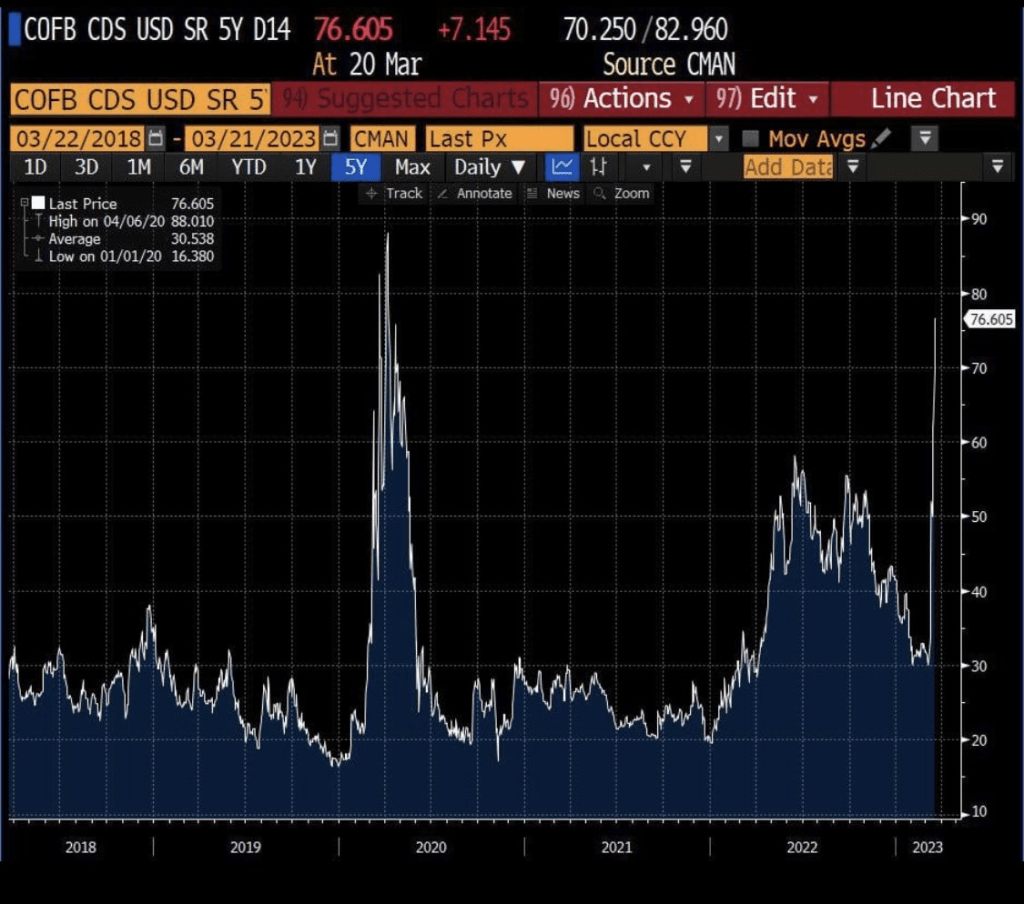
“Five-year CDS on @DeutscheBank were trading at their highest levels since early 2019 and on Thursday saw their largest one-day rise on record, according to @Refinitiv data.” https://t.co/2BPYDMZng6
— Danielle DiMartino Booth (@DiMartinoBooth) March 24, 2023
— Tom Luongo (Head Sneetch) (@TFL1728) March 24, 2023
Per my blog from Tuesday. Writing down the CS AT1 bonds impaired the entire asset class. This is your Euro-zone banking crisis.https://t.co/MQLmtR1wna https://t.co/5Ma2Po9EJ7
— Tom Luongo (Head Sneetch) (@TFL1728) March 24, 2023
And for pure hilarity, here’s Kim with some great theater
How does this make you feel? pic.twitter.com/6swayUx6LB
— Kim Dotcom (@KimDotcom) March 23, 2023

Armstrong Economics: https://www.armstrongeconomics.com/markets-by-sector/interest-rates/the-fed-does-not-back-down/
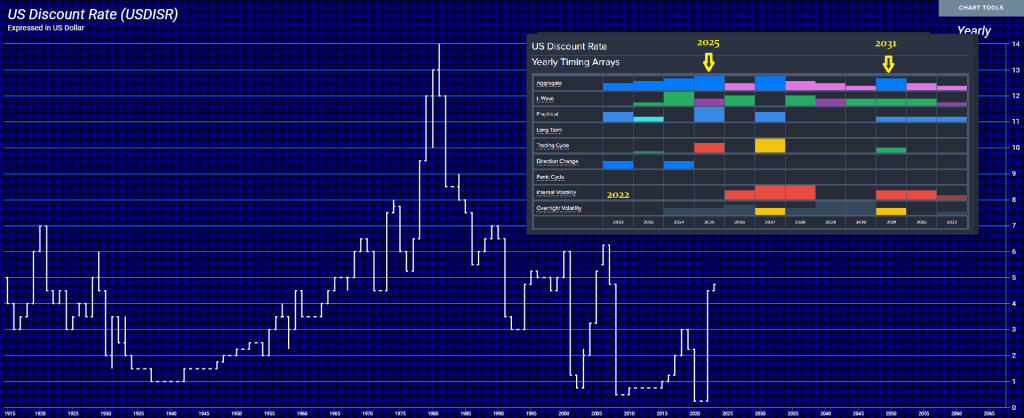
The Fed Does Not Back Down
COMMENT: Marty, it’s refreshing to have Socrates that is totally unbiased. It projected continued rising rates into next year and the Fed just proved its point. It is not backing down.
Thank you. Socrates is very enlightening.
GS
ANSWER: I know there were a lot of talks that surely the Fed had to lower rates and start QE all over again. Most of those sorts of comments have no real experience in markets. They just mouth a lot of hot air. Perhaps instead of putting masks on cows, we should do that on the shills. The Federal Reserve had no choice but to raise interest rates although it was just by a quarter point. Not to do so and the Fed would lose all credibility and the market would then not take them seriously.
You MUST understand that this crisis has unfolded because too many banks were wrapped up in WOKE culture and hired people who were UNQUALIFIED to run risk management. Some were more excited about cross-dressing as a woman and winning the Rainbow award in banking than actually protecting the bank from the risk of rising interest rates. [Emphasis added]
In a statement released at the conclusion of the meeting, Fed officials acknowledged that recent financial market turmoil is weighing on inflation and the economy, though they expressed confidence in the overall system. “The US banking system is sound and resilient.” They had no choice but to make this statement.
“Recent developments are likely to result in tighter credit conditions for households and businesses and to weigh on economic activity, hiring and inflation. The extent of these effects is uncertain.”
The Fed is saying that their rise in rates will in fact reduce inflation and economic activity. The banks have this yield curve risk and that is different from the 2007-2009 crisis where the debt was based on fraud. Here, the debt is US Treasuries so they are not going bankrupt from that aspect, but it is a liquidity crisis.
If these people who scream loudly but know nothing really about finance keep up the nonsense, they will only add to the uncertainly. This inflation is accelerating thanks to the war.
What's amazing about BlackRock's monster $5b trade out of $ESGU and into $QUAL is that it is 100x(!) the avg daily volume for $ESGU. Score one for ETF implied liquidity, which is crazy abundant in $ESGU which is full of large US stocks.. via ETFL<GO> pic.twitter.com/OzrdgmFHF1
— Eric Balchunas (@EricBalchunas) March 21, 2023
Wow, another $1b came out of $ESGU yesterday and went into $QUAL, that makes a $5b-ish single trade, which pretty sure is largest ever in ETF history and it may not even be over yet. pic.twitter.com/tX00KPj6lq
— Eric Balchunas (@EricBalchunas) March 21, 2023
The bomb out of $ESGU on Friday is a big blow to the ESG ETF Category in that it really adds to the ongoing reversal in flows, which tends to go hand in hand with narrative pic.twitter.com/O8PO7HUMFL
— Eric Balchunas (@EricBalchunas) March 20, 2023

“We won’t accept a ceasefire.”
— Kim Dotcom (@KimDotcom) March 20, 2023
The US Govt dictates to Ukraine that it wants more war and more dead Ukrainians. What a friend.pic.twitter.com/BFGVcs9Rhj
I warned you that NATO troops will enter the Ukraine war. It would be the start of WW3 and lead to Nuclear war.
— Kim Dotcom (@KimDotcom) March 19, 2023
The Polish Ambassador to France just said this: “Either Ukraine will defend its independence or we will be forced to enter into this conflict.”pic.twitter.com/dnozvgpPNj
1/2 The US is provoking and simulating a nuclear conflict near the Russian border. The strategic bomber B-52H Stratofortress of the US Air Force again worked out a missile attack on the Leningrad Region. pic.twitter.com/6DWXhFs83F
— Victor vicktop55 (@vicktop55) March 20, 2023
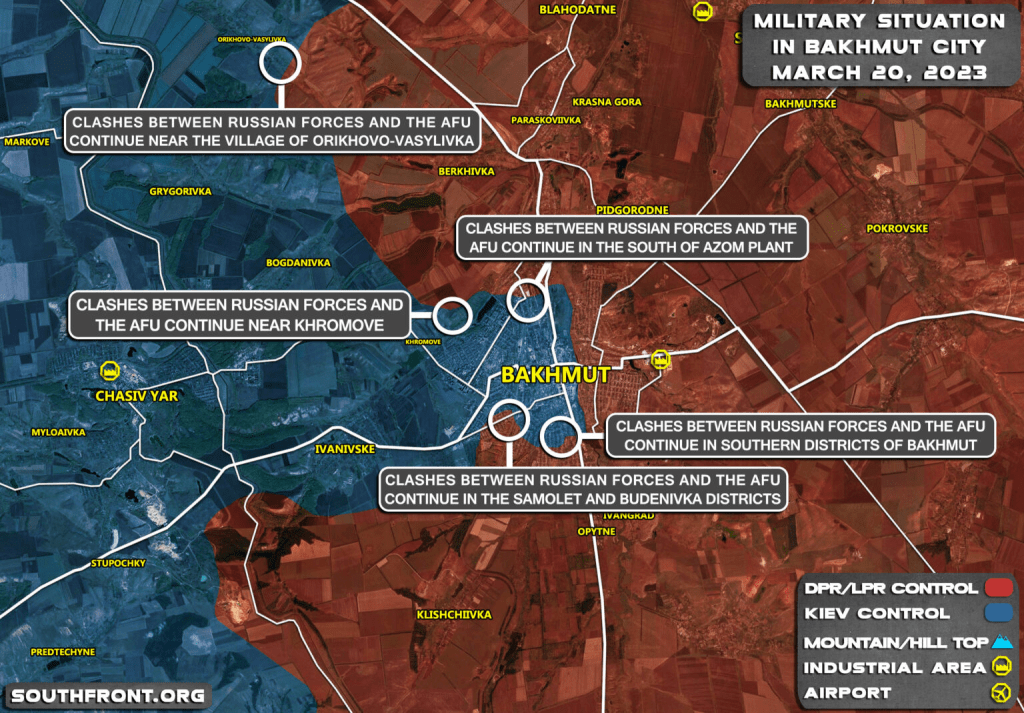
Rumors of an AFU counterattack this week
Zelensky drives forcibly mobilized and columns of American equipment to Bakhmut. https://t.co/juKQPPD2tG pic.twitter.com/p8KBJCu8Jg
— Victor vicktop55 (@vicktop55) March 18, 2023
Missile tests in the Pacific after Xi leaves Moscow
2/2 The tests will take place in the neutral waters of the Pacific Ocean, relatively close to the coast of the United States. The missiles will be equipped with imitation nuclear warheads. https://t.co/sdY2rZlwPo
— Victor vicktop55 (@vicktop55) March 17, 2023

 Econophysics2020