Wolf’s Lair 2.0

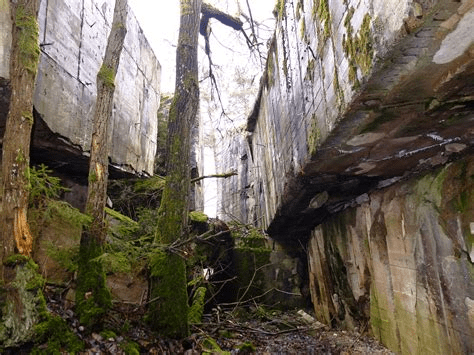
The Wolf’s Lair (GermanWolfsschanzePolishWilczy Szaniec) served as Adolf Hitler‘s first Eastern Front military headquarters in World War II.

The headquarters was located in the Masurian woods, near the village of Görlitz in Ostpreußen (now Gierłoż), about 8 kilometres (5 miles) east of the small East Prussian town of Rastenburg (now Kętrzyn), in present-day Poland. The central complex and the Führer‘s bunker were surrounded by three security zones guarded by two Schutzstaffel (SS) units: the SS-Begleitkommando des Führers, and the Reichssicherheitsdienst. The Wehrmacht‘s armoured Führerbegleitbrigade was held in readiness nearby but, as a part of the Heer‘s elite Großdeutschland Division, was used to counter-attack Red Army break-throughs in Army Group Centre’s front and rescue cut-off HeerLuftwaffe Fallschirmjager and SS panzer troops.

The 20 July Plot, an assassination attempt against Hitler, took place at the Wolf’s Lair on 20 July 1944.

The attempt was made by senior Wehrmacht officers with the backing of Allied nations. If successful, Germany would have been spared the final assault by Soviet and Western forces.

The assassination attempt failed.

With that background, here is John Helmer reprising Wolf’s Lair in the modern age: http://johnhelmer.net/german-general-tells-us-generals-to-lose-the-ukraine-war-as-soon-as-possible-to-prevent-losing-the-empire-in-europe/

**********

GERMAN GENERAL TELLS US GENERALS TO LOSE THE UKRAINE WAR AS SOON AS POSSIBLE TO PREVENT LOSING THE EMPIRE IN EUROPE

By John Helmer, Moscow
  @bears_with

The German generals are trying it again. That’s the Wolf’s Lair plot of July 20, 1944.

To save themselves,  they are begging their counterparts in Washington, DC, to find a way to lose the war in the Ukraine as quickly as possible without losing the US empire in Germany. This means overruling or replacing, not only Vladimir Zelensky’s regime in Kiev but also the Green Party ministers in power in Berlin, Robert Habeck and Annalena Baerbock, and maybe Chancellor Olaf Scholz to boot.

The Wehrmacht plotter this time is a retired brigadier general named Erich Vad (lead image, right).  As German military officers go, he’s unusual. He was trained by a German-born Israeli infantry general turned academic.  Vad then reached general’s rank, according to a senior German politician, but “never led a battalion, never led a brigade, and was never deployed in active operations”; he is a “desk general”.

Vad’s self-advertisements mention no active service or combat command. Instead, he has filled advisor posts at the Bundestag (2000-2006) and the Chancellery (2006-2013) when Angela Merkel was chancellor.  Since 2014 he has been selling his advice either through Vad’s own consulting firm in Munich  or a Swiss intermediary company in Zurich.  

Merkel appointed Vad for the German military and the armaments industry to have a voice  inside her office. Because they didn’t regard Vad as one of their own, Merkel promoted him to general’s rank.   

The bomb Vad has just placed under Zelensky’s table and under the Green ministers’ desks in Berlin can be spotted in an interview he published last week in Cologne.   

In his new press statement, as in every one of them since he left the Chancellery in Berlin, Vad is a supporter of war with Russia and its allies. “It was and is right to support Ukraine,” he declares at the beginning, “and of course Putin’s attack is not in accordance with international law.”  

In July 2014, in his German press debut, Vad supported Germany’s role, alongside the US, in bombing Serbia.   “As is well known, the situation for thousands of innocent people only changed when NATO soldiers set foot on Balkan soil.”  

As Vad wrote this, Merkel had participated in the US overthrow of the Yanukovich government in Kiev; she had also begun her secret plan to rearm the Ukraine, and deceive Moscow of the German intention. A few days after Vad’s interview, after the Kiev regime arranged the shoot-down of Malaysia Airlines Flight MH17, Merkel vetoed a Dutch scheme for a NATO intervention in the Donbass. Vad had been warning Merkel to rearm Germany and the Ukraine before committing forces – Merkel had adopted Vad’s buy-time line.

In 2014 Vad didn’t mention the word “Ukraine”, but he expressly supported Merkel’s notion of rearming Ukraine to fight Russia, particularly if it was profitable for German business: “A responsible security policy,” he said in mid-July 2014,  “also means supporting our partners [Ukraine] in the world across the entire spectrum of our capabilities, from development aid and good governance to equipment assistance and arms exports. As a global economic and financial power, we must not shirk our international responsibility. It is hardly comprehensible that pacifism in this country can go so far that we must not enable countries that act or want to act politically in our interest with the necessary means – e.g. with armaments – without the usual cries of horror. If we Germans ourselves do not want to or should not become militarily active worldwide, then we must at least be allowed to help those who are important for our national security interests in the hot spots of this world.”

In 2016, when asked to describe in detail what he had advised and agreed with Merkel in the earlier years, Vad said next to nothing.

In his latest press statement, dated January 13, 2023,  Vad has warned that the Scholz government’s decision to supply the German-made Marder infantry fighting vehicle, in a joint rearmament plan with the US and France, “is a military escalation, also in the perception of the Russians, even if the 40-year old Marder is not a miracle weapon. We go on a slide. This could develop a momentum of its own that we can no longer control.”

Vad means the war in the Ukraine has already passed the point at which the US and German military believe they can control the outcome. “Now the consequences must be finally be considered” – this is Vad’s acknowledgement the war against Russia is being lost in the Ukraine.

Asked what “consequences” he means, Vad has replied with rhetorical questions: “Do they want to reconquer Donbass or Crimea? Or do they even want to defeat Russia completely?” Vad was identifying the goals of the civilian leaders in Berlin and in the State Department.

“We have a military operational stalemate, but we cannot resolve it militarily”, he noted, adding “this is also the opinion of the American Chief of Staff Mark Milley.” What Vad was implying was not “stalemate” but defeat – defeat by the Russian Army of the war allies in the Ukraine, including all the NATO reinforcements and operational plans. Those, Vad has dismissed: “There is no realistic end-state definition”.

He has then attacked the Green Party ministers in the German ruling coalition — explicitly Foreign Minister Annalena Baerbock, and implicitly Economy Minister and Vice Chancellor Robert Habeck. “I am glad that we finally have a [eine female] foreign minister in Germany, but it is not enough to just engage in war rhetoric and walk around Kiev or the Donbass with helmets and flak vests… I do not understand the Green’s mutation from a pacifist to a war party. I myself don’t know of any Green who has even done military service…The fact that a single party has so much political influence that it can manoeuvre us into a war is worrying.”
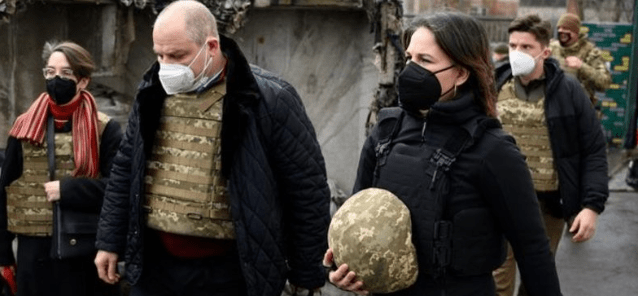
February 8, 2022 – Annalena Baerbock (right) with Ukrainian military escort in the Donbass.

Vad also attacked Scholz. Asked if he were his military adviser, what advice would he have given in February 2022. “I would have advised him to support Ukraine militarily, but in a measured and prudent manner in order to avoid the effect of sliding into a war party. And I would have advised him to influence our most important politically ally. Because the key to a solution to the war lies in Washington and Moscow.”

Vad repeated this message. “The key to resolving the conflict does not lie in Kiev, nor does it lie in Berlin, Brussels or Paris.” Vad’s interviewer didn’t notice the German general had not included London, and was ignoring the British in NATO and in their “special relationship” with the US.

Vad was also attempting to appeal to the Pentagon to save the situation. General Milley, Vad said, “has spoken an inconvenient truth. A truth that, by the way, was hardly published in the German media…. What is being waged in Ukraine is a war of attrition… This strategy did not work militarily then [1914-18] – and will not do so today”. To his German audience, Vad was also reminding them of the threats to German economic survival and political independence which followed the armistice of November 1918 and terms of the Versailles peace treaty of June 1919, and then led into World War II.

General Mark Milley, November 17, 2022.

He then attacked the Scholz coalition for propagandizing the older German war aim without the military capacity to implement it against the Russian forces. “Military experts [and those] who know what is going on among the secret services, what it looks like on the ground and what war really means – are largely excluded from the [German public] debate. They do not fit in with the formation of media opinion. We are largely experiencing a coordination of the media, the likes of which I have never experienced before in the Federal Republic.”

Vad was implying there had been a stronger resistance to the war policies of Adolf Hitler and Joseph Goebbels,  but not now against Baerbock, Habeck,  or Scholz. “[From the German press] this is pure propaganda. And not on behalf of the state, as is known from totalitarian regimes but out of pure self-empowerment.”

“The Greens, FDP [Free Democratic Party] and the bourgeois opposition – flanked by largely unanimous media – are exerting such pressure that the chancellor can hardly resist it.”

Their war against Russia, Vad is warning, is not only lost in the Ukraine. It is threatening to destroy Germany in “a Third World War. And that’s exactly what doesn’t get into the minds of politicians and journalists here in Germany!”
“Germany is and remains an endangered nation”, Vad declared, adding that only the Americans can save the Germans from themselves now. “I myself am a convinced transatlanticist. I tell you honestly, when in doubt, I would rather live under American hegemony than under Russian or Chinese hegemony.”

He then revealed what he, his allies in the German General Staff and in German business circles want the Pentagon to negotiate with the Kremlin before the Russian Army advances to “the further destruction of Ukraine. What is left of this country? It is razed to the ground.”

“It is true that we must signal to the Russians: this far and no further!” How far across Ukrainian territory is that — Vad wasn’t asked and didn’t say. Nor did he disclose the terms which he and his German and US associates think can be negotiated in an agreement with Moscow against the resumption of the war against Russia in future. In fact, he doesn’t abandon the US-German war against Russian “hegemony” at all.

According to Vad, if the Pentagon concedes Russia’s “very specific geopolitical interests in the Black Sea region”, if the Donbass and Crimea remain Russian, “the territorial integrity of Ukraine would have to be restored, with certain Western guarantees. And the Russians also need such a security guarantee”. Exactly what “guarantee” can be negotiated after Merkel  and ex-French President Francois Hollande  have admitted their deception planning, Vad hasn’t advised, at least not in public.  

“The West can send 100 Marders and 100 Leopards – they do not change the overall military situation. And the all-important question is how to deal with such a conflict with a belligerent nuclear power – mind you, the strongest nuclear power in the world! – without going into a Third World War. And that’s exactly what doesn’t get into the minds of politicians and journalists here in Germany!”

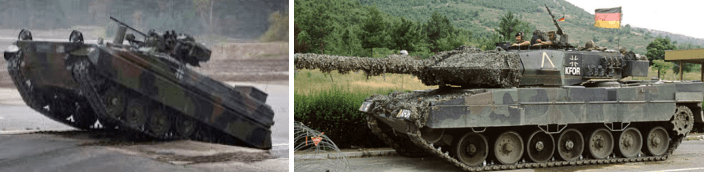
Left – the Schützenpanzer Marder 1, produced by Rheinmetall Landsysteme Maschinenbau in Kiel, between 1969 and 1975. Right, the Leopard main battle tank  by Rheimetall and Krauss-Maffei Wegmann Maschinenbau of Kiel. Kiel voters think war against Russia is good for their incomes and have voted Green to achieve that result.  In the last federal election of 2021, the Kiel vote saw the Greens gain almost 14% to score 28% of the total, while the Social Democratic Party lost ground but held on to the seat with 29.5%. Just over two thousand votes separated them. The anti-war Left and AfD  candidates lost ground in Kiel, ending up  with 5% and just over 7,000 votes each.  

How does Vad and the Germans he is speaking for distinguish themselves now from the Wolf’s Lair plotters who believed – with secret US encouragement between 1943 and 1945 — that if the Wehrmacht could get rid of Hitler, they would make their deal with President Franklin Roosevelt to preserve Germany and continue the fight against the Kremlin? On one point, Vad is conceding the Russian Army is now more powerful by several magnitudes than it was in 1945, and Germany weaker by even greater magnitudes. And the US too, in Europe. This is the meaning of Vad’s phrase describing Russia – “mind you, the strongest nuclear power in the world!”

In such a balance of forces, Vad has calculated that Germany cannot survive as it has until now if the US protectorate is defeated in the Ukraine. He is also implying that the US protectorate which has now replaced Russian-made or locally made arms in Poland, Czech Republic, Slovakia, Romania, Greece,  and Cyprus in exchange for expensive US rearmament, will also collapse into a rout.

“Excellent!” A veteran German banker with longstanding ties to the Chancellery in Berlin comments. “For once a moderating voice!”

From the German media Vad has been attacked for publishing “the opposite reasoning of the US State Department and other military experts”, and for whitewashing the war crimes of the Wehrmacht. According to Volksverpetzer,  which claims to be a crowd-funded fact-checker, “under the guise of ‘expert status,’ [Vad] can then circulate narratives that almost coincide with Russian propaganda and are celebrated by those who spread pro-Russian narratives and disinformation. In his role as an ‘expert’, he first announces the defeat of Ukraine, then downplays attacks by Russia, talks about a nuclear war if heavy weapons are supplied, and denies, contrary to the assessment of many other experts, that Ukraine can win the war. There are other military experts who deserve this status without fear that there might be a politically tinged agenda behind their argument (source). All in all, the favourite general of the New Right seems more like a mouthpiece of Putin than a voice that can seriously assess the current situation.”

NOTE: To understand how committed the German military were, still are, to war for the destruction of Russian “hegemony”, read the works of German historian Christian Gerlach, now at the University of Bern in Switzerland. Start with Gerlach’s interview.  Then his book, Chapter 9, “Hunger policies and mass murder”. According to Gerlach, for months before the attack on the Soviet Union began in June 1941, it was German military strategy to capture an area of Russia 2,000 kilometres deep and 1,600 km wide, seize all its crops and livestock to feed the German army and occupation forces, and starve the 30 million Russians to death. “This starvation policy [was] one of the biggest mass murder plans in human history [and] was designed earlier than any specific plans to kill European Jews, and was intended to kill far more [Russian] people.”  For reference, the territory of the Ukraine in 2014 was 1,316 kms west to east, and 893 km north to south.


By the numbers: The de-dollarization of global trade

Central Bank USD Reserves, per IMF

Per The Cradle: https://data.imf.org/?sk=E6A5F467-C14B-4AA8-9F6D-5A09EC4E62A4

**********

The imposition of US trade restrictions and sanctions against a number of nations, including Russia, Iran, Cuba, North Korea, Iraq, and Syria have been politically ineffectual and have backfired against western economies. As a result, the US dollar has been losing its role as a major currency for the settlement of international business claims.

Because they do not adhere to the policies of the US and other western powers, over 24 countries have been the target of unilateral or partial trade sanctions. These limitations, nevertheless, have turned out to be detrimental to the economies of the Group of Seven (G7) nations and have begun to impact the US dollar’s hegemony in world trade.

In its space, a “new global commercial bloc” has risen to the fore, while alternatives to the western SWIFT banking messaging system for cross-border payments have also been created.

Geopolitical analyst Andrew Korybko tells The Cradle that the west’s extraordinary penalties and seizure of Russian assets abroad broke faith in the western-centric paradigm of globalization, which had been declining for years but had nonetheless managed to maintain the world standard.

“Rising multipolar countries sped up their plans for de-dollarization and diversification away from the western-centric model of globalization in favor of a more democratic, egalitarian, and just one – centered on non-western countries in response to these economic and financial disturbances,” he adds.

Dwindling dollar reserves  

The International Monetary Fund (IMF) recorded a decline in central bank holdings of US dollar reserves during the fourth quarter of 2020—which went from 71 percent to 59 percent—reflecting the US dollar’s waning influence on the world economy.

And it continues to worsen: Evidence of this can be seen in the fact that the bank’s holdings of dollar claims have decreased from $7 trillion in 2021 to $6.4 trillion at the end of March 2022.

According to the Currency Composition of Official Foreign Exchange Reserves (COFER) report by the IMF, the percentage of US dollars in central bank reserves has decreased by 12 percent since 1999, while the percentage of other currencies, particularly the Chinese yuan, have shown an increasing trend with a 9 percent rise during this period.

The study contends that the role of the dollar is waning due to competition from other currencies held by the bankers’ banks for international transactions – including the introduction of the euro – and reveals that this will have an impact on both the currency and bond markets if dollar reserves continue to shrink.

Alternative currencies and trade routes

To boost global commerce and Indian exports, the Reserve Bank of India (RBI) devised in July last year a rupee-settlement mechanism to fend off pressure on the Indian currency in the wake of Russia’s invasion of Ukraine and US-EU sanctions.

India has recently concluded agreements for currency exchanges of $75.4 billion with the UAE, Japan, and various South Asian nations. New Delhi has also informed South Korea and Turkey of its non-dollar-mediated exchange rates for each country’s currency. Currently, Turkey conducts business utilizing the national currencies of China (yuan) and Russia (ruble).

Iran has also proposed to the Shanghai Cooperation Organization (SCO) a euro-like SCO currency for trade among the Eurasian bloc to check the weaponization of the US dollar-dominated global financial system.

Mehdi Safari, Iran’s deputy foreign minister for economic diplomacy, informed the media earlier in June last year that the SCO received the proposal nearly two months ago.

“They must use multilateral institutions like BRICS and the SCO to this aim – and related ones, such as currency pools and potentially even the establishment of a new currency whose rate is based on a basket of their currencies, to mitigate the effects of trade-related restrictions,” Korybko remarked.

The International North-South Transport Corridor (INSTC) is being revived as a “sanctions-busting” project by Russia and Iran. The INSTC garnered renewed interest following the “sanctions from hell” imposed by the west on Moscow. Russia is now finalizing regulations that will allow Iranian ships free navigation along the Volga and Don rivers.

The INSTC was planned as a 7,200 km long multimodal transportation network including sea, road, and rail lines to carry freight between Russia, Central Asia, and the Caspian regions.

Ruble-Yuan Payment System

On 30 December, 2022, Russian President Vladimir Putin and his Chinese counterpart Xi Jinping held a video conference in which Putin reported that bilateral trade between the two countries had reached an all-time high with a 25 percent growth rate and that trade volumes were on track to reach $200 billion by next year, despite western sanctions and a hostile external environment.

Putin stated that there had been a “substantial growth in trade volumes” between January and November 2022, resulting in a 36 percent increase in trade to $6 billion. It is likely that the $200 billion bilateral trade target, if achieved by next year, will be conducted in Russian rubles and Chinese yuan, even though the details of the bilateral trade settlement were not specified in the video conference broadcast.

This is because Moscow and Beijing have already set up a cross-border interbank payment network similar to SWIFT, increased their gold purchases to give their currencies more stability, and signed agreements to swap national currencies in several regional and bilateral deals.

In addition, both Russia and China appear to have anticipated a potential US seizure of their financial assets, and in 2014 they collaborated on energy-centered treaties to strengthen their strategic trade links.

In 2017, the ruble-yuan “payment against payment” system was implemented along China’s Belt and Road Initiative (BRI). In 2019, the two countries signed an agreement to replace the dollar with national currencies in cross-border transactions and converted their $25 billion worth of trade to yuan (RMB) and rubles.

Independence from the dollar

This shift decreased their mutual reliance on the dollar, and currently, just over half of Russia’s exports are settled in US dollars, down from 80 percent in 2013. The bulk of trade between Russia and China is now conducted in local currencies.

Xinjiang in western China has also established itself as a key cross-border settlement center between China and Central Asia, making it a major financial hub in the region. Cumulative cross-border yuan settlement handled in Xinjiang exceeded 100 billion yuan ($14 billion) as early as 2013 and reached 260 billion yuan in 2018.

According to analyst Korybko, significant progress has been made in reducing reliance on the US dollar in international trade, but there is still much work to be done. He notes that the US is not likely to simply accept the challenges to its financial hegemony and is more likely to act to defend it.

“For this reason, it is expected that the US will try to enlist the support of key players by offering them preferential trade deals or the promise of such deals, while simultaneously stoking tensions between Russia, China, India, and Iran through information warfare and possibly threatening to tighten its secondary sanctions regime as ‘deterrence’.”

Eurasian Economic Union

Russia has been working to establish currency swap agreements with a number of trading partners, comprising the five-member Eurasian Economic Union (EEU), which includes Russia, Armenia, Belarus, Kazakhstan, and Kyrgyzstan.

These agreements have enabled the Russian Federation to conduct over 70 percent of its trade in rubles and other regional currencies. With a population of 183 million and a GDP over $2.2 trillion, the EEU poses a formidable challenge to western hegemony over global financial transactions.

Iran and the EEU have recently concluded negotiations on the conditions of a free trade agreement covering over 7,500 categories of goods. When the next Iranian year begins on 21 March, 2023, a market with a potential size of 700 billion dollars will become available for Iranian goods and services.

BRICS is driving de-dollarization

The trend towards de-dollarization in international trade, particularly among the BRICS nations, has gained significant momentum in recent years – together they represent 41 percent of the world’s population, 24 percent of its GDP, and 16 percent of its commerce

In 2015, the BRICS New Development Bank, recommended the use of national currencies in trade. Four years later, the bank provided 25 percent of its $15 billion in financial assistance in local currencies, and plans to increase this to 50 percent in the coming years.

This shift towards de-dollarization is an important step for emerging economies as they seek to assert their role in the global economic system and reduce their reliance on the US dollar. While the adoption of de-dollarization may present some challenges and uncertainties, it is an important step towards a more diverse and balanced global economy.

Polar Vortex 2.0

ZeroHedge: https://www.zerohedge.com/weather/siberia-records-minus-80-degrees-talk-polar-vortex-grows

**********

Siberia Records Minus-80 Degrees As Talk Of Polar Vortex Grows

BY TYLER DURDEN

SATURDAY, JAN 14, 2023 – 07:35 AM

Several weeks after the Christmas Arctic blast, much of the US and Europe have enjoyed record warmth. Recall on Dec. 27, we noted the cold air mass from Siberia that spread across the continental US would dissipate into the new year. So far, this is correct, as three weeks of above-average weather has staved off an energy crisis in the Northern Hemisphere. But just north, in Siberia, temperatures are sinking to near-record lows. And it could only be a matter of time before the giant cold air mass swirling in the North Pole becomes unstable, breaks down, and begins pouring into the US and Europe. 

Global warming alarmists who called for an imminent climate disaster last summer are scratching their heads as the rural northern Siberian town of Zhilinda just recorded temperatures of minus-79.8 degrees, according to climatologist Maximiliano Herrera, who tracks extreme temperatures across the globe.

Herrera told The Washington Post that Zhilinda was just a few degrees off from breaking its record low of minus-82.3 degrees. The all-time low for the Northern Hemisphere was set in Russia in 1933 at minus-89.9 degrees.

Earlier this week, Arcfield Weather’s Paul Dorian said winter isn’t over and called for a significant change in North American weather “in about ten days or so.” Like anything, nothing is ever constant, and the warm spell could give way to colder temps later this month or early February. 

“Sometimes, exceptionally cold air that builds over Siberia spills into the eastern United States,” WaPo explained, adding:

“Although the eastern United States has had very mild weather since that late December cold blast, there is the potential for a significant pattern change toward the end of January.”

For a polar vortex to flow into the US or Europe, there first needs warming in the Arctic stratosphere that pushes cold air lower. As explained by Michigan Weather Forecast:

This begins with the warming in the Arctic stratosphere which pushes the cold air south (simply put). The GFS, GEFS, ECMWS, and GEM models are displaying similar model runs. This is more of a heads-up than anything else. Do with it as you will, it is my humble opinion that winter in the sense of cold and snow isn’t over yet. We will see if the CPC comes on board with this.

And on Twitter, many folks are posting models predicting winter isn’t over and all that cold air trapped in the Arctic could pour into Europe and the US in the coming weeks. 

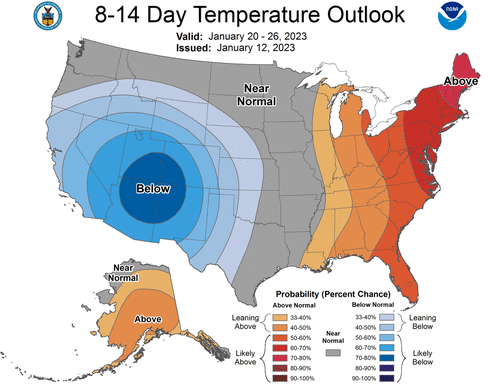
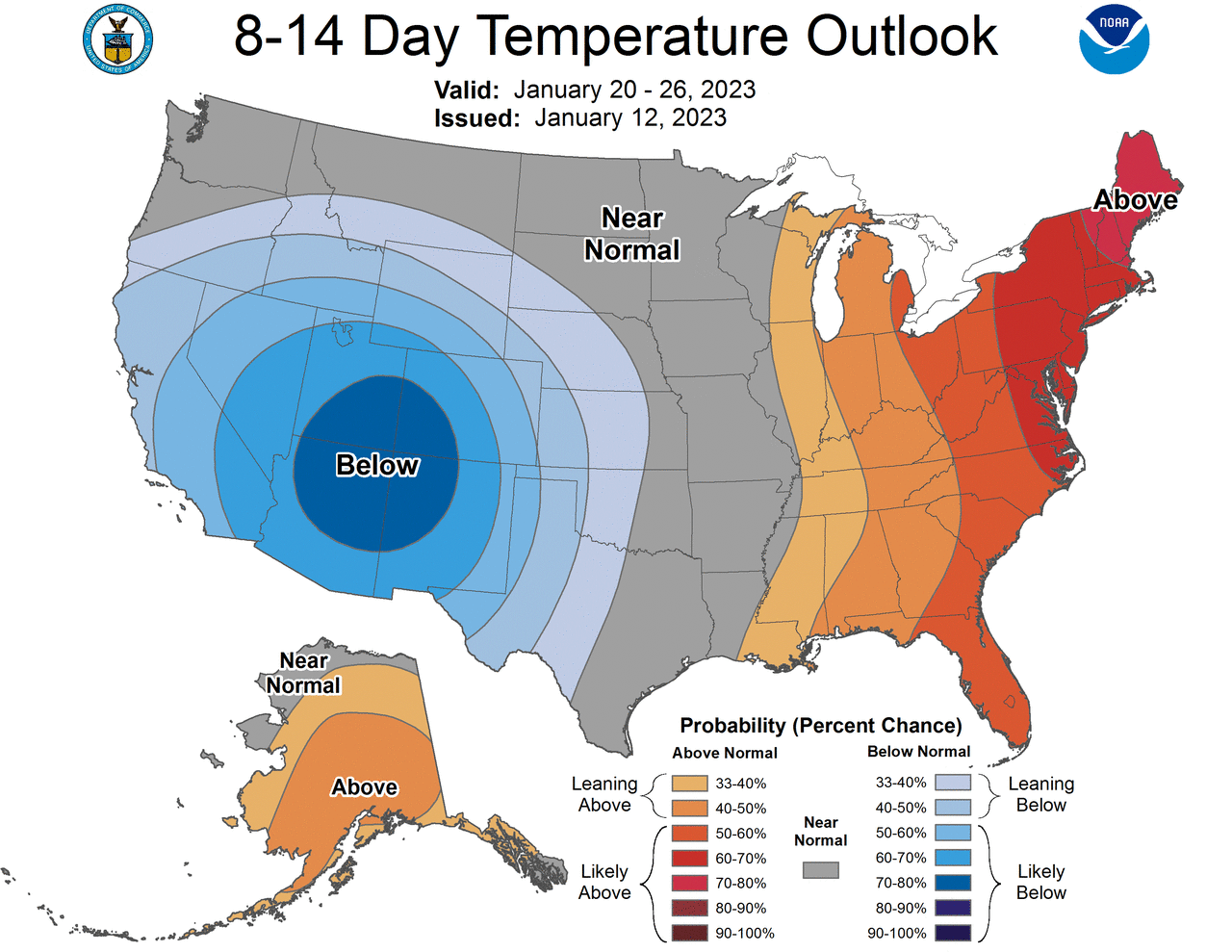
And maybe there’s some validity in the models above as the Climate Prediction Center’s 8-14 day temperature outlook has increasingly shown over the last week of colder weather slated for the end of the month. 

So if the models are correct. Winter was just delayed. 

Ukrainian Defense Lines — What Happens When They Are Breached

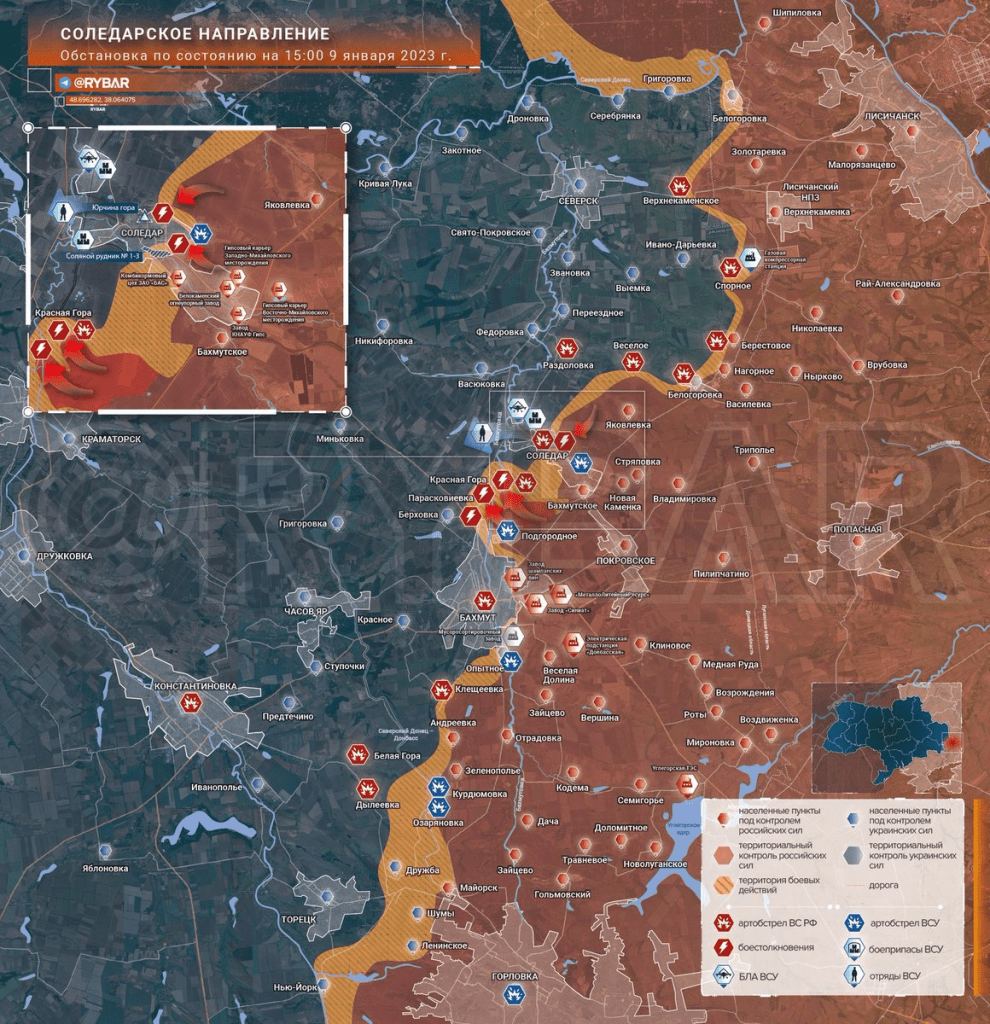
PMC RIGHOZIN VISITS CAPTURED SOLEDAR SALT MINE TUNNELS

Moon of Alabama: https://www.moonofalabama.org/2023/01/ukrainian-defense-lines-and-what-happens-when-they-are-breached.html#more

Emphasis in bold

**********

Soledar has fallen to Russian troops. Bakhmut (Artymovsk) will follow soon.

This constitutes the breach of Ukraine’s second defense line within the Donetzk and Lysichansk oblasts. I will discuss those lines with the maps below.

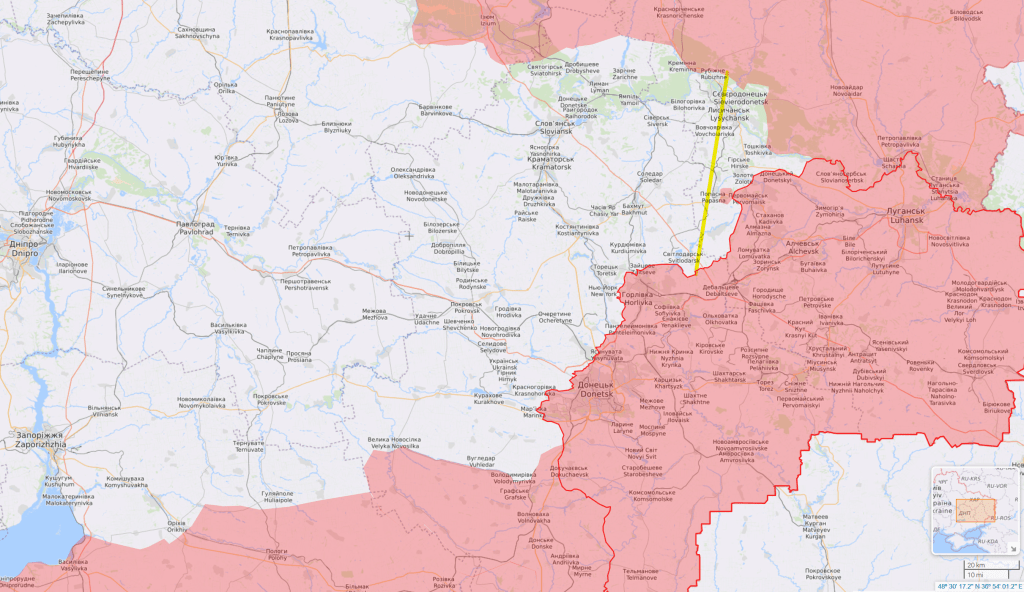
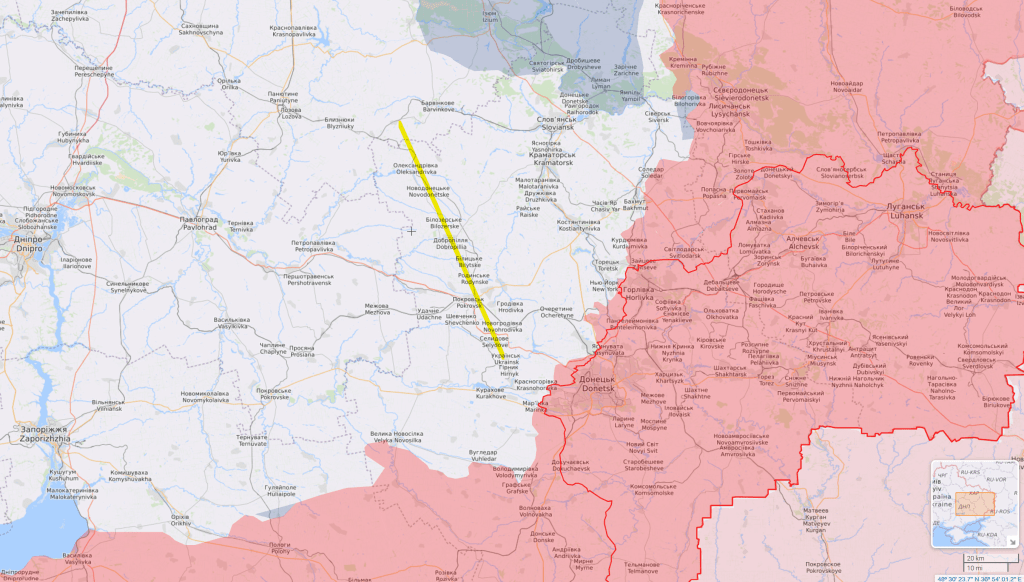
The first map shows the range of land taken by Russian forces by April 1 2022 (Kiev region not shown).

Russia had invaded with a small force of some 100,000 soldiers supported by some 50,000 soldiers of the Donetzk/Luhansk Republics. [Note: in February 2022, I assumed 400K-500K in the SMO invasion force.]The opposing forces were 250,000 regular Ukrainian army troops which quickly grew to 450,000 and then 650,000 by mobilization of reserve  forces plus the Territorial Defense Forces. During the first weeks the Russian forces had taken a huge amount of land that they barely had the numbers to hold.

At that point Russia was still hoping that the negotiations held at that time with Ukraine in Turkey would have a positive outcome. As a confidence measure it had already started to pull back from around Kiev. However, after phone calls from and a visit by the British prime minister Boris Johnson the Ukrainian government ended the negotiations by suddenly adding demands the Russia would never agree to. The troops from Kiev were pulled back anyway and moved to the east of Ukraine where they started an attack on the first defense line (yellow) of the Ukrainian forces.

April 1 2022

This first defense line, like later ones, ran along railway and road communication routes that connect major cities. In the map above the cities that constituted the first defense line were, north to south, Siverodonetsk, Lysichansk, Popasna, Svitlodarsk.

By July 1 2022 the first Ukrainian defense line was breached and defeated by Russian forces. The Ukrainian troops moved back to their second defense line. However, the defeat of the first defense line had taken its toll of the small Russian Special Military Operation force.

July 1 2022

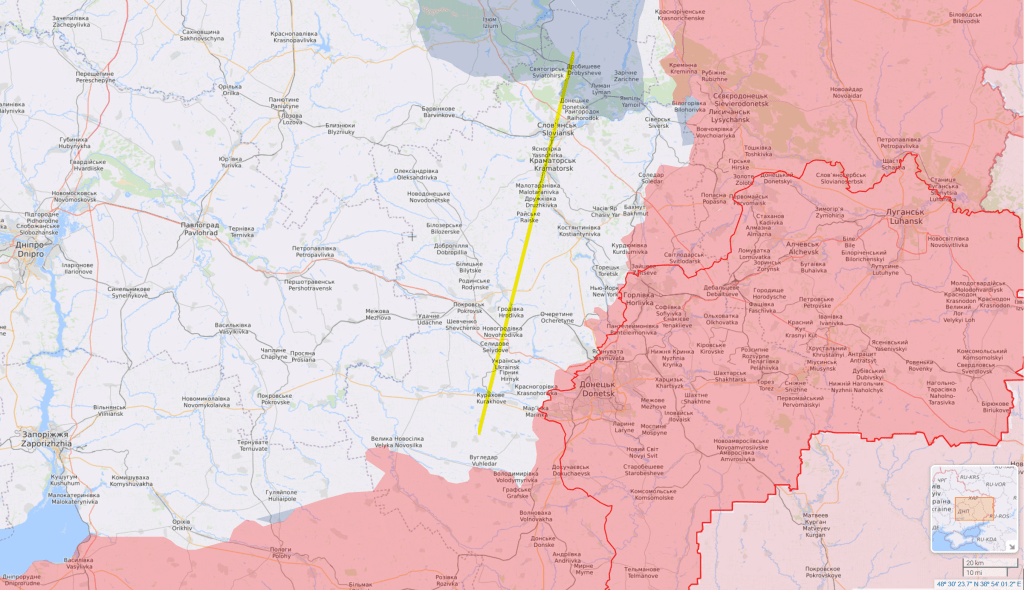
The second Ukrainian defense line, north to south, ran from Siversk to Soledar, Bakhmut, New York agglomeration and then along the old ceasefire line of the Donetzk Republic.

The Russian forces tried to avoid a costly direct attack on the second Ukrainian defense line. It launched an operation to breach into the Donetzk oblast behind the second Ukrainian defense line from the north (now gray area). The battles for Izium and Lyman were fought for that purpose. However, the wooden area north of the Siversky Donets river that runs east to west as well as the river itself proved to be difficult to cross. Several attempts to move significant forces across it failed.

At the end of August 2022 the exhausted Russian forces had switched to a defensive posture and into an ‘economy of force’ mode. Troops that were holding the Kharkiv area north of the Donetzk oblast were reduced. The other forces were moved to the eastern front to strengthen the Russian lines on that front.

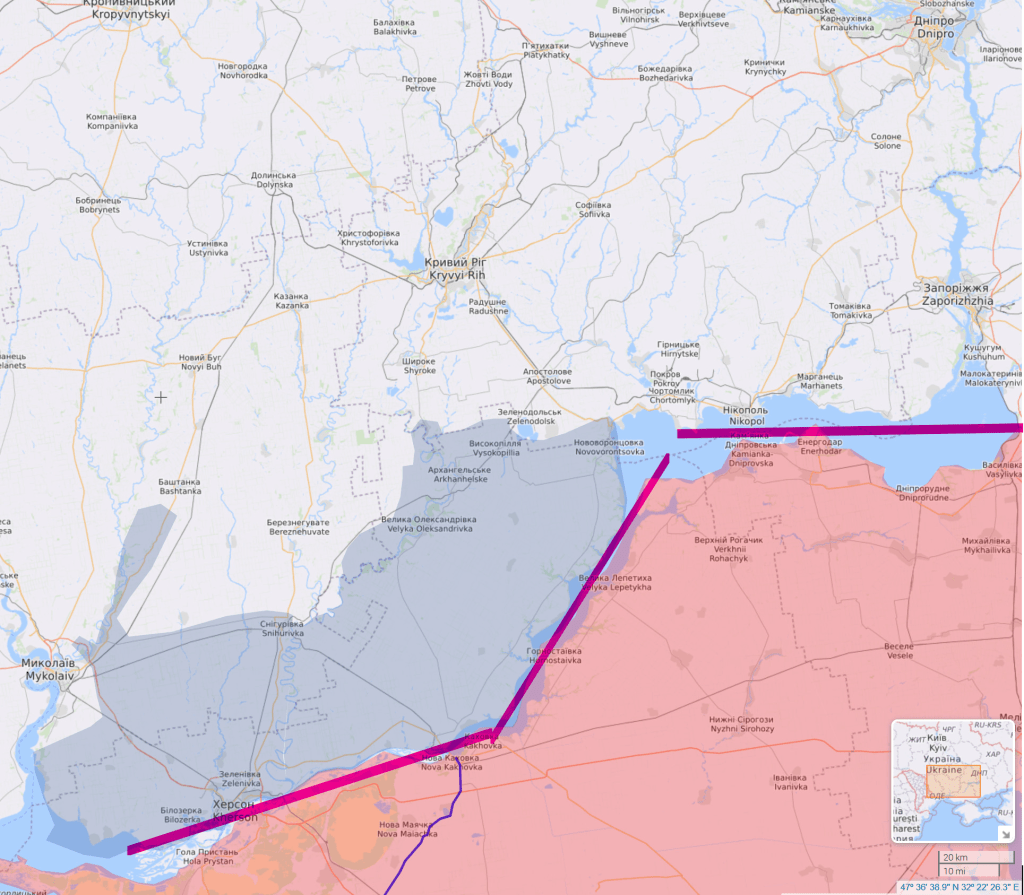
Meanwhile Ukraine was openly discussing and preparing for an attack on the Kherson region north of the Dnieper river with the final aim of crossing the river to then move towards Crimea. Russia responded by further reducing the troop numbers in the northern Kharkiv region to a few thousand men and by using the others to further strengthen its positions in the south around Kherson.

During the fall the Ukrainian attacks on the Kherson region all failed with high losses. However U.S. intelligence advised the Ukrainian command that the Kharkiv region, while still held by Russian forces, was practically empty. The command switched the active front towards the north and successfully moved into the Kharkiv region while Russian troops still positioned there moved further east.

This was a quite fast operation that looked very successful. But the speed also meant that the heavy Ukrainian artillery cover was thin to not existent. This while the retreating Russian forces used their own artillery to attack Ukrainian front formations in pre-planned fire missions. After proceeding fast over some 70 kilometers  from west to east the Ukrainian attack force had taken high losses and ran out of steam. It came up to a new Russian defense line (red) covered by two rivers that proved difficult to cross. The Kharkiv front has since stabilized.

Jan 1 2023

The Ukrainian ‘victory’ in the Kharkiv region gave the Russian government the necessary public backing for the mobilization of additional forces. 300,000 reservists were called up. Some 70,000 additional men joined as volunteers. The Wagner private military company increased its force size to some 50,000 men. Over the last three month of 2022 all those forces were supplied with the necessary equipment and went through refresher training.

Meanwhile a new Russian commander, General Sergey Surovkin, took over. He warned immediately that he would have to take some difficult decisions. This was related to the situation in the Kherson region north of the Dnieper. Constant attacks on the river crossings with U.S. supplied missiles made the logistic situation very difficult. The command decided to pull back behind the river. This operation was remarkably successful. Ten thousands of civilians plus some 25,000 soldiers with all their equipment were removed from the area with only few if any losses.

By the end of the year the shortening of the front lines and the introduction of fresh forces had allowed the Russian forces to regain the initiative. They launched intense attacks on Ukraine’s second defense line. With the successful taking of Soledar that line has now been breached. This makes the situation of Siversk, north of Soledar, and of Bakhmut, south of it, much more difficult. No Ukrainian troops or materials can now be moved on the roads and railways that were part of the line. The breach of the line will allow Russian troops to move west of it to the north and the south to then create cauldrons for the other positions within that same line. ‘Rolling up a defense line’ is a description of that process.

The now heavily reduced Ukrainian forces will likely have to give up on holding the second defense line to then create a third one to the west of it.

The third Ukrainian defense line will run from Sloviansk in the north through Kramatorsk, Druzhkivka, Kostantinovka to the New York agglomeration. I expect the complete defeat and cleanup of the second Ukrainian defense line by the end of March. The third Ukrainian defense line will probably fall by the mid of the year. Whatever is left of the Ukrainian forces will then try to hold a fourth defense line along the string of smaller towns west of it.

This will be the last Ukrainian line in the Donetsk oblast. It likely to fall before by the end of September.

The Russian moves against the third and fourth Ukrainian defense lines will likely be supported by a move from the south that will liberate the rest of the Zaporiziha and Donetsk oblast.

Aside from those operations the Russian command has sufficient number of troops available to run another major attack. This could come from the north into the Kharkiv regain behind the Ukrainian troops currently attacking the Russian lines further east.

The Russian forces in Ukraine were tasked with liberating the oblast that Russia had recognized as independent states (Donetzk and Luhansk) as well as those that had additionally voted to become part of Russia (Zaporiziha and Kherson).

With the breaking up of all four Ukrainian defense lines in Donetzk oblast that task will be fulfilled. This with the exception of the part of the Kherson region north of the Dnieper river which will require a separate operation on its own. The Russian command may want to wait for this until more Ukrainian forces have been destroyed while holding their defense lines.

Another task given to the Special Military operation was to ‘demilitarize’ and ‘denazify’ Ukraine. The Ukrainian tactic of holding fixed lines anchored on major cities at any price has come at a significant cost. Russian artillery is superior to the Ukrainian by a factor of ten. The Russian forces use it to destroy Ukrainian troops holding the lines while taking only few losses on their own side.

Today’s Wall Street Journal finally noted that this Ukrainian battle tactic is not a winning one:

Western—and some Ukrainian—officials, soldiers and analysts increasingly worry that Kyiv has allowed itself to be sucked into the battle for Bakhmut on Russian terms, losing the forces it needs for a planned spring offensive as it stubbornly clings to a town of limited strategic relevance. Some of them say that it would make sense to retreat to a new defensive line on the heights west of Bakhmut while such a pullback can still be organized in a coordinated fashion, preserving the Ukrainian military’s combat strength.

“It’s not me, it’s King Leonidas who figured out that you should fight the enemy on the terrain that is advantageous to you,” said one Ukrainian commander in Bakhmut, referring to the ruler of Sparta who battled the Persian Empire at Thermopylae. “So far, the exchange rate of trading our lives for theirs favors the Russians. If this goes on like this, we could run out.”

The Ukrainian soldier is right. However, a different form of fighting the war would be a mobile delay and retreat action from which local counter offensives would be launched. This requires a lot of equipment, battle tanks and infantry fighting vehicles, that the Ukraine no longer has. It also requires troops and larger formations trained for that type of fight. Some 60 year old mailman drafted during Ukraine’s 9th mobilization wave will not be able to learn this during his two weeks training course.

Had the professional Ukrainian army that exited before the war been allowed to give up on cities and had it used a mobile combined arms tactic of delay-retreat-counterattack it probably would have been more successful. But that army has by now been destroyed with Russian artillery because Kiev insisted on holding cities and lines at any price.

The U.S. will only now start to train Ukrainian troops in combined arms and joint maneuvering. It will be too little too late to make any difference.

As of current news, today we see fake news headlines like this from NBC:

Putin replaces commander of Russia’s war in Ukraine after just 3 months
Valery Gerasimov takes over from Sergei Surovikin, who will now serve as one of his deputies, Russia’s defense ministry said Wednesday.

Russian President Vladimir Putin has replaced the commander leading his forces in Ukraine just three months after he handed him the job.

Gen. Valery Gerasimov will take over from Sergei Surovikin, the country’s defense ministry said on Telegram Wednesday, a change that comes as Kyiv warns Moscow is planning a major new offensive after months of battlefield setback.

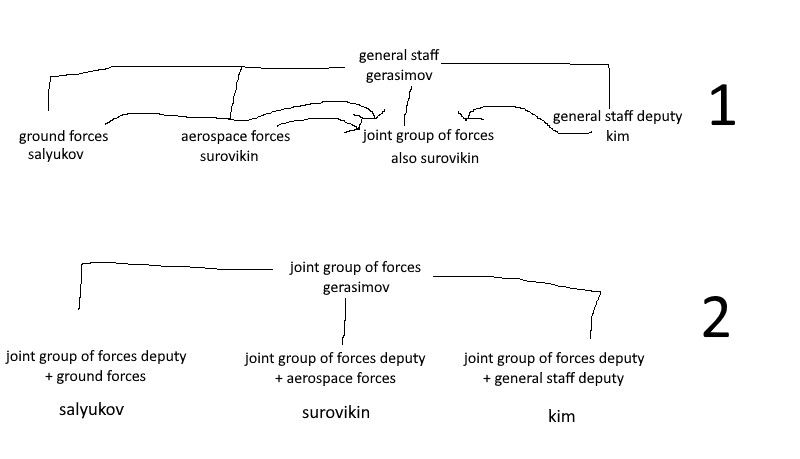
The above is a misinterpretation of a simple naming change.

Russians With Attitude @RWApodcast – 16:09 UTC · Jan 11, 2023

As I understand it, we went from 1 to 2

Neither was Surovkin pushed aside or demoted nor was Gerasimov promoted to a new job. Surovkin will continue to run the theater force in Ukraine. This move did not change command responsibilities but lifted the importance of the whole operation by making it the highest military commander’s priority.

Soledar Collapses — Sanctions Next?

Per Southfront.org: https://southfront.org/breaking-russians-captured-afu-stronghold-soledar/

On 10 January 2022, in the late afternoon, official media sources of the Russian Wagner PMC stated that the city of Soledar had been captured by Russian units.

Soledar was one of the key points of defence of the AFU in the East of Ukraine. The city is home to Europe’s largest salt production facility.

Evgeny Prigoggin, head of the Wagner PMC, announced:
“Wagner PMC units have taken control of the entire territory of Soledar. A cauldron has been formed in the centre of the city, where urban fighting is taking place. The number of prisoners will be announced tomorrow.
I should like to stress once again that no units other than those of the Wagner Cheka were involved in the storming of Soledar.”

Prigozhin himself was also in the ranks of his warriors in Soledar.

BREAKING. Russians Captured AFU Stronghold Soledar

Prigozhin and his soldiers stand at the Salt Mine Museum, which is already closer to the western outskirts of Soledar, confirming full control of the town.

It is currently known that the city, for the most part including the centre, was occupied by Wagner PMC assault groups. The PMC units took all the dominant heights around the city, including Yurchina Mountain, taking direct fire control of the AFU supply roads and outposts. Several hundred more Ukrainian soldiers reportedly remain in the city.

A mopping-up of the city is underway.

The active phase of fighting for Soledar lasted more than four months, but the Ukrainian Armed Forces’ defences were resistant to regular army units and they were subsequently withdrawn from the front line. It took the Wagner Group just over two weeks to take the city directly.

**********

Additional reports:

Updated map showing RF/DPR advances west (note the “cauldron” left behind in Soledar center city — “Mariupol 2.0” — comprising NATO mercenaries)

Here is Meaning in History: https://meaninginhistory.substack.com/p/report-from-the-sanctions-front-with

**********

Report From The Sanctions Front, With Ukraine Update

Mark Wauck

Before we get to the sanctions front, here’s a brief update on the developments in the fighting at Soledar near Bakhmut in the Donbass. It’s sounding like the Russian forces have achieved some sort of breakthrough that significantly advances the slow encirclement of Bakhmut itself. Zelensky’s top adviser, Arestovich, has said: “We are on the defensive, they are advancing.”

This afternoon the reporting on the fighting at Soledar is hot and heavy. Soledar is just north of Bakhmut in the Donbass and secures the northern approaches to Bakhmut. The fall of Soledar will therefore place Ukrainian forces in Bakhmut in even more jeopardy. Reports indicate that Soledar has basically fallen, while pockets of Ukrainian and possibly Polish troops remain trapped in the area. The following tweets are not comprehensive nor authoritative, merely typical of reporting:

If you click on the map below, you’ll see that there are English sub-captions:

In the following discussion—all 21 minutes of which is quite interesting—Douglas Macgregor asserts again what he has been saying for about a week. The Ukrainian forces in the south are crumbling, having been stripped of their best units which have been sent to Bakhmut. I take that reference to refer to the areas in the north of the Zaporozhye Oblast, where Ukraine had been building up forces for an offensive toward Melitopol:

Russian Occupation of Zaporizhzhia Oblast.svg

The significance of what Macgregor is saying is that Russia has built up a very significant force in Zaporozhye and could open up an avenue for a relatively quick advance to the north, trapping the major portion of Ukrainian forces in the Donbass area.

Now, on to the sanctions front. Yesterday, Alex Mercouris remarked that Japan has been basically ignoring the sanctions regime and continues to import huge amounts of oil and gas from Russia. I’m not sure exactly where the Russian oil and gas is coming from. Russian oil from the Arctic is currently transported by tankers to China and India, but there are other possibilities. So, when I saw this item my interest was sparked:

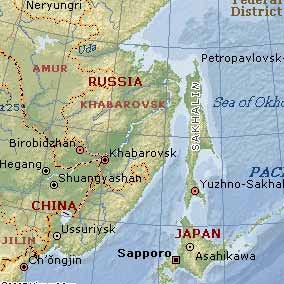
Japan has joint energy projects with Russia in the Sakhalin region, which it has continued despite the sanctions. Sakhalin lies directly north of Japan’s northern island of Hokkaido, and prior to WW2 was split in half between Russia and Japan:

Sakhalin, Russia: Visiting a Place Few Will Ever See - GoNOMAD Travel

The result of all this?

Russia-Japan trade surges despite sanctions – media

The growth is being driven by high global energy prices

Trade between Russia and Japan saw an annual increase of 10% in the first 11 months of 2022 despite Ukraine-related sanctions introduced against Moscow by the West, according to estimates made by TASS, based on Japanese trade statistics.

In monetary terms, bilateral trade reportedly amounted to 2.365 trillion yen (some $18 billion).

Russia, one of the world’s biggest oil producers and exporters, remains one of the major suppliers of liquefied natural gas (LNG) to Japan. The sanctions-hit country accounts for about 9% of Japanese imports of the fuel. Russian gas accounts for 3% of electricity generation in Japan.

Nevertheless:

Tokyo reduced purchases of Russian crude to almost zero in July and August. Moreover, Japan has joined the oil price cap scheme adopted by the Group Seven nations last month. The mechanism bans Russian oil cargoes that are traded above $60 per barrel from getting key services provided by Western companies, including insurance. The price ceiling may be revised depending on market conditions.

What’s going on here? This: Oil and gas from Sakhalin to Japan is excluded from the sanctions regime.

Hypocritical? Realistic? Both? But it doesn’t bode well for the economic war against Russia. The US is a long way off from Japan. Although US bases are near, supply lines are very long. China and Russia are very near.

So here’s what Alex Krainer is talking about today:

Is war on China in the offing?

US military is working hard on “setting the theater” for war on China, emulating the success it’s had in Ukraine.

I don’t know whether we’ll have a war on China this year, but it does appear that the western empire, led by the United States, is preparing for it in earnest. On Sunday, 10 January, Lieutenant General James Bierman, the commanding general of the Third Marine Expeditionary Force and of Marine Forces Japan gave an interview to the Financial Times in which he said that his command is working hard to replicate the empire’s military success in Ukraine. 

I still want to believe that all this crazy talk will end up going nowhere, thwarted by the pressure of events in the Real World.

Banks Underwater

Is JPM Solvent? If not, what about Citi? Is anyone solvent?

An available-for-sale security (AFS) is a debt or equity security purchased with the intent of selling before it reaches maturity or holding it for a long period should it not have a maturity date.

Accounting standards require companies classify any investments in debt or equity securities when they are purchased in one of the following categories:

Available-for-sale securities are reported at fair value; changes in value between accounting periods are included in accumulated other comprehensive income in the equity section of the balance sheet.

As interest rates have risen in response to Federal Reserve policies, the AFS securities have seen significant unrealized losses on their bond portfolios.

The change in bond portfolios has disrupted the bank M&A market and inflicted pressures on large commercial banks.

Generally accepted accounting principles (GAAP) require unrealized losses (or unrealized gain in a different environment) on AFS securities to be reflected on the balance sheet as accumulated other comprehensive income (AOCI).

AOCI losses have been dramatically rising over the past year.

Rising interest rate increases, coupled with soft loan demand and desire for yields, leave banks holding large investment portfolios.

These securities are often weighted down by longer maturities, which means significant, unrealized, losses. These unrealized losses have suppressed bank M&A activity.

The question is to what extent is the rising AOCI impacting large bank solvency.

Here’s R. Chris Whalen to run the numbers coming using the Q3 results: https://www.theinstitutionalriskanalyst.com/post/is-jpmorgan-chase-insolvent

********

Is JPMorgan Chase Insolvent?

November 28, 2022 | Watching the Buy Side Pivot Platoon rev up for a new surge of asset allocation into large cap bank stocks, we remind readers of The Institutional Risk Analyst that US depositories currently are not particularly cheap, in nominal or real terms. In fact, in a stressed scenario, the liabilities of banks exceed the value of the assets by over $1 trillion, the classic definition of insolvency.

Once you adjust reported book value for the asset price inflation & now deflation of the QE/QT roller coaster ride, it is fair to ask: Just where is the value? If we told you that the capitalization of the industry was negative by over $1 trillion at the end of Q2 2022, would you still buy bank stocks for your clients? Let’s have a look at industry paragon JPMorgan Chase (JPM) just for giggles, but first we’ll start off with the industry view.

At the end of Q2 2022, the US banking industry had $2.2 trillion in total capital. That is, book equity. But much of total capital is not tangible, which is why regulators use Tier 1 Capital as the base measure for solvency. The legal definition of Tier 1 Capital, which excludes many items we discuss below, is found at 12 CFR Part 324 of the federal banking regulations.

Specifically, the law:

“requires that several items be fully deducted from common equity tier 1 capital, such as goodwill, deferred tax assets (DTAs) that arise from net operating loss and tax credit carry-forwards, other intangible assets (except for mortgage servicing assets (MSAs)), certain DTAs arising from temporary differences (temporary difference DTAs), gains on sale of securitization exposures, and certain investments in another financial institution’s capital instruments. Additionally, management must adjust for unrealized gains or losses on certain cash flow hedges.”

12 CFR Part 324

Of note, when adopted in 2015, CFR Part 324 allowed all non-advanced approach institutions (aka “little banks”) to make a permanent, one-time opt-out election, enabling them to calculate regulatory capital without AOCI. At the time, accumulated other comprehensive income was a minor entry on bank balance sheets and income statements, minor as in the footnotes. In the age of QE, however, AOCI is now a much bigger deal, but still is dwarfed by how QE has caused unrealized losses on bank balance sheets.

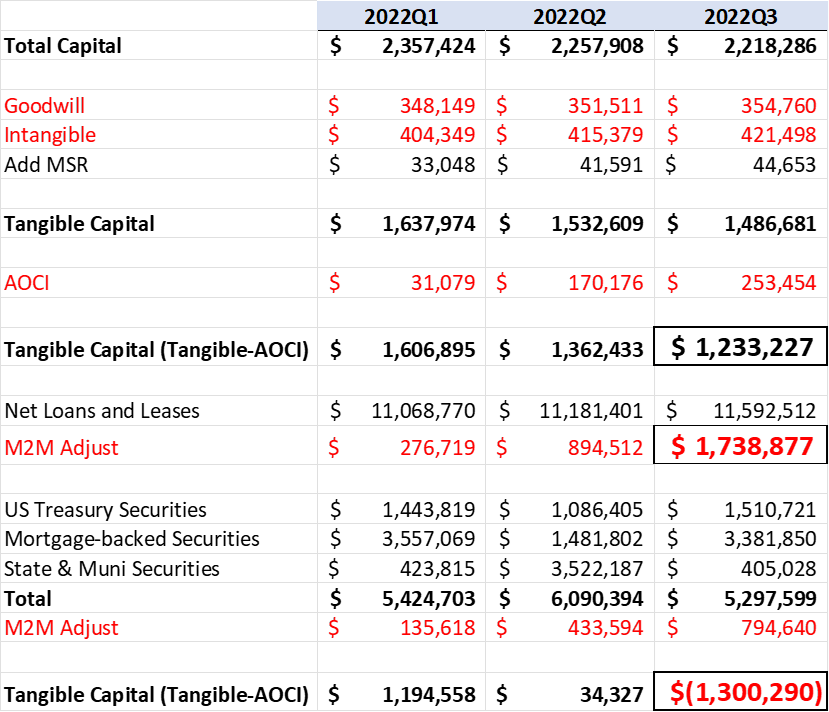
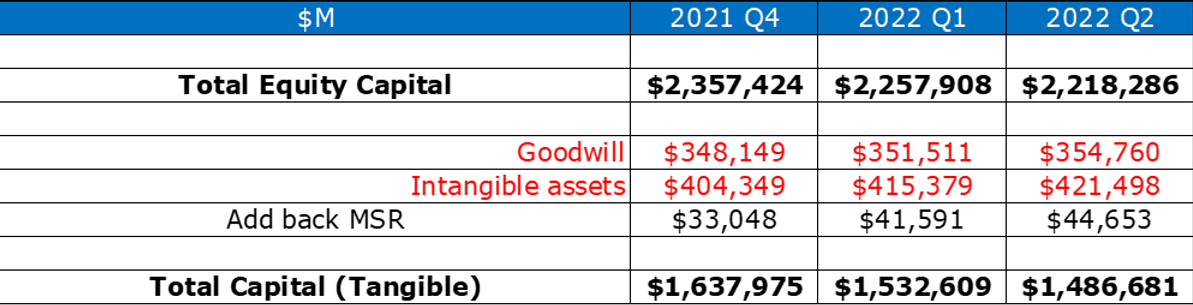
So, let’s begin the fun with the fire-sale calculation we perform using the aggregate data from the FDIC. We start with total capital, the broadest definition of bank equity. We then subtract the goodwill and all of the intangibles, but add back in the mortgage servicing assets just to be nice. Once you see the result of the analysis, you’ll understand why we say “nice” regards adding back the MSRs.

U.S. Banking Industry

Source: FDIC

Notice that tangible capital dropped by several hundred billion in three quarters since Q4 2021. As we’ve noted earlier, the large banks led by JPM plateaued in Q3 2022 in terms of AOCI, mostly through sales of assets and transfers into portfolio to be “held to maturity.” But the risk remains. MSR prices have likewise softened since June. Regulators refer to “assets” rather than rights because sometimes mortgage servicing can become a liability, particularly in the government market.

Thanks to QE and now QT, all sorts of assets have become negative return propositions for banks and nonbanks alike. If the coupon pays less than the funding costs, you’re losing money. Just ask Jerome Powell about the return on the Fed’s SOMA portfolio. Below we take the analysis through adding the net gain or loss reported in AOCI.

U.S. Banking Industry

Source: FDIC

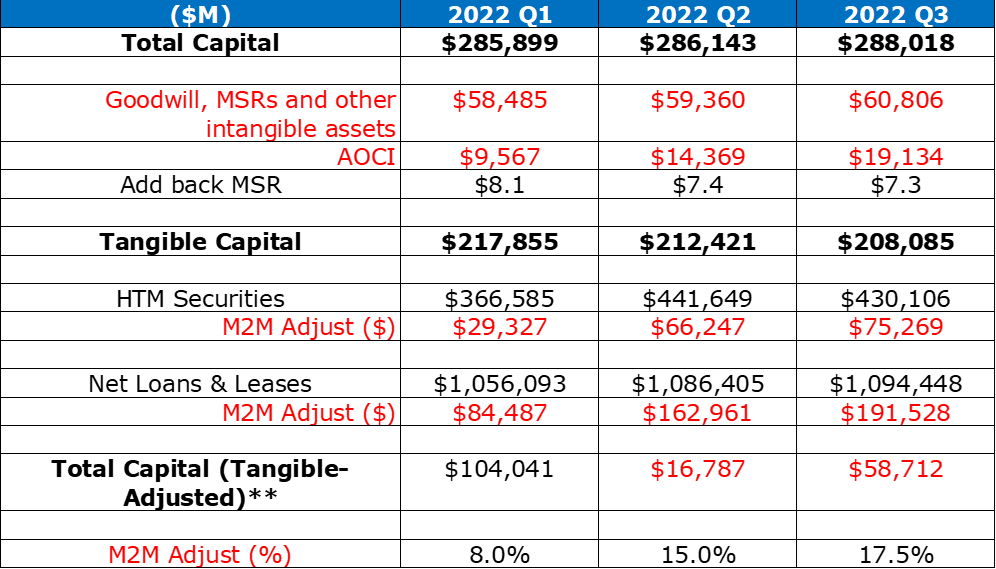
So just subtracting the basics for Tier 1 capital leverage, including taking out the AOCI, we have almost cut Q2 2022 industry capital in half. And we have not even arrived at the fun part, which involves estimating the mark-to-market losses on loans and securities held in portfolio caused by the rapid increase in interest rates by the FOMC.

Even if the bank holds these low-coupon assets created during 2020-2021 in portfolio to maturity, cash flow losses and poor returns could eventually force a sale. This is why people who prattle on about how well capitalized are US banks are just showing their ignorance.

The table below shows our conservative M2M adjustment for the last three quarters on the almost $12 trillion in total loans and leases owned by banks. We adjust Q4 2021 by 2.5%, Q1 2022 by 8% of total loans and leases, and 15% of total loans and leases in Q2 2022 to approximate the low-end of M2M losses due to the rapid increase in interest rates in 2022.

U.S. Banking Industry

Source: FDIC

As you can see, the industry is already insolvent in Q2 2022 with the adjustment to the loan portfolio, which may be significantly underwater by next year. GAAP allows owners of assets held to maturity to ignore mark-to-market losses so long as they have the capacity and the intent to do so.

So, do you sell the 2% and 3% coupon loans and securities at a loss and buy some 8% and 9% loans coupons? Yes you do, eventually. This is how M2M becomes available for sale (AFS) “gradually, then suddenly” to recall Ernest Hemingway’s 1926 novel, The Sun Also Rises.

The final part of the analysis is to apply the adjustments above to the $5 trillion bank securities portfolio. The result is another $700 billion in potential M2M losses as of the end of Q2 2022 and a picture of the US banking industry that is a good bit less positive than the conventional wisdom.

U.S. Banking Industry

Source: FDIC

The value of the FDIC data is that they track all of the AOCI even if the banks do not need to add or subtract the balance from regulatory capital. The fact that the US banking industry had $1.3 trillion more in potential M2M losses that capital at Q2 2022 should put to rest any doubts that QE was too much funny money for too long. Notice that none of the economics reporters who cover the Fed ever ask about the impact of QE on the banking system.

So now if we turn to JPM, which is one of the better managed banks in the US, the results are better than the industry as a whole but the bank still had a negative capital position at the end of Q2 2022 to the tune of -$16 billion in capital. The capital deficit increased to -$58 billion when we increased the M2M adjustment to 17.5% haircut in our stressed scenario.

JPMorgan Chase

Source: FDIC, Edgar

Don’t hold your breath waiting for Fed Chairman Jerome Powell to address the issue of bank solvency at the next FOMC press conference. First QE and now QT has injected such excessive levels of volatility into the prices of assets — all assets — that the value of capital has been compromised. Suffice to say that if the FOMC continues to raise interest rates above current levels, then we think that the issue of bank solvency may be front-and-center by next summer.

*****

They say the first rule of holes is if you find yourself in one, stop digging.

With that in mind, here’s Chris this morning regarding current TBA bids:

System Dynamics of the Global Economy

How did we get here?

Cheap inflation-killing consumer goods coming from China, and cheap inflation-killing Russian energy under competitive western production funded by credit and inflation export.

What comes next?

Here’s Alistair Crooke to sketch the dynamics: https://thealtworld.com/alastair_crooke/systems-dynamics-follow-their-own-rules-and-not-groupthink

**********

While America’s cultural and economic ascendency is portrayed as an End of History ‘normal’, it represents an obvious anomaly

Toward the end of his The Rise and Fall of the Great Powers (1987), “[Yale Historian] Paul Kennedy expressed the then-controversial belief that great power wars were not a thing of the past. One of the main themes of Kennedy’s history was the concept of overstretch – that is to say, that the relative decline of great powers often resulted from an imbalance between a nation’s resources and its commitments”, writes Professor Francis Sempa.

Few in the western Ruling Class even accept that we have reached such a point of inflection. Like it or not, however, great power combinations are fast rising across the globe. U.S. influence already is shrinking back to its Atlanticist core. This shrinkage is not simply a matter of resources vs commitments; that is too simplistic as an explanation.

Metamorphosis is occurring both as the result of the exhaustion of the political and cultural dynamics which powered the previous era, as much as is energised by the vitality of new dynamics. And by ‘dynamics’ is meant too, the exhaustion and coming demise of underlying mechanical financial and cultural structures which in, and of, themselves are moulding the new politics and culture.

Systems follow their own rules – the rules of physical mechanics too – as in, what happens when a further grain of sand is added to a complex, unstable sand pile. Thus, unlike in politics, neither human opinion, nor election outcomes in Washington, will necessarily have the capacity to mould the next era – any more than the opinion of Congress alone can reverse a cascade in a financial sand pile – if big enough – by pouring more sand grains on its top.

The fact is that any expiring groupthink – beyond a certain point on the down-curve – cannot reverse long-term dynamics. In the transition phase from one era to another, it is ‘events’ – ‘events’ which loose-off the truly transformative artillery shells.

In this context, President Xi’s message to the Gulf and other energy-producer states is such an ‘Event’ – one that neatly ‘flips’ an old-entrenched dynamic for a new one. Soltan Poznar has highlighted the framework underlying the proposals made by XI to the Gulf states’ mechanics and implications in his piece, Dusk for the Petrodollar (paywalled):

The old dynamic of oil in dollars in return for American security guarantees gives place to oil for transformative inward Chinese investment, funded in yuan. In some 3–5 years, the petrodollar may be gone, and the non-dollar landscape radically re-worked.

The dominant Élite (Panglossian) view however exudes disdain that the world will change: 2023 maybe be economically difficult for the U.S., due to a mild recession, but this will be nothing more than a run-of-the-mill affair – and that very soon, all the world will return to an U.S.-on-top ‘normal’.

Nonetheless structures – whether psychic, economic or physical (i.e. those related to energy dynamics) are in radical transition. And, consequently, components presently defined as ‘normal’: i.e. two decades of zero interest rates; zero inflation and oodles of newly ‘printed’ credit – turn out rather, to be the abnormal. Why?

Because two twin anomalous structural dynamics were exhausted: Cheap inflation-killing consumer goods coming from China, and cheap inflation-killing Russian energy, both underpinned competitive western production. Consequently, the West lived ‘high on the hog’ of its credit-led expansion, whilst enjoying near zero inflation.

Plainly put, endless cost-free ‘money’ of course is a short-term aberrant condition – one that gives a semblance of prosperity, whilst concealing its distorting pathologies.

Paradoxically however, it was the West that killed its own ‘normal’:

The Trump Administration’s strategists re-discovered the notion of ‘great power competition’ to contain and diminish China, whilst the Biden Administration has gone full throttle on regime change in Russia. The result: Interest rates are spiking and inflation has taken a firm hold – absent those former two ‘inflation-killer’ dynamics.

The real game-changer is rising interest rates which existentially threatens the ‘golden decades of easy, free money’.

The point here is that those former dynamics are not about to U-turn. They have fled the scene. Western classical economists predict either inflation or recession – but not both. When both inflation and recession are present, the economists neither can explain it, nor does it accord with their computer models.

Nonetheless, the phenomenon exists. It is known as cost-push inflation (triggered not by excess demand, but by supply-line dynamics in a schismatic global economy).

Again, the direction of structural dynamics associated with America’s decision to attempt to prolong its hegemony, may temporarily pause, yet are not gone: Inflation-generating energy price hikes (resulting from the separate ‘war’ on fossil fuels, and its attempt to make do on less productive energy sources) will continue.

More pertinent is the structural dynamic of the separation of the world into two trade blocs, which is held (by Washington) to be key to weakening rivals, rather than weakening the West (as it looks to everyone else). One bloc (Eurasia) already is making strides in dominating fossil energy in long-term contracts with producers’ it has too abundant raw materials and a huge population, and access to the colossus of China’s industrial workshop. It will be a cost-competitive, low-cost economy.

The other will be … what? It has the dollar (but not forever), yet what will be its business model? The loss of competitiveness (energy poverty in Europe), coupled with the policy of ‘friend-shoring’ its supply lines, means only one certainty: High costs (and further inflation).

What are the options facing, say, a ‘competitively-challenged’ Europe? Well, either it can protect its now uncompetitive industries through tariffs – or subsidise them through inflation-generating money creation. Most likely the EU will do both. Subsidies inevitably will magnify dysfunctionality in western economies (whether intentionally done, in pursuit of societal control objectives); or as a result of system dilapidation. But both essentially are inflation-generating.

Current western groupthink however, insists on an imminent return to a 2% inflation ‘normal’ – “It will just take a little longer than they originally thought”. But for now, the palliatives of tamping down inflation expectations (managing sales from the U.S. strategic oil reserve) and hyping the messaging of Russia being on the brink of failure, the group-thinkers suggest signals that price normality will return soon.

The pillars to this analysis rest on sand: when Pozsar asked a small group of inflation traders in London this summer about how the market (they) comes up with their five-year forward inflation forecasts, he was told that “there is no top-down or bottom-up work that we do to come up with our estimates; we take central banks’ inflation targets as a given and the rest is liquidity”. In other words, inflation calculations are based on models that are flawed – and which do not ‘price-in’ any shifts to geopolitical dynamics.

On the other hand, if the messaging is contingent on the narrative of an imminent Russia collapse, and in denial of the implications arising from the BRICS+ “paradigm of all-dimensional energy co-operation” – market sentiment in the West may soon experience ‘heart failure’.

Of course, at some point of crisis the Fed will likely ‘pivot’ – when faced with a market ‘medical emergency’ – and will return to the printing presses. “The inconvenient truth however, is that policies of monetary stimulation invariably end with the impoverishment of everyone”.

Complex dynamic systems however follow their own rules, and a ‘butterfly wings’ effect can suddenly overturn comfortable settled expectations: Alasdair Macleod, a former Bank Director, writes:

“What is really happening is that bank credit is now beginning to contract. Bank credit represents over 90% of currency and credit in circulation – and its contraction is a serious matter. It is a change in bankers’ mass psychology, where greed … is replaced by caution and fear of losses [a psychological dynamic that can arrive out of the blue]: This was the point behind Jamie Dimon’s speech at a banking conference in New York last June, when he modified his description of the economic outlook from stormy to hurricane force. Coming from the most influential commercial banker in the world, it was the clearest indication we can possibly have of where we were in the cycle of bank credit: The world is on the edge of a major credit downturn”

“Even though their analysis is flawed, macroeconomists are right to be very worried. Over nine-tenths of U.S. currency and bank deposits now face a meaningful contraction…Central banks see these evolving conditions as their worst nightmare. But because this tin-can has been kicked down the road for far too long, we are not just staring at the end of a ten-year cycle of bank credit – but potentially at a multi-decade super-cyclical event, rivalling the 1930s. And given the greater elemental forces today, potentially even worse than that…

“The private sector establishment errs in thinking that the choice is between inflation or recession. It is no longer a choice, but a question of systemic survival. A contraction in commercial bank credit and an offsetting expansion of central bank credit will almost certainly take place”. It will only make matters worse.

It is against this backdrop of geo-political tectonic plates slipping and sliding, that a new geo-political global landscape is coming into clear view.

What is the operative dynamic at play here? It is that Culture – old ways of managing life – run deeper in the long run than (ideological) economic structures. Commentators sometimes note that Xi’s China of today is much like China of the Han Dynasty. Yet why should that be a surprise?

Then there are geo-political events – psychic events – that shape the collective psychology of the world. The Independence movement in the wake of WW1 and WW2 is one example, though the Non-Aligned movement that emerged – ultimately – was ‘normalised’ through a new form of western financialised colonialism.

‘The event’ of our era, however, is again the U.S. strategic decision to take on both China and Russia in an attempt to preserve its unipolar moment – relative to other great powers. Yet, brief moments in history do not erase long term trends. And the long-term trend is that rivals will emerge.

Again, in retrospect, whilst America’s cultural and economic ascendency is portrayed as an End of History ‘normal’, it represents an obvious anomaly – as seems obvious to any outside spectator.

Even the leading British Establishment journal from the deep-state-linked Anglosphere, the Daily Telegraphoccasionally ‘gets it’ (even if, for the rest of time, the journal remains in aggressive denial):

“This is the summer before the storm. Make no mistake, with energy prices set to rise to unprecedented highs, we are approaching one of the biggest geopolitical earthquakes in decades. The ensuing convulsions are likely to be of a far greater order of magnitude than those that followed the 2008 financial crash, which sparked protests culminating in the Occupy Movement and the Arab Spring …

“This time, élites cannot shirk responsibility for the consequences of their fatal errors … Put simply, the emperor has no clothes: The Establishment simply has no message for voters in the face of hardship. The only vision for the future it can conjure up is Net Zero – a dystopian agenda that takes the sacrificial politics of austerity and financialisation of the world economy to new heights. But it is a perfectly logical programme for an élite that has become unhinged from the real world”.

Today’s western ideology was fundamentally cast through the radical shift in the relationship between state and traditional society – first promoted during the French revolutionary era. Rousseau is often taken as the icon of ‘liberty’ and ‘individualism’, and remains widely admired. Yet here we already experience that ‘nuancing’ of language that metamorphoses ‘liberty’ into its converse – an anti-political, totalitarian colouring.

Rousseau explicitly refused human participation in non-political, shared life. He saw human associations rather, as groups to be acted upon so that all thinking and daily behaviour could be folded into the like-minded units of a unitary state.

It is that unified state – the absolute state – which Rousseau upholds at the expense of the other forms of cultural tradition, together with the moral ‘narratives’ that provide context to terms – such as good, justice and telos.

The individualism of Rousseau’s thought, therefore, is no libertarian assertion of absolute rights against the all-consuming state. Rousseau did not raise the ‘tri-couleur’ against an oppressive state.

Quite the reverse! Rousseau’s passionate ‘defence of the individual’ arises out of his opposition to ‘the tyranny’ of social convention – the forms and ancient myths that bind society: religion, family, history, and social institutions. His ideal may be proclaimed as that of individual freedom, but it is ‘freedom’, however, not in a sense of immunity from control of the state, but in our withdrawal from the supposed oppressions and corruptions of collective society.

Family relationship is thus transmuted subtly into a political relationship; the molecule of the family is broken into the atoms of its individuals. With these atoms today groomed further to shed their biological gender, their cultural identity and ethnicity, they are coalesced afresh into the single unity of the ubiquitous State.

This is the deceit concealed in the ideologues’ language of freedom and individualism. It portends rather, the politicization of everything into the mould of an authoritarian singularity of perception. The late George Steiner said the Jacobins “abolished the millennial barrier between common life and the enormities of the historical [past]. Past the hedge and gate of even the humblest garden, march the bayonets of political ideology and historic conflict”.

The rest of the world ‘gets it’. They can see the “primitive psychological mechanisms” which need to be present for the western ‘distributed narrative’ to evolve into an insidious ‘mass formation’ that destroys an individual’s ethical self-awareness, robbing them of their ability to think critically – thus conditioning a society to acquiesce to foreign ‘colonial’ hegemony.

Then they look up to observe states standing up for their own culture and values (against any western imposition).

This is fiery symbolism. It has an ecstatic component. It is a long-term structural dynamic that only a major war may – or may not – derail.

Bye Bye 1991-2022

What follows is the latest from Pepe Escobar

*************************************************************************************************************

2023 starts with collective NATO in Absolutely Freak Out Mode as Russian Defense Minister Shoigu announces that Russian Navy frigate Admiral Gorshkov is now on tour – complete with a set of Mr. Zircon’s hypersonic business cards.

The business tour will encompass the Atlantic and the Indian Ocean, and of course include the Mediterranean, the Roman Empire’s former Mare Nostrum. Mr. Zircon on the prowl has absolutely nothing to do with the war in Ukraine: it’s a sign of what happens next when it comes to frying much bigger fishes than a bunch of Kiev psychos.

The end of 2022 did seal the frying of the Big Ukraine Negotiation Fish. It has now been served on a hot plate – and fully digested. Moscow has made it painfully clear there’s no reason whatsoever to trust the “non-agreement capable” declining superpower.

So even taxi drivers in Dacca are now betting on when the much- vaunted “winter offensive” starts, and how far will it go. General Armageddon’s path ahead is clear: all-out demilitarization and de-electrification on steroids, complete with grinding up masses of Ukrainians at the lowest possible cost to the Russian Armed Forces in Donbass until Kiev psychos beg for mercy. Or not.

Another big fried fish on a hot plate at the end of 2022 was the 2014 Minsk Agreement. The cook was no other than former chancellor Merkel (“an attempt to buy time for Ukraine”). Implied is the not exactly smokin’ gun: the strategy of the Straussian/neo-con and neoliberal-con combo in charge of U.S. foreign policy, from the beginning, was to unleash a Forever War, by proxy, against Russia.

Merkel may have been up to something telling the Russians, in their face, that she lied like crypto-Soprano Mike Pompeo, then she lied again and again, for years. That’s not embarrassing for Moscow, but for Berlin: yet another graphic demonstration of total vassalage to the Empire.

The response by the contemporary embodiment of Mercury, Russian Foreign Ministry’s Maria Zakharova, was equally intriguing: Merkel’s confession could be used as a specific reason – and evidence – for a tribunal judging Western politicians responsible for provoking the Russia-Ukraine proxy war.

No one will obviously confirm it on the record. But all this could be part of an evolving, secret Russia-Germany deal in the making, leading to Germany restoring at least some of its sovereignty.

Time to fry NATO fish

Meanwhile, deputy chairman of the Russian Security Council Dmitry Medvedev, visibly relishing his totally unplugged incarnation, expanded on the Fried Negotiation Fish saga. “Last warning to all nations”, as he framed it: “there can be no business with the Anglo-Saxon world [because] it is a thief, a swindler, a card-sharp that could do anything… From now on we will do without them until a new generation of sensible politicians comes to power… There is nobody in the West we could deal with about anything for any reason.”

Medvedev, significantly, recited more or less the same script, in person, to Xi Jinping in Beijing, days before the zoom to end all zooms – between Xi and Putin – that worked as a sort of informal closure of 2022, with the Russia-China strategic partnership perfectly in synch.

On the war front, General Armageddon’s new – offensive – groove is bound to lead in the next few months to an undisputable fact on the ground: a partition between a dysfunctional black hole or rump Ukraine on the west, and Novorossiya in the east.

Even the IMF is now reluctant to throw extra funds into the black hole. Kiev’s 2023 budget has an – unrealistic – $36 billion deficit. Half of the budget is military-related. The real deficit in 2022 was running at about $5 billion a month – and will inevitably balloon.

Tymofiy Mylovanov, a professor at the Kiev School of Economics, came up with a howler: the IMF is worried about Ukraine’s “debt sustainability”. He added, “if even the IMF is worried, imagine what private investors are thinking”. There will be no “investment” in rump Ukraine. Multinational vultures will grab land for nothing and whatever puny productive assets may remain.

Arguably the biggest fish to be fried in 2023 is the myth of NATO. Every serious military analyst, few Americans included, knows that the Russian Army and military industrial complex represents a superior system than what existed at the end of the U.S.SR, and far superior to that of the U.S. and the rest of NATO today.

The Mackinder-style final blow to a possible alliance between Germany (EU), Russia and China – which is what is really behind the U.S. proxy war in Ukraine – is not proceeding according to the Straussian wet dream.

Saddam Hussein, former imperial vassal, was regime-changed because he wanted to bypass the petrodollar. Now we have the inevitable rise of the petroyuan – “in three to five years”, as Xi Jinping announced in Riyadh: you just can’t prevent it with Shock’n Awe on Beijing.

In 2008, Russia embarked on a massive rebuilding of missile forces and a 14-year plan to modernize land-based armed forces. Mr. Zircon presenting his hypersonic business card across the Mare Nostrum is just a small part of the Big Picture.

The myth of U.S. power

The CIA abandoned Afghanistan in a humiliating retreat – even ditching the heroin ratline – just to relocate to Ukraine and continue playing the same old broken records. The CIA is behind the ongoing sabotage of Russian infrastructure – in tandem with MI6 and others. Sooner or later there will be blowback.

Few people – including CIA operatives – may know that New York City, for instance, may be destroyed with a single move: blowing up the George Washington bridge. The city can’t be supplied with food and most of its requirements without the bridge. The New York City electrical grid can be destroyed by knocking out the central controls; putting it back together could take a year.

Even trespassed by infinite layers of fog of war, the current situation in Ukraine is still a skirmish. The real war has not even started yet. It might – soon.

Apart from Ukraine and Poland there is no NATO force worth mentioning. Germany has a risible two-day supply of ammunition. Turkey will not send a single soldier to fight Russians in Ukraine.

Out of 80,000 U.S. troops stationed in Europe, only 10% are weaponized. Recently 20,000 were added, not a big deal. If the Americans activated their troops in Europe – something rather ridiculous in itself – they would not have any place to land supplies or reinforcements. All airports and seaports would be destroyed by Russian hypersonic missiles in a matter of minutes – in continental Europe as well as the UK.

In addition, all fuel centers such as Rotterdam for oil and natural gas would be destroyed, as well as all military installations, including top American bases in Europe: Grafenwoehr, Hohenfels, Ramstein, Baumholder, Vilseck, Spangdahlem, and Wiesbaden in Germany (for the Army and Air Force); Aviano Air Base in Italy; Lajes Air Base in Portugal’s Azores islands; Naval Station Rota in Spain; Incirlik Air Base in Turkey; and Royal Air Force stations Lakenheath and Mildenhall in the UK.

All fighter jets and bombers would be destroyed – after they land or while landed: there would be no place to land except on the autobahn, where they would be sitting ducks.

Patriot missiles are worthless – as the whole Global South saw in Saudi Arabia when they tried to knock out Houthi missiles coming from Yemen. Israel’s Iron Dome can’t even knock out all primitive missiles coming from Gaza.

U.S. military power is the supreme myth of the fish to be fried variety. Essentially, they hide behind proxies – as the Ukraine Armed Forces. U.S. forces are worthless except in turkey shoots as in Iraq in 1991 and 2003, against a disabled opponent in the middle of the desert with no air cover. And never forget how NATO was completely humiliated by the Taliban.

The final breaking point

2022 ended an era: the final breaking point of the “rules-based international order” established after the fall of the U.S.S.R.

The Empire entered Desperation Row, throwing everything and the kitchen sink – proxy war on Ukraine, AUKUS, Taiwan hysteria – to dismantle the set-up they created way back in 1991.

Globalization’s rollback is being implemented by the Empire itself. That ranges from stealing the EU energy market from Russia so the hapless vassals buy ultra-expensive U.S. energy to smashing the entire semiconductor supply chain, forcibly rebuilding it around itself to “isolate” China.

The NATO vs. Russia war in Ukraine is just a cog in the wheel of the New Great Game. For the Global South, what really matters is how Eurasia – and beyond – are coordinating their integration process, from BRI to the BRICS+ expansion, from the SCO to the INSTC, from Opec+ to the Greater Eurasia Partnership.

We’re back to what the world looked like in 1914, or before 1939, only in a limited sense. There’s a plethora of nations struggling to expand their influence, but all of them are betting on multipolarity, or “peaceful modernization”, as Xi Jinping coined it, and not Forever Wars: China, Russia, India, Iran, Indonesia and others.

So bye bye 1991-2022. The hard work starts now. Welcome to the New Great Game on crack.

The Bakhmut Encirclement

Mostly Polish and some Germans holding the line.

Larry Johnson: https://sonar21.com/what-is-ukraine-hiding-in-the-bakhmut-salt-mines/

WHAT IS UKRAINE HIDING IN THE BAKHMUT SALT MINES?

7 January 2023 by Larry Johnson 

The prolonged battle for Bakhmut is portrayed in the press as a symbol of Russian weakness. I know that many Westerners have scratched their heads and wondered why such a fierce battle is being waged over this particular piece of territory. The answer, I believe, lies below the surface of Bakhmut/Soledar in the Soledar Salt Mines (aka Artyomsol Salt Mines). The Salt mine is a monster, with a 125 miles of tunnels.

Take a look at these images:

Evgeny Prigozhin, the creator of the Wagner Group offered the following update on the situation in Bakhmut and mentions the Salt mines in passing:

“Bakhmut is the central point of the Eastern Front and a serious logistics center. And our task there is to die as little as possible, and to destroy the enemy as much as possible.
Bakhmut’s feature is in its unique historical and geographical defense capabilities, which include, first, the division of the city into several parts by water barriers. Secondly, the neighborhood of Bakhmut is a complex of settlements that create a unified defense system. Thirdly, this is a unique landscape, ravines and heights, which are natural tunnels. And the icing on the cake is the system of Soledar and Bakhmut mines, actually a network of underground cities. In which there is not only a cluster of people at a depth of 80-100 meters, but also tanks and infantry fighting vehicles move. And stockpiles of weapons have been stored since the First World War “

(c) Prigozhinhttps://t.me/sonar_21/162

I think there is more going on underground than salt-mining. It is a secure warehouse for Ukraine’s military equipment. The blog ScoopTrade provides a great overview:

Prior to the start of the special military operation in Ukraine, Artyomsol was the largest enterprise for the extraction and sale of table salt in Central and Eastern Europe. It consists of five salt mines, which are located within the city limits of Soledar and Praskovievka: mines No. 1, No. 3, No. 4, No. 7 and the Volodarsky mine. They are interconnected by rail and road, as well as a developed system of underground communications, which, after the outbreak of hostilities, were improved by the military personnel of the Armed Forces of Ukraine.

The Artemsoli salt mine system is already being used by the Armed Forces of Ukraine as an underground fortress. Ammunition depots, quarters for personnel, and in some places even hangars for equipment are equipped at great depths. And “get” them from the surface is almost impossible. Underground communications are also used by Ukrainian military personnel to move between positions, and the approaches and some entrances to the mines are mined and ready to be blown up. In terms of difficulty for the assault, the Artemsol mines can easily compete with the famous Azovstal in Mariupol.

This helps explain why Ukraine is pouring shrinking manpower into the meat grinder battle on the surface. It is a critical facility. However, is it possible that Ukraine has stored evidence of its bioweapons program in the mines? This is more than a key transportation/logistics hub.

Curiously, an anonymous White House official this week began pushing the line that Prighozin, who is a Chef, is just interested in getting control of the salt mine financial benefits (and maybe for its culinary quality):

The United States is of the view that Russian President Vladimir Putin’s ally Yevgeny Prigozhin, who is the founder of Russia’s most powerful mercenary group, is interested in taking control of salt and gypsum from mines near the Ukrainian-held city of Bakhmut, a White House official said on Thursday.

There are indications that monetary motives are driving Russia’s and Prigozhin’s “obsession” with Bakhmut, the official added. Prigozhin is the owner of private Russian military company Wagner Group.

https://news.yahoo.com/u-thinks-putin-ally-prigozhin-224346077.html

I think there is more to this than just trying to hang on to a profitable natural resource. Ukraine is not fighting a desperate battle and sacrificing thousands of its troops just to protect a lucrative spice. What do you think?