6 Months Ago, He Said …
http://en.kremlin.ru/events/president/news/67843
President of Russia Vladimir Putin: Citizens of Russia, friends,
I consider it necessary today to speak again about the tragic events in Donbass and the key aspects of ensuring the security of Russia.
I will begin with what I said in my address on February 21, 2022. I spoke about our biggest concerns and worries, and about the fundamental threats which irresponsible Western politicians created for Russia consistently, rudely and unceremoniously from year to year. I am referring to the eastward expansion of NATO, which is moving its military infrastructure ever closer to the Russian border.
It is a fact that over the past 30 years we have been patiently trying to come to an agreement with the leading NATO countries regarding the principles of equal and indivisible security in Europe. In response to our proposals, we invariably faced either cynical deception and lies or attempts at pressure and blackmail, while the North Atlantic alliance continued to expand despite our protests and concerns. Its military machine is moving and, as I said, is approaching our very border.
Why is this happening? Where did this insolent manner of talking down from the height of their exceptionalism, infallibility and all-permissiveness come from? What is the explanation for this contemptuous and disdainful attitude to our interests and absolutely legitimate demands?
The answer is simple. Everything is clear and obvious. In the late 1980s, the Soviet Union grew weaker and subsequently broke apart. That experience should serve as a good lesson for us, because it has shown us that the paralysis of power and will is the first step towards complete degradation and oblivion. We lost confidence for only one moment, but it was enough to disrupt the balance of forces in the world.
As a result, the old treaties and agreements are no longer effective. Entreaties and requests do not help. Anything that does not suit the dominant state, the powers that be, is denounced as archaic, obsolete and useless. At the same time, everything it regards as useful is presented as the ultimate truth and forced on others regardless of the cost, abusively and by any means available. Those who refuse to comply are subjected to strong-arm tactics.
What I am saying now does not concerns only Russia, and Russia is not the only country that is worried about this. This has to do with the entire system of international relations, and sometimes even US allies. The collapse of the Soviet Union led to a redivision of the world, and the norms of international law that developed by that time – and the most important of them, the fundamental norms that were adopted following WWII and largely formalised its outcome – came in the way of those who declared themselves the winners of the Cold War.
Of course, practice, international relations and the rules regulating them had to take into account the changes that took place in the world and in the balance of forces. However, this should have been done professionally, smoothly, patiently, and with due regard and respect for the interests of all states and one’s own responsibility. Instead, we saw a state of euphoria created by the feeling of absolute superiority, a kind of modern absolutism, coupled with the low cultural standards and arrogance of those who formulated and pushed through decisions that suited only themselves. The situation took a different turn.
There are many examples of this. First a bloody military operation was waged against Belgrade, without the UN Security Council’s sanction but with combat aircraft and missiles used in the heart of Europe. The bombing of peaceful cities and vital infrastructure went on for several weeks. I have to recall these facts, because some Western colleagues prefer to forget them, and when we mentioned the event, they prefer to avoid speaking about international law, instead emphasising the circumstances which they interpret as they think necessary.
Then came the turn of Iraq, Libya and Syria. The illegal use of military power against Libya and the distortion of all the UN Security Council decisions on Libya ruined the state, created a huge seat of international terrorism, and pushed the country towards a humanitarian catastrophe, into the vortex of a civil war, which has continued there for years. The tragedy, which was created for hundreds of thousands and even millions of people not only in Libya but in the whole region, has led to a large-scale exodus from the Middle East and North Africa to Europe.
A similar fate was also prepared for Syria. The combat operations conducted by the Western coalition in that country without the Syrian government’s approval or UN Security Council’s sanction can only be defined as aggression and intervention.
But the example that stands apart from the above events is, of course, the invasion of Iraq without any legal grounds. They used the pretext of allegedly reliable information available in the United States about the presence of weapons of mass destruction in Iraq. To prove that allegation, the US Secretary of State held up a vial with white power, publicly, for the whole world to see, assuring the international community that it was a chemical warfare agent created in Iraq. It later turned out that all of that was a fake and a sham, and that Iraq did not have any chemical weapons. Incredible and shocking but true. We witnessed lies made at the highest state level and voiced from the high UN rostrum. As a result we see a tremendous loss in human life, damage, destruction, and a colossal upsurge of terrorism.
Overall, it appears that nearly everywhere, in many regions of the world where the United States brought its law and order, this created bloody, non-healing wounds and the curse of international terrorism and extremism. I have only mentioned the most glaring but far from only examples of disregard for international law.
This array includes promises not to expand NATO eastwards even by an inch. To reiterate: they have deceived us, or, to put it simply, they have played us. Sure, one often hears that politics is a dirty business. It could be, but it shouldn’t be as dirty as it is now, not to such an extent. This type of con-artist behaviour is contrary not only to the principles of international relations but also and above all to the generally accepted norms of morality and ethics. Where is justice and truth here? Just lies and hypocrisy all around.
Incidentally, US politicians, political scientists and journalists write and say that a veritable “empire of lies” has been created inside the United States in recent years. It is hard to disagree with this – it is really so. But one should not be modest about it: the United States is still a great country and a system-forming power. All its satellites not only humbly and obediently say yes to and parrot it at the slightest pretext but also imitate its behaviour and enthusiastically accept the rules it is offering them. Therefore, one can say with good reason and confidence that the whole so-called Western bloc formed by the United States in its own image and likeness is, in its entirety, the very same “empire of lies.”
As for our country, after the disintegration of the USSR, given the entire unprecedented openness of the new, modern Russia, its readiness to work honestly with the United States and other Western partners, and its practically unilateral disarmament, they immediately tried to put the final squeeze on us, finish us off, and utterly destroy us. This is how it was in the 1990s and the early 2000s, when the so-called collective West was actively supporting separatism and gangs of mercenaries in southern Russia. What victims, what losses we had to sustain and what trials we had to go through at that time before we broke the back of international terrorism in the Caucasus! We remember this and will never forget.
Properly speaking, the attempts to use us in their own interests never ceased until quite recently: they sought to destroy our traditional values and force on us their false values that would erode us, our people from within, the attitudes they have been aggressively imposing on their countries, attitudes that are directly leading to degradation and degeneration, because they are contrary to human nature. This is not going to happen. No one has ever succeeded in doing this, nor will they succeed now.
Despite all that, in December 2021, we made yet another attempt to reach agreement with the United States and its allies on the principles of European security and NATO’s non-expansion. Our efforts were in vain. The United States has not changed its position. It does not believe it necessary to agree with Russia on a matter that is critical for us. The United States is pursuing its own objectives, while neglecting our interests.
Of course, this situation begs a question: what next, what are we to expect? If history is any guide, we know that in 1940 and early 1941 the Soviet Union went to great lengths to prevent war or at least delay its outbreak. To this end, the USSR sought not to provoke the potential aggressor until the very end by refraining or postponing the most urgent and obvious preparations it had to make to defend itself from an imminent attack. When it finally acted, it was too late.
As a result, the country was not prepared to counter the invasion by Nazi Germany, which attacked our Motherland on June 22, 1941, without declaring war. The country stopped the enemy and went on to defeat it, but this came at a tremendous cost. The attempt to appease the aggressor ahead of the Great Patriotic War proved to be a mistake which came at a high cost for our people. In the first months after the hostilities broke out, we lost vast territories of strategic importance, as well as millions of lives. We will not make this mistake the second time. We have no right to do so.
Those who aspire to global dominance have publicly designated Russia as their enemy. They did so with impunity. Make no mistake, they had no reason to act this way. It is true that they have considerable financial, scientific, technological, and military capabilities. We are aware of this and have an objective view of the economic threats we have been hearing, just as our ability to counter this brash and never-ending blackmail. Let me reiterate that we have no illusions in this regard and are extremely realistic in our assessments.
As for military affairs, even after the dissolution of the USSR and losing a considerable part of its capabilities, today’s Russia remains one of the most powerful nuclear states. Moreover, it has a certain advantage in several cutting-edge weapons. In this context, there should be no doubt for anyone that any potential aggressor will face defeat and ominous consequences should it directly attack our country.
At the same time, technology, including in the defence sector, is changing rapidly. One day there is one leader, and tomorrow another, but a military presence in territories bordering on Russia, if we permit it to go ahead, will stay for decades to come or maybe forever, creating an ever mounting and totally unacceptable threat for Russia.
Even now, with NATO’s eastward expansion the situation for Russia has been becoming worse and more dangerous by the year. Moreover, these past days NATO leadership has been blunt in its statements that they need to accelerate and step up efforts to bring the alliance’s infrastructure closer to Russia’s borders. In other words, they have been toughening their position. We cannot stay idle and passively observe these developments. This would be an absolutely irresponsible thing to do for us.
Any further expansion of the North Atlantic alliance’s infrastructure or the ongoing efforts to gain a military foothold of the Ukrainian territory are unacceptable for us. Of course, the question is not about NATO itself. It merely serves as a tool of US foreign policy. The problem is that in territories adjacent to Russia, which I have to note is our historical land, a hostile “anti-Russia” is taking shape. Fully controlled from the outside, it is doing everything to attract NATO armed forces and obtain cutting-edge weapons.
For the United States and its allies, it is a policy of containing Russia, with obvious geopolitical dividends. For our country, it is a matter of life and death, a matter of our historical future as a nation. This is not an exaggeration; this is a fact. It is not only a very real threat to our interests but to the very existence of our state and to its sovereignty. It is the red line which we have spoken about on numerous occasions. They have crossed it.
This brings me to the situation in Donbass. We can see that the forces that staged the coup in Ukraine in 2014 have seized power, are keeping it with the help of ornamental election procedures and have abandoned the path of a peaceful conflict settlement. For eight years, for eight endless years we have been doing everything possible to settle the situation by peaceful political means. Everything was in vain.
As I said in my previous address, you cannot look without compassion at what is happening there. It became impossible to tolerate it. We had to stop that atrocity, that genocide of the millions of people who live there and who pinned their hopes on Russia, on all of us. It is their aspirations, the feelings and pain of these people that were the main motivating force behind our decision to recognise the independence of the Donbass people’s republics.
I would like to additionally emphasise the following. Focused on their own goals, the leading NATO countries are supporting the far-right nationalists and neo-Nazis in Ukraine, those who will never forgive the people of Crimea and Sevastopol for freely making a choice to reunite with Russia.
They will undoubtedly try to bring war to Crimea just as they have done in Donbass, to kill innocent people just as members of the punitive units of Ukrainian nationalists and Hitler’s accomplices did during the Great Patriotic War. They have also openly laid claim to several other Russian regions.
If we look at the sequence of events and the incoming reports, the showdown between Russia and these forces cannot be avoided. It is only a matter of time. They are getting ready and waiting for the right moment. Moreover, they went as far as aspire to acquire nuclear weapons. We will not let this happen.
I have already said that Russia accepted the new geopolitical reality after the dissolution of the USSR. We have been treating all new post-Soviet states with respect and will continue to act this way. We respect and will respect their sovereignty, as proven by the assistance we provided to Kazakhstan when it faced tragic events and a challenge in terms of its statehood and integrity. However, Russia cannot feel safe, develop, and exist while facing a permanent threat from the territory of today’s Ukraine.
Let me remind you that in 2000–2005 we used our military to push back against terrorists in the Caucasus and stood up for the integrity of our state. We preserved Russia. In 2014, we supported the people of Crimea and Sevastopol. In 2015, we used our Armed Forces to create a reliable shield that prevented terrorists from Syria from penetrating Russia. This was a matter of defending ourselves. We had no other choice.
The same is happening today. They did not leave us any other option for defending Russia and our people, other than the one we are forced to use today. In these circumstances, we have to take bold and immediate action. The people’s republics of Donbass have asked Russia for help.
In this context, in accordance with Article 51 (Chapter VII) of the UN Charter, with permission of Russia’s Federation Council, and in execution of the treaties of friendship and mutual assistance with the Donetsk People’s Republic and the Lugansk People’s Republic, ratified by the Federal Assembly on February 22, I made a decision to carry out a special military operation.
The purpose of this operation is to protect people who, for eight years now, have been facing humiliation and genocide perpetrated by the Kiev regime. To this end, we will seek to demilitarise and denazify Ukraine, as well as bring to trial those who perpetrated numerous bloody crimes against civilians, including against citizens of the Russian Federation.
It is not our plan to occupy the Ukrainian territory. We do not intend to impose anything on anyone by force. At the same time, we have been hearing an increasing number of statements coming from the West that there is no need any more to abide by the documents setting forth the outcomes of World War II, as signed by the totalitarian Soviet regime. How can we respond to that?
The outcomes of World War II and the sacrifices our people had to make to defeat Nazism are sacred. This does not contradict the high values of human rights and freedoms in the reality that emerged over the post-war decades. This does not mean that nations cannot enjoy the right to self-determination, which is enshrined in Article 1 of the UN Charter.
Let me remind you that the people living in territories which are part of today’s Ukraine were not asked how they want to build their lives when the USSR was created or after World War II. Freedom guides our policy, the freedom to choose independently our future and the future of our children. We believe that all the peoples living in today’s Ukraine, anyone who want to do this, must be able to enjoy this right to make a free choice.
In this context I would like to address the citizens of Ukraine. In 2014, Russia was obliged to protect the people of Crimea and Sevastopol from those who you yourself call “nats.” The people of Crimea and Sevastopol made their choice in favour of being with their historical homeland, Russia, and we supported their choice. As I said, we could not act otherwise.
The current events have nothing to do with a desire to infringe on the interests of Ukraine and the Ukrainian people. They are connected with the defending Russia from those who have taken Ukraine hostage and are trying to use it against our country and our people.
I reiterate: we are acting to defend ourselves from the threats created for us and from a worse peril than what is happening now. I am asking you, however hard this may be, to understand this and to work together with us so as to turn this tragic page as soon as possible and to move forward together, without allowing anyone to interfere in our affairs and our relations but developing them independently, so as to create favourable conditions for overcoming all these problems and to strengthen us from within as a single whole, despite the existence of state borders. I believe in this, in our common future.
I would also like to address the military personnel of the Ukrainian Armed Forces.
Comrade officers,
Your fathers, grandfathers and great-grandfathers did not fight the Nazi occupiers and did not defend our common Motherland to allow today’s neo-Nazis to seize power in Ukraine. You swore the oath of allegiance to the Ukrainian people and not to the junta, the people’s adversary which is plundering Ukraine and humiliating the Ukrainian people.
I urge you to refuse to carry out their criminal orders. I urge you to immediately lay down arms and go home. I will explain what this means: the military personnel of the Ukrainian army who do this will be able to freely leave the zone of hostilities and return to their families.
I want to emphasise again that all responsibility for the possible bloodshed will lie fully and wholly with the ruling Ukrainian regime.
I would now like to say something very important for those who may be tempted to interfere in these developments from the outside. No matter who tries to stand in our way or all the more so create threats for our country and our people, they must know that Russia will respond immediately, and the consequences will be such as you have never seen in your entire history. No matter how the events unfold, we are ready. All the necessary decisions in this regard have been taken. I hope that my words will be heard.
Citizens of Russia,
The culture and values, experience and traditions of our ancestors invariably provided a powerful underpinning for the wellbeing and the very existence of entire states and nations, their success and viability. Of course, this directly depends on the ability to quickly adapt to constant change, maintain social cohesion, and readiness to consolidate and summon all the available forces in order to move forward.
We always need to be strong, but this strength can take on different forms. The “empire of lies,” which I mentioned in the beginning of my speech, proceeds in its policy primarily from rough, direct force. This is when our saying on being “all brawn and no brains” applies.
We all know that having justice and truth on our side is what makes us truly strong. If this is the case, it would be hard to disagree with the fact that it is our strength and our readiness to fight that are the bedrock of independence and sovereignty and provide the necessary foundation for building a reliable future for your home, your family, and your Motherland.
Dear compatriots,
I am certain that devoted soldiers and officers of Russia’s Armed Forces will perform their duty with professionalism and courage. I have no doubt that the government institutions at all levels and specialists will work effectively to guarantee the stability of our economy, financial system and social wellbeing, and the same applies to corporate executives and the entire business community. I hope that all parliamentary parties and civil society take a consolidated, patriotic position.
At the end of the day, the future of Russia is in the hands of its multi-ethnic people, as has always been the case in our history. This means that the decisions that I made will be executed, that we will achieve the goals we have set, and reliably guarantee the security of our Motherland.
I believe in your support and the invincible force rooted in the love for our Fatherland.
Here, Kid, This One’s for You

El Gato: https://boriquagato.substack.com/p/control-the-lending-control-the-schools?utm_source=email
control the lending, control the schools; control the schools, control the students
we just saw a raft of student loan forgiveness run through as yet another goodie room special-interest appeasement to transfer the debt of those who took out loans for educations to those who did not. it’s classic “concentrated benefit, diffuse harm” electioneering.
it’s also a terrible idea as it creates about 900 kinds of perverse incentives, but this positively pales in comparison to what the department of education would like to try next.
not a lot of people seem to know this, but student loans have lots of payment cap provisions in them.
the current rule is that you cannot be required to pay more than 10% of your discretionary income (income above some locally calculated poverty rate that tends to be about $15k for single people, $22k+ for couples more if you have kids) per month over 20 years.
any balance left after a double decade is forgiven.
this already creates all manner of bad incentives, especially as most student loans are made without any rigorous consideration on ability to repay. this endless access to debt is what has driven the price of college into the stratosphere.
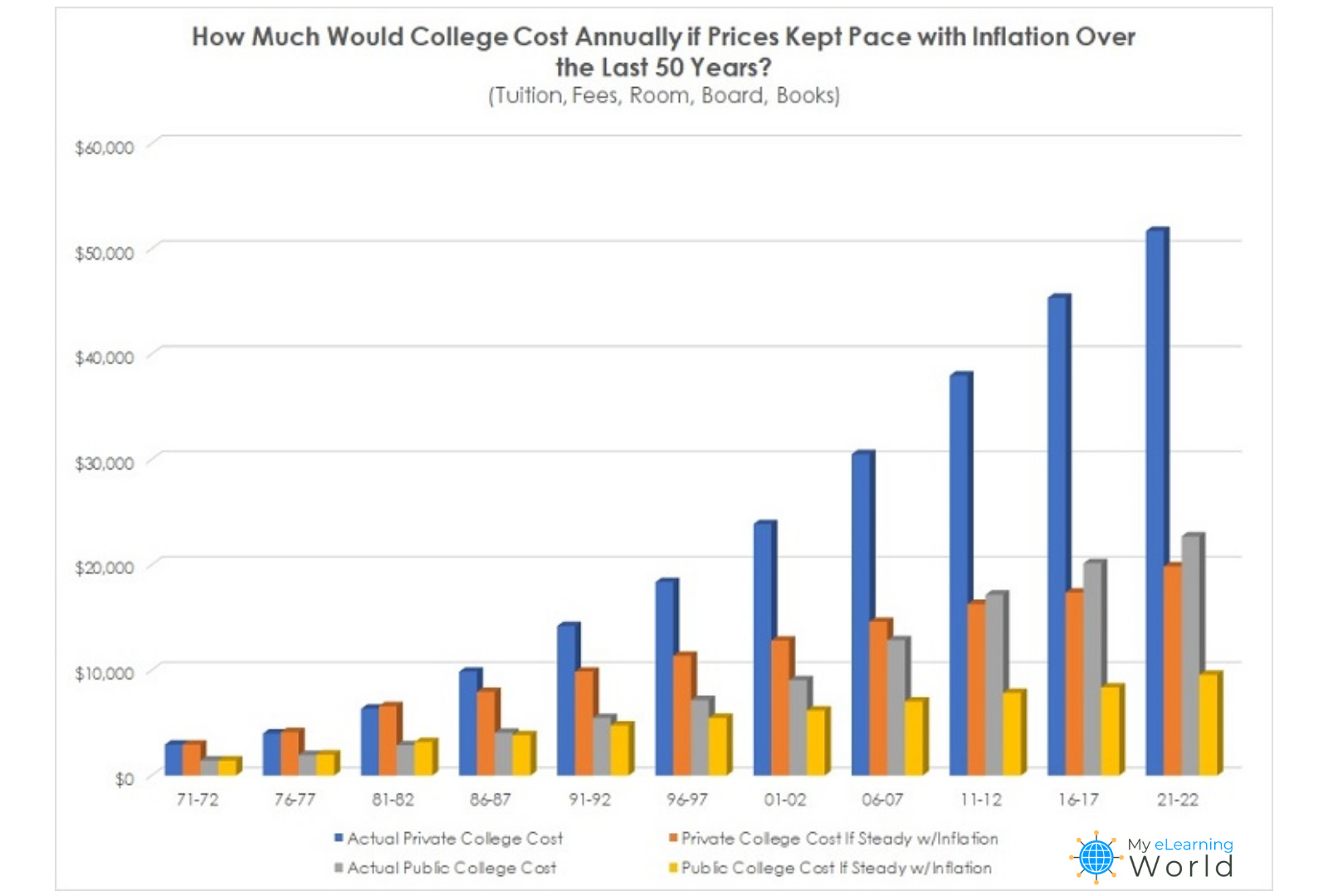
this happens in any market that gets access to leverage.
based on an emerging markets analysis i did years ago, when mortgages become available in a housing market for the first time, over the next 5-10 years the price of a home generally rises to about 4-5X what it was. what was the price of a home becomes the down payment for one as more and more money chases the same dwellings. we saw this all over the US in the 2002-8 period when mandated loans guaranteed by freddie and fannie came to dominate in the US and the age of the rampant liar loan emerged from the ill advised risk shifting colliding with mandates to lend to subprime borrowers at prime rates.
leverage and credit expansions drive explosive price level changes and student loans are no different. the more you offer them, the more people need them because the more the underlying price of tuition soars. colleges love this and it has led them down a primrose path of wild price expansions. when i graduated in the mid 90’s, my university was ~$22k a year. almost no one took out loans. it’s now $81k, WAY outside of middle class affordability. and now loans, grants, or scholarships are required for most people.
see how this 4-5X multiplier works? this program to “help people afford college” has made college unaffordable.
student loans outstanding have risen from $0.4tn in 2005 to $1.75tn today.
and the new student loan plan proposed by the department of ed is going to be worse. it will pretty much turn university pricing into a farce and require that EVERYONE get loans. it will, in fact, create a system where you’d basically have to be an idiot not to. and i fear this may be by design.
let’s look:
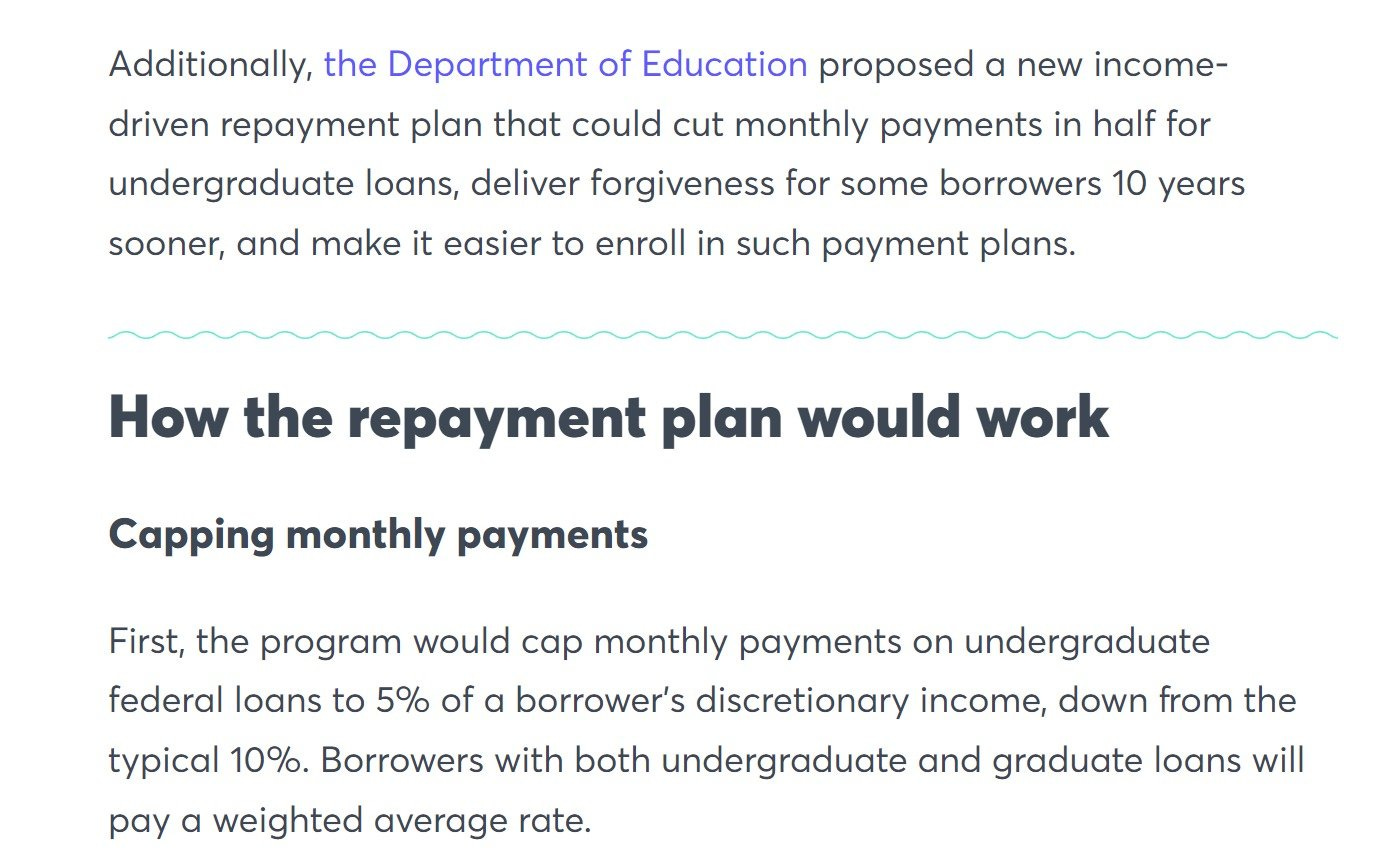
on the surface, this looks like it “helps affordability.” you’re cutting monthly payments, right? but this has not yet looked at what it will do to the price level and how that will affect everyone, especially those who did not previously want loans.
you’re basically doubling the effective leverage in the market. you can expect that to double prices over time. it’s like cutting interest rates in half AND giving out a 50% cut in principal amount on mortgages.
that’s financial dynamite.
i made this chart to demonstrate.

the blue line is the current 20 year cap on repayment set at 10% of discretionary income.
the red line is the new proposed line.
i then calculated the costs for 4 years of undergrad paid back monthly over 20 years using a 3% fixed interest rate (which is lower than current rates) as a total payback amount using the average cost estimates HERE for most schools and HERE for the ivy league. i used $20k as the DI deduction.
as can be readily seen, not many folks are paying back their full loans now but damn near no one would be paying back their full loans anymore under this new system.
this is what break even looks like under current and proposed systems. it’s the minimum amount of gross income you have to earn as an average over 20 years to make payments that will actually add up to what you borrowed.

these are some BIG percentile numbers.

under a 5% cap, you need to be 86th percentile to even pay back in state public college.
you need to be 97th percentile to pay back an average private college and 99th to pay back an ivy loan.
even with income growth over time, that’s just not going to happen for nearly everyone.
what you will get instead is trillions of dollars of write downs, maybe 10’s of trillions.
but what you will also get is explosive college price inflation because you’ve turned the whole thing into a buffet where once you pay, you might as well pig out on lobster.
let’s say you plan to go into a nice career with $100k in income. that’s 80k of DI, so your cap on loan payment is $4k per year X 20 years = $80k.
that means that all school costs over $80k are “free” to you. you do not need to care if college costs $20k a year or $100k a year. you will pay the same.
and what do you think THAT will do to your selection process? and what do you think that will do to the prices asked by universities, especially top ones for which competition is fierce?

creating a system where the customer does not care what the price of your good or service is because they do not pay it is a recipe for monstrous over-consumption. we see this all the time in healthcare. once you hit out of pocket max for a year, the buffet is open. go nuts.
this is not a way to allocate education efficiently. it’s a way to hand you uncle sam’s black amex and turn you loose in a miami beach lambo dealer. and trust me, lamborghini is not gonna cut you a sweetheart deal. they’re gonna sell you the anti-rust undercoating.
now think about grad school. yup. pile that one and start demanding a 5% rate there too.
and this problem just gets worse and worse as income drops. if you’re looking at a career that pays $50k you’re capped at a stunningly low $30k full payment over 20 years. that’s getting down into community college prices. you could NEVER justify spending $400k on education to get that job. well, not before. now you can. now you’re not facing the costs.
aventadors for everyone.

clearly, this is a deeply stupid plan. it will grossly misallocate educational investment, drive unaccountable overconsumption of a good that is almost certainly already over-consumed, and shift costs from those who get loans to those who did not. it will also blow prices into the stratosphere. supply of top schools does not really rise. more money chasing the same places can only end one way.
and this will create not only a situation where 98% of americans are priced out of college unless they take out loans (which will, of course, further increase prices) but will create an actual prisoner’s dilemma where you would be a fool not to take out loans because everyone else will and they are sure as sunrise gonna stick you with their bill so you better stick them with yours too. this is how a trillion in loan losses becomes $10 trillion and how every college kid in america gets fastened to the federal teat.
and that NEVER works out well.
leaving aside the investment misallocation and the financial calamity this will drop upon taxpayers (or savers if they just keep inflating it away) this has another really sinister feature: it places the state in total control of universities.
if you need to get loans to go to college and pretty much every loan comes from the government (or has their express backing) then they are now paying ALL the pipers.
guess who gets to call all the tunes?
this will make title IX and the tax break addictions look like mild suggestions of influence. this will make it total. once they get schools hooked, if the feds make them ineligible for these loans: it’s over.
this will be the defacto ceding of control to the state.
it will also form the basis of a social credit system. if we don’t like the things you say in high school or college: no loan for you. you’re out in the cold.
yeah, your parents too.
probably your siblings as well.
oh, and your friends of course. mustn’t follow dissidents on twitbook.
everybody around you better be good or no college for you.

if this sounds far fetched, it’s already happening in china. they are using exactly this sort of peer and family linked web of social credit. the social scores of your friends affect your own. it’s the kind of plan the WEF loves. and believe you me: it CAN happen here.
this is the thin end of a wedge that you’ll never get out.
control the systems of education, what they teach, and who gets access to them.
require and advance them as critical credentials for success in state and private jobs.
this is how you dominate a whole system. it’s the fascist/socialist/authoritarian playbook, chapter 1.
you’ll need to obey and compete to get access to the lending that you need to buy your future and leviathan will have a monopoly on funding you by deliberately mispricing a market and endlessly forgiving loans. pile on some ESG, DEI, and special loan jubilees for “people that take X kind of job” and now you’re shaping a whole society and workforce.
it’s not about efficient allocation or fairness.
it’s about buying dominance.
it’s also a nasty object lesson in leaving unchecked power lying around.
“just where in hell do they get the right to do this?” many have asked.
the answer, like so many other outrage origins of late finds its genesis in the realm of the patriot act and other such post 9/11 hysteria that abrogated so many rights “because crisis.”
this current action claims authority under the “heroes act” which was intended to to cover disruption from the attacks and wars that followed.
note how terrifyingly broad this is.
it’s a classic trojan framing for a popular cause that then gets re-used for other purposes later.

the patriot act and its little siblings like this one really drove a stake into the heart of the american republic. they basically tossed the idea of limited and enumerated powers out the window in “emergencies.”
and if you grant near unlimited authority during emergencies, well, you can then expect near unlimited emergencies, can’t you?
because some things never change.
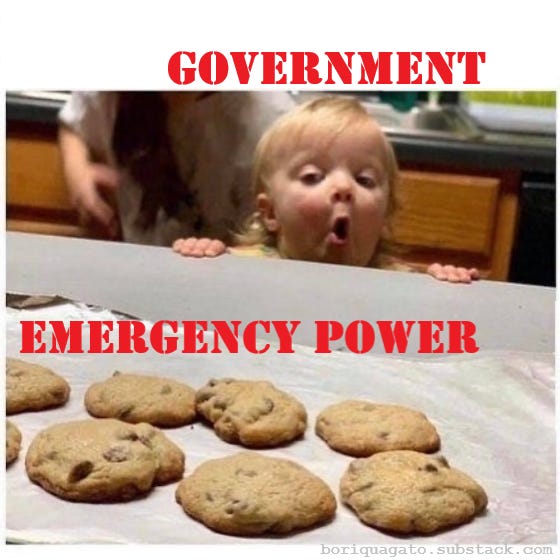
they just keep taking you mile after mile because you ceded the first inch and invited the vampire in.
and it’s going to keep grabbing.
i don’t know if these powers can be used to cut the income cap in half or if that takes actual legislation, but given the broadness of the power grant it sure seems like it could and the inclination to use executive fiat to push vast transformative agendas that cannot pass legislative muster certainly seems present.
we’ve spoken much here about eliminating the regulatory state, but the lending state is just as dangerous, perhaps more so. from farm loans to housing this has been a debacle. everything this firehose of cash has touched has boomed, bust, and wound up with 3 times the federal interference it had before. whole spaces are never the same.
- the federal government now backs well over 50% of us mortgages.
- the fed now owns $2.6 trillion of mortgage backed securities, roughly 1/3 of the total market. this is up from zero in 2009. see how fast that goes?
and see how vulnerable it makes any market under such thrall to domination by politicians and their pet peccadillos?
once the government needle goes in, it never comes out of these markets.
it creates desperate debt supplicants and serfs while breaking markets and misallocating investment and risk.
this is another activity from which we must remove the state. there should be no government lending. none. it almost never serves any useful purpose and winds up devastating those it sought to aid. it creates dependence and crowds out the development of systems that align incentives and generate sound choices by associating return to risk and demanding return on capital.
control of capital allocation and access to credit is control of a people.
this is not a friendly loan. it’s the worst kind of loan sharking, and the true vig is your agency and your liberty.

Marinus: The Russian Invasion of Ukraine
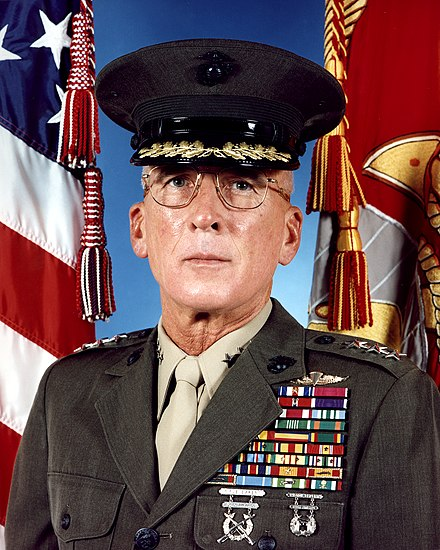
This article originally appeared in the Marine Corps Gazette August 2022 issue authored by an apparently frequent anonymous contributor (“Marinus”) to the Gazette, it has since raised quite a ruckus among the United States military community in various online debates.
This piece has been published in an ever-widening number of venues so we join the crowd
Unconfirmed speculation has it that “Marinus” is none other that USMC Lt. Gen. (ret) Paul K. Van Riper, a long-revered champion of many Marines, and a prominent proponent of the so-called “Maneuverists” – a school of military thought strongly influenced by the work of the incomparable military strategist John R. Boyd.
Van Riper was also the iconoclastic Red team commander for the infamous 2002 Millennium Challenge war games, during which his forces (patterned after Iranian capabilities of the time) sunk the entire US naval fleet in the Persian Gulf by employing methods and capabilities the war game planners failed to consider in their rigid calculations.
Whether Marinus is Van Riper, or a collaboration of Van Riper with his son (as some have conjectured, given that General Van Riper is now 84-years-old), or simply some other insightful former Marine officer is, in the final analysis, probably not all that important.
What is important is that his observations and perceptions of the ongoing conflict in Ukraine are lucid, enlightening, and unsullied by the rampant anti-Russian prejudice that has blinded most in the west to both the underlying causes and now the prosecution of the war in Ukraine.
If the anonymous author(s) or representatives of the Marine Corps Gazette desire to request that we remove this piece, contact us.
The Russian Invasion of Ukraine
Maneuverist Paper No. 22:
Part II: The mental and moral realms
by Marinus
When considered as purely physical phenomena, the operations conducted by Russian ground forces in Ukraine in 2022 present a puzzling picture. In the north of Ukraine, Russian battalion tactical groups overran a great deal of territory but made no attempts to convert temporary occupation into permanent possession. Indeed, after spending five weeks in that region, they left as rapidly as they had arrived. In the south, the similarly rapid entry of Russian ground forces led to the establishment of Russian garrisons and the planting of Russian political, economic, and cultural institutions. In the third theater of the war, rapid movements of the type that characterized Russian operations on the northern and southern fronts rarely occurred. Instead, Russian formations in eastern Ukraine conducted artillery-intensive assaults to capture relatively small pieces of ground.
One way to shed a little light upon this conundrum is to treat Russian operations on each of the three major fronts of the war as a distinct campaign. Further illumination is provided by the realization that each of these campaigns followed a model that had been part of the Russian operational repertoire for a very long time. Such a scheme, however, fails to explain why the Russian leadership applied particular models to particular sets of operations. Resolving that question requires an examination of the mental and moral purposes served by each of these three campaigns.
Raids in the North
American Marines have long used the term “raid” to describe an enterprise in which a small force moves swiftly to a particular location, completes a discrete mission, and withdraws as quickly as it can. [1] To Russian soldiers, however, the linguistic cousin of that word (reyd) carries a somewhat different meaning. Where the travel performed by the team conducting a raid is nothing more than a means of reaching particular points on the map, the movement of the frequently larger forces conducting a reyd creates significant operational effects. That is, in the course of moving along various highways and byways, they confuse enemy commanders, disrupt enemy logistics, and deprive enemy governments of the legitimacy that comes from uncontested control of their own territory. Similarly, where each phase of a present-day American raid necessarily follows a detailed script, a reyd is a more open-ended enterprise that can be adjusted to exploit new opportunities, avoid new dangers, or serve new purposes.
The term reyd found its way into the Russian military lexicon in the late 19th century by theorists who noted the similarities between the independent cavalry operations of the American Civil War and the already well-established Russian practice of sending mobile columns, often composed of Cossacks, on extended excursions through enemy territory. [2] An early example of such excursions is provided by the exploits of the column led by Alexander Chernyshev during the Napoleonic Wars. In September of 1813, this force of some 2,300 horsemen and two light field guns made a 400-mile circuit through enemy territory. At the middle point of this bold enterprise, this column occupied, for two days, the city of Kassel, then serving as the capital of one of the satellite states of the French Empire. Fear of a repetition of this embarrassment convinced Napoleon to detail two army corps to garrison Dresden, then the seat of government of another one of his dependencies. [3] As a result, when Napoleon encountered the combined forces of his enemies at the Battle of Leipzig, his already outnumbered Grande Armée was much smaller than it would otherwise have been.
In 2022, the many battalion tactical groups that moved deeply into northern Ukraine during the first few days of the Russian invasion made no attempt to re-enact the occupation of Leipzig. Rather, they bypassed all of the larger cities in their path and, on the rare occasions when they found themselves in a smaller city, occupation rarely lasted for more than a few hours. Nonetheless, the fast-moving Russian columns created, on a much a larger scale, an effect similar to the one that resulted from Chernyshev’s raid of 1813. That is, they convinced the Ukrainians to weaken their main field army, then fighting in the Donbass region, to bolster the defenses of distant cities.
Rapid Occupation in the South
In terms of speed and distance traveled, Russian operations in the area between the southern seacoast of Ukraine and the Dnipro River resembled the raids conducted in the north. They differed, however, in the handling of cities. Where Russian columns on either side of Kyiv avoided large urban areas whenever they could, their counterparts in the south took permanent possession of comparable cities. In some instances, such as the ship-to-objective maneuver that began in the Sea of Azov and ended in Melitopol, the conquest of cities took place during the first few days of the Russian invasion. In others, such as the town of Skadovsk, the Russians waited several weeks before seizing areas and engaging local defense forces they had ignored during their initial advance.
In the immediate aftermath of their arrival, the Russian commanders who took charge of urban areas in the south followed the same policy as their counterparts in the north. That is, they allowed the local representatives of the Ukrainian state to perform their duties and, in many instances, to continue to fly the flag of their country on public buildings. [4] It was not long, however, before Russian civil servants took control of the local government, replaced the flags on buildings, and set in motion the replacement of Ukrainian institutions, whether banks or cell phone companies, with Russian ones. [5]
Like the model of the reyd, the paradigm of campaigns that combined rapid military occupation with thoroughgoing political transformation, had been part of the Russian military culture for quite some time. Thus, when explaining the concept for operations on the southern front, Russian commanders were able to point to any one of a number of similar enterprises conducted by the Soviet state in the four decades that followed Soviet occupation of eastern Poland in 1939. (These included the conquest of the countries of Estonia, Latvia, and Lithuania in 1940; the suppression of reformist governments in Hungary and Czechoslovakia during the Cold War, and the invasion of Afghanistan in 1979.) [6]
While some Russian formations in the south consolidated control over conquered territory, others conducted raids in the vicinity of the city of Mykolaiv. Like their larger counter-parts on the northern front, these encouraged the Ukrainian leadership to devote to the defense of cities forces that might otherwise have been used in the fight for the Donbass region. (In this instance, the cities in question included the ports of Mykolaiv and Odessa.) At the same time, the raids in the northern portion of the southern front created a broad “no man’s land” between areas that had been occupied by Russian forces and those entirely under the control of the Ukrainian government.
Stalingrad in the East
Russian operations in the north and south of Ukraine made very little use of field artillery. This was partially a matter of logistics. (Whether raiding in the north or rapidly occupying in the south, the Russian columns lacked the means to bring up large numbers of shells and rockets.) The absence of cannonades in those campaigns, however, had more to do with ends than means. In the north, Russian reluctance to conduct bombardments stemmed from a desire to avoid antagonizing the local people, nearly all of whom, for reasons of language and ethnicity, tended to support the Ukrainian state. In the south, the Russian policy of avoiding the use of field artillery served a similarly political purpose of preserving the lives and property of communities in which many people identified as “Russian” and many more spoke Russian as their native language.
In the east, however, the Russians conducted bombardments that, in terms of both duration and intensity, rivaled those of the great artillery contests of the world wars of the twentieth century. Made possible by short, secure, and extraordinarily redundant supply lines, these bombardments served three purposes. First, they confined Ukrainian troops into their fortifications, depriving them of the ability to do anything other than remain in place. Second, they inflicted a large number of casualties, whether physical or caused by the psychological effects of imprisonment, impotence, and proximity to large numbers of earth-shaking explosions. Third, when conducted for a sufficient period of time, which was often measured in weeks, the bombardment of a given fortification invariably resulted in either the withdrawal of its defenders or their surrender.
We can glean some sense of the scale of the Russian bombardments in the east of Ukraine by comparing the struggle for the town of Popasna (18 March – 7 May 2022) with the battle of Iwo Jima (19 February – 26 March 1945.) At Iwo Jima, American Marines fought for five weeks to annihilate the defenders of eight square miles of skillfully fortified ground. At Popasna, Russian gunners bombarded trench systems built into the ridges and ravines of a comparable area for eight weeks before the Ukrainian leadership decided to withdraw its forces from the town.
The capture of real estate by artillery, in turn, contributed to the creation of the encirclements that Russians call “cauldrons” (kotly). Like so much in Russian military theory, this concept builds upon an idea borrowed from the German tradition of maneuver warfare: the “battle cauldron” (Schlachtkessel). However, where the Germans sought to create and exploit their cauldrons as quickly as possible, Russian cauldrons could be either rapid and surprising or slow and seemingly inevitable. Indeed, the successful Soviet offensives of the Second World War, such as the one that resulted in the destruction of the German Sixth Army at Stalingrad, made extensive use of cauldrons of both types.
Freedom from the desire to create cauldrons as quickly as possible relieved the Russians fighting in eastern Ukraine from the need to hold any particular piece of ground. Thus, when faced with a determined Ukrainian attack, the Russians often withdrew their tank and infantry units from the contested terrain. In this way, they both reduced danger to their own troops and created situations, however brief, in which the Ukrainian attackers faced Russian shells and rockets without the benefit of shelter. To put things another way, the Russians viewed such “encore bombardments” not merely as an acceptable use of ordnance but also as opportunities to inflict additional casualties while engaging in “conspicuous consumption” of artillery ammunition.
In the spring of 1917, German forces on the Western Front used comparable tactics to create situations in which French troops advancing down the rear slopes of recently captured ridges were caught in the open by the fire of field artillery and machine guns. The effect of this experience on French morale was such that infantrymen in fifty French divisions engaged in acts of “collective indiscipline,” the motto for which was, “we will hold, but we refuse to attack.” [7] (In May of 2022, several videos appeared on the internet in which people claiming to be Ukrainian soldiers fighting in the Donbass region explained that, while they were willing to defend their positions, they had resolved to disobey any orders that called for them to advance.)
Resolving the Paradox
In the early days of the maneuver warfare debate, maneuverists often presented their preferred philosophy as the logical opposite of “firepower/attrition warfare.” Indeed, as late as 2013, the anonymous authors of the “Attritionist Letters” used this dichotomy as a framework for their critique of practices at odds with the spirit of maneuver warfare. In the Russian campaigns in Ukraine, however, a set of operations made mostly of movement complemented one composed chiefly of cannonades.
One way to resolve this apparent paradox is to characterize the raids of the first five weeks of the war as a grand deception that, while working little in the way of direct destruction, made possible the subsequent attrition of the Ukrainian armed forces. In particular, the threat posed by the raids delayed the movement of Ukrainian forces in the main theater of the war until the Russians had deployed the artillery units, secured the transporting network, and accumulated the stocks of ammunition needed to conduct a long series of big bombardments. This delay also ensured that, when the Ukrainians did deploy additional formations to the Donbass region, the movement of such forces, and the supplies needed to sustain them, had been rendered much more difficult by the ruin wrought upon the Ukrainian rail network by long-range guided missiles. In other words, the Russians conducted a brief campaign of maneuver in the north in order to set the stage for a longer, and, ultimately, more important campaign of attrition in the east.
The stark contrast between the types of warfare waged by Russian forces in different parts of Ukraine reinforced the message at the heart of Russian information operations. From the start, Russian propaganda insisted that the “special military operation” in Ukraine served three purposes: the protection of the two pro-Russian proto-states, “demilitarization,” and “denazification.” All three of these goals required the infliction of heavy losses upon Ukrainian formations fighting in the Donbass. None, however, depended upon the occupation of parts of Ukraine where the vast majority of people spoke the Ukrainian language, embraced a Ukrainian ethnic identity, and supported the Ukrainian state. Indeed, the sustained occupation of such places by Russian forces would have supported the proposition that Russia was trying to conquer all of Ukraine.
The Russian campaign in the south served direct political aims. That is, it served to incorporate territories inhabited by a large number of ethnic Russians into the “Russian World.” At the same time, the rapid occupation of cities like Kherson and Melitopol enhanced the deceptive power of operations conducted in the north by suggesting the possibility that the columns on either side of Kyiv might attempt to do the same to cities like Chernihiv and Zhytomyr. Similarly, the raids conducted north of Kherson raised the possibility that the Russians might attempt the occupation of additional cities, the most important of which was Odessa. [8]
Guided Missiles
The Russian program of guided missile strikes, conducted in parallel to the three ground campaigns, created a number of moral effects favorable to the Russian war effort. The most important of these resulted from the avoidance of collateral damage that resulted, not only from the extraordinary precision of the weapons used, but also from the judicious choice of targets. Thus, Russia’s enemies found it hard to characterize strikes against fuel and ammunition depots, which were necessarily located at some distance from places where civilians lived and worked, as anything other than attacks on military installations.
Likewise, the Russian effort to disrupt traffic on the Ukrainian rail system could have included attacks against the power generating stations that provide electricity to both civilian communities and trains. Such attacks, however, would have resulted in much loss of life among the people working in those plants as well as a great deal of suffering in places deprived of power. Instead, the Russians chose to direct their missiles at traction substations, the remotely located transformers that converted electricity from the general grid into forms used to move trains. [9]
There were times, however, when missile strikes against “dual use” facilities gave the impression that the Russians had, in fact, targeted purely civilian facilities. The most egregious example of such a mistake was the attack, carried out on 1 March 2022, upon the main television tower in Kyiv. Whether or not there was any truth in the Russian claim that the tower had been used for military purposes, the attack on an iconic structure that had long been associated with a purely civilian purpose did much to reduce the advantages achieved by the overall Russian policy of limiting missile strikes to obvious military targets.
The Challenge
The three ground campaigns conducted by the Russians in Ukraine in 2022 owed much to traditional models. At the same time, the program of missile strikes exploited a capability that was nothing short of revolutionary. Whether new or old, however, these component efforts were conducted in a way that demonstrated profound appreciation of all three realms in which wars are waged. That is, the Russians rarely forgot that, in addition to being a physical struggle, war is both a mental contest and a moral argument.
The Russian invasion of Ukraine may mark the start of a new cold war, a “long twilight struggle” comparable to the one that ended with the collapse of the Soviet Empire more than three decades ago. If that is the case, then we will face an adversary who, while drawing much of value from the Soviet military tradition, has been liberated from both the brutality inherent in the legacy of Lenin and the blinders imposed by Marxism. What would be even worse, we may find ourselves fighting disciples of John R. Boyd.
Notes
[1] Headquarters Marine Corps, MCWP 3-43.1, Raid Operations (Washington, DC: 1993).
[2] For the adoption of the concept of the “raid” by the Russian Army of the late nineteenth century, see Karl Kraft von Hohenlobe-Ingelfingem (Neville Lloyd Walford, translator), Letters on Cavalry, (London: E. Stanford, 1893); and Frederick Chenevix Trench, Cavalry in Modern Wars, (London: Keegan, Paul, Trench, and Company, 1884).
[3] For a brief account of the reyd, which was led by Alexander Chernyshev, see Michael Adams, Napoleon and Russia, (London: Bloomsbury, 2006).
[4] John Reed and Polina Ivanova, “Residents of Ukraine’s Fallen Cities Regroup under Russian Occupation,” The Financial Times, (March 2022), available at https://www.ft.com.
[5] David M. Glantz, “Excerpts on Soviet 1938-40 Operations from The History of Warfare, Military Art, and Military Science, a 1977 Textbook of the Military Academy of the General Staff of the USSR Armed Forces,” The Journal of Slavic Military Studies, (Milton Park: Routledge, March 1993).
[6] The classic work on the French mutinies of 1917 is Richard M. Watt, Dare Call It Treason, (New York, NY: Simon and Schuster, 1963).
[7] Michael Schwirtz, “Anxiety Grows in Odessa as Russians Advance in Southern Ukraine,” The New York Times, (March 2022), available at https://www.nytimes.com.
[8] Staff, “Russia Bombs Five Railway Stations in Central and Western Ukraine,” The Guardian, (April 2022), available at https://www.the-guardian.com.
[9] For an example of the many stories that characterized the 1 March 2022 television tower strike as an attack on civilian infrastructure, see Abraham Mashie, ”US Air Force Discusses Tactics with Ukrainian Air Force as Russian Advance Stalls,” Air Force Magazine, (March 2022), available at https://www.airforcemag.com.
Nikolayev Offensive
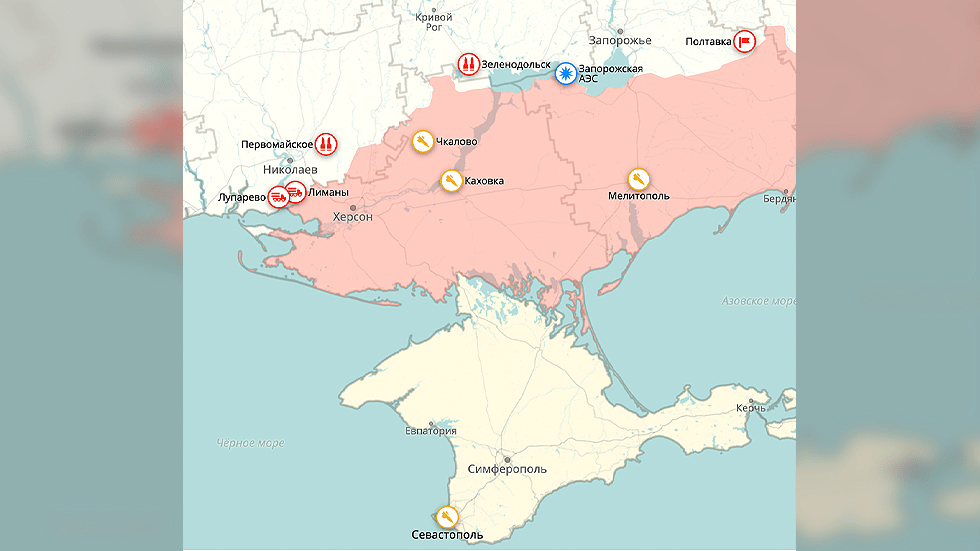
Russian coalition forces are expanding the Nikolayev offensive taking 36 square kilometers of territory under control, the Russian Defense Ministry said on Tuesday.
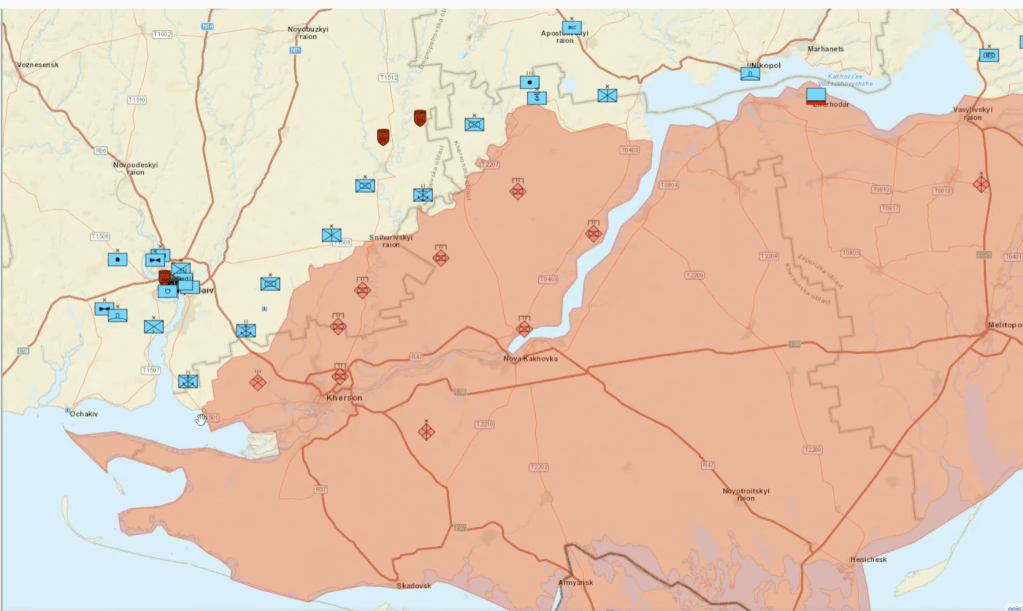
“Coalition troops destroyed units of the Ukrainian army’s 28th Mechanized Brigade on the Kherson-Nikolayev axis and reached the administrative border of the Nikolayev region, ” the Ministry said. “Thirty-six square kilometers of the Kherson region’s territory have been taken under control.”
The Russian Ministry of Defense reports the liberation of the Komsomolskoye settlement and 3-kilometer advance into enemy defense lines.
“On top of that, the Ukrainian army’s 35th Marine Brigade and 46th Air Mobile Brigade suffered considerable losses in the Avdeyevka area. The enemy was dislodged from Blagodatovka and nearby settlements, ” it added.
Gavrilo Princip 2.0?
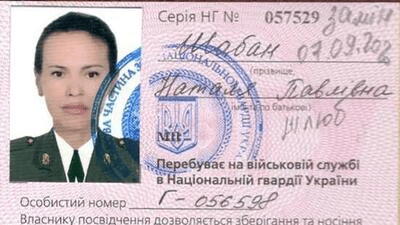
Evidently, this alleged assasin is a member of the fascist Azov Regiment. More on that below.
But first, here’s ZeroHedge: ZeroHedge: https://www.zerohedge.com/geopolitical/russian-fsb-identifies-alleged-dugina-assassin
Russian FSB Identifies Alleged Dugina Assassin
At the turn of the 20th century the delicate fabric of social order in Europe rested on a knife’s edge. As imperial powers expanded their empires, it was only a matter of time before conflict between them would shatter peace in Europe. In that era, Russia found itself against Europe’s most powerful empires, namely Austria-Hungary and Germany.
The fissure between those empires was cemented by the Bosnian Crisis of 1908 which saw Austria-Hungary annex Bosnia and Herzegovina by using Bulgaria’s declaration of independence from the Ottoman Empire as an advantageous political catalyst given its destabilization of the Balkan region. Austria-Hungary’s actions would provoke Russia to rise to the defense of its Slavic brethren situated in Serbia and Montenegro in a response that would forever alter how Russia would align itself among the continental powers of Europe. While a widespread conflict was averted by the amending the Treaty of Berlin, the political climate the Bosnian Crisis cast would light the fuse for the inevitable outbreak of WWI which was detonated with the assassination of Archduke Franz Ferdinand by Bosnian-Serb nationalist Gavrilo Princip.
As the war in Ukraine places Russia at familiar odds with the powers of Europe yet again, the precarious position of ostensibly unsustainable peace across the continent echoes on longer than a century following the First World War. The tension illustrates the axiom that nothing is new under the sun as the volatility of Europe in 2022 mirrors that in 1908. Russia’s position against the European hegemony vested in NATO is analogous to its stance in support of the Slavic realm longer than a century ago. Now, following the assassination of Darya Dugina, this century may have found its own Franz Ferdinand.
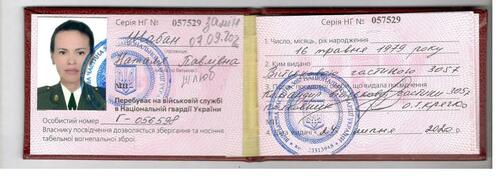
The Russian Federal Security Service (“FSB”) has claimed that the assassination of Dugina was committed by a covert operative of Ukraine. The FSB has identified Natalia Vovk as the alleged assassin. “As a result of a complex of urgent operational-search measures, the Federal Security Service has solved the murder of Russian journalist Darya Dugina, born in 1992,” the FSB announced, going on to emphasize the culpibility of the Ukrainian government by stating that “the crime was prepared and committed by the Ukrainian special services[.]”
According to the FSB’s investigation, Vovk entered Russia in July before situating herself in the same apartment building that Dugina resided in. Vovk would then follow Dugina to the festival in which the explosive device that led to her death was planted. Vovk, who was accompanied by her 12-year old daughter, fled to Estonia following the assassination, according to Russian intelligence. Following her identification, Russian law enforcement agencies declared their intent to seek her extradition.
Following Dugina’s assassination, Ukraine was naturally implicated as being behind the murder given her father’s significant, albeit enigmatic, reputation as one of Vladimir Putin’s most influential ideologues. Kiev urgently washed its hands of any involvement as advisor Mykhailo Podolyak stated “Ukraine, of course, has nothing to do with yesterday’s explosion[.]” Although Ukrainian officials denied any involvement in the attack, President Volodymyr Zelensky warned of his anticipation that Dugina’s murder would inextricably result in the intensification Russia’s military campaign.
Given the reports of Vovk’s escape to Estonia, the location of the alleged assassin places Russia in a conflict against a NATO member state even more directly than the proxy war in Ukraine has. In 2016, the European Court of Justice set precedent which would justify any extradition request for Vovk by Russia. The case law that set that standard occurred when the court found that any member state of the European Union is obligated to accommodate an extradition request of any third-party non-member state even if the subject of the request is not a citizen of the EU nation itself. This decision followed a case in which Russia requested to have Estonian national Aleksei Petruhhin extradited from Latvia for drug trafficking offenses.
The legal framework set by the European Court of Justice will place Estonia in a crucible if Vovk has indeed found safe haven in the Baltic state. In addition to joining the EU in 2004, Estonia joined NATO that same year. The potential conflict arising between Estonia and the Russian Federation has the potential to trigger Article 5 of the NATO Charter which puts forth a collective defense clause meaning that any military engagement with a NATO member state constitutes action taken against the entire trans-Atlantic body whether it occurs as far east as Tallinn or as far west as Hawai’i.
Article 5 has been constantly dangled before Russia as a Sword of Damicles of sorts designed to dissuade any escalation of the Ukrainian conflict. The veiled threat was most recently invoked in response to Russian attack on Zaporizhzhia Nuclear Power Plant and increased military incursions by Ukrainian military forces into Crimea. “Any deliberate damage causing potential radiation leak to a Ukrainian nuclear reactor would be a breach of NATO’s Article 5,” said UK MP Tobias Ellwood. His sentiments were echoed by US Congressman Adam Kinzinger (R – IL) who followed Ellwood’s declaration by stating “This really isn’t even up for debate; any leak will kill people in NATO countries, that’s an automatic article 5[.]” just hours before Dugina’s assassination.
While Article 5 of the NATO Charter has been used to threaten Russia from intensifying any aggression, the officials who have constantly cited the collective defense policy have done so under the pretense of preventing any further aggression. The assassination of Darya Dugina is a drastically different circumstance as Russia will surely perceive any potential action it takes to have Vovk extradited from Estonia as entirely justified and as a response to the murder, not an offensive attack against a NATO member state. As the manhunt for Vovk ensures, Europe again finds itself in the political crucible that enveloped the continent following Gravrilo Princip’s assassination of Archduke Franz Ferdinand. However, in this historical iteration, it is the European central powers who find themselves in a position of being the aggressor that could provoke a catastrophic conflict with Russia.
Here’s Sputnik: https://sputniknews.com/20220822/russias-fsb-ukrainian-special-services-behind-murder-of-daria-dugina-1099854294.html

The 29-year-old journalist and daughter of famed Russian political philosopher Alexander Dugin was killed instantly Saturday night on a highway outside Moscow after a powerful car bomb attached to the SUV she was driving detonated.
Ukraine’s special services are behind the murder of Daria Dugina, and the perpetrator of the crime is Natalya Vovk, a Ukrainian national, the Federal Security Service (Russian acronym FSB) has concluded.
“It has been established that the crime was prepared and committed by the Ukrainian special services. The perpetrator is Natalya Pavlovna Vovk, a citizen of Ukraine born in 1979, who arrived in Russia on July 23, 2022 together with her daughter…,” the domestic security agency said in a statement Monday.
Vovk was said to have rented an apartment in the same building where Dugina lived to obtain information about her lifestyle. The perpetrator was said to have driven a Mini Cooper, with the vehicle entering Russia with Donetsk People’s Republic plates, using Republic of Kazakhstan plates while in Moscow, and Ukrainian plates when leaving the country through Pskov region into Estonia.
“On the day of the murder, Vovk and [her 12-year-old daughter] attended the ‘Tradition’ literary and music festival, where Dugina was present as an honored guest,” the FSB said. “After carrying out the controlled explosion of the Toyota Land Cruiser Prado which Dugina was driving, Vovk and her daughter left [Russia] through Pskov region into Estonia,” the agency indicated.
The security service said it has transferred its information to the Investigative Committee.
The FSB later released footage of Vovk during her time in Russia, including footage from border guard body cameras of the suspected assassin crossing into and out of Russia, and footage from door cams entering the residence where Dugina resided.
Dugina, 29, died instantly in an car bombing west of Moscow on Saturday night. According to investigators, the vehicle belonged to her father, 60-year-old Russian philosopher, journalist, and radical geostrategist Alexander Dugin. Dugina was Dugin’s only daughter.
Donetsk People’s Republic head Denis Pushilin accused Kiev of involvement in the assassination almost immediately after the bombing took place. On Sunday, Russian Foreign Ministry spokeswoman Maria Zakharova said that if suspicions of Ukrainian involvement in the attack were corroborated, it would point to Kiev’s policy of “state terrorism.” Kiev has denied any involvement.
Western media have nearly unanimously reported on Dugina’s murder in the context of her father’s supposed connections to Vladimir Putin, calling the philosopher the Russian president’s “closest aide,” “ally” or even his “brain.” In reality, although Dugin is a leading Russian conservative intellectual and proponent of Eurasianism – a highly eclectic ideology consisting of nationalism, mysticism, Orthodoxy, socialism and anti-modernist views, his connections to or influence on Putin are dubious at best, and there is no evidence that the two have ever even met.
Also on Monday, Russian tycoon Konstantin Malofeev posted a message which he said was from Dugin on Telegram. “[My daughter] was a beautiful Orthodox girl, a patriot, a military correspondent, an expert on the central television channels, a philosopher. Her speeches and reports were always profound, grounded and restrained. She never called for violence or war,” the message said.
“She was a rising star at the beginning of her journey. The enemies of Russia killed her in a scummy, underhanded way. But we, our people cannot be broken even by such unbearable blows. They wanted to crush our will with bloody terror against the best and most vulnerable among us. But they won’t succeed,” the message added.
Dugin wrote that “revenge or retribution” would be “too petty, not in the Russian way,” and that “we need only our victory. My daughter has laid her life on its alter. So win, please!”
The Kremlin’s Telegram channel expressed the Russian president’s condolences to Dugina’s family, calling her killing a “vile and cruel crime,” and characterizing her as a true patriot.
***********************************
Next up – RT’s take on the assassin including a doxing report connecting her to Azov: https://www.rt.com/russia/561318-dugina-suspect-vovk-video/
Footage shows the Ukrainian citizen entering the country and leaving it after allegedly assassinating Darya Dugina

FSB video shows the suspect behind Moscow car bombing, Natalya Vovk, entering the house where the attack’s victim, Darya Dugina, lived © RT
Russia’s Federal Security Service (FSB) has made public a video of Ukrainian national Natalya Vovk, identified as the prime suspect in Saturday’s car bombing that killed journalist Darya Dugina in Moscow. The footage published Monday shows Vovk and her teenage daughter entering Russia, inside the building where Dugina lived, and leaving the country in haste.
Vovk, 43, was named by the FSB on Monday as the prime suspect in the assassination of Dugina. The Ukrainian national arrived in Russia on July 23, using Donetsk People’s Republic license plates to avoid scrutiny. While in Moscow, she swapped the plates on her Mini Cooper to those of Kazakhstan, a friendly former Soviet republic. On Sunday, after the bombing, Vovk drove to Estonia with Ukrainian plates, the FSB said.
Photos of the different license plates were included as part of the video presentation.
The authorities also said Vovk may have used her teenage daughter as cover to move around Russia more easily. She rented an apartment in the same building where Dugina lived, and was captured on the doorway camera.
A photo ID of Vovk in the uniform of Ukraine’s National Guard was published in April on the Russian internet, as part of a dox of neo-Nazi Azov regiment members. It lists her surname as Shaban – the surname her daughter used when entering Russia, according to the FSB. Ukraine previously claimed it was not involved in the assassination.
READ MORE: Russia blames Ukraine for deadly Moscow blast
Dugina, 29, was killed on Saturday evening after attending a conservative family festival near Moscow with her father, philosopher Aleksandr Dugin. Vovk allegedly planted an improvised explosive device under the Toyota SUV that belonged to Dugin, who may have been her intended target.
Ukrainian Positions on Donetz Front Breached
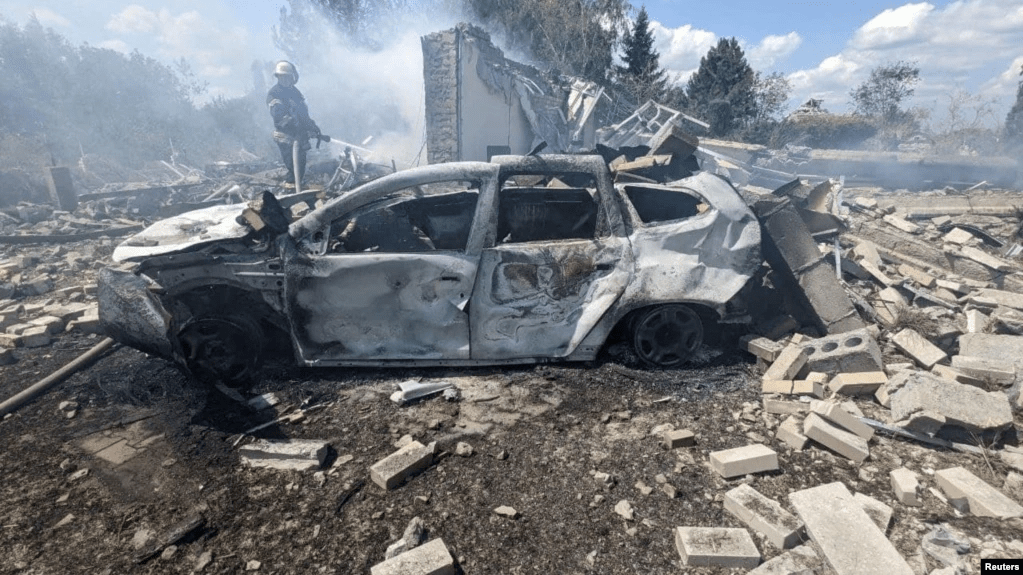
In an address entering the weekend,
Zelenskiy also said that the hundreds of thousands of people still in combat zones in the larger Donbas region needed to leave.
“The more people leave Donetsk region now, the fewer people the Russian Army will have time to kill,” he said, adding that residents would be given compensation.
Within the past twenty-four hours, Ukrainian positions have been breached and in the process being enveloped in the vicinity of the Pisky “meat grinder.
Here is Moon of Alabama: https://www.moonofalabama.org/2022/08/ukraine-sitrep-on-the-ground-report-ukrainian-frontline-collapses.html#more
Ukraine SitRep – On The Ground Report – Ukrainian Frontline Collapses
Below is a slightly edited machine translation of a piece which appeared yesterday on the Ukrainian side censor.net. The piece was promoted by Yuri Butusov, a well known Ukrainian military correspondent. It is originally a social media post by someone who was on the frontline in Pisky, immediately northwest of Donetsk city.
Context:
Over the last two to three months the Ukrainian side has used its positions in the vicinity of Donetsk city to more or less randomly shell the civilian population on the Russian affiliated side. After some serious protests the Russian military command agreed to launch a dedicated counter-artillery operation to shut down the deadly Ukrainian harassment.
Its daily ‘clobber reports’, here is yesterday’s, have since included lines like these on nearly each and every day:
As part of counter-battery warfare 2 artillery batteries of Giatsint howitzers near Dzerzhinsk and Novhorodskoye, Donetsk People’s Republic have been hit.
4 platoons of Grad MLRS and 9 artillery platoons at firing positions near Seversk, Kirovo, Artemovsk, Avdeevka, Peski, Orlovka, Shakhterskoye, Velikaya Novoselka in Donetsk People’s Republic, Dobropolie in Zaporozhye Region, Shirokoye, Bereznevatoye in Nikolaev Region, Russkaya Lozovaya and Nortsovka in Kharkov Region.
The systematic counter-artillery campaign has seriously deteriorated the already rare Ukrainian fire power.
The Russian side has also changed the primary direction of its thrust from the northern front of the Sievierdonetsk-Lysichansk-Siversk direction to a push further south. The current offensive operation is concentrated north-west and west of Donetsk city in the direction of Avdivka. There is an envelope operation going on its north and south to surround that extremely heavily fortified town.
The red territory to the left of the red line marks parts of recent progress.

Source: Live UA map – bigger
Pisky is the southern part of that envelope operation.

Following intense artillery preparations Russian forces are currently – slowly, slowly – clearing the lines of reinforced concrete bunkers and ditches that have been build on the Ukrainian side over the last 8 years. Here now is the view of that battle from the Ukrainian side (edited machine translation, for an alternative translation see this.) (Note: 300 is the military cargo designator for wounded people, 200 is for dead soldiers):
Pisky. Meat grinder
Author: Serhiy Gnezdilov
What is there to lose, what else can be taken from me on the sixth day of my personal hell, in Pisky, a kilometer from the first street of Donetsk, Ukraine? The bodies of those who were dearer to me than my family are lying under the heat in the trenches, broken by 152 caliber. As I wrote earlier, 6,500 shells per damn village in less than a day.
It’s been six such days already, and I can’t imagine how even a small number of our infantry survived in this barrage of enemy fire.
No, I’m not whining.
Two mortars 82 and 120 are working on our side.
Sometimes they wake up and “sneeze” two artillery barrels in the direction of Donetsk.
We hardly respond. There is no counter-battery fire, from the word go, the enemy puts artillery shells in our trenches without any problems, dismantles very strong, concrete positions in tens of minutes, pushing our defense line without pause or minimal rest.
The day before yesterday, the line broke, and a river of 200 or 300 [killed/wounded] was poured. I will not publish any statistics, it is forbidden in our country, but you have no idea the number and percentage of losses.
This is a hell of a meat grinder, where the battalion simply holds back the onslaught with their bodies.
For almost a week, we have been waiting for at least some kind of help that would hit the enemy’s artillery, we, I repeat, are being fired with impunity with everything that the Russian military system is rich in, their aviation was working today.
I am proud of the leadership of the battalion that remained here with us. The combatant is with us, everyone is with us, contused, light 300, bandaged and returned after a couple of hours to the position, if you can call these bottomless ravines that way.
There is a war going on.
But without a counter-battery fight, it turns into a senseless meat grinder, where an insane amount of our infantry is ground up in a day.
Did you really want the truth? Here it is, the naked truth.
The reserve goes to the position, closes the breakthrough, and after five minutes, only one of the 15 people remains intact.
The bodies lie on the ground. If it’s a light 300, maybe you’ll be lucky, you’ll faint, and you’ll get out on foot, you’ll reach the medics.
They just took a 300 [wounded]. He shouted all the way: – “Where is the support? Where is the artillery? Why were we abandoned? Why didn’t anyone cover us?”
I don’t know, my friend, why no one covered us… He screams, and I’m ashamed that I’m still safe and sound, only a couple of good deafening.
I threw up, I pissed myself, I’m sorry, and I’m back in action.
All reserves are destroyed, military equipment is on fire, the enemy approaches and without any problems occupies our positions after another barrage of artillery.
Right now we are losing Pisky, all our human and material resources are almost exhausted.
Denys, a resident of Mariupol, who told me “well, I trust the arrestee [Zelenski advisor Arestovich], we will return everything back very soon” is dead. He was wounded twice, they bandaged him right in the trench, they told him, Denchyk, go to the evacuation, but he answered “guys, I will not abandon you.”
Both wounded for the first time, and after the second wounding, he continued to shoot back.
We still haven’t taken his body. On the ruins of Pisky, he lies with his arms outstretched and his gaze frozen. He asks for revenge. How can I refuse his latest request? How can we all leave Dan?
I believe that Dimka survived after all. Because he could not die, having recently returned from the hospital, having just proposed to his girlfriend. They say that after one of the parishes he simply disappeared. It fell asleep with earth. But, I believe that this is a mistake, and he is alive. Foolish hope and expectation.
I know, my country does not like to think aloud. But, I was left with no choice between victory and arrest. The truth should be heard, not whispers in the kitchen. Of course, he will fly separately for this post, because how? Yes, does the state lie to its own citizens?
I won’t be surprised if someone says today: “Kremlin agent Sirozh talked about the brilliant plan of the victors on the Donetsk front, let’s hang him on the peacemaker.”
I amused to say that everything is under control. Now in Pisky, everything is not under anyone’s control, but for some reason the situation is being hushed up.
Ring broken bells while we cover Pisky with bodies.
We need artillery.
Give us something here to hold on to.
Now put yourself into the position of Serhiy Gnezdilov, Denys or Dimka. Then think about the politicians who sweet talk of heroic Ukrainian resistance and send these men to be slaughtered for no possible gain.
Sorry Serhiy, more artillery wont do it. The Russian side would just grind it up within days. How many of the 120 U.S. M-777 howitzers that were given to Ukraine still exist? Maybe 10 or so, most of them damaged?
There are other operations going on. North of the Donetsk front there is a thrust towards Bakhmut (also known as Artomovsk). Yesterday Soledar, north of Bakhmut was reported to be mostly captured. Vershyna and Zaiseve, south of it, are also gone or will fall soon.

The Ukrainian side has loudly announce an upcoming counter offensive on the southern front towards Kherson city. But the number of Russian units in that larger area have since been increased to a level that makes a new Russian offensive towards Mykolaiv (Nikolaev), Kryvyv Rih (Krivoy Rog) or Zaporitzhia more likely than anything the Ukrainian side could possibly do

The Russian side also wages a continuous campaign against Ukrainian reserves, brigade headquarters and military installations or temporary storage sides far behind the immediate front line. These less visible attacks kill huge numbers of Ukrainian troops. From yesterday’s ‘clobber report’ (also here):
As a result of Russian Aerospace Forces strike on combat positions of 54th Mechanized Brigade of AFU near Mar’inka in Donetsk People’s Republic, more than 50 nationalists of 2nd Battalion of this unit have been destroyed.
High-precision weapons of the Russian Aerospace Forces struck on a temporary deployment point of the Ukrainian Foreign Legion near Nikolaev city. The attacks have resulted in the elimination of up to 250 nationalists and 20 units of military equipment.
High-precision strikes of the Russian Aerospace Forces have eliminated up to 500 nationalists of 92nd Mechanised Brigade of AFU and large amount of military equipment in Merefa and Chuguyiv in Kharkov Region.
Shelling of combat positions of 16th Battalion of 58th AFU Motorized Infantry Brigade near Artemovsk have resulted in the elimination of over 130 nationalists. The remaining battalion servicemen, numbering up to 70, hurriedly left their positions and departed for Konotop, Sumy Region, where they were disarmed and declared deserters.
21st Battalion of 56th Motorized Infantry Brigade, which had suffered significant losses near Peski, came under artillery fire of AFU during its retreat to Vodyanoye and was almost completely eliminated.
Notice the last paragraph. The unit in Pisky (Peski), where Serhiy Gnezdilov reported from, was retreating towards Vodiane (Vodyanoye), north of Pisky (see the second map above). On their way the Armed Forces of Ukraine (AFU) opened fire on them, killing nearly everyone who had survived the Russian attacks against Pisky.
Was this punishment for the already late retreat? Or was it a misidentification by a forward artillery observer who thought that those retreating Ukrainian forces were attacking Russian units? I don’t know, but …
By the way – the opponent casualties numbers given by the Russian ministry of defense are likely over estimated (as all such numbers are). But even if only half of those ~900 claimed yesterday really were wounded or killed on the day before the losses are still devastating. In 1967, at the very height of the Vietnam war, U.S. casualties, dead and wounded, were at maximum about 200 per day. We see a multiple of those on the Ukrainian side each and every day.
This is not sustainable. The Ukrainian government should have given up the uneven fight months ago. It is an immense crime to further urge it on.
Posted by b on August 3, 2022 at 8:07 UTC | Permalink
Redlines 2.0
In November 2021, Vladimir Putin said that Russia would be forced to act if its “red lines” on Ukraine were crossed by NATO, saying Moscow would view the deployment of certain offensive missile capabilities on Ukrainian soil as a trigger.
Speaking at an investment forum in Moscow, Putin said he hoped common sense would prevail on all sides, but that he wanted NATO to be aware of Russia’s own security concerns around Ukraine and how it would respond if the West continued to help Kyiv expand its military infrastructure.
“If some kind of strike systems appear on the territory of Ukraine, the flight time to Moscow will be 7-10 minutes, and five minutes in the case of a hypersonic weapon being deployed. Just imagine,” said Putin.
“What are we to do in such a scenario? We will have to then create something similar in relation to those who threaten us in that way. And we can do that now.”
Putin said Russia had just successfully tested a new sea-based hypersonic missile which would be in service at the start of the new year. He said it had a flight time of five minutes at nine times the speed of sound.
To which our Fearless Leader (“10% for the Big Guy” Biden) had this to say: “I don’t accept anybody’s red lines” (https://tass.com/world/1370773)
Well, we all know what happened next.
So, in possibly another round of war-mongering, the Speaker of the House wants to visit Taipei to inspect her husband’s holdings, and get some selfies.
China has said the U.S. and Taiwan “must fully understand that the red line is a high-voltage one that they cannot step on”
As CNN previewed, China’s PLA Navy is holding “live-fire” exercises in waters off Taiwan, raising the stakes further:
China is planning to conduct live-fire exercises on Saturday in waters near Pingtan Island of Fujian province, which is opposite the self-governing island of Taiwan.
The Pingtan Maritime Safety Administration issued a navigation warning about the drills late Thursday local time, prohibiting all ships from entering waters near the island and the southeastern province of Fujian. It said the “live-fire training missions” would take place from 8 a.m. to 9 p.m.
As Pelosi flies to the region, the US and Chinese militaries are engaged in rival maneuvering in the seas below…
When the USS Reagan strike group entered the South China Sea, there were widespread reports that Chinese destroyers began following closely behind, mirroring and monitoring US Navy movements in the waters.
🇨🇳🇺🇸 Chinese navy warships are chasing the USS Ronald Reagan in the South China Sea
🚩 @ResistanceTrench pic.twitter.com/hch5yrUHjC— TPYXA ⚡ Middle East (@middleeasttime) July 30, 2022
Chinese pundits and others have lately been circulating Archduke Franz Ferdinand memes, suggesting that if something goes wrong, the provocative trip could be what sparks the next world war pitting nuclear-armed superpowers China and the US against each other (and perhaps also Russia, given the war in Ukraine and Moscow-Washington stand-off in Eastern Europe).
A replay of the “Guns of August” following the assassination of the Archduke Ferdinand in 1914?
While prior US media reporting indicated Pelosi’s Taiwan visit would come “next month” – meaning August, it remains entirely possible that Pelosi could suddenly show up meeting with Taiwanese President Tsai Ing-wen as soon as Sunday, July 31 – or into Monday or Tuesday.
Meanwhile, China state-run Global Times has posted an ominous message of “Don’t say we didn’t warn you!” as Pelosi heads to Asia…
Some more worrisome signs…
That suggests the option of grabbing some small Taiwanese island in the Straits — just to make the point.
Here’s Larry Johnson on our globe-trotting, insider-trading, corrupt Progressive regime and the dangerous games they play: https://sonar21.com/will-tweaking-the-dragons-tail-ignite-a-terrible-fire/
WILL TWEAKING THE DRAGON’S TAIL IGNITE A TERRIBLE FIRE WITH CHINA?
29 July 2022
China’s iconic symbol is the “Dragon”. Hence my title. The next two weeks could be two of the most dangerous in the history of the United States because it appears Joe Biden and his clueless national security team are bumbling their way towards a showdown with China that is fraught with the peril of war.
The Chinese Government now rejects the One China Policy that has been the foundation of U.S./Chinese relations for 43 years. CSIS boils it down nicely:
When the United States moved to recognize the People’s Republic of China (PRC) and de-recognize the Republic of China (ROC) in 1979, the United States stated that the government of the People’s Republic of China was “the sole legal Government of China.” Sole, meaning the PRC was and is the only China, with no consideration of the ROC as a separate sovereign entity.
The United States did not, however, give in to Chinese demands that it recognize Chinese sovereignty over Taiwan (which is the name preferred by the United States since it opted to de-recognize the ROC). Instead, Washington acknowledged the Chinese position that Taiwan was part of China. For geopolitical reasons, both the United States and the PRC were willing to go forward with diplomatic recognition despite their differences on this matter.
The Chinese are now unyielding on their claim of sovereignty over Taiwan. It does not matter any more that Washington threatens action if China takes any steps to impose its “sovereignty”, China is going to demonstrate its sovereignty. One way it may do this is to deny Nancy Pelosi and any other dignitary from Washington, DC from flying to Taiwan and setting foot on “Chinese territory” without the permission of Beijing.
The United States does not have an embassy in Taiwan. It has a consulate, which is subordinate to the U.S. Embassy in Beijing. In other words, any official visit by a U.S. official must have country clearance from China. Got it?
What makes the current situation so dangerous is that the Commander of US Forces in the Indo-Pacific region (aka INDOPACCOM) has ordered the Ronald Reagan Carrier Strike Group to the South China Sea as a “show of force.” This is a deliberate act to demonstrate to the Chinese that they have no sovereignty over this territory.
The Chinese reaction to this provocation is alarming:
The Chinese Army urged citizens to “prepare for war” in a social media post Friday that garnered thousands of likes, according to the state-sponsored Global Times.
Chinese officials have issued stark warnings of possible conflict should House Speaker Nancy Pelosi follow through with her promise to visit Taiwan in August, pledging a “forceful” response. The Chinese People’s Liberation Army (PLA) 80th Group Army’s post received over 300,000 thumbs-up on China’s social media platform Weibo within 12 hours “amid high morale among Chinese soldiers,” the Global Times said.
“We must bear in mind the fundamental responsibility of preparing for war and charge on the journey of a strong army,” the 80th Group Army posted in a comment that received 8,000 likes, according to Global Times.
The spokesman for China’s Ministry of Defense was unusually blunt in describing China’s reaction:
Chinese Defense Ministry spokesman Tan Kefei said Tuesday that a Pelosi visit to Taiwan would “seriously violate” the One China principle and “severely endanger China’s sovereignty and territorial integrity.”
While Chinese officials have stopped short of guaranteeing all-out war with the U.S. on the grounds of Pelosi’s Taiwan trip, Kefei said that “the Chinese military will never sit idle by, and will certainly take strong and resolute measures to thwart any interference by external forces and secessionist attempts for ‘Taiwan independence,’ and firmly defend China’s national sovereignty and territorial integrity.”
What can China do apart from imposing a “No Fly Zone” over Taiwan? China has hypersonic missiles.
China maintains the largest and most diverse missile arsenal in the world. Since the end of the Cold War, Beijing has rapidly modernized its missile force, growing from a small arsenal of cumbersome, inaccurate ballistic missiles into a formidable force of precision-guided ballistic and cruise missiles, loitering munitions, and—most recently—hypersonic weapons.
China’s deployment of hypersonic weapons has attracted significant attention, and for good reason. Hypersonic weapons combine the extreme speeds of ballistic missiles with the maneuverability and lower-altitude flight of cruise missiles, stressing traditional means of early warning and defense.
The hypersonic missile can sink a U.S. aircraft carrier. None of the ships in the Ronald Reagan Carrier Strike Group have a defense to counter the hypersonic missile. In other words, China can sink one or more ships in that Task Force if the United States ventures into the Straits of Taiwan.
All of this comes as China faces a major economic crisis at home–a collapse of the real estate market:
The crisis in China’s property market, exemplified by the default of Evergrande, the country’s most indebted real estate developer last November, is spreading. It is threatening a significant fall in economic growth under conditions where the government is battling to deal with the effects of the COVID pandemic.
Over the past few weeks, a home-buyer boycott movement has developed in which purchasers are refusing to continue payments for apartments they have purchased but which are still under construction.
One tried and true method throughout history that governments use to distract domestic discontent is to focus the public attention on a foreign threat.
When you consider all of these factors together, we have an extremely volatile situation where China may very well use military force to repel a “foreign” enemy. I realize that many of the U.S. foreign policy establishment are betting that China will back down. I would not take that bet.
Jake Sullivan Gives Zelensky the Kiss of Death

“It’s not something to make light of because President Zelenskyy’s personal safety is something that that concerns us,” Jake Sullivan, the White House National Security Advisor, said Friday during the Aspen Security Forum.
Russia needs Zelensky to sign a cease fire. Russia needs Zelensky alive.
But the US does not need Zelensky anymore when the front collapses.
When Zelensky goes, Ukraine turns to chaos for the Russians to deal with.
The Europeans are already dialing back their monetary commitments from $9 billion to $1 billion.
The South Vietnam Precedent
Recall in 1963, the JFK Administration approved the assassination of the Diem Regime leading the Republic of Vietnam.
By 1963, however, the Kennedy administration faced a dilemma. After government forces cracked down on Buddhist monks that spring, Kennedy pressed Diem for reforms.
Instead, Diem imposed martial law, and special forces directed by his brother, Ngo Dinh Nhu, launched raids against Buddhist pagodas.
When rumors of a possible coup began to spread in August, many in the administration wondered whether the United States should acquiesce, or indeed support the plotters. Others dissented, seeing the regime, with all its faults, as the best path to success against the southern Vietnamese Communists—derisively labeled the Viet Cong—who were supported and directed by the North Vietnamese. Inside South Vietnam, those seeking to overthrow the regime contacted US officials to ensure continued American support.
On August 26, 1963, the president discusses Diem and Nhu with senior national security officials.
(President Kennedy): If we’re unsuccessful here, and these generals don’t do anything, then we have to deal with Diem as he is, and Nhu as he is. Then the question, what do we do to protect our own prestige and also to make it- see if we can have this thing continue on successfully? Do you have any thought about that?
(Roger Hilsman): It’s pretty horrible to contemplate, sir… I- Nhu is basically anti-American. I- there’s an element of emotional unstability here, I think. I think our position will be increasingly difficult. But also, and most important, is that everyone in the field, and here, too, agree with them; that what you will have in the wake of the desecration of the pagodas and everything is a drifting away of these key, cadre fellows in the army, and that the situation will rapidly worsen.
(Dean Rusk): Mr. President, I think that the choice we have to make there is that unless there’s a major change in Diem and Nhu’s approach to this whole internal problem, is to look at the fact that we’re on the road to disaster, and whether we’d rather take it by our choice, or be driven out by a complete deterioration of the situation in Vietnam, or move in such forces as would involve our taking over the country. And… so most of those are the big decisions we have to make. I don’t think we have-
(Edit.)
(President Kennedy): Let’s… do you have any- I think we ought to get- following along with what Secretary McNamara says. It seems to me we ought to send a message down to Lodge and Harkins on these… I don’t think we ought to let the coup… maybe they know about it, maybe the generals are going to have to run out of the country; maybe we’re going to have to help them get out of there. Still, that’s not a good enough reason to go ahead, if we don’t think the prospects are good enough. I don’t think we’re in that deep, but I’m not sure the generals are. They’ve been probably bellyaching for months, so that I don’t know whether they’re- how many of them are really up to here. So I don’t see any reason to go ahead, unless we think we got a good chance of success. So I think we finally have to put it on Lodge and Harkins to tell us whether they-
(Edit.)
(Frederick Nolting): Isn’t our real sanction here for whether or not we continue U.S. support? And, uh, it would seem to me that one way of posing this question is whether we should tell Diem, or, alternatively, the generals, that we could not continue U.S. support, except under certain modified, different circumstances of government. I must say it seems to me that the proper attitude, action of the U.S. government under any situation would be to tell the chief of state this directly. We could tell him at the same time, that is, if… which won’t be news to him, that the majority of his military leaders feel the same way… and ask him what he wants.
(President Kennedy): Of course if we- we’re not really in a position to withdraw. If he doesn’t accept, then we- for us to go through with that would be pretty hard, wouldn’t it… withdraw our assistance, and pull out Americans?(Dean Rusk): I think the stakes are very high here. If you- when you make that move and fail, then you have to be ready to expect that he will throw you out.
Energy for the coup fizzled in late August, and the Kennedy administration resigned itself to working with Diem, pressuring him to make a series of political, economic, military, and social reforms that were designed to improve the counterinsurgency effort. But by late October, President Kennedy was again grappling with the possibility of a coup and what the United States should do about it. His advisors were divided.
At a late afternoon meeting on October 29, Kennedy heard several opinions, clearly summarized in a memorandum of the conversation.
Secretary of State Dean Rusk suggested, “We should caution the generals that they must have the situation in hand before they launch a coup.”
“Secretary McNamara,” recorded the memo, “asked who of our officials in Saigon are in charge of the coup planning.”
Averell Harriman, undersecretary of state for political affairs, “said it was clear that in Vietnam there was less and less enthusiasm for Diem. We cannot predict that the rebel generals can overthrow the Diem government, but Diem cannot carry the country to victory over the Viet Cong. With the passage of time, our objectives in Vietnam will become more and more difficult to achieve with Diem in control.”
On 1 November 1963, Ngô Đình Diệm, the president of South Vietnam, was arrested and assassinated in a successful coup d’état led by General Dương Văn Minh.
The coup was the culmination of nine years of autocratic and nepotistic family rule in the country. Discontent with the Diệm regime had been simmering below the surface and exploded with mass Buddhist protests against longstanding religious discrimination after the government shooting of protesters who defied a ban on the flying of the Buddhist flag.
The Army of the Republic of Vietnam (ARVN) had launched a bloody overnight siege on Gia Long Palace in Saigon. When rebel forces entered the palace, Diệm and his adviser and younger brother Ngô Đình Nhu were not present, having escaped before to a loyalist shelter in Cholon. The brothers had kept in communication with the rebels through a direct link from the shelter to the palace, and misled them into believing that they were still in the palace.
The Ngô brothers soon agreed to surrender and were promised safe exile; after being arrested, they were instead executed in the back of an armoured personnel carrier by ARVN officers on the journey back to military headquarters near Tân Sơn Nhứt Air Base.
While no formal inquiry was conducted, the responsibility for the deaths of the Ngô brothers is commonly placed on Minh’s bodyguard, Captain Nguyễn Văn Nhung and on Major Dương Hiếu Nghĩa, both of whom guarded the brothers during the trip.
Minh’s army colleagues and US officials in Saigon agreed that Minh ordered the executions. They postulated various motives, including that the brothers had embarrassed Minh by fleeing the Gia Long Palace, and that the brothers were killed to prevent a later political comeback.
The generals initially attempted to cover up the execution by suggesting that the brothers had died by suicide, but this was contradicted when photos of the Ngôs’ corpses surfaced in the media.
Weekly Pentagon Report

Before sharing , here are a few videos I thought might be interesting.
First up, an Tornado-S hit on an AFU depot.
The secondary explosions are extensive. Well targeted.
I almost miss that Navy thing I did years back – nuclear engineering officer running a weapons-grade nuclear reactor plus the opportunity to play with some fun ordnance in its day.
The 9A52-4 Tornado is Russia’s newest 300 mm multiple rocket launcher. It was designed as a lightweight and universal version of the BM-30 Smerch, dubbed 9A52-2. It was first unveiled in 2007 as a more strategically and tactically mobile launcher, albeit at the expense of a slight reduction in firepower. This model is aimed at replacing the previous generation of Russian multiple rocket launchers, including BM-21 Grad, BM-27 Uragan and BM-30 Smerch. Currently the sole operator is Russian Ground Forces. A version will be approved for export.
Nikolaev is on Russia’s road to Odessa. It sits astride the Southern Bug with access to the Black Sea and is one of the main shipbuilding centers of the Black Sea.
Clearly, a major NATO-supplied depot.
Here’s a US-supplied M-777 155 mm artillery piece gettting obliterated on the Kherson front near Nikolaev:
Here is an RT reporter Murad Gazdiev showing you around a captured M-777 position.
Next up, one of Russia’s favorite targets – the rail bridge into Odessa taking yet another hit. This bridge is a double-deck rail-trucking bridge on Route P70 supplying Odess from Romania.
Note the barge strategically positioned to absorb cruise missile hits to the crucial tower:
And now, here’s Brian Berletic for the Friday Follies:


