Diversification is the cornerstone of risk-adjusted portfolio construction. Yet, despite being a well-established principle in finance, diversification has been overlooked in pairs trading strategies, which often focus solely on selecting the most cointegrated pairs in isolation from the broader market structure and without accounting for their combined behavior within a portfolio. Here, we address this gap by introducing a network science framework to construct diversified pairs trading portfolios with minimal risk exposure, using cryptocurrencies as a case study. Our approach builds the structural network of assets based on their cointegration and then applies the Planar Maximally Filtered Graph and Triangular Maximally Filtered Graph to extract an effective market representation, which provides the essential market map for constructing diversified, risk-optimized portfolios. We show that selecting pairs that bridge communities significantly increases portfolio risk and reduces the average returns, as these pairs exhibit less stable long-term relationships because they are influenced by different market dynamics. Conversely, selecting peripheral pairs enhances the overall portfolio performance, consistently outperforming the conventional pairs trading approach of selecting the top cointegrated pairs. Finally, we conclude that incorporating the market network structure where pairs are embedded is essential for building diversified portfolios that mitigate hidden risks and cascading failures.
Contemporary risk management and regulatory policies seek to blunt the “too big to fail” hubris – a mindset said to be the ignition point for the Great Financial Crisis. To guard against increased risk from undue concentration, policies seek to diversify exposure by building connections.
Network science and statistical physics teaches cascading failures of all kinds can also arise from a “too connected to fail” dynamic.
In fact, be it a “too big to fail” network component, or a a “too connected to fail” community, cascading events can be two edges of the same sword.
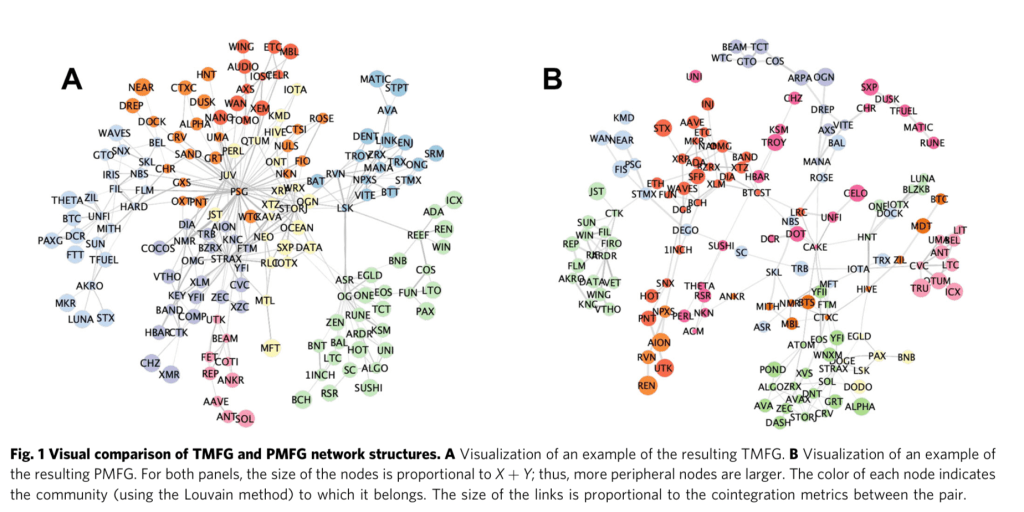
In this paper, Grande & Borondo (2025) report selecting pairs that bridge ticker communities significantly increases portfolio risk and reduces the average returns. Such pairs exhibit less stable long-term relationships because they are influenced by different market dynamics.
Network-based approaches to portfolio diversification has been a rapidly growing part of the literature over the past decade. Network approaches reduce concentration risk (“too big to fail”), leading to more balanced and lower-risk portfolios.
In this paper, Grande & Borodono demonstrate incorporating the network structure rather than relying solely on pairwise co-movement metrics can guide the construction of more resilient pairs trading portfolios with a high concentration of peripheral pairs, thereby reducing exposure to cascading failures.
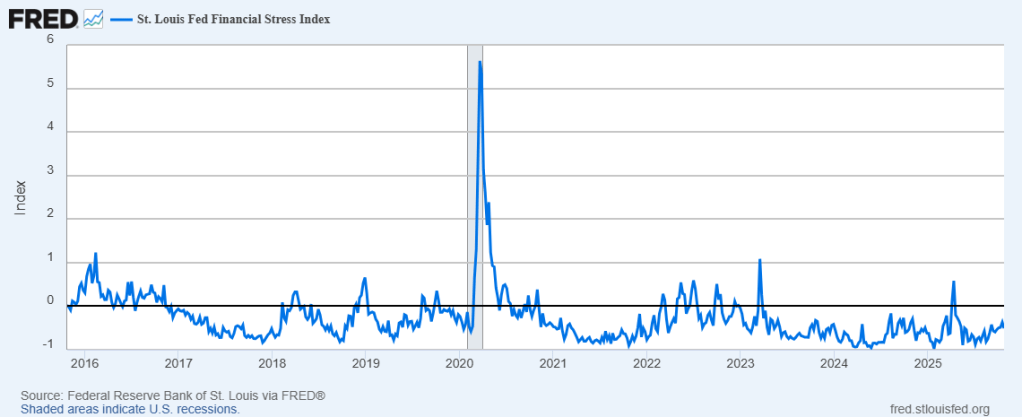
Market chatter seems to be rising reflecting growing fears credit market stress is ascending as Treasury yields fall and other economic warning signs are lighting up.
Manufacturing data and labor markets are retreating and the Fed is shutting down its QT policy ahead of possible rate cuts.
A bank liquidity crisis occurs when a bank lacks sufficient cash or other highly liquid assets to meet its short-term financial obligations, such as sudden large withdrawals by depositors. This can happen because banks often fund long-term assets like loans with short-term liabilities like deposits, creating a maturity mismatch. If many depositors withdraw their funds at once, a bank run can occur, and the bank may be forced to sell assets at a loss to cover the withdrawals, potentially leading to failure.
This dynamic is not restricted to banks. Long-dated capital projects in the energy sector can experience similar systemic risk where funding investments assumes demand is sufficient to recover project costs.
Following the Great Financial Crisis, network science literature has explored cascading dynamics among financial instituations. Among other things, the literature compares the stability of ring and complete network structures and shown completely connected systems tend to be be stable under small shocks but give way to instability under large shocks. In contrast, ring networks tend to be more resilient under large shocks while less so under smaller disruptions.
Fire sales and default contagion dynamics are the principal vectors are two of the main drivers of systemic risk in financial networks. Contagion reflects direct balance sheet exposures between institutions while the consequential fire sales reprices asset valuations thereby transmitting distress throughout the financial system.
Detering et al. (2020) develop a model explaining the joint effect of the two contagion channels and investigatea structures of financial systems that promote or hinder the spread of an initial local shock. They characterize resilient and non-resilient system structures by criteria that can be used by regulators to assess system stability. Further, they provide explicit capital requirements that secure the financial system against the joint impact of fire sales and default contagion.
Amini et al (2025) builds on Detering and presents a framework to better understand the joint impact of fire sales and default cascades on systemic risk in complex financial networks. They quantify quantify how price-mediated contagion across institutions with common asset holdings can worsen cascades of insolvencies in a heterogeneous financial network during a financial crisis. In the numerical studies we investigate the effect of heterogeneity in network structure and price impact function on the final size of the default cascade and fire sales loss.
System or network models typically segments into 3 categories:
Regular networks (without network heterogeneity)
Erdös-Rényi (ER) random networks with low heterogeneity when institutions have a degree (i.e., connections with other entities) close to the average degree
Scale-free networks (with high heterogeneity)
Amini modeled financial institutions in these ways and tested the resulting dynamics following a range of shocks.
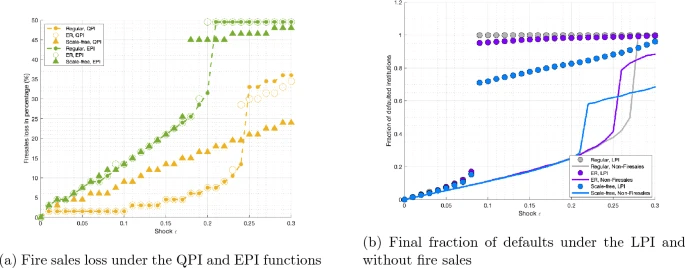
With exponential price impacts, Aminim observed small shocks below the critical shock value for the scale-free network. Network heterogeneity does not have a significant influence on the fire sales loss.
For the quadratic price impact, small shocks trigger larger fire sale losses in the scale-free network.
Networks with higher heterogeneity has a smaller critical value for the shock. When the shock exceeds the critical value for the regular network , the regular network has the largest fire sales loss, while the scale-free network has the smallest loss. This dynamic arises because the scale-free network, has a larger proportion of institutions with low degrees (such as 1 and 2), which have a higher chance of surviving after a large shock. This makes the scale-free network more resilient to a large shock compared to the other two networks.
Aminimi observes their simulations highlight the importance of ensuring that a financial network can withstand large cascades under stress scenarios that put pressure on specific characteristics such as capital or liquidity reserves.
Presently, there is little evidence banking regulations capture these dyanmics.
____________________________________________
Amini, H., Cao, Z. & Sulem, A. Fire sales, default cascades and complex financial networks. Math Finan Econ19, 225–260 (2025). https://doi.org/10.1007/s11579-024-00381-z
Detering, N., Meyer-Brandis, T., Panagiotou, K. et al. An integrated model for fire sales and default contagion. Math Finan Econ15, 59–101 (2021). https://doi.org/10.1007/s11579-020-00273-y
This morning I wrote about the possible significance of an American pope. Of course, strictly speaking, Bergoglio was the first American pope. Strictly speaking—but perhaps metaphorically speaking as well. What seems beyond doubt is that he was the first Globalist pope.
Commenter Doug Hoover wrote today about events from 2013 which many may not recall, or the significance of which they may never have recognized:
America cut off their [Vatican] connection to SWIFT, freezing their ability to transfer or accept money.
America picked an American Pope.
What DH is referring to is NOT the recent death of Bergoglio and the election of Prevost/L14. He’s referring to the coerced removal of Ratzinger/B16 under cover of a “resignation” in 2013. I was still wondering whether to go “there” when commenter American Cardigan appeared to rise to the bait:
Haven’t seen evidence yet that the Vatican is reconnected to SWIFT.
It is clear that SWIFT intervened directly in Church affairs. Was there a blackmail coming from who knows where, (perhaps Soros, Clinton and Obama) through Swift, exercised on Benedict XVI?
“When a bank or territory is excluded from the System, as was the case with the Vatican in the days preceding Benedict XVI’s resignation in February 2013, all transactions were blocked. Without waiting for the election of Pope Bergoglio, the Swift system was unlocked upon the announcement of Benedict XVI’s resignation.”
In point of fact, Vatican City was reconnected to Swift before Bergoglio was elected. That B16 was removed seems beyond doubt. The perps have never taken public credit, so the exact origin of the decision remains murky. Presumably America at least acquiesced in the coup, but it’s conceivable that it was actually instigated by non-American forces and coordinated with America:
The great globalist powers are in a hurry and Ratzinger was a clear obstacle, a slowdown on their lightning-fast trajectory.”
…
And immediately after his [B16’s] passing [i.e., resignation], SWIFT unblocks Vatican transactions, reopens ATMs, and brings the IOR [one of two Vatican banks] back to the honor of the world.
They didn’t wait for Bergoglio to be elected; the expulsion of the “white terrorist” was enough for him.
In the good and unattainable salons between Wall Street and Washington and London, they already knew that the conclave would give the throne to a modernist, to someone they could trust.
How come? Had the SWIFT sanction been coordinated with the “conspirators” in purple who, led by [Jesuit “black” terrorist] Carlo Maria Martini (a cardinal who asked for euthanasia for himself, it should be remembered…) had marked Bergoglio as their candidate for years already?
Was there an agreement between the conspirators with a strong external power, to which they are close in ideology?
But it seems to understand that Ratzinger’s resignation is – he was forced to step down from the throne of Peter under construction.
So, Bergoglio was—perhaps in more than one sense—the first American pope. More to the point, he was probably the first inarguably non-Catholic pope. Regular readers will have seen me use that term fairly regularly. I do use it in all seriousness. Anyone who cares to search the archives here will find that I have questioned the faith of both Wojtyła and Ratzinger on philosophical grounds, but I also recognize that questions of this sort are rarely unambiguous. The Neomodernist takeover—fronted by Bergoglio—does appear to be one of those unambiguous events, allowing for the Neomodernist (and Globalist) desire to continue using the visible institutions of the Catholic Church for their own purposes.
What led to the Globalist Coup—or Regime Change, if you prefer? It could have been that they simply judged that the time had come to remove this hated obstacle, but Traditionalists would argue that it was specifically the wild success of Ratzinger’s 2007 motu proprioSummorum Pontificum that enraged the demonic forces of the Globalists and led them to take action. Technically, Summorum Pontificum allowed for the widespread use of the traditional Roman liturgy, what is often referred to as the Tridentine Mass—which is the codification of the Roman liturgy that reached its first definitive form under Gregory I in around 590. The core of the Roman liturgy is its “canon”, which has roots that go back far earlier than Gregory. It is the earliest documentable “eucharistic prayer”. The point is that, until the post Vatican 2 revolution, the Roman Canon was the only eucharistic prayer known to the Catholic Church. The Roman Canon embodies the core of the Catholic faith in its worship. Post Vatican 2 the Roman Canon was—for practical purposes—supplanted by a variety of Neomodernist (“Teilhardian”) tinged “prayers”. Don’t take my word for it—Ratzinger himself referred to the “cosmic” aspects of the New Order. And so Traditionalists argue that this threatened widespread return to full Christian faith and re-evangelization in the West aroused the demonic forces of Globalism to a fury. Do you see now why so much importance has been attached to Prevost’s documentable use of the traditional Roman liturgy?
All of that lends urgency to the questions surrounding the most recent conclave. It appears that the most radical Neomodernist forces were routed. Exactly where Prevost fits in isn’t entirely clear. He rose rapidly under Bergoglio and was complicit in some of the worst excesses regarding the appointment and removal of bishops (itself a troubling matter—as if bishops were little more than functionaries or vicars of the “pope”). On the other hand, there are documentably hopeful signs that Prevost will take the faith he professes seriously. Look, I’m not making some sort of unqualified endorsement of Prevost, but I am suggesting that God can work through imperfect human beings, flawed individuals.
Inevitably, this leads to Trump and his money—his reported $14 million donation to “the Vatican”. We know that Trump’s first election win in 2016—three years after Ratzinger’s removal—frustrated Globalist plans. While MAGA shares some features with Globalism, the appeal to normal people—who could be influenced by religious faith, as opposed to demonic ideology—posed an existential threat to the Globalist establishment. Trump’s predilection to deal making—especially with Russia—was viewed, rightly or wrongly, as a setback for the Globalist agenda. We saw how that frustration played out in the removal of Trump in 2020, but the debacle of the four Zhou years forced the Globalists to reconcile to a Trump return.
As I’ve noted several times, a little remarked feature of Trump’s 2024 campaign was his persistent outreach not just to Catholics but to the most traditionalist strains of Catholicism. Trump’s repeated use of traditional Catholic iconography during the campaign was unparalleled in American politics, yet passed with next to no comment. Who was behind this? One thing seems certain—Trump himself could hardly have formulated that outreach. This wasn’t coincidence or a whimsical feature of the campaign. And now we learn of Trump’s prominence in Rome—including his reported cash infusion as well as the influence of Trump connected cardinals like Dolan in the election itself.
What does it all mean? I can’t tell you. It could be that Trump—are some in his circle—have contrived to engineer a liberation of the Catholic Church from its “Babylonian Captivity” under the Neomodernists. Certainly this could work to Trump’s political advantage, both at home as well as in his dealings with Europe, where traditionalist Catholics are one among the few reliable opponents of the Globalist order. If any of this is the case, we should expect L14 to move fairly quickly. Will any of these developments have a positive impact on the notoriously mercurial and emotional Trump, who is highly impressionable when it comes to imagery and symbolism? We can hope.
If you had a bad week in markets since “Liberation Day”, here’s your “Daisy”.
Stephen Miran.
American economist and current chair of the Council of Economic Advisers since March 2025. (Sorry Mark, you’re STILL a “bridesmaid” and a hilarious talking head for a very sketchy operation — LOL)
Let’s take some liberties with what Stephen actually said, and paraphrase Miran’s key points:
“Listen up, you Freeloading Bozos – we do it all for you. We give and we give and we give. But there ain’t no more to give.”
“We provide you ‘serious muscle’ – a security umbrella creating the greatest era of peace mankind has ever know. Our dollar, Treasury securities, and reserve assets underwrite the global trading and financial system which made you (and our DC War Party politicos) richer than you really should be.”
“As much as we love you all (COUGH), this party is not cheap or free for us. You’re pigging out and your damn trade deficits are unsustainable.”
“Your pig-out trashed our manufacturing sector. Our working-class families and their communities (beloved voters that they are) are getting pillaged.”
“Our voters have been paying for your peace and prosperity”.
“The USDs and Fed policies the world loves kept everyone’s borrowing rates insanely low making the rich richer and the poor poorer. But things are getting out of hand – notably in currency markets.”
“The Don says the party’s over.”
“So, we’re going to make some changes with the PRC/PBOC in mind.”
“Want to continue enjoying our USDs and DOD? Time to pay up. We can do it the easy way or the hard way – but regardless what you decide, things are going to change.”
“Here’s the deal — you can accept tariffs on your exports to the United States without retaliation. That’s the easy way.”
“Or, you can stop unfair and harmful trading practices by opening your markets and buying more from America — a lot more. That’s also the easy way.”
“Or, you can start paying your own way defending your pathetic little fiefdoms – also part of the easy way.”
“Or, you can build factories here in the USA. Easiest of all.”
“Or, Venmo the dough directly to us. We can make that work if you prefer.”
“We’re still here for you freeloading cherry pickers as you work the numbers. Our trading systems, too”.
“But, however you decide to pay, it’s time to pay. And, one way or the other you will pay.”
“Prefer retaliating? Don’t recommend it but, hey, I get it – there are some hotheads out there. OK, we can do it that way, too Remember who supplies your weapons, ammo, spare parts and intelligence to your defense. How long do you think you can run on inventory. Our Carrier Strike Groups, and advance-deployed Army, Marine Corps, and Air Force can pack up and leave as quick as we dumped Afghanistan. And remember who runs SWIFT.”
“As Treasury Secretary John Connolly famously said in 1971 when the US suspended gold convertibility, and threw an extra 10% across-the-board tariff on y’all, the dollar is ‘our currency, but it’s your problem‘”.
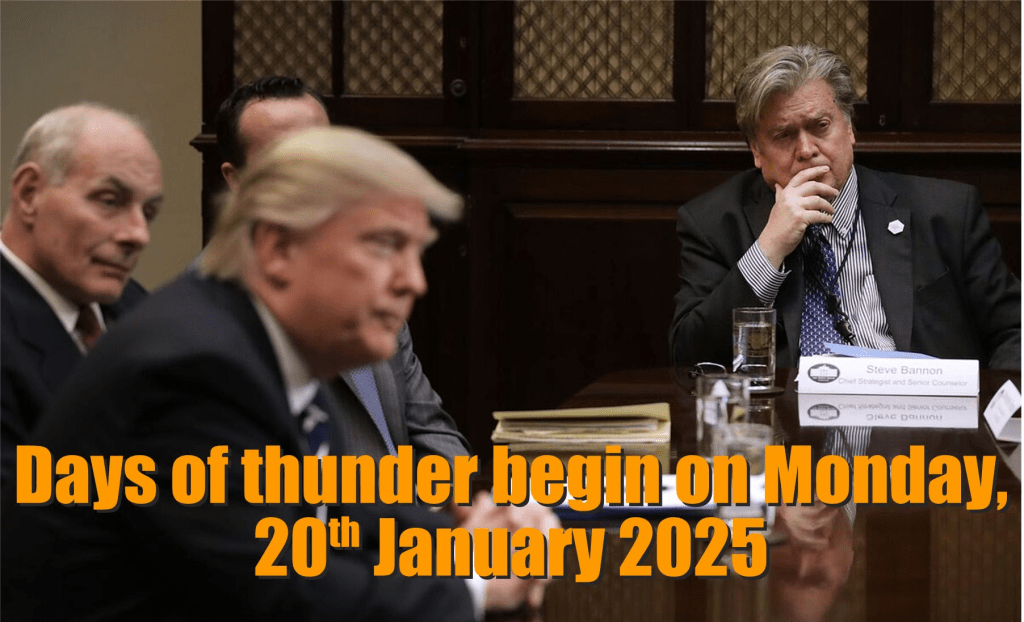
Last night I had the privilege of being included in a Zoom call with Steve Bannon, former investment banker and media executive, host of the “War Room” show and chief political strategist during the first seven months of Donald Trump‘s first term in office. Much of what Bannon presented wasn’t surprising, but what seemed significant was that he confirmed that Trump and his team will go on the offensive from day one in office. “The days of thunder begin on Monday,” he said, and the world will not be the same again. Bannon wasn’t talking about Trump going on the offensive against the Chinese, Iranians or the Russians. Trump and his team are preparing to take on the “they.”
“They,” in Bannon’s words, are the people who control the world’s most powerful empire and, elections or no elections, democracy or no democracy, they will not voluntarily relinquish their privileges and the control over their empire: there will be a fight. In a few recent podcasts, I discussed what this likely implies, simply on the basis of what the nature of this power struggle entail
Namely, taking on the imperial cabal is a fight to the death. “They,” are vicious, unscrupulous and extremely vindictive. If Trump and his team falter in this struggle, the cabal will not content themselves with merely defeating Trump politically. I believe they would not relent until they entirely destroyed him, his fortune, his collaborators and his family.
The price of defying the Empire
When the United States declared independence from the British Empire, the signatories of the Declaration of Independence were not just a bunch of belligerent rebels with nothing to lose. In many ways, they were similar to the people flanking Donald Trump today. They were all educated men of means and privileged members of society.
They all defied the Empire and pledged their lives
Of the 56 signatories, twenty four were lawyers and jurists; eleven were wealthy merchants; nine were farmers and large plantation owners. In signing the Declaration of Independence they provoked the wrath of the empire, knowing for sure that if they were captured their penalty would be death. Five of them were in fact captured by the British as traitors and tortured before they died. Twelve had their homes ransacked and burned. Two lost their sons and another two had their sons captured and imprisoned.
Nine of the 56 fought and died from wounds or hardships in the revolutionary war. Carter Braxton, a wealthy planter and trader saw all his ships sunk by the British Navy. To pay his debts he was forced to sell his home and his properties. He died a poor man. To avoid capture, Thomas McKeam had to move his family around the country almost constantly. He served in Congress without pay and his family was kept in hiding. Ultimately, his possessions were taken from him and he too, died in poverty. The home and properties of Francis Lewis were destroyed and his wife was jailed. She died within a few months.
The properties of Ellery, Clymer, Hall, Walton, Gwinnett, Heyward, Ruttledge, and Middleton were vandalized and destroyed by British troops or their proxy terror squads. British General Cornwallis took over Thomas Nelson‘s home for his headquarters. It was destroyed during the battle of Yorktown and Nelson died bankrupt. John Hart had to flee his homestead after his fields and gristmill were destroyed. For over a year he hid, living in forests and caves. When he returned home, his wife was dead and their 13 children all vanished. The grief and distress killed him within a few weeks. Norris and Livingston suffered similar fates.
When the imperial cabal decided to break up the United States, which precipitated the Civil War, they were confronted by President Abraham Lincoln. In 1863, Russian Czar Alexander II came to Lincoln’s aid by dispatching his Baltic fleet to New York and his Pacific fleet to San Francisco. The move blocked the Empire’s intervention on the side of the Confederation, which was planned by the British with the support of France and the Vatican. The U.S. – Russian alliance ultimately prevailed and the United States was preserved.
Alliance between Russia and the USA saved the union from the British Empire. Note how Lincoln is portrayed as a troglodyte in London.
But to exact their revenge, the cabal dispatched assassins. Abraham Lincoln was killed in 1865, shortly after the end of the Civil War, and Alexander II was assassinated in St. Petersburg in 1881. In 1917 the whole family of the Czar Nicholas II was killed by the Bolsheviks on the orders of the New York banker Jacob Schiff. Arguably, the low life expectancy among the Kennedy family men is also likely due to their propensity to irritate the imperial cabal.
I do believe that Donald Trump and at least some of the people around him are probably well aware of all this and understand the stakes in the struggle they took on. During our call last night Steve Bannon confirmed that this is indeed the case. The nature of this conflict dictates that “they” can’t be left standing and whoever comes into the White House after four years of Trump will be tasked with continuing the struggle until the imperial cabal is entirely uprooted and disenfranchised.
The clash is global and it’s between two systems of governance
Just like in the Middle East, Ukraine and elsewhere, what we’ll witness is another front in the struggle between two systems of governance. In that sense, the geopolitical conflicts around the world will likely be subordinated to the civil war shaping up in the United States, which could prove the central battle in the whole conflict. That civil war might not resemble the civil wars of the past with large armies fighting one another in fields and insurrections in cities. Instead, we’ll likely see chaos, sabotage, assassinations and terrorism in the U.S. – but also in Europe and the U.K.
One of the participants in yesterday’s call was also Christine Anderson, member of the German AfD party and the European Parliament. She reported that the authorities in Germany, as in France, UK and other European nations, are “berserk,” and that the Trump election has pushed them over the edge of overt authoritarianism which they no longer even bother to conceal.
As a result, there’s open talk about cancelling the upcoming 23 February elections in Germany, and more aggressive censorship of social media. Elon Musk‘s recent interview of AfD leader Alice Weidel only added to the hysteria and now German authorities want to prosecute Musk as they construed his interview of Weidel as an illegal campaign donation.
Participants from the UK reported perhaps the most distressing news, agreeing that the situation in the nation is simply awful, that they do not even recognize their country. One doctor said that he sees that people are increasingly giving up and many are “losing the will to live.” One concrete piece of news, which was confirmed to be true, is that for some months now, elected politicians no longer appoint judges in Britain. I did not understand who does appoint them as our call ran overtime before I had the chance to ask, but I’m sure it’s probably some really nice people.
Another distressing development in the UK is the upcoming Climate and Nature Bill which, if passed, will legally enshrine Britain’s commitment to net zero policies, which could prove devastating to its economy including the energy market, farming and industrial output. I elaborated what net zero entails for the British economy in this article.
You could get away with a 40 billion trade deficit if your currency was the world’s reserve currency, but the British pound is not.
In all, it seems that the days of thunder begin next week. These are the times to be brave. Maybe Trump and the people around him just want a bigger slice of the pie and there’s nothing more to it than that. But perhaps the struggle is bigger than that. Steve Bannon recently spent four months in prison – not a country club, as he said, but a real prison. Trump had two, perhaps more attempts at his life. The struggle is very real.
However, Trump’s adversaries are in a panic, according to Bannon. Most of them really didn’t think Trump would win the elections last November. Bannon said that Trump is a “blunt force instrument,” and that the cabal sustained a “blunt force trauma.” Hundreds, perhaps thousands of their minions, including Dr. Anthony Fauci, are jockeying to obtain pardons from the Biden team, even on a pre-emptive basis. Well, we’ll find out – it won’t be boring.
Late yesterday afternoon Judge Nap featured a session with Jeffrey Sachs that held out tantalizing possibilities for those of us—and who isn’t?—who are trying to come to grips with what Trump is up to these days with his many and provocative public statements. This followed mere hours after my post expressing deep disquiet regarding Trump’s “hellish” threats directed at the Middle East.
The session begins with a video of Professor Sachs speaking—he’s at the Cambridge University Student Union and he’s talking about the US Deep State in historical perspective. That perspective is to shed light on current events. I’ve done a transcript of that portion, but I’ll give away the punch line—this video was linked at Truth Social by none other than Donald J. Trump. Now, we already know that Trump in the past was an outspoken critic of our fraudulent forever wars, but I think it goes without saying that he wouldn’t lightly draw attention to what Sachs is saying—all of what Sachs is saying—without acquainting himself with the contents. So:
Sachs: It’s a game. This is the Deep State and they have their wars, and every war has been phony. Some wars the American people are basically never told about–for example the war in Syria. You may actually hear from grownup reporters–who are lying through their teeth or ignorant beyond imagining–that, ‘Oh, the war in Syria, yes, Russia intervened in Syria.’ Well, do you know that Obama tasked the CIA to overthrow the Syrian government, starting 4 years before Russia intervened? What kind of nonsense is that? And how many times did the New York Times report on Operation Timber Sycamore, which was the presidential order to the CIA to overthrow Bashar al-Assad? Three times in 10 years! This is not democracy. This is a game, and it’s a game of narrative.
Why did the US invade Iraq in 2003? Well, first all it was completely phony pretenses. It wasn’t, ‘Oh, we were so wrong–they didn’t have weapons of mass destruction [after all].’They actually did focus groups in the fall of 2002 to find out what would sell that war to the American people.Abe Shulsky–if you want to know the name of the PR genius. They did focus groups on the war! They wanted the war all the time, they [just] had to figure out how to sell the war to the American people, how to scare the shit out of the American people. It was a phony war. Where did that war come from? You know what? It’s quite surprising. That war came from Netanyahu, actually. You know that? It’s weird, and the way it is, is that Netanyahu had, from 1995 onward, the theory that the only way we’re going to get rid of Hamas and Hezbollah is by toppling the governments that support them–that’s Iraq, Syria, and Iran. The guy’s nothing if not obsessive. He’s still trying to get us to fight Iran–this day, this week. He’s a deep, dark, son of a bitch–sorry to tell you–cuz he’s gotten us into endless wars, and because of the power of all of this in US politics he’s gotten his way. But that war was totally phony. So what is this democracy versus dictatorship? Come on–these are not even sensible terms!
Judge: That of course was Professor Jeffrey Sachs at the Cambridge Student Union. Why do I run that? Because that was posted, a reference to it was posted, on Truth Social by the President Elect of the United States [Donald J. Trump].
Now that—linking to Sachs calling Netanyahu a “deep, dark, son of a bitch”—is remarkable even by Trumpian standards. I can’t actually think of any reason why Trump would do that other than that he really believes it. Sachs himself argues that that isn’t the action of a guy who wants to get America into another crazy war. The big question is this: How far does this reveal the inner Trump? Sachs is clearly on solid ground when he argues, in the discussion that follows, that Trump—in the portion of his remarks that were clearly made for the benefit of the Russian leadership—is now openly recognizing that Russia has legitimate security interests in their “near abroad”, and explicitly so in Ukraine. Doug Macgregor must certainly be smiling today.
How far we can extrapolate to the Middle East is another matter, and yet …
Trump’s link to Sachs’ remarks either directly preceded or followed hard on the heels of Trump’s statements about bringing “hell” to the Middle East. Can we say that Trump was signalling that we should take his rhetoric with a grain of salt? But a PR savvy guy like Trump has to understand the dangers of positioning himself out on a limb. By the same token—on the other hand—adopting by link Sachs’ characterization of Netanyahu as a “deep, dark, son of a bitch” who is ultimately responsible for instigating most of our forever wars certainly places Trump out on a limb with regard to the The Israel Lobby.
As so often with Trump, we’ll need to wait and see. Nevertheless, this is definitely grist for the speculative mill.
Citation: Helge F. Goessling et al., Recent global temperature surge intensified by record-low planetary albedo. Science 0, eadq7280DOI:10.1126/science.adq7280
Abstract:
In 2023, the global mean temperature soared to almost 1.5K above the pre-industrial level, surpassing the previous record by about 0.17K. Previous best-guess estimates of known drivers including anthropogenic warming and the El Niño onset fall short by about 0.2K in explaining the temperature rise. Utilizing satellite and reanalysis data, we identify a record-low planetary albedo as the primary factor bridging this gap. The decline is apparently caused largely by a reduced low-cloud cover in the northern mid-latitudes and tropics, in continuation of a multi-annual trend. Further exploring the low-cloud trend and understanding how much of it is due to internal variability, reduced aerosol concentrations, or a possibly emerging low-cloud feedback will be crucial for assessing the current and expected future warming.
To understand Russia’s current strength, attitude and strategy, one must understand the developments since 1990. Only then will one understand why President Putin is doing what he is doing and why he will be successful. Analysis.
When the Soviet Union collapsed, Russia was at its lowest point. Boris Yeltsin, Russia’s first president, was unable to lift the country out of its misery. There were concrete reasons for this, which can be found both inside and outside Russia.
The West – under the leadership of the USA – pursued an unmistakable strategy of destruction. Sachs provides first-hand evidence that Poland, which later became a member of the EU and NATO, was helped back on its feet from 1989 onwards with billions in aid from the G7, the IMF and other Western institutions – very successfully.
The situation with Russia was completely different. Russia was never meant to become a partner of the West, and Professor Sachs shows how he failed as an advisor to Gorbachev and then to Yeltsin to organize support from the West. The USA’s goal was not to restore Russia to health, but to break it up into small, digestible portions, which would then be taken over by the USA through puppets. This plan is still being pursued with enormous effort and has reached its current climax in the war in Ukraine. We reported on this last summer in an article: ” The planned dismemberment of Russia .”
Russia after the planned dismemberment
The climax of the road to Russia’s destruction occurred in the late summer of 1998, when Russia’s economy collapsed, the ruble lost 99.9% of its value and the state was unable to service its debts. The United States was almost at the goal of its dreams.
Things turned out differently – a previously inconspicuous and unknown man came to the levers of power – Vladimir Putin.
The development of Russia under President Putin
In 1999, President Yeltsin first appointed Vladimir Putin as Prime Minister. On the last day of the same year, he was then installed as acting President of the Russian Federation.
Vladimir Putin, the new president, was faced with the ruins of a once feared world power. The economy was in ruins, the infrastructure practically non-existent, the people disillusioned. A few oligarchs who had grabbed the best parts of Russia with the help of American investment banks controlled politics in order to steal even more at the expense of the general public. The army – always the backbone of the Russian state – was a shadow of its former self and NATO’s eastward expansion was in full swing.
In short, Russia was in a deplorable state and many observers did not give the country much chance of survival as a unit.
President Putin achieved the impossible. First, he publicly disempowered the oligarchs politically. He ensured that wages, salaries and, above all, pensions were gradually paid again – regularly and in accordance with the law. In doing so, he created a basis for later trust. As a result, foundations were laid in all areas of life and the economy that made the later upturn possible.
The few words used here to describe this unprecedented process of change do not begin to describe the colossal problems that had to be solved. It took years before the first successes became visible and tangible for the population, and this development continues to this day.
The course of the young president’s first years in office is the source of the phenomenon that the political West simply cannot and is not willing to understand and which can be described in its own way as a fundamental trust in Putin. Putin provided wages, pensions, food, basic compliance with the law, stability and prosperity – the basis for modern Russia.
In terms of foreign policy, President Putin initially sought proximity to the West and pursued a policy aimed at making Russia an equal partner of the EU and developing friendly relations with the USA. After 9/11, Putin even allowed the USA to use Russian airfields.
Speech from Munich – Georgia – Maidan – Syria
In his famous speech on February 10, 2007 at the Munich Security Conference, President Putin criticized for the first time the monopolistic dominance of the USA and its almost unbridled use of force in international relations, as well as the unstoppable eastward expansion of NATO. This was a surprising turn of events for the West. It had to accept that Russia would no longer accept this development.
Georgia’s attack on its breakaway territories under Russian auspices in 2008 – organized and orchestrated by the United States – resulted in Russia being forced to reassess the structure and armament of its military in light of the threat situation. Under the pretext of reclaiming former Georgian territories, the actual aim of the aggression was to create the conditions for the admission of new countries into NATO – namely Georgia and Ukraine – and thus, above all, to weaken Russia.
The admission of Georgia and Ukraine was to be decided at the NATO summit in Bucharest in 2008. Surprisingly, Russia was also invited to the summit as a guest – proof of how weak the USA considered the Russian Federation to be at the time.
All these events forced Russia to devote great energy to rebuilding its military. This was only possible because the economic and political conditions for this had been created.
The Maidan in 2013/14 and an eight-year covert war by the West against the Russian-speaking Donbass confirmed Russia’s decisions made in 2008.
The non-compliance with the Minsk I and II agreements – initially welcomed by Russia, in particular in its reliance on Germany, as an effective instrument for settling the cruel internal Ukrainian disputes – ultimately represented the end of any trust Russia had in the political leaders of the West and in Western diplomacy as a whole. They did not want a peaceful solution.
Russia first demonstrated its new military strength in Syria in 2015. Its intervention resulted in the failure of the American plans to destroy Syria as part of the Wolfowitz Plan of 1992. Russia achieved the turning point in Syria with a skillful military approach using a very manageable military force.
The strategic capabilities of the Russian leadership
Clearly defined overall strategy is consistently implemented
President Putin sees the war in Ukraine as just one piece of the puzzle in a great chess game that began with the collapse of the Soviet Union and whose 64 squares stretch across the globe. He has repeatedly referred to this in his speeches. In my opinion, it is absurd that the West does not pay the attention to President Putin’s speeches that they deserve. Unlike many Western leaders, Putin is a prime example of strategic transparency. He implements exactly what he says in his speeches. This may come as a surprise to the West. It is also becoming increasingly clear that Western strategy is limited to being against Russia. This means that the West has no strategies whatsoever regarding its own interests. The economic and social collapse of Germany as a de facto colony of the USA is a prime example of this. See my article ” Germany is a naive pawn of the USA with no power to turn around “.
The fact that Russia is stronger today than at any time in its recent history is based on a rational, systematic and forward-looking long-term strategy, not only by Putin, but by the entire Russian leadership over the last 24 years.
The reasons why Russia not only survived the largest storm of sanctions ever imposed by the West, but is actually thriving, can be found precisely in this. The Russian leadership anticipated the West’s policies and made the necessary and, above all, correct political and economic decisions years in advance. Today, despite the storm of Western sanctions, Russia has sound economic and social foundations that allow it to respond quickly and efficiently to any new economic attacks.
The result is surprising in the West: Russia is one of the few countries without net debt. This year it has achieved economic growth of over 5%. In contrast, the USA and the EU are in a de facto recession and are bankrupt by any standard of balance sheet analysis, which is becoming increasingly evident as the manipulation of economic figures becomes less and less effective at concealing reality.
The political West’s view of President Putin as a dictator who does and controls everything himself cannot be further from the truth. Putin has assembled a team around him, which consists largely of top people who understand their tasks and can carry them out competently. In recent months, this has included an uncompromising fight against corruption throughout the country, which has not even stopped at ministers and is taking place very publicly. The consistency shown is extraordinary and shows that Russia is preparing for a long conflict, even if not all the swamps have been drained yet.
In addition to the economic strengthening during this crisis and the clear military victory on the front, Russia managed to become, alongside China, the foreign policy and diplomatic heavyweight of the Global South. Russia’s partnership with China is reflected in an increasingly effective coordination of their decisions. These two giants are forging economic and security policy organizations with the BRICS and SCO organizations, which will bid farewell to the hegemonic system of the West and form a multipolar community of states in this world.
Kursk and further western escalation
The Ukrainian attack on the Kursk region caught Russia unprepared. The reaction of the Russian leadership and the population made it clear almost from the start that even this action, which would have been impossible without Western coordination and material support, would not be able to deter Russia from its path. It will take weeks for the Ukrainian troops to be expelled, but ultimately the invasion of Kursk will only hasten the end of today’s political Ukraine. The action has already failed and will probably go down in history as the last stand of a loser.
This is also reflected in the fact that Kiev is constantly trying to explain the purpose of this military suicide mission. If the declared aim was to obtain a bargaining chip for negotiations by occupying the Kursk nuclear power plant, for example, this goal was not achieved. The explanations were then changed to say that the aim was to force the Russians to withdraw their units from the Donbass to Kursk in order to ease the pressure on the Ukrainian troops. This did not happen either, and the Russian troops are even accelerating their actions.
The aim of instilling fear and terror in the Russian population was also not achieved. The fact that Russian territory was attacked for the first time since 1941 had the opposite effect on the Russian population. Estimates show that up to 30,000 Ukrainians and Western mercenaries invaded Kursk and that over 12,000 of them have already died. It can be assumed that the remaining troops will be wiped out over the next weeks and months. These forces are now missing from the front in Donbass; they were the best that could still be assembled.
I expect the Americans to escalate the conflict further. The Americans will probably supply the JASSMs , which can be fired from the F16. This weapon will – depending on the design – theoretically be capable of reaching even Moscow; theoretically, because in order to reach Moscow it would be necessary to bring an F-16 to the east of Ukraine, which is not impossible due to the dense Russian air defenses, but would be associated with considerable difficulties – and impossible without Western logistical support.
Such long-range weapons will go down in history as the next new wonder weapon, which is supposed to change the course of war, but – like all the others – will have no influence on the course of the war. We already explained this 18 months ago in our article ” Wonder weapons, weapon systems and chatter ” and we were right.
Will President Putin allow himself to be provoked by these provocations, which will ultimately be militarily ineffective and will have no influence on the final outcome?
Real strategists have infinite patience
President Putin’s patience is often the subject of contemplation – by both pro-Western and pro-Russian exponents. One commentator on our article ” Kursk: Invasion, beginning of war, diversion, pawn? ” quoted the proverb “Beware the fury of a patient man.”, which comes from John Dryden.
In my opinion, however, to describe the attitude of President Putin and his team as patient is an oversimplification and does not get to the heart of the Russian strategy. A chess player without patience inevitably loses. A gifted chess player creates the conditions for defeating his opponent by patiently implementing a strategy once he has recognized it as correct.
Putin’s chessboard extends as far as Russian interests extend. He will not change his strategy, which has proven successful over the last 24 years, by reacting emotionally to the events in Kursk or the missile strikes in Russia, which were quite painful for the population affected. Anyone who thinks that Russia can be provoked in this way is wrong in my opinion and has – once again – failed to understand Russia’s strategy and how it is being implemented. The fact that the entire West is following this line of provocation and believes in it is by no means an argument for its success, but rather shows that the West has no strategy at all. The lack of a strategy is easy to prove: in our article ” The consequences of the intercepted German air force conversation mean war ” we described a possible target for Russia in response to the use of Taurus . Let’s assume that Russia were to launch such a strike, which would be easy to achieve. What would Germany’s reaction be? – Outcry, nothing more. NATO in Europe as a whole would have no tools to respond seriously to this. In a conventional conflict, NATO would have no chance. That is not an assertion, but a fact. NATO has suffered a bloody nose in Ukraine over the past two and a half years, at the expense of the Ukrainians. NATO forces themselves have no serious forces in Europe, neither in terms of size nor quality. The only serious army in NATO is Turkey, and it will certainly not march against Russia. In 1941, Germany invaded the Soviet Union with an army of almost four million men, which was militarily poorly prepared at the time. The result is well known. What would happen if NATO invaded Russia with a few hundred thousand soldiers from various NATO member states, a Russia that has never been so strong and battle-hardened militarily? A downright ridiculous thought.
Thoughts on Russia’s next steps
principle
Any reaction by Russia must be understood in the context of the overall situation on the global chessboard. With regard to Ukraine, President Putin’s goals are known in principle and have been clearly communicated again and again since February 2022: denazification, demilitarization and neutrality of Ukraine (NATO) and the retention of Crimea (Istanbul 2022) as well as the retention of the Lugansk, Donek, Saparoshiya and Kherson regions (Istanbul+) under Russia.
Since President Putin is aware of the US long-term strategy (dismemberment of Russia) and the broken agreements (1991 and Minsk I + II), Russia will not be willing to agree to a ceasefire followed by negotiations. Negotiations will take place at the earliest when there are no more Ukrainian soldiers on Russian territory; this includes the four regions mentioned above that are now part of Russia.
These goals are currently within Russia’s grasp. The situation in Kursk, or rather the destruction of the Ukrainian troops, has accelerated in recent days and it can be assumed that this suicide mission by the West will soon be history. If one follows developments on the Donbass front, it is clear that the Russian advance is accelerating daily and it is only a matter of time before the Russian armed forces are on the Dnieper. The Ukrainian armed forces are practically disintegrating. There is a lack of soldiers and material.
diplomacy
Trump’s nominee for Vice President, Senator Vance, explains the peace proposal Trump would likely put forward: (1) A demarcation line along which the existing front line would run and be fortified so that the Russians could not attack again; (2) Guarantee of Ukraine’s neutrality towards Russia, i.e. no membership in NATO or other allied institutions. (3) The Germans and other European countries must finance the reconstruction of Western Ukraine.
As expected, the Trump-Vance campaign’s proposed policy on Ukraine is nothing less than forcing the Government of Ukraine to formally cede all occupied territory and abandon accession to NATO or other “allied institutions” with a guarantee of neutrality to Russia. pic.twitter.com/ycfqDSv3s1
By November, the Russians will probably be on the Dnieper and will have achieved militarily what Vance and Trump intend territorially – or more.
(President) Zelensky will be furious if this plan is implemented. He is exercising his power without any legal basis because his term of office expired in May and he did not stand for re-election. How could he? He no longer has any support among the people and the war is lost. He must fear not only for his power but also for his life. Anyone who believes that he will use his stolen billions to lead a comfortable life in exile – in Miami, for example – does not know Americans. The American plan in Ukraine has failed, so the USA no longer needs this man in Kiev and Zelensky, who is heavily addicted to cocaine, knows too much. He will probably suffer the same fate as Ngo Dinh Diem, who was executed – probably on orders from the USA – on November 2, 1963. Problem solved.
The typical end of an American puppet: Ngo Dinh Diem
Europe, especially Germany, will be furious. Germany has ruined itself as a loyal vassal for US interests in Ukraine, economically and socially, and has contributed to the destruction of Ukraine with its military and financial support. If Trump becomes president, he will abandon Germany and leave the bill for reconstruction on the table in Berlin.
However, the peace plan is not only a disaster for Zelensky and Europe, but also for the deep state in the USA. Trump recognizes that the USA cannot afford a war against Russia financially and he would accept another foreign policy and military defeat. The deep state does not. I explained why in my article ” US elections decide on war or peace “. The above-mentioned plan to dismember Russia would be set back by decades or made impossible entirely by a Trump-style peace. The fact that the deep state is trying everything to prevent a Trump election was already evident in this week’s debate: the two ABC “journalists” who were supposed to conduct this debate neutrally actually fought for Kamala Harris, who is closely allied with the head of ABC.
It is not clear who will win this election, but I assume that Donald Trump’s life is in danger.
American pressure on BRICS countries
It is evident that the US is putting massive pressure on BRCS countries – especially Brazil and India – to get Russia to negotiate. These countries, which do business with both the Global South and the Collective West, are trying to pass this pressure on to Russia.
China is also being put under pressure, with the result that payment transactions between Russia and China are currently being affected due to the pressure on Chinese banks . China’s ties with Russia may be characterized by strong economic cooperation, but strategically – especially for the Chinese – they are military. China’s interest in the Russians defeating NATO in Ukraine is vital for the Middle Kingdom’s survival. China, as the USA’s declared main enemy in its fight to maintain its hegemony, will only be able to withstand this pressure as long as Russia is strong at its side. China’s chance of winning this fight – which will be fought over the next generations – depends militarily on Russia. China may have a very large army that is being consistently expanded and has an impressive high-tech arsenal, but China has no experience of war – in contrast to Russia. Andrei Martyanov argues convincingly that Russia is now the only armed force in the world that has mastered “combined warfare”. an indispensable prerequisite for winning a real military conflict. Real means against a serious enemy. That is precisely the reason why Ukraine – even with the active support of NATO – has no chance against Russia.
Russia certainly takes these calls from its BRICS partners at the diplomatic level seriously, but will under no circumstances deviate from its strategy on the matter.
Russia’s reactions to the Western escalation
The attack on the Kursk region has already had consequences, such as the destruction of the NATO-run training center in Poltava in early September. In this center, Ukrainian troops were trained by NATO officers for drone and missile attacks on Russia. According to my sources, around 720 soldiers were killed in this attack, including a large number of NATO instructors from Sweden, Germany, France and Poland. Not mercenaries, but NATO officers.
In Poltava, personnel were trained on a large scale to operate drones and for electronic reconnaissance. Sweden intended to sell two SAAB 340 AEW Erieye aircraft, a smaller version of the American AWACS aircraft.
SAAB 340 AEW Erieye
Sweden also trained personnel for this purpose in Poltava. The completely unexpected resignation of the Swedish Foreign Minister on the morning after the Russian attack should not surprise anyone.
One indication that this information is true is the flight movements of some of the huge S Lookheed Martin K 130 aircraft, which in the Medvac version can transport 74 injured people. A large number of Medvac flights were carried out by Poland, Germany and Romania. This makes the statement that many NATO personnel were injured very credible.
Screenshot: Flight radar. September 5, 2024
President Putin speaks on September 12 about the use of long-range weapons against Russia
President Putin does not see the permission of the USA and Great Britain to use western long-range weapons against Russia as permission, but as a clear and direct entry of NATO countries into a war against Russia. He justifies this view by saying that these attacks cannot be carried out by Ukraine without NATO support. On the one hand, Ukraine does not have any satellite reconnaissance of its own, and on the other hand it does not have the personnel to provide technical support for the weapons systems.
President Putin’s conclusion in full:
If this decision is made, it will mean nothing other than the direct involvement of NATO countries, the United States and European countries in the war in Ukraine. This is their direct involvement, and this, of course, significantly changes the essence, the nature of the conflict.
It means that NATO countries, the United States and European countries are at war with Russia. And if that is the case, then given the changed nature of that conflict, we will make appropriate decisions based on the threats that will arise for us.http://kremlin.ru/events/president/news/75092
These statements by President Putin are once again a brilliant move. In doing so, he automatically creates a legal basis for an attack on any NATO member in the event that these long-range weapons are used. He doesn’t have to – he can – at any time.
Conclusion
President Putin is well aware of the United States’ long-term strategy toward Russia: the dismemberment of Russia.
During the first 22 years of his term in office, Putin has tried to solve this problem diplomatically, with Russia refraining from using armed force until February 2022. On the one hand, Putin’s long exhaustion of diplomatic means is being ignored by the West or interpreted as weakness. On the other hand, this angelic patience is sometimes criticized within his own ranks.
In the period up to 2022, Russia flourished thanks to an unprecedented economic and social policy, so that only Germany’s post-war boom after the Second World War can be used as a parallel, although this comparison is flawed: Germany was supported with huge resources, especially by the USA, to make its success possible. Russia did not have this privilege, but managed it on its own, which makes Russia’s boom since 2000 all the more impressive.
Putin’s strategy is a holistic, global game of chess, which is balanced down to the last detail and rests on such a stable foundation that even the largest storm of sanctions ever initiated by the West not only failed to harm the Russian economy, but led to an economic upturn.
Russia has no military opponents today: the West has no strategy – neither a geopolitical nor a military one – but uses propaganda as its main weapon and embarrasses itself on the battlefield so that one would have laugh lines if gloating were appropriate – it is not. Countless people die as a result of these cynical games that a few sociopaths are playing, and the media in the West are either bought or so stupid that it makes you stop laughing.
Russia will end this war and dictate the terms. It is astonishing that, according to the statements of Vice President candidate Vance, a possible President Trump would come very close to the Kremlin’s terms. However, it is up in the air whether Trump will live to see the election, as the deep state will do everything it can to keep the ball of war in play; that can only be achieved without Trump.
I assume that the attacks on Russia with drones and missiles – including long-range missiles – will continue and be intensified. Like the adventure in Kursk, these actions will have no impact on the overall military situation. The situation on the main front is becoming more and more of a catastrophe for Ukraine: the Russians are gaining ground rapidly and the Ukrainians are suffering ever greater losses as the forcibly recruited soldiers are increasingly deserting. Even CNN reported this, another indication of the catastrophic situation in which Ukraine finds itself.
While I do not rule out an attack on a NATO base outside Ukraine by Russia – one should never do that – I consider it unlikely at the moment. However, if long-range attacks on Russia are staged from Poland or Romania, they would also be legally justified.
The Russians are known for reacting unconventionally, and thus American bases in the Middle East are ideal targets that the Russians could attack – this time through their proxies.
Let us hope that there is still some sanity left in the Western decision-making centres so that the worst does not happen.
I met John Mearsheimer many years ago in a place we both attended and we spoke casually — John a few years ahead of me in the early study of the warrior art. I doubt he remembers me.
But John said some things to me then that galvanized me to change my direction.
And the rest, as they say, made all the difference.
This article about the DNC and Israel’s genocide in Gaza reminds me of why I am a realist.
Realism emphasizes that there is no higher authority in the international system that can come to your rescue if you are in serious trouble and that you cannot depend on other states to come to your aid in the crunch. Indeed, those other states might someday put their gunsights on you. After all, who can know the future intentions of another state? In those circumstances, there is no chance that international law or just war theory will save you.
In such a world, the best way to survive is to have a state of your own and make sure that state has a lot of military power. This is what we realists call a self-help world.
Turning to the Palestinians in Gaza, there is no question Israel is threatening their survival. There is obviously no higher authority that can rescue them. The Israelis thumb their noses at the International Criminal Court (ICC) and the International Court of Justice (ICJ), not to mention the United Nations.
One might expect “liberal” America to come to the Palestinians’ rescue, especially since it is governed by the Democratic Party, which is filled with people who constantly preach about the rule of law, human rights, and morality in foreign policy.
In fact, the Biden administration is complicit in Israel’s devastating campaign in Gaza. And, as the above article in The Nation makes clear, the Democrats at the top of the party did everything possible to keep the Palestinian issue off the DNC’s agenda while celebrating Joe Biden and Kamala Harris, who are playing an important role in making Israel’s genocide happen.
To take this one step further, Jews have suffered enormously over time, in good part because they did not have their own state. Zionism, which is all about creating and maintaining a powerful Jewish state, was aimed at fixing this problem. One might think that a people who see themselves as “eternal victims” would have some measure of introspection and sympathy for the Palestinians — and given the Holocaust, be horrified by the mere possibility of genocide being committed in their name. But that is not happening.
Given the horrors that have befallen the Palestinians, it seems to me — thinking like a realist — that their only hope is to get a viable state of their own and make it as powerful as possible.
In a dramatic twist to the investigation into the attempted assassination of former President Donald Trump, the heads of the Secret Service, FBI, and Department of Homeland Security have mysteriously refused to testify at a crucial Congressional hearing. While the hearing proceeded with other witnesses, the absence of these key officials has fueled speculation and suspicion. As the investigation continues, the missing testimonies have left many wondering if there’s a deeper, undisclosed reason behind their no-shows.
On the second day of the Congressional investigation into the attempted assassination of former President Donald Trump, the leaders of the Secret Service, FBI, and Department of Homeland Security are allegedly refusing to testify.
The House Homeland Security Committee is presently having its second hearing on the subject, according to FOX News, which broke the story initially.
“The House Homeland Security Committee is investigating the attempted assassination of former President Trump and is holding its second congressional hearing. However, the directors of Homeland Security, the FBI, and the Secret Service have all declined to testify at this session. It is being listened to. Fox News stated, “We will bring you the news from it as it happens.”
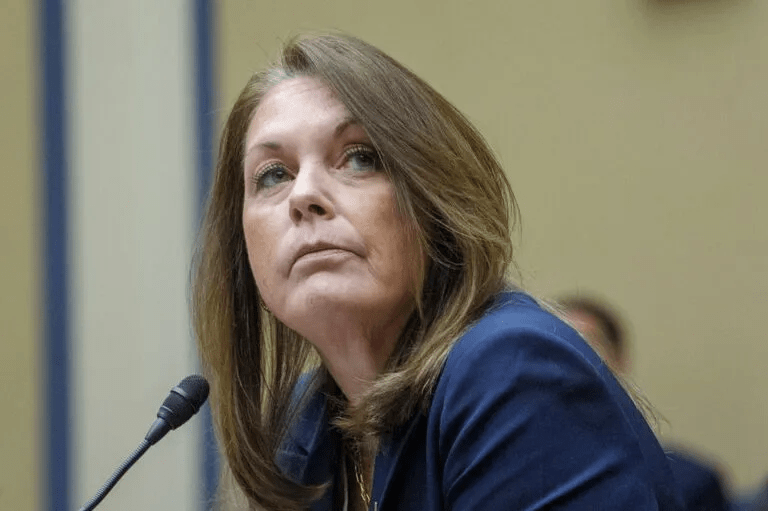
Colonel Christopher L. Paris, the Commissioner of the Pennsylvania State Police, and Patrick Yoes, the National President of the Fraternal Order of Police, are the witnesses scheduled for today’s hearing. Kim Cheatle, who was also anticipated to attend, resigned earlier and failed to show up for the hearing.
“The PSP is responsible for investigating one homicide and two attempted homicides of rally attendees, both state crimes under Pennsylvania’s Crimes Code, as well as the use of force by a United States Secret Service (USSS) sniper,” Paris said in his opening statement.
“Conversely, in accordance with the applicable provisions of the Federal Criminal Code, the FBI is responsible for investigating the attempted homicide of former President Trump. Due to these crimes stemming from the same sequence of events, the FBI and the PSP have combined investigative efforts. To date, over 100 interviews have been conducted and 1,000 pieces of evidence gathered.”
Last week, The Washington Times revealed:
FBI Director Christopher A. Wray has declined the House Homeland Security Committee’s request for him to testify Tuesday on the federal investigation into the attempted assassination of former President Donald Trump, a committee aide told The Washington Times.
Mr. Wray, however, has confirmed an appearance before the House Judiciary Committee on Wednesday.
The appearance is for the Judiciary’s annual FBI oversight hearing, but members plan to use it as an opportunity to question Mr. Wray about his agency’s investigation into the Trump assassination attempt.
A second hearing has been scheduled by the House Judiciary Committee for tomorrow, July 24, 2024, at 10:00 a.m. ET. The purpose of this hearing, “Oversight of the Federal Bureau of Investigation,” is to examine how the FBI handled the Trump assassination attempt.
The focus will also include claims that Attorney General Merrick Garland and FBI Director Christopher Wray are continuing to politicize the country’s top law enforcement organization.





 Econophysics2020