“This Is The Sharpest Turn In The Housing Market Since The 2008 Crash” As Mortgage Rates Soar Above 6%
THURSDAY, SEP 15, 2022 – 11:40 AM
And the hits just keep on coming for the US housing sector.
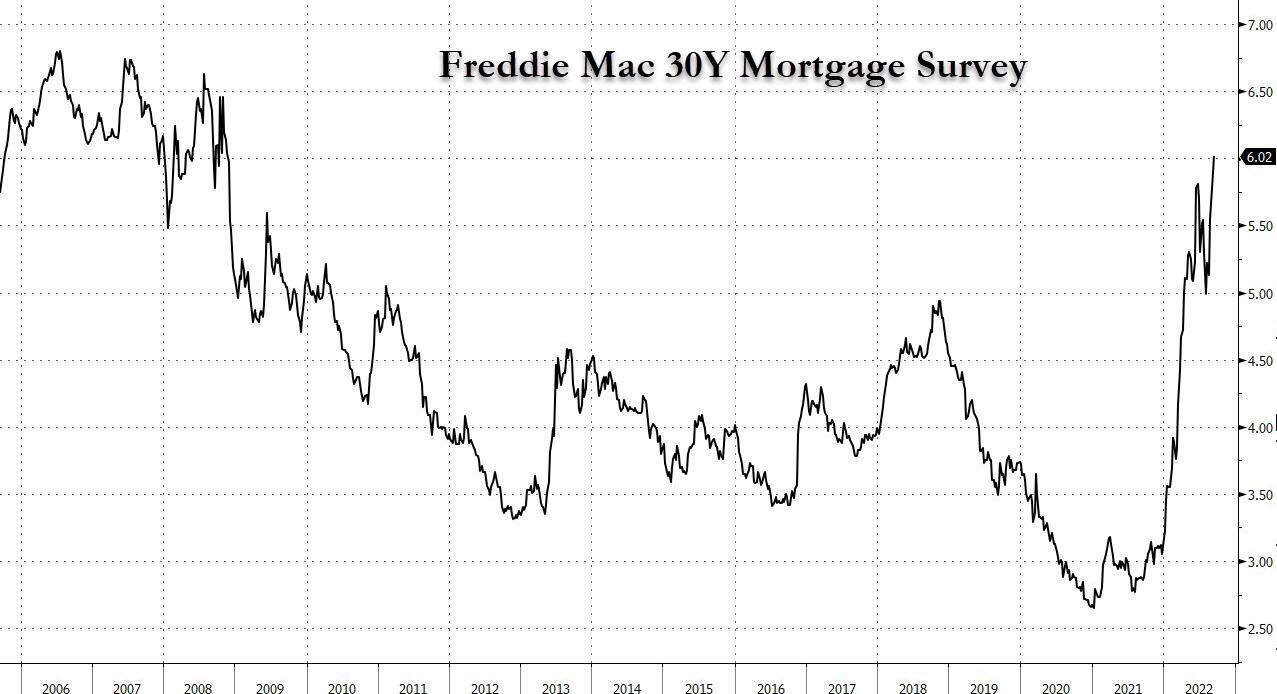
Three months after hitting the highest level in 14 years, on Thursday mortgage rates hit a fresh post-financial crisis high when they topped 6%, a jolt to home buyers who last year were paying less than half that.
The latest mortgage lender survey by Freddie Mac found that the average rate on a 30-year fixed mortgage climbed to 6.02% this week, up from 5.89% last week and 2.86% a year ago. The last time rates were this high was in the heart of the financial crisis in November 2008, when the U.S. was deep in recession.
The jump in mortgage rates – a welcome development by the US central bank which now wants to unleash a crippling recession on the US economy – is one of the most pronounced effects of the Federal Reserve’s campaign to curb inflation by lifting the cost of borrowing for consumers and businesses and crush demand for all levered purchases.
Already, it has ushered in a sea change in the housing market by adding hundreds of dollars or more to the monthly cost of a potential buyer’s mortgage payment, slowing what was a red-hot market not so long ago. Higher rates are forcing some would-be buyers to continue renting. Since the start of the year, the average mortgage payment has risen 38.5% to $2,306 from around $1,700 at the start of the year.
Other buyers are skimping elsewhere to make their mortgage payments.
Rising mortgage costs have been among the largest factors hampering affordability in the housing market recently. While home prices and rents have risen swiftly this year, rising mortgage costs have tipped the scales in favor of renting for many Americans.
The swift reversal in rates this year has brought tough times to the mortgage industry. Originations topped $4.4 trillion last year, but are expected to drop to just over half that in 2022, according to forecasts by the Mortgage Bankers Association, a trade group. Refinancings in particular have slowed down because higher rates erode the benefit for most homeowners. Refinancing activity is down more than 80% from a year ago, MBA said. Just 452,000 homeowners would be good candidates for a refinancing that lowers their rate by at least 0.75 percentage point, according to an analysis by Black Knight Inc., a mortgage technology and data provider. That is down from a peak of over 19 million in late 2020.
As the WSJ reports, would-be buyers like Desi Duncker and Victoria Lauture Duncker are waiting for the market to settle down before moving ahead. They and their daughter moved from Manhattan to Bloomfield, N.J., last year and rented while he introduced his family to the area, where he grew up.
They would like to buy but have been derailed by higher mortgage rates, rising home prices and a decline in the value of their investments, including bitcoin, Mr. Duncker said. Stocks and cryptocurrencies are down sharply this year, slowed in part by the Fed’s higher rates.
“Every possible factor that could have gone against buyers since January has happened,” Duncker said. He keeps a Google Doc with notes about buying and in June began noting that mortgage costs were becoming a problem. They might look to rent an apartment near the train station for now. He commutes into New York City for his job in finance at a tech company.
Meanwhile, despite the soaring mortgage rates, home prices continue to show large gains from a year ago, and as of July the median sales price for an existing was around $400,000 although it has dropped sharply since. Existing-home sales fell for six straight months through July, and the pace of price growth has decelerated.
And signs are pointing to an even sharper slowdown: the good news – so to speak – is that the Fed’s dream of sparking a crash is about to come true: in the four weeks that ended Sept. 4, homes on average sold for 0.3% below their final list price, according to Redfin, a real-estate brokerage. For the year-and-a-half before that, homes were generally selling above list price. The firm also said that home-touring activity is down 38% from the beginning of the year.
“This is the sharpest turn in the housing market since the housing market crash in 2008,” said Daryl Fairweather, Redfin’s Chief Economist.
“We haven’t seen interest rates this high since 2008, 2007, so it is a big change from the housing market we’ve all gotten used to,” Fairweather said.
“Buyers just don’t have the 40% extra money to put towards housing every month,” Fairweather said. “A lot of homebuyers had to drop out and go to the rental market instead or choose not to buy that second home or investment property.” Redfin said larger cities like San Francisco and Los Angeles are seeing the greatest impacts from this.
“When you’re talking about a $1.5 million home, that’s an extra thousand dollars a month towards a mortgage payment.”
In New Orleans, the president of the Metropolitan Association of Relators David Favret said there’s more homes on the market in his area than in the last two years.
On the flip side, Redfin also said now is still a good time to buy if you qualify for a mortgage because you can always refinance when mortgage rates go back down.
“If you find a house that meets all your needs and you’re going to stay in it for at least 5 years, it’s still a great time to buy,” Fairweather said.
Finally, when asked if we could enter another housing financial crisis, Redfin – which is in the housing business after all – said it’s unlikely.
“People who own homes right now are in a good financial position generally,” Fairweather said. “The criteria for getting a mortgage is really high. It’s not like during the housing market crash when people were getting mortgages they had no business getting.”
Fairweather did say, however, that if we do enter another recession, homebuyers need to consider if they’ll still be able to afford their home if they unexpectedly lose their job. The answer here should be obvious, and is why we are about to see a housing crash that will match if not surpass the bursting of the first housing bubble.
by Pepe Escobar, posted with the author’s permission and widely cross-posted
Wars are not won by psyops.
Ask Nazi Germany.
Still, it’s been a howler to watch NATOstan media on Kharkov, gloating in unison about “the hammer blow that knocks out Putin”, “the Russians are in trouble”, and assorted inanities.
Facts: Russian forces withdrew from the territory of Kharkov to the left bank of the Oskol river, where they are now entrenched. A Kharkov-Donetsk-Luhansk line seems to be stable. Krasny Liman is threatened, besieged by superior Ukrainian forces, but not lethally.
No one – not even Maria Zakharova, the contemporary female equivalent of Hermes, the messenger of the Gods – knows what the Russian General Staff (RGS) plans, in this case and all others. If they say they do, they are lying.
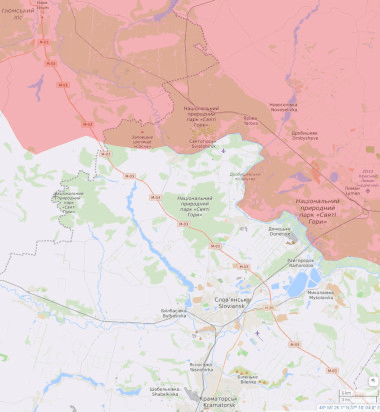
As it stands, what may be inferred with a reasonable degree of certainty is that a line – Svyatogorsk-Krasny Liman-Yampol-Belogorovka – can hold out long enough with their current garrisons until fresh Russian forces are able to swoop in and force the Ukrainians back beyond the Seversky Donets line.
All hell broke loose – virtually – on why Kharkov happened. The people’s republics and Russia never had enough men to defend a 1,000 km-long frontline. NATO’s entire intel capabilities noticed – and profited from it.
There were no Russian Armed Forces in those settlements: only Rosgvardia, and these are not trained to fight military forces. Kiev attacked with an advantage of around 5 to 1. The allied forces retreated to avoid encirclement. There are no Russian troop losses because there were no Russian troops in the region.
Arguably this may have been a one-off. The NATO-run Kiev forces simply can’t do a replay anywhere in Donbass, or in Kherson, or in Mariupol. These are all protected by strong, regular Russian Army units.
It’s practically a given that if the Ukrainians remain around Kharkov and Izyum they will be pulverized by massive Russian artillery. Military analyst Konstantin Sivkov maintains that, “most combat-ready formations of the Armed Forces of Ukraine are now being grounded (…) we managed to lure them into the open and are now systematically destroying them.”
The NATO-run Ukrainian forces, crammed with NATO mercenaries, had spent 6 months hoarding equipment and reserving trained assets exactly for this Kharkov moment – while dispatching disposables into a massive meat grinder. It will be very hard to sustain an assembly line of substantial prime assets to pull off something similar again.
The next days will show whether Kharkov and Izyum are connected to a much larger NATO push. The mood in NATO-controlled EU is approaching Desperation Row. There’s a strong possibility this counter-offensive signifies NATO entering the war for good, while displaying quite tenuous plausible deniability: their veil of – fake – secrecy cannot disguise the presence of “advisers” and mercenaries all across the spectrum.
Decommunization as de-energization
The Special Military Operation (SMO), conceptually, is not about conquering territory per se: it is, or it was, so far, about protection of Russophone citizens in occupied territories, thus demilitarization cum denazification.
That concept may be about to be tweaked. And that’s where the tortuous, tricky debate on Russia mobilization fits in. Yet even a partial mobilization may not be necessary: what’s needed are reserves to properly allow allied forces to cover rear/defensive lines. Hardcore fighters of the Kadyrov contingent kind would continue to play offense.
It’s undeniable that Russian troops lost a strategically important node in Izyum. Without it, the complete liberation of Donbass becomes significantly harder.
Yet for the collective West, whose carcass slouches inside a vast simulacra bubble, it’s the pysops that matters much more than a minor military advance: thus all that gloating on Ukraine being able to drive the Russians out of the whole of Kharkov in only four days – while they had 6 months to liberate Donbass, and didn’t.
So, across the West, the reigning perception – frantically fomented by psyops experts – is that the Russian military were hit by that “hammer blow” and will hardly recover.
Kharkov was preciously timed – as General Winter is around the corner; the Ukraine issue was already suffering from public opinion fatigue; and the propaganda machine needed a boost to turbo-lubricate the multi-billion dollar weaponizing rat line.
Yet Kharkov may have forced Moscow’s hand to increase the pain dial. That came via a few well-placed Mr. Khinzals leaving the Black Sea and the Caspian to present their business cards to the largest thermal power plants in northeast and central Ukraine (most of the energy infrastructure is in the southeast).
Half of Ukraine suddenly lost power and water. Trains came to a halt. If Moscow decides to take out all major Ukraine substations at once, all it takes is a few missiles to totally smash the Ukrainian energy grid – adding a new meaning to “decommunization”: de-energization.
According to an expert analysis, “if transformers of 110-330 kV are damaged, then it will almost never be possible to put it into operation (…) And if this happens at least at 5 substations at the same time, then everything is kaput. Stone age forever.”
Russian government official Marat Bashirov was way more colorful: “Ukraine is being plunged into the 19th century. If there is no energy system, there will be no Ukrainian army. The matter of fact is that General Volt came to the war, followed by General Moroz (“frost”).
And that’s how we might be finally entering “real war” territory – as in Putin’s notorious quip that “we haven’t even started anything yet.”
A definitive response will come from the RSG in the next few days.
Once again, a fiery debate rages on what Russia will do next (the RGS, after all, is inscrutable, except for Yoda Patrushev).
The RGS may opt for a serious strategic strike of the decapitating kind elsewhere – as in changing the subject for the worse (for NATO).
It may opt for sending more troops to protect the front line (without partial mobilization).
And most of all it may enlarge the SMO mandate – going to total destruction of Ukrainian transport/energy infrastructure, from gas fields to thermal power plants, substations, and shutting down nuclear power plants.
Well, it could always be a mix of all of the above: a Russian version of Shock and Awe – generating an unprecedented socio-economic catastrophe. That has already been telegraphed by Moscow: we can revert you to the Stone Age at any time and in a matter of hours (italics mine). Your cities will greet General Winter with zero heating, freezing water, power outages and no connectivity.
A counter-terrorist operation
All eyes are on whether “centers of decision” – as in Kiev – may soon get a Khinzal visit. This would signify Moscow has had enough. The siloviki certainly did. But we’re not there – yet. Because for an eminently diplomatic Putin the real game revolves around those gas supplies to the EU, that puny plaything of American foreign policy.
Putin is certainly aware that the internal front is under some pressure. He refuses even partial mobilization. A perfect indicator of what may happen in winter is the referenda in liberated territories. The limit date is November 4 – the Day of National Unity, a commemoration introduced in 2004 to replace the celebration of the October revolution (it already existed in imperial times).
With the accession of these territories to Russia, any Ukrainian counter-offensive would qualify as an act of war against regions incorporated into the Russian Federation. Everyone knows what that means.
It may now be painfully obvious that when the collective West is waging war – hybrid and kinetic, with everything from massive intel to satellite data and hordes of mercenaries – against you, and you insist on conducting a hazily-defined Special Military Operation (SMO), you may be up for some nasty surprises.
This is an existential war. A do or die affair. The American geopolitical /geoeconomic goal, to put it bluntly, is to destroy Russian unity, impose regime change and plunder all those immense natural resources. Ukrainians are nothing but cannon fodder: in a sort of twisted History remake, the modern equivalents of the pyramid of skulls Timur cemented into 120 towers when he razed Baghdad in 1401.
If may take a “hammer blow” for the RSG to wake up. Sooner rather than later, gloves – velvet and otherwise – will be off. Exit SMO. Enter War.
All have fallen for the believe that the Ukrainian rapid advance has caused a Russian defeat. That however is not the case.
The main Russian forces had already left the area. What was left were sentry guards of the Luhansk People’s Republic and a few companies of the Russian National Guard which is more or less a police force. That is why the ‘western’ official talking with Reuters is quite cautious with his assessment:
“There’s an ongoing debate about the nature of the Russian drawdown, however it’s likely that in strict military terms, this was a withdrawal, ordered and sanctioned by the general staff, rather than an outright collapse.” … “Obviously, it looks really dramatic. It’s a vast area of land. But we have to factor in the Russians have made some good decisions in terms of shortening their lines and making them more defensible, and sacrificing territory in order to do so,” the official said, adding he did not expect Russia to immediately seek to regain lost territory.
The main Russian reason for holding onto Izium southeast of Kharkov was to use it as a springboard to attack Sloviansk and Kramatorsk along the M-03 highway. However over the last months several Russian attempts to cross the Siverski Donets river south and east of Izium and to establish a bridgehead on the southern side had failed.
The Ukrainians were well established in the ‘Sherwood Forest’ on the southern side and had defeated all attempts to push a larger Russian forces into the area. (According to Yves Smith Alexander Mercouris had made that point and predicted a Russian withdrawal from Izium in one of his shows before the Kharkov ‘counteroffensive’ started.) I myself had missed that point.
The region, which is sparsely populated (Izium had a pre-war population of some 40,000), has little additional value. Russian forces that had been there shortly after the war began had been pulled out over time to rotate into other areas.
According Colonel Markus Reisner from the Austrian military the Ukraine used six full brigades (vid) in its attack. If Russian Defense Ministry numbers are halfway right the Ukrainian forces lost some 4,000+ soldiers, nearly two brigades, in the attack. These were troops that ran into areas that the Russian artillery had pre-registered. They received barrage after barrage and were destroyed.
The Russian air force caused additional damage. Hundreds of tanks and armored vehicles the ‘west’ had delivered to Ukraine were destroyed. Talk of large Russian material losses and of thousands of Russians taken prisoners of war are nonsense.
One Washington Post piece today cites a partisan ‘open source’ organization about the losses:
According to preliminary estimates from Jakub Janovsky, a military analyst and contributor to the Oryx blog tally of equipment losses, Russia lost 40 tanks, 50 infantry vehicles, 35 armored vehicles and two jets.
The equipment left behind in the video amounts to about a tank company, Hodges said, which is typically outfitted with about 10 or 11 tanks. … Another video, taken along a street in central Izyum, shows a marooned 2S19 Msta self-powered howitzer. The system does not have obvious signs of being disabled.
Other pictures taken in Izyum show heavier damage to Russian military equipment, indicating they were hit in battle. One armored vehicle can be seen at a gas station in the city with bullet holes, burn marks and deflated tires.
Ukrainian forces published a video showing the husk of a TOS-1A, a multiple-rocket launcher, using its nickname “Solntsepyok.”
Given the huge areas that does not sound like large losses. British ‘intelligence’ claims that the 1st Guards Tank Armywas destroyed in the attack are ludicrous. The 1st Guard has the equivalent of about 20 brigades with some hundred tanks and armored vehicles in each. Its units were not even in the area when the attack happened.
As Larry Johnson has laid out, planning for a withdrawal from a large area takes time. The Russian decision to let go of the Kharkov region must have been made before the Ukrainian counterattack was launched. That it was coming was known. Since mid of August the deployment map by Military Land showed strong tank formations south and west of the Izium area. The Russians had reported attacks on those and other units on a daily base. Dima of the Military Summary channel had mentioned them several times.
When the counterattack happened the Russian forces pulled back to the eastern side of the Oskol river and are now protected by it. At the southern end, near Lyman, the Siverski Donets river is used to cover the Russian forces. These are strong positions, hard to attack, that can be held by a limited force.Current situation:
I had expected that Russia would draw in the attacking Ukrainian forces to then cut them off. But it did not had the forces, or interest, to do so now. It had instead ordered a withdrawal. The use of artillery and air force to attack the Ukrainian forces while they were still on the roads, attacking an enemy that was no longer there, has proved to be the right decision.
Colonel Reisner, linked above, says the first ‘counteroffensive’ in the south against Kherson was a major failure that has cost many Ukrainian lives. Another military professional, Lt.Col.(ret) Daniel Davis agrees:
When Putin prioritized the capture of the Donbas as his primary objective, the Kremlin conducted what’s known as “economy of force” missions in the north around Kharkiv and in the south near Kherson. The intent of the Russian missions in the north and south was to use as few troops as possible to keep the UAF tied up so that they could not move more troops to the Donbas to resist Russia’s offensive there. Russia then thinned its defenses even more in late August to deploy more troops to defend against the known offensive about to start near Kherson. … The additional Russian troops in Kherson appear to have helped Moscow’s forces inflict grievous casualties on the Ukrainian attackers in the Kherson region but fatally weakened Russian defenses in the Kharkiv region.
When the Ukrainian troops shocked the Russian defenders at the start of the Kharkiv offensive, the Russians began to surrender territory quickly. They not only had few troops left in the area, but those troops were mainly volunteers. Moscow began frantically sending reinforcements to try and stem the tide, but Ukraine advanced faster than Russia could get reinforcements in place. The Russian leadership was faced with a conundrum: order its troops to contest every meter of territory in an attempt to buy time for reinforcements to arrive, or evacuate the area and preserve its manpower for future fights.
They chose the latter. Russia not only surrendered Izyum without a fight but later evacuated nearly the whole of the territory they occupied north of Kharkiv all the way to the Russian border, up to 3,000 total square kilometers back under Ukrainian control. Many in the West are hailing this move as proving Ukraine is well on its way to winning the war and might even result in the downfall of Vladimir Putin. A little context might be helpful before making such sweeping judgments.
Daniel Davis says that “Moscow began frantically sending reinforcements to try and stem the tide”. He must refer to the video, released by the Russians, that showed armored air-mobile forces landing in huge Mi-26 helicopters. But Colonel Reisner says that those helicopters landed east of the Oskol river. The troops they carried never went into battle in the Kharkov region. The helicopter video was a deception as there was nothing left in the Kharkov region to reinforce.
Davis concludes:
Ukraine has likely expended the majority of its striking power in these twin offensives, suffered many casualties, and will require considerable replenishment and replacements before being able to go much further (there are reports that a smaller Ukrainian attack may be in the offing for Ugledar [southwest of Donetsk] but as of this writing none has materialized).
I also still expect another Ukrainian attack in southern Donbas region. But the Russian forces there were reportedly reinforced by the new 3rd Russian corps. Those are some 30-50,000 Russian veterans called up to form a new formation. They will likely be able to withstand anything the Ukraine can throw against them.
Adding:
Yves just published a writeup on the more political side of things. Scholz continues to be one of the dimmest guys in this game:
UNDERSTANDING PLANNING, ORDERS AND TROOP MOVEMENTS IN UKRAINE
10 September 2022
PATTON, the movie, was a masterpiece of entertainment. It is not historically accurate on many points and that is a problem with respect to Ukraine. What? I suspect some of you believe I have really crossed over to crazy land, but hear me out. Remember that scene when the Germans launched the Battle of the Bulge in December 1944 and Patton saved the day by “immediately” diverting his Army 90 degrees to head north and rescue the beleaguered paratroopers of the 101st and 82nd airborne divisions (note, the paratroopers insisted they did not need to be rescued, but that’s another story for another day)?
That cinema account of how Patton planned and shifted the axis of attack of his troops is presented as something hastily put together. The German offensive started on 16 December and Patton met with Eisenhower on the 19th of December and received orders to relieve Bastogne. Patton’s troops moved out on the 22nd of December and reached Bastogne on the 26th. What the movie account fails to convey is that the planning for moving his Army north began on December 9, ten days before the emergency conference with Eisenhower.
By the end of October four panzer divisions had been identified refitting near Paderborn, far north of the Third Army’s left boundary.
By November 10 the Germans had pulled five more panzer divisions out of the line.
Of the fifteen panzer divisions in the west, only five remained in contact in mid-November.
Starting November 17, aerial reconnaissance detected huge German rail movements to the north of the Third Army’s projected zone of advance—226 trains on November 18 alone.
By November 23 Koch had identified the newly established Sixth Panzer Army, including five of its reconstituted panzer divisions.
On December 2 the U.S. Seventh Army, to the south of Third Army, reported that the formidable Panzer Lehr Division was out of the line.
By December 7 the Germans were holding at least thirteen divisions in reserve.
(I encourage you to read the whole article about the real story of Patton’s rescue effort at the link above.)
So why is this important? The process any first world army (e.g., United States, Russia, Ukraine) follows in moving troops and equipment from one point to a distant location follows a well-defined planning process.
The planning process Patton followed is similar to what the U.S. military uses today. The current system is known as the Joint Operation Planning and Execution System aka JOPES. I have been involved in scripting and executing over 240 crisis response exercises. I worked for 23 years for the man who wrote JOPES, so I have some insight to the process. He beat it into me. It starts with an Alert Order (e.g. Be Prepared to Act) usually followed Warning Order (e.g., Houston we have a specific problem, tell us how you plan to solve it). The military command that receives the warning order immediately tasks it staff to prepare Courses of Action aka COAs.
Those COAs are then sent back via a written message laying out what forces would be used, what resources (i.e., air support, artillery, vehicles, medical, etc.) are required to carry out the COA. The COA for organizing and deploying a Special Operations unit is much easier and less time consuming than that required to organize and deploy battalions and regiments of soldiers.
Once the COA is approved the relevant military units receive a Deployment Order. It means what it says. The military units identified for action start moving via train, truck or plane. Depends on the operation. But they are moving into place and do not initiate action until they commanders receive an Execution Order.
Since the United States and NATO are involved directly with Ukraine’s military planning, I am certain they followed the JOPES process. That means the planning for the Kharkov offensive probably started the first of September, perhaps even earlier, i.e. July or August. Assembling and moving the men and equipment to deployment points took some time. It was not done overnight.
I am not familiar with the Russian planning system, but I am pretty sure the Russians follow a similar procedure to JOPES. It is important to understand this with reference to the offensive taking place around Kharkov. The Russian forces started moving into the area on Thursday, 8 September. And we are talking about hundreds of trucks, tanks, towed artillery and troops.
So, was Russia caught by surprise? No. They had at least one week’s warning of the impending Ukrainian attack. If you want to believe that Russia’s intelligence service is incompetent or was deceived in this operation, enjoy the fantasy. The Russian planners had a couple of choices. They could have moved their forces into position earlier but that would have tipped off the Ukrainians and west that the planned offensive was compromised.
Alternatively, the Russian planners may have decided to mask their movements and made choices about which villages and cities to defend and which to abandon. If Russia had moved preemptively to reinforce Izyum that would have raised warning flags for the Ukrainian and NATO planners.
I agree with Andrei Martyanov’s take–the Russians knew it was coming and chose to let the Ukrainians flood the zone in order to eventually hit the Ukrainian forces with a massive counter attack. The Ukrainians are no longer in fortified defensive positions and their lines of communication to support the forward troops are now defined precisely. The Ukrainian attack has not destroyed nor disrupted Russia’s air, artillery, rocket and missile assets. Attacking the Ukrainian units is an easier task, not more difficult.
I am not privy to the Russian plan. But what I do know is that the planning process required to deploy the troops and equipment moving into Kharkov was not a panicked response. Hollywood can create the illusion of rapid movement of military troops, but the real world requires alerting units, making sure they are properly supplied and then undertaking the logistic task of moving those units into combat. This means the planning was deliberate, not a crisis response.
In the middle we can see the Oskol river flowing north to south. Along it run railway tracks and roads that connect Izium region at the bottom of the map with Urazovo in Russia (further north, not on the map).
Here is the situation in the same area on the morning of September 9.
The Ukrainian forces have broken through the Russian positions on a wide front and in remarkable depth.
The above maps are from the Ukraine friendly site LiveUAmap. On the Russian side’s map, as provided by Dima in his latest video, the Ukrainians are shown even further east and have reached the Oskol river.
This is latest Rybar version of the map which confirms that the Ukrainian side has at least in part reached the river. They took the town of Senkovo on the western side of it.
bigger (German version as the English one does not load correctly.)
Izium, Lyman and several other important positions along the Izium front are now in imminent danger of losing their main supply route.
How could this happen?
Well, I am not in the Russian high command and have no idea of the how and why.
But what we know is that there were mostly conscripted men of the Luhansk Peoples Republic at the frontline when this episode started. The troops that held the town of Balakleya for two days where Russian National Guard forces. Those are militarized police units, not real armed forces. The Russian military had to send army forces to evacuate them.
Apparently the whole Russian front in that area was very thin and had too little artillery support. The Ukrainians moved extremely fast skipping towns and just blocking off local resistance to move on. They had a very significant number of tanks and armored transport as well as long range artillery support by several HIMARS systems. Many of the units must also have had night vision equipment as they did not stop even after sunset. There are also reports of strong foreign elements but those are hard to verify.
The LPR forces and whatever else was in the area had no chance. They were killed or captured or moved out.
The Russian side seems to have had little information about the size of the attack. The forces in the area were too few and too light. There should have been way more forces to block the Ukrainian move much earlier.
Then again – I do not know what plans the Russian military has had or might have. We might still see surprises.
Armored Russian reinforcements are now coming in from the north from the northern Kharkov region as well as from the east through Svatove. But they will still need some time to reach the front lines and to set up for battle.
The best countermove is likely to move the battle group seen in Svatove down to Izium and then up northwest and the group from the north southward in an attempt to pincer and envelope the Ukrainian forces.
Going this deep and this fast makes the attacking Ukrainian troops vulnerable. They will need some time to consolidate and to move up their artillery. Their supplies will have to come from Andivka on the left of the map and from Chuhuiv on the upper left. That are some 75 kilometer or 45 miles one way distances.
The Russian missile forces can interdict those routes by destroying the bridges along the way. They should do this as soon as possible. Andivka itself is surrounded by a river in the south, west and north. The handful of bridges over the river should also be dropped to cut the town off.
Ukrainian forces south of Izium and Lyman try to cross the Siversky Donets river to attack those cities from another direction. The idea is likely to bind the Russian forces there and to not let them move north to counter the upper Ukrainian strike.
There may be some ingenious Russian plan behind this to drag the Ukrainian forces in to then destroy them in place. But I do not see any evidence for that.
The “Scariest Paper Of 2022” Reveals The Terrifying Fate Of Biden’s Economy: Millions Are About To Lose Their Job
For much of the past year (and certainly at the time, more than a year ago, when the so-called experts, central bankers and macrotourists were still yapping about “transitory inflation” and other things they were wrong about and do not understand), we were warning that at some point the Fed will realize that it is simply impossible to contain supply-driven inflation through stubborn rate hikes which instead would lead to a dire alternative – millions in mass layoffs and newly unemployed workers …
3 mass layoff announcements in the past 3 hours, meanwhile 12 hikes priced in through February. pic.twitter.com/7Q4wfP9J79
… and will revise its 2% inflation target higher, a move which will send every risk asset – from high-beta trash and meme stonks, to blue-chip icons, to bitcoin and cryptos limit up.
To remind readers of this coming phase shift, we most recently warned in June that “at some point Fed will concede it has no control over supply. That’s when we will start getting leaks of raising the inflation target“…
At some point Fed will concede it has no control over supply. That's when we will start getting leaks of raising the inflation target
Well, it turns out that we were right, and not just about the coming mass layoffs, but also about the inflation target leaks. But first, lets back up a bit.
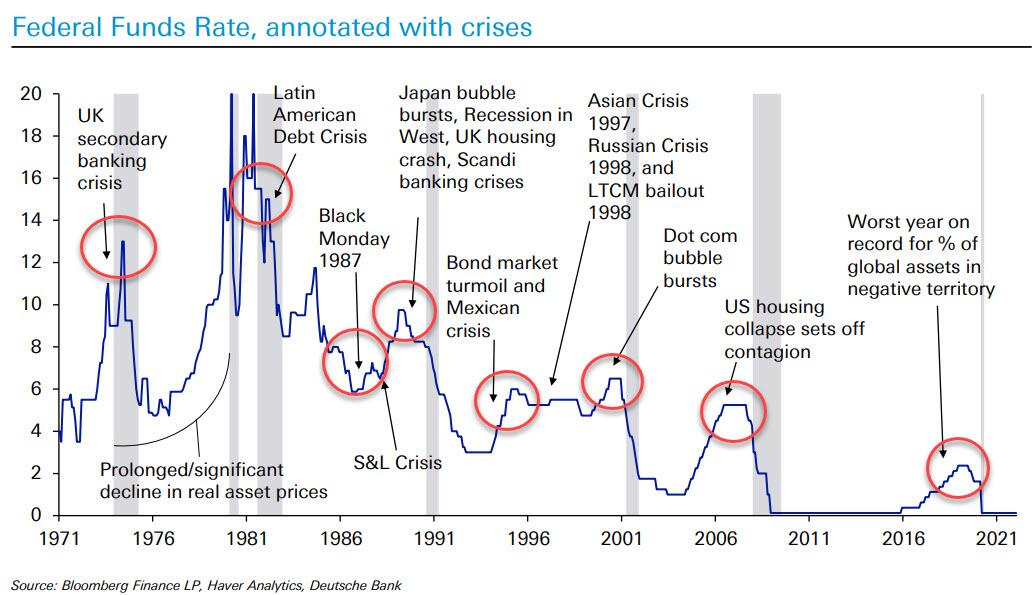
A little over one year after nobody expected the Fed would be hiking rates like a drunken sailor until some time in late 2023 or 2024, it has now become fashionable to not only predict that the Fed will keep hiking rates at every FOMC meeting and at the fastest pace since the near-hyperinflation of the 1980s, but that the central bank will somehow manage to avoid a hard landing (i.e., the hiking cycle won’t end in a recession or depression), even though every single Fed tightening cycle since 1913 has ended in disaster.
An example of this was the statement by former Fed vice chair (and PIMCO’s “twice-revolving door”) Rich Clarida, who told CNBC that “failure is not an option for Jay Powell,” adding that “I think they’re going to 4% hell or high water. Until inflation comes down a lot, the Fed is really a single mandate central bank.”
"Failure is not an option for Jay Powell," says Former Fed Vice Chair Richard Clarida. "I think they're going to 4% hell or high water. Until #inflation comes down a lot, the Fed is really a single mandate central bank." pic.twitter.com/4hfLCVWZDP
Of course, if one could hike rates in a vacuum that could work – after all, Clarida himself, who admits he got this year’s soaring inflation dead wrong when he was still a daytrading god and part oft he Fed in 2021, said that the Fed may as well have just one mandate, namely to tame inflation. But what so few seem to recall is that the Fed is “hiking to spark a recession“, or as CNBC’s Steve Liesman put it, there is no such thing as “immaculate rate hikes” meaning that rate hikes have dire tradeoffs in other sectors of the economy. In other words, if the Fed’s intention is to spark a recession, it will spark a recession… leading to millions of Americans losing their jobs, something which even Elizabeth Warren appears to have grasped.
SENATOR WARREN SAYS SHE IS VERY WORRIED THAT FED IS GOING TO TIP ECONOMY INTO RECESSION
Yet due to the recency bias of Biden’s trillions in stimmies, and a world where workers – whether working form home or the office – have virtually all the leverage, few today can conceive of a world where inflation is zero or negative and is instead replaced with millions in unemployed workers, an outcome which one could (or rather should) say is even worse for the ruling democrats than roaring inflation. At least, with runaway prices, most people have a job and their wages are rising (at least nominally, if not in real terms).
However, the higher rates rise, the closer we get to that inevitable moment when the BLS – unable to kick the can any longer – admits what has been obvious to so many for months: the US is facing a labor crisis of epic proportions with millions and millions of mass layoffs. And for those to whom it is not yet obvious, we urge to read a WSJ op-ed published by none other than Jason Furman, who is not some crackpot republican but Obama’s own top Economic Adviser from 2013-2017 and currently economic policy professor at Harvard.
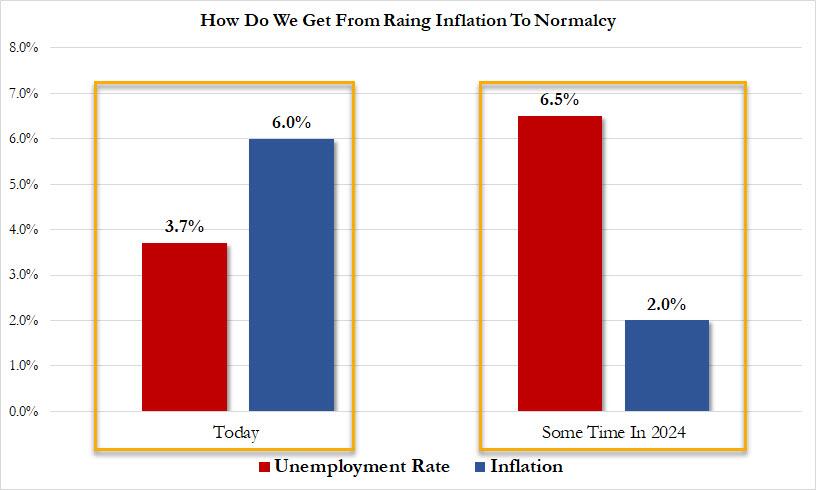
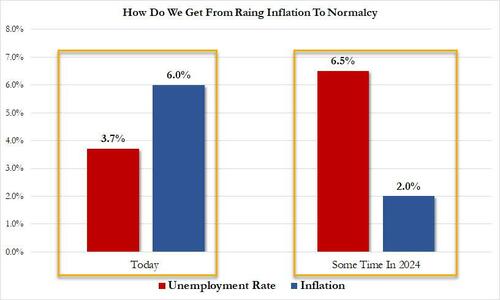
In “Inflation and the Scariest Economics Paper of 2022“, Furman summarizes a paper written by Johns Hopkins macroeconomist Larry Ball with co-authors Daniel Leigh and Prachi Mishra of the International Monetary Fund released by the Brookings Papers on Economic Activity, whose conclusion is as follows: “To bring price increases down to 2%, we may need to tolerate unemployment of 6.5% for two years.“
In other words, just as we said, inflation – much of which is supply-driven, which the Fed can do nothing about – will force the Fed to crush the economy by keeping rates for much longer, the result of which will be many millions in unemployed workers, or as Furman puts it, the paper “shows why the Federal Reserve will likely need to maintain its war on inflation, even if unemployment continues to rise.”
What is more remarkable about Furman’s read of the economist paper is that in addition to its primary theme (the lack of labor slack, or labor tightness, is responsible for some 3.4% of underlying inflation in July 2022), the paper admits precisely what we have been saying all along – that the Fed can’t control supply-side variables:
The paper also argues, convincingly in my view, for a different measure of underlying inflation. Fluctuations in energy and food prices are generally due to factors outside the control of macroeconomic policy makers. Geopolitics and weather have elevated the inflation rate in recent years. Plunging gasoline prices are temporarily lowering the inflation rate now. That’s why economists since the 1970s have focused on “core” inflation, which excludes food and energy.
But food and energy aren’t the only things people buy that are subject to supply-side volatility. Prices of new and used cars, for example, have gyrated over the past two years for reasons that are mostly unrelated to the strength of the overall economy. Both regular and core inflation are based on taking averages of price increases and can be distorted by large changes in outlier categories. The median inflation rate calculated by the Federal Reserve Bank of Cleveland drops outliers to remove these distortions.
According to Furman, median inflation – which is a statistically better measure of the underlying inflation that policy makers can actually control – is well above the Fed’s preferred headline inflation print (which fell to zero in July on a sequential basis and has stabilize) and shows no sign of moderating and has run at a 6.6% annual rate in the last three months.
But the “scariest” part of the new paper, Furman reveals, is when the authors use their model to forecast the unemployment rate that would be needed to bring inflation down to the Fed’s 2% target. He explains why this is so scary:
The authors present a range of scenarios, so I ran their model using my own assumptions… Under these assumptions, which are more optimistic than the authors’ midpoint scenario, if the unemployment rate follows the Federal Open Market Committee’s median economic projection from June that the unemployment will rise to only 4.1%, then the inflation rate will still be about 4% at the end of 2025. To get the inflation rate to the Fed’s target of 2% by then would require an average unemployment rate of about 6.5% in 2023 and 2024.
Under these scenarios if the unemployment rate rises to 4.1% then inflation will stay above 3%. If it rises to 7.5% then inflation will slightly undershot the Fed's target.
The unemployment rate needed to hit the Fed's target in this scenario is 6.4%. pic.twitter.com/ysUDUU6yaG
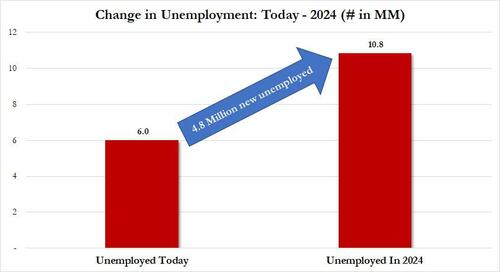
Where is unemployment now: it’s 3.7% (6.014 million unemployed workers vs 164.746 million civilian labor force). This matters, because according to one of the most erudite economist Democrats, by the end of the Biden admin in 2024, the unemployment will have to soar to 6.5% for inflation to plunge to the Fed’s historical target of 2.0%
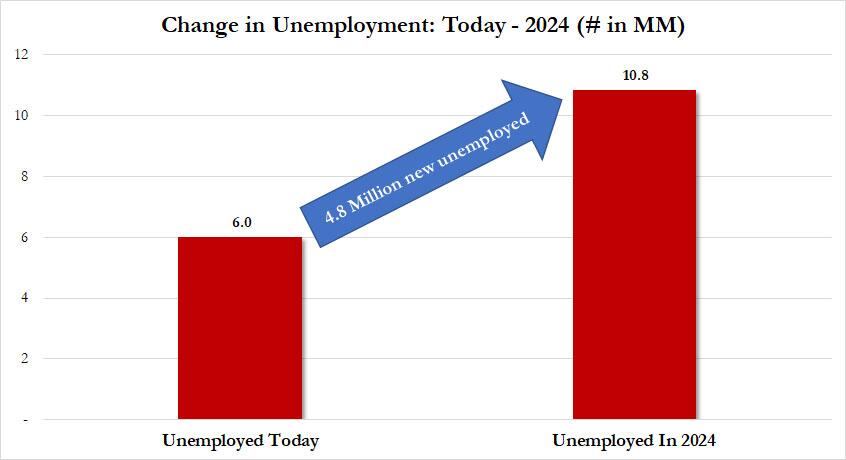
What does this mean in absolute numbers? Assuming a modest increase in the US labor force, a 6.5% unemployment rate in 2024 would translate into no less than 10.8 million unemployed workers, an 80% increase from the 6 million today!
Still think that politicians – and especially Democrats – will sit quietly and blindly ignore how high the Fed is hiking rates if it means that to normalize inflation back to 2% it means nearly doubling the number of unemployed Americans (and a crushing recession to boot). Spoiler alert: no, they won’t, and this may be one of the very rare occasions when Elizabeth Warren is actually right to worry about what the coming mass layoff wave means for Democrats… and the 2024 presidential election.
So what should the Fed do? Well, according to Furman, the Fed has four options:
First, place more emphasis on the ratio of job openings to unemployment and median inflation as it assesses the tightness of labor markets and the underlying rate of inflation.
Second, the new paper shows how much easier it will be to tackle inflation if expectations remain under control. The Fed should follow up on Chairman Jerome Powell’s tough talk at Jackson Hole with meaningful action such as a 75-basis-point increase at the next meeting.
Third, be prepared to accept the unemployment rate rising above 5% if inflation is still out of control.
While we doubt #3 is actionable, what is more remarkable is Furman’s final proposal: it’s the one that, like the Dude’s proverbial rug, ties the room together and sets the stage for what is coming:
Finally, stabilizing at a 3% inflation rate is probably healthier for the economy than stabilizing at 2%—so while fighting inflation should be the central bank’s only focus today, at some point the Fed should reassess the meaning of victory in that struggle.
And just in case his WSJ proves too complicated for some mainstream experts and economists, here it is in truncated, twitter format:
(iii) Seriously consider raising the inflation target to something like 3 percent
This one is tricky. On a blank slate a 3% target would be better than a 2% target. But shifting to that could deanchor expectations.
And there you have it: remember what we said on June 21: “At some point Fed will concede it has no control over supply. That’s when we will start getting leaks of raising the inflation target.” Well… there it is.
And while mainstream economists and the market may require quite a few months to grasp what is coming, it is the only way out of a crisis of commodities – as Zoltan has repeatedly and correctly put it – and which central banks have no control over, and thus will have to move not only the goalposts but the entire football field to avoid a social revolt or something even scarier.
While we wait, we can’t help but snicker at what the 79-year-old figurehead in the White House tweeted today…
My first two years in office spurred the strongest economic recovery in recent history. Today, I'm releasing my Economic Blueprint, a look at how our wins are rebuilding an economy that works for working families.https://t.co/eSlr3ymdo8
… because what Biden calls “the strongest economic recovery in recent history” is – even according to Democrats – about to be the biggest economic disaster in modern history.
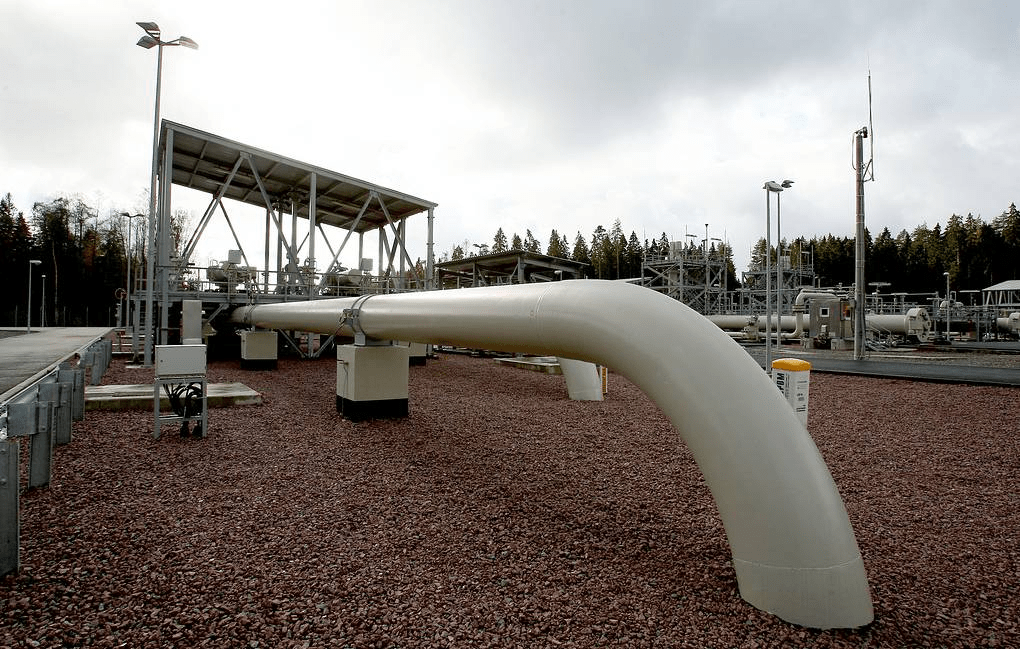
According to the Russian president, Nord Stream 1 is currently virtually closed, and the West claims that Moscow is using the gas pipeline as an energy weapon.
VLADIVOSTOK, September 7. /TASS/. Russia is ready to start pumping gas through the Nord Stream 2 pipeline, Russian President Vladimir Putin said on Wednesday at the Eastern Economic Forum.
“We are not building anything for no reason. We have received and perfected the necessary technology. We will turn on Nord Stream 2 if necessary,” Putin said.
According to him, Nord Stream 1 is currently virtually closed, and the West claims that Moscow is using the gas pipeline as an energy weapon. “Nonsense. We supply as much as our partners need – we fulfill whatever they put in the application,” Putin added.
Organized by the Roscongress Foundation, the Seventh Eastern Economic Forum will be running from September 5 to September 8 in Vladivostok. TASS is the event’s general information partner and its official photohost agency. This year, the theme of the forum is: “On the Path to a Multipolar World.”
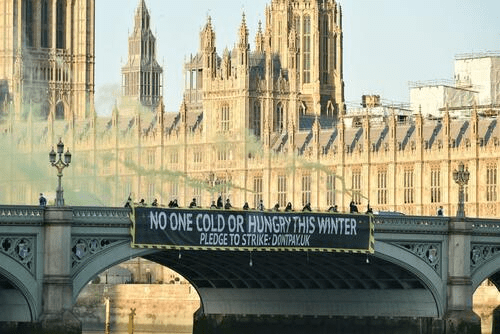
Leaked Paper Shows UK Cops Preparing For “Greater Civil Unrest” This Winter
New Prime Minister Liz Truss may have only weeks to deliver a confidence turnaround in the UK economy or face a surge in violent crime and breakdown in public order caused by a cost-of-living crisis.
The Times revealed police chiefs fear “economic turmoil and financial instability” has the “potential to drive increases in particular crime types,” such as shoplifting, burglary, vehicle theft, and online fraud and blackmail, as Brits face one of the worst collapses in living standards in a century amid energy hyperinflation.
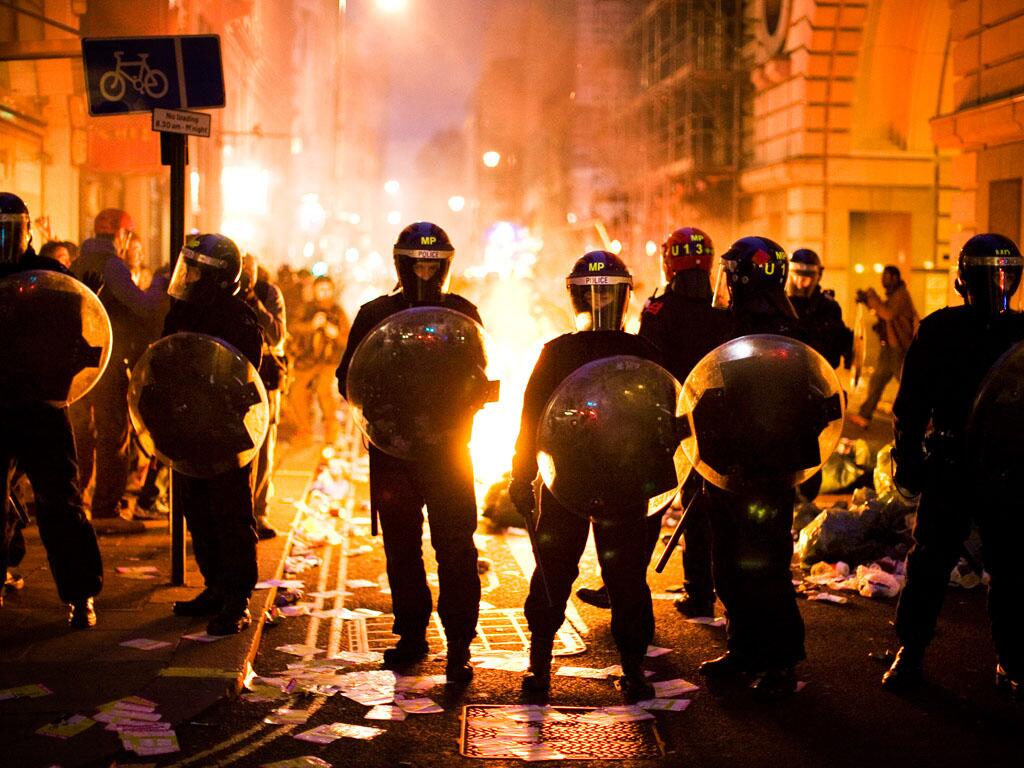
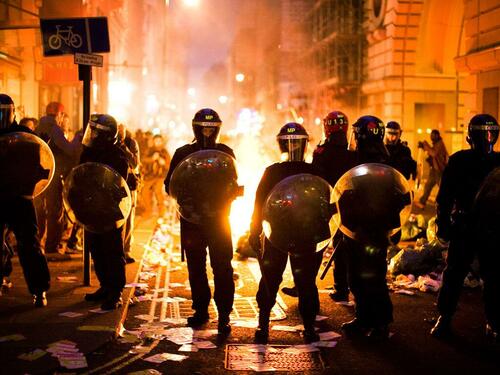
“Prolonged and painful economic pressure” could spark “greater civil unrest,” similar to the 2011 London riots, the leaked national strategy paper read.
“Greater financial vulnerability may expose some staff to a higher risk of corruption, especially among those who fall into significant debt or financial difficulties,” it continued.
One police chief noticed increased violent crime as inflation is stuck at multi-decade highs. This comes as energy regulator Ofgem increased the cap on power bills to a record £3,549 ($4,189) beginning Oct. 1 from £1,971 ($2,330). That cap is expected to rise to £5,439 ($6,427) by January and £7,272 ($8,594) by spring.
Besides police, energy executives warned that mass civil unrest looms as people cannot afford their heating and electricity bills this winter.
Last Friday, Russia’s energy giant Gazprom PJSC halted flows via Nord Stream 1 to Europe, sending EU natural gas and electricity prices soaring on Monday. This means Truss hardly has any time to deliver a coherent strategy to save households from energy poverty and businesses from failing.
The massive protest in Prague this past weekend, where tens of thousands of Czechs flooded the streets, offers a glimpse of the impending social unrest that could hit the street of the UK if power bills continue rising without government intervention.
Published last week was a new report via Verisk Maplecroft, a UK-based risk consulting and intelligence firm, warning there’s a high risk of social unrest in Europe later this year due to rising inflation.
Europeans are finally waking up to how bad Western sanctions on Russia have backfired, as their governments sacrificed ordinary people over NATO’s proxy fight against Russia in Ukraine. These protests could spread like wildfire across Europe, and it appears the UK is preparing for the worst-case scenario.
By a narrow margin Boris Johnson’s clownish Defense Minister Liz Truss will become the next Prime Minister of the United Kingdom. She doesn’t have a lot of time to put together a government lest the U.K. have to suffer through yet another general election.
Truss, by virtue of her full-throated support for Ukraine against Russia, was the choice of those Tories committed to maintaining the UK’s relationship with the US, leaving it nominally more independent from the European Union.
Davos man-child Rishi Sunak, the darling of the Remainers of City of London the true hounds of winter here, failed to overtake Truss in the end. What started as a Davos-style decapitation of Johnson, who rightfully deserves to be jailed for his undermining Russian/Ukrainian peace talks in April, ended with the female version of him in office.
While I’d like to say I’m happy to see Davos lose another major conflict in Europe, empowering the US neoconservatives is not a win here. In the end, the deep ties between the US and UK intelligence and military services won out in the Tory leadership battle.
Again, there are no winners from our perspective, here.
Truss comes in vowing to fix everything, from lowering taxes (good) to dealing with an energy crisis she helped create by leading the charge to sanction Russian energy to hell and back. She’ll deficit spend like she’s supposed to because making peace with Putin or breaking with Davos over developing Scotland’s energy reserves is verboten.
She wants to be thought of as the new Thatcher, but she has neither the support Maggie had nor one-third her talent or smarts.
And she doesn’t have the trust of the London banks, who themselves are now rightfully staring at a black hole thanks to her manifest stupidity and belligerence.
Truss is a typical midwit just smart enough to know who’s giving the orders and how to make them manifest but not smart enough to rise above that. I remind everyone that this is a woman so unqualified for the job she had that she doesn’t know where the borders of Russia and Ukraine are but believes in the ‘territorial integrity of Ukraine.’
Like all good servants of the elites she represents, she was rewarded for her incompetence.
The choice between Truss and Sunak was another classic Hobson’s Choice — continued war with Russia across every vector (Truss) or the surrender of the UK to the EU and the reversing of Brexit (Sunak).
Either way there is not much hope this morning if you are a Brit.
At best she will be an even weaker leader than Johnson was, since she has no issue to rally the country around, like Brexit, which she won’t even discuss in public. This was reflected in the final party leadership vote where 20% of Tories stayed home.
So, even if Truss is able to cobble together a government and presents it to the Queen to rubber stamp, she will do so with the Tories having been thoroughly discredited as a party. Not that Labour is any useful opposition here.
While the old guard of British politics may have won this fight, it is a Pyrrhic victory for them. It’s still a country with no friends as long as Biden is in power.
British politics have been frozen for months because of this ridiculous affair. All it did was extend everyone’s misery as the UK warmongers cling to the vestiges of their former power.
What’s truly sad is that Johnson backed a Hail Mary in Ukraine surrounding the Zaporizhia Nuclear Power Plant (ZNPP) that may now have to be considered the British version of the Bay of Pigs, but with far vaster implications.
The massacre that occurred last week was a plan so retarded it reveals the mendacity and desperation of both British Intelligence and former Prime Minister Boris Johnson to escalate the conflict, remain in power and advance their ultimate agenda of weakening global support for Russia at the UN.
The Ukrainian Armed Forces, with significant help from British ‘advisors,’ staged a multi-pronged commando amphibious landing north of the ZNPP. The goal was to attack it and take it over while the Russian garrison had been mostly removed while awaiting the IAEA inspectors.
The idea being to shame the Russians out of the ZNPP to show that it wasn’t being used as a military staging area and attack it while it was lightly defended. Then… and this is the insane part… take the entire IAEA delegation hostage but doing so POSING AS RUSSIAN TROOPS.
The Kremlin was aware of the plans of the Main Intelligence Directorate of the Armed Forces of Ukraine to take advantage of the arrival of the IAEA mission and carry out an amphibious landing in order to try to seize the Zaporizhzhya Nuclear Power Plant and make statements for days that it was Russian special forces. Under ideal conditions for the work of the DRG, they calculated the task of taking the mission itself hostage and keeping the nuclear power plant under mines, making demands for the complete withdrawal of Russian troops to the territory of Crimea.
Boris Johnson brought the plan of operation and some of the instructors with him as a demobilization chord of his premiership, but if the GUR was successful, he would have refused to transfer power, referring to an international emergency threatening a catastrophe on a planetary scale. At the moment, 47 DRG fighters have been destroyed, three have been taken prisoner (!), Two are in serious condition between life and death. A group of 12 people is blocked on three sides and cut off from the water and boats, by 15:00 CTO will be over. Zelensky’s statement on this situation is expected in the late afternoon, the head of the IAEA Mission has already been notified of the situation, as well as UN Secretary General Guterres. The operation was coordinated by MI6 officers from their headquarters in the suburbs of Kyiv.
All 64 DRGs have recently completed training in the UK and traveled from Warsaw to Odessa on 29 August.
Now, clearly this is a Russian version of events. But it is backed up by the statements coming from the UN in the aftermath, praising the Russian military for securing the safety of the IAEA inspectors, something they would never have done.
Even if the whole ‘impersonating Russians holding IAEA inspectors hostage’ plan failed, the story is still deeply disturbing, because this type of multi-pronged (5 different invasion points of the area) operation had to have been planned well in advance.
Moscow has suggested that Kiev’s plan was to capture the nuclear plant and then use the staff of the UN nuclear watchdog as “human shields” to maintain control over it.
What this means is that the Johnson and the US Dept. of Defense/National Security Council (all staffed by the move virulent Neocons) have been planning something like this for months which is why they refuse to allow the Ukrainians to surrender.
It’s also why the EU/Davos (who clearly want out of this insanity) are throwing Johnson under the bus for blowing up April’s peace talks. Russian President Vladimir Putin keeps tightening the screws on the energy-starved Europeans causing all kinds of havoc there politically.
The timing of his announcement Gazprom was shutting down Nordstream 1 indefinitely while the IAEA inspectors were at the ZNPP is yet another clue to what the real story was. Moreover, note that since this inspection went off without a hitch there was little to no breathless reporting on it.
It vanished from the media as quickly as the prospects for the UK’s economic recovery with the announcement of Truss’ big win.
The Brits under Johnson and Truss have been trying to create a false flag incident to justify official NATO involvement in the Ukraine conflict since the beginning of the war.
The excuse of a multi-country nuclear meltdown incident would more than provide that justification.
This was their big operation to finally turn the entire world against the Russians by saying that in order to suppress the real story at the ZNPP Russia kidnapped peaceful IAEA inspectors and used them as political hostages.
Because even if Ukrainian forces stormed the plant, do you think the lying British media would tell you a story even remotely pro-Russian?
No. These are the same people who have been trying to convince you that Russia was shelling its own troops there for weeks now.
This may have allowed Neocon-backed Johnson to stay in power through emergency powers and set the precedent for Biden to do the same thing before the mid-terms. Truss’ election as the head of the Tories in the UK ensure this type of insanity will continue uninterrupted because she’s too stupid to see the obvious ploy to discredit both the UK and the US while Europe plays the victim.
Playing through their strategy, any kind of ‘accident’ at ZNPP can be coordinated with a collapse of capital markets as NATO officially gets involved in Ukraine and vast nationalization of whole swaths of the West’s industrial base then ensues.
Thankfully the Russians escorting the IAEA inspectors into the ZNPP and the amphibious assaults vaporized (which they have), this entire disgusting affair ends.
I bring this up not because I believe the entire story. I don’t. But it is emblematic of the mindset of the people in charge.
There is more than a whiff of desperation and fear emanating from all across Europe, but especially from the UK as they have been brought to the edge of extinction by inept leadership refusing to accede to the reality that not only has the sun finally set on the British Empire, but it’s not likely to rise again anytime soon.
The only hope the UK had was in the US supporting its bid for independence from the EU via Brexit. Once Biden was selected that hope died, minus an Oliver Cromwell moment.
What they got was Liz Truss.
The reason I’m so set on my thesis about the Fed being against Davos is the actions of the UK in this conflict. It was clearly an operation that both the US/UK neocons and the Davos globalists saw common ground in using Ukraine to attack Russia.
Their interests aligned all during the eight year lead up to Russia’s invasion.
They really did believe their own clownish stories about the fragility of Putin’s government, Russia’s economy and the depth of the West’s financial and legal power to extract pain from those that defied them.
The failure of the Biden junta to secure the Fed means that not only did the Davos/Neocon alliance crack but US sovereigntist forces saw the opportunity to take out City of London and Amsterdam in the chaos. Now both the UK and the EU are caught between the Fed draining them dry in the capital markets and the Russians refusing them much needed energy.
When I look at a long-term chart of the British Pound all I see is oblivion.
It’s on pace for the lowest close in history this year. And thanks to Gordon Brown there are no gold reserves left to back the currency nor any new energy sources to stabilize it. It, along with the Canadian dollar are the ultimate form of ‘Inside Money.’
And Inside Money is falling fast, first to the US dollar (USDX knocking on 110 and rising) and then to the broad commodity sector and eventually gold itself.
The Euro chart is worse.
Russia and Putin understand this and all they have to do is continue doing nothing, or more explicitly pumping nothing, and the collapse will finally be complete. All the Fed has to do is stay its course.
So, while City of London thought they were circling the Brexiteers and Russia going for the kill, they were themselves encircled by the real dogs of war.
Maybe Davos wants this collapse. Sure, they talk a good game about Building Back Better and the Great Reset, but they didn’t imagine it would be on someone else’s terms, namely both the Americans’ and the Russians’.
Yes, they are selling the carbon-free future to their people but at what price and with what capital?
Yes, they believe they can consolidate their financial problems in the ECB, a European-style Resolution Trust bad bank, then default through George Soros’ idea of Perpetual Bonds and emerge with a clean balance sheet. But who is going to invest in them ever again after the pain they put everyone through?
Not Russia. Not China. Maybe a weakened US. Europe will be a smoking ruin for decades if this happens.
Putin is not only interested in finally besting Russia’s centuries-old enemy, Britain. He’s also no longer smitten with the ideas of old Europe. If there is to be détente between Europe and Russia it will be on Russia’s terms, not Europe’s.
So far the EU is doubling down on its stupidity because it fits their plan, as stupid as it is, much as I expect Truss to double down on Johnson’s because of legendary British arrogance and stubbornness. Just don’t expect Putin or Powell at the Fed to come to their rescue anytime soon.
Liz Truss is a woman more bloodthirsty than Hillary Clinton with one-tenth of her gravitas. The British people certainly deserve better because no one should be treated to such depravity. She is a band-aid on an open wound festering as the hounds of winter circle in for the kill.










 Econophysics2020