The Next 3 Weeks in the Donbass Cauldron
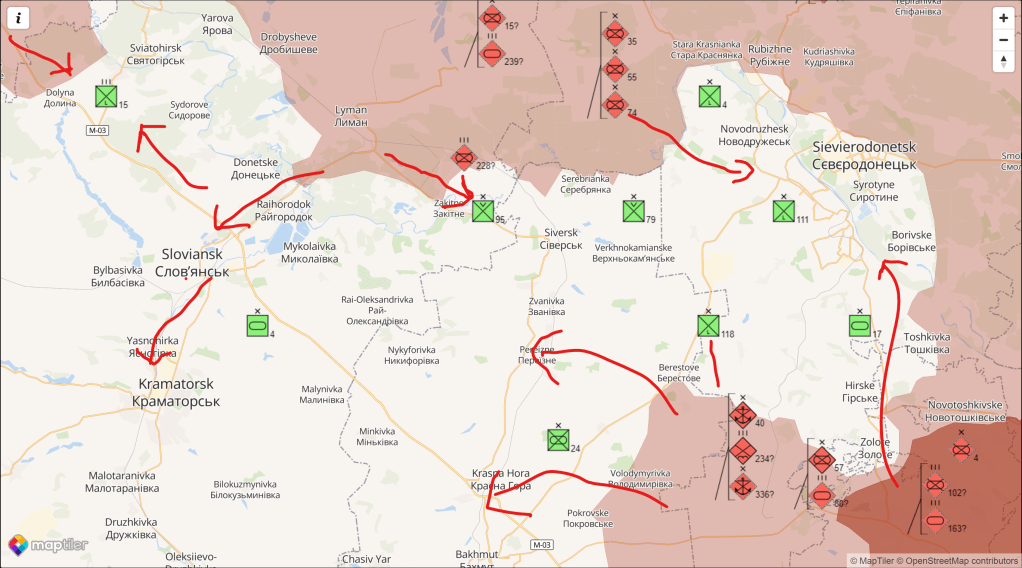
Russian Federation forces have taken the residential areas of Sieverondonetsk as Ukrainian forces retreat into the industrial zone west-southwest of the city while the retreating units (presumably, the remmants of the 111th Territorial Defense Brigade) attempt to make a stand in Lisichansk on the high ground on the west bank of the Sversky Donets River a mile or two west.
The 111th Territorial has been significantly degraded reportedly up to 40%. It’s not a Tier 1 unit and seems to be cannon fodder for the Ukrainian government.
With the fall of the last Donetsk city in Ukrainian hands, it’s possible Russian forces will shift to the southwest to advance on Mykolaiv and on to Odessa.
But our view is Russia intends to finish the job on the main units of the Ukrainian Army — some 12,000 left out of an orginal 25,000 caught in the eastern cauldrons while moving on to Karamatorsk and Slavyansk.
Russian artillery is reportedly moving up to the AFU defenses holding the line in Raihorodok, and then on to Sloviansk where appears to the site of the AFU last stand.
Further to the east, the Russians appear to have the bridges across the Siversky Donest river under fire control. However, the principal line of attack will likely come in from the northwest behind the AFU position on the hills.
Severodonetsk Falling

It’s been reported for days now that only one bridge remained open leading to the west side of the river, so it’s unlikely that much, if any, heavy equipment could be evacuated. Indeed, the likelihood is of large numbers of surrendering Ukrainian troops.
Cue the wild accordion music and dancing Chechens:
Next up …
Putin understands that this is an existential struggle. No point even in a ceasefire in place, much less with withdrawal.
This seems like a good place to include a discussion of Russian tactics, courtesy of Will Schryver:
The Russians spent the previous month carving Ukrainian forces in the Donbas into relatively small, isolated concentrations of troops. Then they proceeded to savage them with massed artillery 24/7.
Now they are methodically advancing their mobile infantry into the shattered remnants under an umbrella of low-level close air support and drone-corrected precision artillery strikes.
Consequently, the demoralized Ukrainian soldiers are surrendering en masse.
Western mainstream media has, for three months now, fed its audience a never-ending clown car parade of utterly clueless “expert military analysts” who have spun fairy tales of super-hero Ukrainian “freedom fighters” and comically inept Russian conscripts.
That narrative is now souring as rapidly as the cream of the AFU in the Donbas.
No doubt much fighting remains – particularly in the Odessa region as Russia consolidates the entire Black Sea coast of Novorossiya. But the final outcome of this war is no longer in question.
After a sometimes uncertain start, the Russians have rapidly adapted their tactics and are now systematically routing Ukrainian forces across the entire front, including the ill-advised Ukrainian “counter-offensive” north of Kharkov, which is now being torn apart.
It is my considered opinion that, for many years to come, this war will be widely studied in war colleges around the world as a definitive example of expertly prosecuted 21st century urban warfare.
Perhaps most significantly, looking forward to potential NATO/Russia conflict, the Russian military has quickly evolved into a battle-hardened and surprisingly nimble and quick-to-adapt fighting force. The US has not faced such a force since WW2.
As for Slavoviansk, wher is the breakout from Lyman through the Sviati Hory forest.
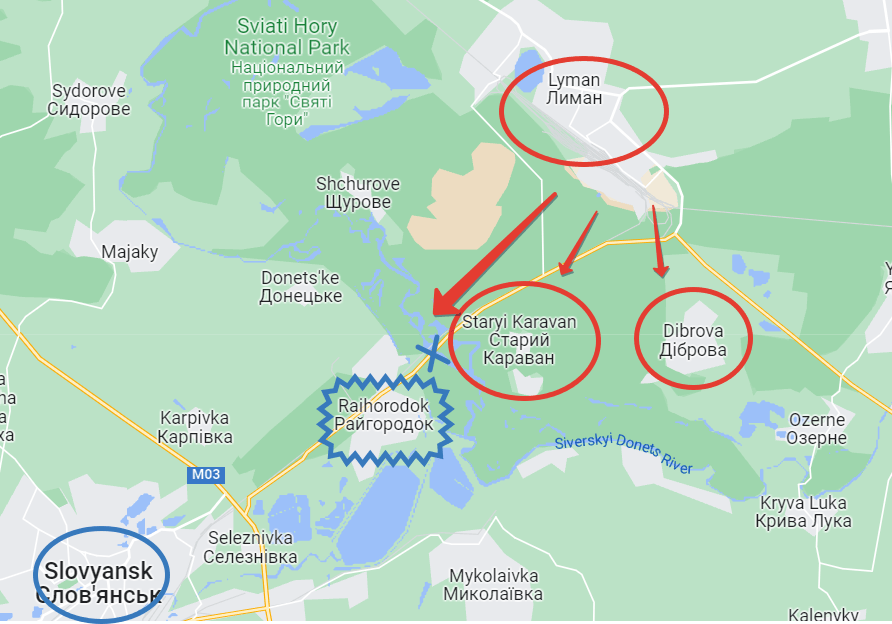
On May 30, the Defence Staff of the Donetsk People’s Republic confirmed that the Armed Forces of the Russian Federation and the DPR People’s militia took control over the villages of Dibrova and Stary Caravan.
After the town of Krasny Liman came under the DPR control, Russian-led forces continued their advance to the west towards the city of Slavyansk, which is one of the main strongholds of the Armed Forces of Ukraine in the region. LINK
By now, DPR and Russian troops have approached the city of Raygorodok, which is located 12 kilometers from Slavyansk. The Ukrainian positions in the area have been shelled by the artillery.
Clashes continue on the northern bank of the Seversky Donets River, and Russian-led forces have are yet to cross the river. The bridge in the area was destroyed by the retreating AFU units more than a week ago.
Here are Spetznaz (Russian special forces) in mop-up outside Lyman
The Washington Post is Reading My Blog
This probably explains those strange calls on my phone.
Actually, more like reality catching up with the DC Uniparty’s “Pravda”.
There gets to be a point where the propaganda yields to reality.
Here’s ZH on the story: https://www.zerohedge.com/military/wapo-stunning-first-admits-catastrophic-conditions-collapsing-morale-ukraine-forces-front
In Stunning Shift, WaPo Admits Catastrophic-Conditions, Collapsing-Morale Of Ukraine Front-Line Forces
With Russia’s war in Ukraine now in its fourth month, mainstream media consumers have been treated to seemingly endless headlines and analysis of Russia’s extensive military losses. At the same time Ukrainian forces have tended to be lionized and their battlefield prowess romanticized, with essentially zero public information so far being given which details up-to-date Ukrainian force casualties, set-backs, and equipment losses.
But for the first time The Washington Post is out with a surprisingly dire and negative assessment of how US-backed and equipped Ukrainian forces are actually fairing. Gone is the rosy idealizing lens through which each and every encounter with the Russians is typically portrayed. WaPo correspondent and author of the new report Sudarsan Raghavan underscores of the true situation that “Ukrainian leaders project an image of military invulnerability against Russia. But commanders offer a more realistic portrait of the war, where outgunned volunteers describe being abandoned by their military brass and facing certain death at the front.”
As many careful and less idealistic observers suspected the whole time, a steady stream of both wartime propaganda and one-sided social media feeds where it seems the only tanks being blown up are Russian ones has served to present a very skewed portrayal of the battlefield to the Western public. While it’s perhaps easier to get sucked into this pro-Ukraine bias based on the innumerable so-called open source intelligence self-anointed ‘experts’ on Twitter, this is less so if one wades into Telegram, where a flood of uncensored videos from both sides gives a truer picture, as the fresh report seems to also suggest.
The Washington Post report belatedly admits the avalanche of propaganda based in a pro-Kiev, pro-West narrative from the outset: “Videos of assaults on Russian tanks or positions are posted daily on social media. Artists are creating patriotic posters, billboards and T-shirts. The postal service even released stamps commemorating the sinking of a Russian warship in the Black Sea.”
The report then pivots to the reality of an undertrained, poorly commanded and equipped, rag-tag force of mostly volunteers in the East who find themselves increasingly surrounded by the numerically superior Russian military which has penetrated almost the entire Donbas region. “Ukraine, like Russia, has provided scant information about deaths, injuries or losses of military equipment. But after three months of war, this company of 120 men is down to 54 because of deaths, injuries and desertions,” the report reads as it follows one particular battalion.
The report’s sources speak out despite threat of being court-martialed amid a heavily controlled information flow:
“War breaks people down,” said Serhiy Haidai, head of the regional war administration in Luhansk province, acknowledging many volunteers were not properly trained because Ukrainian authorities did not expect Russia to invade. But he maintained that all soldiers are taken care of: “They have enough medical supplies and food. The only thing is there are people that aren’t ready to fight.”
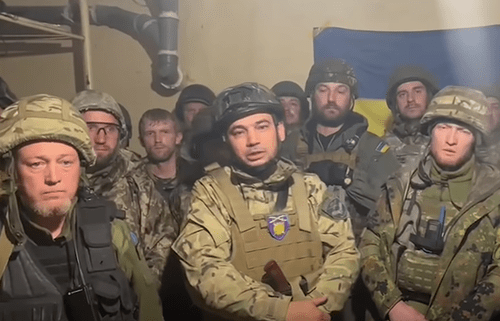
The report references a video widely circulating online this week wherein a group the size of a platoon declares they simply can’t fight for lack of weaponry, ammunition, food and proper command support:
“We are being sent to certain death,” said a volunteer, reading from a prepared script, adding that a similar video was filmed by members of the 115th Brigade 1st Battalion. “We are not alone like this, we are many.”
Ukraine’s military rebutted the volunteers’ claims in their own video posted online, saying the “deserters” had everything they needed to fight: “They thought they came for a vacation,” one service member said. “That’s why they left their positions.”
In the wake of the video, the Ukrainian troops featured are being accused of ‘desertion’:
Additional videos have surfaced that are similar: units complain even of being left to fight in already impossible conditions with WWI and WWII-era rifles, which can do little up against Russia’s far superior firepower.
The stunning WaPo report further documents volunteer groups of men who were previously oil well technicians, salesmen, or other ordinary jobs like farmers being sent to front line positions in the south and east – even though they thought they were first bound to simple security posts in much less intense environs like Lviv.
“We shot 30 bullets and then they said, ‘You can’t get more; too expensive,’” one volunteer described. And more: “When we were coming here, we were told that we were going to be in the third line on defense,” Lapko said. “Instead, we came to the zero line, the front line. We didn’t know where we were going.”
The situation has gotten more dire as even water is in short supply amid the most intense Russian push to surround Ukrainian positions in the Donbas to date:
And in recent weeks, he said, the situation has gotten much worse. When their supply chains were cut off for two days by the bombardment, the men were forced to make do with a potato a day.
They spend most days and nights in trenches dug into the forest on the edges of Toshkivka or inside the basements of abandoned houses. “They have no water, nothing there,” Lapko said. “Only water that I bring them every other day.”
Meanwhile the very noticeable shifting rhetoric issued from prominent officials and pundits of late has strongly suggested not all is well for Ukraine’s military…
The WaPo further includes the following devastating testimony and assessment:
“Many got shell shock. I don’t know how to count them,” Lapko said.
The casualties here are largely kept secret to protect morale among troops and the general public.
“On Ukrainian TV we see that there are no losses,” Lapko said. “There’s no truth.”
Many of the casualties suffered by the above referenced volunteer unit were due to lack of logistics available to transport the wounded to hospitals behind the front lines. The report emphasizes that the entirety of the catastrophic conditions of frontline forces has led to officers and enlisted increasingly refusing to follow orders from higher command.
With this fresh and unexpected Washington Post report, the mainstream seems to now belatedly be admitting what only weeks ago could get a person banned from Twitter…
“Lapko and his men have grown increasingly frustrated and disillusioned with their superiors. His request for the awards has not been approved,” the report finds. “His battalion commander demanded that he send 20 of his soldiers to another front line, which meant that he couldn’t rotate his men out from Toshkivka. He refused the order.”
The Foegen effect
A mechanism by which facemasks contribute to the COVID-19 case fatality rate
National Pulse story: https://wordpress.com/post/econophysics2020.com/5198
Abstract:
Extensive evidence in the literature supports the mandatory use of facemasks to reduce the infection rate of severe acute respiratory syndrome coronavirus 2, which causes the coronavirus disease (COVID-19). However, the effect of mask use on the disease course remains controversial. This study aimed to determine whether mandatory mask use influenced the case fatality rate in Kansas, USA between August 1st and October 15th 2020.
This study applied secondary data on case updates, mask mandates, and demographic status related to Kansas State, USA. A parallelization analysis based on county-level data was conducted on these data. Results were controlled by performing multiple sensitivity analyses and a negative control.
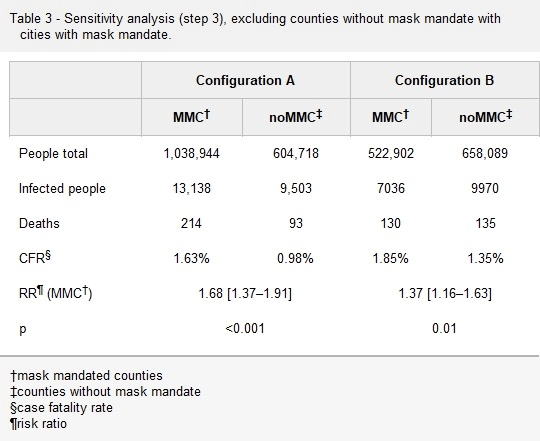
A parallelization analysis based on county-level data showed that in Kansas, counties with mask mandate had significantly higher case fatality rates than counties without mask mandate, with a risk ratio of 1.85 (95% confidence interval [95% CI]: 1.51–2.10) for COVID-19-related deaths. Even after adjusting for the number of “protected persons,” that is, the number of persons who were not infected in the mask-mandated group compared to the no-mask group, the risk ratio remained significantly high at 1.52 (95% CI: 1.24–1.72). By analyzing the excess mortality in Kansas, this study determines that over 95% of this effect can solely be attributed to COVID-19.
These findings suggest that mask use might pose a yet unknown threat to the user instead of protecting them, making mask mandates a debatable epidemiologic intervention.
The cause of this trend is explained herein using the “Foegen effect” theory; that is, deep re-inhalation of hypercondensed droplets or pure virions caught in facemasks as droplets can worsen prognosis and might be linked to long-term effects of COVID-19 infection. While the “Foegen effect” is proven in vivo in an animal model, further research is needed to fully understand it.
National Pulse Story:
Mask mandates caused higher COVID-19 death rates, according to the bombshell claims made in a new medical journal report analyzing fatality rates across the state of Kansas.
The observational study – “The Foegen Effect: A Mechanism by Which Facemasks Contribute to the COVID-19 Case Fatality Rate” – was published in Medicine in February 2022, authored by German doctor Zacharias Fögen.
The paper analyzed “whether mandatory mask use influenced the case fatality rate in Kansas” during the time period of August 1st, 2020 to October 15th. Kansas was used for comparison because the state allowed each of its 105 counties to decide whether or not to implement mask mandates, with 81 counties deciding against the measure.
“The most important finding from this study is that contrary to the accepted thought that fewer people are dying because infection rates are reduced by masks, this was not the case,” summarized the paper.
“Results from this study strongly suggest that mask mandates actually caused about 1.5 times the number of deaths or ∼50% more deaths compared to no mask mandates.”
The study also posited a potential reason for the disparity in risk ratio (RR) for dying from COVID-19:
“A rationale for the increased RR by mandating masks is probably that virions that enter or those coughed out in droplets are retained in the facemask tissue, and after quick evaporation of the droplets, hypercondensed droplets or pure virions (virions not inside a droplet) are re-inhaled from a very short distance during inspiration.”
Dubbed the “Foegen effect,” the theory suggests that COVID-19 “virions spread (because of their smaller size) deeper into the respiratory tract.”
“They bypass the bronchi and are inhaled deep into the alveoli, where they can cause pneumonia instead of bronchitis, which would be typical of a virus infection.”
“These findings suggest that mask use might pose a yet unknown threat to the user instead of protecting them, making mask mandates a debatable epidemiologic intervention,” concludes the paper.
The study follows another recently published analysis of international data showing the same relationship between COVID-19 and masks.
The Consent of the Governed Is Slipping Away
Charles Hugh Smith: http://charleshughsmith.blogspot.com/2022/05/the-consent-of-governed-is-slipping-away.html
The realization that we’re not actually being represented at the federal level has eroded the consent of the governed for the national government.
The foundation of any government is the consent of the governed. Democracies and republics are founded on the consent of the governed earned via representational or direct democracy: those who have a say and a stake in the system will give their consent to the government, even if an opposing view is in the majority because their opinion is part of the governance structure.
Even totalitarian states ultimately depend on the consent of the governed, as repressive states that lose legitimacy cannot imprison or kill a majority of their populaces, or restore legitimacy via coercion once the populace has nothing left to lose and the organs of state oppression realize the regime is doomed.
It feels like the consent of the governed is slipping away in the U.S. The reason is so obvious we dare not acknowledge it or discuss it: those in power–elected and unelected–only give lip-service to “serving the public interest and common good.” Beneath this flimsy facade of PR, every action serves the interests of a wealthy, politically potent elite or the self-interests of those in power.
Commoners have no real say in governance. We are consenting to rule by self-interested elites under the guise of being represented by an elite who governs at the behest and expense of hyper-wealthy individuals, families, corporations, cartels and monopolies.
Consider the issue of legalizing cannabis. Poll after poll shows the majority of the American citizenry favor legalizing cannabis, yet our federal representatives and regulators insist on ignoring the public will, public interest and the common good by continuing to classify cannabis as a Schedule 1 drug, as addictive and dangerous as heroin and fentanyl.
This is patently false and absurd. Hundreds of thousands of American die from alcohol and opioids every year, while deaths attributed solely to cannabis use are near-zero. Yet the federal government and our elected representatives refuse to accept the reality that cannabis isn’t equivalent to fentanyl and other synthetic opioids which continue to kill thousands every year.
Why? It’s the money, honey, greasing their palms and paychecks. Big Pharma views cannabis as a competitor so it lavishes billions of dollars on campaigns, lobbying and shaping the media narrative to serve their agenda of maximizing profits by any means available.
The War on Drugs Gulag of private prisons, law enforcement and the judiciary also skim billions of dollars as a result of cannabis being Schedule 1 (i.e. just as deadly as fentanyl). These powerful elites would lose billions in funding if the will of the people actually counted for something.
The realization that we’re not actually being represented at the federal level has eroded the consent of the governed for the national government, and pushed the electorate to seek legitimate representation at the state and local level. In response, states are openly flouting federal statutes (for example, the Schedule 1 absurdity of federal cannabis regulations) and claiming sovereign rights on issues such as currency (declaring gold coins as legal tender in the state, etc.) and cryptocurrency.
We can anticipate a cross-migration as residents who disagree with the majority views in their state move to states where the majority-approved policies align with their own preferences. This cross-migration will strengthen existing majorities into super-majorities, further accelerating cross-migration as policies that were considered extreme are normalized within states.
Within states, this relocalization of the consent of the governed is trickling down to counties, which are increasingly under pressure from the citizenry to ignore (or leave unenforced) state mandates which the residents disagree with.
Capital also manifests the consent of the governed. Capital will migrate away from states where it’s treated poorly, science-based enterprises will migrate away from states which restrict or starve research and development and manufacturing will migrate to states with willing, educated workforces and attractive infrastructure and tax structures.
States and counties whose policies are detrimental to capital will become poorer as capital chooses to locate to places where it has a say in governance, just as individuals want to live in a place where they have a say.
As the consent of the governed unravels, citizens may increasingly decide which statutes they’re going to obey and which ones they’ll ignore. Locales with strong community values will rely less on statutes and enforcement and more on social norms and community standards to maintain social order, while locales without any coherent community standards and shared values will have to rely on enforcement to avoid social disorder or meltdown.
Choose your community wisely. Thousands of pages of regulations won’t preserve the social order if the the consent of the governed and the social contract both unravel.
ESG Hits a Reality Wall

OilPrice.com: https://oilprice.com/Energy/Energy-General/ESG-Crusade-On-Backburner-As-World-Grapples-With-Energy-Crisis.html
The ESG investment momentum has run up against energy supply disruptions since the Russian invasion of Ukraine. As shareholders at the biggest energy companies are asked to vote—again—on various climate resolutions, many investors continue to call for more transparent and detailed plans for how firms intend to align with the Paris Agreement goals. Others, such as the world’s top asset manager, BlackRock, expect to support fewer shareholder proposals this AGM season compared to 2021 as it finds that climate-related shareholder proposals have become unduly more prescriptive and micromanaging.
Sure, large institutional investors are not abandoning the ESG trend or insistence that companies need to be prepared to change as the energy transition progresses. But some, including BlackRock, acknowledge the current energy market pressures and the need for investment in both traditional and renewable energy sources.
Fund managers want companies to double down on the energy transition, which has become an even more urgent topic of conversation after the Russian war in Ukraine and Europe’s subsequent struggles to cut—and ultimately eliminate—its dependence on Russian fossil fuels.
Yet, energy security and economic stability in the short term appear to override the longer-term drive to accelerate the transition toward green energy sources.
Investors are also looking to shift their focus onto actual outcomes instead of on simplified ESG ratings that are based on policy statements.
BlackRock: Investment In Both Traditional And Renewable Energy Needed BlackRock said in early May that “many of the climate-related shareholder proposals coming to a vote in 2022 are more prescriptive or constraining on companies and may not promote long-term shareholder value.”
“Importantly, in the context of voting on shareholder proposals regarding climate-related risk, companies face particular challenges in the near term, given under-investment in both traditional and renewable energy, exacerbated by current geo-political tensions,” BlackRock Investment Stewardship (BIS) said.
“This set of dynamics will — at least in the short- and medium-term — drive a need for companies that invest in both traditional and renewable sources of energy and we believe the companies that do that effectively will produce attractive returns for our clients.”
That’s why BlackRock is likely to back proportionately fewer climate-related resolutions this proxy season than in 2021, as it does not consider them to be consistent with its clients’ long-term financial interests, the asset manager said.
Doubling Down On Energy Transition
Still, investors are not backing down on seeking active engagement with companies and demanding detailed, credible energy-transition plans.
“The way out of the situation we currently find ourselves in is not to abandon the energy transition but to double down,” Nick Stansbury, head of climate solutions at the UK’s largest fund manager, Legal & General Investment Management (LGIM), told the Financial Times.
Last month, LGIM said in its ‘Active Ownership’ report for 2021 that “We believe voting against a company is a powerful tool to express our views and concerns on key thematic issues such as climate change and diversity, as part of our ‘engagement with consequences’ approach.”
LGIM welcomed in its report “positive steps” taken by ExxonMobil to commit to net-zero emissions for operated assets by 2050, as well as BP’s strengthened climate targets announced in February 2022.
“We engaged with BP’s senior executives on six occasions in 2021 as they develop their climate transition strategy to ensure alignment with Paris goals. Following constructive engagements with the company, we were pleased to learn about the recent strengthening of BP’s climate targets, announced in a press release on 8 February 2022, together with the commitment to become a net-zero company by 2050 – an ambition we expect to be shared across the oil and gas sector as we aim to progress towards a low-carbon economy.”
Change Of Focus
Investors are also increasingly looking to affect change in the companies they are invested in, rather than just picking firms with the best ESG scores on paper.
“What do ESG scores tell us about anything?” Ben Caldecott, director of the UK Centre for Greening Finance and Investment, told FT. “They are mainly measuring processes and policies — if a company has a policy in place against deforestation it will get a good score, even if it is deforesting.”
Others are shifting focus to the industries that use the energy produced by oil and gas companies. For example, the Church of England Pensions Board said earlier this month that after co-leading the investor process to establish the first Net Zero Standard for the oil and gas sector, it is shifting focus this year to industry sectors.
“This will see the Board step down from leading engagement with Shell and begin co-leading engagement with Europe’s largest car manufacturers, BMW, Mercedes-Benz, Renault, and Volkswagen,” the board said.
“If the demand for energy doesn’t change, those companies that are supplying it won’t change. We have developed an exacting global net zero standard for the oil and gas sector, which companies that wish to retain their social license can implement. Ultimately those same companies’ ability to deliver on their targets will largely be shaped by a change in demand for oil and gas from sectors like autos, aviation and shipping” said Adam Matthews, Chief Responsible Investment Officer at the Church of England Pensions Board.
However, with energy security concerns front and center and governments prioritizing energy supply in the biggest energy market shock in decades, demand for oil and gas is set to rise in the short term, while chronic underinvestment would plague supply in the medium term.
From Currency Resets to Limiting Infinite Growth

Tom Luongo on the New-New Normal: https://tomluongo.me/2022/05/19/from-currency-resets-to-limiting-infinite-growth/
A couple of weeks ago, RT ran a story purporting to explain the mystery behind the rise in exchange rate of the Russian ruble. It touched on a concept I’ve talked about vis a vis Russia for years: the disparity between nominal GDP which yields a number roughly the size of Canada and Purchasing Power Parity (PPP) GDP which puts Russia on par with Germany.
While everything quoted here I feel is worth considering seriously, that GDP disparity that is what is important.
… the West had defaulted on its obligations to Russia when it froze the assets of the country’s central bank. “This is the abolition (something like cancel culture) of the rules of international financial relations based on global total return swaps, redistribution of risk, guarantees of property rights and distribution of seigniorage.”
It was these rules that determined the old ruble exchange rate and the approaches to its establishment that we are accustomed to, the expert said, adding that those rules “no longer apply.”
Kopylov explained that the strengthening of the ruble is due to the fact that it is now based purely on exports and imports, and its value is determined by its purchasing power parity (PPP). The International Monetary Fund (IMF) estimated the Russian currency’s PPP at the end of 2021 at 29.127 rubles per one dollar. According to the Big Mac Index, that rate stood at 23.24 rubles to the dollar.
I have pointed out for years that all discussions of the Russian economy in terms of nominal GDP are bogus. Nominal GDP is spending within the Russian economy converted through the RUB/USD exchange rate.
But that metric is irrelevant. It doesn’t say anything about what that spending buys the average Russian.
GDP is a stupid metric. It should be called GNS, Gross National Spending. It is a dumb way to measure the ‘output’ of a society. It’s at best a very gross approximation but it is, again, just aggregated spending.
This is the fundamental fallacy of Keynesian demand-side economics and all theories about which economies are expanding or contracting based on spending are literally bogus.
But we have all been trained to believe in GDP as some all-powerful measure of growth and power. It’s not anything of the sort. When you have the ability to print money at will to bid up the cost of the goods purchased with that money, how is that telling you anything about the health of the country, the people… or frankly anything at all?
What it’s telling you is that spent money, but did you take that money from the pool of real savings and deploy it into sustainable economic projects? Or did you print the money out of thin air, issue debt that borrows against the future labor of the country’s citizens (or their kids…. or their grandkids) and pay someone to fulfill a ‘shovel-ready’ job of digging a hole and filling it back in?
GDP, in statistical terms, is NOT an independent variable because of this. It’s value is dependent completely on the people controlling the inputs to it. Therefore, as data, it is worthless. As a scientist, I would throw it out of any discussion because it can’t be controlled for.
This is why the discrepancy between the ruble’s purchasing power internally is so much higher than its purchasing power externally. Pre-war the ruble traded at 75 or so versus the dollar. But it’s PPP value was less than 30? This means Russian GDP is at least (by this flawed metric) 2.5 higher than the nominal value. This is how the Russian economy in PPP terms is actually larger than Germany’s.
But even then, PPP GDP is still a terminally flawed metric as a measure of output. It gets us closer to fair comparisons between country’s but it still says nothing about the economic value of the things the country spent their money on.
The funny thing is Russia’s economy shouldn’t be larger than Germany’s in real terms, since most of Russia’s output is base commodities, which have the lowest value-added component of any good in a market. The whole point of a sophisticated division of labor and economic system is to build up value through each stage in the production chain.
Cars, for example, should have more ‘value’ associated with them than the iron ore that went into making the frame.
This tells you how out of whack the world is in terms of the diversion of capital to unsustainable activity it actually is if a commodity producer is leading a manufacturing giant in wealth generation. This is exactly why the currency shift from debt-based to commodity-based money is going to be so painful.
And why the debt issuers are willing to risk nuclear war over it occurring. To them this is the end state of their power.
From Finite World to Infinite Growth
In a recent article on this blog, I did a quick and dirty takedown of the globalist talking point about infinite growth in a finite world. That gaslighting was at the core of the conflict in the big story of the Marvel Cinematic Universe of films, which centered on Thanos coming to bring balance by destroying half of the life in the Universe.
Davos has gaslit two entire generations of westerners in the Malthusian talking point that you can’t have infinite growth in a finite world. All of their economic dogma is predicated on this.
It doesn’t matter that this talking point is predicated on an inane premise, truth is, after all treason, at this point in the economic and cultural cycle. But, to try and explain quickly for the slow-witted. GDP growth is not necessarily real growth. It’s just spending. It says nothing for the quality of the spending or whether, in real terms, the people spending the money are materially better off than they were at a previous point in time.
What isn’t measured by GDP is VALUE. Value is what we crave, the ability to plan further into the future, using our ingenuity to find better mousetraps to build and more efficient, and yes sustainable, ways of deploying scarce capital and time.
When you have a monetary system and regulatory regime designed to thwart that to stop growth then you have the world we live in today. That infinite growth is a subjective, not objective, measure…. not in GDP terms but in the ‘alleviation of human misery’ terms.
Davos absolutely doesn’t want this because a world where everyone gets maximal value for their time is a world without our need for them.
But in order for us to have a discussion about this, I need to lay out some base assumptions. First, that we have owners who agree with Julian Huxley that growth will lead to destruction of the planet, therefore we should not have any more meaningful growth.
Second, only those who are currently with power have the will, intelligence and expertise to guide us to this next phase of humanity’s existence.
In service of these controlling ideas:
- They have erected systems and barricades to real growth for decades in real terms, i.e. energy usage per unit ‘wealth’ … some call this EROEI = Energy Returned over Energy Invested.
- They have stymied more efficient use of human capital by running us around in mazes which are dead ends — Light Water Nuclear Reactors vs. oil, replacing both with Solar, Wind, Electric Vehicles, etc.
- They foment wars to divert capital to useless weapons rather than applying it things which make our lives better, more predictable. They specifically divert spending (GDP) to humans building systems which increase chaos and unpredictability rather than decrease it.
- They empower and expand bureaucracy to keep otherwise ‘useless people’ employed with meaningless jobs
- They have supported cultural degradation which undermined the nuclear family and local culture by promoting women into the workforce, divorcing them from their core strength as mothers and caregivers and putting them effectively on welfare, UBI.
These are all the basic distractions which force us to waste most of our productive time running around on a hamster wheel of arbitrary obstacles in order to eke out some small measure of comfort.
The basic reason for Human Action, as defined by Mises, is to alleviate future uncertainty. Man acts purposefully towards that end, otherwise he wouldn’t act or he would act differently.
That said, we can have our rationality diverted to purposes which do not serve our better interests because of the perverse incentives placed in front of us through artificial barriers to capital formation.
Therefore, if we were acting with purpose towards our most efficient and creative ends to a more predictable future, infinite GDP growth would be a no-brainer. This isn’t to say infinite GDP growth is infinite resource utilization.
Because as you travel up the production chain to higher order goods, you produce more value relative to the input commodities… if you didn’t, then you wouldn’t do it. You would do something that did.
What’s more valuable a tree growing on your property or the lumber you turn it into and then use to build a shelter?
For an even more idiotic example, is there really $10,000 difference between a BMW 230i starting at $37.5k and a Ford Mustang in terms of raw input commodities, especially when, in the real world we’re talking more like $15,000? No. Both are roughly 3500 lbs of aluminum, steel, leather and plastic.
So, where’s the value difference? In the materials? Again, not really. It’s in the intellectual property of the engineering, the final driving experience and the perception of value by the consumer.
But in terms of them being a tool for potential wealth creation, the two care are, really fungible. They can transport up to 3 people (realistically) and a little bit of cargo somewhere to do whatever it is that they do.
Is that reflected in the purchasing price of these cars? No. Not at all. But, if we sell more BMW’s as a percentage of Mustangs sold, are we expected to impute a higher capability of sustaining wealth production because of higher overall spending as measured by GDP?
Sadly yes.
And that’s where the disconnect is.
This is why, fundamentally, GDP is a poor measure of ‘growth.’
That said, absent the diversion of capital to the unsustainable as practiced by Davos you can have constant ‘growth’ in value terms. It is better stated that ‘growth’ is the alleviation of human suffering and/or uncertainty, which is what value is.
This is true because if we’re driving costs down to utilize natural resources ever more efficiently thanks to proper pricing of the money used to procure the input commodities, then we can move more of our spending out of base commodities into higher order goods with higher returns of perceived value.
Moreover, the Malthusian/Huxleyian argument presupposes somehow that the Universe isn’t governed by the Laws of Conservation. Iron isn’t destroyed when a car is trashed, we just store it in a junkyard. The same goes for landfills and plastic.
The problem we have today is that we act within a system which skims all the wealth created by our actions to the betterment of the people who produce nothing at all. All they produce is money and bad ideas, the former of which is based on your future labor and the latter sustained by it.
Then they dupe you into selling your future labor back to you at a vig while trying to take all the intellectual property rights for your innovation and skill. We call these people Venture Capitalists.
No wonder the Marxists see this system as exploitative. It is! But it’s also not the only way things can and/or should be organized. This isn’t a fault of capitalism and property but of our not properly pricing the cost of the State and all of its enforcement of our ‘rights.’
This is what leads to the concentration of power in the hands of rent-seeking douchebags and vandals.
Sustainable growth where all factors of production are properly priced up the value-adding chain is the first step. That will lead to the rewards being shared more equitably by all involved.
That model is not only possible, it’s the only system that is inevitable.
Davos decided if we were not controlled and forced onto low-margin hamster wheels we would strip-mine the planet and destroy it. That’s why it needs to be controlled and real growth curtailed.
What we have now is a system of maximal wastage of natural resources with minimal returns: cheap money begetting conspicuous consumption of resources while erecting barriers to new, competitive technologies at the expense of the producers of those input commodities.
Thanos in the Marvel films makes the same mistake Davos and Huxley made, deciding in their hubris and arrogance that because they couldn’t see a solution to a problem they’d defined, that solution did not exist. This justified their acquisition of power unlimited to re-make the world in their image.
The truly despicable nature of the Marvel films is that they spend so much time trying to make Thanos’ quest a noble one, a sympathetic one, rather than the rantings of a small-minded homunculus.
I wonder who ordered that rewrite of the script to Infinity War?
The Return of the Commodity King
This is why the ruble is so undervalued, up until recently commodities had been driven below their cost of production through the corruption of all of us into the land of cheap money. It is why now, with the changes coming to the monetary architecture of the world, the ruble’s real purchasing power will finally be expressed, forcing commodity inflation in real terms on those whose currencies are overvalued.
Gresham’s Law has never been wrong.
Overvalued money circulates to procure unearned goods in the real world.
Undervalued money is hoarded because savings is the pre-requisite of capital deployment.
We are at the end of the cycle where the pile of real wealth has built up for decades unable to express itself while the ultimate psy-op fuels the biggest Ponzi scheme in history.
When the confidence in the overvalued money (debt) falls, inflation rises rapidly as people demand goods and eschew money. This will raise the prospect of the undervalued money (commodities) entering into circulation as its true value is finally expressed in the market.
At that point you will then see what the real growth rate of the world is. Gary North used to say that prior to the early 1800’s the real rate at which wealth compounded was ~1% annually. Then something changed and it doubled to 2% and that scared the bejeesus out of the elites because too many people were getting rich too quickly to need them to look out for their interests.
Now you know why the Club of Rome began in the 1850’s [Ed: actually, the Club of Rome started in 1968], why central banking was so bitterly fought over here in the US then. It’s why Marx’s insane ideas were adopted by those with generational power. It was to STOP our growth as a species, not keep it from destroying the planet, but their system of unearned privilege.
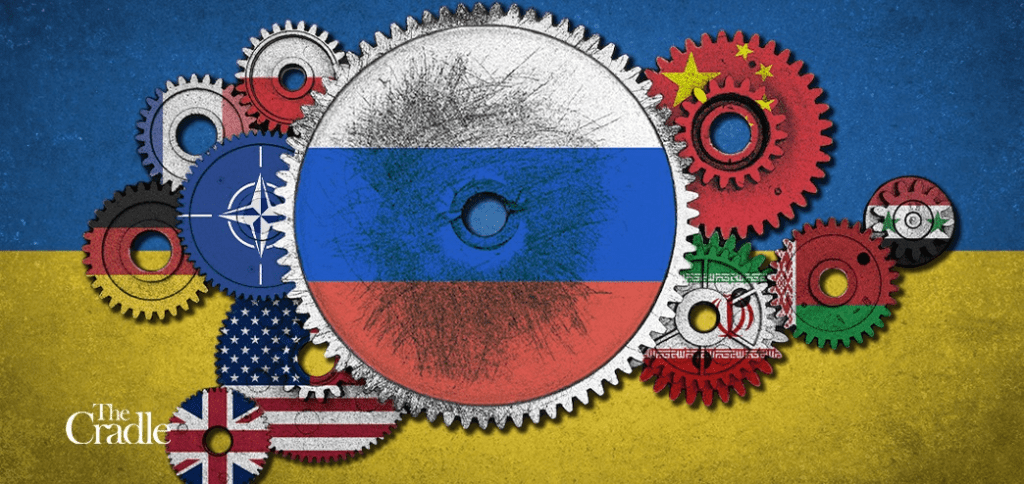
Death by a thousand cuts: where is the west’s Ukraine strategy?
Pepe Escobar: https://thecradle.co/Article/columns/10277
While we are all familiar with Sun Tzu, the Chinese general, military strategist and philosopher who penned the incomparable Art of War, less known is the Strategikon, the Byzantium equivalent on warfare.
Sixth century Byzantium really needed a manual, threatened as it was from the east, successively by Sassanid Persia, Arabs and Turks, and from the north, by waves of steppe invaders, Huns, Avars, Bulgars, semi-nomadic Turkic Pechenegs and Magyars.
Byzantium could not prevail just by following the classic pattern of Roman Empire raw power – they simply didn’t have the means for it.
So military force needed to be subordinate to diplomacy, a less costly means of avoiding or resolving conflict. And here we can make a fascinating connection with today’s Russia, led by President Vladimir Putin and his diplomacy chief Sergei Lavrov.
But when military means became necessary for Byzantium – as in Russia’s Operation Z – it was preferable to use weaponry to contain or punish adversaries, instead of attacking with full force.
Strategic primacy, for Byzantium, more than diplomatic or military, was a psychological affair. The word Strategia itself is derived from the Greek strategos – which does not mean “General” in military terms, as the west believes, but historically corresponds to a managerial politico-military function.
It all starts with si vis pacem para bellum: “If you want peace prepare for war.” Confrontation must develop simultaneously on multiple levels: grand strategy, military strategy, operative, tactical.
But brilliant tactics, excellent operative intel and even massive victories in a larger war theater cannot compensate for a lethal mistake in terms of grand strategy. Just look at the Nazis in WWII.
Those who built up an empire such as the Romans, or maintained one for centuries like the Byzantines, never succeeded without following this logic.
Those clueless Pentagon and CIA ‘experts’
On Operation Z, the Russians revel in total strategic ambiguity, which has the collective west completely discombobulated. The Pentagon does not have the necessary intellectual firepower to out-smart the Russian General Staff. Only a few outliers understand that this is not a war – since the Ukraine Armed Forces have been irretrievably routed – but actually what Russian military and naval expert Andrei Martyanov calls a “combined arms police operation,” a work-in-progress on demilitarization and denazification.
The US Central Intelligence Agency (CIA) is even more abysmal in terms of getting everything wrong, as recently demonstrated by its chief Avril Haines during her questioning on Capitol Hill. History shows that the CIA strategically blew it all the way from Vietnam to Afghanistan and Iraq. Ukraine is no different.
Ukraine was never about a military win. What is being accomplished is the slow, painful destruction of the European Union (EU) economy, coupled with extraordinary weapons profits for the western military-industrial complex and creeping security rule by those nations’ political elites.
The latter, in turn, have been totally baffled by Russia’s C4ISR (Command, Control, Communications, Computers, Intelligence, Surveillance and Reconnaissance) capabilities, coupled with the stunning inefficiency of their own constellation of Javelins, NLAWs, Stingers and Turkish Bayraktar drones.
This ignorance reaches way beyond tactics and the operational and strategic realm. As Martyanov delightfully points out, they “wouldn’t know what hit them on the modern battlefield with near-peer, forget about peer.”
The caliber of ‘strategic’ advice from the NATO realm was self-evident in the Serpent Island fiasco – a direct order issued by British ‘consultants’ to Ukraine’s President Volodymyr Zelensky. The Commander-in-Chief of the Armed Forces of Ukraine, Valery Zaluzhny, thought the whole thing was suicidal. He was proven right.
All the Russians had to do was launch a few choice anti-ship and surface Onyx missiles from bastions stationed in Crimea on airports south of Odessa. In no time, Serpent Island was back under Russian control – even as high-ranking British and American marine officers ‘disappeared’ during the Ukrainian landing on the island. They were the ‘strategic’ NATO actors on the spot, doling out the lousy advice.
Extra evidence that the Ukraine debacle is predominantly about money laundering – not competent military strategy – is Capitol Hill approving a hefty extra $40 billion in ‘aid’ to Kiev. It’s just another western military-industrial complex bonanza, duly noted by Deputy Chairman of the Security Council of Russia Dmitry Medvedev.
Russian forces, meanwhile, have brought diplomacy to the battlefield, handing over 10 tons of humanitarian assistance to the people of liberated Kherson – with the deputy head of the military-civil administration of the region, Kirill Stremousov, announcing that Kherson wants to become part of the Russian Federation.
In parallel, Georgy Muradov, deputy prime minister of the government of Crimea, has “no doubts that the liberated territories of the south of the former Ukraine will become another region of Russia. This, as we assess from our communication with the inhabitants of the region, is the will of the people themselves, most of whom lived for eight years under conditions of repression and bullying by the Ukronazis.”
Denis Pushilin, the head of the Donetsk People’s Republic, is adamant that the DPR is on the verge of liberating “its territories within constitutional borders,” and then a referendum on joining Russia will take place. When it comes to the Luhansk People’s Republic, the integration process may even come earlier: the only area left to be liberated is the urban region of Lysychansk-Severodonetsk.
The ‘Stalingrad of Donbass’
As much as there’s an energetic debate among the best Russian analysts about the pace of Operation Z, Russian military planning proceeds methodically, as if taking all the time it needs to solidify facts on the ground.
Arguably the best example is the fate of Azov neo-Nazis at Azovstal in Mariupol – the best-equipped unit of the Ukrainians, hands down. In the end they were totally outmatched by anumerically inferior Russian/Chechen Spetsnaz contingent, and in record time for such a big city.
Another example is the advance on Izyum, in the Kharkov region – a key bridgehead in the frontline. The Russian Ministry of Defense follows the pattern of grinding the enemy while slowly advancing; if they face serious resistance, they stop and smash the Ukrainian defensive lines with non-stop missile and artillery strikes.
Popasnaya in Luhansk, dubbed by many Russian analysts as “Mariupol on steroids”, or “the Stalingrad of Donbass,” is now under total control of the Luhansk People’s Republic, after they managed to breach a de facto fortress with linked underground trenches between most civilian houses. Popasnaya is extremely important strategically, as its capture breaks the first, most powerful line of defense of the Ukrainians in Donbass.
That will probably lead to the next stage, with an offensive on Bakhmut along the H-32 highway. The frontline will be aligned, north to south. Bakhmut will be the key to taking control of the M-03 highway, the main route to Slavyansk from the south.
This is just an illustration of the Russian General Staff applying its trademark, methodical, painstaking strategy, where the main imperative could be defined as a personnel-preserving forward drive. With the added benefit of committing just a fraction of overall Russian firepower.
Russian strategy on the battlefield stands in stark contrast with the EU’s obstinacy in being reduced to the status of an American dog’s lunch, with Brussels leading entire national economies to varying degrees of certified collapse and chaos.
Once again it was up to Russian Foreign Minister Sergei Lavrov – a diplomatic master – to encapsulate it.
Question: “What do you think of Josep Borrell’s (Lavrov’s EU counterpart) initiative to give Ukraine frozen Russian assets as ‘reparations?’ Can we say that the masks have come off and the west is moving on to open robbery?”
Lavrov: “You could say it is theft, which they are not trying to hide … This is becoming a habit for the west … We may soon see the post of the EU chief diplomat abolished because the EU has virtually no foreign policy of its own and acts entirely in solidarity with the approaches imposed by the United States.”
The EU cannot even come up with a strategy to defend its own economic battlefield – just watching as its energy supply is de facto, incrementally turned off by the US. Here we are at the realm where the US tactically excels: economic/financial blackmail. We can’t call these ‘strategic’ moves because they almost always backfire against US hegemonic interests.
Compare it with Russia reaching its biggest surplus in history, with the rise and rise of commodity prices and the upcoming role of the stronger and stronger ruble as a resource-based currency also backed by gold.
Moscow is spending way less than the NATO contingent in the Ukrainian theater. NATO has already wasted $50 billion – and counting – while the Russians spent $4 billion, give or take, and already conquered Mariupol, Berdyansk, Kherson and Melitopol, created a land corridor to Crimea (and secured its water supply), controls the Sea of Azov and its major port city, and liberated strategically vital Volnovakha and Popasnaya in Donbass, as well as Izyum near Kharkov.
That doesn’t even include Russia hurling the entire, collective west into a level of recession not seen since the 1970s.
The Russian strategic victory, as it stands, is military, economic, and may even coalesce geopolitically. Centuries after the Byzantine Strategikon was penned, the Global South would be very much interested in getting acquainted with the 21st century Russian version of the Art of War.
“What’s Next”: Former Russian President Warns West’s “Self-Harming” Sanctions Mean “Collapse Of US-Centric World”
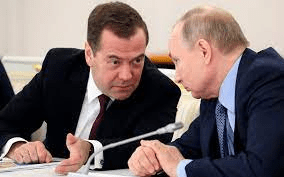
In case you think Russia han’t completely thought this all through, here’s Dmitry Medvedev, former President of Russia and a member of Putin’s inner circle: https://t.me/s/medvedev_telegram
Russian children play chess, and study advanced mathematics, multiple languages and classical music.
American children play with Instagram and TikTok, and struggle with arithmetic.
***************************************************************************
What will happen next, or the World after anti-Russian sanctions (not a forecast at all)
- A number of global supply chains of goods will collapse, a major logistical crisis is possible, including the collapse of the activities of foreign airlines that are prohibited from flying over Russian territory.
- The energy crisis will intensify in those states that have imposed “shooting themselves in the foot” sanctions on the supply of Russian energy carriers, further growth in fossil fuel prices will continue, and the development of the digital economy in the world will slow down.
- A full-fledged international food crisis will come with the prospect of starvation in individual states.
- A monetary and financial crisis is possible in some countries or communities of countries, associated with the undermining of the stability of a number of national currencies, galloping inflation and the destruction of the legal system for protecting private property.
- New regional military conflicts will arise in those places where the situation has not been peacefully resolved for many years or the significant interests of major international players are ignored.
- Terrorists are becoming more active, believing that the attention of Western authorities today is diverted to a showdown with Russia.
- New epidemics will begin, caused by the rejection of honest international cooperation in the sanitary and epidemiological sphere or by direct facts of the use of biological weapons.
- There will be a decline in the activities of international institutions that have not been able to prove their effectiveness in the course of settling the situation in Ukraine, such as, for example, the Council of Europe.
- New international alliances of countries based on pragmatic rather than ideological Anglo-Saxon criteria will be formed.
- As a result, a new security architecture will be created, in which de facto, and then de jure, the existing realities are recognized: a) the weakness of Westernized concepts of international relations such as “Order based on rules” and other senseless Western junk; b) the collapse of the idea of an American-centric world; c) the presence of interests respected by the world community in those countries that are in an acute stage of conflict with the Western world.
**********************************************************************************
Russia’s leaders see the future and act in their national interests.
Our leaders can’t even keep baby formula in stock after shutting down the largest production plant 5 months ago.
 Econophysics2020