Chatter says the pilot actually played Wagner’s “Ride of the Valkyries”
A lone ground attack aircraft on a low attack run – the very definition of air superiority
Chatter says the pilot actually played Wagner’s “Ride of the Valkyries”
A lone ground attack aircraft on a low attack run – the very definition of air superiority

“You know, we’re kind of poking the bear here… We’re bragging about it,” Republican Sen. Tuberville complained.
Antiwar.com: https://news.antiwar.com/2022/05/10/sen-tuberville-says-us-risks-war-with-russia-by-poking-the-bear-in-ukraine/
Tuberville made the comments during a Senate hearing with DNI Avril Hainesby Dave DeCamp Posted onCategoriesNewsTagsRussia, Ukraine
Sen. Tommy Tuberville (R-AL) warned Tuesday that the US is risking war with Russia by “poking the bear” in Ukraine.
Tuberville made the comments during a Senate Armed Services Committee hearing with Director of National Intelligence Avril Haines and the director of the Defense Intelligence Agency, Lt. Gen. Scott Berrier.
Tuberville told Haines and Berrier the US is risking escalating the war by bragging about intelligence sharing with Ukraine. In recent weeks, US officials claimed to the media that US intelligence has helped Ukrainian forces shoot down a plane carrying Russian troops, kill Russian generals, and sink a Russian warship.
“You know, we’re kind of poking the bear here … We’re bragging about it. Even President Biden said today, ‘Wait a minute. We got to cut back on this,’” Tuberville said. Biden reportedly told senior US officials that the leaks to the media on intelligence-sharing must stop.
Tuberville warned the US is also risking provoking Moscow by sending high-level officials to Kyiv. “We do not want to take that step forward to where we get a lot of our men and women involved in this. It looks like to me that we’re taking way too many chances of sending people over there for a photo op,” he said.
The senator said he favored supporting Ukraine in its war against Russia but warned there was no turning back if things escalated into a direct conflict between Washington and Moscow. “There’s a point of no return here if we cross that line,” he said.
While the US has sent billions in arms to Ukraine, restarted training Ukrainian troops, and expanded intelligence sharing, US officials still deny the idea that Washington is engaged in a proxy war against Moscow. When pressed by Tuberville, Haines said that Russia believes it’s fighting a war against both Ukraine and the West.
“Russia has historically believed that they are in a conflict, in effect, with NATO and the United States on a variety of issues,” Haines said. When asked directly if Russia believes it’s fighting the US, Haines said, “In a sense, their perception.”
During the hearing, Berrier and Haines described the war in Ukraine as a “stalemate” and said Russian President Vladimir Putin was preparing for a long-term conflict. Haines said over the next few months, the war could “see us moving along a more unpredictable and potentially escalatory trajectory.”
President of Russia Vladimir Putin: Fellow Russian citizens,
Dear veterans,
Comrade soldiers and seamen, sergeants and sergeant majors, midshipmen and warrant officers,
Comrade officers, generals and admirals,
I congratulate you on the Day of Great Victory!
The defence of our Motherland when its destiny was at stake has always been sacred. It was the feeling of true patriotism that Minin and Pozharsky’s militia stood up for the Fatherland, soldiers went on the offensive at the Borodino Field and fought the enemy outside Moscow and Leningrad, Kiev and Minsk, Stalingrad and Kursk, Sevastopol and Kharkov.
Today, as in the past, you are fighting for our people in Donbass, for the security of our Motherland, for Russia.
May 9, 1945 has been enshrined in world history forever as a triumph of the united Soviet people, its cohesion and spiritual power, an unparalleled feat on the front lines and on the home front.
Victory Day is intimately dear to all of us. There is no family in Russia that was not burnt by the Great Patriotic War. Its memory never fades. On this day, children, grandchildren and great-grandchildren of the heroes march in an endless flow of the Immortal Regiment. They carry photos of their family members, the fallen soldiers who remained young forever, and the veterans who are already gone.
We take pride in the unconquered courageous generation of the victors, we are proud of being their successors, and it is our duty to preserve the memory of those who defeated Nazism and entrusted us with being vigilant and doing everything to thwart the horror of another global war.
Therefore, despite all controversies in international relations, Russia has always advocated the establishment of an equal and indivisible security system which is critically needed for the entire international community.
Last December we proposed signing a treaty on security guarantees. Russia urged the West to hold an honest dialogue in search for meaningful and compromising solutions, and to take account of each other’s interests. All in vain. NATO countries did not want to heed us, which means they had totally different plans. And we saw it.
Another punitive operation in Donbass, an invasion of our historic lands, including Crimea, was openly in the making. Kiev declared that it could attain nuclear weapons. The NATO bloc launched an active military build-up on the territories adjacent to us.
Thus, an absolutely unacceptable threat to us was steadily being created right on our borders. There was every indication that a clash with neo-Nazis and Banderites backed by the United States and their minions was unavoidable.
Let me repeat, we saw the military infrastructure being built up, hundreds of foreign advisors starting work, and regular supplies of cutting-edge weaponry being delivered from NATO countries. The threat grew every day.
Russia launched a pre-emptive strike at the aggression. It was a forced, timely and the only correct decision. A decision by a sovereign, strong and independent country.
The United States began claiming their exceptionalism, particularly after the collapse of the Soviet Union, thus denigrating not just the entire world but also their satellites, who have to pretend not to see anything, and to obediently put up with it.
But we are a different country. Russia has a different character. We will never give up our love for our Motherland, our faith and traditional values, our ancestors’ customs and respect for all peoples and cultures.
Meanwhile, the West seems to be set to cancel these millennia-old values. Such moral degradation underlies the cynical falsifications of World War II history, escalating Russophobia, praising traitors, mocking their victims’ memory and crossing out the courage of those who won the Victory through suffering.
We are aware that US veterans who wanted to come to the parade in Moscow were actually forbidden to do so. But I want them to know: We are proud of your deeds and your contribution to our common Victory.
We honour all soldiers of the allied armies – the Americans, the English, the French, Resistance fighters, brave soldiers and partisans in China – all those who defeated Nazism and militarism.
Comrades,
Donbass militia alongside with the Russian Army are fighting on their land today, where princes Svyatoslav and Vladimir Monomakh’s retainers, solders under the command of Rumyantsev and Potemkin, Suvorov and Brusilov crushed their enemies, where Great Patriotic War heroes Nikolai Vatutin, Sidor Kovpak and Lyudmila Pavlichenko stood to the end.
I am addressing our Armed Forces and Donbass militia. You are fighting for our Motherland, its future, so that nobody forgets the lessons of World War II, so that there is no place in the world for torturers, death squads and Nazis.
Today, we bow our heads to the sacred memory of all those who lost their lives in the Great Patriotic War, the memories of the sons, daughters, fathers, mothers, grandfathers, husbands, wives, brothers, sisters, relatives and friends.
We bow our heads to the memory of the Odessa martyrs who were burned alive in the House of Trade Unions in May 2014, to the memory of the old people, women and children of Donbass who were killed in atrocious and barbaric shelling by neo-Nazis. We bow our heads to our fighting comrades who died a brave death in the righteous battle – for Russia.
I declare a minute of silence.
(A minute of silence.)
The loss of each officer and soldier is painful for all of us and an irretrievable loss for the families and friends. The government, regional authorities, enterprises and public organisations will do everything to wrap such families in care and help them. Special support will be given to the children of the killed and wounded comrades-in-arms. The Presidential Executive Order to this effect was signed today.
I wish a speedy recovery to the wounded soldiers and officers, and I thank doctors, paramedics, nurses and staff of military hospitals for their selfless work. Our deepest gratitude goes to you for saving each life, oftentimes sparing no thought for yourselves under shelling on the frontlines.
Comrades,
Soldiers and officers from many regions of our enormous Motherland, including those who arrived straight from Donbass, from the combat area, are standing now shoulder-to-shoulder here, on Red Square.
We remember how Russia’s enemies tried to use international terrorist gangs against us, how they tried to seed inter-ethnic and religious strife so as to weaken us from within and divide us. They failed completely.
Today, our warriors of different ethnicities are fighting together, shielding each other from bullets and shrapnel like brothers.
This is where the power of Russia lies, a great invincible power of our united multi-ethnic nation.
You are defending today what your fathers, grandfathers and great-grandfathers fought for. The wellbeing and security of their Motherland was their top priority in life. Loyalty to our Fatherland is the main value and a reliable foundation of Russia’s independence for us, their successors, too.
Those who crushed Nazism during the Great Patriotic War showed us an example of heroism for all ages. This is the generation of victors, and we will always look up to them.
Glory to our heroic Armed Forces!
For Russia! For Victory!
Hooray!
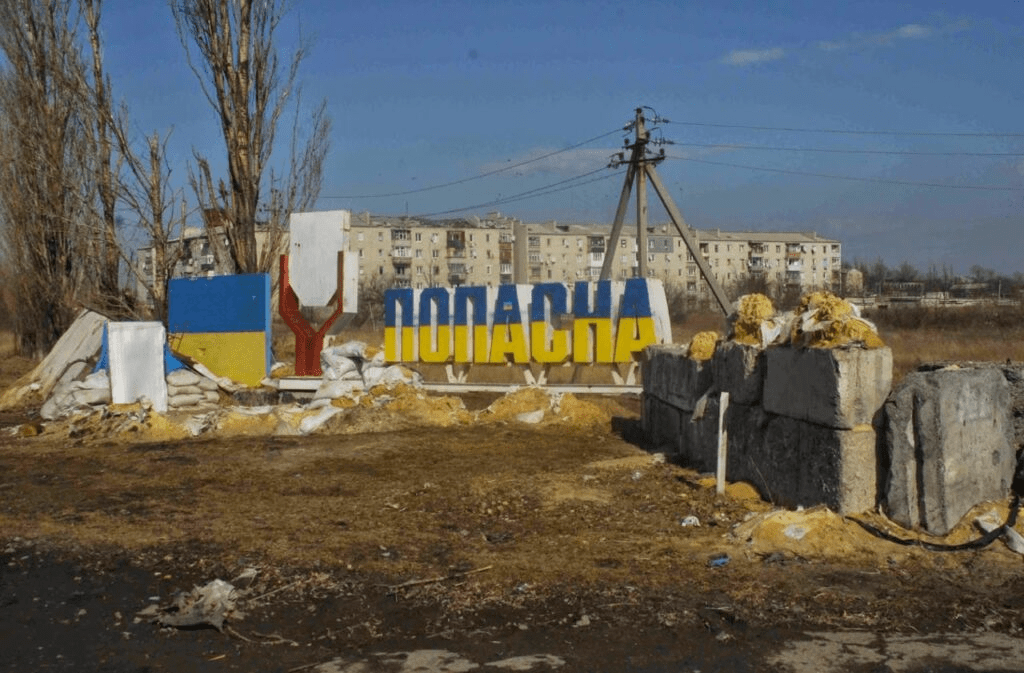
Famous line by “Cowboy” in “Full Metal Jacket.”
After taking Popasnaya over the weekend, the head of Chechnya special forces explains to Ramzan Kadyrov actively covering the work of Chechen units in Ukraine provided the following comments to the videos:
“Almost every house and every street here is littered with modern weapons, which the nationalists abandoned at the first threat.
Machine guns, javelins, dry rations and even Bandera food storages are now at our disposal. Thus, the vaunted assistance to the Ukrainian army, provided by the countries of Europe and America, ultimately benefits us.
⠀
I thank Mr. Biden for his firm position on the issue of equipping the Bandera forces. Thanks to his integrity, our fighters are provided with additional food and weapons.”
The military of the Luhansk People’s Republic officially claimed control of the town of Popasnaya and the village of Nizhny on May 9. According to local reports, the mop up operation in Popasnaya was completed two days ago. The Ukrainian military confirmed the loss of Popasnaya on May 8.
The Ukrainian Armed Forces withdrew from their positions in the area of the town. Some clashes were reported in residential areas on the outskirts.
On May 9, the Russian Ministry of Defence reported that high-precision air-based missiles of the Russian Aerospace Forces destroyed two control points and a Ukrainian battery of multiple rocket launchers Grad in the area of Popasnaya settlement during the night.
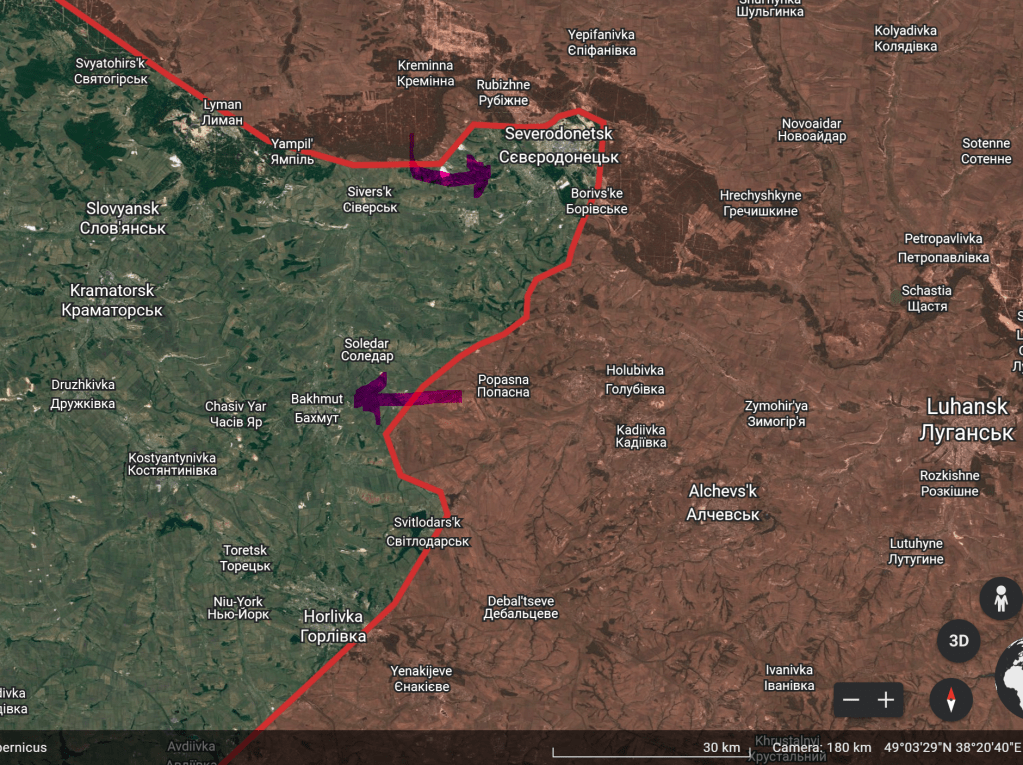
After the Russian-led forces secured the town of Popasnaya from the AFU’s 24th Mechanized Brigade, the Chechen advance towards a major transport hub in the city of Bakhmut (aka Artemovsk) should be expected.
The map below shows the threat axes towards Bakhmut and Severodnoetsk (2nd Guards Tank Army).
Reportedly, AFU units are trying to retreat before the escape route closes.

The pace is picking up in the East.
In the last 24 hours, the Russian Federation forces took two towns threatening the AFU position in and south Severodnetsk:
The AFU supply line is the blue-highlighted road ~3000 meters south of the town — well within artillery and rocket range.
Presently, the AFU has 3-5 days of supplies. Cut the supply line and those inventories quickly run out.
Like Guderian through the Ardennes in the 1940 Battle of France, the Russians 2nd Guards Tank Army successfully cleared the woods to the northwest of Bilohivka, and successfully forced a crossing of the Siversky Donetz River and broke through the AFU defenses.
From here on is open country.
Similarly, the successful assault on Voronove further east leaves AFU forces in rifle pits and trenches north of the airport just west of town – out in the open.
To put this action in perspective, here are the battle lines — including the vise applied to the left flank of the AFU line:
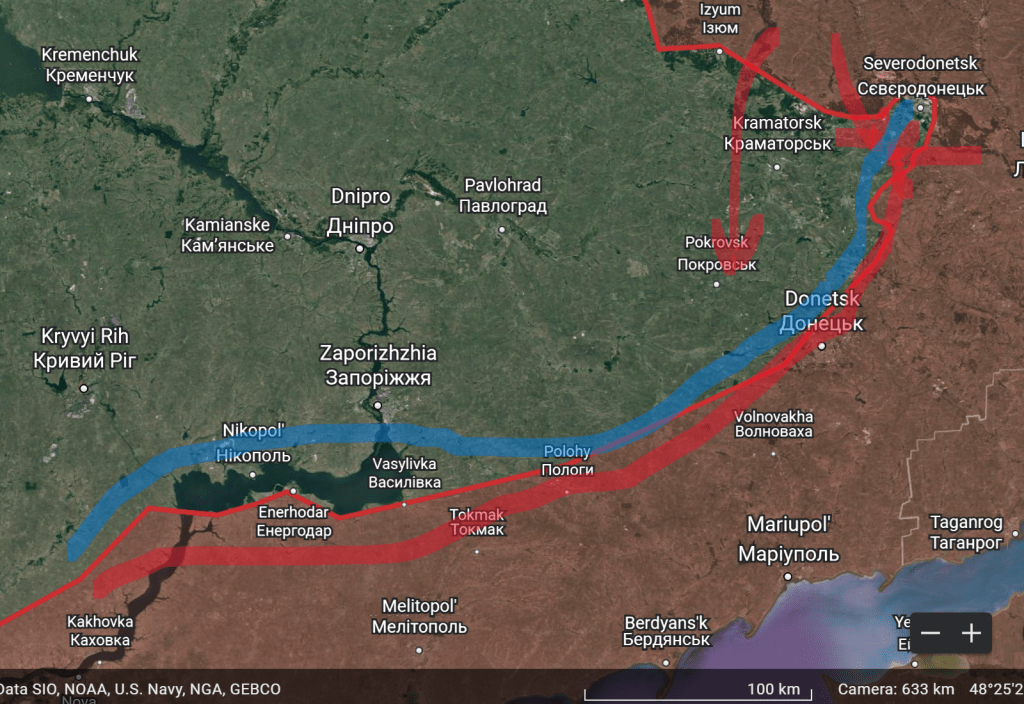
Viewed at a high level, 5th Guards Combined Army is punching through from the East. The AFU’s 24th Mechanized has been regrouping around Bakhmut when it was hit with a missile attack.
Meanwhile, the 2nd Guards Tank Army is dropping down behind Severodonetsk from the north, and 1st Guards Tank Army is poised to drive into the AFU rear west of 2nd Guards while covering its right flank.
As AFU units attempt to reform, they are taking missile strikes near Pyatikhatka, Artsyz, and Krasnopolie.
The problem AFU faces is their units have insufficient fuel to maneuver, and cannot easily disengage from the Russian Federation forces facing them.
On the Donesk front, the AFU is dug into fortified positions. If they try to move, they get hit. And if they move, they can’t move quickly enough.
Their air force is at risk – 2 Su-24’s were destroyed over the past 24 hours.
The cadence should begin to accelerate over the next 2 weeks – slowly, at first, and then ever faster.
Wikileaks: https://wikileaks.org/plusd/cables/08MOSCOW265_a.html
We could label this cable: “Russia never bluffs”
Ambassador Burns is current Director of the US Central Intelligence Agency (CIA)
**********************************************************************************
NYET MEANS NYET: RUSSIA’S NATO ENLARGEMENT REDLINES
Date:2008 February 1, 14:25 (Friday) Canonical ID:08MOSCOW265_a
Original Classification:CONFIDENTIAL Current Classification:CONFIDENTIAL
Handling Restrictions– Not Assigned —
Character Count:9713
Executive Order:– Not Assigned — Locator:TEXT ONLINE
TAGS:NATO – North Atlantic Treaty Organization | PREL – Political Affairs–External Political Relations | RS – Russia | UP – Ukraine Concepts:– Not Assigned —
Enclosure:– Not Assigned — Type:TE – Telegram (cable)
Office Origin:– N/A or Blank —
Office Action:– N/A or Blank — Archive Status:– Not Assigned —
From:Russia Moscow Markings:– Not Assigned —
To:Joint Chiefs of Staff | NATO – European Union Cooperative | National Security Council | Russia Moscow Political Collective | Secretary of Defense | Secretary of State Linked documents or other documents with the same ID:08MOSCOW2653_a
08MOSCOW2655_a
08MOSCOW2656_a
C O N F I D E N T I A L MOSCOW 000265
SIPDIS
SIPDIS
E.O. 12958: DECL: 01/30/2018
TAGS: PREL, NATO, UP, RS
SUBJECT: NYET MEANS NYET: RUSSIA’S NATO ENLARGEMENT
REDLINES
REF: A. MOSCOW 147
B. MOSCOW 182
Classified By: Ambassador William J. Burns. Reasons 1.4 (b) and (d).
MFA: NATO Enlargement “Potential Military Threat to Russia”
intervene; a decision Russia does not want to have to face.
Russia’s opposition to NATO membership for Ukraine and Georgia is both emotional and based on perceived strategic concerns about the impact on Russia’s interests in the region. It is also politically popular to paint the U.S. and NATO as Russia’s adversaries and to use NATO’s outreach to Ukraine and Georgia as a means of generating support from Russian nationalists. While Russian opposition to the first round of NATO enlargement in the mid-1990’s was strong, Russia now feels itself able to respond more forcefully to what it perceives as actions contrary to its national interests.
BURNS

Southfront.org: https://southfront.org/battle-for-popasnaya-result-in-russias-victory-videos/
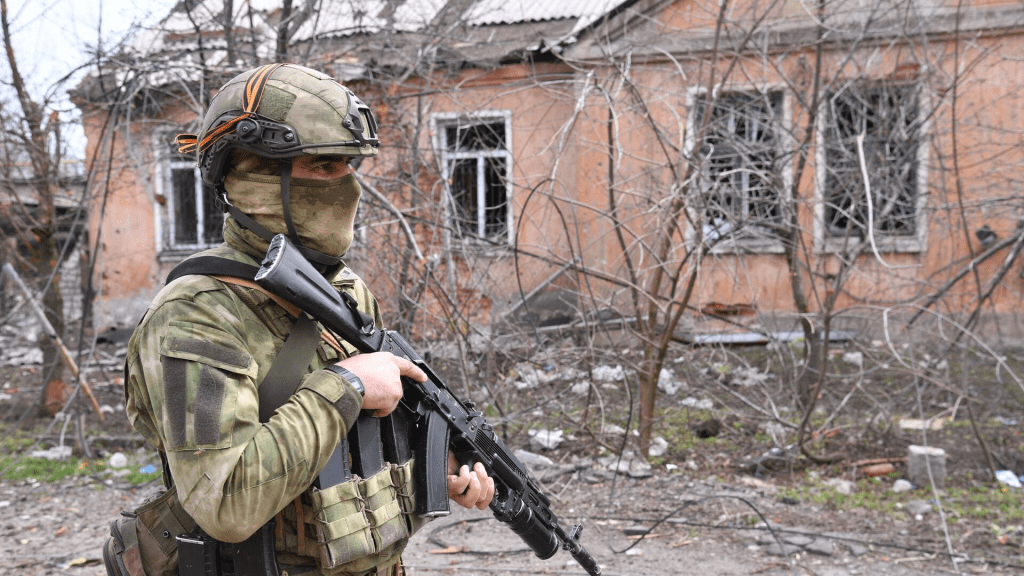
Note the proper handling of this Izhmash AN-94 (Abakan) (successive to the AK-47). The safety and the fire selector are two separate controls. The safety is mounted inside the triggerguard, and the fire selector is a small switch above the triggerguard at the left side of the receiver. The fire selector has 3 positions, for single shots, 2-round bursts and for full-auto. Safety has 2 positions – Safe and Fire.
On May 7, the Armed Forces of Ukraine (AFU) units reportedly retreated from the town of Popasnaya in the Luhansk People’s Republic (LPR), where violent clashes continued for several weeks. Russian troops together with the LPR People’s Militia continue the offensive.
According to the reports from the area, the 24th Mechanized Brigade of the AFU was defeated and withdrew from the city towards the town of Bakhmut. The mop-up operation continues on the north-western outskirts of Popasnaya.
Chechens inside the town (see map above for the location).
According to the head of Chechnya Ramzan Kadyrov, Popasnaya is 80% controlled by Russian forces. Chechen units are also deployed in the area.
Russian-led forces mopped-up the industrial zone and destroyed the Ukrainian strongholds around Popasnaya.
“Almost all strongholds around the city have been destroyed, Popasnaya is blocked, and is 90% in the ring, only one road needs to be closed. Popasnaya was a very fortified village, it was impossible to go there, but our specialists found the key, opened the door, went in and destroyed…” – Ramzan Kadyrov claimed
At the same time, units of the LPR PM are advancing from the south towards Lisichansk. An important road junction of the settlement of Svetlichnoye has been taken under the Russian control. Earlier, clashes were reported in the villages of Nizhny and Orekhovo.
According to Ramzan Kadyrov, Russian forces took control of the town of Nizhny on May 7. The report is yet to be confirmed by the LPR military officials.
The breakthrough around Popasnaya marks the collapse of the northern flank of the grouping of Kyiv’s forces in the sector. This will likely lead to the collapse of Kyiv’s defense in Severodonetsk and Seversk and will open route towards Bahmut.
The advance from Nizhny and Orekhovo will let LPR forces cut off another road leading to the Severodonetsk-Lisichansk area.
**********************************************
As reported above by Southfront, the AFU’s 24th Mechanized Brigade was defeated and pushed north-northwest as the cauldron continues to close.
~20 miles away to the rear of the 24th Mech are southbound forces of the Russian Federation’s 1st Guards Tank Army.
Here’s a little history regarding the 1st Guards Tank Army. 1st Guards was formed twice: once in July 1942 and reformed in January 1943. It was subsequently upgraded to an elite “Guards” unit in January 1944.
1st Guards fought in the early defense during the Battle of Stalingrad, and Operation Uranus. 1st Guards also participated in the historic Battle of Kursk, as well as the Proskurov-Chernovtsy Operation, Lvov-Sandomierz Operation, Vistula-Oder Offensive and the Battle of Berlin.
During the Cold War, 1st Guards was designated to race to the Fulda Gap outside Frankfurt and seize the Rhine crossings.
Notably, in light of its history and after the 2014 Maidan coup in Kiev, 1st Guards Tank Army was reassembled as a unit in 2015 by President Vladimir Putin.
Over the past few days, 1st Guards made some progress towards clearing the north bank of Siverskyi Donets and appears to be preparing to seize a bridgehead south of Kreminna to envelop Ukraine’s defense in Sievierodonetsk.
In some respects, 1st Guards is a replay of the Battle of 73 Easting during the Gulf War. fought on February 26, . 1991, during the Gulf War.
In the Gulf War, Coalition armored forces (US VII Corps and UK 1st Armoured Division) engaged the Iraqi armored forces (Republican Guard and Tawakalna Division) in the final battle of that war. The lead unit was 2nd US Armored Cavalry Regiment.
2nd ACR faced the 1st Guards Tank during the Cold War.
In the way of 1st Guards on the road to Siversk and playing the role of the Republican Guard is the AFU’s 95th Air Assault Brigade.
Here is fighting outside Lyman on the road to Siversk involving Russian Spetsnaz (special forces). Under Russian Combined Arms theory, Spetsnaz work ahead of main units and operate as light infantry. Their role is to locate, engage, and fix the positions of enemy units for destruction by artillery, helicopter gunships, tactical aviation:
Currently inside the envelopment east of Siversk are 4 AFU brigades:
When Siversk is taken, the last supply road will be cut.
Ukrainian Luhansk governor stated that he expect a significant Russian offensive to begin in the three days at either Sievierodonets or outside Popasna.
Three days will be May 9 — Victory Day of the Great Patriot War against Germany.
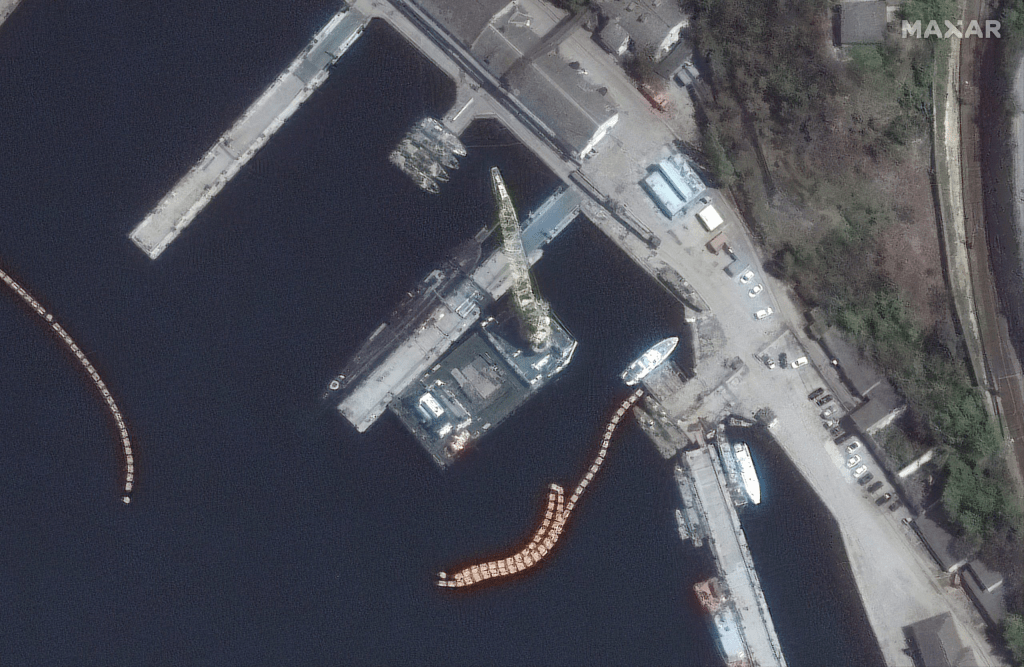
Per Reuters
May 4 (Reuters) – Russia said on Wednesday it had fired two Kalibr cruise missiles at Ukrainian targets from a submarine in the Black Sea and reiterated a warning that it would seek to hit shipments of NATO weapons to Ukraine.
The defense ministry published video footage of the cruise missiles being launched from the Black Sea, and said they had hit unspecified ground targets in Ukraine.
Russia previously said it had mounted similar strikes from a submarine on April 29.
Earlier on Wednesday, Defence Minister Sergei Shoigu reiterated a warning that Russia would seek to destroy convoys of arms shipments to Ukraine from Western countries, which in recent weeks have stepped up these supplies.
“The United States and its NATO allies are continuing to pump weapons into Ukraine,” Shoigu told a conference of defense ministry officials on day 70 of what Russia calls its special military operation in Ukraine.
“We view any transport of the North Atlantic Alliance arriving on the territory of the country with weapons or materials destined to the Ukrainian army as a target to be destroyed.”
Russia’s defense ministry said earlier that it had disabled six railway stations in Ukraine used to supply Ukrainian forces with Western-made weapons in the country’s east by bombing their power supplies.
It was not possible to independently verify the claim, which did not say which Western-made weapons were supplied to Ukrainian forces via those stations. There was no immediate reaction from Kyiv.
Chief of Staff Valery Gerasimov was shown at Shoigu’s side during the meeting of defense officials. On Monday, the United States said it believed Gerasimov visited Ukraine’s eastern Donbas region last week but could not confirm media reports that he was wounded during fighting.
(Reporting by Reuters; editing by Mark Trevelyan)
*******************************
For those unfamiliar with the diesel-electric Kilo, here’s a writeup from “1945”: https://www.19fortyfive.com/2022/05/russia-submarines-kilo-class/

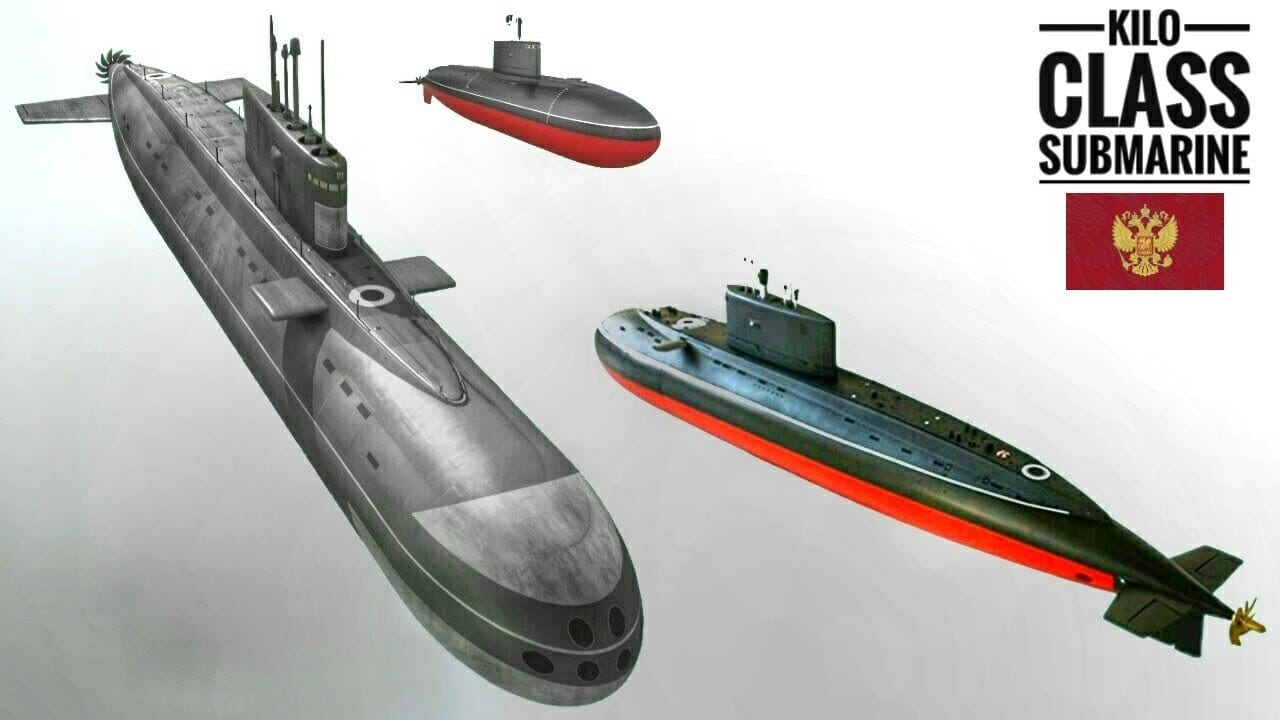
Kilo-class Submarine. Image Credit: Creative Commons.
Russia’s quiet and improved Kilo-class submarines are patrolling the Black Sea, carrying deadly Kalibr cruise missiles that they have used to destroy targets in Ukraine. These subs are conventionally powered. But despite lacking nuclear propulsion, they can sneak around the coast of Ukraine and create mischief without being detected. The Rostov-na-Donu is the most recent submarine of this class to enter the Black Sea. It arrived in the area earlier this year from the Dardanelles, bringing the total of improved Kilo-class boats in the theater of operations to four.
A curious silence
The Russian Navy ordered six of the improved Kilo-class subs (Project 636.3) , which are built at St. Petersburg’s Admiralty Shipyard.
In October 2021, the Magadan became the latest submarine in this class to enter Russian service. Project 636.3 subs are built on the original Kilo-class from the early 1980s. The newer subs are believed to be some of the quietest in the world. So difficult are they to detect that they have earned the nickname “Black Hole.”
That silent quality is a curiosity. The improved Kilo-class still relies on non-nuclear, diesel-electric propulsion. Compare that to the U.S. Navy: America’s last diesel-electric boat retired more than 30 years ago. But a number of features help the improved Kilo-class run silent. The engine plant is placed away from the hull, which eliminates some noise. The vessel also has a rubber-like coating to reduce sound.
Built to attack
The Project 636.3 boats are 243 feet long and displace 3,900 tons. They have a small crew of 52 sailors. The subs can cruise at a depth of 787 feet, with a maximum depth of 984 feet, and they have a range of 7,500 miles. A considerable shortcoming is that they can only sail for 45 days before they need to be resupplied.
These are attack submarines. Their purpose is to eliminate enemy subs and destroy surface ships. Their cruise missiles also give them land-attack capabilities. And since they are so quiet, they can also patrol close to shore and collect reconnaissance and intelligence data.
The new Kilo subs are improved in other ways. They have enhanced internal navigation, a modern fire control system, and better torpedoes. The subs can only steam 10 to 20 knots with two diesel engines. Each submarine carries six torpedo tubes with 18 torpedoes. These same tubes can launch the Kalibr.
Popular Sub for Export
The 636.3 subs have been exported to China, Vietnam, and Algeria. This is an interesting mix of clients. China and Vietnam are maritime rivals, with competing claims to islands in the South China Sea. This means the Kilo boats might try to track each other in that area of operations.
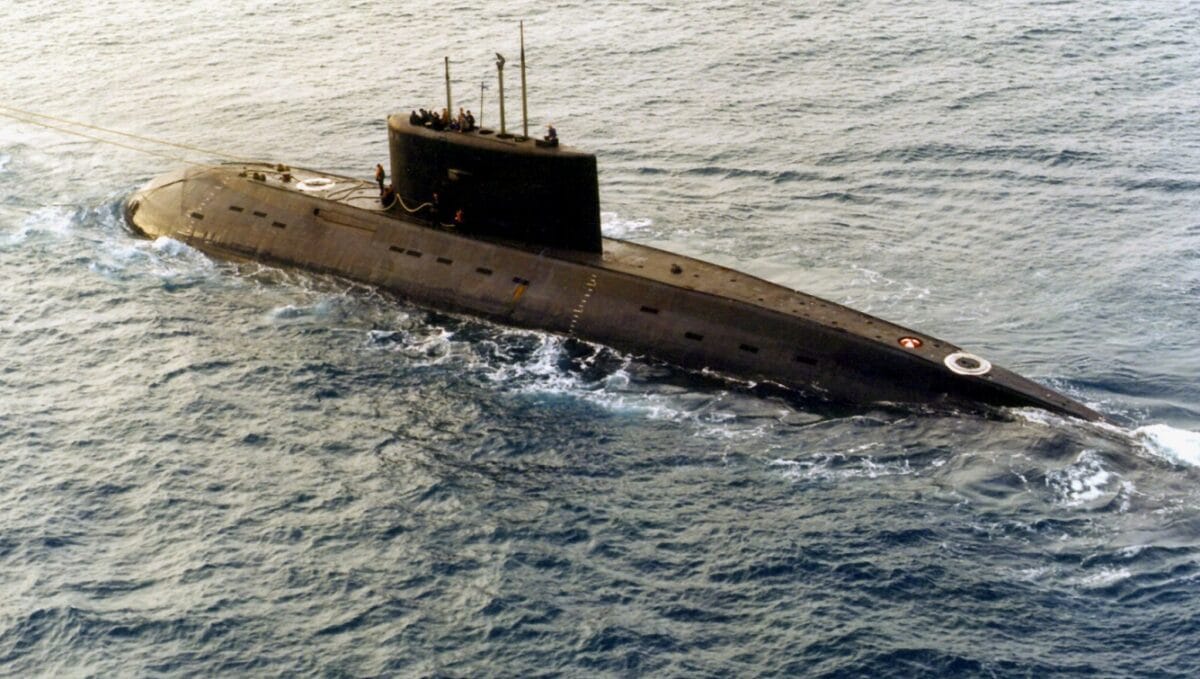
A Russian-built, Kilo-class diesel submarine recently purchased by Iran, is towed by a support vessel in this photograph taken in the central Mediterranean Sea during the week of December 23. The submarine and the support ship arrived at Port Said, Egypt, on Tuesday and were expected to begin transiting the Suez Canal today, Jan. 2, 1996. Ships and aircraft from the U.S. NavyÕs Sixth Fleet are tracking the submarine, which has been making the transit on the surface. This is the third Kilo-class submarine the Iranians have purchased from Moscow. DoD photo
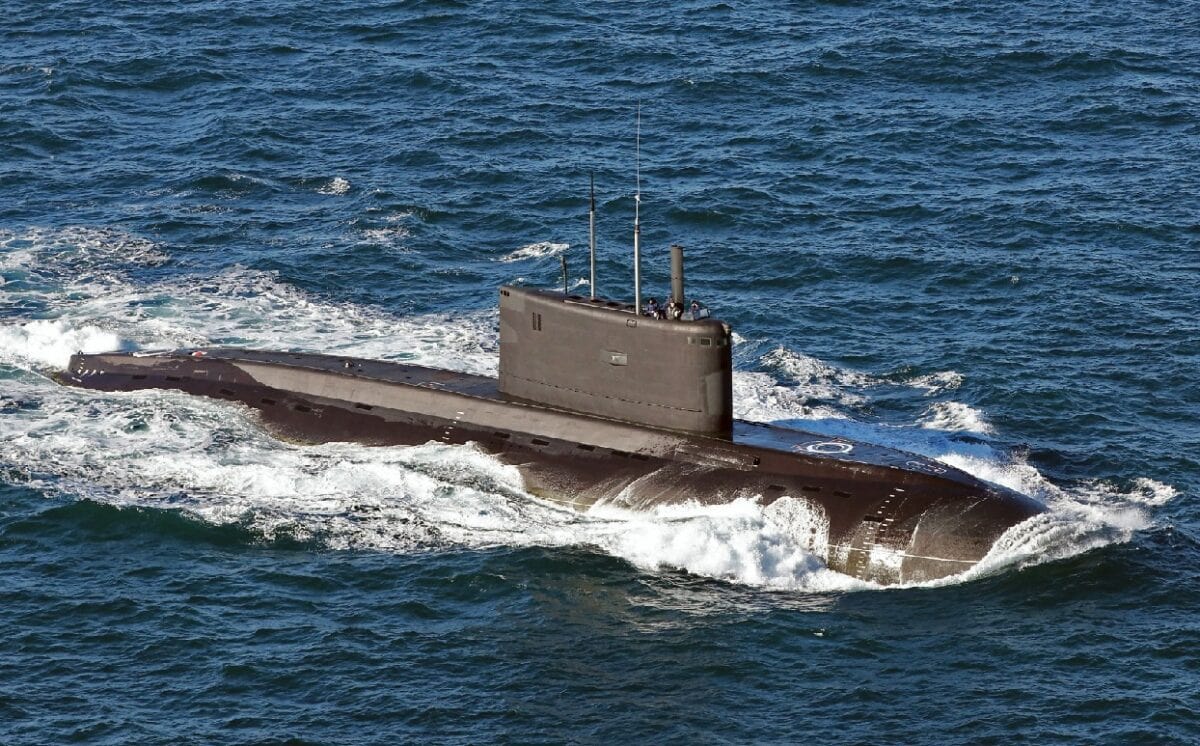
Kilo-class Submarine. Image Credit: Creative Commons.
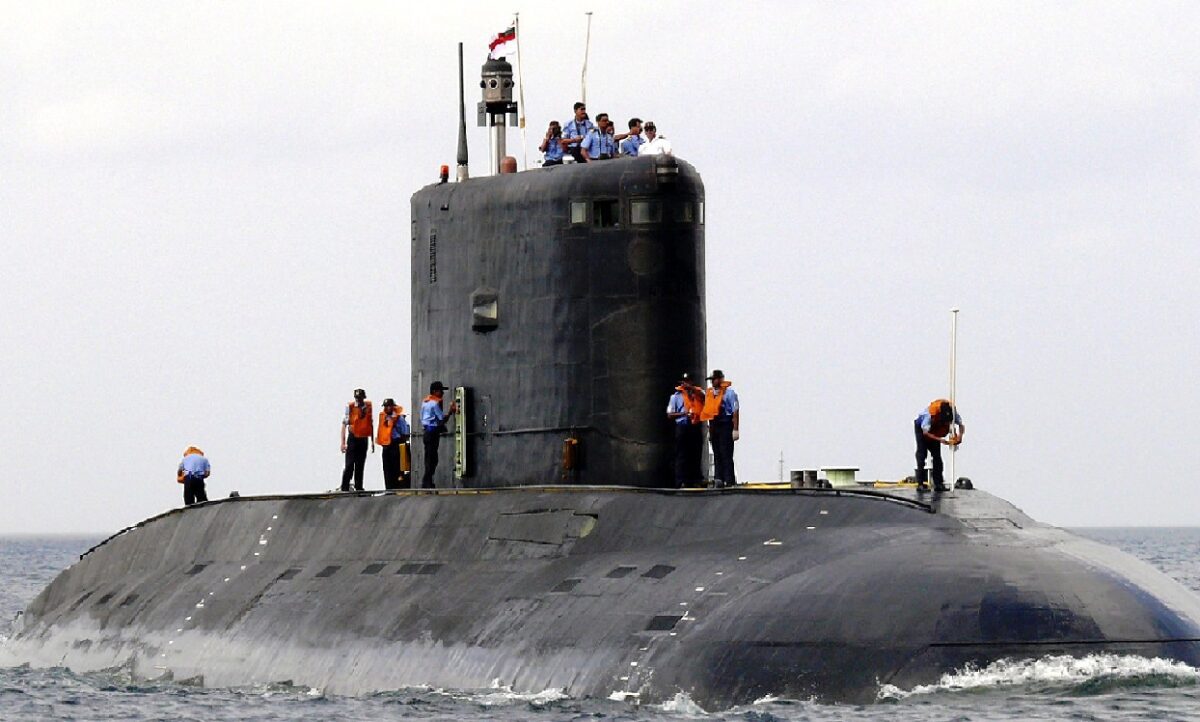
Kilo-class Submarine.
The Kilo has served the Russians well over the years, and exports of the boats have been successful. But they do have weaknesses. They are small, and they do not carry many torpedoes. They are also slow, and they cannot stay out to sea very long compared to nuclear-powered boats. But they are some of the world’s quietest submarines. Expect them to continue to play a land-attack role in the Black Sea, launching Kalibr cruise missiles while submerged. There is nothing Ukraine can do to stop them.

Meaning in History: https://meaninginhistory.substack.com/p/scotus-law-clerk-research-breaking
But first, a disclaimer:
I have no inside information. This thread is speculation, based almost entirely on publicly available information. I could easily be wrong.
Cool? Cool.Her academic background isn’t that uncommon for Supreme Court clerks. Yale undergrad, Yale law, and 2 British Master’s degrees, from LSE and Cambridge.
Do note the Master’s degree in Gender.Here’s where things start to get interesting. Every law student has to write a note – a long legal research paper, usually making a novel argument about the law.
Elizabeth Deutsch wrote hers about reproductive rights and abortion.Specifically, she argued that Obamacare’s non-discrimination provision should be interpreted to *force* Catholic hospitals to perform “emergency abortions.”
Aggressive argument – and hey, law students make aggressive arguments.While in law school she wrote a NYT op-ed about reproductive rights. Sensing a theme here.
Her career page on LinkedIn doesn’t reveal that much…until we start digging a little further.
First, thanks to her NYT wedding announcement (of course), we know that she clerked for judge Nina Pillard.
Pillard was one of the DC Circuit judges appointed by Obama and forced through by Harry Reid blowing up the filibuster.
She’s stridently pro-choice. Perhaps not shocking.After her clerkships, she got a Gruber fellowship at the ACLU for a full year.
What was she working on?
You guessed it. Abortion and reproductive rights.But none of this proves anything. Yes, Deutsch’s career seems pretty focused on abortion. But without some connection to Josh Gerstein (the journalist who received the leak opinion) there would be no reason to suspect her.
Let’s go back to that NYT wedding announcement.
“The bride and groom met at Yale. She is a lawyer. He is a journalist.Isaac Arnsdorf just got hired by the Washington Post as a national political reporter. (Of course he’s on the Trump beat).
But where has he written in the past?
Oh, look. He wrote for POLITICO.
SHARING A BYLINE WITH JOSH GERSTEIN.Looks like Gerstein and they are still bros – chatting on Twitter, interacting as recently as last year.
So, to conclude:
We have a currently-serving Supreme Court law clerk whose career has been almost solely focused on abortion.
She wrote her law school note on abortion.
She wrote op-eds about reproductive rights.
She spent a year working on abortion for the ACLU.She clerked for a stridently pro-choice appellate judge.
And it just so happens that her husband is a journalist, who shared bylines with Josh Gerstein at Politico, and it looks like they are still buds.I don’t know that Elizabeth Deutsch leaked the draft opinion.
But I certainly think someone who has spent much of their academic and professional life fighting to expand the right to get an abortion could be desperate enough to do so.
FIN
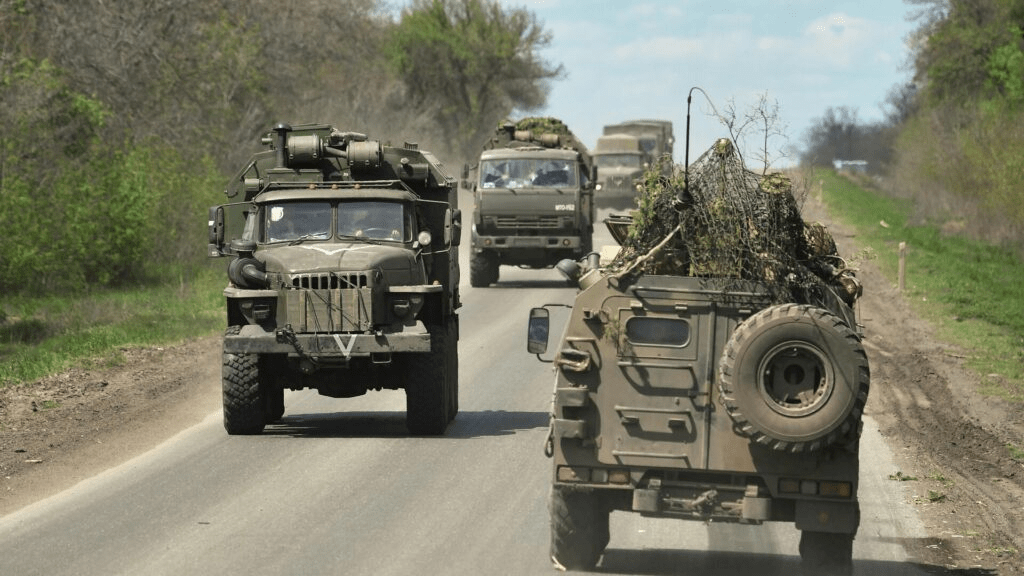
Southfront.org: https://southfront.org/war-in-ukraine-day-69-steady-offensive-of-allied-troops/
On May 3, 2022, the situation in Ukraine did not change significantly. However, there are noticeable successes in the advance of Russian and LDPR military forces in some areas.
Northern direction:
The Russian Armed Forces conducted retaliatory strikes against Ukrainian military facilities in the Sumy region. These actions were revenge for the sabotage of late April and early May.
In the Kharkiv direction, an attempt by the Ukrainian military to push the front line further north and east of Kharkiv ended in failure: Russian forces repulsed attacks by the AFU, and carried out their own artillery and air strikes. The Russian Armed Forces also foiled attempts by the AFU to destroy crossings in the vicinity of Izyum. Thus, the counterattack promised by Alexey Arestovich ended in failure.
Furthermore, in Kharkiv Region, Members of the Russian National Guard servicemen prevented an attack by Ukrainian militants on a convoy of Russian troops. They discovered a large cache of weapons and ammunition of a Ukrainian saboteur’s group in the Izyum region. Among other things, they found two Turkish, two Swedish and three American anti-tank grenade launchers. The cache also contained a large amount of combat gear and food supplies for several days.
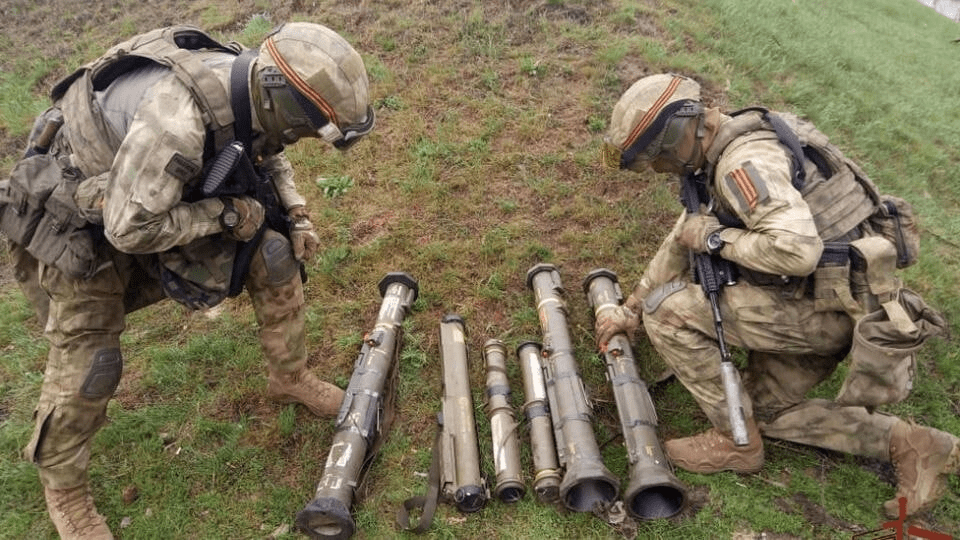
Members of the Russian National Guard prevented a strike on a convoy of Russian troops.
Luhansk direction:
An offensive by the Russian Armed Forces and the LPR military forces to the south of Izyum continues. The main successes are in the area of Liman, Donetsk Region. Allied forces blocked the Ukrainian grouping in this area, forcing them to blow up the Seversky Donets River crossings. Thus, they actually sacrificed their lives and left themselves only one way to retreat along the road leading through Sviatogorsk, Donetsk Oblast, which is already practically under the control of Russian troops. With the defeat of the Liman garrison, the entire left bank of the Seversky Donets River will be cleared of the AFU. A large amount of military equipment was repulsed.
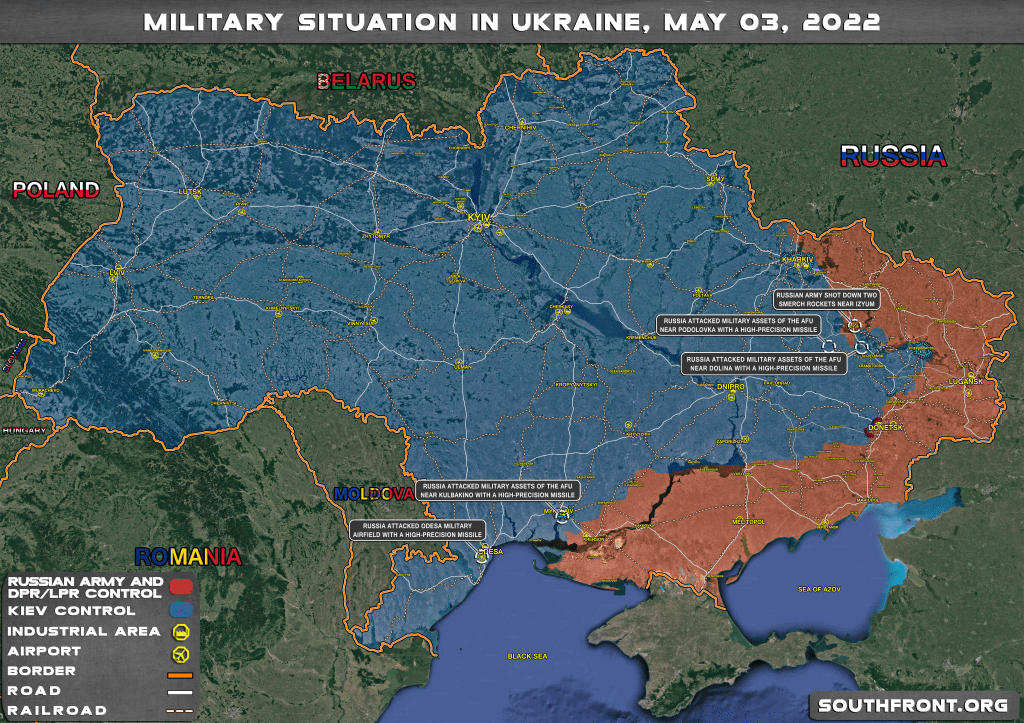
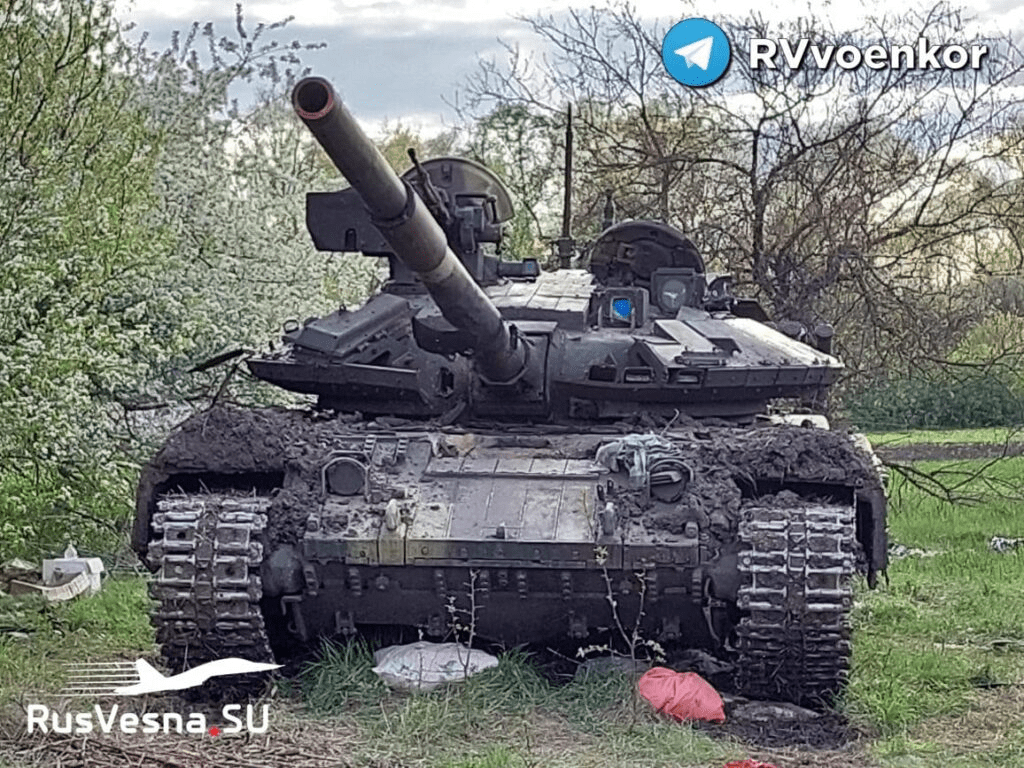

In the city of Popasna, Allied forces continue to mop up the southeastern districts of the city. Once this operation is completed, the Russian and LPR Armed Forces will be left to clear only the northwestern districts of the city. Then they will reach the boundaries of the Lisichansk-Severodonetsk agglomeration. The LPR People’s Militia released 20 hostages, civilians held in basements by Ukrainian radicals. The punishers used the people as human shields, and not only that, Lieutenant Colonel Andrei Marochko of the MN LNR told Donbass Resolves.
“Young people were used as slave labor: forced to build fortifications. Under the fear that close relatives would be shot, they were given weapons. Hostages were forcibly armed and forced to shoot. In this way the Ukrainian Nazis covered their escape.”
Donetsk direction:
Compared to the previous days of May, the fighting in the vicinity of Gorlovka has subsided. However, shelling of the city by the Ukrainian military continues. According to the Mayor of Horlivka, 39 shelling of the city’s territory has been recorded to date.
In the southern districts of Avdeevka, there is an intensive exchange of blows. The DPR units (including “Somali” detachment deployed to that area) are effectively fighting against the Ukrainian fortified areas. However, in response to the intense attacks by the Donetsk people, the Ukrainian forces are literally razing the outskirts of Yasinovataya, DPR.
Near Mariupol, a new UN and Red Cross convoy was formed under the protection of allied DPR and Russian forces. It includes 48 buses and several ambulances, as well as escort vehicles.
It is reported that the storming of Azovstal has begun. Russian Army and DPR forces began to destroy Azov’s firing positions after the militants came out of hiding, taking advantage of the silence regime.
Southern direction:
There is fierce fighting in the vicinity of Gulyaypole, Zaporizhzhia region, according to Ukrainian media. The Ukrainian Armed Forces in this direction have to repel attacks by the Crimean grouping of the Russian Armed Forces.
In the Odessa region, the bridge in Zatoka was hit for the 3rd time today. At this point, according to both the Russian and Ukrainian media, confirmed by military sources, the crossing has been permanently destroyed. Reconstruction will be complicated. There have also been strikes against military (AFU and territorial defense) positions concentrated in and around Odessa.
According to the Russian Defense Ministry, high-precision airborne missiles struck 38 military facilities in Ukraine overnight. Among them: four command posts, 30 strongholds, areas of concentration of manpower and Ukrainian military equipment, and three missile and artillery weapon depots in the areas of Pervomayskoye and Illichivka settlements (Donetsk region). They also destroyed an Osa AKM surface-to-air missile system and a battery of multiple rocket launchers near Arkhangelivka (Kharkiv region).
Russian air defenses destroyed three Bayraktar-TB2 unmanned aerial vehicles near Snake Island. Four Ukrainian unmanned aerial vehicles were also shot down in the areas of Chervony Oskol and Nevskoye (Kharkiv region), as well as Veseloye (Donetsk People’s Republic). In addition, five Smerch rockets were intercepted in the districts of Izyum, Topolskoye and Malaya Kamyshevakha.
However, according to the command of the AFU, two Russian Raptor boats were destroyed by Bayraktar TB2 UAV strikes near Snake Island at dawn today.
Secretary of the National Security and Defence Council of Ukraine Danilov accused Hungary of attempting to annex Ukrainian territory
In a broadcast of the Ukrainian telethon, Danilov said that Hungary had been warned by Moscow about an attack on Ukraine and was planning to annex part of Ukrainian territory.
“Hungary was warned by Putin that there would be an attack on our country. You saw her position. She thought she could take some of the territory away. Well, we’ll see what the consequences will be for this country,” Danilov said.
According to the Pentagon, the U.S. has sent 14 planes with military aid to Ukraine in 24 hours, and another 23 flights were made by five other countries. Moreover, there were announced deliveries of another 5,000 Javelin anti-tank missiles to Ukraine
Thus, the allied forces continue a steady offensive in several directions. Moreover, as of today it is clearly visible that the AFU grouping in Donbass is gradually falling into encirclement. At the same time, Kyiv is sending more and more forces to the blockaded areas. Kyiv’s concept, imposed by Western countries, of conducting a war “to the last Ukrainian” continues to be enforced. The increase in arms deliveries is a consequence of this.
****************************************
Here is ZeroHedge reporting on the intensified strikes on NATO weapons deliveries into western Ukraine.
BY TYLER DURDEN
TUESDAY, MAY 03, 2022 – 03:44 PM
On Tuesday multiple media correspondents reporting from the western Ukrainian city of Lviv said they heard several large blasts in the evening hours. It has since emerged that railway power substations are coming under attack, after the Kremlin last week indicated its military would ramp up efforts to thwart Western arms deliveries into Ukraine.
Ukrainian Railways has announced Tuesday night that a number of trains are delayed after the blasts. “In particular, trains have been detained at the entrance to Lviv, information is being updated,” a statement from the rail authority quoted by CNN said. The attacks, which are being called the biggest cruise missile strikes on Lviv and perhaps across Ukraine since the war’s start, have knocked out power and internet to parts of the city. Vital power and train stations have also been hit in other key areas of the country Tuesday night (local time).
Confirmed: An internet disruption has been registered in Lviv, western Ukraine, amid reports of explosions and power outages following a Russian missile strike; real-time network data show connectivity down to 87% https://t.co/VD8tMFSwEG via @netblocks pic.twitter.com/rUsWPdOyKo
— Liveuamap (@Liveuamap) May 3, 2022
Traffic throughout the city also came to a halt, correspondents on the ground noted. Largescale strikes on Lviv have been a rarity throughout Russia’s over 2-month long invasion, given the major Western city’s distance from the frontlines of fighting, which remains in Donbas as well as to the south.
Whole sections of the city are also without power:
Lviv Mayor Andrii Sadovyi said that parts of the city are without power. Sadovyi also said that “as a result of the missile strikes, two power substations were damaged.”
Explosions were reported in multiple locations across the city, including in positions south, east and west.
It’s believed though unconfirmed that at least five cruise missiles slammed into Lviv – and there were many more across other parts of the country.
#BREAKING: Large smoke column over Lviv, Ukraine following reported Russian cruise missile strikes. https://t.co/JoYTwK8XS5 pic.twitter.com/yMRssccdch
— Moshe Schwartz (@YWNReporter) May 3, 2022
CNN correspondents are reporting:
Blasts heard in Lviv, Ukraine, coming from east, south and west of the city center. One site is close to the city center. From another, a huge plume of black smoke can be seen billowing across sky. All the lights across city appear to be out.
The moment of one of the missile strikes on Lviv #Ukraine. According to local officials, three electrical substations were damaged. pic.twitter.com/JQGutUNNbl
— Ostap Yarysh (@OstapYarysh) May 3, 2022
The Monday prior, Russian forces attacked at least six railway stations and facilities, some of them also near Lviv.
Multiple Russian cruise missile strikes on infrastructure targets across Ukraine tonight, parts of Lviv without power. Likely the biggest barrage since the beginning of the war.
— Yaroslav Trofimov (@yarotrof) May 3, 2022
Ukraine’s military command previously commented that targeting rails has been part of ongoing Russian efforts to completely disable the country’s military transport infrastructure, specifically with an eye on foreign arms transfers as what the Kremlin previously dubbed “legitimate targets”. Kiev and the UN have also condemned attacks on civilians and vital civilian transport at a time of unprecedented numbers of internally displaced war refugees.
A Ukrainian military statement published last week alerted the public that the Russians “are trying to destroy the supply routes of military-technical assistance from partner states. To do this, they focus strikes on railway junctions.
#Russia has hit an "infrastructure facility" in the mountains of Zakarpattia Oblast, the governor says. The 1st strike in the westernmost region.
— Alexander Khrebet/Олександр Хребет (@AlexKhrebet) May 3, 2022
Tonight 🇷🇺 targeted railways system. I'm afraid, they hit the Beskydy Tunnel in the Carpathian between Zakarpattia and Lviv Oblasts. https://t.co/jbWkhY8rP0
And further attacks on railway and power infrastructure are being reported into the Tuesday night hours in various parts of the country.
🚨 Alert is over in Western Ukraine but not everywhere: Cherkasy, Kropyvnytskyi, Mikolaiv & Odesa in Central Ukraine, & Luhansk in the East, are still on high alert.
— Emmanuelle Chaze (@EmmanuelleChaze) May 3, 2022
In Lviv, there are power & water outages in some parts of the city, officials say they're working on fixing it. pic.twitter.com/LxyZRKB0tb
A number of cities continue to be on high alert as the Russian military is apparently increasing its targeting of power and transport infrastructure sites.
Have a WordPress.com account? Log in now.

