You Know Things Are Bad When Saudi State TV Mocks Joe Biden
You know things are bad when Saudi television mocks the president of the United States in a SNL-style spoof. A state-run TV station featured a comedy sketch depicting Joe Biden attempting to address the Ukraine crisis, but he’s seen wandering away from the podium and falling asleep mid-sentence, while also being constantly prodded by his VP over what to say given he struggles to remember basic names and information.
The sketch went viral after it hit social media on Monday, and comes after last month Saudi Crown Prince Mohammed bin Salman reportedly rejected attempts by the White House to set up a phone call between he and Joe Biden, at a moment the US is urging the Saudis to ramp up oil output. Watch the brief segment above.
The sketch from the show Studio 22 begins with “Biden” barely aware of his surroundings as “Harris” tries to pull him back on stage in order to stutter through some short sentences, as The Jerusalem Postdescribed further:
The overarching theme of the clip is that President Biden is old. The character is obviously unaware of his surroundings and prone to falling asleep mid-sentence. Consequently, the audience sees Harris, played by a male actor in drag, telling the President what to say and do. At the end of the clip, Biden finally falls asleep and Harris literally puppets his unconscious body, screaming, “clap for the president!”
The clip was an obvious and perhaps over-the-top attempt at highlighting the 79-year old president’s cognitive decline in old age, also after a series of recent remarks on Ukraine that the White House had to scramble to walk back. The Saudi spoof included the following dialogue:
BIDEN: Yeah, we gotta talk about the crisis in Africa.”
HARRIS: [taps and whispers again]
BIDEN: Yeah Russia. And I wanna talk about President of Russia–[pauses].
HARRIS: [whispers]
BIDEN: Putin. Putin. Putin! Listen to me, I have [a] very important message to you. The message is [falls asleep and snores].
But just days ago a very real clip of Biden giving a press conference on the White House lawn while standing beside Harris wasn’t too far off from the extremes that the Saudi skit depicted…
BIDEN: "I was in the the foothills of the Himalayas with Xi Jinping, traveling with him, that's when I traveled 17,000 miles when I was Vice President. I don't know that for a fact." pic.twitter.com/hoiGCUGckR
He began by saying “America as a nation can be defined as a single word…”
But then Biden inexplicably drifted off and changed thought entirely, breaking into his own sentence with “…excuse me, I was in the foothills of the Himalayas with Xi Jinping, traveling with him, traveled 17,000 miles when I was Vice President. I don’t know that for a fact.”
And it’s of course unclear what the bizarre Himalaya story was meant to convey. Given the timing and fact that the Saudi skit was produced days after that last Friday White House speech, the Saudis were clearly taking aim at the incident, using it to highlight current lack of faith in Biden as a global leader during the Ukraine crisis.
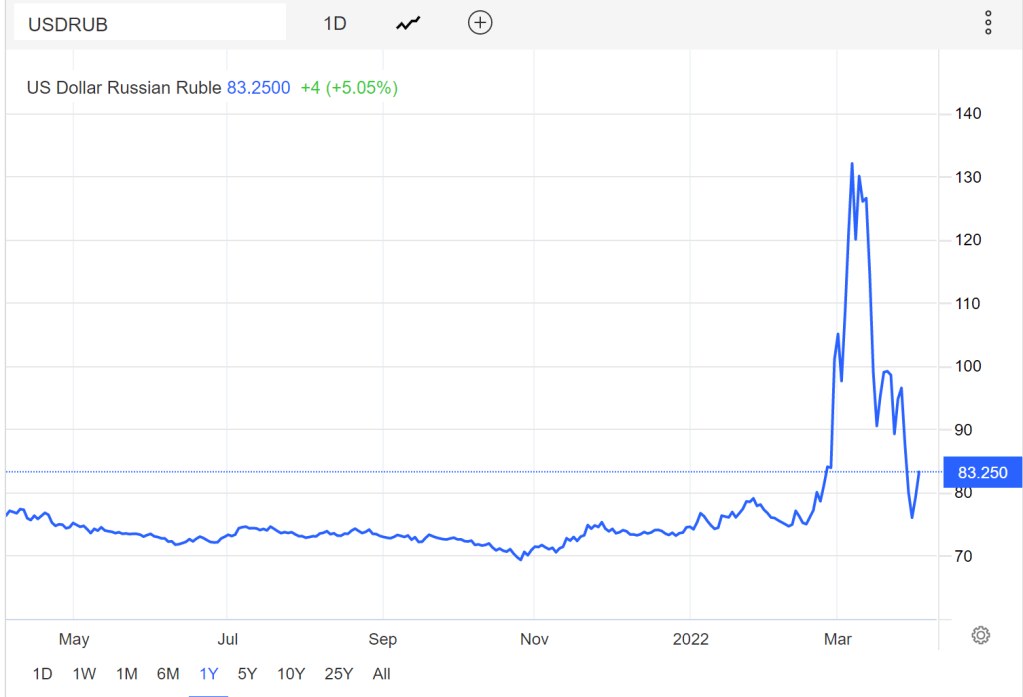
Probably the most current metric for how Russia is doing is the Ruble. So far, it is holding its own even as Biden sanctions are destroying the EU economy and crippling the US.
We’ll summarize what we know about principal military attack vectors, share Russian/DPR perspective, and end with Scott Ritter’s analysis.
We’re not cheerleaders. But with Western media nothing more than Biden Regime “psyops”, it’s always helpful to see how the other side sees things, plus a little reality check.
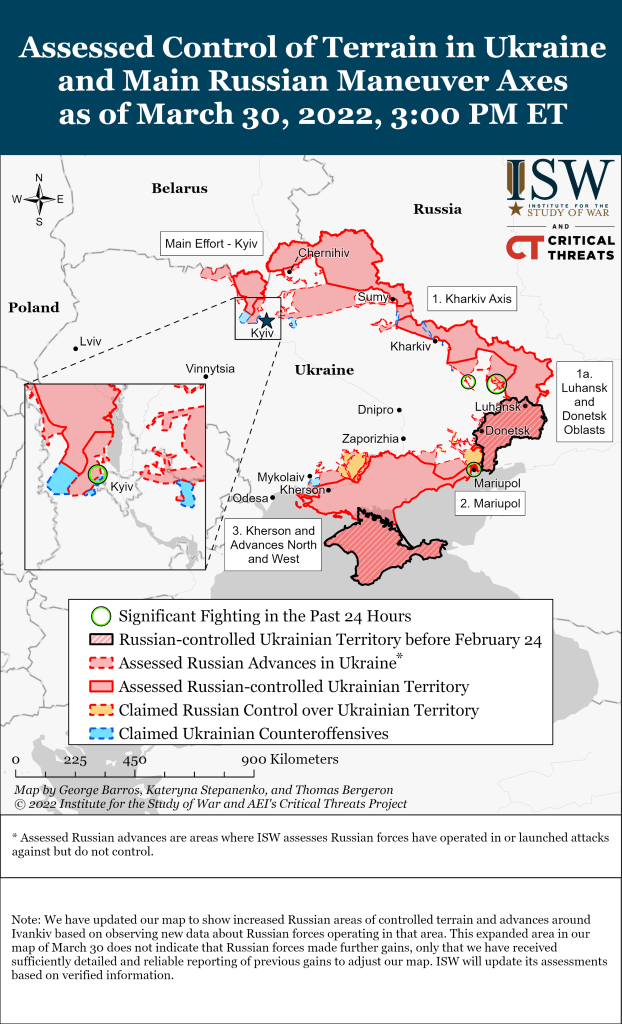
Now to the front which has shifted north and east as the Mariupol ends.
Karkiv
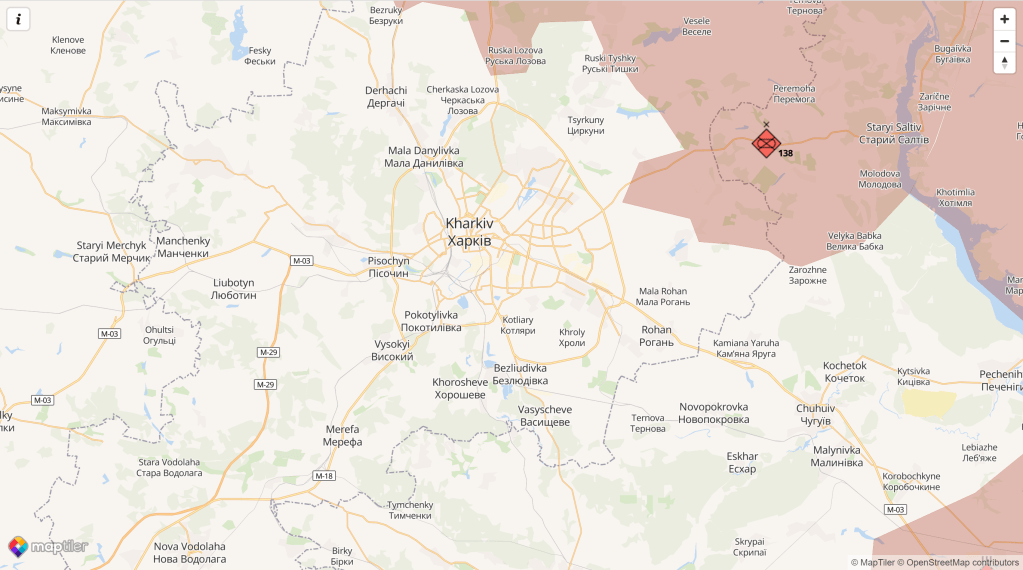
On the right flank of the Russian position is the 138th Separate Guards Motorized Rifle Brigade of the 6th Combined Arms Army (6th CAA). The 138th employs MT-LBV armored personnel carriers and T-72B3 tanks. According to the Finnish newspaper Helsingin Sanomat article, two battle groups of approximately 800 men each from the brigade had been sent to participate in the 2022 Russian invasion of Ukraine.
Here are some T-72s reportedly in the vicinity ot Kharkiv.
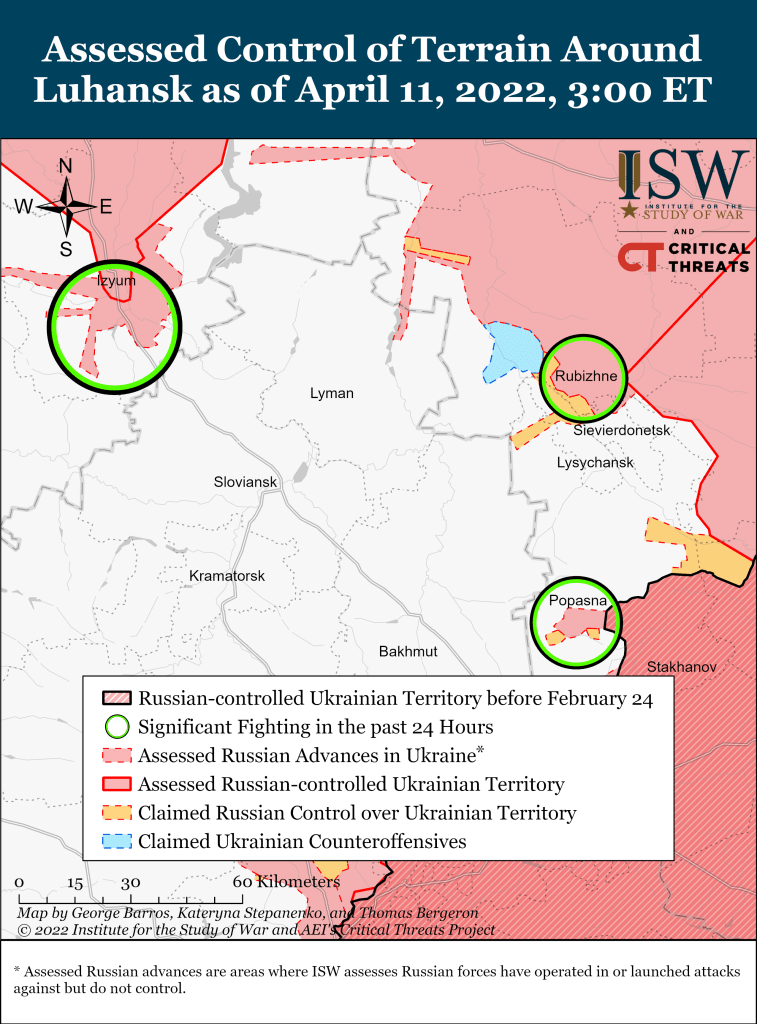
Russia completed its withdrawal from Sumy Oblast and additional forces from the 35th Combined Arms Army (CAA) arrived on the Izium axis. 2nd Guards Motorized Rifle DIvision’s (2nd GMRD) 1st Guards Tank Regiment conducted a possible probe south of Izium near Sulyhivka. 1st Guards Tank Army’s remaining combat power may not be enough to achieve a breakthrough without further reinforcements. 35th CAA likely begun to arrive in this sector, with Ukraine’s General Staff noting the arrival of the 38th Seperate Motorized Rifle Brigade.
This appears to be a flank security position for the larger body of troops aimed at IZyum.
Izyum
The 1st Guards Tank Army is the Russian hammer.
Russian forces will continue reinforcing the Izyum-Slovyansk axis and attempting to advance to and through Slovyansk to encircle Ukrainian forces.
Here we see the bulk of the 1st Guards Tank Army stretched along the vital M-03 road.
More broadly, Russia continued its redeployment of VDV and Eastern Military District forces from Belarus to the Donbas and Kharkiv Oblast. Additional 35th Combined Arms Army (CAA) elements and possibly part of the 76th Guards Air Assault Division arrived at Valuyki and Kup’yans’k. The 35th CAA’s remaining combat capable units will arrive over the next five days, possibly achieving allowing Russia overall to reach a correlation of forces favorable enough to mount an offensive south of Izium. 5th CAA elements have been identified in the Sievierodonetsk area. Kherson has been slightly reinforced by an unidentified naval infantry unit, possibly indicating Russia intends to try to hold it.
But back to the M-03: the primary rail hubs being used to reinforce the Izium axis are Valuyki and Kup’yans’k.
Imperial (black and yellow and white) and St. Andrew (Russian Marines) flags – units heading east
Abrams tank captured by DPR forces on the Eastern front.
As reported by Tass:
“During the day, high-precision land-based missiles hit a battalion command center, three company strongholds, two company tactical groups of the 24th Ukrainian mechanized brigade and a territorial defense brigade, and two place of the deployment of personnel, weapons and military hardware near the settlements of Popasnaya, Novozvanovka, and Zolotoye in the Donetsk region,” he said, adding that up to 300 Ukrainian militants were killed and more than 50 armored combat vehicles were destroyed.
Mariupol and the Russian/DPR Point of View
Finally, Scott Ritter on the Battle of Donbass – the “Double Envelopment”
Shocking Consumer Credit Numbers: Credit Card Debt Soars With Savings Long Gone
BY TYLER DURDEN
THURSDAY, APR 07, 2022 – 03:21 PM
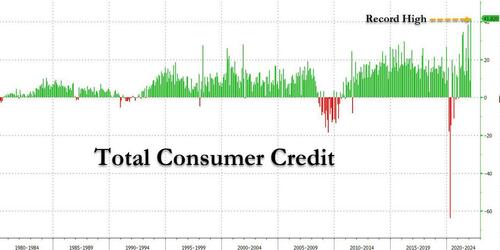
While it is traditionally viewed as a B-grade indicator, the February consumer credit report from the Federal Reserve was an absolute stunner and confirmed what we have been saying for month: any excess savings accumulated by the US middle class are long gone, and in their place Americans have unleashed a credit-card fueled spending spree.
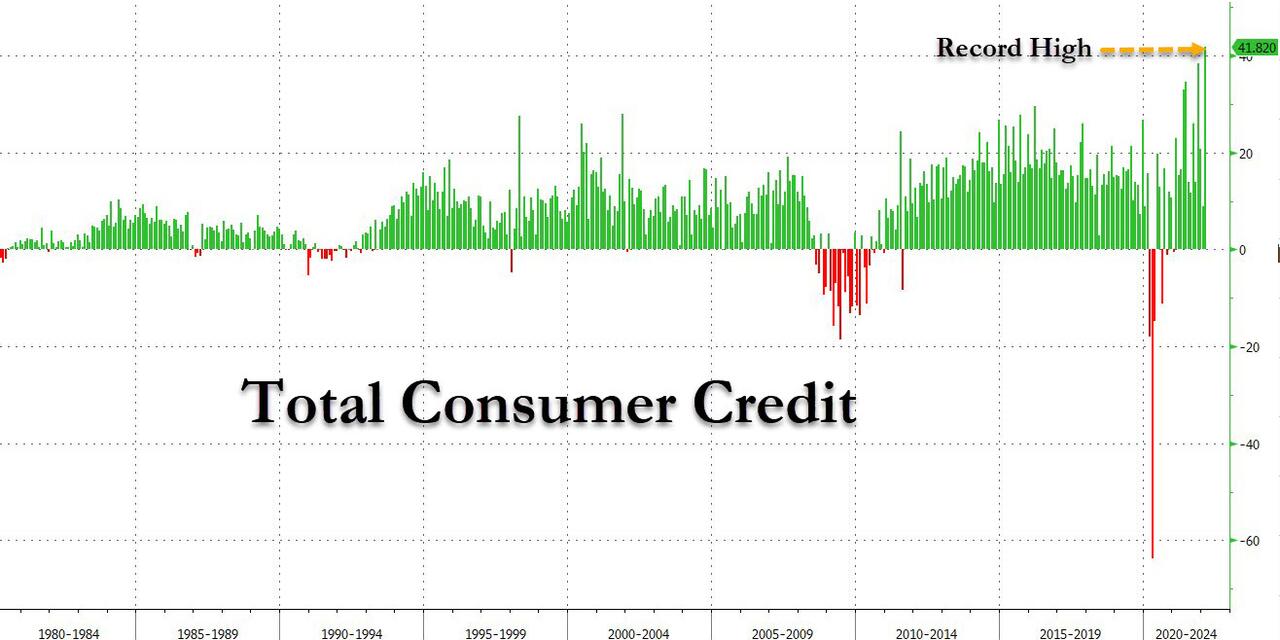
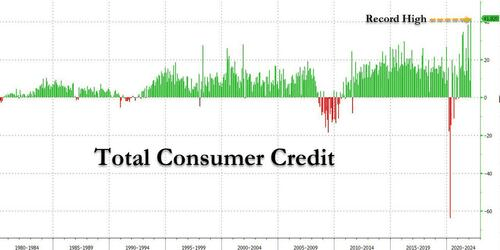
Here are the shocking numbers: consumer credit exploded by a whopping $41.8 billion, more than double the expected $18.1 billion print, nearly five times more than the upward revised $8.9 billion January number (revised from $6.8 billion), and the highest on record!
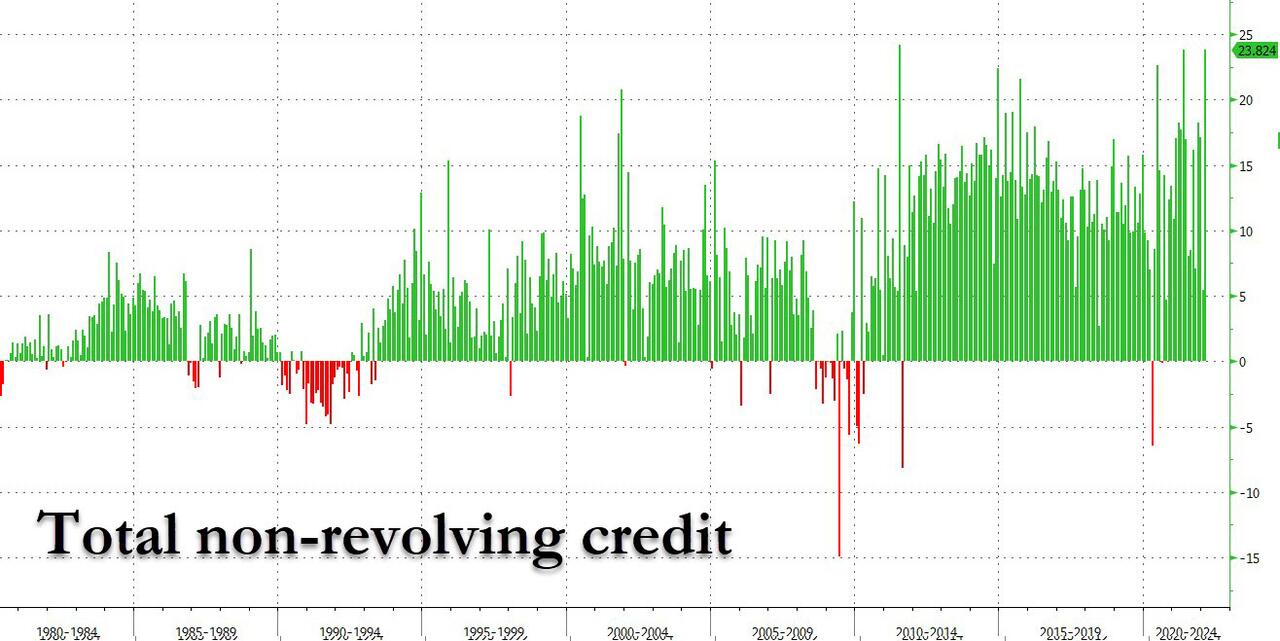
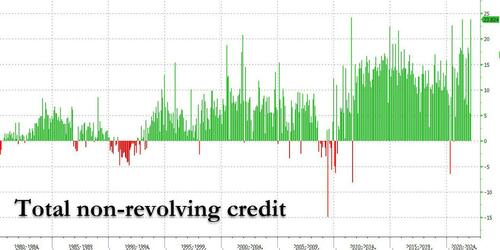
And while non-revolving credit (student and car loans) surged by a near record 23.8 billion, the third highest on record…
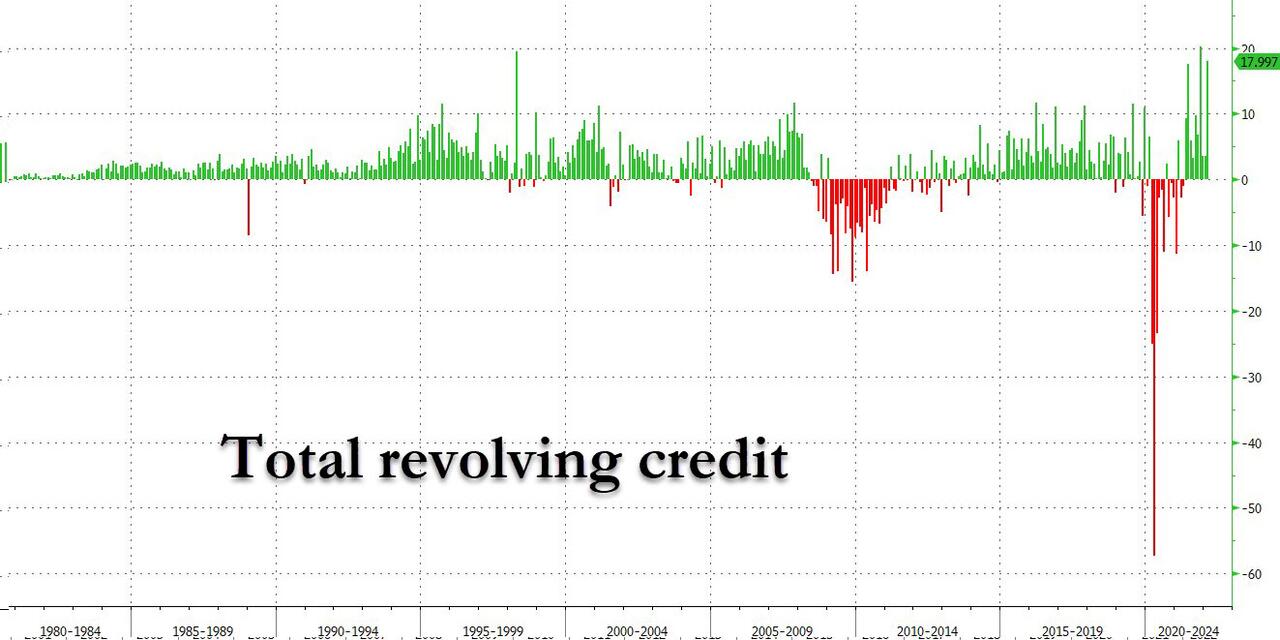
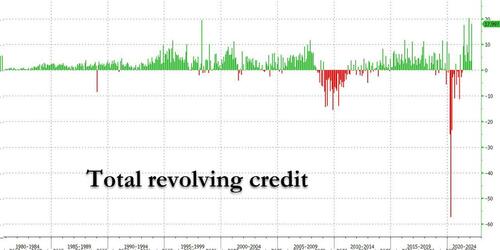
… the real stunner was revolving, or credit card debt, which soared nearly six-fold February to $18 billion from $3.1 billion in January, the second highest print on record, just in time for those credit card APR to starting moving higher, first slowly and then fast.
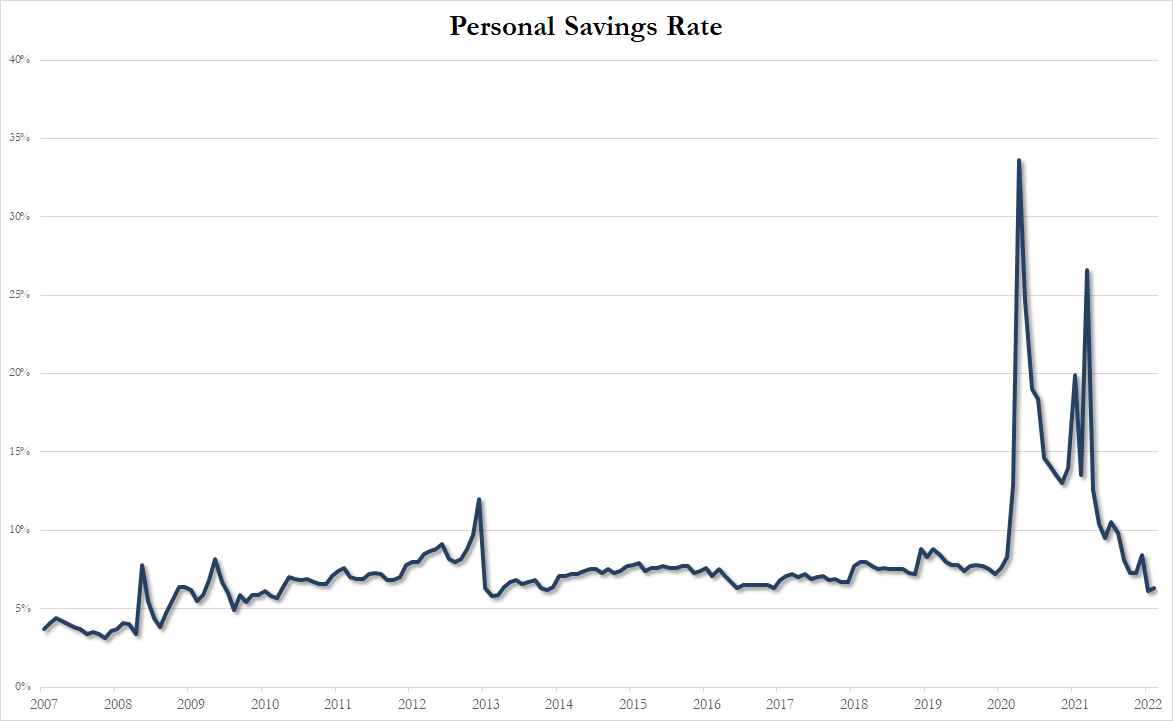
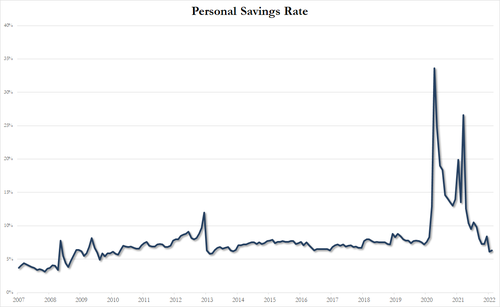
While this unprecedented rush to buy everything on credit at a time when there were no notable Hallmark holidays should not come as much of a surprise, after all we have repeatedly shown that for the middle class any “excess savings” are now gone, long gone…
… the fact is that most economists – such as those at Goldman Sachs – had previously anticipated that continued spending of savings by consumers (who they fail to realize are now tapped out) is what will keep the US economy levitating in 2022. Unfortunately, as today’s consumer credit numbers clearly demonstrate, any savings that US middle class households may have stored away courtesy of stimmies, are now gone. The implications are profound: any model that projected that US spending will be fueled by “savings” can now be trashed. And since this is most of them, the consequences are dire as they confirm – once again – that the Fed is tapering, QTing and hiking right into a recession, which according to Deutsche Bank will begin in late 2023 and which according to Morgan Stanley can start in as little as 5 months. Today’s data suggests that Morgan Stanley is right…
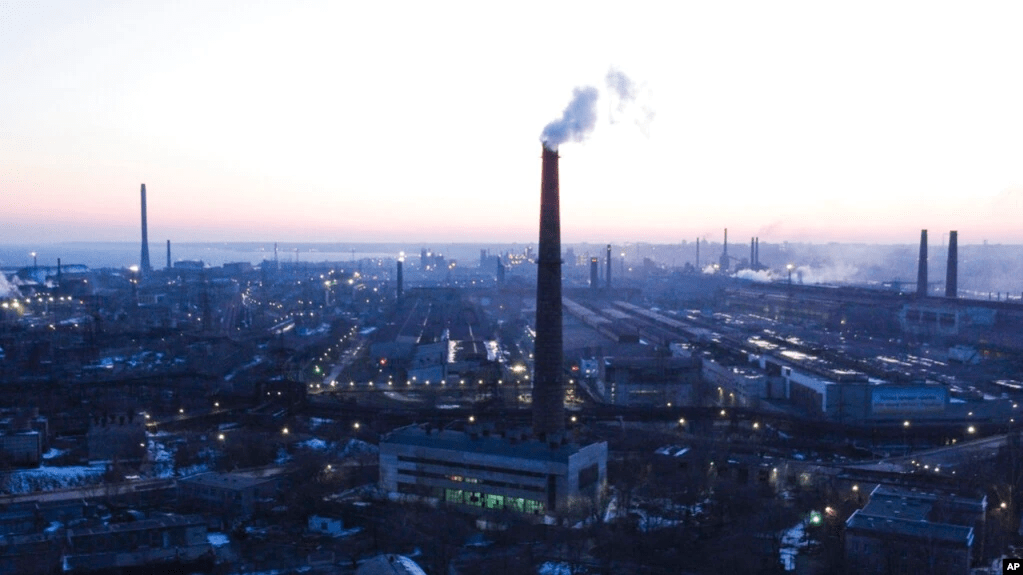
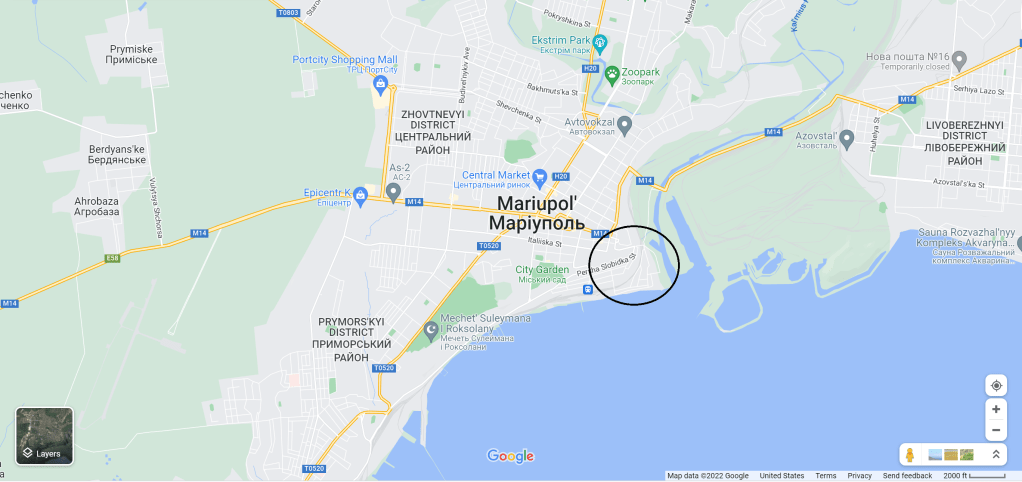
The city map below highlights the Steel Plant where the last of the “really out there” Azov Battalion (more like a division) and other units of the dwindling Ukrainian forces are using their American weapons to the last round duking it out with Chechen, Russian Marines, and LDPR units.
Before a few of today’s videos, first a bit about Mariupol.
The city is largely and traditionally Russian-speaking, while ethnically the population is divided about evenly between Ukrainians and Russians. There is also a significant ethnic Greek minority in the city.
In 2002, ethnic Ukrainians made up the largest percentage (48.7%) but less than half of the population; the second greatest ethnicity was Russian (44.4%). A June–July 2017 survey indicated that Ukrainians had grown to 59% of Mariupol’s population and the Russian share had dropped to 33%.[62]
The city is home to the largest population of Pontic Greeks in Ukraine (“Greeks of Priazovye”) at 21,900, with 31,400 more in the six nearby rural areas, totaling about 70% of the Pontic Greek population of the area and 60% for the country.
Following the 2022 Russian invasion of Ukraine, Mariupol stood as a strategic target for Russian and pro-Russian forces. From 25 February, the city has been under siege. On 13 March the Red Cross warned that the siege had become a humanitarian crisis.
A month into the conflict, Ukrainian authorities said that about 90% of buildings in Mariupol were damaged or destroyed.[ An aid worker from the Red Cross described the conditions there as “apocalyptic”, with concerns for the humanitarian situation caused by severe damage to infrastructure, access to sanitation, and food shortages.
By 18 March, Mariupol was completely encircled and fighting reached the city centre, hampering civilian evacuation efforts.
On 24 March, Russian forces entered central Mariupol as part of the second phase of the invasion.
That operation is coming to a close as isolated Ukrainian units run out of supplies.
Mass surrender of 264+ Ukrainian servicemen from the 501st Separate Marine Battalion, 36th Marine Brigade of the Armed Forces of Ukraine.
Russia to see record capital inflow this year – reports
Skyrocketing oil prices and falling imports are the main factors, experts say
Russia’s balance of payments surplus could hit a historic high this year, amounting to $200-$300 billion, business news outlet RBC reported on Monday. Economists polled by RBC have predicted record capital inflows into the country, despite the tightening Western sanctions. [Note: $300 billion is what the US and EU stole – err, “froze” after the Biden Sanctions. And, that freeze prompted Russia’s insistence for payment in rubles]
They pointed to major factors behind the inflow, such as the increase in the value of Russian energy exports, and a reduction in merchandise imports to Russia by up to 50%.
“The key driver of the Russian balance of payments surplus [hydrocarbon exports] still looks confident,” the Institute of International Finance (IIF) said in its review, seen by RBC.
According to a Bloomberg analysis, Russia will get an estimated $321 billion in energy exports revenue in 2022, marking a surge of more than a third compared to last year. That’s despite the huge discounts the country provides. The Russian Ministry of Finance said last week that, on average, Russian Urals oil cost over $89 per barrel in March, which is a 40% rise year-on-year.
The IIF said that the number of oil tankers moored in Russian ports awaiting departure is only slightly less than in the same period in previous years. Data by TankerTrackers, a company that tracks the movement of oil tankers around the world, showed that Russia still exports about three million barrels per day of oil by sea, and those deliveries are quite transparent.
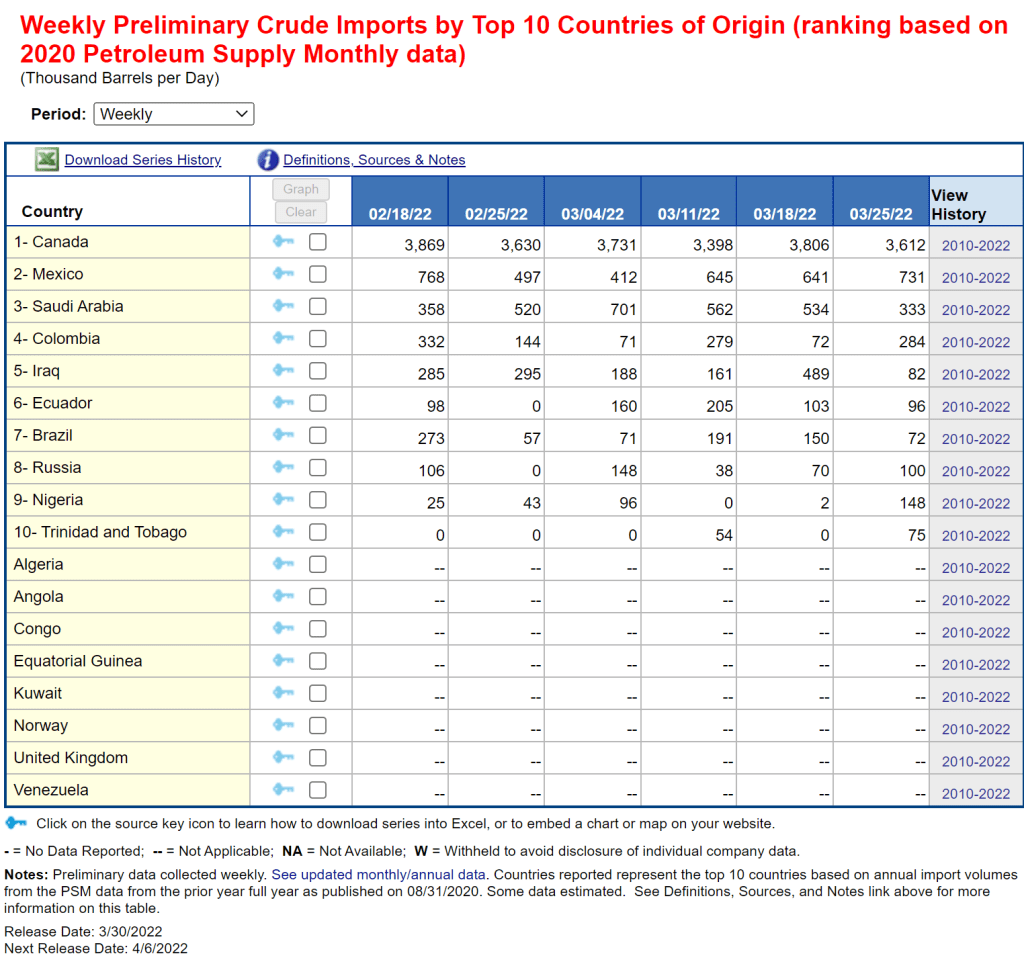
President Biden banned U.S. imports of crude oil, refined petroleum products, natural gas, coal, and coal products that originate in Russia. The President’s executive order, however, does not restrict U.S. energy imports originating in other countries that transit through Russia or depart from Russia’s ports. Crude oil exported from countries including Kazakhstan, Azerbaijan, and Turkmenistan moves through Russia’s energy export infrastructure. Crude oil from Russia can be imported into the United States if it is marketed and loaded with a certificate of origin verifying that the crude oil is of non-Russian origin.
Crude oil exported from Kazakhstan moves primarily through the Caspian Pipeline Consortium (CPC) system. The CPC travels around the north side of the Caspian Sea and through Russia, transporting crude oil produced in Kazakhstan to the Russian Black Sea port of Novorossiysk. Some crude oil produced in Russia is transported in the same pipeline as CPC grade crude oil, but it represents around 10% of the crude oil exported through the CPC system.
Crude oil is also exported from Kazakhstan through Russia’s Transneft pipeline system to Novorossiysk and the Russian Baltic Sea port of Ust Luga, as well as through the Kazakhstan-China Pipeline to China. Most exports originating in Kazakhstan travel by pipelines through Russia or are shipped out of Russia’s ports.
Exports of crude oil from Azerbaijan are largely transported through the Turkish port of Ceyhan through the Baku-Tbilisi-Ceyhan (BTC) pipeline, which does not pass through Russia. However, small amounts of crude oil are exported from Azerbaijan through Russia. Significant volumes of crude oil are not exported from Turkmenistan, but it can travel west to Ceyhan through the BTC pipeline or travel north to Novorossiysk from the Russian Caspian port of Makhachkala through the Baku-Novorossiysk pipeline. In 2021, 25,000 barrels per day (b/d) was exported from Azerbaijan, and 43,000 b/d was exported from Turkmenistan through Russia, according to data from Argus Media.
In 2021, most exports of crude oil from Kazakhstan went to Europe, but some were received in the United States. Ports on the U.S. East Coast received 18,000 b/d of light, sour crude oil imports from Kazakhstan—an amount representing less than 0.3% of U.S. crude oil imports that year. Crude oil from Azerbaijan has not been imported into the United States since 2018, and crude oil from Turkmenistan has never been imported into the United States.
Russian Ruble relaunched linked to Gold and Commodities – RT.com Q and A
With Russia’s central bank having just profoundly altered the international trade and monetary system by linking the Russian ruble to both gold and commodities, the journalists at RT.com in Moscow asked me to write a Q and A article on what these developments mean, and the ramifications of these changes on the Russian ruble, the US dollar, the gold price and the global system of currencies. This article has been published on the RT.com website here.
Regular readers will recall that I have contributed to quite a few RT.com articles before, such as about Australian gold (see BullionStar here), US Treasury gold (see BullionStar here), Poland’s gold (see RT site here), China’s gold (see RT’s Spanish site here), why buy physical gold (see RT site here), and gold price manipulation (see RT site here).
However, since RT.com is now blocked and censored in many Western locations such as the EU, UK, US and Canada, and since many readers may not be able to access the RT.com website (unless using a VPN), my Questions and Answers that are in the new RT.com article are now published here in their entirety.
Who would have thought that citizens of ‘free speech’ Western countries would need a VPN to read a Russian news site?
Why is setting a Fixed Price for Gold in Rubles significant?
By offering to buy gold from Russian banks at a fixed price of 5000 rubles per gram, the Bank of Russia has both linked the ruble to gold and, since gold trades in US dollars, set a floor price for the ruble in terms of the US dollar.
We can see this linkage in action since Friday 25 March when the Bank of Russia made the fixed price announcement. The ruble was trading at around 100 to the US dollar at that time, but has since strengthened and is nearing 80 to the US dollar. Why? Because gold has been trading on international markets at about US$ 62 per gram which is equivalent to (5000 / 62) = about 80.5, and markets and arbitrage traders have now taken note, driving the RUB / USD exchange rate higher.
So the ruble now has a floor to the US dollars, in terms of gold. But gold also has a floor, so to speak, because 5000 rubles per gram is 155,500 rubles per troy ounce of gold, and with a RUB / USD floor of about 80, that’s a gold price of around $1940. And if the Western paper gold markets of LBMA / COMEX try to drive the US dollar gold price lower, they will have to try to weaken the ruble as well or else the paper manipulations will be out in the open.
Additionally, with the new gold to ruble linkage, if the ruble continues to strengthen (for example due to demand created by obligatory energy payments in rubles), this will also be reflected in a stronger gold price.
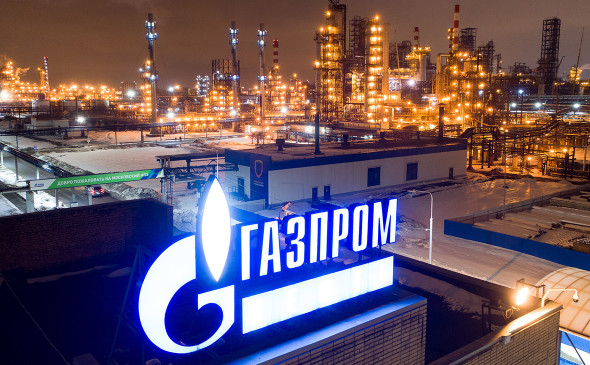
Gazprom – Natural gas powerhouse and Russia’s largest company
What does this mean for Oil?
Russia is the world’s largest natural gas exporter and the world’s third largest oil exporter. We are seeing right now that Putin is demanding that foreign buyers (importers of Russian gas) must pay for this natural gas using rubles. This immediately links the price of natural gas to rubles and (because of the fixed link to gold) to the gold price. So Russian natural gas is now linked via the ruble to gold.
The same can now be done with Russian oil. If Russia begins to demand payment for oil exports with rubles, there will be an immediate indirect peg to gold (via the fixed price ruble – gold connection). Then Russia could begin accepting gold directly in payment for its oil exports. In fact, this can be applied to any commodities, not just oil and natural gas.
What does this mean for the Price of Gold?
By playing both sides of the equation, i.e. linking the ruble to gold and then linking energy payments to the ruble, the Bank of Russia and the Kremlin are fundamentally altering the entire working assumptions of the global trade system while accelerating change in the global monetary system. This wall of buyers in search of physical gold to pay for real commodities could certainly torpedo and blow up the paper gold markets of the LBMA and COMEX.
The fixed peg between the ruble and gold puts a floor on the RUB / USD rate but also a quasi-floor on the US dollar gold price. But beyond this, the linking of gold to energy payments is the main event. While increased demand for rubles should continue to strengthen the RUB / USD rate and show up as a higher gold price, due to the fixed ruble – gold linkage, if Russia begins to accept gold directly as a payment for oil, then this would be a new paradigm shift for the gold price as it would link the oil price directly to the gold price.
For example, Russia could start by specifying that it will now accept 1 gram of gold per barrel of oil. It doesn’t have to be 1 gram but would have to be a discounted offer to the current crude benchmark price so as to promote take up, e.g. 1.2 grams per barrel. Buyers would then scramble to buy physical gold to pay for Russian oil exports, which in turn would create huge strains in the paper gold markets of London and New York where the entire ‘gold price’ discovery is based on synthetic and fractionally-backed cash-settled unallocated ‘gold’ and gold price ‘derivatives.
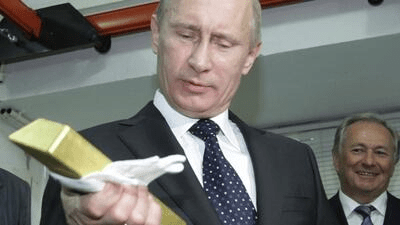
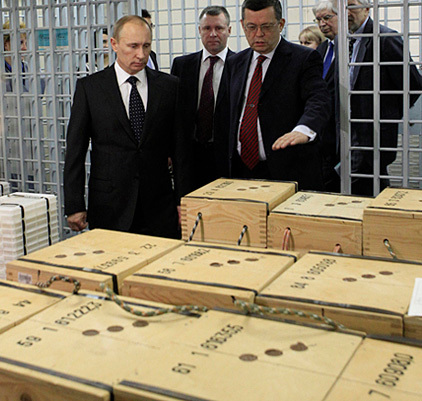
Russian gold bars stored in wooden boxes in the Gokhran vaults, Moscow
What does this mean for the Ruble?
Linking the ruble to gold via the Bank of Russia’s fixed price has now put a floor under the RUB/ USD rate, and thereby stabilized and strengthened the ruble. Demanding that natural gas exports are paid for in rubles (and possibly oil and other commodities down the line) will again act as stabilization and support. If a majority of the international trading system begins accepting these rubles for commodity payments arrangements, this could propel the Russian ruble to becoming a major global currency. At the same time, any move by Russia to accept direct gold for oil payments will cause more international gold to flow into Russian reserves, which would also strengthen the balance sheet of the Bank of Russia and in turn strengthen the ruble.
Talk of a formal gold standard for the ruble might be premature, but a gold-backed ruble must be something the Bank of Russia has considered.
What does this mean for Other Currencies?
The global monetary landscape is changing rapidly and central banks around the world are obviously taking note. Western sanctions such as the freezing of the majority of Russia’s foreign exchange reserves while trying to sanction Russian gold have now made it obvious that property rights on FX reserves held abroad may not be respected, and likewise, that foreign central bank gold held in vault locations such as at the Bank of England and the New York Fed, is not beyond confiscation.
Other non-Western governments and central banks will therefore be taking a keen interest in Russia linking the ruble to gold and linking commodity export payments to the ruble. In other words, if Russia begins to accept payment for oil in gold, then other countries may feel the need to follow suit.
Look at who, apart from the US, are the world’s largest oil and natural gas producers – Iran, China, Saudi Arabia, UAE, Qatar. Obviously, all of the BRICS countries and Eurasian countries are also following all of this very closely. If the demise of the US dollar is nearing, all of these countries will want their currencies to be beneficiaries of a new multi-lateral monetary order.
“It was once said that ‘gold and oil can never flow in the same direction’.” ANOTHER 1997
What does this mean for the US Dollar?
Since 1971, the global reserve status of the US dollar has been underpinned by oil, and the petrodollar era has only been possible due to both the world’s continued use of US dollars to trade oil and the USA’s ability to prevent any competitor to the US dollar.
But what we are seeing right now looks like the beginning of the end of that 50-year system and the birth of a new gold and commodity backed multi-lateral monetary system. The freezing of Russia’s foreign exchange reserves has been the trigger. The giant commodity strong countries of the world such as China and the oil exporting nations may now feel that now is the time to move to a new more equitable monetary system. It’s not a surprise, they have been discussing it for years.
While it’s still too early to say how the US dollar will be affected, it will come out of this period weaker and less influential than before.
What are the Consequences of these Developments?
The Bank of Russia’s move to link the ruble to gold and link commodity payments to the ruble is a paradigm shift that the western media has not really yet been grasped. As the dominos fall, these events could reverberate in different ways. Increased demand for physical gold. Blowups in the paper gold markets. A revalued gold price. A shift away from the US dollar. Increased bilateral trade in commodities among non-Western counties in currencies other than the US dollar.
The question here is what Russian troops can we account for in Ukraine.
What’s missing?
Where are they?
And where are they going?
Presently, there are ~280,000 on active duty in the Russian Ground Forces.
~150,000 were mobilized for action in Ukraine following US and Ukrainian refusual to negotiate a security treat proposed by Russia in December 2021.
So, 150,000 is the number
Elements of the 29th, 35th and 36th Combined Arms Armies (CAAs) were deployed to Belarus, supported by additional S-400 systems, a squadron of Su-25 and a squadron of Su-35; additional S-400 systems and four Su-30 fighters were deployed to the country for joint use with Belarus.
Russia also had the 20th and 8th CAAs and the 22nd AC regularly deployed near the Ukrainian border, while elements of 41st CAA were deployed to Yelnya, elements of 1st TA and 6th CAA were deployed to Voronezh and elements of the 49th and the 58th CAA were deployed to Crimea.
The 1st and 2nd AC were rumored to be operating in the Donbass region during this time.
Russian Tactical Concepts
Let’s drill into some basic organizational analysis.
Russian positional assignments are typically based on a battalion-sized unit or “battalion tactical group” (BTG) comprising 700-1000 troops.
BTGs are normally deployed in a mobile defense covering some 10 km of front and 10 km of depth supported by artillary and tactical aviation.
A regiment will consist of 2-3 BTGs though typically structured as specialty units (Marine or special forces). Similarly, a brigade may consist of 3 or more BTGs with supporting units covering a mobile defense front of 50-60 km front and comparable depth.
Note that in the Russian Army, “Guards” units are considered Tier 1 troops.
“Guards” (гвардия) units trace back to elite military units from the imperial period (pre-Bolshevik) and was subsequently adopted as a distinction for various units and formations of the Soviet Union and the modern Russian Federation.
So, when you see “Guards” you are dealing with the first team.
Also, recall airborne troops are not used in urban combat. They are reserved as blocking units or deployed to block a retreat.
When airborne troops disapper, assume they’ll reappear when you don’t want them.
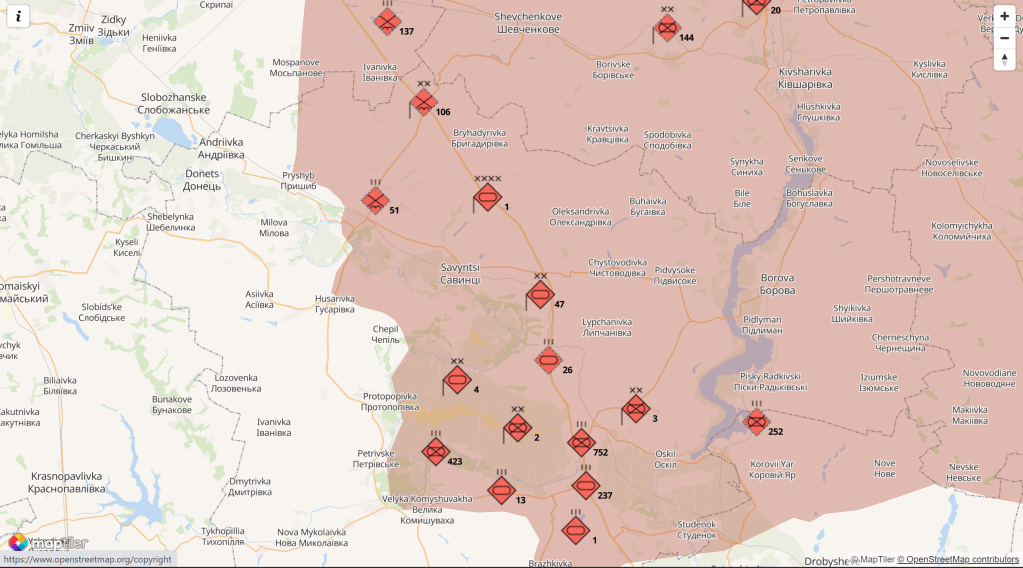
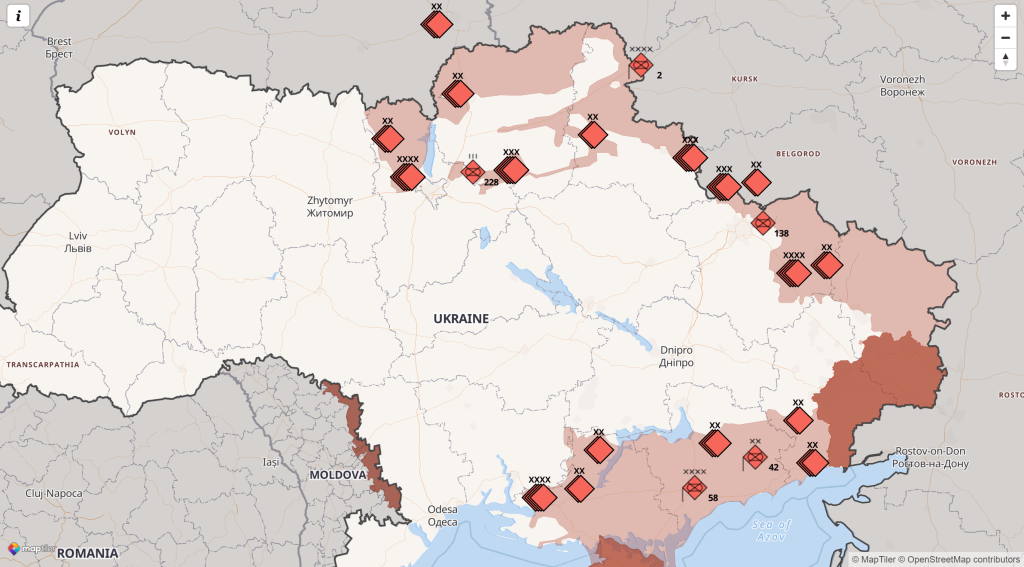
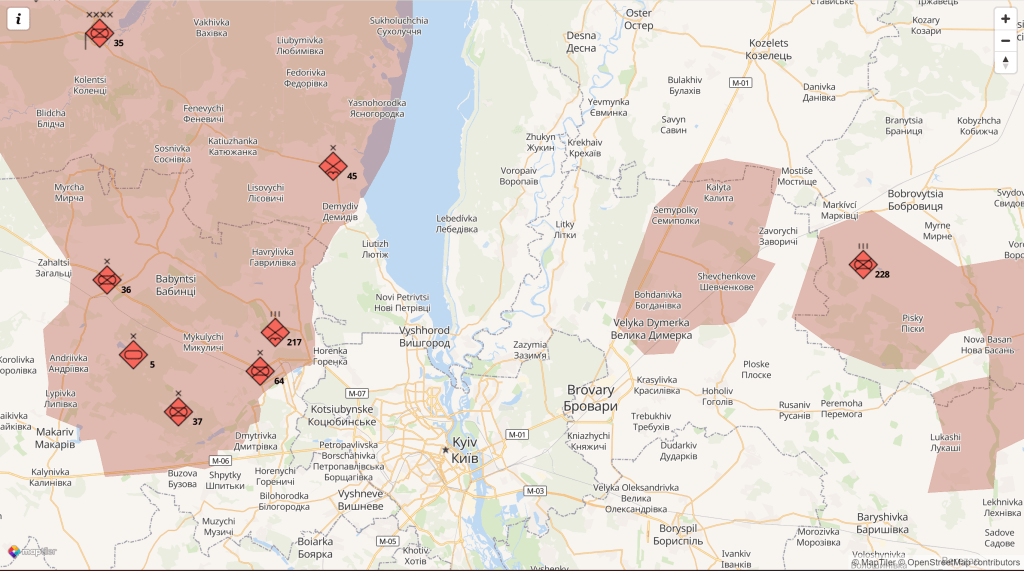
Before going to the map, let’s first review the symbols:
III – regiment.
X – brigade
XX – division (2 or more brigades or equivalent)
XXX – corps (2 or more divisions or equivalent)
XXXX – army (multiple divisions or corps).
Units Around Kiev
Kiev is (or was) blocked from the west by the 35th Combined Arms Army headquartered in Kolensti (Коленці) ~85 km northwest of Kiev. Units subordinated to the 35 CAA include (counterclockwise):
45th Separate Guards Special Purpose Brigade (airborne infantry)
217th Guards Airborne Regiment (attached to the 98th Guards Airborne Division)
64th Separate Motorized Rifle Brigade, a mechanized infantry brigade equipped with T-80BVM tanks, and BMP-2 armored personnel carriers. T-80s are older tanks from the Soviet era based on the T-64, while incorporating features from the later T-72. Similarly, the BMP-2 is a second-generation, amphibious infantry fighting vehicle introduced in the 1980s in the Soviet Union.
37th Separate Guards Motorized Rifle Brigade
5th Separate Guards Tank Brigade equipped with T-72B3 tanks
36th Separate Guards Motorized Rifle Brigade equipped with T-72B3 and BMP-2s
This appears to be a blocking force threatening Kiev but not positioned for assault. The unit positions appear focused on isolating Kieve from Ukrainian forces in Operational Command West including
39th Air Defence Missile Regiment , Volodymyr-Volynsky, Volyn Oblast
703rd Operational Support [Engineer] Regiment, Sambir, Lviv Oblast
130th Reconnaissance Battalion , Dubno, Rivne Oblast
To the east of Kieve — and all alone — is the 228th Motorized Rifle Regiment. It’s seemingly a picket for the 90th Guards Tank Division – a rear guard.
Much of the Western media reports about Ukrainian success near Kiev involves attacks on this isolated regiment.
Rear guards give ground in a mobile defense. Don’t confuse retreat with defeat. Think of Sitting Bull at Little Big Horn – scouts retreated as Custer advanced.
We could walk through the units to the East but they are the assault troops but also holding positions. They include:
2nd Guards Motorized Rifle Division (just over the border in Russia)
12th Guards Tank Regiment, 4th Guards Tank Division
1st Guards Tank Army (just over the border in Russia)
6th Guards Army (just over the border in Russia)
200th Separate Motorized Rifle Brigade
144th Guards Motorized Rifle Division
47th Guards Tank Division
3rd Motorized Rifle Division
Then there is the 58th Combined Arms Army operating out of Crimea. We’ll leave them alone.
All in, there appears to be only about 50-60 total Russian BTGs in Ukraine — roughly 50,000 – 60,000 troops in total deployment.
That means only ~1/3 of the 150,000 deployed appeared to have been committed.
Which means there are ~100,000 Russian troops mobilized and still in Russia (hint – I named them).
Phase 1 is Over – Phase 2 Begins
On March 29, 2022, the Russian Defense Ministry decided to cardinally decrease the military activity in the direction of Kiev and Chernigov,.
“Due to the fact that the talks on preparing an agreement on Ukraine’s neutrality and non-nuclear status as well as on providing Ukraine with security guarantees are moving to the practical sphere, considering the principles discussed during the meeting today, in order to bolster mutual confidence and create the necessary conditions for the further talks and the achievement of the final goal – the coordination and the signing of the aforementioned agreement – the Russian Defense Ministry has made a decision to cardinally, several-fold decrease the military activity in the direction of Kiev and Chernigov.”
Where are they going?
The point is Kiev was never the main event – it was always the feint.
And the blocking units successfully pinned down the Ukrainian ground forces while the Russian aerospace forces trashed the air units and established air superiority.
Sure, a few low flyer helos, operating at 50 FT, can evade most air defenses.
They might even light up a refinery just over the border.
But, they don’t survive very long.
Russia has air superiority.
It’s 670 km from Slovyansk to Kiev. A killing zone for Ukrainian armor or mechanized units to traverse — flat, open country — vulnerable to air and rocket strikes, especially as Russia has largely finished off the Ukraine’s high-altitude air defenses east of the Dniepr in the last week.
But, for Phase 2 to work, Russia needs a bridge.
It appears they now have one.
Bridge Over Seversky Donets
The Seversky Donets originates in the Central Russian Upland, north of Belgorod, flows south-east through Ukraine (Kharkiv, Donetsk and Luhansk Oblasts) and then again through Russia (Rostov Oblast) to join the river Don, about 100 km (62 mi) from the Sea of Azov.
The Donets is the fourth longest river in Ukraine and the biggest in the Eastern Ukraine.
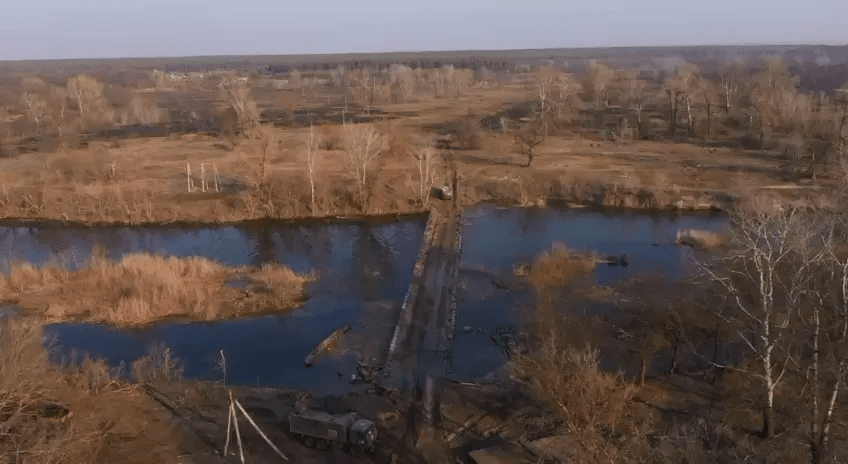
The image below shows Russian vehicles crossing a temporary bridge over the Seversky Donets southeast of Izium within the past few days.
The vicinity of the bridge saw two weeks of fighting and Ukrainian artillery bombardment, which killed among others the deputy head of engineering for Russia’s Western Military District. But as of the time this image was taken the bridgehead is so large that there is evidently no need for guards, defensive emplacements, or air defense within sight of the bridge.
This route allows Russian forces to bypass Ukrainian holdouts just south of Izium (who may have been cleared out already, as of now).
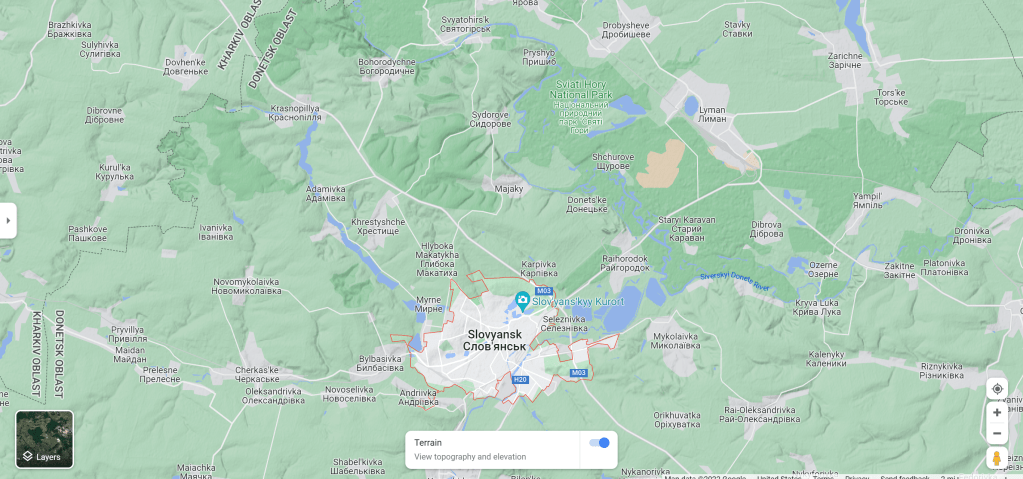
It appears Phase 2 now begins with a staging for an advance down the M-03 highway to help effect a historic encirclement of Ukrainian garrisons in Slaviansk-Kramatorsk (and Severodonetsk-Lisichansk.)
The highway, the Sversky-Donets are shown below.
Russian forces are now advancing near the border of Donetsk and Zaporozhia, west of Ugledar.
It appears Russia’s strategic reserve in the Crimea has been committed to the Cauldron.
The involvement of “mainland” Russian fores (not just Donetsk and Lugansk) in the central and northern Donbass fronts has increased markedly in recent days.
With heavy artillery support, Donetsk forces are slowly advancing through very difficult enemy defenses west of Gorlovka, north of Donetsk city.
We know the United States has long engaged in dangerous experiments offshore. Under Dr. Anthony Fauci’s direction, the US government enriched his corporate and research cronies with grants to conduct dangerous gain-of-function experiments offshore. More likely than not, related experiments at the Wuhan Institute of Virology set loose a murderous pandemic.
So, should we be surprised that Hunter Binden, point main for “Biden Inc.”, takes a cut of research involving dangerous pathogens in Ukraine — the country Joe Biden ran under Barack Obama?
Just as we can count on US media to dismiss Biden’s Laptop as “Russian disinformation”, count on them to bury the Ukraine biolab story.
So, here is RT – a Russian media company taking Russian Federation money – and their story about US biolabs.
Russia presents new evidence from US-funded Ukraine biolabs
Pentagon-backed facilities made “biological weapons components” and tried to cover it up, Russian military says
Materials relating to the military biological activities of the United States in Ukraine which were presented by Lieutenant General Igor Kirillov are seen on a screen during a briefing in Moscow, Russia.
Moscow believes that laboratories in Ukraine funded by the US military were making biological weapons components, but that local staff was being kept in the dark about their research, a senior Russian general said on Thursday.
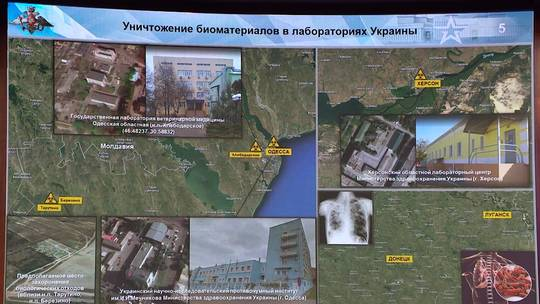
Lieutenant-General Igor Kirillov, who commands the Nuclear, Biological and Chemical Protection Forces of Russia, presented documents and imagery showing why the military has come to such a conclusion.
“We believe that components of biological weapons were being made on the territory of Ukraine,” said Kirillov.
He noted that the documents he was presenting “have the signatures of real officials and are certified by the seals of organizations,” for those journalists and experts in the West doubting their veracity.
One document, dated March 6, 2015 confirms the “direct participation of the Pentagon in the financing of military biological projects in Ukraine,” Kirillov said. The US officially funded the projects through the Ukrainian Ministry of Health, according to the Agreement on Joint Biological Activities. However, the evidence shows that the real recipients of some $32 million in funds were Ukrainian Defense Ministry laboratories in Kiev, Odessa, Lvov and Kharkov.
These facilities were chosen by the US Department of Defense’s Threat Reduction Administration (DTRA), and the contractor Black and Veatch, to carry out the U-P-8 project, aimed at studying the pathogens of Crimea-Congo hemorrhagic fever, leptospirosis, and hantaviruses, Kirillov said, pointing to a slide with the Pentagon’s request.
“From our point of view, the interest of US military biologists is due to the fact that these pathogens have natural foci both in Ukraine and in Russia, and their use can be disguised as natural disease outbreaks,” the general said.
According to the evidence, the labs isolated three bacterial pathogens (causing plague, brucellosis and leptospirosis) and six families of viruses, including coronaviruses, all of which were drug-resistant and spread rapidly from animals to humans. A number of documents confirmed the samples taken in Ukraine to other countries – Georgia, Germany, and the UK.
Kirillov showed official documents confirming the transfer of 5,000 samples of blood serum taken from Ukrainian citizens to the Pentagon-backed Richard Lugar center in Tbilisi, Georgia. Another 773 biological assays were transferred to the UK, while an agreement was signed for the transfer of “unlimited quantities” of infectious materials to the Friedrich Loeffler Institute, Germany’s leading center for animal diseases.
However, the analysis of the obtained evidence suggests that Ukrainian specialists were not aware of the potential risks of transferring these materials, and may have been kept in the dark about the true goal of the ongoing research, Kirillov noted.
Documents from Project P-781, a study of ways of transmitting diseases to humans through bats, showed it was carried out by the Kharkov laboratory and the Lugar Center in Georgia, but Ukraine received most of the $1.6 million grant for the project. Kirillov said that “systematic” research in this area has been carried out since 2009, under the supervision of US specialists – referencing projects P-382, P-444 and P-568.
As one of the key people involved, Kirillov named the head of the DTRA office at the US Embassy in Kiev, Joanna Wintrol.
“Maybe she’s worth talking to, journalists?” he said.
Wintrol left Kiev in August 2020. In her parting interview, she insisted no US scientists worked in Ukrainian biolabs and accused Russia of spreading “false information” about the program.
Kirillov pointed to mass outbreaks of avian flu in Russia and the EU in 2021, causing billions in damages, while the Kharkov Institute of Veterinary Medicine was studying wild birds as transmission vectors and assessing conditions under which the spread could cause economic damage and food insecurity. Evidence now shows the institute collected strains of avian flu capable of jumping species, Kirillov said, calling for an international investigation into the matter.
Some of the documents at the Kherson laboratory appear to be missing and may have been destroyed, Kirillov said, suggesting it was related to the 2018 outbreak of a mosquito-borne parasitic disease in that region, and a possible cover-up.
Four cases of dirofilariasis were detected in February that year, which is not typical for mosquito life cycles, the general said. Pentagon representatives visited the local hospitals in April, collecting medical records and getting briefed on the epidemiological investigation. However, “no documentary evidence regarding this outbreak has been found in the Kherson laboratory,” leading the Russian military to believe that “the urgency of destroying such documentary evidence is explained by the desire to prevent access to them by Russian specialists.”
There was also an outbreak of drug-resistant tuberculosis in 2018, among the citizens of the Donetsk and Lugansk People’s Republics, with 70 cases detected around the village of Pesky – on the frontline with Ukrainian troops – alone.
“This may indicate a deliberate infection, or an accidental leakage of the pathogen from one of the biological laboratories located on the territory of Ukraine,” Kirillov said.
The Russian general brought up the long history of US conducting banned biological research in other countries, noting as an example that in 2010 Washington apologized for syphilis experiments in Guatemala.
“We will continue to examine the evidence and inform the global community about the illegal activities of the Pentagon and other US government agencies in Ukraine,” Kirillov said.
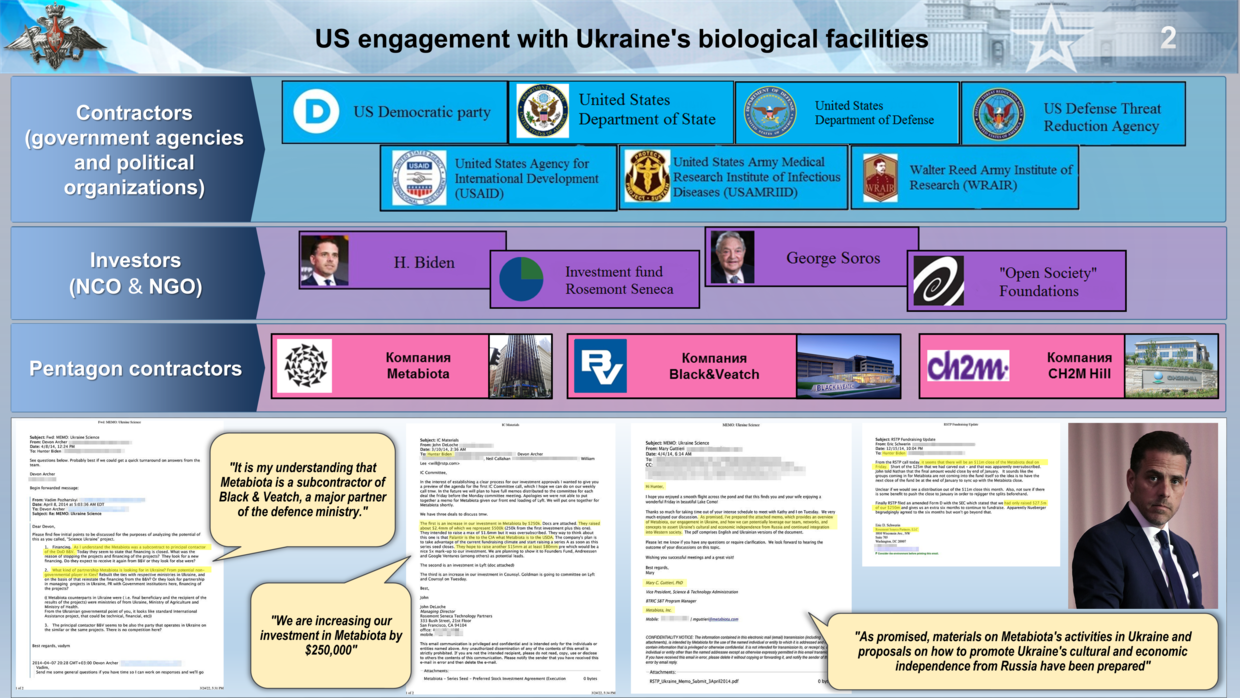
On Thursday, the Russian Ministry of Defense (MoD) released new files procured by Russian forces in eastern Ukraine, which include communications between American financier Hunter Biden – the son of US President Joe Biden – and figures engaged in biological research in Ukraine that his investment company aided in financing.
The documents revealed an intent to create a “Central Depository of Especially Dangerous Microorganisms in Kiev,” according to Russian MoD spokesperson Maj. Gen. Igor Konashenkov, as well as ways to distribute biological agents via drone.
The emails disclosed the identities of numerous key American leaders from Metabiota and Black & Veatch, and also officials from the US Defense Threat Reduction Agency (DTRA), who were involved in biological research initiatives. Those named include:
From 2017 to 2020, Pope served as the DTRA’s deputy director of operations, readiness, and exercises. He formerly worked at the Pentagon, the US Air Force European Command (USAFE), and the US Central Command (USCC). Pope was essential in the creation of radiochemical methods for monitoring international nuclear weapons treaties (Air Force Technical Application Center).
Between 2016 and 2019, Pope corresponded with Ukraine’s acting health minister, Ulana Suprun, an American-born Ukrainian who travelled to Ukraine to take part in the US-backed revolution in 2014.
Rhys M. Williams
Williams, who was formerly the agency’s director of development, test, and evaluation, ended up taking over for Pope as acting DTRA director in 2020. He oversaw the Pentagon’s project to establish capabilities for detecting, locating, and neutralizing foreign weapons of mass destruction and improvised explosive devices. Williams was also Assistant Deputy Administrator for Nonproliferation at the US Department of Energy’s National Nuclear Security Administration (NNSA), which is in charge of the country’s nuclear arsenal.
Joanna Wintrol
At the Defense Threat Reduction Office of the US Embassy in Kiev, Wintrol oversaw DTRA programs in Ukraine until 2021.
According to emails released by the Ministry of Defense, she oversaw projects such as the UP-2 Project for “mapping highly infectious diseases in Ukraine,” including anthrax; the UP-4 Project for “risk assessment of particularly dangerous pathogens transmitted by birds in Ukraine during migration”; and the UP-8 Project for studying “spread of Crimean-Congo hemorrhagic fever virus and hantaviruses in Ukraine and the potential need for differential diagnosis of patients with suspected leptospirosis.” She also headed Project P-782, which investigated disease transmission through bats, according to previously disclosed records.
In early 2021, Wintrol switched to Chemical Security and Elimination (CSE). CSE was previously known as the Chemical Weapons Elimination (CWE) and Chemical Weapons Destruction (CWD) programs, according to a DTRA document. The effort “started in 1992 to build the capacity of the states of the Former Soviet Union (FSU) to reduce the threat from chemical weapons (CW) by securing and eliminating CW stockpiles, chemical research capabilities, and production facilities, while also redirecting scientists to peaceful purposes,” the agency said.
Edwards has been the CEO of Black & Veatch, an American engineering business that has long been a Pentagon contractor for a range of building projects, since 2013. He joined the firm in 1978 and previously served as its Chief Operating Officer.
Black & Veatch has long been known to collaborate on Pentagon initiatives in Ukraine, but records procured by Russian forces earlier this month divulged the company’s role in supervising biological programs in the country, including the UP-8 project, which analyses Crimean-Congo hemorrhagic fever, leptospirosis, and hantaviruses.
Lance Lippencott
Since 2011, he has served as the project manager and biological project coordinator for Black & Veatch in Ukraine. He informed the Kansas City Business Journal in August 2021 that his efforts in Ukraine on airborne biological agents had aided Black & Veatch in developing a system for cleaning air of SARS-CoV-2 virus particles, the pathogen that induces COVID-19. Lippencott is a West Point graduate of the United States Army Military Academy.
A report from Ukraine’s Kherson region’s Security Service was included in one of the papers disclosed by the MoD, and it mentioned “a potential threat to the epidemiological and epizootic situation in our country that has recently come to light as a result of DTRA’s intentions through Black & Veatch to establish control over the functioning of Ukrainian microbiological laboratories that conduct research into particularly dangerous pathogens that can be used to create or upgrade new types of biological weapons.”
Another paper addressed to the Ukrainian Ministry of Defense by Lippencott addresses the extension of the UP-8 project previously described.
David Mustra
“Issues of biomonitoring and transfer of information were supervised by David Mustra, who is closely associated with another Pentagon contractor, Metabiota,” Konashenkov said. “Previously, he led military bio-projects in Ukraine and Eastern Europe as part of the Cooperative Threat Reduction Program.”
Mustra was the firm’s biosafety recruitment manager in Ukraine, as well as the biosurveillance and control managers and the research and development director.
Guttieri, who holds a doctorate in microbiology from UMass Amherst, served as Metabiota’s Executive Vice President from 2014 to 2019, and was formerly the company’s Vice President of Technology and Science Administration. At Labyrinth Global Health, she has become the head researcher.
Guttieri was the integrator of research programs for the US biology program in Ukraine, and she oversaw the implementation of biological programs involving the study of animals as disease vectors.
Nita Madhav
Since 2019, Madhav has led Metabiota as its CEO. With a PhD in Public Health, she focuses in epidemiology and pandemics. The Russian Ministry of Defense, on the other hand, claims that there was no evidence in the records that she was in charge of any particular biological activities in Ukraine.
Scott Thornton
Between 2006 and 2016, Thorton worked for Metabiota as a senior microbiologist and lab start-up coordinator. He served as a research microbiologist and the chief of the Navy’s Threat Assessment Department for the past 20 years in the US Navy. Thornton “conducted research on disease agents of military relevance, especially enteric pathogens” at covert sites, as per his CV, one of which is in Cairo, Egypt.
Thornton advised local workers in DTRA projects in Ukraine on extremely hazardous pathogens and other epidemic disease-related concerns, and organized the update of reference labs in Ukraine to biosafety level 3 (BSL-3), which can be used to research contagious agents or toxins that can be spread via the air and induce potentially deadly infections.
Russia presents new evidence on Ukraine biolabs, comments on links to Biden and US
Documents detail fate of US-funded deadly pathogens that may have been tested on Ukrainians
The Russian military has presented documents showing Ukraine’s interest in using drones to deliver weaponized pathogens developed in US-funded biolabs. Names of US officials involved in the biolabs projects, and the role the current US president’s son played in the program, were also made public during the special briefing on Thursday.
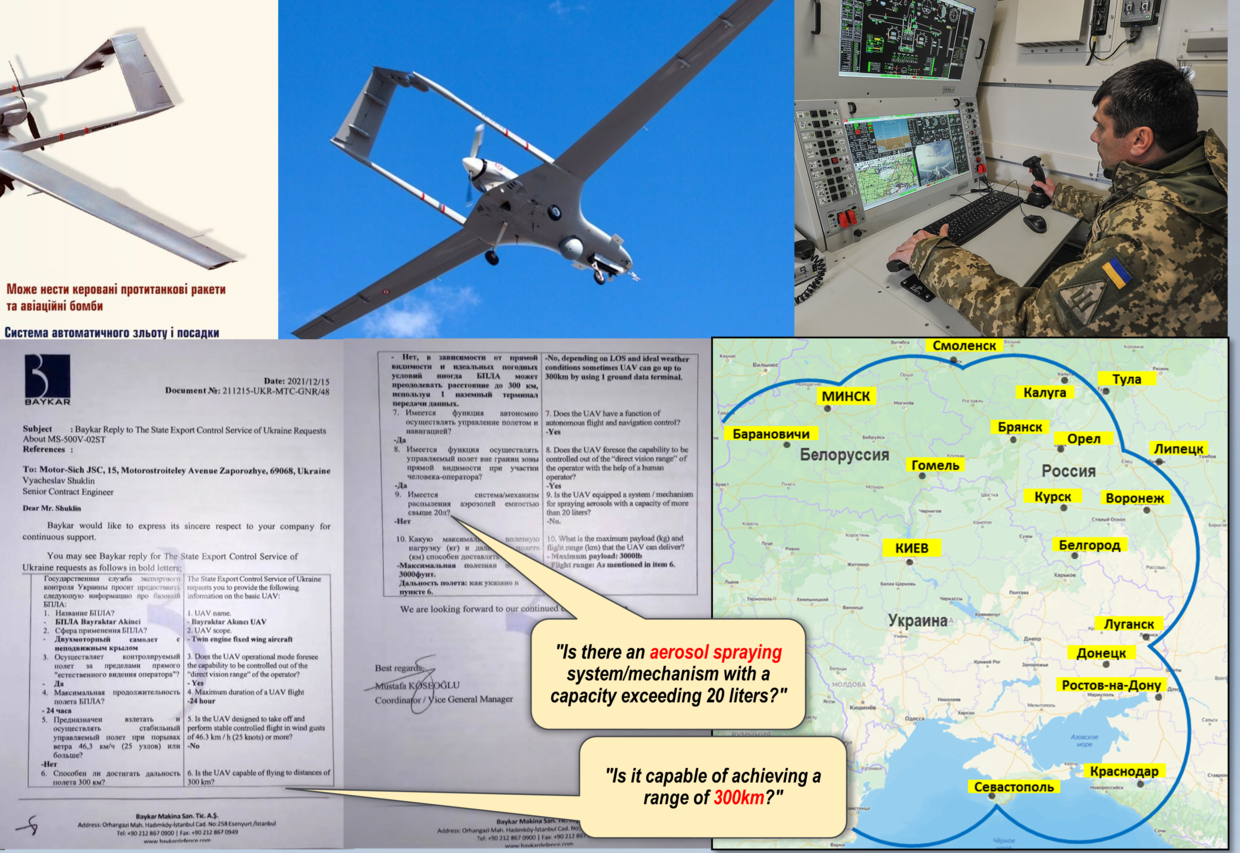
One of the key pieces of evidence was a letter from the Ukrainian company Motor Sich to the Turkish drone manufacturer Baykar Makina – makers of the Bayraktar TB2 and Akinci UAVs – dated December 15, 2021. The Ukrainians specifically asked if the drones could carry 20 liters of aerosolized payload to a range of 300 kilometers – putting them in range of a dozen major Russian cities and almost all of Belarus.
“We are talking about the development by the Kiev regime of technical means of delivery and use of biological weapons with the possibility of their use against the Russian Federation,” said Lieutenant General Igor Kirillov, commander of the Russian Nuclear, Biological and Chemical Protection Forces.
Kirillov also referenced a US patent (No. 8,967,029) for a mechanism to deploy aerosolized pathogens from a drone. The US response to a 2018 Russian inquiry about this patent did not deny its existence, but claimed that it technically did not violate Washington’s obligations under the treaties banning chemical and biological weapons, he pointed out.
Kirillov showed signed contracts between US government agencies – Defense Threat Reduction Agency (DTRA), the Pentagon, the Department of State – and the Ukrainian Ministry of Health, as well as the specific facilities inside Ukraine. The Pentagon spent more than $30 million for biological research at just one Ukrainian facility, the Public Health Center of the Ministry of Health, according to the Russian military.
DTRA official Robert Pope was “one of the key figures” in the program, and “the author of the idea of creating a central depository of especially dangerous microorganisms in Kiev,” Kirillov said. The Pentagon’s biological projects in Ukraine were coordinated by Joanna Wintrol, head of the DTRA office in Kiev, until she left in August 2020. She directly supervised projects UP-4, UP-6, and UP-8 to study deadly pathogens, including anthrax, the Congo-Crimean fever, and leptospirosis, according to Kirillov.
The US agency’s point of contact was Ukraine’s Health Minister (2016-2019) Ulyana Suprun, herself a US citizen, Kirillov noted, while a major go-between was the private contractor Black and Veatch, whose Kiev office was headed by Lance Lippencott. Another Pentagon contractor, Metabiota, also had a role in the project.
Kirillov said that Hunter Biden – son of the current US President Joe Biden – played “an important role in creating a financial opportunity to work with pathogens on the territory of Ukraine,” pointing to several emails between him and executives of Metabiota and Black and Veatch. In particular, he described the Metabiota VP as “a confidant of Hunter Biden,” based on their correspondence. According to the general, the “Western media” has confirmed the authenticity of these emails – presumably a reference to materials published last week by the British newspaper the Daily Mail.
Even Kiev was concerned about the biolabs, according to a memo Kirillov showed. A 2017 letter from the Kherson department of the Ukrainian Security Service (SBU) said that DTRA and Black and Veach intend to “establish control over the functioning of microbiological laboratories in Ukraine conducting research on pathogens of particularly dangerous infections that can be used to create or modernize new types of biological weapons.”
Pointing to a June 2019 document from the Public Health Center of the Ministry of Health of Ukraine, Kirillov wondered why it insisted on secrecy and required that “serious” incidents “including the death of the subjects” had to be reported to the US bioethics authorities within 24 hours – when other documents about that specific program only reference standard blood sampling work.
“We do not exclude that the official research program is only the ‘visible part of the iceberg’, while in practice, volunteers were infected with the Congo–Crimean fever virus, hantaviruses and the causative agent of leptospirosis,” the general said, accusing the US of “a dismissive attitude towards the citizens of Ukraine,” and treating them as guinea pigs for biological and medical experimentation.
The US has long claimed that allegations about Pentagon-funded biolaboratories in Ukraine were “Russian disinformation.” Earlier this month, however, US diplomat Victoria Nuland testified before the Senate that “biological research laboratories in Ukraine” did exist, and that Washington was working with Kiev “to ensure that the materials of biological research do not fall into the hands of Russian forces.”
According to Kirillov, all pathogenic biomaterials stored in Ukraine were “transported by military transport aircraft to the United States via Odessa,” in early February 2022. On February 24, as Russian troops entered Ukraine, the ministry of health in Kiev ordered the remaining strains to be destroyed, the general said.
Kirillov said that the Russian intervention halted activities at five Ukrainian biolabs that had been working with anthrax, tularemia, brucellosis, cholera, leptospirosis, and African swine fever.
I’ve had the good fortune to have been exposed to enough defense and national security matters in my career to learn at any early age (and reinforced along the way) the role of information in conflict.
“Believe everything and believe nothing.”
Always remember what Kenny Ortiz famously said: “There’s a war going on for your mind.”
So here is James Rickards who says it all so well:
All wars are full of lies.
Winston Churchill famously said, “In wartime, truth is so precious that she should always be attended by a bodyguard of lies.”
We accept that idea broadly. Secret invasion plans should be closely held. The identities of spies must be kept under wraps. New weapons and defensive tools should not be revealed because enemies will be alerted to their potential and begin offensive workarounds.
Still, just because the government has legitimate reasons to deceive the public in wartime does not mean that citizens don’t have a duty to find the truth to the extent they can.
The Russian-Ukraine kinetic war and the broader U.S.-Russian economic war are full of more lies than any public events I’ve seen in my lifetime including Vietnam, Watergate and the Iraq War.
That’s how big the lies are.
The Bodyguard of Lies
Here’s the official U.S. narrative as echoed by the mainstream media: Russia’s invasion of Ukraine was unprovoked, Putin’s three-day blitzkrieg of Kyiv has failed, Russian forces are bogged down and valiant Ukrainian troops are putting up a powerful defense and regaining lost ground with the help of weapons from NATO.
In this version, President Zelenskyy is the new Churchill rallying patriots against an evil dictator. All of that is either entirely or mostly false.
Here’s the real story: Russia’s invasion is the end result of 14 years of provocation by the West, including repeated declarations that Ukraine will join NATO and a U.S.-backed coup d’état in 2014 that displaced a pro-Russian president.
Russia never planned a blitzkrieg on Kyiv. That’s a Western invention intended to make Putin look like a failure. In fact, Russia is slowly and methodically taking territory in the south and east of Ukraine in order to control the seacoasts, eliminate pro-fascist elements in Mariupol and establish pro-Russian autonomous zones in Donbas.
Churchill? Really?
A full assault on Kyiv, if it ever comes, is last on the list. Ukraine may reoccupy a village here and there, but they’re losing ground in Kherson, Mykolaiv, Melitopol, Mariupol, Kharkiv, Luhansk, Donetsk and surrounding areas.
Moreover, Zelenskyy is no Churchill.
He’s succeeded in presenting himself as a strong wartime leader, standing up to the big, bad Putin. But in reality, he’s a corrupt oligarch with millions of dollars hidden offshore. His acting skills have enhanced his propaganda efforts, but it doesn’t take much training to see how phony he is.
Innocent civilians, including women and children, are dying under his failed leadership and inability to come to terms with Putin before the invasion began. In a nutshell, Zelenskyy bet on support from Biden and the West and lost.
There is ample evidence from numerous sources to support this analysis. Some of the best sources come from Switzerland, where military experts are infuriated that traditional Swiss neutrality has been cast aside.
Most tellingly, Pentagon leaks say the same thing. The story from inside the Pentagon is that Putin is not acting recklessly but is being patient and methodical. It also says that, despite some civilian casualties, Putin is actually using a restrained approach. Furthermore, there are no signs he is preparing for the use of chemical or biological weapons.
So what about the economic sanctions? Are they working?
The Most Severe Sanctions in History
Payments in and out of Russia have been blocked. The Central Bank of Russia has been banned from the global dollar payments systems. The same is true for the 10 largest Russian banks and a long list of oligarchs and Russian government officials.
Accounts of Russian targets in Western banks have been frozen. Exports of critical technology and high-tech equipment to Russia have been banned. U.S. and European airspace has been closed to Russian airlines.
Secondary sanctions have been imposed so that if another nation like China sells goods to Russia made with U.S. technology or machines, that nation will be punished also. The list goes on.
Economic sanctions of these kinds sound powerful when they’re announced and do have some impact. But in the long run they never work. In the end, the costs are real but the effects of the sanctions are nil. It’s a lose-lose proposition.
Sanctions Against Oligarchs Are Doing Putin a Favor
Some losses are incurred by those whose accounts are frozen or whose businesses are handicapped. A few Russian oligarchs may lose their yachts, but guess what? Putin doesn’t like the oligarchs anyway.
We’re actually doing Putin a favor by clipping the oligarchs’ wings. Putin’s power comes from the military and security services, not the oligarchs.
Tellingly, the strategic goals that justified the sanctions are never achieved. At most, they are slowed down temporarily. It’s just a matter of time before the affected parties devise workarounds to the sanctions.
The bottom line is Russia has not stood still. Russian exports of critical strategic metals such as nickel, titanium, palladium and aluminum have been cut off. Russian (and Ukrainian) wheat and other grains have also been cut off.
This will result in starvation in certain parts of the world and massive food price inflation everywhere. Given the extent of these sanctions and the retaliation, the damage to world trade, supply chains and even the availability of goods will be massive.
But what about the strategic aims of the sanctions?
Sanctions Won’t Stop the Ukrainian War
Here, the sanctions are a complete failure. They have had zero impact on Russian advances on the battlefield and Russian goals in Ukraine. In fact, Putin has proved to be a master chess player as he runs rings around the sanctions.
When the U.S. imposed sanctions on Russian banks, the value of the ruble collapsed. Still, oil and natural gas exports from Russia were allowed because Europe is dependent on them and the world is facing an energy shortage independent of the war in Ukraine.
Oil and natural gas are paid for in dollars. In a masterpiece of judo, Putin is now demanding that Russian oil and natural gas bought by states imposing sanctions be paid for in rubles. This mystified many. If Russia needs dollars (they do), why be paid in rubles?
The answer is that the only way for Europe to get rubles quickly is to buy them from the Central Bank of Russia using dollars. Under Putin’s plan, Russia still gets the dollars, still sells oil and natural gas but he has the added benefit of making rubles stronger because Europe has to buy them to pay for the energy exports.
Cutting off Russian exports of oil and natural gas is pointless because Russia will just sell the same energy to China and India. But the price will go up. It’s a world market, after all.
Putin’s Many Moves Ahead of Biden
This is how judo works. You use your enemy’s power against him by avoiding the main attack and turning the tables. Putin’s a judo expert in real life and he just demonstrated that he can practice it in economic warfare. The West will now be engaged in propping up the ruble after they did so much to destroy it.
Putin thinks many moves ahead on the chessboard while Biden is playing pin the tail on the donkey, blindfolded.
Sanctions ultimately harm everyday citizens and consumers most. Inflation is surging in Russia and the United States because of the sanctions. But the pain on the American people has only begun. It’s about to get much worse.
U.S. consumers and investors will suffer as prices soar, growth lags and stocks collapse.
This is all unpleasant news for Western warmongers. But it’s critical for investors to know what’s actually going on so they don’t lose money in the chaos to come.
The best information is that the war in Ukraine will last longer than most expect, will produce supply chain disruptions and will amplify the inflation that’s already present.
In the end, Putin will prevail in Ukraine, while the Ukrainian people and Western consumers will pay the heaviest price.
Combat footage in the Azov stronghold in Mariupol below from within the last 24 hours as DPR, Russian Marines, and Chechen allies secure the Azov Bastion.
Not shown but published films include the wreckage of an emergency evac helo shot down with top staff killed in the failed escape attempt.
Chechen forces in Mariupol firing NATO anti-tank (presumably captured on the battlefield) and Russian RPGs at Azov sniper position.
I guess they will fight to the end for Mariupol – price for freedom and peace.









 Econophysics2020