The Russian Army appears to be employing an encirclement strategy intended to isolate and degrade Ukrainian brigades in major cities – rather than incurring the casualties (military and civilian) from direct assault on urban areas.
This move eliminates the bulk of the Ukrainian Army but for ~2 brigades in metro Kiev and scattered National Guard units to the west of the Dnieper.
As it is, the suppression of the helicopter transport and destuction of Ukrainian tactical air units effectively eliminated the Ukrainian Army’s capacity to maneuver a week ago.
Note that as the Donbass Pocket closes in the east, Russian forces are now back on the move to complete the encirclement of Kiev.
Next up is Odessa — likely an amphibious assault on both sides of the city within the next few days supported by armored cavalry support coming in from the northeast.
In other news, Zelensky is now saying he is not seeking entry into NATO.
“Russia demanded on Wednesday that the United States explain to the world why it had supported what Moscow cast as a military biological program in Ukraine involving deadly pathogens including plague and anthrax.
“Foreign ministry spokeswoman Maria Zakharova demanded transparency from Washington over the allegation, which is denied by Kyiv and which a Pentagon spokesman has described as absurd.
“She said evidence of the alleged programme had been uncovered by Russia during what it calls its ‘special military operation’ in Ukraine, which its forces invaded on Feb. 24.
“‘We can already conclude that in Ukrainian biological laboratories in direct proximity to the territory of our country, development of components of biological weapons was being carried out,’ she said.
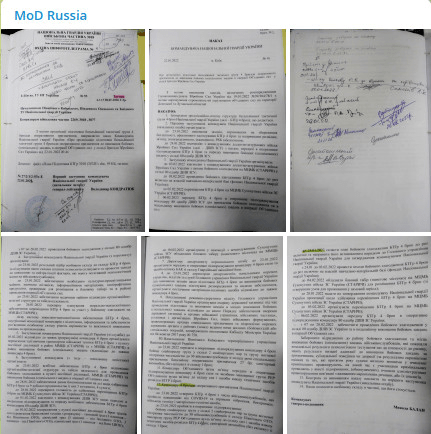
“Zakharova said Russia had documents showing that the Ukrainian health ministry had ordered the destruction of samples of plague, cholera, anthrax and other pathogens after Feb. 24.
“It was not possible to independently confirm the authenticity of any such documents.”
Hilariously, the National Pulse reports Obama has his fingerprints on these labs – seriously.
The document is addressed to the heads of the northern Kiev, southern Odessa and western territorial departments of the National Guard of Ukraine.
▪️ The order, brought to the command of the National Guard of Ukraine, explains the plan for preparing one of the shock groups for offensive operations in the so-called “Joint Forces Operation” zone in Donbass. The document approves the organizational structure of the battalion-tactical group of the 4th operational brigade of the National Guard, the organization of its comprehensive support and reassignment to the 80th separate air assault brigade of Ukraine.
▪️ Since 2016, this formation of the air assault troops of Ukraine has been trained by American and British instructors under the “NATO standard” training programs in Lvov.
▪️ In accordance with the order, the Deputy Commander of the National Guard was tasked with organizing joint combat training of the battalion-tactical group of the National Guard as part of the 80th separate air assault brigade of the armed forces of Ukraine from February 7 to February 28, 2022.
▪️All events of joint combat training of the nationalists are ordered to be completed by February 28 in order to further ensure the fulfillment of combat missions as part of the Ukrainian “Joint Forces Operation” in Donbass.
▪️The document contains the original signatures of the officials of the command of the National Guard of Ukraine responsible for the tasks.
US-Russian joint tactical victory, European and Ukrainian defeat
Celebrations have been taking place in the self-declared Republics of Donetsk and Luhansk in what is almost universally recognized Ukraine. Having declared independence eight years ago, events have now forced Russia’s hand in which these two nascent entities are now recognized by Moscow, with all the protections that come with it. One cannot help but understand why these people are celebrating.
Another celebration is taking place in the USA. The State Department has achieved its main objective of seeing Nordstream 2 put on ice. American LNG producers are now popping champagne bottles as they can envision huge stacks of cash to be made by overcharging Europeans desperate for gas. The Military-Industrial Complex is chuffed as well, as the arms will continue to pour into Ukraine and into the NATO armies in its periphery.
How did we get here?
Despite assurances to the contrary, NATO is not a ‘defensive organization’. Even though American memories are short, people elsewhere remember the bombing campaign against Serbia, and the removal of Gaddafi from power in Libya. What NATO is in fact is the military arm of US hegemony, a hegemony that has seen it expand eastwards through Europe, right up to Russia’s very own borders.
“Don’t individual states reserve the right to enter into alliances with those they see fit, Niccolo?” Of course they do. But not all countries are islands, and most countries have neighbours. And not all neighbouring states are created equal, and they have their own national security concerns and interests. This is the case with Russia.
Russia has been invaded several times from the west since Napoleon first crossed the border to enter Imperial Russian soil in 1812. Every time since, western powers have been forced out, but have left behind devastation in their wake. This explains why Russia has sought buffers to its west ever since, with the largest buffer being its puppet regimes in eastern and central Europe during the Cold War.
NATO, originally set up to counter the USSR’s expansion into Europe, was left without a raison d’etre after the fall of the Berlin Wall and the collapse of the USSR. Nevertheless, it pressed on eastwards, and thanks to the CIA and MI6, effected Colour Revolutions to put into power friendly regimes that sought NATO membership in places like Tbilisi and Kiev. Where Colour Revolutions weren’t necessary due to historical grievances against Russia, NATO missile systems pointed at Russia have been set up (Romania and Poland).
For Russia, the nightmare scenario of dismemberment from the west is now tangible. You may disagree with their perspective, but what is important is HOW they view the situation. If you can’t understand their views, it is therefore impossible to talk to them, unless you are only willing to lecture to them or threaten them.
And lectures on democracy and threats to their economy and existence are all that have come out of the west towards Russia recently.
Ukraine’s Geostrategic Importance
Zbigniew Brzezinski, Jimmy Carter’s National Security Advisor, wrote in his vital work “The Grand Chessboard” that without Ukraine, Russia goes from a Eurasian power to simply Asian, i.e. a world power demoted to that of a regional one. Since Boris Yeltsin left power, US foreign policy goals sought to detach Ukraine from Russia’s sphere of influence. Why?
Not just for the reason Brzezinski illustrated, but because of a concept known as ‘nuclear primacy’. Nuclear primacy is the condition in which a nuclear power can defeat another nuclear power by eliminating its nuclear weapons before they can be launched against them. The reason why NATO ABM sites have been built in Poland and Romania is to push their reach closer to Russia’s European borders, the part where most Russian citizens live. This already increases the threat to Russia immensely, and has informed their military tech research and manufacturing to focus on anti-missile defence and away from conventional threats.
By capturing Ukraine and incorporating it into NATO, Ukraine could then potentially serve as a much, much closer missile launching site for NATO missiles pointed at Russia. The Ukrainian border is less than 500km from Moscow, for example. Can you blame the Russians for freaking out? I certainly can’t.
For Russia, Ukraine is an existential matter. For the USA, it is only an asset that can be easily sacrificed for the greater objective of surrounding and neutralizing Russia so as to achieve nuclear primacy and ensure is own hegemony.
You Should Be Nice to Your Neighbours, Especially When They Are Much More Powerful Than You Are
Ukraine has the right to rule over its territory as it sees fit. This is called sovereignty. Ukraine also has the right to seek alliances to maintain that sovereignty and to protect its own perceived interests.
Theory is great, but it is only theory. Reality does tend to intrude though. In this case, the Ukrainians have made a mess out of their post-Maidan revolution by exacerbating Moscow’s natural paranoia through its constant requests to join NATO. By doing this, Ukraine antagonizes its much more powerful neighbour which sees itself under existential threat from its smaller neighbour’s invitations to host a hostile organization on its soil. It is therefore only natural that Russia would act to neutralize this existential threat, because it can and it showed in 2014 (and again this week) that it will.
Much like how the USA would never tolerate a Chinese client regime in Mexico with nukes pointed at it, the Russians have shown that they won’t tolerate NATO in Ukraine. For the past few months, head Russian diplomat Lavrov has patiently explained to the West that NATO in Ukraine is a non-starter for them, and that they will take actions to ensure that their national security interests are protected. These security interests come at the cost of Ukrainian sovereignty over Crimea in 2014, and now over the Donbass as of yesterday.
What Are the Ukrainians Thinking?????
Everyone wishes to maximize their own autonomy, and Ukrainians aren’t that different in that respect. The calculation that Ukrainians have made in the past and continue to make going forward is that by tying themselves to the world’s superpower, the USA, they will protect their own state and sovereignty, even if they have to make some painful concessions to the Americans (such as economic and political reforms, and cultural reforms like gay pride parades in this very conservative country). Therefore, get away from Russia > being under the American thumb. The Ukrainians took one look at their neighbours in Poland, Lithuania, and Romania and saw that NATO membership protected them from unwanted Russian advances. They also saw that Georgia was partitioned in between the two para-states known as Abkhazia and South Ossetia, with rump Georgia, a state that wasn’t under the NATO umbrella.
Ukraine’s calculation failed because it didn’t take into account three important points:
historical-cultural ties between it and Russia
Ukraine’s sheer size and geographic position
the fact that the two points above make Ukraine, unlike the other states listed, an existential matter to Russia
There is a fourth point which completely tanks Ukraine’s position:
The forces will move to Estonia, Latvia and Lithuania, Biden said, adding that that these are “totally defensive moves on our part.” “We have no intention of fighting Russia," he said, but US & allies will defend "every inch of NATO territory." https://t.co/jyeHGeYcdH
President Joe Biden has consistently and loudly stated that the American and NATO calvaries are not coming to Ukraine’s rescue if the Russians do invade. The USA, the prime mover in this crisis, is openly stating that it is willing to sacrifice Ukraine and Ukrainian lives for its own larger objectives.
Ukrainian President Shecky Greenberg is fucked beyond belief. I strongly doubt he is as passionate about Ukrainian independence as a Banderista from West Ukraine, but I don’t doubt that he does harbour some desire to see his country free from Russian control. The problem is that he has zero room for maneuver, caught between a Russia breathing down his neck, and a USA that has him by the balls as he is listed in corruption indexes as having overseas accounts with money thieved from his own country’s coffers, no doubt via his sponsor, Ukrainian oligarch Igor Kolomoisky. He has to dance to the USA’s tune, or it’s all over him. Still, he deserves a little bit of respect since he has been actively pushing back against the US Goverment and media’s Peter Cries Wolf act.
Since the 2014 Maidan Revolution, Ukraine has seen the following happen to it:
Crimea annexed by Russia
Donbass now effectively Russian
Russia stating that Donbass extends into presently-held Ukrainian territory
Millions of Ukrainians fleeing/emigrating Ukraine
Collapsed economy
Economic and political reforms stalled
Collapse in birth rate (happening everywhere, of course)
What has Ukraine gained since the Maidan revolution? This is a fair question to ask. Another fair question to ask is “how are you going to get your occupied territories back, since doing so means war with Russia?”
The most important question to ask Ukrainians is: “In light of all the things that you have lost and in light of the USA openly saying that they will not defend you, is ‘freedom’ and ‘democracy’ really worth it, considering that you might even lose more than you have already?
USA Triumphant
Ukraine is disposable in American eyes. That warmongering bitch Vicki “Fuck the EU” Nuland (she runs Russia policy in the US State Department) must be laughing her fat and disgusting ass off at how stupid the Ukrainians are to willingly sacrifice themselves for her project to surround, neutralize, and dismember Russia. All is going according to plan.
This crisis was not about Ukraine. Ukraine only provided the setting for which this crisis is playing itself out. The point of this crisis, from the US perspective, is to effect a final cut off of Russia from Europe economically, so as to reduce Russian influence and increase US dominance on the continent, while cashing in by way of LNG exports to replace Russian gas deliveries. That’s it. The USA is more than happy in seeing Kiev occupied by Russian forces, because it kills the NordStream 2 pipeline, and opens up new business for American LNG companies, as well as bigger business for US arms exporters.
The ideal situation to them is to see the Russians invade, overextend themselves, and fall into an Afghanistan-type quagmire, in which Ukraine is set ablaze, and Ukrainians, backed by massive arms deliveries from the USA, engage in a partizan/mujahidden guerrilla war with Russian forces to drain Russia and to embarrass it. Who cares how many Ukrainian cities are levelled, how many civilians die? It will all be pinned on Vladimir Putler anyway, at the Hague War Crimes Tribunal that they dream of in their sleep.
The USA already dominates Europe by way of NATO and trade agreements, its scheisskultur permeates much of the continent, whether through popular culture or though academic trends such as wokeness. Why not solidify that control by way of controlling its energy sector as well?
US media has made a fool out of itself, as have American talking heads…..but this is what they are there for. Without any accountability for their words and actions, they have every reason to continue lying to us as they have done now for decades in service to their foreign policy designs. Take a look at this one:
Putin’s stated intention to round up, jail or even execute dissidents, LGBTQ and religious and ethnic minorities in Ukraine portends crimes against humanity. That nation’s 200,000 Jews are directly targeted. Sadly, economic sanctions are all we and our NATO allies have available.
Nordstream 2 represented a nightmare scenario for US policy planners: Russia and Germany engaging in cooperation outside of US monitoring. With Russia turning towards China, the apocalyptic vision of a China-Russia-Germany alliance begins to unfold in Washington, DC. Not allowed!
Europe: Led By Cowards
Poland, Finland, the Baltic States, Romania, and others all have their historical grievances towards Russia, which must be understood and accepted. Only time heals these deep wounds. Aside from that, Europe’s interests should be in tapping into Russia’s massive natural resources, and to trade with the USA, China, and others. Instead, Europe is once again paying the price for Amerian foreign policy as the US does very little trade with Russia, while Europe does quite a lot!
The Americans are happy to fight Russia to the last Ukrainian, and to sanction Russia to the last European with five Euros in his pocket. It bears the brunt of sanctions against Russia just like it has with sanctions on Iran.
Much was made of Macron’s shuttle diplomacy these past few weeks, but the Russians saw right through his ‘good cop’ act, which ran in tandem with the US ‘bad cop’. They entertained his overtures due to diplomatic protocol, but that was it. Macron wasted his time and our time.
The Brits continue to yap like the American poodles that they are.
The Germans are the sad figures here. Putting Nordstream 2 on ice due to this crisis politicizes the pipeline, where Scholz’s predecessors insisted on it being independent of politics altogether. Even though it is ‘temporarily’ suspended, this politicization makes it now a white elephant. The Germans are going to have to figure out how to import power in light of decommissioning their nuclear reactors and swearing off of coal. Germany’s Greens are, of course, detached from reality, thinking that they can get renewables to fill in the coming gap:
Cutting itself off completely from Russian gas would leave a big hole in the market that in the first instance would “drive prices higher”, said Habeck of the Green party.
However Germany’s power demands could be “compensated” with other energy sources and suppliers, including an accelerated renewables push set out by the government, he said.
Germany has chosen a negative economic impact, including more inflation, to achieve what, precisely? To make the USA even happier?
Russia Has Had Enough
The Russians have insisted that NATO in Ukraine is a red line for them that cannot be crossed. The USA has called their bluff and Putin is now beginning to show his hand.
Despite Ukraine being technically ineligible for NATO entry due to having border disputes with Russia (Crimea, Donbass), it has undergone a ‘stealth NATO’ in recent years, in which US/UK and other advisors are training Ukrainian forces, and are arming them as well. The Russian fear is that they will use this to attack the inferior Donbass forces, creating a massive refugee crisis for Russia, and a loss of face for Putin.
Up until two days ago, Russia has insisted that the Donbass remain a part of Ukraine, but that its incorporation be guided by the Minsk Agreement. Minsk was dead a long time ago, as Ukraine refused to talk to the separatists, but is now de jure dead as Russia has recognized the two breakaway republics there. By doing this, Russia is creating client states like it already has in Georgia and Moldova. These serve not just as tampon zones, but allow Russia to negate formal entry of these countries into antagonistic organizations.
The precedent for recognizing these breakaway republics was set by the USA when it detached Kosovo from then Yugoslavia, and recognized its Universal Declaration of Independence a few years later. The 1999 NATO bombing campaign against Yugoslavia is what turned Russia away from the West, famously symbolized by then Premier Primakov ordering his jet to turn back to Moscow. It was at this point that the USA tore up international law. Albanian freedom from Serbian rule in Kosovo has now come at the cost of the loss of Crimea and Donbass to Russia.
Vladimir Putin’s speech on Monday reflected the exasperation with the West and the USA in particular. The most important highlights were:
The USA is agreement incapable (meaning it will constantly renege as it changes administrations)
Russia expects sanctions no matter what it does
The USA does not respect Russian national security concerns
For example:
So for Russia, this is apparently an existential crisis. “Many Ukrainian airfields are located close to our borders. NATO tactical aircraft stationed here, including carriers of high-precision weapons, will be able to hit our territory to the depth of the Volgograd-Kazan-Samara-Astrakhan line. The deployment of radar reconnaissance assets on the territory of Ukraine will allow NATO to tightly control the airspace of Russia right up to the Urals.”
The complete rejection of all Russian points by the USA seems to have now cemented the final victory in Moscow of the Siloviki (state security chiefs) over the westernizers, with the most western of faces throwing in the towel:
German Chancellor Olaf Scholz has issued an order to halt the process of certifying the Nord Stream 2 gas pipeline. Well. Welcome to the brave new world where Europeans are very soon going to pay €2.000 for 1.000 cubic meters of natural gas!
This represents the final break of Russia with the West, a break that it has been preparing for now for years. It has amassed a massive foreign wealth currency reserve (north of $600 billion USD), and has sanctions-proofed its economy, ironically thanks to US-sanctions regime forcing it to discipline itself by ways such as import-substitution.
Putin and Xi recently met and with 100% certainty have coordinated their recent actions and reactions. Little wonder, as the USA continues to push Russia into the arms of China.
Russia’s so far unwillingness to invade the rest of Ukraine while recognizing the two breakaway Donbass republics has wrongfooted many in the West. This represents a tactical victory for Russia, as it now increases its buffer zone in Ukraine. But it does not yet resolve the question regarding rump Ukraine and NATO. Russia might now feel the temptation to resolve this issue once and for all. This conflict is far from over.
The USA has also achieved a tactical victory in that it managed to secure itself the cancellation of Nordstream 2 by creating a win-win for itself: Putin acts, NS2 gets cancelled. Putin doesn’t act, NATO moves closer to Moscow and Volgograd, and he loses face.
Tactical victories are tactical for a reason. The strategic perspective is more interesting because it is rather obvious that Russia has moved closer to China. People are left wondering how the Americans plan to take on both Moscow and Beijing at the same time as the US pivots to Asia.
Trying to contain both of these nuclear powers reeks of hubris and detachment from reality. This detachment has become more and more pronounced lately, with the hilarious collapse of the US-backed forces in Afghanistan last summer a prime example.
At 1238 BET, President Zelensky’s 14-hour old ABC News interview was repackaged as a concession:
“In another apparent nod at placating Moscow, Zelensky said he is open to ‘compromise’ on the status of two breakaway pro-Russian territories that President Vladimir Putin recognized as independent just before unleashing the invasion on February 24.
“‘I have cooled down regarding this question a long time ago after we understood that … NATO is not prepared to accept Ukraine,’ Zelensky said in an interview aired Monday night on ABC News.
“‘The alliance is afraid of controversial things, and confrontation with Russia,’ the president added.
…
“‘I’m talking about security guarantees,’ Zelenski said.”
Last week, some on Wall Street were quietly gloating when the “Lehman Weekend” consequences predicted by repo guru Zoltan Pozsar failed to materialize and central banks did not flood global markets with a torrent of liquidity, in a repeat of what happened in September 2008.
In his latest not published late on Friday, the Credit Suisse strategist admits that “Yes, we got central banks’ need to step in to calm funding market pressures this week wrong (still no need yet)” but he counters that “we got the direction of spreads right – on February 24th we warned about an imminent sentiment shift in funding markets. There was no premium last week but there is some funding premium now, and it feels that things can get worse still.” So net-net, he concludes, “our call was absolutely right.”
But how was he “absolutely right” if the funding squeeze he predicted did not materialize? Well, as Zoltan explains in the bulk of his note, what is happening right now is something that nobody really understands, and what is yet to happen may be a combination of the worst parts of the 2008, 2018 and 2020 crises, as a result of one thing: the collapse of commodity-based collateral (something China understands very well after it learned – on more than one occasion – that its thousands of tons of its commodity stockpile, especially copper and aluminum, had been rehypothecated, i.e., used as collateral repeatedly).
As the Hungarian writes, his point with the Lehman analogy last Sunday “was to underscore the point that just as the market didn’t realize the complexity and interconnectedness of the financial system then, it may not realize the same today. Again, we are not saying that we are about to have another Lehman moment, only that things can get much worse than you realize.”
Underscoring the unknown unknowns of a global sanctions blockade against Russia launched not by central bankers but by politicians, Zoltan writes that “when you rip $500 billion of FX reserves from the system, sanction and de-SWIFT banks (which goes live March 12th), and force Western banks and commodity traders to self-police and not trade commodities from the single-largest commodity producer of the world (Russia), unforeseen things can happen and do happen.“
He then writes something that all those pushing for an escalating conflict with Russia will hardly want to hear:
If you believe that the West can craft sanctions that maximize pain for Russia, while minimizing financial stability risks in the West, you could also believe in unicorns.
At this point the former NY Fed monetary plumbing expert pivots to what he failed to realize last weekend, and whose consequences will be more profound over the longer-term than a simple short-term plumbing block: “Yes we were also wrong on Sunday about the trigger of funding pressures – it’s not the Bank of Russia’s inability to roll FX swaps or de-SWIFTing that caused funding pressures to date, but rather the market’s self-imposed unwillingness to buy, move, or finance Russian commodities that’s driving the current massive bid for cash.”
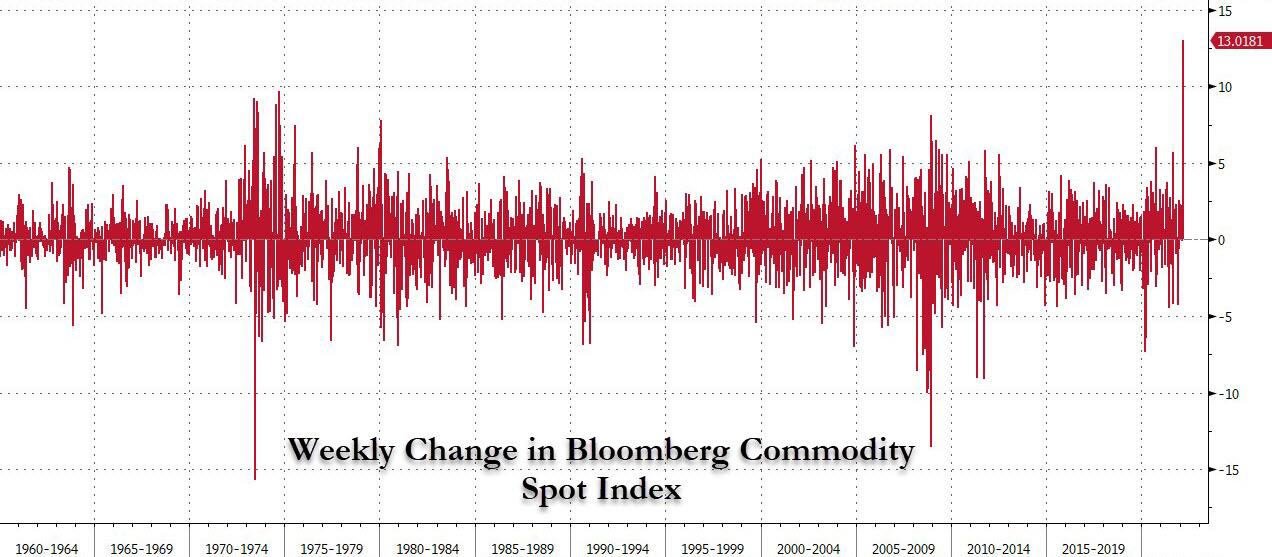
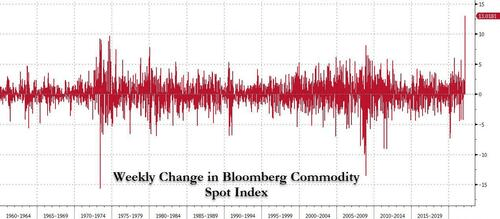
This translated into what Bloomberg called a “historic” commodities rally, manifesting itself in the biggest weekly increase in commodity prices on record…
… and so the margin calls must be historic too, according to Pozsar.
According to Pozsar, the answer is market participants that are long commodities either in the ground or in transit and want to lock in a price by shorting futures:“these include every commodity producer in the world including Russia, and every major commodity trading house, respectively.”
While it is unknown (for now) if that is indeed the case, Pozsar suggest that it’s reasonable to wonder “if Russian commodity producers are experiencing margin calls now, and if they have the resources to pay – could they choose not to pay because their sovereign’s FX reserves were seized?” This is one risk the Credit Suisse strategist says the market needs to carefully consider.
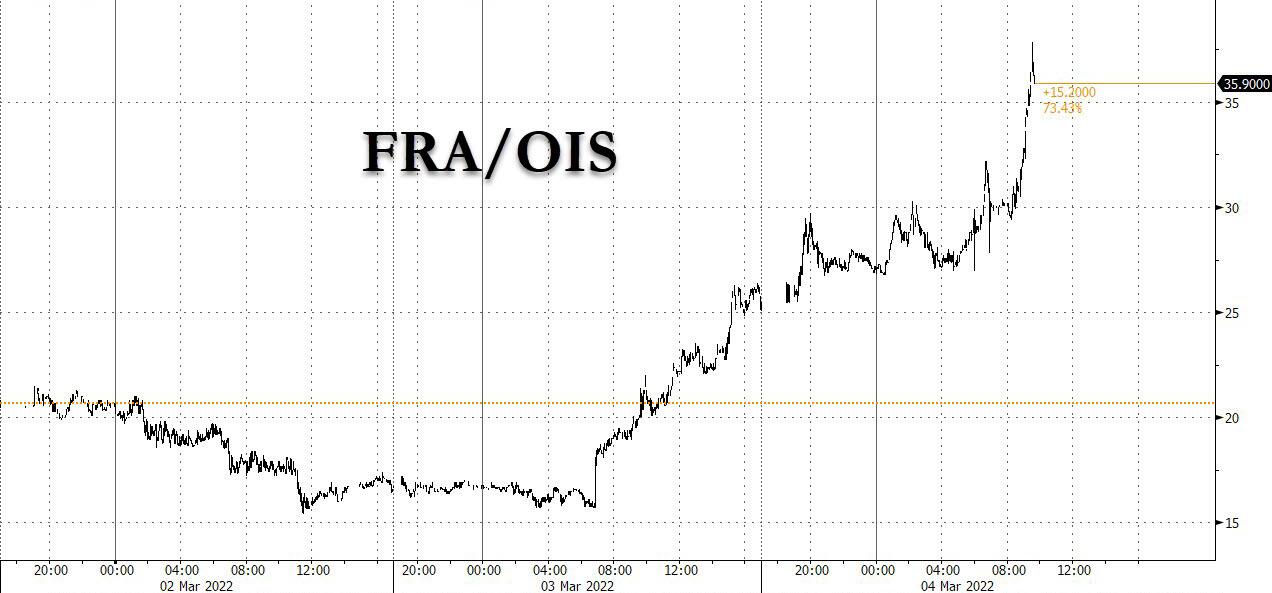
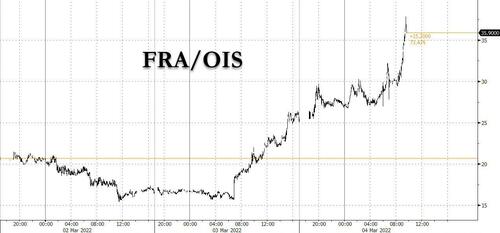
“As for the commodity traders, which are suffering a correlated surge in commodity prices (Russia and Ukraine export pretty much everything imaginable), margin calls can be funded by drawing on credit lines from banks, issuing CP, or swapping FX”, something that may already be happening as suggested by the sharp spike in the FRA-OIS funding stress indicator.
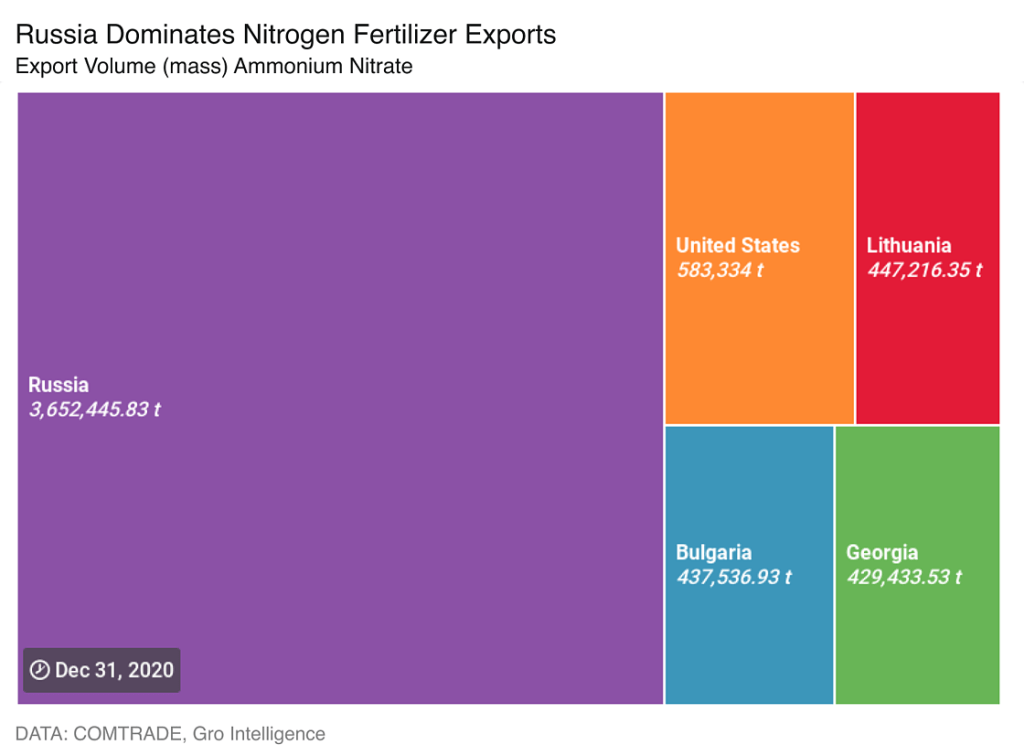
Here, instead of taking readers back to September 2008, Pozsar draws on one of the main lessons from the March 2020 liquidity crisis, which is that corporate credit lines (which have a low drawdown assumption according to Basel III) can be drawn across all industries and across all geographies at the same time in a pandemic, “and the lesson about the present crisis is that you can have a rally in all sorts of commodities from oil to gas, fertilizers, wheat, palladium, and neon during war, especially if the G7 force the world to self-police and boycott Russian stuff.”
Which takes us to the crux of today’s note: the role of commodities as collateral, which is critical because as Pozsar puts it, “every crisis occurs at the intersection of funding and collateral markets.”
Take Urals spot, which Zoltan writes “is trading at a discount to WTI is like subprime CDOs going from AAA to junk” and prompts him to ask if “all commodities sourced from Russia trade at a significant discount?” We put it somewhat differently last week, when we said that while Russian oil is trading bidless, non-Russian oil feels like it will soon go offerless.
Taking the analogy to CDOs further, Pozsar asks if it is possible that the Western boycott of Russian commodities is turning AAA commodities to junk (or bidless): “Does going from AAA to junk trigger margin calls? You bet!”
Besides collateral, the repo guru also reminds us that leverage and liquidity are also important, and takes us on a brief walk down the not too distant memory lane:
In 1998, we had Russian bonds and a leveraged LTCM.
In 2008, we had mortgages and leveraged banks and shadow banks.
In March 2020, we had leveraged bond basis trades.
The pattern Pozsar points to is the following: “Collateral, leverage, funding” – in 1998 and 2008, collateral went bad and a funding crisis hit as a consequence. In 2020, corporations drew on credit lines, which sucked funding away from leveraged bond RV trades, which then triggered a forced sale of good collateral. As he summarizes it, “crises happen either because collateral goes bad or funding is pulled away – that’s been the central lesson in every crisis since 1998.”
Now on to today.
Pozsar points to Glencore’s iconic – if criminal – founder, whose Marc Rich’s legacy in the annals of global finance was to introduce the concept of leverage and borrowed money into commodity trading. It’s simple: a bank lends you the money to lease ships and buy commodities to deliver them sometime and someplace in the future at a locked-in price (via short futures).
The pattern should ring a bell.
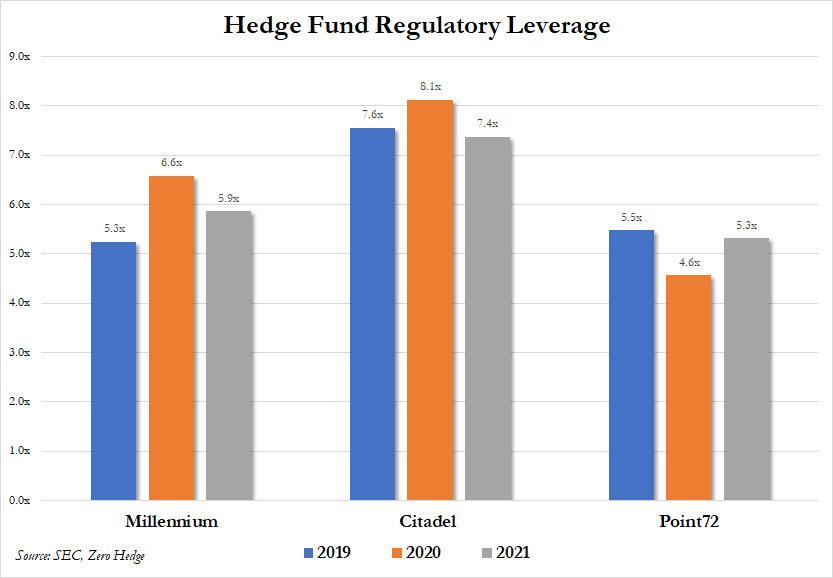
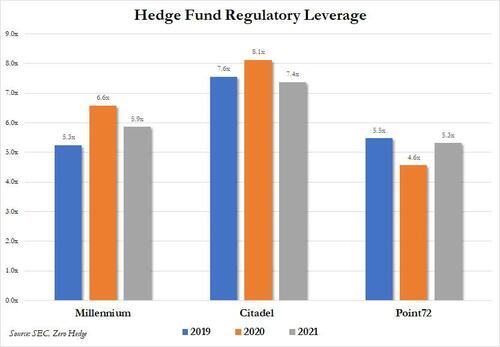
Consider your typical, highly levered bond RV fund, such as Millennium and Citadel, is long the bond, short the future, and funds the package in the repo market. It was this bond basis trade that was behind the repo market crash of 2019 and then blew up just a few months later in March 2020; it’s also why hedge funds with regulatory leverage as high as 8x were begging for a Fed bailout when their RV trades blew up, similar to what happened to LTCM in 1998.
That analogy, Pozsar argues, is the same as a commodity trader moving stuff around. But if collateral spoils, funding is impossible to come by and spot price spikes are triggering margin calls, or as he puts it “March 2020 all over again?” While it probably is not the same size, the repo guru advises readers to “be mindful of the parallels and the funding and collateral linkages.”
Which brings us to the punchline of Pozsar’s note:
We could be looking at the early stages of a classic liquidity crisis that has elements of both collateral and liquidity problems (1998 and 2008), where some players – commodity traders – are not regulated and have no HQLA, and some players – state-linked commodity producers – are not liquid enough because their backstop – the Bank of Russia’s FX reserves – has been seized.
The Hungarian then goes on a historical tangent looking at sudden stops in the financial system, or as we call them, repo breaks.
In 1997, we broke some FX pegs because FX reserves we thought were there weren’t, and capital stopped flowing in.
In the present context, we clearly are not worried about funding because “o/n RRP is at $1.5 trillion and banks have reserves coming out of their ears”.
We will note that it is rewarding to see that one of the biggest minds in finance agrees with what we have pointed out previously, namely that the blowout in the FRA-OIS when there is still $1.5 trillion in the overnight repo, is quite a remarkable achievement and suggests that not everything is as smooth as so many self-proclaimed Polyannish financial experts would lead you to believe. Furthermore, as Zoltan notes, “you should worry about a sudden stop of commodity flows for three potential reasons.”
First, gas gets turned off “at the top”.
Second, there is an accident – lots of pipes run through Ukraine and it’s a war.
Third, sabotage in Ukraine to kick-start Nordstream 2.
Reverting again to his analogy on RV pair trades, Pozsar asks “what happens to the gas bit of the commodity derivatives market when there is a sudden stop of physical commodity flows, and what does that do to dealers’ matched books? There is the potential for some exposure there Will it happen? We don’t know, but again, the question itself is worth a spread.”
* * *
Summarizing his latest, mostly stream of consciousness note, Pozsar says that “we have bases creeping in and commodities, like collateral in 2008, are becoming bifurcated.” Meanwhile, spot prices are staging a historic and correlated surge that is driving demand for cash at a time of excessive leverage in the system both overt and covert – think “commodity RV trades” (as an analogue to bond RV trades) – and a lack of FX liquidity because of seized FX reserves.
Pozsar then gives one more thing to think about: “Is the reason why we’ve cocooned energy and other commodity flows and related payments and institutions from sanctions to protect the consumer at the pump, or to protect the commodity derivatives ecosystem? Clearly, the West does not want to turn off the flow of energy, but there are growing risks – more sanctions, more self-policing, and the Russian leadership can act as well.”
Having found himself in his prime, where he is connecting dots and observing causal linkages between his favorite financial topics and seemingly disparate corners of the financial system – in this case the commodity collateral sector – Pozsar is only just warming up, and next writes that “there are links between all this and headline inflation and interest rate hikes, and links between the seizure of Russia’s FX reserves and the dollar and demand for long-term Treasuries”, and asks readers to consider a quote from George Soros carved into the wall of the CEU (Central European University)…
“Thinking can never quite catch up with reality; reality is always richer than our comprehension. Reality has the power to surprise thinking, and thinking has the power to create reality. But we must remember the unintended consequences – the outcome always differs from expectations”.
… and to think about that both in the present context, and in the context of ABN Amro freezing redemptions from its funds in August of 2007 – a year before Lehman: did markets think it would get that bad back then?
Putting it all together, Pozsar writes that while this time systematically important banks won’t fail, some other traders might fold, and losses, even if not lethal, can curb balance sheet provision (see Archegos) for all other stuff that the buy side needs – repo, FX, and equity derivatives.
Pozsar concludes with another quote, this time from Larry Summers (from a speech he delivered in Toronto at an INET event about the lessons learned during the 2008 crisis):
“crises are not about estimating their economic impact and estimating to the decimal point the GDP impact of a shock. Crises are about fear and greed…”
Going back to the spark behind Pozsar’s latest stream of consciousness, commodity collateral, he writes that Russia and Ukraine are the single-largest commodity exporters in the world. And while Russia accounts for just 5% of the world’s GDP, it is financially deeply interlinked – it used to have $500 billion of FX reserves, and owes about as much in debt to the rest of the world, not to mention “off balance sheet” debt that it owes to the world through derivatives when spot commodity prices rally, like they do now.
His parting words are a warning to all those who think that it will be easy to sever all financial ties to Russia:
It’s a bit more complex to de-SWIFT Russia than it was to de-SWIFT Iran… To be clear – your correspondent is a funding expert, not a commodity expert, but I see a link between the two markets at the present, and parallels to 2008. I wasn’t an expert in CDOs in 2007 either, but started to dig the day after Paul McCulley coined the term “shadow banking” at Jackson Hole and I wrote this. My interest was piqued by the legendary Paul McCulley, and current events piqued my interest in the opaque world of the commodity derivatives complex.
The books about 1997, 1998, and 2008 have FX pegs, default and leverage, and collateral and leverage as their central themes, respectively. The books about today’s market events will have commodities as collateral as the central theme.
It’s this “commodity as collateral” theme that Pozsar believes will spark the next liquidity crisis.
Pozsar’s full note is available to pro subs in the usual place.
Mearsheimer is best known for developing the theory of offensive realism, which describes the interaction between great powers as being primarily driven by the rational desire to achieve regional hegemony in an anarchic international system. In accordance with his theory, Mearsheimer believes that China’s growing power will likely bring it into conflict with the United States.
Comment: John Mearsheimer is from Brooklyn and served as a commissioned officer. If you’re from Brooklyn and served as a commissioned officer, you might recognize his life view.
Having that background, I certainly do.
If you don’t know Ray McGovern, he’s is a former CIA Analyst and commissioned officer. Class act and you should check him out. A Fordham graduate makes him a Jesuit product. And, from the Bronx.
I’m fine with the Ignatius Loyola point of view. As for the Bronx, Ray married a Brooklyn girl. So, despite the Bronx thing, he’s ok by marriage.
Reproduced above is the Saker’s summary of the Ukraine theater as seen from the Russian side as of 11 PM local, March 3, 2022.
It is notable that for all the PsyOp news coverage in Western media since Russia invaded, we never see a theater map.
I have no idea how much of The Sakr’s map is correct but some fixed points on his map seem to correlate with a subset of the otherwise emotional news reports.
Also, by way of full disclosure, it’s worth noting how this blogger describes himself:
Born in Switzerland to a Dutch father and Russian mother
Raised by his mother
Started in Swiss military and strategic intelligence
Later worked at the UN Institute for Disarmament Research
BA International Relations, American University and MA Strategic Studies, Johns Hopkins University
The Day 9 map shows the development of an encirclement of Ukrainian forces in Donbass. Russian units appear to moving at the speed of ~10 miles per day. On this front, Russian forces have branched out along two main axes, one northwest along the Pivdennyi Buh River, and another northeast along the coast and inland towards the Donbass region. Assuming the arrows represent those major lines of Russian advance, 10 miles per day translates to complete encirclement of Ukrainian forces in the east within a week.
At that point, the combined Russian forces in the east can advance unimpeded to the Dnieper — splitting Ukraine in two with a Russian population in the east.
We aren’t in WW3 yet – despite worries Russia, not bad weather, just took down a Romanian military helicopter and jet – but this crisis is answering a question I have long pondered: how would our 24/7 clickbait, read-no-history, central-bank-liquidity-addled, algo-driven markets have traded WW2? The answer: stupidly. Every other day for six years they would have wondered if it was over yet. While the Battle of Stalingrad raged, they would ponder waterfront condos in the city centre. On D-Day they would have turned the TVs off and gone back to their desks, exactly like the traders I worked with at another bank did in 2003’s Iraq War after the statue of Saddam Hussein fell. “No more to see here.” “What about insurgency, terrorism, Iran, and regional chaos?” “Shut up and buy assets.” Of course, in WW2 markets were largely closed and stockbrokers had to fight too, as in Ukraine now, which changes one’s view of how to trade life.
In a war where one side is led by a former comedian, our less reality-based traders and analysts are inadvertently the funny ones. How about Moody’s saying Russia’s refusal to allow payments on new FX debts was “a credit risk”(!) and that this decision suggested “a lack of checks and balances” in the Kremlin(!) And how about the attempt to rally on news Russia will talk to Ukraine? Because the Kremlin has never lied: it didn’t claim it would never invade Ukraine; it didn’t just claim it was *Ukraine* which bombed Kharkhiv’s Freedom Square yesterday.
Here’s a clue for analysts: don’t read what leaders or foreign ministers or ambassadors say abroad in English summarised in Bloomberg bullets. Read what they say at home in their own language.And *read who their leaders read* because that tells you what they are thinking. Last year I told people to read Marx vis-à-vis Common Prosperity; to predict this war one should have read Dugin or Ilyin, a fascist so favoured by Putin that he was personally involved in having his body reburied in Russia and his grave reconsecrated. If you can’t read in the original or are pressed for time, let others do it for you. @y_akopov summarised Russian nationalist intellectual thinking on Twitter yesterday thus:
The war is expected to be over in days, or weeks at most. The main bulk of Ukrainian forces in the East is going to be encircled soon, and the main cities are already under siege. The losses are admitted to be “higher than expected”, but it changes nothing. The possibility of resistance after the active phase of war is dismissed, they are confident that after there is a change of power and Ukrainian activists are purged by military police, most people in Ukraine will come to their senses and accept the new reality.
The war is existential in a way that it is supposed to destroy the Ukrainian identity. The desired outcome seems to be not friendly Ukraine with a new government, but at least partial annexation with Ukrainian culture suppressed. There is no talk of a nuclear or further wars yet in these circles. This so far can only be found (albeit quite easily) in ‘normie’ accounts. Europe arming Ukraine is seen like a futile exercise (too little too late) rather than casus belli.
Sanctions. They are widely considered to be survivable thanks to preparations made since 2014, and the most severe ones are expected to be lifted soon after when Ukraine is defeated. Russian billionaires forced to move to Russia with their money is considered to be great. Autarky is believed to be good. The focus is mostly on tech with explanations how Yandex can provide everything Russia needs. Imports from China are expected to cover all reasonable needs in goods, and domestic manufacturing is expected to boom.Overall, complete dehumanisation of Ukraine, dismissal rather than aggressive challenging of the West (yesterday’s hegemon) and the start of a Russian golden era.
Does any of this sound like a regime about to enter into productive peace talks? Meanwhile, Russia just closed its last two semi-independent radio stations and made spreading “fake news” about the war illegal, with a prison sentence of up to 15 years. There are reports that departing airport passengers have to unlock their phones to show their social-media profiles and prove they have not made anti-war statements. Rumours are of mobilisation of men of fighting age and/or an exit ban for those aged 18-60, as in Ukraine: that is where you get an army large enough to occupy a large neighbor from; or more than one neighbor. Or we could see martial law imposed tomorrow. All this suggests a regime doubling down not backing off under pressure. Likewise, for those thinking this is a chance for China to emerge as a good global actor and rebuild bridges to the West by helping broker peace, the US are claiming Beijing knew the invasion was going to happen and asked Putin to delay until after the end of the Olympics.
Of course, Russia is under huge pressure. There are also widespread reports of the Russian military seeing rising troop discontent and self-sabotage: the 40-mile convoy to Kyiv is perhaps a traffic jam, because it isn’t moving into Kyiv proper. There is certainly much more artillery fire to grind out Russian victories across the south of Ukraine. Reportedly, entire residential districts of besieged Mariupol have been leveled; the town of Konotop was told to surrender or be flattened; the key city of Kherson just fell, opening up the roads to the grain port of Odessa; and we already saw the black comedy moment via Belarus’s Lukashenko inadvertently showing the world that Moldova may be next. But if there are to be negotiations, Russia wants to make them with a knee on Ukraine (and Moldova’s?) neck, making any Ukrainian and Western concessions harder to conceive.
As such, Russia and Belarus are being further excised from the international community, economy, and markets. Sanctioned or not, nobody wants to touch Russian goods or assets. As someone on Twitter claims, “I work in the aviation sector, and I can tell you that for all intents and purposes Russian aviation has -at best- about three weeks before it’s show over.” Likewise, no more Apple products; and no more Microsoft. Even MSCI are to remove “uninvestable” Russia from their benchmark market indices (but the big Western accounting firms and management consultancies are staying put). Meanwhile, Ukraine’s foreign minister has stated that coordinated efforts to prevent evasion of sanctions are needed. That says that we are not just in our Ukraine metacrisis Scenario B (war and biting sanctions), but the risks are we are edging towards Scenario C (war and biting sanctions and secondary sanctions – and a bifurcated global economy).
So now let’s pivot to a cliché getting lots of airing by The Street – “You can’t trade geopolitics“. But why not? Is geopolitics inherently different to a natural disaster; or elections with binary outcomes and opinion polls that can be wrong; or economic data which can be six sigma outliers; or central bank policy cycles? It’s either all a random walk or nothing is. The key point is not all “geopolitical” developments matter to markets. In fact, very few do. In order to qualify, one needs to involve either large economies and/or a critical mass of economies, and/or critical inputs/outputs. You shouldn’t try to day-trade a brief firefight in the Middle East. However, that’s not the same as using economic history, political science, sociology, psychology, ideology and theology, heterodox economics, defence studies, and the assumption of complex non-linear dynamics to look for triggers for huge market shifts. That’s just hard to do:it’s not that you can’t trade geopolitics, it’s that *you* can’t trade geopolitics.
As an example, and of more inadvertently funny analysis, see the notes from people who didn’t see this war coming arguing how markets trade during wars – using WW2, the Korean War, the Vietnam War, and the Gulf War as one example, and then averaging them; or the Suez Crisis, the Cuban Missile Crisis, the Soviet invasion of Czechoslovakia (but not Hungary for some reason), the Yom Kippur War, the Soviet-Afghan War, the Gulf War, the bombing of the World Trade Centre, 9/11, the Iraq War, and the 2014 Crimea Annexation as another set, and then averaging them. To put a median through these is like plotting median war deaths in every past conflict (WW2 was 85 million; the Soviet Invasion of Afghanistan was 2 million; the Soviet Invasion of Czechoslovakia was just *249*). It is geopolitically and statistically ridiculous in that it misunderstands the very fat tail risks involved in both. To put it another way, it makes as much sense as saying “This is the average hospital bill for every health event over your lifetime” when we all know that, except for some unlucky folk, the bills when we are young (e.g., a broken arm or a minor op, etc.) are usually a fraction of the ones of when we are older (e.g., for a serious/chronic disease, heart attack, or organ transplant, etc.)
Yes, ‘Gavrilo Princip’ moments don’t happen every day, and looking for them daily is ridiculous. But not looking for them when we know they can happen is a sillier strategy. Did we not flag back in January and again pre-war that if we were to see this war then:
Energy prices would soar: as nobody now wants to touch Russian oil, the US hints at Russian energy sanctions, Brent touches $115, and European gas leaped 55% and coal 30% on the day.
Agri commodity prices would soar: as wheat hits a 14-year high and other key benchmarks move higher with it.
Bond yields would fall: which they had before partially reversing, and even global bellwether US and UK 2s yo-yo like penny stocks. Despite Powell’s statement yesterday that “the near-term effects on the US economy of the invasion of Ukraine, the ongoing war, the sanctions, and of events to come, remain highly uncertain”, which Philip Marey covers in more detail here, January’s huge ADP job losses flipping to huge job gains on revision is more on the Fed’s radar than NATO. Indeed, while they may go slower now due the war, the war risk is they will have to do more later on, despite the yield curve already screaming policy error. And when that occurs, recall the Fed’s website shows during WW2 it “supported the war effort in several ways: it helped finance wartime spending, fund our allies, embargo our enemies, stabilize the economy, and plan the return to peacetime activities.”
Equities would fall: which they have when they remain focused on what matters (which is never for long of course).
The Russian ruble would collapse and perhaps see the FX market frozen entirely, which is the case, while the US dollar would outperform as traditional safe haven, especially vs. the Euro. Meanwhile, with Russia disappearing from the economic map, and so Russian petrodollars disappearing from the global rinse cycle just as rising US dollar commodity prices mean global importers need more greenbacks to feed and fuel themselves, ex-Fed Street guru Zoltan Pozsar argues US sanctions are likely to see demand for the dollar to *fall*(!) Yes: once we find an alternative currency with a massive import-based consumer economy, rule of law, liquid financial assets, an open capital account, and a hegemonic military machine. Until then, not so much. That’s a funny market call when trying to trade geopolitics.
As argued many times previously, this would be the kind of political excuse needed to crack down harder on crypto, which is what we also heard from the Fed yesterday.
How hard is that “geopolitics” to trade? If you want to ignore all of the above then ironically let one market drive your view of geopolitics, not vice versa: are US defense stocks dipping yesterday signal or noise? But then again, what is the off-ramp from here? How does one plot out the roll-back of current sanctions? Oh dear – we are back to difficult questions for The Street: time to say “You can’t trade geopolitics” again!
The map above is from The Skar. Note the black lines – they appear to be emergent threat axes for two double envelopments – one east of the Dnieper and a second well west of the Dnieper along a line anchored by Odessa and Kiev.
The operations at Kiev are starting to appear to be a demonstration meant to hold Ukrainian forces in place. Meanwhile, an amphibious assault on Odessa appears to be developing which would cut off both a retreat to the Black Sea as well as interdict a port of entry should NATO attempt to engage in the 11th hour.
Very reminiscent of the Gulf War where Coalition forces held the Iraqi army in the east with a demonstration by US Marine Corps heavy armor on the ground and combined forces aboard amphibious vessels in the Gulf while a mechanized cavalry/heavy armor force swung out into the desert and crashed into the Republican Guard flank at the Battle of 73 Easting to broadcasted cavalry bugles sounding a 19th century “charge” straight out of a John Wayne movie.
The double envelopment maneuver is taught to all officers and built into military tactics of all Tier 1 armies throughout history. It was used by Alexander the Great at the Battle of the Hydaspes in 326 BC. Launching his attack at the Indian left flank, the Indian king Porus reacted by sending the cavalry on the right of his formation around in support. Alexander had positioned two cavalry units on the left of his formation, hidden from view, under the command of Coenus and Demitrius. The units were then able to follow Porus’s cavalry around, trapping them in a classic pincer movement.
If you think the “40 mile convoy” is all about a direct assault on Kiev, consider an alternative destination — cutting off the last retreat of Ukrainian forces.
Last week I wrote that Russian President Vladimir Putin rewrote the rules for the geopolitical game board. A week into his campaign to officially “demilitarize and de-Nazify Ukraine” it’s clear to me that Putin’s ambitions lie far beyond this stated goal.
He will, however, stick to that script until that part of the campaign is complete.
Today I want to start outlining where we go next and to do that we have to describe where we are.
Looking around the reports that are the most credible (and properly bracketing for any partisanship) we are staring at a complete, effective neutralization of the Ukrainian Armed Forces (UAF) to hold any of the ethnically-dominant areas of Ukraine.
MacLeod: Both sides probably do not know how fragile the Eurozone banking system is,with both the ECB and its national central bank shareholders already having liabilities greater than their assets. In other words, rising interest rates have broken the euro system and an economic and financial catastrophe on its eastern flank will probably trigger its collapse.
I’ve been banging my shoe on this table for 3 years now. If the US/NATO respond with some kind of guerilla war here to hang Ukraine like an albatross around Putin’s neck, as we should expect, then Europe is in big trouble financially.
Because the financial war will keep escalating as Putin responds militarily. Remember, he’s openly threatened the ‘decision makers’ here. And no amount of mealy-mouthed CIA/MI6 disinformation will deter him from action anymore.
This is always what I meant by “spooks start civil wars, militaries end them.” There is no more War for Ukraine.
I still believe that. This isn’t a war for Ukraine, it’s a war for the future of the entire world. Ukraine represents the hill both Davos and Russia have chosen to live or die on.
The Afghanistan Gambit
Davos has refused to let President Zelensky surrender because if he does then legally there is no more war to sanction Russia with. It’s not Putin’s War at that point, it is a settled conflict and terms negotiated.
At that point what’s left of Ukraine can be carved up into pieces. It’s way to early for that to occur, so you’ll see constant threats of peace talks, but that’s only to assuage the fears of the capital markets, which is where Davos has the most control over the situation.
The primary goal of the information war from the West is to push capital markets as far in its favor as possible, keeping things within the bounds of the ‘acceptable’ to avoid any short-term pain. Gold is still under it’s all-time high, which is just hilarious.
That said, in that same post I put up this map of a future Ukraine which I felt, conservatively, would be in effect by the end of this year. Events are moving far faster than that, however.
Chernihiv and Sumy are also in play, as is Lviv as a bargaining chip to Poland. As Fmr. Col. Douglas Macgregor pointed out on Fox News recently, everything east of the Dnieper River will become part of a new Novorussia, if not part of the Russian Federation.
Clearly this is Putin’s initial goal, the partitioning of Ukraine. He’s moved militarily, the EU and the rest of the West have responded financially. Their hope is to turn Ukraine into a quagmire, a la Afghanistan (per Hillary Clinton’s recent remarks), which they hope Russia will not be able to sustain after being choked off from the global economy.
The financial sanctions regime put in place so far are brutal but also full of holes wide enough for Putin to maneuver within and around because of the well understood facts of Russia’s dominance as a global supplier of life-sustaining commodities for the entire world.
This is an asymmetric war.
There isn’t much farther the West can go financially. They’ve seized Bank of Russia foreign assets, for pity’s sake. What other weapons do they really have in their arsenal which can threaten Russia with?
They have, in effect, executed their nuclear first strike against Russia. Once you’ve gone nuclear, where do you go next? Real nukes? Yes, that’s a possibility, sadly, given the people we’re talking about.
On the other hand, Russia has so far only committed the necessary troops to neutralize Ukraine. So, in this respect, big advantage Russia.
Facts on the ground are facts. Russia has taken territory it can maintain. By not targeting civilians or civilian infrastructure, Russia has put itself in a very good position to not face an insane insurgency which the West can finance in the way that it has in past conflicts.
Much of NATO’s in-country assets have been neutralized. And you know this because the propaganda and rhetoric have been so thoroughly crude, cartoonish and strident. Again, ask why the financial and informational war has been so intense?
Is it because the West thinks it’s winning or because it’s trying desperately to pivot domestic populations to solidarity after losing massive credibility during the last year with COVID-19 related lockdowns, vax passes, and the unpersoning of whole swaths of Western society?
The Real Russian Cauldron
Now let’s ask the next question that keeps coming up.
Why has Putin not shut off the gas to a Europe that is rapidly running out of it?
Because to do so would target civilian populations. If he’s not targeting civilians in Ukraine to minimize their anger at being invaded, then why would he use that weapon now against civilians in Germany who hold the key to getting overthrowing the insane politicians and oligarchs who provoked this war in the first place?
It doesn’t make any strategic sense. It also speaks to a kind of confidence in Russia’s military position in Ukraine, thereby lending credence to the reports that Russia is achieving her strategic goals on the ground in Ukraine.
Okay, that’s the lay of the land.
So, what are Putin’s real goals? Like I said at the outset, nothing less than breaking the back of Davos and their agents in the US/UK who have tormented Russia for more than a century.
How does he achieve that goal?
Putin is creating incontrovertible facts which his opponents must respond to. Again, he’s setting the operational tempo, like I said last week.
Their counter-moves are insipid and predictable. Ukraine has asked for admission into the EU. The EU is open to this. Georgia is now doing the same thing. Turkey is livid. Hungary is not getting involved.
No one is willing to actually send arms to Ukraine.
What does the EU achieve by adding Ukraine? Do they think because they signed a piece of paper with a person who is de facto not in charge of his country going to change the facts on the ground there?
Because if the EU accepts Ukraine into its ranks, then it will be responsible for the next stage of escalation, not Putin. It will then have to figure out how to oust the Russians from their territory.
Last night President Sundowner made the entire US State of the Union about Ukraine. Do they really think a president with an approval rating that is, at best 37%, capable of marshalling the US into fighting a war for Europe against Russia after bankrupting us with NATO for three generations?
If they are, they are more delusional than even I’ve contemplated at this point.
Is NATO prepared to expand now into Ukraine under the umbrella of EU membership?
What’s obvious to me is the neocons and neoliberals controlling the West think they can turn Ukraine into a quagmire for Putin, but what if Putin thinks he can turn Ukraine into a quagmire for them?
Russia is not capable of conquering Europe. But he doesn’t need to to defeat them. He just needs to create a version of the map I posted above.
The Limits of Money Wars
If Putin and Russia have achieved, or are about to achieve, all of their military goals in Ukraine, what do they do to secure those gains?
They have to neutralize the financial war waged against them and create an environment where Europe spends money it doesn’t have, with failing political capital domestically, and bankrupts them completely.
What does this mean? It means simply that Russia has now, in effect, begun the remonetization of gold for domestic purposes. By removing the VAT on gold purchases Russian citizens can now offset their currency risk with gold and stabilize the domestic monetary situation.
The first step in offsetting financial warfare from the West is allowing the domestic population to be immune to collapses in their currency from foreign actors pulling capital out of the country. Companies doing international business now have an alternative to hold time deposits which are far less volatile than the ruble without penalty. Gold becomes the coin of Russia’s international business.
It’s the beginning of the process of draining physical gold from the global market and control over its price by the ponzi schemes that are the COMEX and the LBMA.
This is a first step in rebuilding confidence in the Russian banking system rather than what we’re seeing in the West which is the ritualistic assault on privacy, wealth generation and the value of our labor, which is degrading rapidly thanks to inflation, which will rage from here as all energy and commodity markets are scared to death of Davos’ financial war on Russia.
As Luke Gromen pointed out on Twitter this is the big signal that the petrodollar system is headed for the ashbin of history.
Failure of imagination, or western hubris.
Alternative view: Russia will soon begin to demonstrate in very stark terms that in the Petrodollar system, it is the "Petro-" portion that is the true value, not the "-dollar" portion, via either price or shortages or both. https://t.co/ee6MlHTogu
With the global oil market in a complete state of shock as no one wants to run afoul of US and/or EU sanctions on Russian energy, the price of oil here potentially goes parabolic. At that point reality hits the money masters squarely in the face.
Those that brave the waters will get their oil at a steep discount, those that don’t will pay through the nose, further accelerating the decline of those economies as inflation spirals out of control and the people put the blame, not on Putin, but on the people in charge.
Moreover, Russia has kept the gas flows going to ensure that money keeps flowing into the country to finance further expansion of its gold reserves.
The current shock will abate. Russia is not Iran. It can insure its own tanker fleet. It can deliver the oil. If Iran could survive what Trump did to them, Russia can thrive under this new regime, changing the entire flow of capital around the world.
Now, I want to turn your attention to the other news of which further corroborates that Davos and Europe are trapped. FOMC Chair Jerome Powell testified today telling the world that the Fed will still hike 25 basis points in March. Bullard came out and said the Fed has to withdraw accommodation to maintain its credibility.
Further Powell blamed both the Fed and Congress for inflation. It’s a result of too much spending.
Powell even floated the idea that the world can have more than one reserve currency (!!). Meanwhile Biden is talking about bringing back Build Back Better and sending us down the road to financial ruin.
The fight between Davos and the Fed, which I identified last summer is real, folks. That leaves a belligerent yet impotent Europe caught between the Scylla of a Fed drying up the global supply of dollars and the Carbides of a Russian military capable of withstanding anything Europe throws at them if the US doesn’t get involved, i.e. this doesn’t go nuclear.
NATO isn’t getting involved in Ukraine even if Ukraine becomes an EU member. They can have the landlocked rump of what’s left over. If Putin is smart, which he is, he will offer the Poles Lviv and Hungary Transcarpathia. The EU gets the dregs.
It’s clear from the wailing and gnashing of the Neocon/Neolibs that they want Putin Milosevic’d for daring to put them in this position. They still dream of overthrowing him. It’s also clear that there are a lot of people who are not down with the willful destruction of the current global economy within the upper reaches of US policy makers and European corporate boards.
This is the real fight for the future and if Davos thinks extreme demand destruction will be tolerated for any length of time over a regional conflict like Ukraine because it’s their ox being gored, then this war, while still raging is, in effect, already over.
We also have the text for tonight’s State of the Union, courtesy of Simon Black of Sovereign Man
March 1, 2022
My fellow Americans.
Now that my approval ratings are roughly at the same level as my blood pressure, i.e. barely detectable, and my credibility is nonexistent, I thought I might actually try being honest for a change about the real State of the Union.
Just over a year ago when I took oath of office, I talked about “the common objects we love that define us as Americans. . . Opportunity. Security. Liberty. Dignity. Respect. Honor. And yes, the truth.”
So let me describe to you the State of our Union in those terms:
First, opportunity.
Under my leadership, inflation has reached a 40+ year high and shows no signs of abating.
I’ve also demonstrated how serious I am about fighting inflation by re-appointing the very same Federal Reserve officials who created the inflation to begin with, to another four-year term.
Further, the supply chain crisis we engineered from our cascading failures of labor policy, environmental policy, trade policy, monetary policy, and public health policy, also shows little sign of resolving.
We’ve also been instrumental in destroying the labor market and making it virtually impossible to find workers.
Plus my administration continues to impose new regulations by the day, threaten new taxes, and put out unintelligible public health policies, that make things especially difficult for small and medium-sized businesses.
But at least Pfizer’s profits are at a record high.
Second, security.
Our southern border was overwhelmed with countless migrants almost literally the moment I took office. We continue to ignore this growing crisis.
Similarly, we choose to ignore soaring rates of murder in America’s cities.
As Commander-in-Chief, I ordered the US military to hastily withdraw from Afghanistan without sufficient time to make adequate preparations. As a result, the entire world witnessed one of the most disgraceful, shameful events in US history as we left behind our citizens, our allies, and tens of billions of dollars of taxpayer-funded military equipment to our sworn enemy.
I tried making up for this personal and national humiliation by trying to outmaneuver Vladimir Putin over Ukraine.
My son Hunter and I obviously have a soft spot for Ukraine. But my real priority was using Putin’s military buildup as an opportunity to appear strong again, and hopefully boost my sagging poll numbers.
Despite my years of foreign policy experience, I failed to foresee the consequences of provoking Putin, pushing him into a corner, and essentially daring him to invade.
(And now, by the way, as we are pushing Russia out of the SWIFT international banking platform, I am also failing to foresee the obvious risk of Putin hacking it. But more on that another time…)
You may recall that, while I was hiding in my basement during the 2020 Presidential campaign, I promised voters a “steady hand” when it came to diplomacy and national security.
Well, this is what 5 decades of government experience gets you.
Third, liberty.
We continue to foster a climate where the government tells you what you’re supposed to believe, what you have to put in your body, and how you’re allowed to educate your children.
We think nothing of imposing illegal, unconstitutional mandates, and handing public health bureaucrats the authority to regulate everything from nationwide commerce to the entire US housing market.
Justin Trudeau recently set a fantastic example for us to follow when it comes to individual freedom, and so we’re working hard to become Canada as quickly as possible.
Fourth, dignity and respect.
I promised the American people unity in my inaugural address. I said that “we must end this uncivil war that pits red against blue, rural versus urban, conservative versus liberal.”
Naturally I have completely abandoned that promise. Not only have I failed to rein in the intolerant, out-of-control leftist puritans waging cultural genocide across America, but I set a clear example for them by labeling my ideological opponents as White Supremacists.
I call legislation I don’t like “Jim Crow 2.0”. And I encourage federal police agencies to investigate parents who don’t want Critical Race Theory taught to their children in public schools.
Fifth, honor.
My short time in office has brought extreme dishonor upon the reputation of the United States. In addition to the humiliation in Afghanistan, the rest of the world must be in shock as they see the constant chaos and absurdity of our government.
We are more consumed by pronouns than progress. We publicly embrace Marxist ideologies. We push our intelligence agencies to prioritize diversity and inclusion over national security. We deliberately undercut our ally—the French—to do a submarine deal with Australia that provided absolutely zero benefit to our nation.
And just recently our public debt reached a whopping $30 trillion… which hardly brings any honor or esteem to our nation.
Last but not least, truth.
I told Americans last year during my inauguration that “each of us has a duty and responsibility, as citizens, as Americans. . . to defend the truth and to defeat the lies.”
That’s why my administration has worked diligently to suppress free speech. We believe that #science has only one authority figure, and anyone who disagrees with his eminence, Lord Protector Fauci, is guilty of misinformation.
For that reason we enlisted the support of Big Tech to remove posts and terminate user accounts upon our request.
We claim that we love democracy so much, yet we continue to assert federal control over state and local elections. One of our goals is to squash any state law requiring voters to present valid identification before being allowed to cast their ballots.
Requiring identification would help reduce voter fraud and increase election security. But we like voter fraud… so we’re opposed to any identification requirement and label them as racist.
We also rely on the mainstream media, which absurdly claims to be objective and unbiased, to reinforce our ridiculous propaganda. They do so willingly and voluntarily, refraining from holding me accountable or asking any difficult questions whatsoever.
This, my fellow Americans, is the real State of our Union.
(Tonight, however, I’m going to tell a bunch of pathetic lies that no one will believe about what a great job I’m doing.)
And if you feel a bit down about the State of our Union, just remember– I’ll still be President for another 3 years, 10 months, 19 days. We have a looooong way to go.
Following Zoltan Pozsar’s blueprint for how the US/UK/EU sanctions unveiled over the weekend could lead to problems in the “plumbing” of the global financial ecosystem, we have seen several cracks appear already.
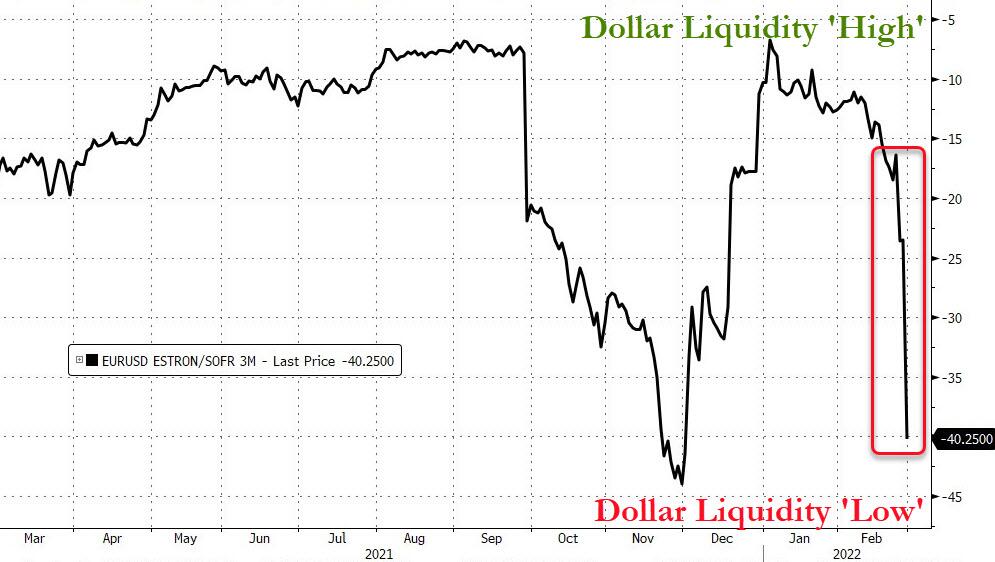
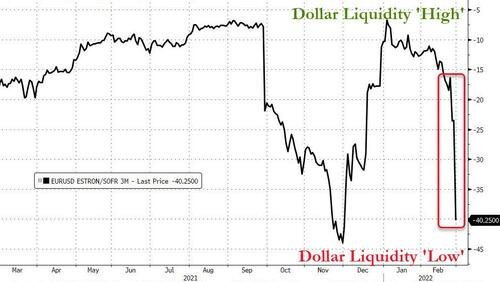
Dollar liquidity is drying up – and thus getting more costly – especially against the Euro…
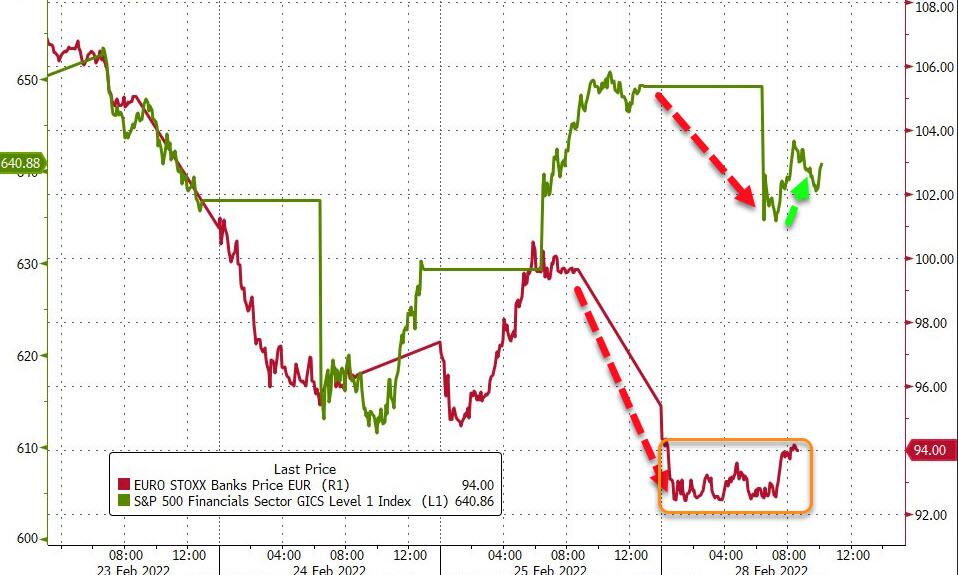
And while both US and European bank stocks were clubbed like a baby seal today, we note that US bounced back modestly while Europe’s financials couldn’t managed much (despite the overall indices rebounding from deep losses)…
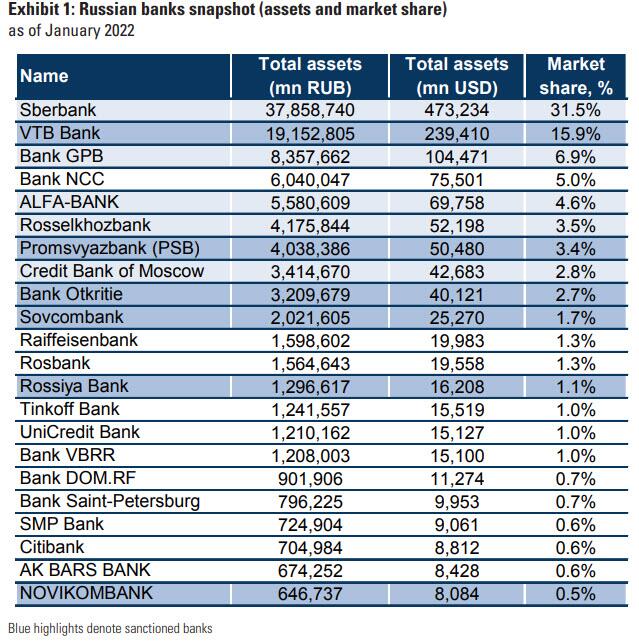
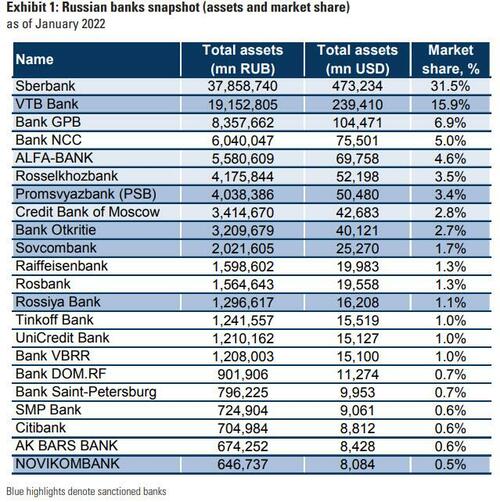
So, the question is – which banks are most exposed to the ongoing (and escalating) threat of sanctions on Russia?
Specifically, among other more arcane details, the sanctions relate to:
freeze of assets,
capabilities of certain largest Russian banks to process transactions and
proposed ban of certain payment avenues (SWIFT).
While the Russian banks have been in freefall recently (most especially the sanctioned ones)…
In their latest report, Goldman Sachs attempts to calculate the exposures that US and European banks face to these threats.
European banks exposure
In assessing exposure to Russia we use data from the latest EBA transparency exercise (June 2021); we acknowledge that certain banks have disclosed more recent figures and that the aggregate picture may have changed since June 2021 – but we use EBA data for the purpose of comparability. This data shows that (i) overall Russia exposure of European (EU/EEA) banks is small at €66bn – this is equivalent to 0.25% of banks aggregate exposure amount, (ii) concentrated among three banks (RBI, SG and UCG) and (iii) the impact on these groups is diluted owing to geographic diversification (Russian exposure is <5% of group loans for all banks apart for RBI at 9%). The direct exposure is therefore limited, in our view.
The EBA data shows that the banks with the largest exposure to Russia are (as at 06/21):
UniCredit: Total exposure of €13.7bn (of which €1.2bn is Government, €12.6bn is Retail & Corporate) equivalent to 1.6% of total exposure.
Société Générale: Total exposure of €14.3bn (of which €2.5bn is Government, €11.8bn is Retail & Corporate) equivalent to 1.7% of total.
Raiffeisen Bank International: Total exposure of €14.3bn (of which €2.4bn is Government, €11.9bn is Retail & Corporate) equivalent to 9.3% of total exposure.



 Econophysics2020