Following Zoltan Pozsar’s blueprint for how the US/UK/EU sanctions unveiled over the weekend could lead to problems in the “plumbing” of the global financial ecosystem, we have seen several cracks appear already.
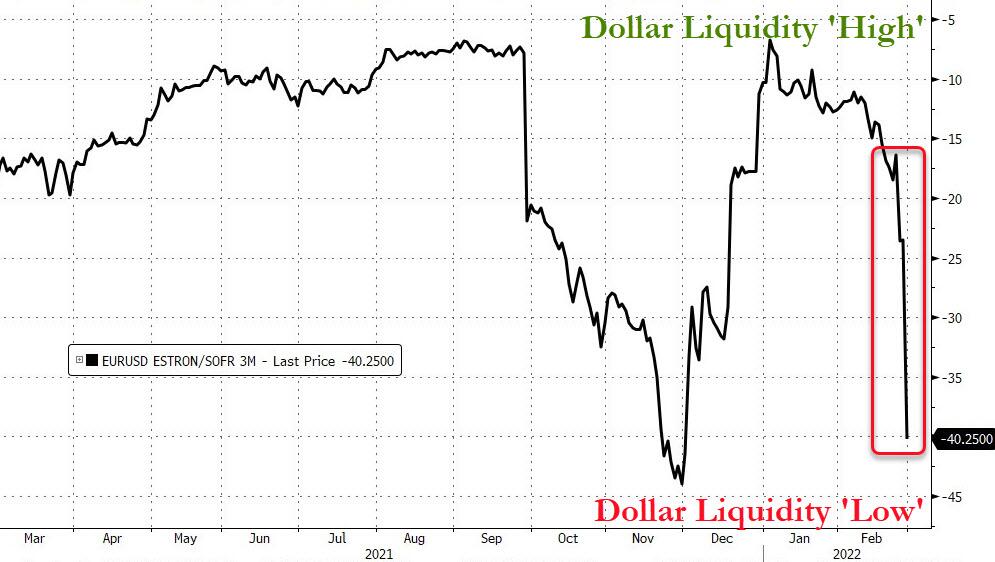
Dollar liquidity is drying up – and thus getting more costly – especially against the Euro…
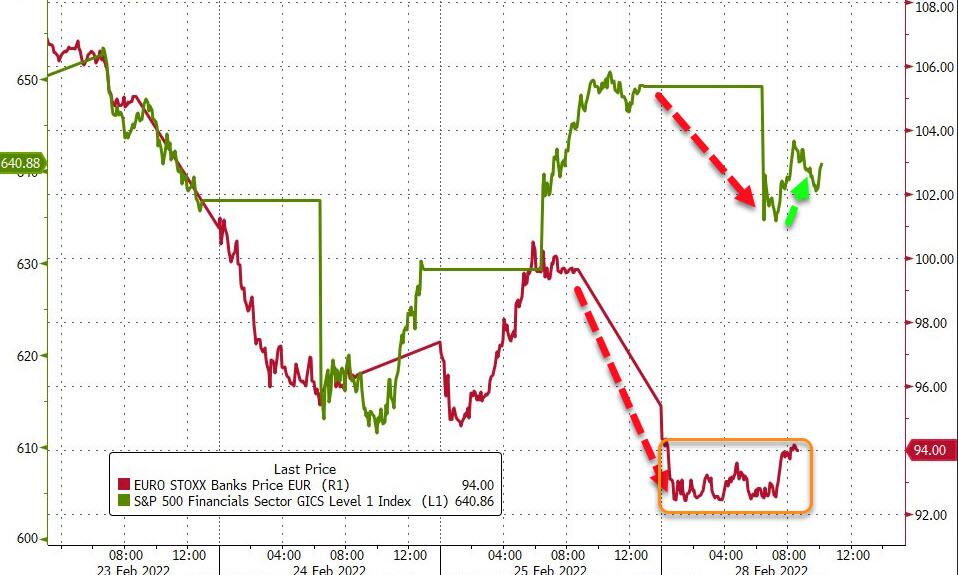
And while both US and European bank stocks were clubbed like a baby seal today, we note that US bounced back modestly while Europe’s financials couldn’t managed much (despite the overall indices rebounding from deep losses)…
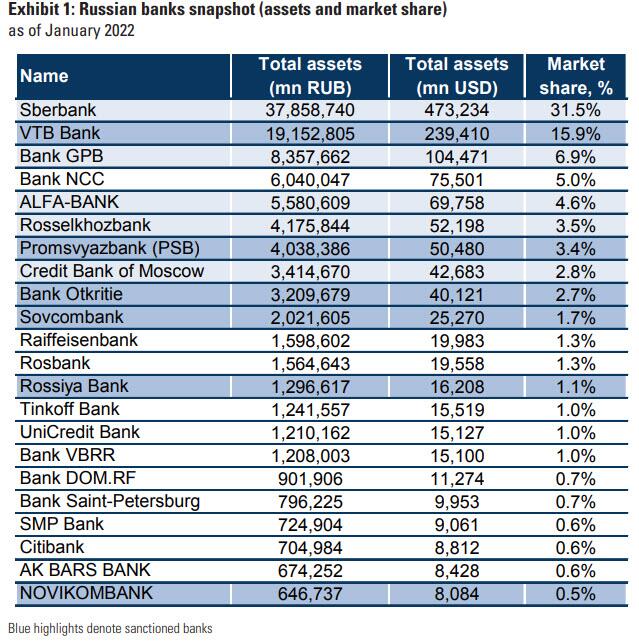
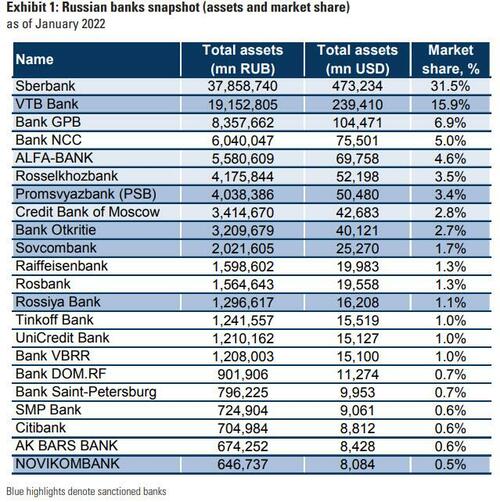
So, the question is – which banks are most exposed to the ongoing (and escalating) threat of sanctions on Russia?
Specifically, among other more arcane details, the sanctions relate to:
freeze of assets,
capabilities of certain largest Russian banks to process transactions and
proposed ban of certain payment avenues (SWIFT).
While the Russian banks have been in freefall recently (most especially the sanctioned ones)…
In their latest report, Goldman Sachs attempts to calculate the exposures that US and European banks face to these threats.
European banks exposure
In assessing exposure to Russia we use data from the latest EBA transparency exercise (June 2021); we acknowledge that certain banks have disclosed more recent figures and that the aggregate picture may have changed since June 2021 – but we use EBA data for the purpose of comparability. This data shows that (i) overall Russia exposure of European (EU/EEA) banks is small at €66bn – this is equivalent to 0.25% of banks aggregate exposure amount, (ii) concentrated among three banks (RBI, SG and UCG) and (iii) the impact on these groups is diluted owing to geographic diversification (Russian exposure is <5% of group loans for all banks apart for RBI at 9%). The direct exposure is therefore limited, in our view.
The EBA data shows that the banks with the largest exposure to Russia are (as at 06/21):
UniCredit: Total exposure of €13.7bn (of which €1.2bn is Government, €12.6bn is Retail & Corporate) equivalent to 1.6% of total exposure.
Société Générale: Total exposure of €14.3bn (of which €2.5bn is Government, €11.8bn is Retail & Corporate) equivalent to 1.7% of total.
Raiffeisen Bank International: Total exposure of €14.3bn (of which €2.4bn is Government, €11.9bn is Retail & Corporate) equivalent to 9.3% of total exposure.
Publius Cornelius Tacitus c. AD 56 – c. 120) was a Roman historian and politician and widely regarded as one of the greatest Roman historians
He lived in the Silver Age of Latin literature and has a reputation for the brevity and compactness of his Latin prose, as well as for his penetrating insights into the psychology of power politics.
The surviving portions of his two major works—the Annals (Latin: Annales) and the Histories (Latin: Historiae)—examine the reigns of the emperorsTiberius, Claudius, Nero, and those who reigned in the Year of the Four Emperors (69 AD). These two works span the history of the Roman Empire from the death of Augustus, in 14 AD, to 70 AD in the First Jewish–Roman War of 66–73. There are substantial lacunae in the surviving texts, including a gap in the Annals that is four books long.
“To ravage, to slaughter, to steal, this they give the false name of empire; and where they create a desert, they call it peace.”
Tacitus, “Agricola”
The core of the campaign history of the Roman military is an aggregate of different accounts of the Roman military‘s land battles, from its initial defense against and subsequent conquest of the city’s hilltop neighbors on the Italian peninsula, to the ultimate struggle of the Western Roman Empire for its existence against invading Huns, Vandals and Germanic tribes. These accounts were written by various authors throughout and after the history of the Empire. Following the First Punic War, naval battles were less significant than land battles to the military history of Rome due to its encompassment of lands of the periphery and its unchallenged dominance of the Mediterranean Sea.
Despite their formidable reputation and host of victories, Roman armies were not invincible. Romans “produced their share of incompetents” who led Roman armies into catastrophic defeats. Nevertheless, it was generally the fate of even the greatest of Rome’s enemies, such as Pyrrhus and Hannibal, to win the battle but lose the war. The history of Rome’s campaigning is, if nothing else, a history of obstinate persistence overcoming appalling losses.
“He realized that monarchy was essential to peace, and that the price of freedom was violence and disorder.”
Tacitus, “Histories”
The year 238 AD began with Maximinus I as Emperor of Rome– a former peasant who had worked his way up through the ranks of the military before being chosen as Emperor by his troops.
By August of that year, Maximinus was dead, and five other men had briefly held the title of Emperor. Only one (Gordian III) was still alive by the end of 238 AD.
This is known in Roman history as the ‘Year of the Six Emperors’, and it was an obvious watershed moment in the decline of the empire.
It’s not like Rome hadn’t seen plenty of turmoil before–
There had been full-blown civil war between Julius Caesar and Pompey the Great nearly three centuries prior in 49 BC. Caligula managed to engineer a major supply chain crisis during his reign in the early 1st century AD.
Much of the city of Rome burned to the ground under Emperor Nero in 64 AD. Caracalla heavily debased the currency and caused widespread inflation in the early 200s.
And more than a dozen emperors had been assassinated up to that point in Roman history.
People were used to crisis and chaos. But the Year of the Six Emperors felt different. It was as if Romans suddenly realized they were no longer the dominant superpower.
“Prosperity is the measure or touchstone of virtue, for it is less difficult to bear misfortune than to remain uncorrupted by pleasure.
Tacitus
Although the crisis of the 3rd century was not the absolute beginning of Rome’s decline, it nevertheless did impose a severe strain on the empire as Romans waged war on one another as they had not done since the last days of the Republic.
Within the space of a single century, twenty-seven military officers declared themselves emperors and reigned over parts of the empire for months or days, all but two meeting with a violent end.
The time was characterized by a Roman army that was as likely to be attacking itself as it was an outside invader, reaching a low point around 258 AD. Ironically, while it was these usurpations that led to the breakup of the Empire during the crisis, it was the strength of several frontier generals that helped reunify the empire through force of arms.
The next few decades, in fact, are known as the “Crisis of the Third Century”, with more than two dozen emperors seizing the throne in a power struggle, murdering their political enemies, and then being assassinated themselves.
Some emperors, like Silbannacus, Quintillus, and Saloninus, literally sat on the throne for a matter of days before being killed.
The government was extremely unstable, and notoriously corrupt. They rigged elections. They sent Praetorian guards to harass and intimidate their opponents. And they sewed social conflict so that Romans turned on one another.
“We are corrupted by prosperity. And when the state is corrupt, then the laws are most multiplied.”
Tacitus
In the meantime, the Roman economy was collapsing. Inflation became so rampant that Diocletian infamously had to implement extreme price controls, and then threaten to kill anyone who didn’t follow them.
They also lost control of their borders, as countless barbarian tribes poured into the empire and squatted on Roman lands.
The barbarian migration eventually turned into full-blown invasions and military conflict, and the Roman military lost a number of major battles.
In 251 AD, for example, Rome suffered a crushing defeat by the invading Goths at the Battle of Abritus. The Goths decimated three Roman legions, killed the emperor, and stole TONS of gold.
Even the lowest peasant was able to figure it out: dominant superpowers don’t lose battles.
They maintain secure borders. They have strong currencies. They don’t blow through six leaders in a single year. They aren’t in a constant state of social revolution. And they aren’t bankrupt.
We could easily apply the same logic today.
And this is especially true after last week’s watershed moment in which the US national debt reached $30 trillion for the first time.
It’s hardly controversial to assert that dominate superpowers don’t accumulate $30 trillion in debt (which, by the way, is 25% larger than the entire US economy).
But it’s not just the debt. It’s so much more.
Dominant superpowers don’t surrender tens of billions of dollars of military equipment to their sworn enemy, and then fly away with local civilians clinging to the side of their aircraft.
Dominant superpowers don’t abandon their own citizens abroad.
Dominant superpowers don’t engineer historically high inflation… and then ignore it. Nor do they embrace socialism, i.e. the literal opposite of the capitalist economic system that created so much wealth and power to begin with.
Dominant superpowers don’t send their government agents to harass innocent citizens, or tell parents they have no say in the education of their children.
Dominant superpowers don’t suspend their Constitutions because of a virus. They don’t give people incentives to NOT work. They don’t constantly make it difficult for small businesses to succeed.
Dominant superpowers don’t deliberately reduce their military’s physical fitness standards in the name of diversity and inclusion. They don’t prioritize “equity” over national security. And they certainly don’t fire experienced intelligence operatives because of individual medical decisions.
Dominant superpowers don’t placate their adversaries and bow to their demands. They aren’t afraid to offend their rivals.
Dominant superpowers don’t create incentives for countless people to illegally cross the border and go live under a bridge.
And above all else, dominant superpowers are able to deal with challenges.
Yes, there’s always been conflict and disagreement. But dominant superpowers have stable, effective governments who can do what is necessary to solve problems. And they have societies whose people can coexist peacefully without being at each others’ throats all the time.
It might not be pleasant to think about, but these are all true statements about the United States. And like Rome, they are all obvious signs of decline. Simply put, the US is no longer the dominant superpower.
Rabobank: Russia Is Prepared To Declare Economic War On The West, Inflicting “Huge Economic Pain”
By Michael Every of Rabobank
Choosing wallpaper during the Blitz
There seems no way to bridge the fundamental differences in interpretations of the 1975 Helsinki European security agreement that says all states are sovereign and free to decide which defence alliance they want to join, and that no state should join an alliance seen as a threat by another. Which clause has primacy? The former, if you view NATO as defensive. The latter, if you see NATO as offensive.
As in the 1920s/30s, you also get passionate, polarized views on who is to blame. There are those who see Putin as Hitler and Ukraine as the Sudetenland – or Poland. There are those who see the ‘US Deep State’ driving things. And both can be true, which just makes matters worse.
Meanwhile, the scandal-plagued UK government (this time it is about prosecco, not cake) and its Polish and Ukrainian counterparts are to signa trilateral defence treaty. Of course, such defense pacts are not new – back in September 1996 the same trio were saying the same thing. Yet the UK guaranteeing not just Ukraine’s but Poland’s border…are history, and the UK government, slurring old lyrics, rhyming or repeating themselves?
There is also pressure building in the Balkans: Bosnia, Kosovo, Albania, Serbia, Montenegro, and North Macedonia –maybe even EU member Bulgaria– are all in a pot Russia is helping to stir. Its Foreign Minister just stated he does not accept that Montenegro and North Macedonia should be NATO members when they already are.
Yet NATO member Hungary’s PM just visited Moscow, and the Russian Ministry of Foreign Affairs oozed: “Hungary has invariably confirmed its reputation as a reliable partner in the transit of Russian fuels. Naturally, we are willing to build up mutually advantageous cooperation in this area.” In other words, don’t expect any EU energy sanctions if Budapest has a veto? Yet that means the West has no pressure point against Russia except the military, where it is outgunned.
Meanwhile, Russia just banned the export of ammonium nitrate for two months (while Lithuania has fully blocked the rail shipment of potash from Belarus). The potential upside impact on fertilizer prices in Europe should be obvious. So should the fact that Russia clearly understands the geopolitical and geoeconomic pressure points that *it* controls. They can see the US does not want to raise rates but has to. They can also see that they can force inflation far higher, inflicting huge economic pain, even if they take some too. That is how economic wars work. Are we ready to fight one, or are we going to redraw borders to avoid one?
The scale of what is happening over markets’ heads –and the naval-gazing drivel on Bloomberg this morning– is summarized by former Portuguese politician Bruno Maçães in a Time magazine article, “What Happens Next in Ukraine Could Change Europe Forever”. In it, he notes: “The Russian television anchor Dmitry Kiselyov, known as a reliable Kremlin mouthpiece, explained on air during the past weekend that the current crisis is not about Ukraine: ‘The scale is much bigger.’” I concur: which is why I called it a metacrisis.
Maçães adds another line I have been stressing since 2017: “We no longer live in the old liberal order where rules must be enforced, and violators punished. We live in a new order where power must be balanced with power.” And the EU has no such power! If only its preparations had been made as far back as 2017 when ‘The Great Game of Global Trade’ came out.
As such, Maçães argues “The US must reflect on whether it can afford to reduce its presence in Europe before a proper counterweight to Russia has been created in Brussels. The pivot to Asia may need to wait for a solution to the European crisis. As for Europeans, they need to quickly prepare themselves for a new world, where their sovereignty and security may well be at stake.” Except the dynamic in the US is not moving in that direction. Asia is the priority, regardless.
He continues: “The existing order is starting to buckle, and Washington needs to decide how best to replace it with new arrangements. Does it prefer to reach a grand bargain with Moscow whereby the two powers divide Europe among themselves? Or does it prefer to encourage and support the development of a new European pole capable of balancing Russian power?”He is literally talking about a new partition of Europe into spheres of interest: and European markets are looking at what the ECB will do on Thursday. I can tell you ECB rates are unlikely to rise ahead –what’s new there?– but I can’t tell you what the geography and political architecture of the EU where you borrow that money will look like in 5 years. Keeping a focus just on the screens at times like this is akin to happily choosing new wallpaper during the London Blitz.
Maçães concludes: “To me the choice seems an obvious one, but what is frustrating about the current crisis is how we keep avoiding the larger questions of political order. By hesitating we allow others to assume the role of reformers and innovators. Eurasia, the supercontinent, is being reshaped before our eyes.” Yes – as the EU is talking about its usual soft, cuddly 2005-vintage talking points. But don’t worry – the Conference on the Future of Europe is waiting for your input! The website hasn’t added Russian as a language option yet.
We do perhaps see key movement from Germany – not against Russia, but China. It is reported Chancellor Scholz is to officially prioritize engagement with democratic partners in the Indo-Pacific instead of China, will travel to Japan to hold consultations, and fully supports Lithuania against Chinese coercion; hawkish Foreign Minister Baerbock will be allowed to champion initiatives against China; and German diplomats in the Indo-Pacific are “being encouraged to push the envelope and resist old habits to self-censor” when developing new China strategies. Obviously, this will greatly exacerbate EU-China economic tensions – but there is no military component. So, are these steps a quid pro quo to try to ensure the US stays committed to the EU’s defence, rather than –as Maçães says– carving it up with Russia and looking to Asia?
Perhaps. Yet if you have decided to turn your economy into a weapon, as the EU thinks it has, then using it involves taking hits: armies take damage in war – economies take damage during economic wars. That is how economic wars work. The US is most unlikely to change its mind on strategic options vis-à-vis Asia unless the EU is prepared to take pain on the sanctions front to send Russia a message. Even then, what to do about Hungary, should consensus be required?
Let’s all go and look at wallpaper patterns instead, why not?
Well, now, wasn’t that on point?
So, how else might we wrap that one up but Sean Connery’s famous speech from “The Hunt for Red October”.
Many of us know it by heart.
Sing it!!!!
Russian Cyrillic
Russian Romanization
English translation
Россия — священная наша держава, Россия — любимая наша страна. Могучая воля, великая слава – Твоё достоянье на все времена!
Припев: Славься, Отечество наше свободное, Братских народов союз вековой, Предками данная мудрость народная! Славься, страна! Мы гордимся тобой!
От южных морей до полярного края Раскинулись наши леса и поля. Одна ты на свете! Одна ты такая – Хранимая Богом родная земля!
Припев
Широкий простор для мечты и для жизни Грядущие нам открывают года. Нам силу даёт наша верность Отчизне. Так было, так есть и так будет всегда!
Припев
Rossiya — svyashchennaya nasha derzhava, Rossiya — lyubimaya nasha strana. Moguchaya volya, velikaya slava – Tvoyo dostoyanye na vse vremena!
Ot yuzhnyh morey do polyarnogo kraya Raskinulis’ nashi lesa i polya. Odna ty na svete! Odna ty takaya – Hranimaya Bogom rodnaya zemlya!
Pripev
Shirokiy prostor dlya mechty i dlya zhizni Gryadushchiye nam otkryvayut goda. Nam silu dayot nasha vernost’ Otchizne. Tak bylo, tak yest’ i tak budet vsegda!
Pripev
Russia is our sacred state, Russia is our beloved country. A mighty will, great glory – Your dignity for all time!
Chorus: Be glorified, our free Fatherland, The age-old union of fraternal peoples, Ancestor-given wisdom of the people! Be glorified, country! We are proud of you!
From the southern seas to the polar edge Our forests and fields are spread out. You are the only one in the world! You are the only one – the native land so kept by God!
Chorus
A wide scope for dreams and for life The coming years open to us. We are given strength by our fidelity to the Fatherland. So it was, so it is and it will always be so!
Photo credit: Paul Mobley + Tore Sætre, CC BY-SA 4.0
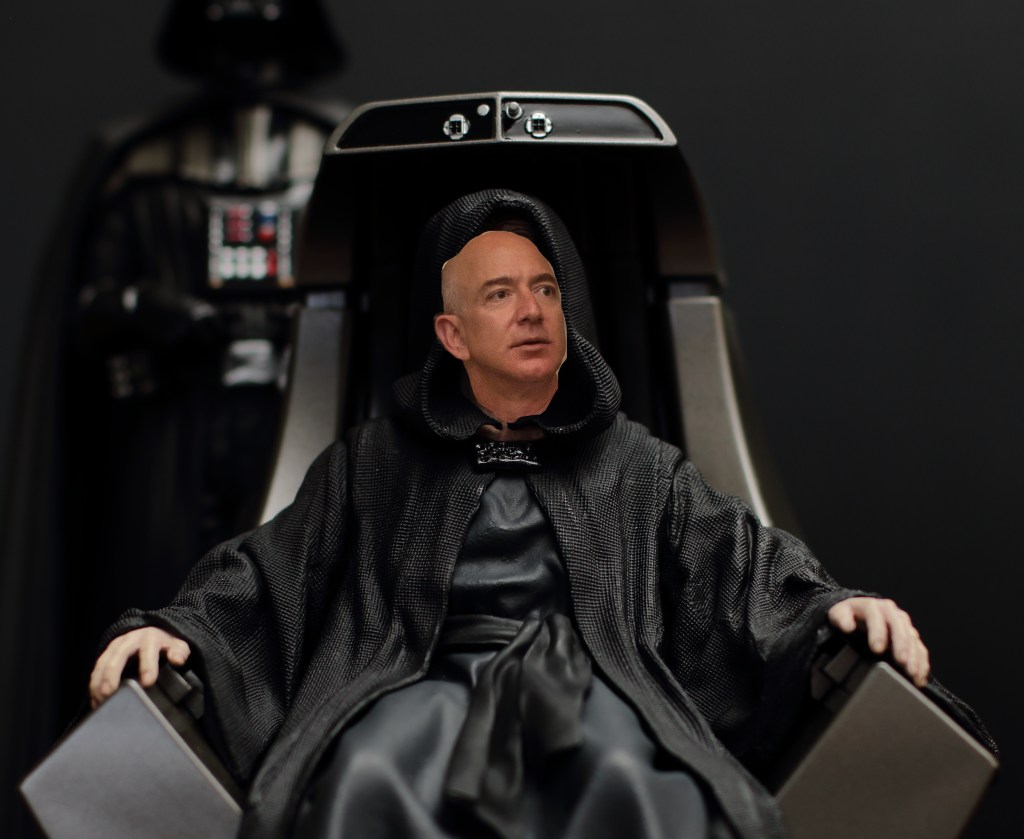
Cui bono?
In a world of Sock Puppets, who makes Neil speak? And Joni Mitchell and Nils Lofgren?
Saagar Enjeti suggests “Hedge Funds for Neil”:
“You see a recent trend in the music business in that iconic artists such a Neil Young sell their catalogs to big-money groups who then reap the profits in perpetuity. Young actually sold his catalog in Jan. 2021 to a company called Hipgnosis. Now Hipgnosis is a $1 billion company that recently announced an ownership agreement with Blackstone.”
Enjeti said Blackstone is focused on taking over single-family housing and turning America into a nation of renters, but it also has interests everywhere.
“Blackstone, BlackRock and these big private equity giants are ruthless in their pursuit of profits and they’re savvy political players who know how to play the game,” Enjeti said. “They have all sorts of ties to the pharmaceutical industry, including announcing the former CEO and chairman of Pfizer would be joining Blackstone as a senior advisor.”
“Do you really think it’s a coincidence that days after Neil Young’s music was pulled off of Spotify he debuts a 4-month free trial to any person who wants to sign up for Amazon music — who has struggled to gain market share and has long-standing connections with all of the big money people in the game?” Enjeti asked.
Would be a real shame if *something* happened to it.
Or you find your career prematurely “terminated.”
At BLK, we are an integrated team of quants, analysts, lawyers, cloud-based technologists, social media flacks, and hacks – well connected, if you know what I mean.
For a fee, BLK and our business partners can game your ESG rating to minimize the adverse effects of anticompetitive and unlawful conduct under the Sherman Act by one and several entities and financial institutions acting loosely and in concert (hereinafter, the “BLK ESG Trust” or simply “ESG Trust), under non-competitive, secret, and illegal agreement including enterprise racketeering as defined by the RICO Act (18 U.S.C. §§ 1961–1968), seeking to unlawfully disrupt market equilibrium to gain an unfair market advantage, conspiracy or combination to monopolize, manipulate stock and bond prices, and extort higher fees.
Now, wouldn’t you rather have BLK on your side?
Would be a real shame to see you and your business’s reputations forever smeared, libeled, and slandered resulting in a hostile take-over, endless state and civil lawfare, greenmail, NGOs, and activist mobs protected by Progressive prosecutors we installed.
If you do retain our services, one of our social media/customer success hacks named Tait or Muffy with a real journalism degree from Columbia will thank you on behalf of the planet and work with you to spruce up your ESG “credentials.”
After your check clears, of course.
And get the pronouns right – we wouldn’t want you to mess up those pronouns. That kind of hate wouldn’t be inclusive.
Importantly, your thoroughly woke board members will award you an “extra special bonus” for your passionate commitment to social justice and the planet’s survival.
Plus save us from the inconvenience of scheduling remedial woke indoctrination and re-education at one of our “training facilities.” Or worse.
Remember, this isn’t about money – it’s about morality and inclusivity.
I think it might a smart idea that you do the moral thing here, for your own good, of course.
Hate to see something unfortunate happen.
Got it?
Call us right now. Operators are standing by in our offshore call centers 24×7.
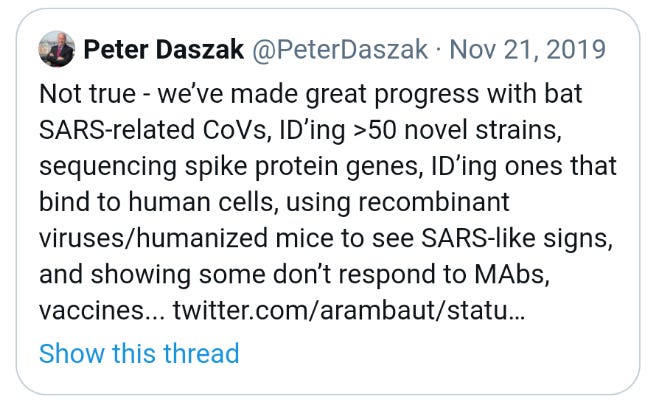
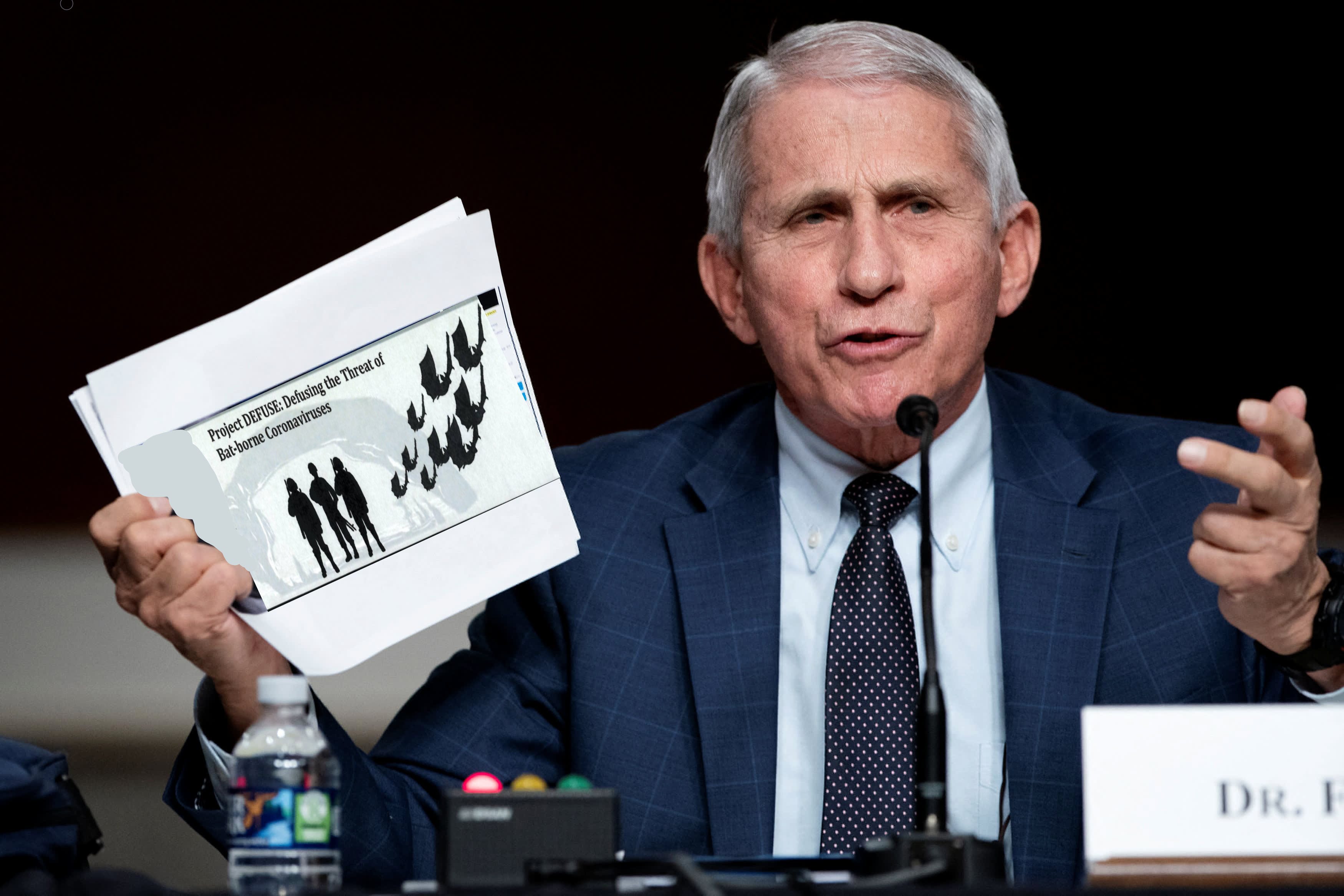
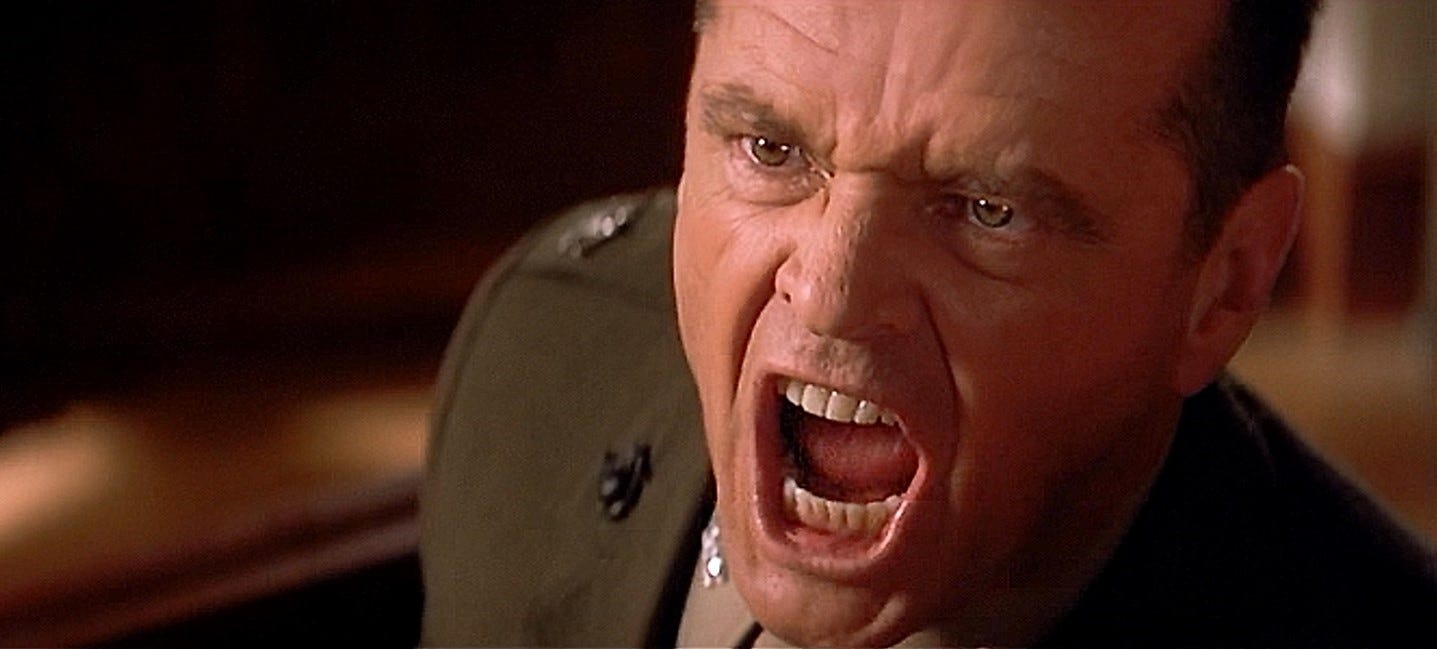
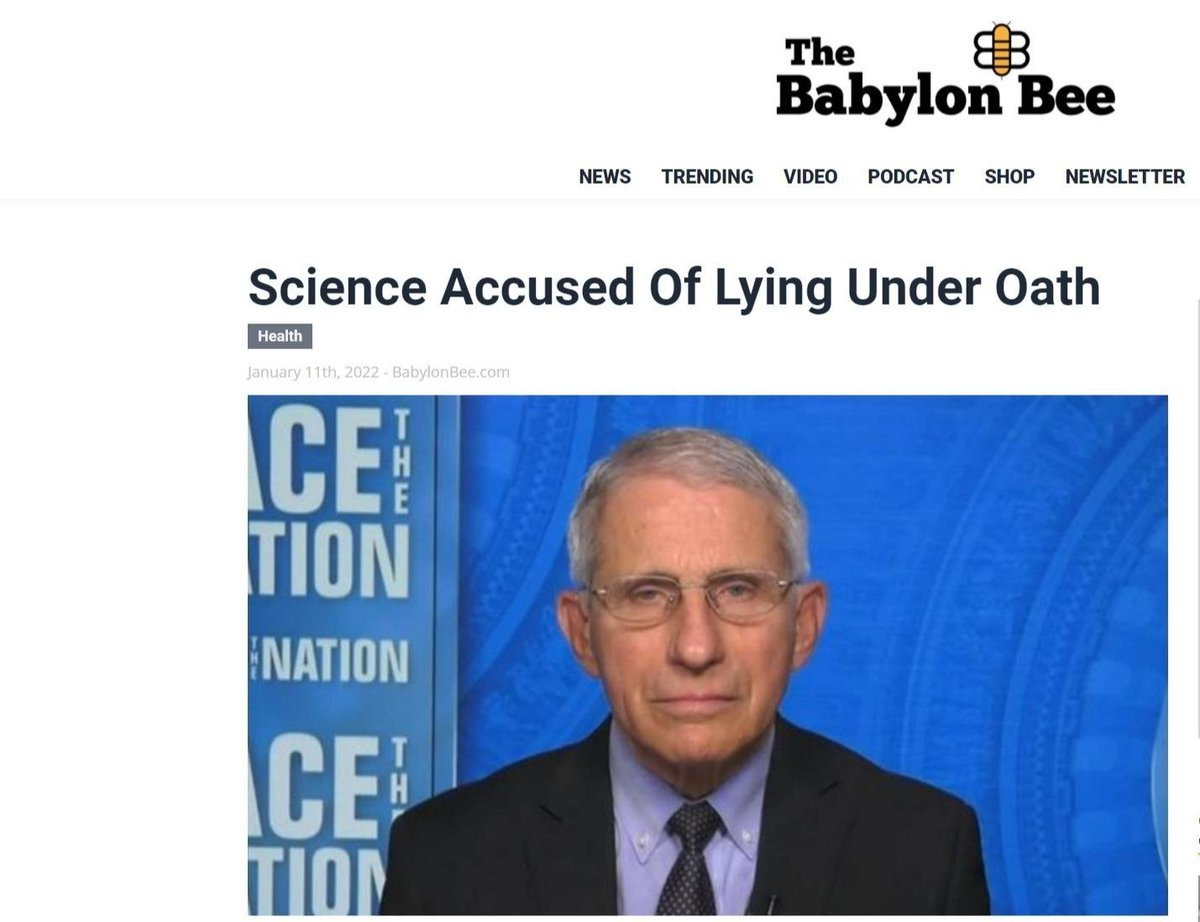
fauci: son, we live in a world that has bats, and those bats have to be experimented on by men with NIAID grants. who’s gonna do it? you? the wimps at DARPA? i have a greater responsibility than you can possibly fathom. you weep for wuhan and you curse their institute of virology. you have that luxury. you have the luxury of not knowing what i know — that this global pandemic, while tragic, probably saved lives; and my existence, while grotesque and incomprehensible to you, saves lives.
you don’t want the truth because deep down in places you don’t talk about at parties, you want me in that cave — you need me in that cave.
we use words like “spike protein” “gain of function” “illegal vaccine program.” we use these words as the backbone of a life spent feathering nests and generating plausible deniability. you use them as a punch line.
i have neither the time nor the inclination to explain myself to a man who rises and sleeps under the nagging cough of the diseases that i provide and then questions the side effects of the half baked vaccines we licensed out and claimed would stop them.
i would rather that you just said “thank you” and went on your way. otherwise, i suggest you pick up a virus and serially passage it though some rodents! either way, i don’t give a DAMN what you think you’re entitled to!
senator paul: did you order the gain of function?
fauci: I did the job —
senator paul: — did you order the gain of function?!
“To me, left unchecked, the price of carbon goes to infinity.” – Lawson Steele
On Friday, October 24, 2008, Volkswagen’s (VW) stock closed at EUR 210 per share, down 50% over the prior two weeks. Like many manufacturing companies, VW was reeling from the global financial crisis. Because of its high debt load and diminishing prospects, the stock was a popular pick among short sellers and approximately 13% of the total shares outstanding were sold short. That might not seem like a very high number, but as a percent of the company’s free float it was substantial. At that time, Porsche owned 42.6% of VW’s shares and the German state of Lower Saxony held 20.3%.
On Sunday, October 26, 2008, Porsche issued a press release that would kick off one of the most famous short squeezes of all time. Here’s how the English version of the release began (emphasis added through this piece):
“Due to the dramatic distortions on the financial markets Porsche Automobil Holding SE, Stuttgart, has decided over the weekend to disclose its holdings in shares and hedging positions related to the takeover of Volkswagen AG, Wolfsburg. At the end of last week Porsche SE held 42.6 percent of the Volkswagen ordinary shares and in addition 31.5 percent in so called cash settled options relating to Volkswagen ordinary shares to hedge against price risks, representing a total of 74.1 percent. Upon settlement of these options Porsche will receive in cash the difference between the then actual Volkswagen share price and the underlying strike price in cash. The Volkswagen shares will be bought in each case at market price.”
Further down in the same press release, Porsche lays bare their motivations and strategy with classic German humor:
“Porsche has decided to make this announcement after it became clear that there are by far more short positions in the market than expected. The disclosure should give so called short sellers – meaning financial institutions which have betted or are still betting on a falling share price in Volkswagen – the opportunity to settle their relevant positions without rush and without facing major risks.”
It doesn’t take a PhD in mathematics to understand that if Porsche claims to own 74.1% of VW and Lower Saxony has 20.3%, that leaves only 5.6% for everybody else. With short sellers on the hook to buy back 13% of the shares outstanding, panic buying in an effort to close out their short positions ensued. VW’s stock soared in the days following Porsche’s audacious gambit – at one point crossing EUR 1,000 per share – temporarily making the struggling automaker the most valuable company in the world. The crisis abated when Porsche announced it would close a portion of its option position, thereby freeing up float for short sellers to cover. Market participants lost billions in the fiasco, and there’s no telling where the price of VW might have risen absent Porsche’s opening of the release valve.
As argued in this outstanding and comprehensive research paper published just months ago in the Journal of Financial Economics, Porsche’s move was blatant and plainly illegal stock manipulation driven by their own looming insolvency. Ironically, Porsche’s bankruptcy risk arose from the very same options strategy it bragged about in its press release, although a critical detail went undisclosed: to pay for its call options in VW, Porsche had sold put options on the stock. As VW’s stock fell in the weeks prior to the infamous press release, Porsche faced a series of margin calls as those puts went in the money. If it had fallen much further, Porsche would have defaulted on its obligations. Instead, Porsche pocketed at least EURO 6 billion in illicit gains from the squeeze, turning a catastrophic and undisclosed trading blunder into a windfall.
Short squeezes are a hot topic in today’s frothy markets, which is ironic given how few short sellers are left standing. This is especially true with meme stonk AMC Entertainment Holdings (AMC), which we’ve written about here and here. There’s an entire cult of retail investors – the self-described AMC apes – who are conspiring together in the hopes of recreating a VW-like frenzy in what they call the mother of all short squeezes (MOASS). No really, MOASS is a thing. Find your way onto their Twitter Spaces “conference calls” and you’ll hear talk of dark pools, evil hedge funds, and various other theories concocted to rationalize why this squeeze has thus far failed to materialize.
Putting aside the fact that conspiring to manipulate the price of any security is illegal – even for a group of retail investors openly doing it on social media for all the authorities to see – we submit that the apes are chasing the wrong banana, because the real MOASS might well unfold in Europe in the coming months.
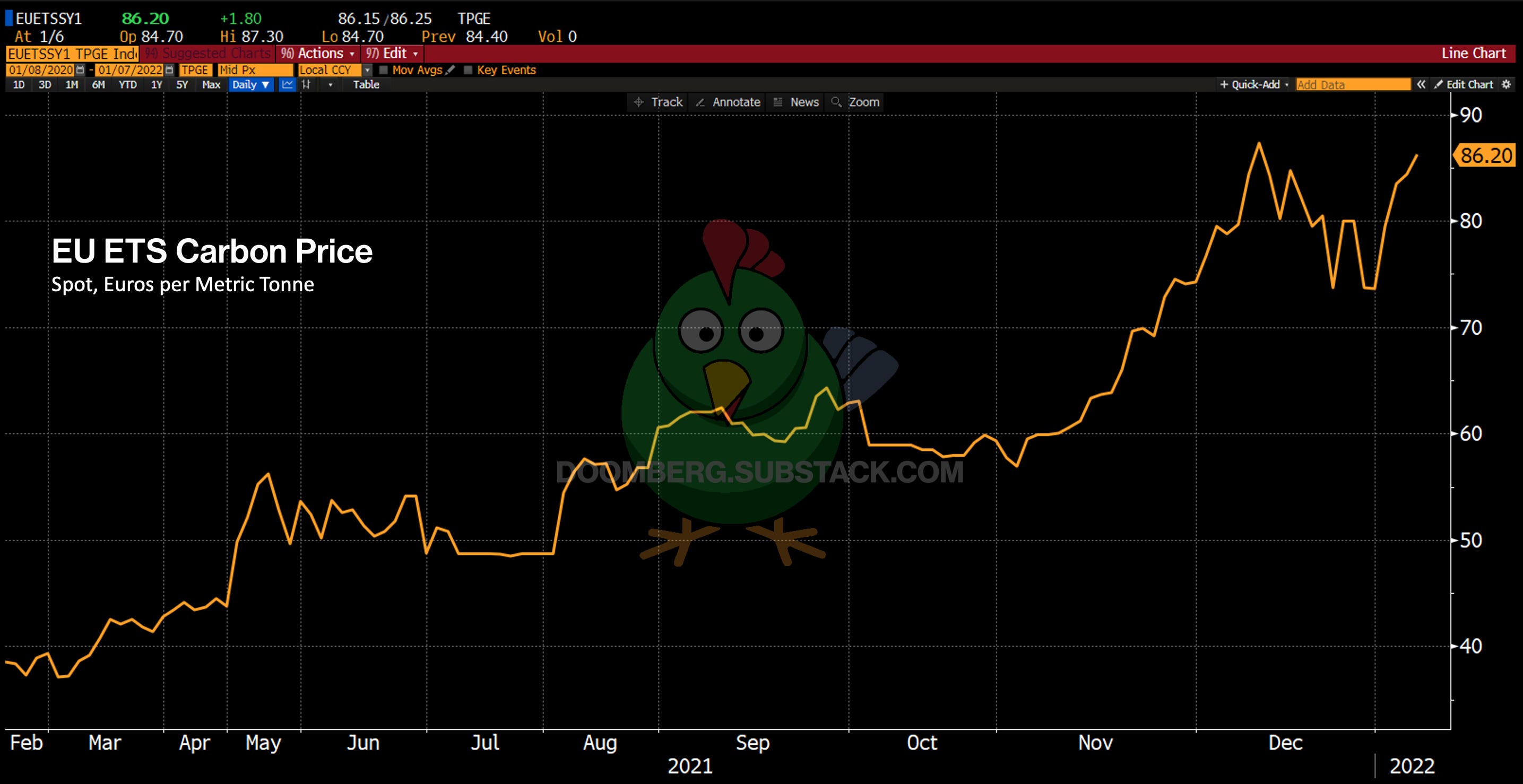
We tell the VW short squeeze story – and direct the apes to turn their attention to Europe – because we were reminded of both when we listened to this spellbinding edition of Chris Dark’s fantastic podcast Dr Dark After Dark. Dark interviewed Lawson Steele, a Senior Analyst at Berenberg Bank who has covered utilities for nearly three decades. In early 2018, Steele made a prescient call on where he thought the price of carbon credits was headed in Europe. Since he got long the trade, the price of those credits is up twelvefold, and he makes a compelling case for why this may be just the beginning. You can follow Dark’s Twitter account here and Steele’s account here.
The European Union Emissions Trading System (EU ETS) is designed to leverage market forces to achieve the EU’s aggressive emissions reduction targets, specifically its commitment to reduce carbon emissions 55% by 2030 (from the 1990 base). Here’s a relatively benign overview of the system from Wikipedia:
“Under the ‘cap and trade’ principle, a maximum (cap) is set on the total amount of greenhouse gases that can be emitted by all participating installations. EU Allowances for emissions are then auctioned off or allocated for free and can subsequently be traded. Installations must monitor and report their CO2 emissions, ensuring they hand in enough allowances to the authorities to cover their emissions. If emission exceeds what is permitted by its allowances, an installation must purchase allowances from others. Conversely, if an installation has performed well at reducing its emissions, it can sell its leftover credits. This allows the system to find the most cost-effective ways of reducing emissions without significant government intervention.”
This all sounds well and good, but, as Lawson describes, there appears to be a significant flaw in the design of the EU ETS: emitters are net short and the free float is shrinking.
Integrated across the European economy, companies are emitting far more CO2 than allowed by their ever-more-aggressive targets, and Lawson sees the situation getting worse in the years ahead. If a company has emitted more than the number of allowances it owns, it must go into the open market and procure more. If it fails to do so by the annual deadline of April 30, two things happen. First, the company must pay a fine of EURO 110 for each allowance shortfall, and – most critically – paying this fine does not alleviate its obligation to deliver the allowances! The obligation merely rolls forward to the next period, thus increasing the demand for next period’s limited allowances. Naturally, the market has begun to digest this dynamic and the price of these credits has soared, although they still trade well below this EURO 110 fine.
To compound matters, the EU measures and publishes the Total Number of Allowances in Circulation (TNAIC) and it uses this measure to further reduce the number of new allowances made available for auction in the upcoming period. Here’s a quote from a European Commission press release on the matter which was published in May of last year:
“The European Commission published today the total number of allowances in circulation on the European carbon market. It amounts to 1,578,772,426 allowances. At the same time last year the amount was 1,385,496,166 allowances.
The total number of allowances in circulation plays an important role for the operation of the Market Stability Reserve (MSR), which began operating in January 2019. This indicator shows the amount of allowances in circulation in a transparent and predictable manner.
As long as the indicator exceeds the threshold set in the legislation of 833 million allowances, a certain share of the total number of allowances in circulation is placed in the MSR each year. For the years 2019 to 2023, this share is set at 24% of the total number of allowances in circulation. Allowances are placed in the MSR by decreasing the amount of allowances that Member States auction.
Based on the indicator published today and on the provisions of the legislation (Decision 2015/1814, the MSR Decision), auction volumes from September 2021 to August 2022 will be reduced by 378,905,382 allowances, which will be placed in the MSR.”
This is, in effect, a HODL Mechanism™. While the EU ETS reduces its newly issued allowances, their scheme simultaneously encourages outside speculators to buy and hold existing allowances, soaking up supply knowing full well there is a forced buyer on the other side of the trade. As the opening quote of this piece by Lawson accurately summarizes, absent a political intervention it is difficult to see a scenario where a VW-type short squeeze can be avoided. Of course, such intervention can happen at any moment, and Lawson and Dark spend a fair amount of time debating at what price a political relief valve must be opened. Since they are both bullish on the trade, it is natural that they agree that price is much higher, and we find it tough to argue with their informed opinions.
Europe has been doing its level best to hammer its domestic power producers and erode its industrial base for years. What stops foreign adversaries from helping them along by bidding up the price of these carbon credits to create economic advantage for themselves? How much money would it really take to double or triple the price of carbon in the EU from here? Whatever happens, this is one of the most fascinating stories we’ve come across in quite some time.
We should close with an important disclaimer. We do not give investment advice at Doomberg, nobody on our team has any investments related to these carbon credits schemes, and we will not open any positions for at least 72 hours after this piece publishes, if at all. There are several ways in which investors can participate in this market, including by directly speculating in futures or by using ETFs that attempt to track this and other carbon markets globally, and we encourage our readers to do their own due diligence before making investment decisions. In the Chicken Coop™, it’s every ape for themselves.







 Econophysics2020