America Has Lost the Trade War with China, and the Real Pain Has Yet to Begin

Charles Hugh Smith: https://charleshughsmith.blogspot.com/2021/07/america-has-lost-trade-war-with-china.html

Corporate America sacrificed national interests in service of greed, and so did the U.S. government.

As we all know, the source of Corporate America’s unprecedented explosion in profits in the 21st century is the offshoring of manufacturing to China. If you doubt this, please study the chart below of corporate profits. Apologists claim many excuses in an attempt to evade the central role of offshoring production to China, but they all ring hollow: no, it wasn’t increasing productivity or automation or Federal Reserve magic, it was shipping production to China and other low-labor-cost nations.

Whether we like to admit it or not–mostly not–the American economy is entirely dependent on manufacturing in China. America’s short-sighted obsession with increasing profits to fund buybacks and golden parachutes for corporate insiders and vast fortunes for financiers has led to a dangerous dependency that has handed China tremendous leverage, which China is now starting to make use of. (And why not? Wouldn’t the U.S. start using the same leverage if it could?)

A long-time U.S. correspondent who prefers to remain anonymous for obvious reasons recently shared his experiences with parts shortages and price increases from previously reliable suppliers in China. Here is his account of the disruptive shift in the supply chain of essential parts from China to the U.S.

China is laying siege to the USA by slowing down production and delivery of goods. It doesn’t take much to hang up US production, just one missing item can do it. So much stuff is sourced through China they can affect all supply chains. Semiconductors are just the canary–because the chains are so long and complex, and specialized materials are required, etc. But it is happening everywhere.

I have a little manufacturing company and I am seeing this in supply lines. I sent an order to China for printed circuit boards (US prices are astronomical because of various factors). They don’t get back for a week, then they quote, then I send money, then they sit on it, then I call and they say they are having problems with some process… etc. But all the suppliers are like this, it is not an isolated incident. They are sandbagging.

So just as in laying siege, the attackers have the food outside the castle and wait for the people inside to starve.

As prices rise the Chinese manufacturers take bigger profits so the slowdown effects on that end are mitigated. For products they do not have a monopoly on, like PC boards, they slow down. for things like LCD displays and NFeB magnets, the items become unavailable (try buying magnets on Amazon).

I have to say this is a brilliant idea on China’s part, and no one on this side has realized the situation yet. This plan is straight out of Sun-Tzu. implications? inflation and shortages will continue for a long time… maybe forever. The only long-term solution is repatriation of manufacturing to the US. But it is going to cause some serious hurt, vastly more than the sanctioning of Chinese tech companies.

i just sent a request for quote for some radio chips I use to Alibaba. they are $1 each and there are many vendors. I sent notes to 2 vendors i used before and after 4 or 5 days got a ping back that my requests were cancelled. i wound up getting the parts–for 2x the price– from Hong Kong, which at the moment seems to be something of a channel to the mainland. But I expect they will close that leak pretty soon.

I have long made the case that manufacturing, energy and food are all fundamentally national security issues. Those benefiting from “free trade” (there is no such thing, that’s just a handy PR cover) have sold the unwary the fraudulent notion that “everyone benefits” from globalization. Nothing could be further from reality. A handful of corporate insiders and financiers have benefited at the expense of everyone else.

And now the chickens are coming home to roost. Essential parts and feedstocks become unavailable for all sorts of flimsy excuses, prices double, triple, then double again, and since we’ve allowed our entire economy to become dependent on a handful of sources for these essentials because that dependency maximized profits, then there are no alternatives.

America has already lost the trade war, but the pain has yet to begin. Corporate America sacrificed national interests in service of greed, and so did the U.S. government. Now it’s too late, and all the good seats at the banquet of consequences have already been taken.

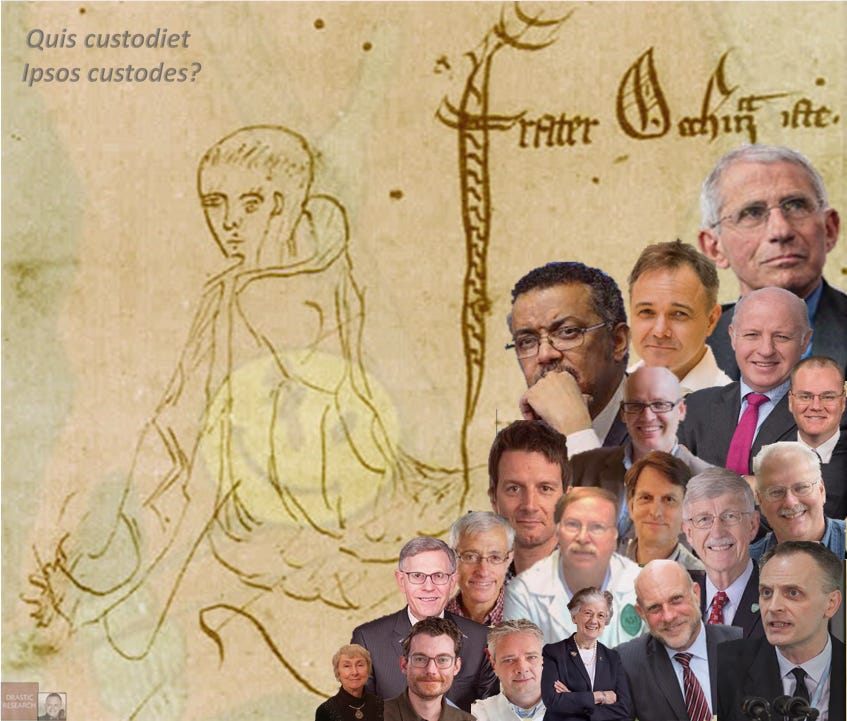
Quis custodiet ipsos custodes?

Satires of Juvenal

By Charles Rixey, Prometheus Shrugged: https://prometheusshrugged.substack.com/p/who-watches-the-watchmen-faucis-noble

Who Watches the Watchmen? – Fauci’s ‘noble lie,’ exposed

*Note — This article details current historical research into COVID-19’s origins, as part of the D.R.A.S.T.I.C. team of scientists, journalists & researchers. Recent news: D.R.A.S.T.I.C.’s research forms a large portion of the basis for investigations begun by the US SenateHouse & National Institutes of Health. Recent appearances and/or discussion on 60 MinutesThe Joe Rogan Exp., Fox NewsJRE [again]Bill Maher, & CNN.
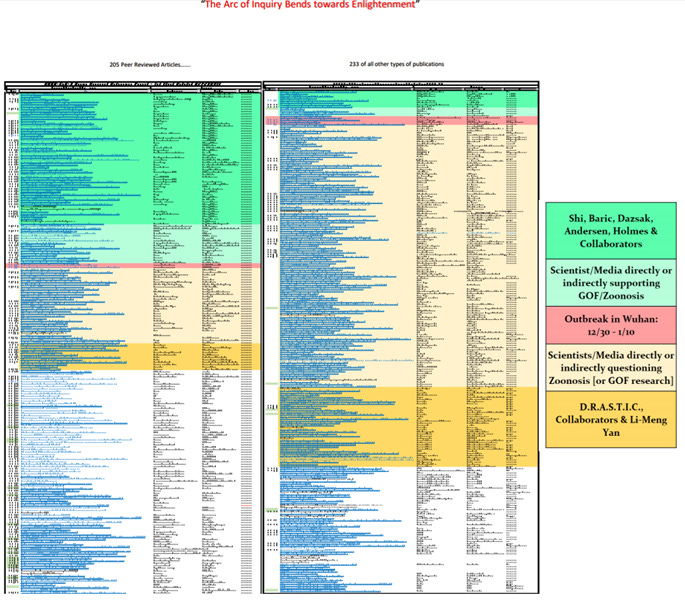
All references for this and other articles are compiled under my research project The Arc of Inquiry Bends Towards EnlightenmentThe files include my statistical analysis of the impact of censorship on the search for the origin of SARS-CoV-2.
More than 100K pages of FOIA documents referenced here have been condensed into 173 pages of the most relevant selections in my appendix Prometheus ShruggedIt was here, last February, that the role of Dr. Fauci in ongoing academic censorship of COVID’s origin was first exposed. A chronological narrative of the events described throughout my research will included in a forthcoming volume of DRASTIC’s set of published collections of evidence.
A medieval doodle of William of Ockham accompanying a litany of scientists using his razor to shred evidence.

The philosopher Arthur Schopenhauer once wrote that truth goes through 3 stages:

1st, it is ridiculed; 2nd, it is violently opposed; and 3rd, it is accepted as being self-evident

Guess what’s next for us?


Quis custodiet ipsos custodes? – Who Watches the Watchers?

Six months ago, I began my first article on scientific censorship during COVID-19 by introducing Dr. Fauci as a surprise character that had emerged unexpectedly while digging through what was then 83,000 FOIA emails, published by US Right-to-Know over the course of the last year:

[see files related to Ralph BaricLinda SaifRita ColwellColorado State/Rocky Mountain National Laboratory & the NCBI; other FOIA releases from Judicial Watch, Buzzfeed & the Washington Post include NIH funding of the WIV & Dr. Fauci’s emails]

I’ve been trying for quite some time to get people to understand the full scope of the Dr. Fauci ‘situation,’ but it’s clear that segments of our national leadership are preventing an honest and open inquiry into his actions because they fear the backlash/collateral damage that will result from the tarnishing of their sacred cow. It’s time Americans were told the truth – that the grant money sent to the Wuhan Institute of Virology [WIV] is merely a footnote in this narrative. After all, Dr. Fauci controls nearly $4 billion of annual grant funding for the NIAID, the institute within the NIH he has directed since 1984; over 37 years, more than 50,000 research projects have been supported with more than $50 billion [conservatively] of taxpayer funds have been doled out to them.

It’s reasonable to hold him accountable for the results of his organization’s efforts, but the direct funding received by the WIV for Gain-of-Function (GOF) research represents only a tiny fraction of Fauci’s involvement in enabling risky research – the 2017 repeal of the GOF ban was decided without the consultation of the Trump administration, even though news coverage during the pandemic blamed him for the decision.Neither Fauci nor his boss Francis Collins [the NIH director] bothered to clarify the record, which looks especially disgusting in the wake of persistent rejections of Senator Rand Paul’s assertions [with accompanying evidence] that the NIH ever financially supported such research:

Contents:

  • Dr. Fauci’s true legacy
  • The evidence of his involvement
  • The questions Congress [and everyone else] should be asking Dr. Fauci
  • The impact of his efforts

First, do no harm … to Fauci’s Legacy

It’s important to plainly state that I’m aware of the intense politicization of virtually every aspect of the pandemic and the pandemic response. Since many readers may not be aware, I’ll point out that my specific motivation for building a COVID-19 website [later moved here to Substack] and speaking to a broader audience about the various facets of the pandemic was to offer unfiltered information to counter the disgusting polarization I observed:

I feel obligated to re-iterate my stance, because the nature and importance of the situation can’t be ignored any longer; Congress is now actively engaged in investigating the pandemic’s origins, and we must confront the truth if we are to gain meaningful insight that can help us prepare for future crises. There is no level of partisanship that justifies ignoring a tragedy of this magnitude.

“Everything rises and falls on leadership” – John Maxwell

It’s hard to place a dollar value on the impact of Fauci’s leadership decisions upon almost all aspects of the COVID-19 pandemic, which is why it’s not difficult to understand the willingness of some to avoid a legitimate inquiry into the issue altogether. After all, he sits at the nexus of –

A) the NIH’s role in supporting the research & development of mRNA technology and new antiviral drugs like Remdesivir, and the resulting conflicts of interest that the NIH continues to ignore

B) His role in pushing those NIH-sponsored inventions; specifically, advocating for Remdesivir on the basis of weak evidence while rejecting legitimate investigations into generic alternatives with no less statistical support, as well as…

C) …His role in obfuscating concerning data and censoring public debate over the risk/benefit evidence emerging about COVID-19 vaccines. Had Fauci been bluntly honest about the unknowns involving the new technology throughout the pandemic, Americans would still largely have assumed the risk – at least, assuming that antibody dependent enhancement [ADE] was not a likely outcome. Oops.

D) His evolving stances on masking, lockdowns, school closures and other non-pharmaceutical interventions [NPI], largely the result of growing public awareness that those decisions have consistently been based upon reducing the accountability of cowardly officials, not the best interest of their constituents [Note: this is a conclusion from my research focus last year, that I will return to once the origin issue allows me to do so].

E) His refusal to address the blatant censorship of vaccine side-effect data; it takes a disturbing level of cynicism to witness the large-scale skepticism and uncertainty that has resulted from such censorship and then vilify those willing to speak up – and blaming them for any future vaccine breakout when one of the most likely causes would be ADE. ADE with SARS-CoV-2 would most likely result from the specific targeting of the MRNA vaccines, not vaccine hesitancy [in the absence of a simultaneous global administration of the jabs – which was never feasible under the geopolitical and temporal constraints of the pandemic.

Each of those factors has contributed to the fading perception of Fauci as ‘America’s Doctor, but each has also become a divisive litmus test for which the evidence for and against is hotly debated. My purpose here is not to offer judgment on those [self-evident] issues; rather, I want to highlight the fact that Dr. Fauci’s legacy includes elements far beyond the scope of my research – and the context of those debates is directly relevant for the proper framing of the failures illuminated here. The same hubris and gaslighting in defense of ‘Science’ has plagued every facet of our government’s response to COVID-19.

My disgust doesn’t stem from casual reflection & an exaggeration of weak assertions to fan partisan flames. It stems from my analysis of 100K pages of FOIA documents, 1,000+ research articles reviewed, and my own published analysis of the the impact of Fauci’s censorship, which was the 1st of its kind:

My approach was external to science – from the perspective of an historian seeking to understand the ‘why’ behind the further collapse of trust in our institutions during the pandemic. My conclusions were formed over six months of investigation, and focused on the realization that one of the worst developments of the pandemic is the evaporation of public trust in scientists [see Edifice Wrecks]. I’ve never sought to inflame conspiracies or ignore evidence in support of zoonosis, but I’ve personally entered into discussions with a half-dozen of the scientists highlighted below, and none of them ever addressed the emerging evidence that, under normal circumstances, would’ve been part of the open debate that Fauci pretends already took place.

Every additional moment spent in denial and suppression just adds fuel to the coming backlash, and thus far discussions have ignored what I believe is the largest and most consequential elephant in the room:

F) Fauci quietly but directly ensured that scientific censorship was implemented, in large measure, to prevent public awareness of the extent of his role in GOF research and the controversies surrounding it. The evidence proves that, at the start of the pandemic, Dr. Fauci and many leading scientists moved to protect themselves – not us, who weren’t yet aware of the potential calamity at our doorstep. Fauci LED the efforts to obstruct research into COVID’s origins, colluding with the President’s Science Advisor Kelvin Dreogemeier and Wellcome Trust head Jeremy Farrar, to proactively undermine consideration of the evidence that directly tied their global research initiatives to the lab at the center of the COVID-19 pandemic.

To date, all of their efforts have been focused on preventing disclosure of embarrassing connections – not preventing another novel pathogen from sparking a global pandemic; to prevent future scrutiny, not future tragedy.

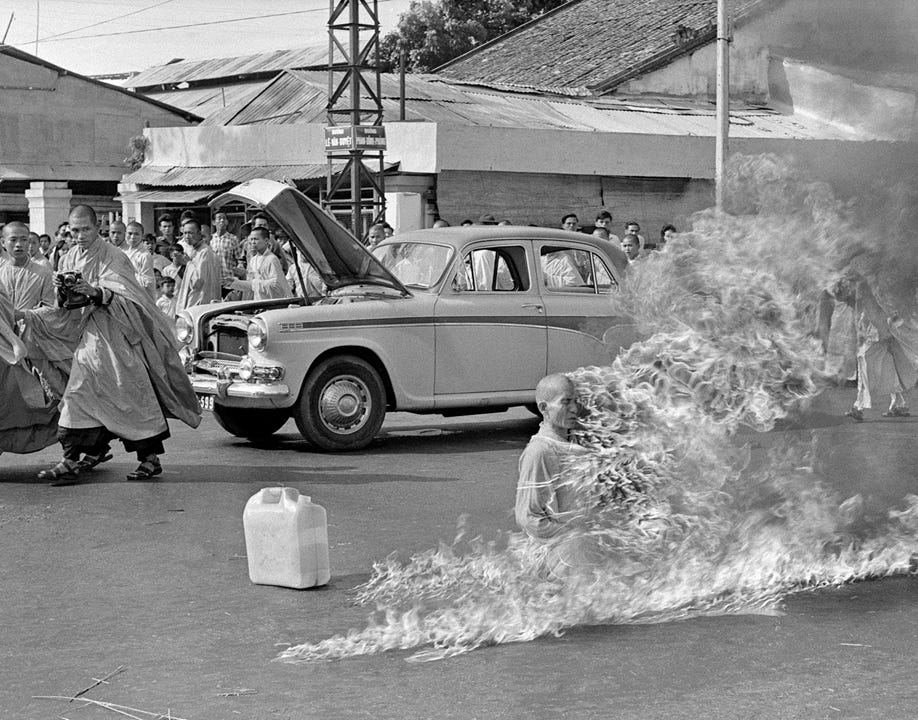
Scientists, if you’re struggling to understand the distinction between degrees of commitment to truth, I offer the example of Thích Quảng Đức, pictured here protesting the corrupt S. Vietnam regime in a prologue of the Vietnam War:

You see, the message for scientists who believe that a threat is existential is that words gain true meaning when they are supported by the actions & sacrifices of the speaker. What message are we supposed to derive from the COVID-19 pandemic?

I’d recommend pausing for reflection – on the image above, specifically – because what the world is beginning to see is that the scientific establishment made a mockery of the trust it had been given. The world’s leading experts in virology and public health called attention to a threat by setting the world on fire, rather than themselves – and then blaming us for being too simple to believe their noble lie.

Priorities

The baseline assumption of the public at large has been that Dr. Fauci has earned the benefit of the doubt thanks to his five decades of public service and consistency in defending establishment science – the admiration of which has risen nearly to cult worship in recent decades. The cognitive dissonance between appearance and reality have created a situation where trust in ‘science’ has reached its sacred peak at the exact moment when such trust is least deserved.

At the center of this incestuous arrogance is Dr. Anthony Fauci, the recipient of unquestioned adulation by those in the political sphere who have spent more than a century arguing that a Platonic ‘philosopher-king’ ideal must be forced upon intellectually vacuous masses whom, left to their own devices, would inevitably self-immolate.

Scientists reached new heights in the ivory tower when they warned us that man’s evil nature had left previous generations protected only by the horrific death equation of Mutually Assured Destruction. Setting aside the obvious complicity of scientists in the creation of nuclear weapons, trusting science over many decades has simply led to a new formulation of that Faustian bargain – Mutually Assured Corruption.

A Study in Scarlet

Before heading down the long and winding road, it’s important to explain what zoonosis  is and why Fauci’s denial of basic facts simply kicks the accountability can down the road. Should we really be surprised that Dr. Fauci is ‘confused’ by the definition of “Gain of Function?” After all, not that long ago, he also ridiculed the idea that the virus could’ve come from a lab before finally admitting that it was a statistical possibility.

Zoonosis in the context of viral emergence doesn’t mean a virus originally sprung from nature – all viruses do. It means that the jump from animals to humans happened in the wild, as the result of a fortuitous combination of mutations that allow a virus to survive the switch. If human intervention artificially encouraged the process of adaptation by experimentation, or simply by virtue of bringing a virus to a lab and increasing the odds of such exposure, then the origin of a viral pandemic is a lab.

What’s sickening about his tortured twisting of language is that Fauci knows this better than almost anyone; thus his lies aren’t borne of ignorance. What he’s done is use his scientific gravitas to pretend that observers’ understanding of literal definitions is flawed because we are too ignorant to appreciate the complexity of the issues. The truth, however, is that our generation’s most prominent infectious disease expert is gaslighting the citizens of the country he swore an oath to protect [one could also use the term epistemic injustice].


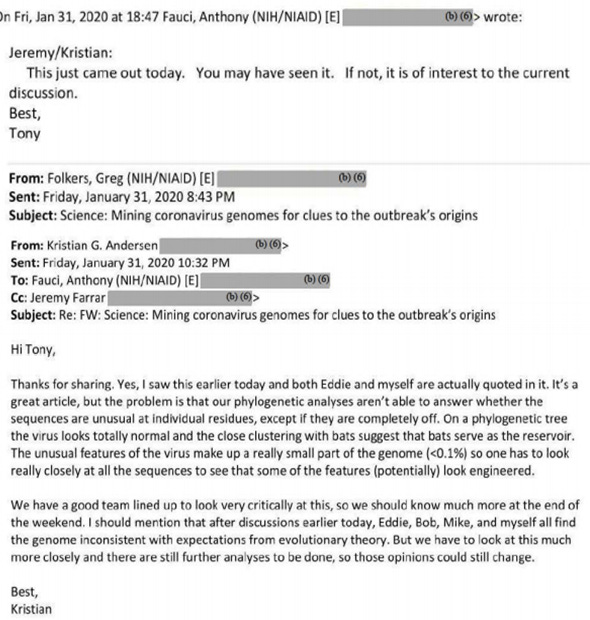
We begin this story on 1/31/2020, on the eve of a 4-day stretch that seemingly made true believers out of serious skeptics:

*[Note – I’ve published this article, but I’m still adding in pictures and links]

The brief exchange above was a precursor to a conference call the next day [2/1/20], organized by Jeremy Farrar & Dr. Fauci for the explicit purpose of addressing the swirling rumors that had emerged following the publication of an Indian pre-print that alleged the discovery of inserts identical to sequence segments within the HIV genome

As far as sparking the intense reaction, the proof is in the pudding – between the various collections of FOIA emails, the Indian paper and Zero Hedge commentary are explicitly mentioned. The purpose of this meeting was to address several aspects of the SARS-CoV-2 genome that pointed towards an artificial origin, by means of generating adaptive changes through passaging and/or direct manipulation of the genome. Immediately afterwards, Baric’s 2015 paper was investigated and shared amongst Fauci, his assistant Hugh Auchincloss, and others.

There’s no reason to discuss the meeting’s purpose as a hypothetical – the Indian paper proposed a possible method of tweaking, and the Sirotkins’ paper & Adrian Bond’s arguments, as later magnified via Zero Hedge, discussed the general outline of how the WIV would’ve approached it, based on published experiments. The assembled experts on the conference call knew this, and they also knew [by 2/1, anyway], that Baric’s chimaera and the methods within that paper needed to be compared and considered to determine what to do next. I took it as quite likely that the reference to ‘backbone’ directly stems from that paper.

In retrospect, it makes sense for there to be questions about the lovechild from that 2015 experiment, because the full sequence wasn’t added to the article’s supplementary files until May 22, 2020– 3 months after that conference call. Given that the experiments immediately triggered renewed debate about gain-of-function [GOF] research, less than a year after the GOF ban began, pretending that repeated corrections [in this case, relatively minor sequence segments] are acceptable for the world’s leading coronavirologist publishing a landmark paper in the world’s most prestigious journal is stupid.

Also completely obscured is the fact that at least one, and very likely all, of the people on the conference call were aware of the existence of the FCS, since Bill Gallaher had pointed it out on 1/29 and Robert Garry reiterated it [just a day before the conference call]: [Analysis of Wuhan Coronavirus: Deja Vu – SARS-CoV-2 coronavirus / nCoV-2019 Evolutionary History – Virological]. There is some confusion as to whether or not Garry actually made it onto the call, given a comment just prior, but further emails show that Garry’s input nonetheless was received by 2/2.

-2/2 was also the day that Marion Koopmans mentioned a “backbone” and an “insert.”

Thus, just like Zheng-Li Shi, the Proximals [the five editors of The Proximal Origin of SARS-CoV-2, plus their running mates in the virological community] already knew about the existence of the FCS, certainly by the end of the conference call. If not, then they lied later about ‘nothing emerging to change their mind about the possibility of engineering.’ Then, they said nothing for two weeks and let Etienne Decroly & co. break the news. That’s pretty shitty, since the first notions of asymptomatic spread were also arising,

and the implications for many scientific disciplines, diplomatic interactions and public health interventions are profound.

It’s even worse when you consider that 18 months later, they still can’t explain it – the Proximals refuse to respond to the fact that the FCS doesn’t exist within the sarbecovirus sub-genus that SARS-CoV-2 falls under. This is a problem, because members of the sub-genus are too distinct to recombine with the varieties of SARS-like viruses from other branches that do contain the FCS.

In sum, having gone through now 100K pages of FOIA emails and all 600+ articles on my origin-only reference list, I’d be comfortable testifying that:

1) The Proximals were gathered by Farrar & Fauci explicitly to compare emerging arguments with what was known of Baric’s work, the spectrum of experiments conducted at the Wuhan Institute of Virology [WIV]

2) Whatever specifics they covered that were pulled from the Indian paper & Zero Hedge included elements from Baric’s experiments with SHC014[?] 

3) They were nervous about the claims within the Indian paper [even if not tied to HIV per se] even though it had already been pulled – it struck a nerve

4) They were concerned that unrestrained interest would lead back to them directly

5) They were concerned about transgenic mice [header for 1 discussion], the ZH article, the Indian retraction, a backbone, an insert, Baric/Shi’s SHC014 love child, and preventing further inquiries into all of them. 

6) They almost certainly also knew about the FCS on 2/1, but Garry might never have made it to the conference call, per the emails, so it’s possible that [if no one saw the Virological.com posting] this news had to wait until 2/3, when the Proximals were summoned again.

7) Based on continuing conversations, the decision to censor might not have been formally made until 2/3. 

Public alarm? Lol, that’s not the emotion they’re afraid of. 

Why? Because the part that everyone is mostly missing is the far more important aspect of the Baric emails – one that got lost amidst their 83K pages. The big news last fall was that Daszak et all conspired to shape the narrative. 3 months later, I found and pointed out that the biggest nugget had been missed. Sadly, It mostly stayed that way even after the Fauci emails, despite my efforts. 

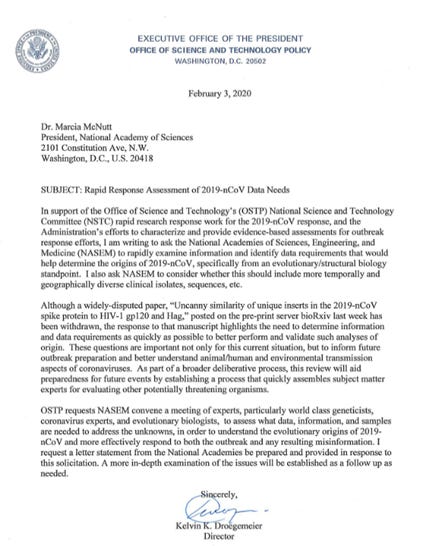
The Proximals’ 2/4 collusion efforts were spawned by the 2/3 OSTP meeting, of which the stated purpose was to combat ‘misinformation.’ There were obviously still concerns amongst the 2/4 crowd, but they intentionally suppressed them for the OSTP letter. This wasn’t their own secret plan – Kelvin Droegemeier, the recipient of said letter, was a speaker at the meeting on 2/3, so they weren’t obfuscating for him, or Fauci, or the NASEM presidents in whose name the letter was being written.

That was a quick turnaround – this letter was emailed the morning of 2/3, and the meeting it called for took place that afternoon [I’ve added in pictures of the speakers/participants]:

Note) NIAID Director Dr. Fauci coordinated this meeting with Kelvin Droegemeier, the Presidential Science Advisor, and included WMD/PPP expert Chris Hassell & the National Academies’ policy director Alexander Pope.

The meeting’s purpose:

The outcome: This group slapped the table on what the narrative was going to be – not what the science indicated. They hid their conflicts of interest from the NSTC & the President; most still continue to fight tooth and nail to suppress that information. This esteemed group of virologists expended more effort and publications in advancing their cover-up than leading the charge against the exploding pandemic, until at least the summer of 2020.

The biggest picture-the 2/1 attendees included:

1) The world’s largest public (Fauci) and private (Farrar) grant money distributors, whom organized the call; Farrar is also an editor of the New England Journal of Medicine

2) seemingly no GOF opponents

3) Nearly all of the major scientists with conflicts of interest (COI) related to the WIV who later published zoonosis materials

4) Francis Ross but no other HHS, DHS, Ex. branch officials

5) Ron Fouchier, famous for his Spanish Flu concoction

The 2/3 meeting that decided to censor included:

1) The policy head of the NASEM academies that controlled fellowship conferral & published Science

2) Heads of most of the most prestigious virology labs on the planet

3) The president’s science advisor/OSTP head

4) The HHS science advisor/PPP authority

5) A mandate to control the narrative

Therefore, the signal was sent to all scientists that pursuing the lab origins angle meant career death (no academy membership), no funding (via Fauci or Ross or Farrar), no publication in the big 4 journals during the historic pandemic (NEJM, Science, The Lancet & Nature [by virtue of their publishing of the tone-setting pieces]), no executive patronage for things like generic drugs, etc. 

The disparity between peer-reviewed articles and everything else is stark:

If sorted chronologically, the impact from February to May of 2020 is even clearer.

It’s disgusting, and the extension of that censorship to all Americans just ices the cake.

Edifice Wrecks

I’ve pondered the contents of the emails that were redacted before release, but I can’t imagine what could possibly be redacted that is worth protecting. The West didn’t make COVID-19, even if they taught the Chinese how to do major aspects of it. But, these people did decide to lie from the start, and then continued to do so after it exploded from 40 deaths to 4 million. It means that they refuse to call a spade a spade even now, and the prospect of China getting off scot-free as a direct result is horrifying. The protection of Fauci is a mid-term election decision only, and that means the goal is to drag this out until the electoral damage can be mitigated. Anything that clarifies this to the public negates being worthy of redaction. 

The recent Congressional appearances by Fauci, however, have shown that he is willing to drag this fight out forever in defense of his legacy, and many politicians are sympathetic to his plight. Thus, it’s clear that better questions are needed to build the proper level of awareness amongst the public to the full implications of Fauci’s concerted effort to prevent that same public discourse he claimed to support in 2012. Below are the questions I would lead with, were I appearing at his future hearings.

10 questions for Fauci:

1) Where did the buck stop? In 2014, who served as the final approval authority for Baric’s pending research, which ultimately allowed it to be grandfathered under the impending GOF ban? Why did the experiment not get forwarded to Chris Hassell’s committee for review?

-why did no one notice that the experiment included the use of humanized mice to increase human pathogenicity, which David Relman had asked Ralph Baric about directly in November of 2014, and which Baric denied any current research interest in that area?

-Coincidentally, it was also the research that Zheng-Li Shi was in North Carolina working with Baric on, and then immediately returned to the Wuhan Institute of Virology and continued in 2016?

2) Holding Dr. Fauci to his word – In 2012, Dr. Fauci called for an open, public debate on the GOF issue, saying that scientists should justify their research to the broader public any time the risks of such research carried a non-negligible probability of an accident that could affect them. Why then, in 2017, did the NIH rescind the GOF pause – without first engaging the public or its constitutionally elected president/representatives?

3) Secrecy – What did Peter Daszak tell Erik Stemmy & Alan Embry “off the record” on 1/8/20? When did they pass on the contents of that discussion to Dr. Fauci?

4) Redactions – When did you first learn of the existence of the furin cleavage site within the genome of SARS-CoV-2 -What were the insert/backbone referred to by Marion Koopmans? Was the insert the FCS? Why were emails with the topic heading “humanized mice” redacted?

Let me ‘recombine’ these queries into a single thematic question: Why did the world’s leading virologists/microbiologists and top American/UK officials refrain from releasing their knowledge of the existence of the FCS when they first learned of it? The FCS is so good at increasing pathogenicity that it’s the specific insertion typically added by labs worldwide for such experiments. In fact, much has been made of the omission of that specific segment of the genome in the WIV’s landmark paper introducing the likely connection between SARS-CoV-2 and its purported ‘predecessor RaTG13.

What possible justification could there have been to ignore the FCS, other than limit discussion during the early phase of their censorship? And what effect might that have had on our doctors’ ability to characterize the virus?

5) Silence – Why did Victor Dzau and the other two academy presidents of NASEM ultimately remove the forceful pro-zoonotic statements inserted by Daszak et al from the final version of their public letter to the OSTP? What reservations justified that decision, and why did they not speak out when censorship prevented the doubts of others from being published?

6) Selective Inclusion – Why was Robert Kadlec, the HHS Assistant Secretary for Preparedness & Response, not included in any correspondence with Jeremy Farrar or your gathered audience of world-renowned virologists? His deputy is the chair of the PPP oversight panel and he is an expert on C-WMD & biological weapons. The existence of any doubt in the possibility of a zoonotic source [doubts which you harbored] should’ve made his inclusion mandatory.

-instead, you shaped the information provided to those outside the scientific community.

7) Why were you and Francis Collins the only US officials involved in the 2/1 conference call?

8) Subversion – Did you, Collins or Droegemeier alert Matt Pottinger, Robert Redfield, President Trump or any member of the National Security Council to the substance of the 2/1 conference call, or the decision-making over the next 3 days that led to an un-announced censorship of non-natural origin hypothesis for the origin of SARS-CoV-2? Why not?

9) Diverging Narratives – Jeremy Farrar’s experts decided on natural origins of COVID-19 on 3/17? So, Fauci & the Pres. Sci. Adv. lied to us/Trump in the OSTP letter on 2/7? And in ‘Proximal,’ on 2/16? -written by your future dream team? What was the basis of the 2/4 decision to reject a lab-leak origin and produce “Proximal Origin” – if no additional evidence was added to the 2/16 version prior to its 3/17 online appearance in Nature?

Both Fauci & Farrar explained the general make-up and purpose of a ‘group of experts:’

By this point [2/13] 10 days had passed since the ‘Proximals’ & Fauci had held a second conclave, this time with the OSTP director, that was followed directly by a flurry of peer-reviewed letter, articles and ‘collaboration’ [collusion] to smother the scientific community with pro-zoonotic propaganda.

10) Prove it? Which evidence, specifically, led to the ‘Proximals’ reversal from 2/1 to 2/4? The arguments made in the following weeks were pathetically unsubstantiated. If stronger evidence exists, why wouldn’t it have been shown.

The answer, of course, is that the driving force behind the shift had nothing to do with the quality or quantity of the supporting evidence.

Paved by Good Intentions

The only proper action for Dr. Fauci to take at this point is to resign immediately, and apologizing for prioritizing the suppression of embarrassing & extensive conflicts of interest, double standards and political decisions masked as sound policy. Ideally, such a statement would include a call for the retraction of Proximal Origin of SARS-CoV-2, one of the most-read [and potentially most impactful] pieces of scientific propaganda published in at least a generation. Each of its 5 authors intentionally framed the COVID origin debate around ‘evidence’ and ‘facts’ that they couldn’t prove, and a finality of their conclusions that the known facts couldn’t justify.

These actions are independent of the ultimate answer to the origin question, because the failures of leadership I’ve described are ethically and morally indefensible, regardless of China’s guilt or innocence in the sparking of the pandemic. Any remaining shreds of credibility left in the public’s perception of scientists must be salvaged by new leaders who are willing to do what needs to be done to clean the Augean Stables.

Sufficient evidence already exists for Congress to do the right thing moving forward. Given the enormity of the failures, and of the efforts to hide, censor and destroy the credibility of anyone who spoke out against lockdowns, vaccines, masks, generic drugs, mRNA efficacy vs. risks, and the curtailment of numerous constitutional/human rights in the last 18 months, it will take historic leadership to honestly converse with a righteously indignant citizenry [in the US and everywhere else]. We must accept that our current representatives have proven manifestly unqualified to assume such leadership – in the last 6 months, censorship has been expanding, not receding.

The COVID-19 pandemic has manifestly proven that there is no lie so ‘noble’ that it overrides the rights and wisdom of a free and informed public. That doesn’t mean that the public will inherently do better.

It’s just acknowledging the inescapable conclusion – that we can’t possibly do worse.

C. H. Rixey


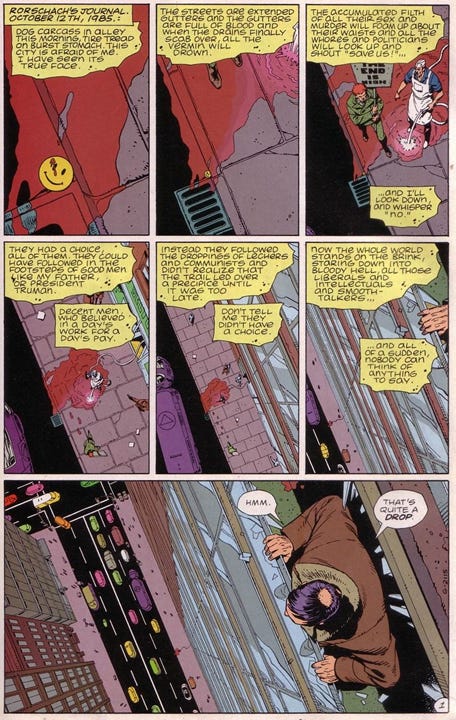
Epilogue: Alan Moore’s prophetic vision, from a generation ago

The Horror of Losing Federal Funding

This image has an empty alt attribute; its file name is https%3A%2F%2Fbucketeer-e05bbc84-baa3-437e-9518-adb32be77984.s3.amazonaws.com%2Fpublic%2Fimages%2Fa04df5d5-c2f0-4eb8-a7a4-7e6cbc7a3c75_1567x955.jpeg

Support Duffel Blog: https://www.duffelblog.com/p/taliban-calls-emergency-meeting-after

Taliban calls emergency meeting after US, its largest donor, pulls funding

You can sponsor the Taliban for only $5 per day.

By Cat Astronaut

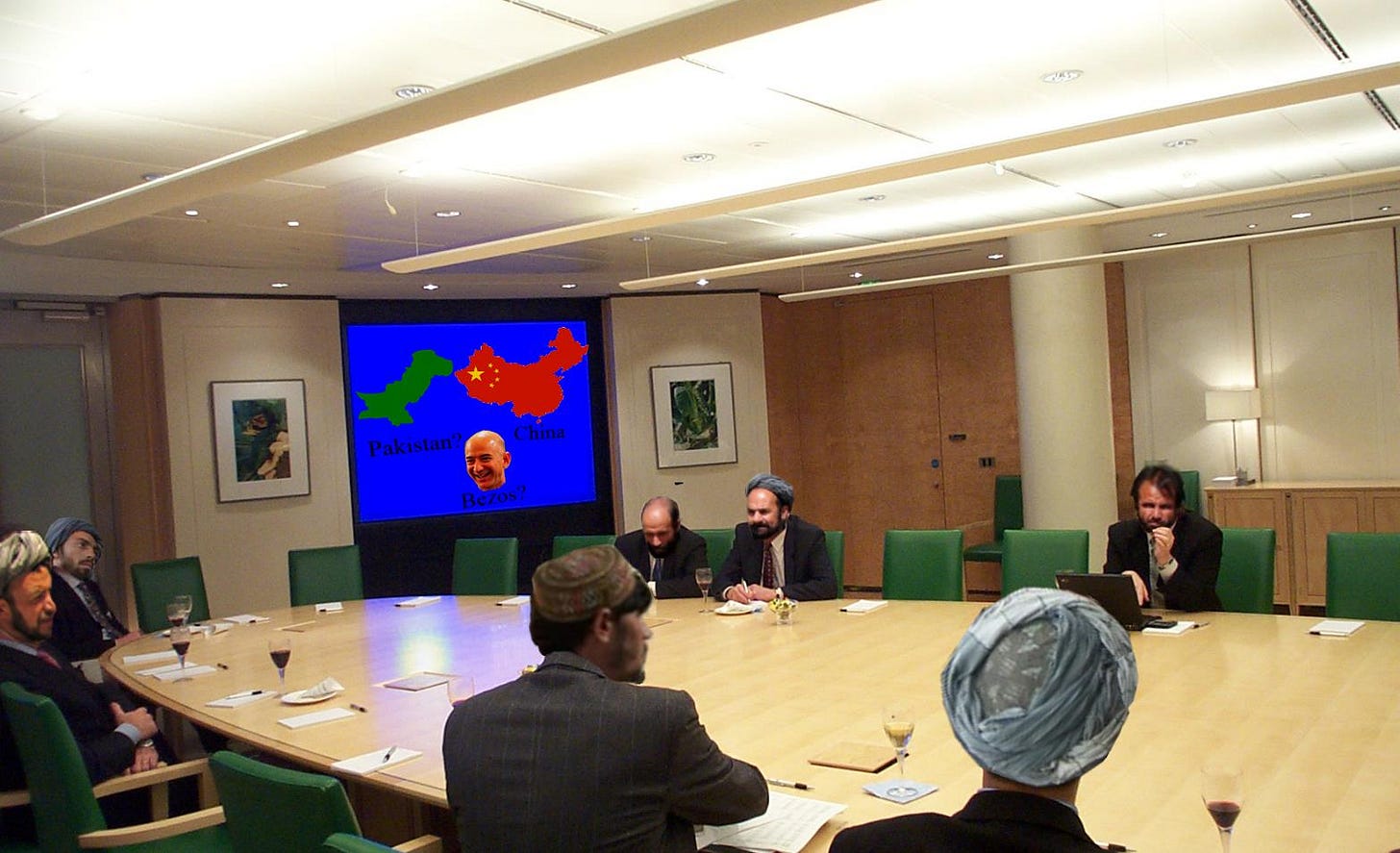
AFGHANISTAN — Nonprofit organization the Taliban called an emergency Board of Directors meeting earlier this week after its largest donor the United States of America pulled all financial support, sources say.

“Ladies and gentlemen, I appreciate the great work you’ve all been doing, but I would not have called you here if the circumstances were anything less than dire,” said Taliban leader Hibatullah Akhundzada. “Pretty much our entire budget was reliant on Uncle Sam, and we need to find some new sources of cash flow ASAP.”

The Taliban said it will be able to continue operating for a few months on donations from individual opium traffickers and through extortion and assassination-related fundraising drives, but it won’t be able to thrive in the long run without finding another superpower with deep pockets and very little accountability to invade Afghanistan. 

Akhundzada said the Board also considered raising money through online crowdfunding campaigns, but “the American bastards took the internet when they left, too.”

A few financiers, including neighboring country Pakistan and billionaire Jeff Bezos, have expressed interest in invading, but neither could guarantee the inept leadership or incoherent strategy the U.S. provided. The Taliban has found that generating leads in an economic environment racked by COVID-19 can be difficult, especially since it gutted and/or beheaded most of its fundraising department over the past few years.

“Most of our best lead generators blew themselves up back in 2009 or 2010,” said Akhundzada. “Others have left to take chic jobs with ISIS or al-Qaeda. It’s becoming harder and harder to find good people to join your terrorist organization.”

Despite its uncertain future, the Taliban remains confident it will find another superpower to invade Afghanistan before its financial situation becomes fatal.

“If history proves anything,” said Akhundzada, “it’s that there’s always someone dumb enough to invade Afghanistan.”

Cat Astronaut is a demobilized mobile infantryman and the creator of Ye Olde Tyme News. Like or Rock or Something contributed to reporting.

Will there be blood?

Simon Watkins explains some oil realities: https://oilprice.com/Energy/Energy-General/The-Real-Reason-Oil-Prices-Arent-At-80.html

The Real Reason Oil Prices Aren’t At $80

By Simon Watkins – Jul 21, 2021, 8:00 PM CDTTrade Oil Futures And Energy Stocks

The UAE’s awarding last week of a slew of huge drilling contracts aimed at increasing its crude oil output capacity from around 4 million barrels per day (bpd) to 5 million bpd underlines that the principal market risk from an oil trader’s perspective is still skewed towards further supply against a backdrop of an uneven bounce back in demand following the height of the global COVID-19 crisis in 2020.

In the short- and medium-term, significant supply increases are likely to come from ongoing failures in the OPEC decision and implementation structure, and in the longer term from a potential flood of new crude from Iran in the official oil markets and increases from non-OPEC crude producers.

This trader-centric view is the basic reason that, despite the huge recent buying in the crude oil market by some leading investment banks and their fund manager clients (and their frantic bidding of oil on dips) with a view to hitting the much-vaunted US$80 per barrel point, crude has failed to meaningfully threaten that level or the once-steady US$100 per barrel price that prevailed for years before the Saudis launched the 2014-2016 Oil Price War.

This inability to threaten these key price levels is also a function of the political reality that, however much the supposedly environmentally-friendly U.S. President Joe Biden might, in theory, be happy to see oil prices go higher to narrow the retail pricing discrepancy between it and more ‘green energy’ alternatives, in the cold light of political reality the fact remains that he is acutely aware of how damaging for any presidency such a price rise would be.  As was very clearly demonstrated under the government of former President Donald Trump – but pertains to all U.S. presidencies of recent years – the top person in the White House does not, in general, want oil prices on the higher side. The economic reason for this is that for every US$0.01 that the U.S.’s national average price of gasoline rises, more than US$1 billion per year in discretionary additional consumer spending is estimated to be lost.

As a general historical rule of thumb, it is estimated that every US$10 per barrel change in the price of crude oil results in a US$0.25 change in the price of a gallon of gasoline. Based on more recent historical precedent, a US$90-95 per barrel of Brent oil price equates to around US$3 per gallon of gasoline and a US$125-130 per barrel of Brent equates to around US$4 per gallon of gasoline. The ‘danger zone’ for U.S. presidents starts at around US$3.00 per gallon and at US$4.00 per gallon they are being advised to pack their bags in Pennsylvania Avenue or start a war to divert the public’s attention. The point was underlined by Bob McNally, the former energy adviser to the former President George W. Bush that: “Few things terrify an American president more than a spike in fuel [gasoline] prices.” 

Related: Can The Airline Industry Live Without Fossil Fuels?This is the key reason why an unofficial White House oil price cap of around US$75-80 per barrel of Brent has operated since the end of the 2014-2016 Oil Price War. On the only notable occasion when the Brent crude oil price rose significantly above the US$70 per barrel level for any sustained period and looked like threatening the cap – in the second half of 2018, with the Saudis ramping up prices in concert with Russia – President Trump sent the first threatening message in a speech aimed at the Saudis.

The message made clear that in the U.S.’s view Saudi Arabia was contravening the foundation 1945 agreement on Bitter Lake between Roosevelt and Abdulaziz and, therefore, put at risk the U.S. support of the Al-Saud ruling family as the monarchy of Saudi Arabia. This came shortly after a similar comment from Trump in a speech before the U.N. General Assembly: “OPEC and OPEC nations are, as usual, ripping off the rest of the world, and I don’t like it. Nobody should like it,” he said. “We defend many of these nations for nothing, and then they take advantage of us by giving us high oil prices. Not good. We want them to stop raising prices. We want them to start lowering prices and they must contribute substantially to military protection from now on.”

Oil’s inability to break these key levels is also a significant reason why the U.S. shale oil sector producers and their Wall Street backers are under no government pressure to ramp up production right now. If Brent crude oil started to rise decisively above the US$80 per barrel level for a sustained period and looked like it was heading for US$90-100 per barrel, though, this status quo would likely change very quickly. At the same time, huge pressure would be brought to bear by the White House on Saudi Arabia and the rest of the OPEC producers to increase production and lower oil prices, as has been highlighted repeatedly by OilPrice.com.

Aside from the domestic political reasons why the U.S. government is happy to accommodate a big increase in the UAE’s crude oil output capacity in a relatively short time, the Emirates’ ambition also aligns perfectly with Washington’s new policy in the Middle East as a whole, which began with the ‘relationship normalization’ deals forged between the U.S., Israel and various Arab states in the last days of the presidency of Donald Trump.

In its most basic terms, this policy is aimed at engaging with anchor Arab states that are not already too tied into the rampant China-Russia-Iran power axis, whilst also trying to at least partially loosen the grip of Beijing and Moscow on Iran (and therefore Iraq). If the policy is successful – although the part of it relating to Iran and Iraq seems also certain to fail despite clearly being worth a try – the U.S. will also be able to further reduce any significant dependence on Saudi Arabia, at least whilst it is under the control of Crown Prince Mohammed bin Salman. In all eventualities, though, the UAE is vital to the U.S. plans, which is why it was one of the first countries to be approached for the normalized relations program. 

Related: Oil Dips After EIA Reports Crude Inventory Build

Since that point, the UAE has broadened and deepened its relationship with India – which the U.S. is sponsoring as the prime regional political and economic alternative to China – embarked on a huge economic expansion project (‘Operation 300 Billion’), established a new global benchmark trading platform for its oil (ICE Futures Abu Dhabi platform) in partnership with the U.S.-based Intercontinental Exchange, and begun to expand the Fujairah oil export hub as a counterpoint to Iran’s new Goreh-Jask oil export route.

More broadly, the UAE has also removed the previous impediments to the speedy realization of its oil ambitions by reorganizing its Supreme Petroleum Council and has increased its activities as part of a joint intelligence initiative between the UAE and Israel (and, by extension, the U.S.) of the purchase of commercial and adjunct residential properties in Iran’s southern Khuzestan province. The area is a vital hub for Iran’s oil and gas reserves and the influx of UAE-registered businesses, particularly those based in Abu Dhabi and Dubai, but in large part funded by Israel, provides a forward operating platform for various ongoing intelligence-gathering operations. Building on this, last month saw a landmark US$510 million deal with Italy’s Saipem to expand the capacity of the UAE’s flagship Shah Sour Gas Plant, which will ensure that the UAE becomes self-sufficient in gas. This is aimed at safeguarding it from any external pressure that might be brought upon it by the big gas powers in the region, notably Iran, were it to lack this self-sufficiency.

Exactly the same theme of major contracts being given to companies of countries supporting the U.S.’s new policy in the Middle East is seen in the awarding last week of US$764 million in drilling contracts aimed at boosting crude oil output to 5 million bpd as soon as possible on or before 2030.

The UAE’s principal oil firm, the Abu Dhabi National Oil Company (ADNOC), through its Offshore trading unit, awarded the contracts to U.S. companies Schlumberger, and Halliburton, in addition to its own ADNOC Drilling. The contracts will provide integrated rigless services across six of ADNOC Offshore’s artificial islands in the Upper Zakum and Satah Al Razboot fields, according to ADNOC. “These important awards for integrated rigless services will drive efficiencies of drilling and related services, and optimize costs in our offshore operations as we ramp up our drilling activities to increase our production capacity and enable gas self-sufficiency for the UAE,” concluded ADNOC Upstream’s executive director, Yaser Almazrouei, last week. 

”On the Historical Unity of Russians and Ukrainians“

Vladimir Putin, July 13, 2021

http://en.kremlin.ru/events/president/news/66181

During the recent Direct Line, when I was asked about Russian-Ukrainian relations, I said that Russians and Ukrainians were one people – a single whole. These words were not driven by some short-term considerations or prompted by the current political context. It is what I have said on numerous occasions and what I firmly believe. I therefore feel it necessary to explain my position in detail and share my assessments of today’s situation.

First of all, I would like to emphasize that the wall that has emerged in recent years between Russia and Ukraine, between the parts of what is essentially the same historical and spiritual space, to my mind is our great common misfortune and tragedy. These are, first and foremost, the consequences of our own mistakes made at different periods of time. But these are also the result of deliberate efforts by those forces that have always sought to undermine our unity. The formula they apply has been known from time immemorial – divide and rule. There is nothing new here. Hence the attempts to play on the ”national question“ and sow discord among people, the overarching goal being to divide and then to pit the parts of a single people against one another.

To have a better understanding of the present and look into the future, we need to turn to history. Certainly, it is impossible to cover in this article all the developments that have taken place over more than a thousand years. But I will focus on the key, pivotal moments that are important for us to remember, both in Russia and Ukraine.

Russians, Ukrainians, and Belarusians are all descendants of Ancient Rus, which was the largest state in Europe. Slavic and other tribes across the vast territory – from Ladoga, Novgorod, and Pskov to Kiev and Chernigov – were bound together by one language (which we now refer to as Old Russian), economic ties, the rule of the princes of the Rurik dynasty, and – after the baptism of Rus – the Orthodox faith. The spiritual choice made by St. Vladimir, who was both Prince of Novgorod and Grand Prince of Kiev, still largely determines our affinity today.

The throne of Kiev held a dominant position in Ancient Rus. This had been the custom since the late 9th century. The Tale of Bygone Years captured for posterity the words of Oleg the Prophet about Kiev, ”Let it be the mother of all Russian cities.“

Later, like other European states of that time, Ancient Rus faced a decline of central rule and fragmentation. At the same time, both the nobility and the common people perceived Rus as a common territory, as their homeland.

The fragmentation intensified after Batu Khan’s devastating invasion, which ravaged many cities, including Kiev. The northeastern part of Rus fell under the control of the Golden Horde but retained limited sovereignty. The southern and western Russian lands largely became part of the Grand Duchy of Lithuania, which – most significantly – was referred to in historical records as the Grand Duchy of Lithuania and Russia.

Members of the princely and ”boyar“ clans would change service from one prince to another, feuding with each other but also making friendships and alliances. Voivode Bobrok of Volyn and the sons of Grand Duke of Lithuania Algirdas – Andrey of Polotsk and Dmitry of Bryansk – fought next to Grand Duke Dmitry Ivanovich of Moscow on the Kulikovo field. At the same time, Grand Duke of Lithuania Jogaila – son of the Princess of Tver – led his troops to join with Mamai. These are all pages of our shared history, reflecting its complex and multi-dimensional nature.

Most importantly, people both in the western and eastern Russian lands spoke the same language. Their faith was Orthodox. Up to the middle of the 15th century, the unified church government remained in place.

At a new stage of historical development, both Lithuanian Rus and Moscow Rus could have become the points of attraction and consolidation of the territories of Ancient Rus. It so happened that Moscow became the center of reunification, continuing the tradition of ancient Russian statehood. Moscow princes – the descendants of Prince Alexander Nevsky – cast off the foreign yoke and began gathering the Russian lands.

In the Grand Duchy of Lithuania, other processes were unfolding. In the 14th century, Lithuania’s ruling elite converted to Catholicism. In the 16th century, it signed the Union of Lublin with the Kingdom of Poland to form the Polish–Lithuanian Commonwealth. The Polish Catholic nobility received considerable land holdings and privileges in the territory of Rus. In accordance with the 1596 Union of Brest, part of the western Russian Orthodox clergy submitted to the authority of the Pope. The process of Polonization and Latinization began, ousting Orthodoxy.

As a consequence, in the 16–17th centuries, the liberation movement of the Orthodox population was gaining strength in the Dnieper region. The events during the times of Hetman Bohdan Khmelnytsky became a turning point. His supporters struggled for autonomy from the Polish–Lithuanian Commonwealth.

In its 1649 appeal to the king of the Polish–Lithuanian Commonwealth, the Zaporizhian Host demanded that the rights of the Russian Orthodox population be respected, that the voivode of Kiev be Russian and of Greek faith, and that the persecution of the churches of God be stopped. But the Cossacks were not heard.

Bohdan Khmelnytsky then made appeals to Moscow, which were considered by the Zemsky Sobor. On 1 October 1653, members of the supreme representative body of the Russian state decided to support their brothers in faith and take them under patronage. In January 1654, the Pereyaslav Council confirmed that decision. Subsequently, the ambassadors of Bohdan Khmelnytsky and Moscow visited dozens of cities, including Kiev, whose populations swore allegiance to the Russian tsar. Incidentally, nothing of the kind happened at the conclusion of the Union of Lublin.

In a letter to Moscow in 1654, Bohdan Khmelnytsky thanked Tsar Aleksey Mikhaylovich for taking ”the whole Zaporizhian Host and the whole Russian Orthodox world under the strong and high hand of the Tsar“. It means that, in their appeals to both the Polish king and the Russian tsar, the Cossacks referred to and defined themselves as Russian Orthodox people.

Over the course of the protracted war between the Russian state and the Polish–Lithuanian Commonwealth, some of the hetmans, successors of Bohdan Khmelnytsky, would ”detach themselves“ from Moscow or seek support from Sweden, Poland, or Turkey. But, again, for the people, that was a war of liberation. It ended with the Truce of Andrusovo in 1667. The final outcome was sealed by the Treaty of Perpetual Peace in 1686. The Russian state incorporated the city of Kiev and the lands on the left bank of the Dnieper River, including Poltava region, Chernigov region, and Zaporozhye. Their inhabitants were reunited with the main part of the Russian Orthodox people. These territories were referred to as ”Malorossia“ (Little Russia).

The name ”Ukraine“ was used more often in the meaning of the Old Russian word ”okraina“ (periphery), which is found in written sources from the 12th century, referring to various border territories. And the word ”Ukrainian“, judging by archival documents, originally referred to frontier guards who protected the external borders.

On the right bank, which remained under the Polish–Lithuanian Commonwealth, the old orders were restored, and social and religious oppression intensified. On the contrary, the lands on the left bank, taken under the protection of the unified state, saw rapid development. People from the other bank of the Dnieper moved here en masse. They sought support from people who spoke the same language and had the same faith.

During the Great Northern War with Sweden, the people in Malorossia were not faced with a choice of whom to side with. Only a small portion of the Cossacks supported Mazepa’s rebellion. People of all orders and degrees considered themselves Russian and Orthodox.

Cossack senior officers belonging to the nobility would reach the heights of political, diplomatic, and military careers in Russia. Graduates of Kiev-Mohyla Academy played a leading role in church life. This was also the case during the Hetmanate – an essentially autonomous state formation with a special internal structure – and later in the Russian Empire. Malorussians in many ways helped build a big common country – its statehood, culture, and science. They participated in the exploration and development of the Urals, Siberia, the Caucasus, and the Far East. Incidentally, during the Soviet period, natives of Ukraine held major, including the highest, posts in the leadership of the unified state. Suffice it to say that Nikita Khrushchev and Leonid Brezhnev, whose party biography was most closely associated with Ukraine, led the Communist Party of the Soviet Union (CPSU) for almost 30 years.

In the second half of the 18th century, following the wars with the Ottoman Empire, Russia incorporated Crimea and the lands of the Black Sea region, which became known as Novorossiya. They were populated by people from all of the Russian provinces. After the partitions of the Polish-Lithuanian Commonwealth, the Russian Empire regained the western Old Russian lands, with the exception of Galicia and Transcarpathia, which became part of the Austrian – and later Austro-Hungarian – Empire.

The incorporation of the western Russian lands into the single state was not merely the result of political and diplomatic decisions. It was underlain by the common faith, shared cultural traditions, and – I would like to emphasize it once again – language similarity. Thus, as early as the beginning of the 17th century, one of the hierarchs of the Uniate Church, Joseph Rutsky, communicated to Rome that people in Moscovia called Russians from the Polish-Lithuanian Commonwealth their brothers, that their written language was absolutely identical, and differences in the vernacular were insignificant. He drew an analogy with the residents of Rome and Bergamo. These are, as we know, the center and the north of modern Italy.

Many centuries of fragmentation and living within different states naturally brought about regional language peculiarities, resulting in the emergence of dialects. The vernacular enriched the literary language. Ivan Kotlyarevsky, Grigory Skovoroda, and Taras Shevchenko played a huge role here. Their works are our common literary and cultural heritage. Taras Shevchenko wrote poetry in the Ukrainian language, and prose mainly in Russian. The books of Nikolay Gogol, a Russian patriot and native of Poltavshchyna, are written in Russian, bristling with Malorussian folk sayings and motifs. How can this heritage be divided between Russia and Ukraine? And why do it?

The south-western lands of the Russian Empire, Malorussia and Novorossiya, and the Crimea developed as ethnically and religiously diverse entities. Crimean Tatars, Armenians, Greeks, Jews, Karaites, Krymchaks, Bulgarians, Poles, Serbs, Germans, and other peoples lived here. They all preserved their faith, traditions, and customs.

I am not going to idealise anything. We do know there were the Valuev Circular of 1863 an then the Ems Ukaz of 1876, which restricted the publication and importation of religious and socio-political literature in the Ukrainian language. But it is important to be mindful of the historical context. These decisions were taken against the backdrop of dramatic events in Poland and the desire of the leaders of the Polish national movement to exploit the ”Ukrainian issue“ to their own advantage. I should add that works of fiction, books of Ukrainian poetry and folk songs continued to be published. There is objective evidence that the Russian Empire was witnessing an active process of development of the Malorussian cultural identity within the greater Russian nation, which united the Velikorussians, the Malorussians and the Belorussians.

At the same time, the idea of Ukrainian people as a nation separate from the Russians started to form and gain ground among the Polish elite and a part of the Malorussian intelligentsia. Since there was no historical basis – and could not have been any, conclusions were substantiated by all sorts of concoctions, which went as far as to claim that the Ukrainians are the true Slavs and the Russians, the Muscovites, are not. Such ”hypotheses“ became increasingly used for political purposes as a tool of rivalry between European states.

Since the late 19th century, the Austro-Hungarian authorities had latched onto this narrative, using it as a counterbalance to the Polish national movement and pro-Muscovite sentiments in Galicia. During World War I, Vienna played a role in the formation of the so-called Legion of Ukrainian Sich Riflemen. Galicians suspected of sympathies with Orthodox Christianity and Russia were subjected to brutal repression and thrown into the concentration camps of Thalerhof and Terezin.

Further developments had to do with the collapse of European empires, the fierce civil war that broke out across the vast territory of the former Russian Empire, and foreign intervention.

After the February Revolution, in March 1917, the Central Rada was established in Kiev, intended to become the organ of supreme power. In November 1917, in its Third Universal, it declared the creation of the Ukrainian People’s Republic (UPR) as part of Russia.

In December 1917, UPR representatives arrived in Brest-Litovsk, where Soviet Russia was negotiating with Germany and its allies. At a meeting on 10 January 1918, the head of the Ukrainian delegation read out a note proclaiming the independence of Ukraine. Subsequently, the Central Rada proclaimed Ukraine independent in its Fourth Universal.

The declared sovereignty did not last long. Just a few weeks later, Rada delegates signed a separate treaty with the German bloc countries. Germany and Austria-Hungary were at the time in a dire situation and needed Ukrainian bread and raw materials. In order to secure large-scale supplies, they obtained consent for sending their troops and technical staff to the UPR. In fact, this was used as a pretext for occupation.

For those who have today given up the full control of Ukraine to external forces, it would be instructive to remember that, back in 1918, such a decision proved fatal for the ruling regime in Kiev. With the direct involvement of the occupying forces, the Central Rada was overthrown and Hetman Pavlo Skoropadskyi was brought to power, proclaiming instead of the UPR the Ukrainian State, which was essentially under German protectorate.

In November 1918 – following the revolutionary events in Germany and Austria-Hungary – Pavlo Skoropadskyi, who had lost the support of German bayonets, took a different course, declaring that ”Ukraine is to take the lead in the formation of an All-Russian Federation“. However, the regime was soon changed again. It was now the time of the so-called Directorate.

In autumn 1918, Ukrainian nationalists proclaimed the West Ukrainian People’s Republic (WUPR) and, in January 1919, announced its unification with the Ukrainian People’s Republic. In July 1919, Ukrainian forces were crushed by Polish troops, and the territory of the former WUPR came under the Polish rule.

In April 1920, Symon Petliura (portrayed as one of the ”heroes“ in today’s Ukraine) concluded secret conventions on behalf of the UPR Directorate, giving up – in exchange for military support – Galicia and Western Volhynia lands to Poland. In May 1920, Petliurites entered Kiev in a convoy of Polish military units. But not for long. As early as November 1920, following a truce between Poland and Soviet Russia, the remnants of Petliura’s forces surrendered to those same Poles.

The example of the UPR shows that different kinds of quasi-state formations that emerged across the former Russian Empire at the time of the Civil War and turbulence were inherently unstable. Nationalists sought to create their own independent states, while leaders of the White movement advocated indivisible Russia. Many of the republics established by the Bolsheviks’ supporters did not see themselves outside Russia either. Nevertheless, Bolshevik Party leaders sometimes basically drove them out of Soviet Russia for various reasons.

Thus, in early 1918, the Donetsk-Krivoy Rog Soviet Republic was proclaimed and asked Moscow to incorporate it into Soviet Russia. This was met with a refusal. During a meeting with the republic’s leaders, Vladimir Lenin insisted that they act as part of Soviet Ukraine. On 15 March 1918, the Central Committee of the Russian Communist Party (Bolsheviks) directly ordered that delegates be sent to the Ukrainian Congress of Soviets, including from the Donetsk Basin, and that ”one government for all of Ukraine“ be created at the congress. The territories of the Donetsk-Krivoy Rog Soviet Republic later formed most of the regions of south-eastern Ukraine.

Under the 1921 Treaty of Riga, concluded between the Russian SFSR, the Ukrainian SSR and Poland, the western lands of the former Russian Empire were ceded to Poland. In the interwar period, the Polish government pursued an active resettlement policy, seeking to change the ethnic composition of the Eastern Borderlands – the Polish name for what is now Western Ukraine, Western Belarus and parts of Lithuania. The areas were subjected to harsh Polonisation, local culture and traditions suppressed. Later, during World War II, radical groups of Ukrainian nationalists used this as a pretext for terror not only against Polish, but also against Jewish and Russian populations.

In 1922, when the USSR was created, with the Ukrainian Soviet Socialist Republic becoming one of its founders, a rather fierce debate among the Bolshevik leaders resulted in the implementation of Lenin’s plan to form a union state as a federation of equal republics. The right for the republics to freely secede from the Union was included in the text of the Declaration on the Creation of the Union of Soviet Socialist Republics and, subsequently, in the 1924 USSR Constitution. By doing so, the authors planted in the foundation of our statehood the most dangerous time bomb, which exploded the moment the safety mechanism provided by the leading role of the CPSU was gone, the party itself collapsing from within. A ”parade of sovereignties“ followed. On 8 December 1991, the so-called Belovezh Agreement on the Creation of the Commonwealth of Independent States was signed, stating that ”the USSR as a subject of international law and a geopolitical reality no longer existed.“ By the way, Ukraine never signed or ratified the CIS Charter adopted back in 1993.

In the 1920’s-1930’s, the Bolsheviks actively promoted the ”localization policy“, which took the form of Ukrainization in the Ukrainian SSR. Symbolically, as part of this policy and with consent of the Soviet authorities, Mikhail Grushevskiy, former chairman of Central Rada, one of the ideologists of Ukrainian nationalism, who at a certain period of time had been supported by Austria-Hungary, was returned to the USSR and was elected member of the Academy of Sciences.

The localization policy undoubtedly played a major role in the development and consolidation of the Ukrainian culture, language and identity. At the same time, under the guise of combating the so-called Russian great-power chauvinism, Ukrainization was often imposed on those who did not see themselves as Ukrainians. This Soviet national policy secured at the state level the provision on three separate Slavic peoples: Russian, Ukrainian and Belorussian, instead of the large Russian nation, a triune people comprising Velikorussians, Malorussians and Belorussians.

In 1939, the USSR regained the lands earlier seized by Poland. A major portion of these became part of the Soviet Ukraine. In 1940, the Ukrainian SSR incorporated part of Bessarabia, which had been occupied by Romania since 1918, as well as Northern Bukovina. In 1948, Zmeyiniy Island (Snake Island) in the Black Sea became part of Ukraine. In 1954, the Crimean Region of the RSFSR was given to the Ukrainian SSR, in gross violation of legal norms that were in force at the time.

I would like to dwell on the destiny of Carpathian Ruthenia, which became part of Czechoslovakia following the breakup of Austria-Hungary. Rusins made up a considerable share of local population. While this is hardly mentioned any longer, after the liberation of Transcarpathia by Soviet troops the congress of the Orthodox population of the region voted for the inclusion of Carpathian Ruthenia in the RSFSR or, as a separate Carpathian republic, in the USSR proper. Yet the choice of people was ignored. In summer 1945, the historical act of the reunification of Carpathian Ukraine ”with its ancient motherland, Ukraine“ – as The Pravda newspaper put it – was announced.

Therefore, modern Ukraine is entirely the product of the Soviet era. We know and remember well that it was shaped – for a significant part – on the lands of historical Russia. To make sure of that, it is enough to look at the boundaries of the lands reunited with the Russian state in the 17th century and the territory of the Ukrainian SSR when it left the Soviet Union.

The Bolsheviks treated the Russian people as inexhaustible material for their social experiments. They dreamt of a world revolution that would wipe out national states. That is why they were so generous in drawing borders and bestowing territorial gifts. It is no longer important what exactly the idea of the Bolshevik leaders who were chopping the country into pieces was. We can disagree about minor details, background and logics behind certain decisions. One fact is crystal clear: Russia was robbed, indeed.

When working on this article, I relied on open-source documents that contain well-known facts rather than on some secret records. The leaders of modern Ukraine and their external ”patrons“ prefer to overlook these facts. They do not miss a chance, however, both inside the country and abroad, to condemn ”the crimes of the Soviet regime,“ listing among them events with which neither the CPSU, nor the USSR, let alone modern Russia, have anything to do. At the same time, the Bolsheviks’ efforts to detach from Russia its historical territories are not considered a crime. And we know why: if they brought about the weakening of Russia, our ill-wishes are happy with that.

Of course, inside the USSR, borders between republics were never seen as state borders; they were nominal within a single country, which, while featuring all the attributes of a federation, was highly centralized – this, again, was secured by the CPSU’s leading role. But in 1991, all those territories, and, which is more important, people, found themselves abroad overnight, taken away, this time indeed, from their historical motherland.

What can be said to this? Things change: countries and communities are no exception. Of course, some part of a people in the process of its development, influenced by a number of reasons and historical circumstances, can become aware of itself as a separate nation at a certain moment. How should we treat that? There is only one answer: with respect!

You want to establish a state of your own: you are welcome! But what are the terms? I will recall the assessment given by one of the most prominent political figures of new Russia, first mayor of Saint Petersburg Anatoly Sobchak. As a legal expert who believed that every decision must be legitimate, in 1992, he shared the following opinion: the republics that were founders of the Union, having denounced the 1922 Union Treaty, must return to the boundaries they had had before joining the Soviet Union. All other territorial acquisitions are subject to discussion, negotiations, given that the ground has been revoked.

In other words, when you leave, take what you brought with you. This logic is hard to refute. I will just say that the Bolsheviks had embarked on reshaping boundaries even before the Soviet Union, manipulating with territories to their liking, in disregard of people’s views.

The Russian Federation recognized the new geopolitical realities: and not only recognized, but, indeed, did a lot for Ukraine to establish itself as an independent country. Throughout the difficult 1990’s and in the new millennium, we have provided considerable support to Ukraine. Whatever ”political arithmetic“ of its own Kiev may wish to apply, in 1991–2013, Ukraine’s budget savings amounted to more than USD 82 billion, while today, it holds on to the mere USD 1.5 billion of Russian payments for gas transit to Europe. If economic ties between our countries had been retained, Ukraine would enjoy the benefit of tens of billions of dollars.

Ukraine and Russia have developed as a single economic system over decades and centuries. The profound cooperation we had 30 years ago is an example for the European Union to look up to. We are natural complementary economic partners. Such a close relationship can strengthen competitive advantages, increasing the potential of both countries.

Ukraine used to possess great potential, which included powerful infrastructure, gas transportation system, advanced shipbuilding, aviation, rocket and instrument engineering industries, as well as world-class scientific, design and engineering schools. Taking over this legacy and declaring independence, Ukrainian leaders promised that the Ukrainian economy would be one of the leading ones and the standard of living would be among the best in Europe.

Today, high-tech industrial giants that were once the pride of Ukraine and the entire Union, are sinking. Engineering output has dropped by 42 per cent over ten years. The scale of deindustrialization and overall economic degradation is visible in Ukraine’s electricity production, which has seen a nearly two-time decrease in 30 years. Finally, according to IMF reports, in 2019, before the coronavirus pandemic broke out, Ukraine’s GDP per capita had been below USD 4 thousand. This is less than in the Republic of Albania, the Republic of Moldova, or unrecognized Kosovo. Nowadays, Ukraine is Europe’s poorest country.

Who is to blame for this? Is it the people of Ukraine’s fault? Certainly not. It was the Ukrainian authorities who waisted and frittered away the achievements of many generations. We know how hardworking and talented the people of Ukraine are. They can achieve success and outstanding results with perseverance and determination. And these qualities, as well as their openness, innate optimism and hospitality have not gone. The feelings of millions of people who treat Russia not just well but with great affection, just as we feel about Ukraine, remain the same.

Until 2014, hundreds of agreements and joint projects were aimed at developing our economies, business and cultural ties, strengthening security, and solving common social and environmental problems. They brought tangible benefits to people – both in Russia and Ukraine. This is what we believed to be most important. And that is why we had a fruitful interaction with all, I emphasize, with all the leaders of Ukraine.

Even after the events in Kiev of 2014, I charged the Russian government to elaborate options for preserving and maintaining our economic ties within relevant ministries and agencies. However, there was and is still no mutual will to do the same. Nevertheless, Russia is still one of Ukraine’s top three trading partners, and hundreds of thousands of Ukrainians are coming to us to work, and they find a welcome reception and support. So that what the ”aggressor state“ is.

When the USSR collapsed, many people in Russia and Ukraine sincerely believed and assumed that our close cultural, spiritual and economic ties would certainly last, as would the commonality of our people, who had always had a sense of unity at their core. However, events – at first gradually, and then more rapidly – started to move in a different direction.

In essence, Ukraine’s ruling circles decided to justify their country’s independence through the denial of its past, however, except for border issues. They began to mythologize and rewrite history, edit out everything that united us, and refer to the period when Ukraine was part of the Russian Empire and the Soviet Union as an occupation. The common tragedy of collectivization and famine of the early 1930s was portrayed as the genocide of the Ukrainian people.

Radicals and neo-Nazis were open and more and more insolent about their ambitions. They were indulged by both the official authorities and local oligarchs, who robbed the people of Ukraine and kept their stolen money in Western banks, ready to sell their motherland for the sake of preserving their capital. To this should be added the persistent weakness of state institutions and the position of a willing hostage to someone else’s geopolitical will.

I recall that long ago, well before 2014, the U.S. and EU countries systematically and consistently pushed Ukraine to curtail and limit economic cooperation with Russia. We, as the largest trade and economic partner of Ukraine, suggested discussing the emerging problems in the Ukraine-Russia-EU format. But every time we were told that Russia had nothing to do with it and that the issue concerned only the EU and Ukraine. De facto Western countries rejected Russia’s repeated calls for dialogue.

Step by step, Ukraine was dragged into a dangerous geopolitical game aimed at turning Ukraine into a barrier between Europe and Russia, a springboard against Russia. Inevitably, there came a time when the concept of ”Ukraine is not Russia“ was no longer an option. There was a need for the ”anti-Russia“ concept which we will never accept.

The owners of this project took as a basis the old groundwork of the Polish-Austrian ideologists to create an ”anti-Moscow Russia“. And there is no need to deceive anyone that this is being done in the interests of the people of Ukraine. The Polish-Lithuanian Commonwealth never needed Ukrainian culture, much less Cossack autonomy. In Austria-Hungary, historical Russian lands were mercilessly exploited and remained the poorest. The Nazis, abetted by collaborators from the OUN-UPA, did not need Ukraine, but a living space and slaves for Aryan overlords.

Nor were the interests of the Ukrainian people thought of in February 2014. The legitimate public discontent, caused by acute socio-economic problems, mistakes, and inconsistent actions of the authorities of the time, was simply cynically exploited. Western countries directly interfered in Ukraine’s internal affairs and supported the coup. Radical nationalist groups served as its battering ram. Their slogans, ideology, and blatant aggressive Russophobia have to a large extent become defining elements of state policy in Ukraine.

All the things that united us and bring us together so far came under attack. First and foremost, the Russian language. Let me remind you that the new ”Maidan“ authorities first tried to repeal the law on state language policy. Then there was the law on the ”purification of power“, the law on education that virtually cut the Russian language out of the educational process.

Lastly, as early as May of this year, the current president introduced a bill on ”indigenous peoples“ to the Rada. Only those who constitute an ethnic minority and do not have their own state entity outside Ukraine are recognized as indigenous. The law has been passed. New seeds of discord have been sown. And this is happening in a country, as I have already noted, that is very complex in terms of its territorial, national and linguistic composition, and its history of formation.

There may be an argument: if you are talking about a single large nation, a triune nation, then what difference does it make who people consider themselves to be – Russians, Ukrainians, or Belarusians. I completely agree with this. Especially since the determination of nationality, particularly in mixed families, is the right of every individual, free to make his or her own choice.

But the fact is that the situation in Ukraine today is completely different because it involves a forced change of identity. And the most despicable thing is that the Russians in Ukraine are being forced not only to deny their roots, generations of their ancestors but also to believe that Russia is their enemy. It would not be an exaggeration to say that the path of forced assimilation, the formation of an ethnically pure Ukrainian state, aggressive towards Russia, is comparable in its consequences to the use of weapons of mass destruction against us. As a result of such a harsh and artificial division of Russians and Ukrainians, the Russian people in all may decrease by hundreds of thousands or even millions.

Our spiritual unity has also been attacked. As in the days of the Grand Duchy of Lithuania, a new ecclesiastical has been initiated. The secular authorities, making no secret of their political aims, have blatantly interfered in church life and brought things to a split, to the seizure of churches, the beating of priests and monks. Even extensive autonomy of the Ukrainian Orthodox Church while maintaining spiritual unity with the Moscow Patriarchate strongly displeases them. They have to destroy this prominent and centuries-old symbol of our kinship at all costs.

I think it is also natural that the representatives of Ukraine over and over again vote against the UN General Assembly resolution condemning the glorification of Nazism. Marches and torchlit processions in honor of remaining war criminals from the SS units take place under the protection of the official authorities. Mazepa, who betrayed everyone, Petliura, who paid for Polish patronage with Ukrainian lands, and Bandera, who collaborated with the Nazis, are ranked as national heroes. Everything is being done to erase from the memory of young generations the names of genuine patriots and victors, who have always been the pride of Ukraine.

For the Ukrainians who fought in the Red Army, in partisan units, the Great Patriotic War was indeed a patriotic war because they were defending their home, their great common Motherland. Over two thousand soldiers became Heroes of the Soviet Union. Among them are legendary pilot Ivan Kozhedub, fearless sniper, defender of Odessa and Sevastopol Lyudmila Pavlichenko, valiant guerrilla commander Sidor Kovpak. This indomitable generation fought, those people gave their lives for our future, for us. To forget their feat is to betray our grandfathers, mothers and fathers.

The anti-Russia project has been rejected by millions of Ukrainians. The people of Crimea and residents of Sevastopol made their historic choice. And people in the southeast peacefully tried to defend their stance. Yet, all of them, including children, were labeled as separatists and terrorists. They were threatened with ethnic cleansing and the use of military force. And the residents of Donetsk and Lugansk took up arms to defend their home, their language and their lives. Were they left any other choice after the riots that swept through the cities of Ukraine, after the horror and tragedy of 2 May 2014 in Odessa where Ukrainian neo-Nazis burned people alive making a new Khatyn out of it? The same massacre was ready to be carried out by the followers of Bandera in Crimea, Sevastopol, Donetsk and Lugansk. Even now they do not abandon such plans. They are biding their time. But their time will not come.

The coup d’état and the subsequent actions of the Kiev authorities inevitably provoked confrontation and civil war. The UN High Commissioner for Human Rights estimates that the total number of victims in the conflict in Donbas has exceeded 13,000. Among them are the elderly and children. These are terrible, irreparable losses.

Russia has done everything to stop fratricide. The Minsk agreements aimed at a peaceful settlement of the conflict in Donbas have been concluded. I am convinced that they still have no alternative. In any case, no one has withdrawn their signatures from the Minsk Package of Measures or from the relevant statements by the leaders of the Normandy format countries. No one has initiated a review of the United Nations Security Council resolution of 17 February 2015.

During official negotiations, especially after being reined in by Western partners, Ukraine’s representatives regularly declare their ”full adherence“ to the Minsk agreements, but are in fact guided by a position of ”unacceptability“. They do not intend to seriously discuss either the special status of Donbas or safeguards for the people living there. They prefer to exploit the image of the ”victim of external aggression“ and peddle Russophobia. They arrange bloody provocations in Donbas. In short, they attract the attention of external patrons and masters by all means.

Apparently, and I am becoming more and more convinced of this: Kiev simply does not need Donbas. Why? Because, firstly, the inhabitants of these regions will never accept the order that they have tried and are trying to impose by force, blockade and threats. And secondly, the outcome of both Minsk‑1 and Minsk‑2 which give a real chance to peacefully restore the territorial integrity of Ukraine by coming to an agreement directly with the DPR and LPR with Russia, Germany and France as mediators, contradicts the entire logic of the anti-Russia project. And it can only be sustained by the constant cultivation of the image of an internal and external enemy. And I would add – under the protection and control of the Western powers.

This is what is actually happening. First of all, we are facing the creation of a climate of fear in Ukrainian society, aggressive rhetoric, indulging neo-Nazis and militarising the country. Along with that we are witnessing not just complete dependence but direct external control, including the supervision of the Ukrainian authorities, security services and armed forces by foreign advisers, military ”development“ of the territory of Ukraine and deployment of NATO infrastructure. It is no coincidence that the aforementioned flagrant law on ”indigenous peoples“ was adopted under the cover of large-scale NATO exercises in Ukraine.

This is also a disguise for the takeover of the rest of the Ukrainian economy and the exploitation of its natural resources. The sale of agricultural land is not far off, and it is obvious who will buy it up. From time to time, Ukraine is indeed given financial resources and loans, but under their own conditions and pursuing their own interests, with preferences and benefits for Western companies. By the way, who will pay these debts back? Apparently, it is assumed that this will have to be done not only by today’s generation of Ukrainians but also by their children, grandchildren and probably great-grandchildren.

The Western authors of the anti-Russia project set up the Ukrainian political system in such a way that presidents, members of parliament and ministers would change but the attitude of separation from and enmity with Russia would remain. Reaching peace was the main election slogan of the incumbent president. He came to power with this. The promises turned out to be lies. Nothing has changed. And in some ways the situation in Ukraine and around Donbas has even degenerated.

In the anti-Russia project, there is no place either for a sovereign Ukraine or for the political forces that are trying to defend its real independence. Those who talk about reconciliation in Ukrainian society, about dialogue, about finding a way out of the current impasse are labelled as ”pro-Russian“ agents.

Again, for many people in Ukraine, the anti-Russia project is simply unacceptable. And there are millions of such people. But they are not allowed to raise their heads. They have had their legal opportunity to defend their point of view in fact taken away from them. They are intimidated, driven underground. Not only are they persecuted for their convictions, for the spoken word, for the open expression of their position, but they are also killed. Murderers, as a rule, go unpunished.

Today, the ”right“ patriot of Ukraine is only the one who hates Russia. Moreover, the entire Ukrainian statehood, as we understand it, is proposed to be further built exclusively on this idea. Hate and anger, as world history has repeatedly proved this, are a very shaky foundation for sovereignty, fraught with many serious risks and dire consequences.

All the subterfuges associated with the anti-Russia project are clear to us. And we will never allow our historical territories and people close to us living there to be used against Russia. And to those who will undertake such an attempt, I would like to say that this way they will destroy their own country.

The incumbent authorities in Ukraine like to refer to Western experience, seeing it as a model to follow. Just have a look at how Austria and Germany, the USA and Canada live next to each other. Close in ethnic composition, culture, in fact sharing one language, they remain sovereign states with their own interests, with their own foreign policy. But this does not prevent them from the closest integration or allied relations. They have very conditional, transparent borders. And when crossing them the citizens feel at home. They create families, study, work, do business. Incidentally, so do millions of those born in Ukraine who now live in Russia. We see them as our own close people.

Russia is open to dialogue with Ukraine and ready to discuss the most complex issues. But it is important for us to understand that our partner is defending its national interests but not serving someone else’s, and is not a tool in someone else’s hands to fight against us.

We respect the Ukrainian language and traditions. We respect Ukrainians’ desire to see their country free, safe and prosperous.

I am confident that true sovereignty of Ukraine is possible only in partnership with Russia. Our spiritual, human and civilizational ties formed for centuries and have their origins in the same sources, they have been hardened by common trials, achievements and victories. Our kinship has been transmitted from generation to generation. It is in the hearts and the memory of people living in modern Russia and Ukraine, in the blood ties that unite millions of our families. Together we have always been and will be many times stronger and more successful. For we are one people.

Today, these words may be perceived by some people with hostility. They can be interpreted in many possible ways. Yet, many people will hear me. And I will say one thing – Russia has never been and will never be ”anti-Ukraine“. And what Ukraine will be – it is up to its citizens to decide.

Peak Powell?

GPC721213.png

Yesterday, Powell committed to his personal “full employment” plan by signing onto to the Sock Puppet’s Regime’s inflation program, locking in his renomination as Chairman of the monetary politburo (see https://www.bloomberg.com/news/articles/2021-07-21/powell-has-broad-support-among-top-biden-aides-for-new-fed-term).

Translation – no tapering anytime in the next 5 years.

In lockstep with the Wizard of Oz’s decision, the NYFed executed a celebratory market manipulation (red rectangle in the chart below) – literally levitating markets 39 points higher on, well, no discernable signal.

GPC72221.png

When the NYFed’s thumb lifted late morning as everyone went to lunch, stocks traded sideways for the remainder of the session.

GPC722212.png

What happens next?

Well, here’s the market v. the 20-dma and the PPO(1, 20, 1).

GPC721212.png

The PPO tells us every time stocks have been this far above the 20-dma, they will eventually revert.

In the meantime, seems like a sideways move for the foreseeable future.

“TED’s Dead, Baby. TED’s Dead”

The gospel according to Tim Knight: https://slopeofhope.com/2021/07/smashed.html

Just in case any of you with mortgages and other interest-bearing debt are worried about rates, I’d say this is not a situation that is going to change anytime in our natural lives.

And, while we’re on the subject, here’s the IMF on the corrosive effect firm market power has on monetary policy effectiveness: https://www.imf.org/en/Publications/WP/Issues/2021/07/09/Market-Power-and-Monetary-Policy-Transmission-461332