For better or for worse, recall it was intervening in the American Revolution that tipped the French monarchy into the Revolution, the Terror and Napolean.
It was the American Civil War that introduced central banking and elastic currencies into the US.
It was the income tax and the Federal Reserve that fueled the rise of the national government, gutted the currency, and dispatched conscripted armies into overseas adventures.
It was the Great War that drove Czarist Russia into 70 years of Soviet oppression, Germany into the arms of National Socialism, and set the stage for the horrors of Second World War and everything that followed.
It was the Vietnam War and LBJ’s “Guns and Butter” that led to Nixon closing the gold window, and the debauching dollar.
War and national states are unhealthy to peace and prosperity.
Here’s Mish:
Daylight Robbery
In Daylight Robbery, Dominic Frisby takes you on a whirlwind journey through the history of taxation, from ancient Mesopotamia to the present day.
From the French Revolution to the great wars of the Twentieth Century, and somewhere underneath you will find a tax story. Wars are made possible by taxes.
In a world on the brink of revolution and revolt, Frisby argues governments need to radically change who they tax and how if they are to survive.
Book Excerpts
Tax is power. Whether king, emperor or government, if they lose their tax revenue, they lose their power. This rule has always applied, from the first king of ancient Sumer to the social democracies of today.
Every war, from ancient Mesopotamia to modern Iraq, was paid for by some kind of tax. Taxes make wars possible. If you want to end war, end taxes.
The aim of every conqueror, from Alexander the Great to Napoleon and beyond, was to take control of the tax base : the land, the labour, the produce and the profits. Conquerors plunder and then they tax. ‘ Taxes are the chief business of a conqueror of the world,’ said George Bernard Shaw ’s Caesar.
‘No taxation without representation ’ was the cry of the American revolutionaries. Ruinous taxes levied by the tsar against peasant farmers led to the Russian Revolution. Perhaps most explicitly of all, the Philippine Revolution began with the Cry of Pugad Lawin, exhorting rebels to tear up their tax certificates. From Spartacus to Boudicca to Robin Hood to Mahatma Gandhi, the greatest rebels in history were usually tax rebels. History looks different when viewed through this lens of taxation.
Rulers have a long history of justifying taxes on moral grounds. Former Chancellor George Osborne ’s sugar taxes were introduced not for the good of government coffers, but for the good of your health. French president Emmanuel Macron imposed fuel taxes for the good of the climate. The spin is apparent even in the language of tax – a tax is your ‘ duty ’, your ‘ tribute ’, your ‘ due ’
In 1187 when the great Kurdish leader Saladin annihilated the armies of the Crusaders and took Jerusalem, the Christian cause was shaken to its core. There must be a new crusade, said the kings of England and France, and to pay for it Henry II levied a special tithe, the Saladin tithe. It was a 10% tax on revenues and movable properties, with special exemptions for the ‘ arms, horses and garments of knights ’ and the ‘ horses, books, garments and vestments, and all appurtenances of whatever sort used by clerks in divine service ’. Everyone else paid – though if you joined the crusade you were exempted, which proved an extremely effective recruiting tool.
War Costs Money
The greater the war, the greater the tax burden. The second World War gave the world even higher taxes. President Franklin D. Roosevelt said, ‘ War costs money.’
The real cost of war is perpetual debt.
Seeking to indoctrinate people about how to pay their taxes and to reduce public resentment following World War II, Secretary of the Treasury Henry Morgenthau Jr commissioned Walt Disney to make a film. It was called The New Spirit and Donald Duck was cast as the star.
The US turned to other entertainers in its mission to promote the payment of tax not just as a patriotic duty but also as a joy. Irving Berlin wrote a song, which Gene Autry sang: ‘I Paid My Income Tax Today’.
Inflation is Taxation by Another Means
Like debt, inflation may not be an official tax, but that does not mean it does not exist. Indeed, it is often deliberately propagated, and its effect is the same : it confiscates wealth from one group and transfers it to another – from the salaried or the saver to the state, from creditor to debtor, from employee to employer. It is ‘ a particularly vicious form of taxation ’, said economist Henry Hazlitt.
Milton Friedman was equally damning: ‘ It is a hidden tax that at first appears painless or even pleasant . . . It is a tax that can be imposed without specific legislation. It is truly taxation without representation.
Frisby claims war is mass murder funded by theft and that conscription is the moral equivalent of kidnapping.
Care to disagree? Then read the book.
Tax reform is one of the few ways by which politicians really can change the world.
How the Book Started
In addition to being an economic writer, Frisby is a stand-up comedian. His book started life in 2016 as a comedy show at the Edinburgh Festival called Let ’s Talk About Tax.
Comedy gave way to a serious endeavor that took years to write.
Overlooked History
There is a tax story , often an overlooked one, somewhere near the heart of almost all of humanity ’s defining events.
British inventor Michael Faraday explained electricity and the discoveries he had made about it to the Chancellor of the Exchequer, William Gladstone.‘
But, after all, what use is it ? ’ Gladstone asked petulantly. Faraday ’s response was immediate: ‘Why, sir, there is every probability that you will soon be able to tax it.
Jesus was only born in Bethlehem because Mary and Joseph were there to pay tax. And in 2017, Microsoft founder Bill Gates declared the robot that takes your job should pay taxes.
Get the book. It’s educational and fun. You will enjoy it.
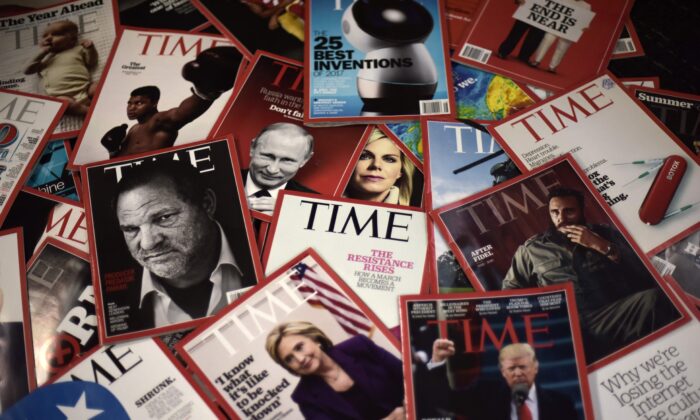
In a surprisingly brazen article, “The Secret History of the Shadow Campaign That Saved the 2020 Election,” Time magazine chronicles a myriad of pre- and post-election actions taken by a loose coalition of Democratic operatives, grassroots activists, mainstream media, tech companies, and corporate CEOs before and after the 2020 presidential election.
According to the article, the effort consisted of “a well-funded cabal of powerful people, ranging across industries and ideologies, working together behind the scenes to influence perceptions, change rules and laws, steer media coverage and control the flow of information.”
In the post-election days, the author refers to this disparate grouping of players as a “conspiracy unfolding behind the scenes, one that both curtailed the protests and coordinated the resistance from CEOs” resulting in an “informal alliance between left-wing activists and business titans.”
Although the words “cabal” and “conspiracy” are used to describe the sweeping activities of these groups, collectively referred to as the “Shadow Campaign,” the article’s author takes pains to note that these efforts weren’t aimed at “rigging the election; they were fortifying it.”
Indeed, throughout the article, there is the repeated claim that these efforts were made not with the intention of subverting the election, but rather as part of a heroic grassroots movement intent on salvaging our democracy and preserving the integrity of this and future elections.
“The scenario the shadow campaigners were desperate to stop was not a Trump victory. It was an election so calamitous that no result could be discerned at all, a failure of the central act of democratic self-governance that has been a hallmark of America since its founding,” the article reads.
Although the article treats the actions taken by this “Shadow Campaign” as necessary steps toward saving our democracy, a more objective reader of events might make the case that our democracy was actually trampled underfoot.
According to the players in this saga, the perceived threat to our democracy was so consequential that it would require “an effort of unprecedented scale” and a measure of cooperation heretofore not seen during an election process. And one that would encompass a surprisingly broad coalition of interests that would include “Congress, Silicon Valley and the nation’s statehouses.”
As the article notes, the efforts of this cabal “touched every aspect of the election,” including our election laws. These groups engaged in a unified legal front to “change voting systems and laws” at the state level, often unconstitutionally bypassing state legislatures and shifting power to the states’ governors in the process. Conservative efforts to fight against this process were euphemistically termed as “voter-suppression lawsuits.”
The terminology and framing of issues bring us to a peculiar characteristic of the article. It’s written as though 75 million Trump voters simply don’t exist—as though a nation was somehow wholly united against a self-imposed second term of a Trump presidency. There is no acknowledgment that President Donald Trump enjoyed support from a large segment of the population. When the term “voters” is used, it’s always in reference to those who were voting against Trump and for Biden.
Other than a few short paragraphs, the reader could be forgiven for thinking the election was ever even in question.
While an intense focus on the Trump campaign is present in the article, there’s an almost surprising lack of discussion regarding the Biden campaign. As the article states, the Shadow Campaign was “separate from the Biden campaign and crossed ideological lines.” Indeed, Biden is mentioned in the article only a handful of times and never in direct relation to anything he or his campaign was doing to prepare for the election.
Media Framing, Online Efforts and Tech Companies
In tandem with the focus on Trump, there is another almost unifying theme of gaslighting that traces its way throughout the article. Any activity, position, or response from conservatives or the Trump administration was automatically labeled and then framed as inherently nefarious, even villainous. Meanwhile, a notion of false nobility was attached to every action taken by the left.
Pre-election warnings from the Trump campaign “and his henchmen” on the risks from an unprecedented shift to mail-in ballots were, according to the article, designed to “spoil the election.” Conservative legal pushback against the unconstitutional changes to state election law was termed as “spurious.” Despite being the legal instigators, the article stated that “Democratic lawyers battled a historic tide of pre-election litigation.”
Meanwhile, information from the right was repeatedly deemed to be “Trump’s lies,” “conspiracy theories” or “Bad actors spreading false information.” According to the article, these efforts, along with “the involvement of foreign meddlers made disinformation a broader, deeper threat to the 2020 vote.”
By contrast, when leftist organizations such as the Voting Rights Lab and IntoAction created “state-specific memes and graphics” designed to claim that mail-in voting was safe and not subject to fraud, their actions were framed as “battling bad information.” Nor was this any small effort. As the article notes, these memes and graphics were “widely disseminated by email, text, Twitter, Facebook, Instagram and TikTok” and were viewed “more than 1 billion times.”
Another focus of this campaign was to convince the public that election results would be delayed, perhaps for a number of days. These efforts were designed to condition the voting public to not expect, or even accept, an outcome on election night. As the article notes, the “organization’s tracking polls found the message was being heard: the percentage of the public that didn’t expect to know the winner on election night gradually rose until by late October, it was over 70 percent. A majority also believed that a prolonged count wasn’t a sign of problems.”
Perceptions and information are crucial in an election, and in recognition of this, Democratic operatives “successfully pressured social media companies” in advance of the election. These efforts were largely successful as large numbers of conservative accounts were deplatformed and crucial stories that might injure the Biden campaign were suppressed, while the media relentlessly attacked the Trump campaign.
While acknowledging the involvement of technology companies in the effort, the article portrays the resulting suppression of information and conservative deplatforming in a positive light. When stories such as the ones regarding Hunter Biden’s business activities in China were dismissed or simply not covered by the mainstream media, these tactics were labeled as taking a “harder line against disinformation” in an ongoing effort to “fight viral smears.”
There is a side question raised by the participation of the tech companies in online suppression. If accounts were deplatformed from places such as YouTube and Twitter purely for political ends, does this not raise the specter of a meaningful breach of fiduciary duty to the companies’ stockholders?
Mail-In Ballots and Shadow-Campaign Funding
These groups also engaged in large-scale “national public-awareness campaigns” designed to convince Americans that “the vote count would unfold over days or weeks” as an unprecedented number of mail-in ballots were systematically flooding into our electoral system.
With 100 million mail-in ballots sent out in an effort to get “millions of people to vote by mail for the first time,” the coalition recruited “armies of poll workers” to deal with the influx of absentee ballots. Large amounts of money would be required to deal with the processing, and, in preparation for this, the group “helped secure hundreds of millions in public and private funding.”
This money had two material sources. The first, surprisingly, came from the first round of COVID-relief packages in March 2020. As the article notes, activists lobbied Congress in March 2020, “seeking $2 billion in election funding.” This effort was led by the Leadership Conference on Civil and Human Rights.
Although the group didn’t get anywhere close to their lofty $2 billion goal, they were still wildly successful. When the CARES (Coronavirus Aid, Relief, and Economic Security) Act passed in March, it contained “$400 million in grants to state election administrators.”
From there, the informal group turned to private funding for additional sources; Silicon Valley tech companies were the primary focus. According to the Time article, an “assortment of foundations contributed tens of millions in election-administration funding. The Chan Zuckerberg Initiative chipped in $300 million.”
These contributions were framed as an effort to fill “funding gaps” left by the federal government, while ignoring that it was Democratic operatives who were pushing the mail-in vote efforts.
Indeed, focus groups were held by the Voter Participation Center (VPC), designed to “find out what would get people to vote by mail.” Several months later, the VPC would send out ballot applications to “15 million people in key states.” The group followed up with mailing campaigns and digital ads urging these targeted voters to “not wait for Election Day.”
These efforts were historically successful and transformative. As the article notes: “In the end, nearly half the electorate cast ballots by mail in 2020, practically a revolution in how people vote. About a quarter voted early in person. Only a quarter of voters cast their ballots the traditional way: in person on Election Day.”
The Left’s Control of the Mobs
There are several material admissions made in the article, not the least being that the left actually did control the activities of groups such as Antifa, Black Lives Matter, and others that rioted throughout the election year. As the article notes, “Many of those organizers were part of [Mike] Podhorzer’s network,” the man credited in Time’s article as being “The Architect” of the entire election effort.
The article notes that more than 150 liberal groups joined the “Protect the Results” coalition and stated that “the group’s now-defunct website had a map listing 400 planned post-election demonstrations, to be activated via text message as soon as Nov. 4. To stop the coup they feared, the left was ready to flood the streets.”
There’s another unspoken admission here as well. The trigger for the pre-planned riots was a Biden loss, not a “stolen election.” Or said another way, the left would determine what comprised a stolen election only by its outcome.
This matter was further highlighted in a recounting of election night events after Fox News called Arizona for Biden. Angela Peoples, director for the Democracy Defense Coalition, told Time, “We wanted to be mindful of when was the right time to call for moving masses of people into the street.”
But after Fox called Arizona for Biden, a decision was made to “stand down.” As Podhorzer noted: “They had spent so much time getting ready to hit the streets on Wednesday. But they did it … there was not a single Antifa vs. Proud Boys incident.”
In other words, Podhorzer and his crew effectively controlled the actions of Antifa and Black Lives Matter—if not completely, then at the very least during these critical moments and days.
The Importance of Fox’s Arizona Call
The description surrounding election night, while short, is telling and raises further questions. Despite the overall tone of the article, it seems clear that Democrats thought they had lost the election in the later hours of Nov. 3, 2020:
“Election night began with many Democrats despairing. Trump was running ahead of pre-election polling, winning Florida, Ohio, and Texas easily and keeping Michigan, Wisconsin, and Pennsylvania too close to call.”
According to the article, the “liberal alliance gathered for an 11 p.m. Zoom call. Hundreds joined; many were freaking out.” While Podhorzer was speaking, Fox News “surprised everyone by calling Arizona for Biden.”
The Fox News call changed everything. As the article put it, “The public-awareness campaign had worked: TV anchors were bending over backward to counsel caution and frame the vote count accurately. The question then became what to do next.”
There is another related item of note as well. Podhorzer was sharing his data regarding a “Blue Shift”—the term used to describe a late surge in Democrat votes from mail-in voting—with “media organizations who would be calling the election.”
One analyst, described as a “member of a major network’s political unit who spoke with Podhorzer before Election Day” told Time that having access to Podhorzer’s data and being able to “document how big the absentee wave would be and the variance by state was essential.”
Arnon Mishkin, an outside contractor and a Democrat, was the individual at Fox who reportedly made the call on Arizona at 11:20 p.m. New York time. According to one report, “No announcement was made until anchor Bill Hemmer, reviewing the latest status of an electoral map that was looking positive for Trump, glanced at the southwest, where the decision desk had left its yellow check mark on Arizona awarding the state to Biden.”
After making his call on Arizona, Mishkin stated that Trump was “likely to only get about 44% of the outstanding votes that are there.” Mishkin was wrong. Trump got a significantly higher percentage of the remaining votes, and although the Arizona call ultimately stood, it was far closer than Mishkin had forecast. Indeed, there’s currently a parallel audit underway in Maricopa County, Arizona’s most populous county.
Post-Election Impact
While voters on the right protested in seemingly unorganized groups, the left appeared to be far more prepared. At roughly 10 p.m. local time on election night, a bus carrying Republican election observers arrived at Detroit’s TCF Center. The article provides a rather biased description, stating that Republican observers “were crowding the vote-counting tables, refusing to wear masks, heckling the mostly Black workers.”
When the Republican observers arrived, Art Reyes III, leader of ‘We the People Michigan,’ “sent word to his network.”
“Within 45 minutes, dozens of reinforcements had arrived. As they entered the arena to provide a counterweight to the GOP observers inside, Reyes took down their cell-phone numbers and added them to a massive text chain.”
Election boards were another “pressure point.” Activists called “attention to the racial implications of disenfranchising Black Detroiters. They flooded the Wayne County canvassing board’s Nov. 17 certification meeting with on-message testimony.” Detroit’s vote was certified by the Republican board members.
Finally, the pressure on state legislatures was intense. On Nov. 20, Trump invited the Republican leaders of the Michigan legislature to the White House. According to the article, a “full-court press” was launched by the left and “Protect Democracy’s local contacts researched the lawmakers’ personal and political motives.”
Reyes’s activists rallied at departure and arrival terminals for the Republican state lawmakers’ trip to Washington, D.C.
The final step in certifying the Michigan vote was a vote from the state canvassing board, which was composed of two Republicans and two Democrats. “Reyes’s activists flooded the livestream and filled Twitter with their hashtag, #alleyesonmi. A board accustomed to attendance in the single digits suddenly faced an audience of thousands.”
The vote was certified 3–0, with one Republican abstaining.
Shadow Campaign Wants You to Know
The in-your-face detailing of events in the Time article leads to one somewhat alarming conclusion. The leaders of the Shadow Campaign want you to know what they did. Whether this stems from hubris or a position of power isn’t entirely clear, but there are some important people who were willing to contribute to this article. And to be openly quoted.
In addition to Podhorzer, Norman Eisen is quoted at several points in the article. In addition to recruiting members for the Voter Protection Program, Eisen is one of the architects and authors of two Brookings Reports that were written during the Mueller investigation.
Eisen, a senior fellow at Brookings, served as White House special counsel for ethics and government reform under President Barack Obama and is the founder of CREW (Citizens for Responsibility and Ethics in Washington). Eisen, according to his Brookings profile page, advised Obama “on lobbying regulation, campaign finance law, and open government issues.” He also served as the ambassador to the Czech Republic from 2011 to 2014.
Eisen and Berke were later retained by House Judiciary Committee Chairman Jerry Nadler (D-N.Y.) on a consulting basis as special oversight counsels to the Democratic majority staff.
As Nadler noted in an announcement, the two men had a particular focus on reviewing Mueller’s investigation and would advise the committee. It also appears Nadler intended for the two lawyers to question Attorney General William Barr, who ultimately declined to attend the hearing—leading to a Democratic vote to hold Barr in contempt.
Ill-Fated Jan. 6 Rally
On Jan. 6, thousands of Trump supporters came to Washington for what would be an ill-fated rally, culminating in an assault on the Capitol building. The fallout from this event would be severe and the full effect has yet to be determined.
The new administration, along with many in Congress, appear to making domestic terrorism threats a top priority. Biden’s newly installed U.S. Homeland Security chief Alejandro Mayorkas has stated publicly that “one of the greatest threats that we face currently on our homeland … is the threat of domestic terrorism.”
Despite the expectations of many, there didn’t appear to be a material presence of counter-demonstrators from the left at the Jan. 6 rally.
The author of the Time article appears to have been in continued contact with members of the Shadow Campaign, including Podhorzer, the group’s “architect.” On the morning of Jan. 6, she said Podhorzer had texted her, noting that the activist left was “strenuously discouraging counter activity.”
His message concluded with a “crossed-fingers emoji.”
No, this market is really not behaving that much differently from the one that led to the February 2020 top. Back then of course the Fed too was printing running their Repo program having cut rates three times already, now of course printing still $120B a month with rates at zero following the balance blow out to $7.4 trillion.
Numbers aside the structure of the broader market is behaving very similarly to last year, hence it is noteworthy that some of the signals are also virtually the same, in fact suggesting a signal fire of warnings is under way.
For one note the new highs on a negative divergence as in 2020:
Now that could just be temporary and if markets rally further the divergence could disappear. Yet note transports suddenly lagging, not making new highs while $SPX is, also very much like 2020:
Also notable, on the new highs here we see a similar program running with the $SPX components above their 50MA:
Nearly the same readings compared to January/February 2020 with lower readings versus new index highs. Weird. Same time frame, same behavior, same program.
In February 2020 these highs ultimately gave way to the now long forgotten 35% crash. Crashes are extremely rare, but corrections still do happen, the severity of course dependent on a number of factors, the relevance of which usually only become apparent after the fact.
Yet despite all the similarities there are also important differences to note compared to 2020.
For example, small caps are now at a record 40% extensions above their 200 day moving average and never before has the weekly chart seen such a steep disconnect from the weekly 50 moving average:
However there is no market history, none, that doesn’t see an eventual reconnect with the weekly 50MA, the question of course is the when and where. The moving average is by definition moving and is now trending higher. Just a standard/basic reconnect at this time would constitute a market crash as prices are so historically extended. And be clear: Reconnects can take quite some time to happen, but it’s rare for it not to happen for more than a year.
Bulls I suppose can take comfort in the history that extremes can become even more extreme as the tech sector showed in 2000:
So yes, extremes can become more extreme and hence the 4156 $SPX area remains a clear technical possibility for now.
If that’s the hill you want to die on go ahead for all chart history shows extreme extensions don’t last. Rebalancing will come and the severity of the rebalance is also driven by the extreme of the previous disconnect.
And that’s a critical point for there is yet another difference between now and 2020 and 2000 for that matter: Market cap to GDP now at 194.9% versus 158% in February 2020 and 150% in the year 2000.
Never have we seen markets this disconnected from the economy:
A rational bubble it’s been called because of the exorbitant amount of liquidity flowing through the system distorting everything.
Yet despite all this liquidity this market is behaving in a curious way. It is repeating the same behavior as it did last year before the crash. Except this year it is even more valued and more disconnected from technicals and fundamentals.
Last year the market topped February 19/20 and risk happened fast:
Don’t @ me saying I’m calling for a crash, I’m not. But a sizable correction remains very much overdue for this market that still appears impervious to all valuation concerns and remains among the most complacent markets in memory. In 2020 markets didn’t top until the later part of February. In 2000 markets didn’t top until March. 2021 has yet to show its hand.
But hey, maybe it’s different this time, although analyzing the charts above it appears that the more things change the more they stay the same.
Markets move 87% of price in only 11% of the time, that is both combined to the up side and the down side.
Within that 87 percentile markets either go UP or push SIDEWAYS 80% to 90% of the time.
This means rising or range bound markets represent the most common environment that traders will see throughout their trading career.
Downside corrections only represent ~15% of the 87% during which markets move the most. That leaves us with only about 11% of the time during which markets move significantly to the downside.
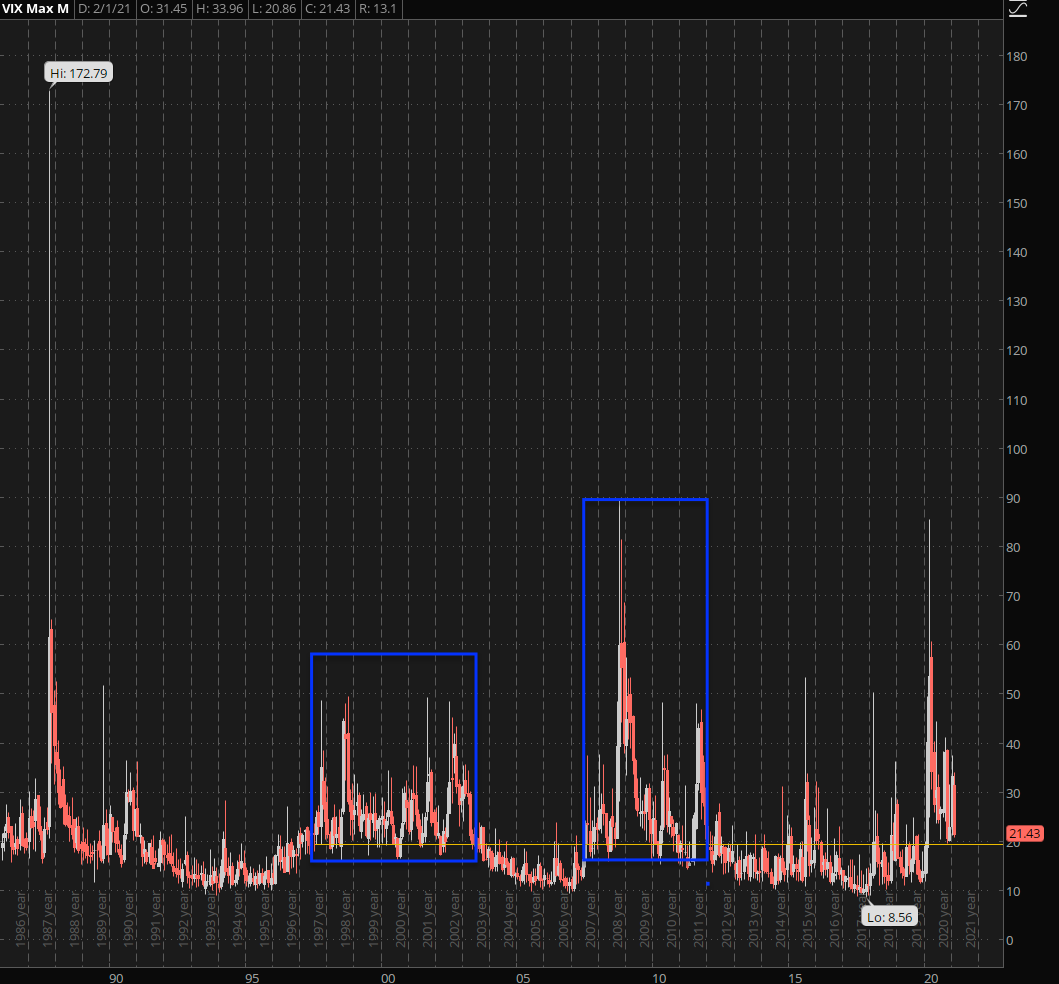
Volatility spikes usually beget more volatility which is shown by the multi-year plateaus I have highlighted on the chart. That’s however a topic for another day.
All these stats were present many years before the Federal Reserve jumped the QE shark, cut interest rates to zero, and pulled every conceivable trick in its considerable arsenal to bias the market to the upside.
The long term chart of the VIX I posted above makes the boring stats above abundantly clear. Although we are all idiots and our eyes are immediately drawn to the outliers you can see that the VIX spends most of its time churning in a relatively contained sideways range.
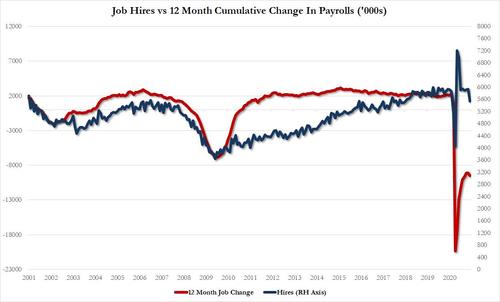
Meanwhile, after a positive month for hiring in November, when 5.935MM people were hired, in December the pace of hiring crashed, plunging to just 5.539MM, a drop of 396K for the month after a 23K increase in November. The coincides and validates the 227K drop in payrolls on December, the first contraction since April.
…
Hires decreased in accommodation and food services (-221,000); transportation, warehousing, and utilities (-133,000); and arts, entertainment, and recreation (-82,000). Hires increased in retail trade (+94,000). The number of hires in December (not seasonally adjusted) edged down over the year (-237,000). Hires decreased in accommodation and food services; arts, entertainment, and recreation; and educational services. Hires increased in a number of industries with the largest increases in wholesale trade, nondurable goods manufacturing, and durable goods manufacturing. The number of hires decreased in the West region.
While hires plunged, the number of total total separations was little changed at 5.5 million, and the total separations rate was little changed at 3.8 percent. The total separations level decreased in federal government (-86,000). Total separations increased in arts, entertainment, and recreation (+68,000). Also notable, 1,812,000 people were fired or laid off in Dec. vs 1,893,000 in Dec. last year, while an additional 362,000 people left their employer due to retirements, transfers to other locations, death, and separations due to disability.
The growing number of Western countries aiming for net-zero emissions by 2050 and the U.S. Administration’s drive to limit oil and gas extraction on federal land and waters are likely to benefit the biggest oil firms in Russia and Saudi oil giant Aramco, analysts and portfolio managers told Bloomberg.
While major developed economies are vowing to ‘build back greener,’ the world will still run on oil, and the beneficiaries, at least in the short term, will be the oil firms in countries that haven’t pledged net-zero targets and whose major oil companies are doubling down on oil production.
Ekaterina Iliouchenko, a money manager with Frankfurt-based Union Investment Privatfonds, told Bloomberg that while Big Oil, especially in Europe, vows to boost investment in renewables and streamline oil and gas operations, the world will still need to pump oil and “That’ll be the Russians and Saudi Aramco.”
Some investors have increased their exposure to Russian oil stocks, including in the biggest companies Rosneft and Lukoil, as they expect those companies to take advantage of the ‘greening’ elsewhere and double down on oil projects.
The recent major shift in U.S. oil policies with the new Administration could also play in the hands of Russian and Saudi oil, as it would eventually limit drilling on federal lands and waters once the current backlog of permits expires.
The U.S. oil industry, via the American Petroleum Institute (API), argues that the suspension of new drilling on federal lands and waters would undermine environmental progress as it would increase U.S. dependence on foreign oil imports from countries with lower environmental standards and replace oil produced with fewer emissions in the U.S. with higher-emission crude pumped elsewhere.
“With a stroke of a pen, the administration is shifting America’s bright energy future into reverse and setting us on a path toward greater reliance on foreign energy produced with lower environmental standards,” API President and CEO Mike Sommers said in a statement last month.
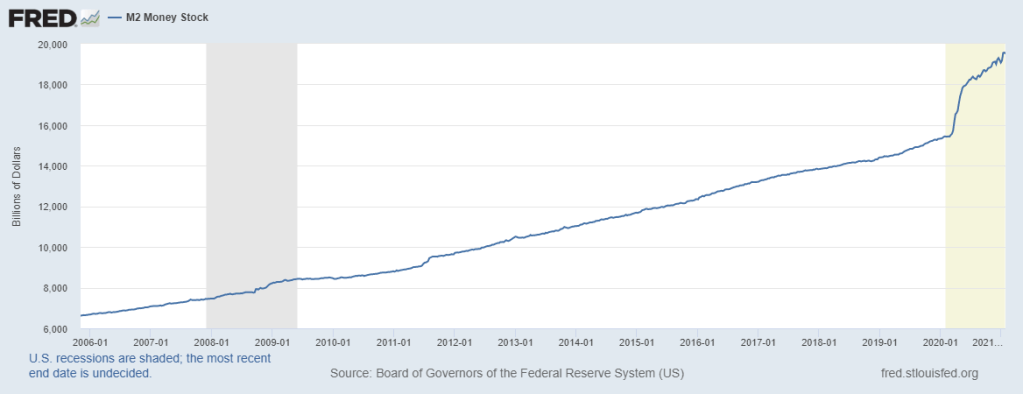
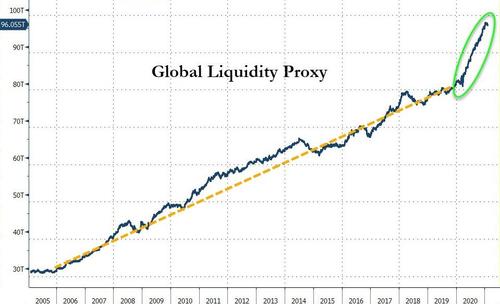
Combined, Americans saved about $2.9 trillion in 2020, more than doubling the previous record high of $1.2 trillion in 2018. As of the third quarter of 2020, the amount Americans held in checking accounts, savings accounts, time deposits, and money market funds was up $2.8 trillion from the year prior. Add another $1.9 trillion in federal government stimulus spending (borrowing from the future, to spend today) and the US is awash in cash, much of which is funded by Washington’s money printing.
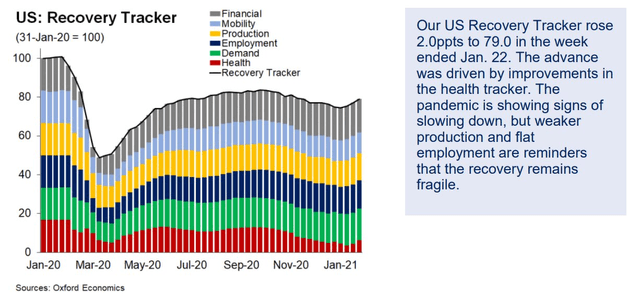
Unfortunately, in spite of a strong recovery in output, industrial production is 3.3% below pre-COVID levels, while real GDP is 2.5% below. In other words, demand is OK, it’s supply that’s still hurting – a perfect recipe for inflation.
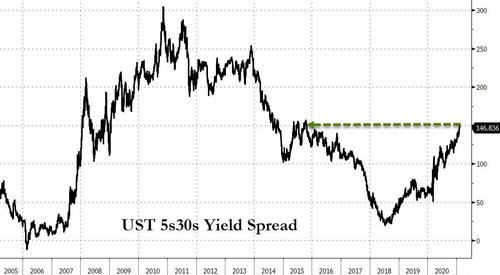
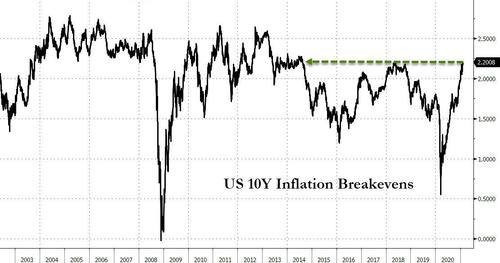
We can see the impact of this affecting markets. The 10-year Treasury yield has risen from roughly 0.6% in May 2020 to 1.2% today. The gap between the yield on the normal 10-year Treasury Note and the inflation-adjusted 10-year Treasury Note suggests investors expect an annual average increase of 2.2% in the consumer price index (CPI) in the next ten years, and those expectations are rising.
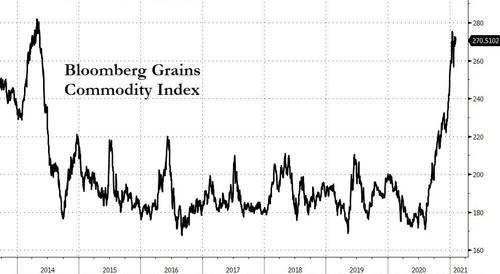
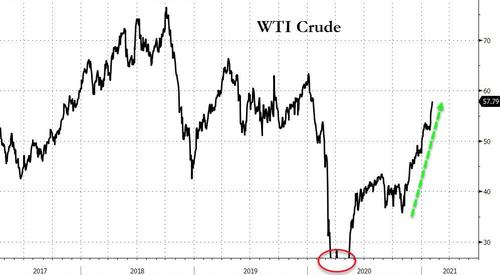
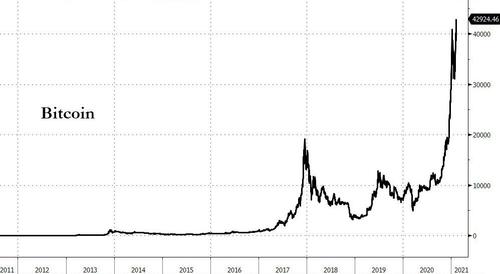
Bitcoin, while we doubt it will ever be real money, hit a record high today reflecting fears of lost dollar purchasing power. Commodity prices continue to surge.
All this money printing threatens to eventually create a sugar high in equities. We aren’t there yet, but markets are floating on a sea of new money. In fact, it’s more like a tsunami! Inflation hedges (real estate, commodities, materials companies) will do well. Traditional fixed income (long-term bonds) is at risk. The return of inflation because of misguided policy choices is a very real threat to the long-term health of the US economy.
And if that’s not clear enough, try this – Treasury curve is steepist since 2015
The 2020 US presidential elections wasn’t “rigged,” oh no, but “fortified” by a conspiracy of activists united in saving “Our Democracy” from the Bad Orange Man, now proud to share their story in a friendly tell-all piece in TIME.
“There was a conspiracy unfolding behind the scenes,” writes Molly Ball – a biographer of House Speaker Nancy Pelosi, by the way – in TIME magazine this week, describing it as a “vast, cross-partisan campaign to protect the election – an extraordinary shadow effort.”
Ball’s article reveals a lot, from why there were no street riots by Democrats either on November 4 or on January 6 – the organizers of this “conspiracy” stopped them – to who was behind the push to alter election rules in key states and set up mail-in voting, who organized “information” campaigns about the results of the election, and who even threatened election officials into making the “right” decision to certify the vote.
While everyone – myself included – was focused on the summer riots as a possible “color revolution,” they turned out to be misdirection. According to TIME, the real action was taking place behind the scenes, as Democrat activists and unions joined forces with NeverTrump Republicans, Chamber of Commerce, corporations, and Big Tech to make sure the 2020 election turns out the way they wanted. They call this a victory of democracy and the will of the people, of course, for no one is ever a villain in their own story.
In a few days, a trial will begin in the Senate of the United States to decide if the former President Donald J. Trump is guilty or not guilty of inciting an insurrection against the country he led for four years. It promises to be spellbinding. Millions will watch as the drama unfolds on national television, but if they would like an indication of what may transpire, they may avail themselves of volume 2 of Winston Churchill’s A History of the English-Speaking Peoples; and it would benefit Mr. Trump and his attorneys to do so.
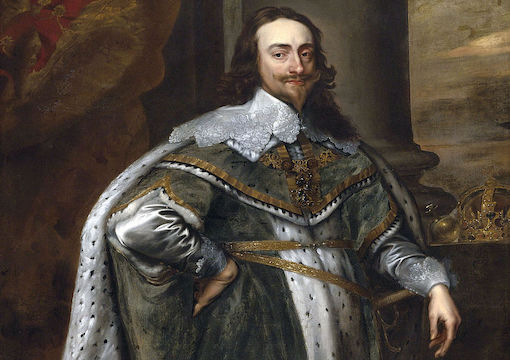
In 1649, Charles I, King of England, Scotland, France, and Ireland, after years of quarreling over what were the powers of the Crown versus the powers of the elected and unelected houses of Parliament, was defeated on the field of battle by an army organized by Parliament and commanded by Olivier Cromwell, a religious fanatic who wished to remake the world into a Reformationist utopia—by force if necessary. The King was arrested and brought to London under the charge of having incited and committed treason. There would be a trial.
Charles Stuart was an elegant man in both dress and speech. He sensed that this was not a judicial exercise but rather a theatrical piece designed for public consumption; though he could not prevent it, he would play his part by his script. When called before the “Court,” the King entered under armed escort. Dressed all in black to mirror the style of his enemies, the Puritans, the only color evident was the embroidered star of the Order of the Garter on his cape and the blue ribbon and medal of the Order about his neck. He regarded his “Judges” with disdain as the charges against him were read. When he was finally asked how he wished to answer the charges, the King knew his moment had come. “I would know by what power I am called hither, by what lawful authority?” he calmly replied.“They might possess evidence, they may even have a case, but they do not have the legal basis for the procedure.”
And there it was, the central question. The judges, called “Commissioners,” had expected the question, but they still held their breath when Charles spoke it aloud. They knew—that he knew—that there was no law permitting these proceedings. There was no law, no statute, no process, and no precedent; they were indeed making it up as they went along. And with only one utterance, the King had exposed their deceit. They responded that they were empowered by Parliament and that the King was answerable to Parliament. It was not true and still isn’t.
For each of the following three days the King refused to acknowledge the legality of the “Court”; he termed it “power without law.” The Commissioners could not dent his argument that this trial was a fiction, a political instrument being employed to fulfill a forgone conclusion. Some of them wavered, but Cromwell was there to steady them.
The rest, as they say, is history. Some may argue that this example is not applicable to the case against Donald John Trump: “He is not a King, and here, no man is above the law!” Just so. But no man is beneath the protection of the law, either. And if there is no law to punish his transgressions, what then?
Let us therefore look at the law contained in the U.S. Constitution regarding the impeachment of a President. Article I, Section 3, reads: “Judgement in cases of impeachment shall not extend further than to removal from office, and disqualification to hold and enjoy any office of honor, trust or profit under the United States.” Donald Trump is not President of the United States, he has already left office, he is a private citizen. There is no law that empowers Congress to prosecute a private citizen under the impeachment clause; though it may dearly wish that it existed, it may wish what it wishes—but it does not exist. They might possess evidence, they may even have a case, but they do not have the legal basis for the procedure. However, just as Cromwell’s Commissioners were committed to charging, trying, and condemning the King, there are many in Congress who are determined that this event will take place. The added fact that the Chief Justice of the Supreme Court of the United States has refused to preside over the trial as did the three Chief Justices of the Common Law courts of England in Charles’ time is of no consequence. It will happen, they are determined to do it, regardless of the fact that they have no legal right. And like the Parliamentary Commissioners, they do not care. It will be done. They will make it up as they go along. Their hatred of the individual in question is so great that they intend to pursue him into private life. It is, on its face, what Churchill termed a “monstrous illegality.”
And there is a greater, unspoken purpose for this trial.
It is to send a message, the same message that Parliament sent out with the condemnation and execution of Charles, and that message is that there is a new power in the land, namely: “If we can do this to the King, we can do this to you.” It sent then, and sends now, new instructions of obedience to the general populace: “We are in control, you are not; abide in your status.”
Charles Stuart knew that he was a condemned man the minute he walked into Westminster Hall and sat before his “Judges.” But he seized the essence of the issue at hand when he declared: “For if power without law may make laws, may alter fundamental laws of the kingdom I do not know what subject he is in England that can be sure of his life or anything he calls his own.”




 Econophysics2020