End of the American Republic

The Durham Report: https://www.justice.gov/storage/durhamreport.pdf

Key Takeaways:

  • “The FBI discounted or willfully ignored material information that did not support the narrative of a collusive relationship between Trump and Russia.”
  • Crossfire Hurricane “was opened as a full investigation without [the FBI] ever having spoken to the persons who provided that information.” Days after it was opened, Peter Strzok was telling a London FBI employee that “there’s nothing to this.”
  • Internal FBI communications discussing the Crossfire Hurricane during its early stages: it’s “thin” and “it sucks”.
  • British Intelligence pushed back on Mueller requests for assistance: “[a British Intelligence person] basically said there was no [expletive] way in hell they were going to do it.”
  • Durham documents TWO investigations into Hillary Clinton – one involving the Clinton Foundation and one involving illegal foreign contributions to Clinton’s Campaign.
  • In one Clinton Campaign investigation, an FBI confidential human source (CHS) had offered an illegal foreign contribution to the campaign through an intermediary. The Clinton Campaign was “okay with it” and “were fully aware”. The CHS offered the FBI a copy of the credit card charge; the FBI never got receipts. In fact, the FBI handling agent told the CHS “to stay away from all events relating to Clinton’s campaign.”

Here is Mark Wauck’s take: https://meaninginhistory.substack.com/p/bull-durham-master-of-the-bleeding

Bull Durham, Master Of The Bleeding Obvious: The Russia Hoax Really Was A Hoax

The Real Story: The US/UK Deep State And Their Political Enablers Got Away With This Hoax, And Got The Disastrous War On Russia That They Wanted. The Losers In All This? Look In The Mirror.

MARK WAUCK

MAY 15, 2023

So that’s the big news after all these years—the Russia Hoax really was a hoax. As if anyone with an IQ above room temperature ever doubted it. Here’s Zerohedge’s summary of this not-so-stunning revelation:

According to Just the Newsthe report concludes that the FBI had no verified intelligence or evidence when it opened up an investigation into Donald Trump and his campaign in the summer of 2016.

Durham placed blame on the FBI and DOJ for failing to follow their own standards in a probe which should have never taken place – including the agency’s surveillance of an American citizen without basis.

Let’s repeat that: The investigation should never have taken place simply because there was no reasonable basis for it. None. “No verified intelligence or evidence.” And this stuff was reviewed by the best legal minds the FBI and DoJ could come up with. Do you really think they were fooled into believing there was a reasonable basis? If you do, read the next two paragraphs.

“Based on the review of Crossfire Hurricane and related intelligence activities, we concluded the Department and the FBI failed to uphold their important mission of strict fidelity to the law in connection with certain events and activities described in this report,” wrote Durham.

“The FBI personnel also repeatedly disregarded important requirements when they continued to seek renewals of that FISA surveillance while acknowledging — both then and in hindsight — that they did not genuinely believe there was probable cause to believe that the target [Carter Page] was knowingly engaged in clandestine intelligence activities on behalf of foreign power.”

Let’s be totally clear about this. Durham’s bottom line conclusion was obvious from the very start—all the way back in the summer and fall of 2016. It almost makes me ill to think of the amount of time I spent beating this dead horse. It was always about “predication”—the requirement that investigative agencies of the federal government have some reasonable and articulable basis for believing that a criminal offense occurred before opening an investigation. That’s basic, and it’s the core issue before you even get to the probable cause requirements in FISA. I’m not going to go into this again. Anyone who wants to go over this again can just delve into past posts that I’ve pulled up by doing basic searches, like: predicationprobable causeFISACarter PageChristopher Steele, and any other searches you care to come up with. How could it take years for Bull Durham to come to such an obvious conclusion? Yeah, I know …

Trust me on this—everyone involved knew it was complete bullshit from the very start, just like Durham says. Here’s a tell on that from Techno Fog. While the Deep State, led by the FBI and DoJ, was targeting Trump based on their hoax, what were they doing about known serious violations by Hillary?

The FBI and DOJ restricted two investigations into Hillary Clinton during the 2016 election:

1) The Clinton Foundation investigation

2) Illegal foreign contributions to the Clinton Campaign

“No investigative activities occurred for months”

— Techno Fog (@Techno_Fog) May 15, 2023

According to an FBI CHS in early 2016, the Clinton Campaign was “fully aware” of and “ok with” a foreign contribution in violation of federal law.

The FBI agent didn’t get receipts – and asked the source to stay away from the Clinton campaign.

The FBI made “no effort” to investigate “the Clinton campaign’s acceptance of an illegal “campaign contribution that was made by the FBI’s own long-term CHS.”

The obvious conclusion is that the Deep State was determined to push the Russia Hoax on Trump and get it into the public consciousness, at the same time that they were determined to Deep Six any real information that could harm Hillary by revealing what she really is. How soon into their review do you think Durham and Barr realized this? Let’s be charitable and say, by the end of the first week. After all, Barr wrote that famous memo to Rosenstein saying as much.

Jonathan Turley is reviewing the 300 page non-bombshell report and will, no doubt, produce an article. In the meantime he has provided tweets as he proceeds throught he report. Here are what he see as five key points that the media should—but won’t—dig into:

(1) There was never a foundation for the launching of the Russian collusion investigation that occupied most of the Trump presidency.

(2) Salacious reports like the Moscow hotel tape appear to be entirely invented by the Steele team funded by the Clinton campaign.

(3) the Steele dossier was not only funded and pushed by the Clinton campaign, but General Counsel Marc Elias pushed the media campaign (and later refused to cooperate voluntarily with investigators).

(4) DOJ and FBI officials violated core departmental standards, including some [who had] … a “predisposition” to investigate Trump.

(5) [T]he lack of support and contradictions of these allegations were clear from the outset.

Again: From the start. They knew it was bullshit all along. Just as we all did. How did it take so long for Durham to write that report?

Turley gets into all the hypocrisy of the media and the mendacious, dishonest conduct of the FBI and DoJ—and please never, ever, forget the key enabling role of the DoJ. However, he cites two passages in the report that I want to take issue with:

Another notable line: “on July 26, 2016, Clinton allegedly approved a proposal from one of her foreign policy advisors [Jake Sullivan] to tie Trump to Russia as a means of distracting the public from her use of a private email server.”

Durham notes “Foreign Policy Advisor-1 [Jake Sullivan] stated, however, that it was possible that [Clinton] had proposed ideas on these topics to the campaign’s leadership, who may have approved those ideas.”

Please don’t buy into that narrative. The reality is that the emails and the server weren’t a significant campaign issue. The Deep State saw to that by the totally irregular means of having a RINO FBI Director decline prosecution on an utterly bogus rationale. The FBI has no authority to do that, but the Deep State brazened their way through, with political cover from the DC establishment. But Hillary went ahead with the Russia Hoax. Why?

Think of the risks Hillary ran—right? If anyone in the media or, God forbid, the FBI or DoJ had taken a close look at the whole Russia Hoax narrative, she could have been exposed as playing fast and loose with a national security hoax without regard for the implications for relations with a major nuclear power. That would be very bad—right?

Except that we know she ran no such risk at all. The media, the Deep State, the DC political establishment—they were all in the tank for HIllary. Why? Because of Trump’s crazy idea of doing a deal with Russia, coming to an understanding with Russia so that America could deal with China from a position of considerable strength. The Deep State wanted nothing to do with that—they had been planning the dismemberment and subjugation of Russia, the despoiling of Russia’s natural resources, ever since the end of the Cold War. Hillary was totally part of that Neocon cabal. In fact, during the closing years of the Obama regime the Neocons had actually put in place the perfect mechanism for bringing this plan to fruition, by overthrowing the Kiev regime and beginning the process of arming Ukraine to the teeth. And Trump could throw a spanner into that.

From this perspective we can see that the Russia Hoax play two roles. On the one hand, it would help put HIllary—an indifferent campaigner and shrewish personal presence at best—over the top. But the claim of Russian interference in a presidential election could gin up righteous outrage among the American public and lend support for the coming war with Russia. In the event, of course, Hillary lost. The Russia Hoax ended up being used by the Neocons mostly to tie Trump’s hands on foreign policy with regard to Russia. A Hillary regime might have seen a sanctions war to the hilt, such as we now see, before Putin had prepared Russia for that eventuality. Trump’s presidency, despite his own sanctions regime, put that plan on hold—thus the undying Neocon hatred for Trump.

However, the DC Establishment rallied around Joe Biden to defeat Trump. Key in this effort, Bluto Barr buried the Hunter laptop, turned a blind eye to the prospect of massive election fraud and to Antifa violence—beyond protecting a few public buildings—and enabled Durham’s slow walking of the Russia Hoax investigation, with nothing really to show for it except confirmation of the bleeding obvious. And so here we are. The Ruling Class got Biden installed in the White House, they got their war, and now America is facing geopolitical defeat on a grand scale thanks to our corrupt Ruling Class. You have to wonder. But for the Russia Hoax, would the war on Russia even have been possible? The constant repetition of the false claims that Russia had “meddled” in our election, the bipartisan consensus in that lie—to what degree did that enable the war on Russia by preparing the American public to accept such madness because Russia evil? Coupled with the long running coup against Trump—faux impeachment based on Ukraine, protecting Zhou’s Ukraine dealings, and all the rest.

Two closing thoughts.

First, I get Turley’s outrage at the media. Pulitzer’s all round for the hoaxers at the NYT, but none for the NYPost’s coverage of the Hunter laptop. But for a guy who spends so much time discussing constitutional issues, isn’t it high time for him to turn his attention to the reality of a Ruling Class that leads America into wars without a by your leave from We The People?

Second, wouldn’t it have been a gracious gesture on Durham’s part to acknowledge and thanks Trump for his role in forcing all this political and Deep State corruption out into the light of day, for We The People to see it for what it is. The last decade or so has been a Great Awakening for so many of us, and nobody deserves more credit in that regard than Trump.

********************************************************************************************

You can say you were witness to history:

A coup executed by the Democrat National Committee, the Obama Regime, and the Executive Branch.

One that ended with two impeachments and corruption of the 2020 election.

And has now brought us into a Proxy War with Russia.
Are Banks Solvent?

NY Times: https://www.nytimes.com/2023/05/04/opinion/silicon-valley-bank-first-republic-financial-crisis.html

In an NY Times OpEd, Professor Amit Seru (Stanford) write: “A damaging combination of fast-rising interest rates, major changes in work patterns, and the potential of a recession could prompt a credit crunch not seen since the 2008 financial crisis.”

Could?

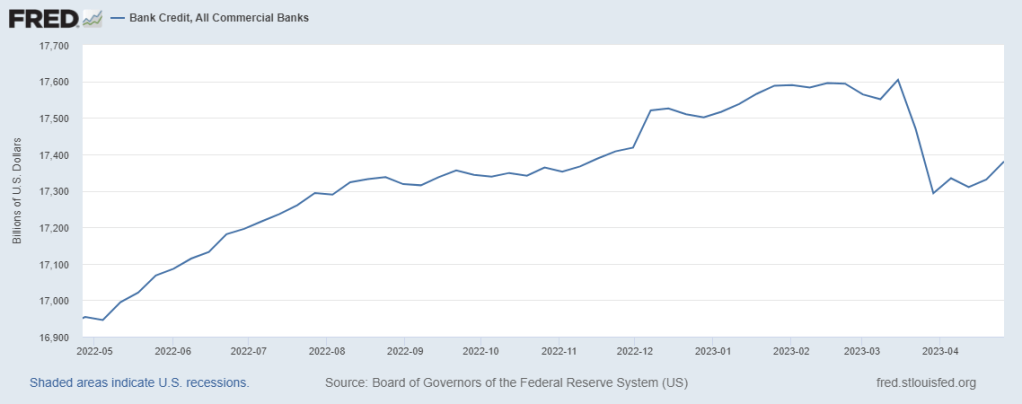
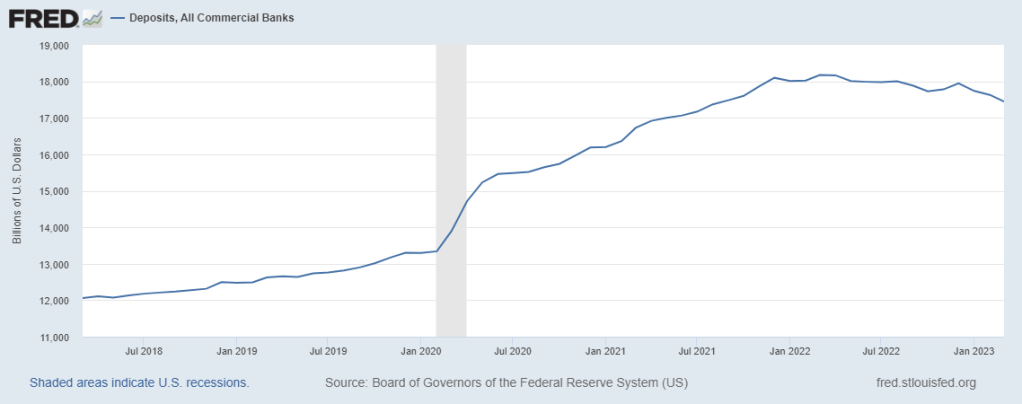
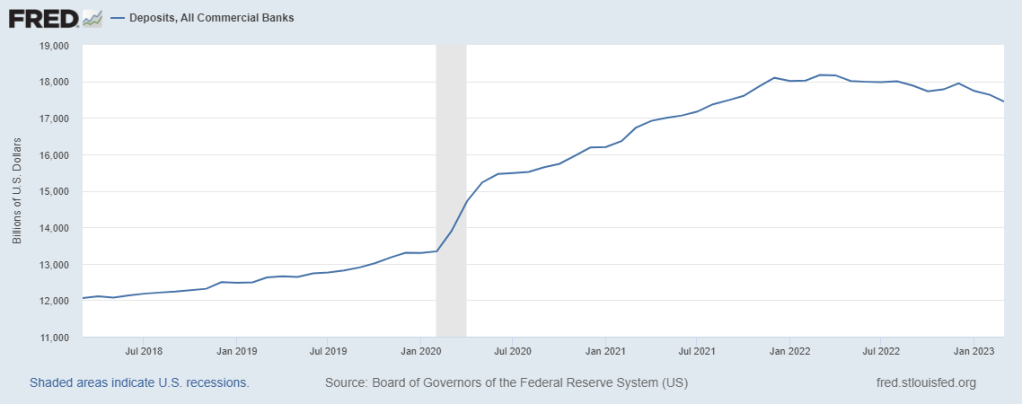
Well, we can see deposits draining over the past year.

Credit is down YoY

Professor Seru:

“Just in the past few months, Silicon Valley Bank, Signature Bank and First Republic Bank have failed. Their combined assets surpassed those held by the 25 banks (when adjusted for inflation) that collapsed at the height of the financial crisis. While some experts and policymakers believe that the resolution of First Republic Bank on Monday indicates the turbulence in the industry is coming to an end, I believe this may be premature. On Thursday, shares of PacWest and Western Alliance are falling as investors’ fears spread. Adverse conditions have significantly weakened the ability of many banks to withstand another credit shock — and it’s clear that a big one may already be on its way.

Rapidly rising interest rates create perilous conditions for banks because of a basic principle: The longer the duration of an investment, the more sensitive it is to changes in interest rates. When interest rates rise, the assets that banks hold to generate a return on their investment fall in value. And because the banks’ liabilities — like its deposits, which customers can withdraw at any time — usually are shorter in duration, they fall by less. Thus, increases in interest rates can deplete a bank’s equity and risk leaving it with more liabilities than assets. So it’s no surprise that the US banking system’s market value of assets is around $2 trillion lower than suggested by their book value. When the entire set of approximately 4,800 banks in the United States is examined, the decline in the value of equity is most prominent for midsize and smaller banks, reflecting their heavier bets on long-term assets.

Here’s ZeroHedge:

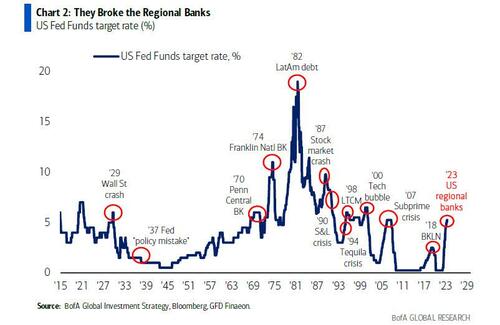
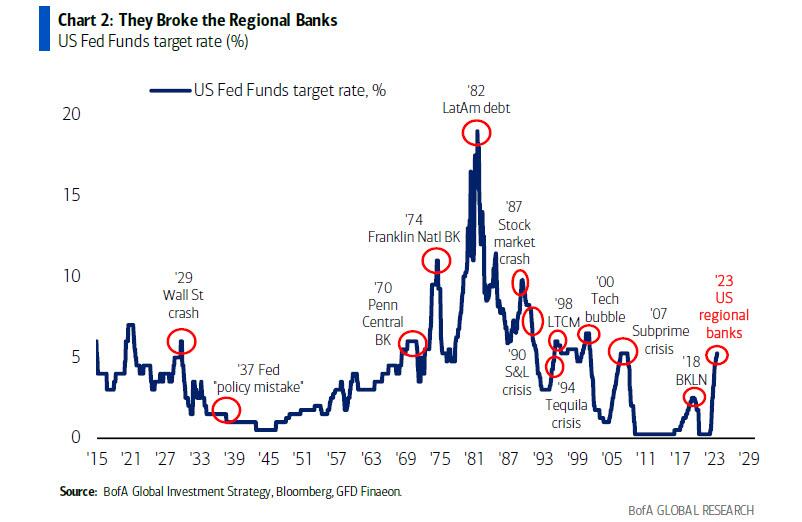
Our latest note, featuring BofA strategist Michael Hartnett highlights that “every Fed tightening cycle ends in crisis“, in this case US regional banks. 

Finally, the apocalyptic warning about the US banking system comes as JPMorgan CEO Jamie Dimon claims that the system is very, very sound.” 

Are they?

NBER: https://www.nber.org/digest/20235/feds-monetary-tightening-and-risk-levels-us-banks

“Between March 7, 2022, and March 6, 2023, the Federal Reserve increased the federal funds rate by nearly 4.5 percentage points. This led to a $2.2 trillion aggregate decline in the market value of long-term bank assets such as government bonds, mortgages, and corporate loans. These decreases are not fully reflected in banks’ book values. In Monetary Tightening and US Bank Fragility in 2023: Mark-to-Market Losses and Uninsured Depositor Runs? (NBER Working Paper 31048) Erica Xuewei JiangGregor MatvosTomasz Piskorski, and Amit Seru show how such declines in asset values can increase bank insolvency risk due to runs by uninsured depositors, as illustrated most dramatically by the failure of Silicon Valley Bank (SVB).”

“The researchers collect data on bank asset holdings, including bond maturities, for all 4,844 FDIC-insured banks from their regulatory filings from the first quarter of 2022 onward. They estimate banks’ market values of assets by using data on traded indexes in real estate and US Treasury securities. They find that by the first quarter of 2023, the increase in interest rates had resulted in a 9 percent decline in the marked-to-market value of the median bank’s assets. The worst 5 percent of banks had declines of about 20 percent. These marked-to-market losses are similar in magnitude to the total book equity of the US banking system. Only about 6 percent of aggregate assets in the US banking system are hedged by interest rate swaps, too little to offset most of the market value losses.

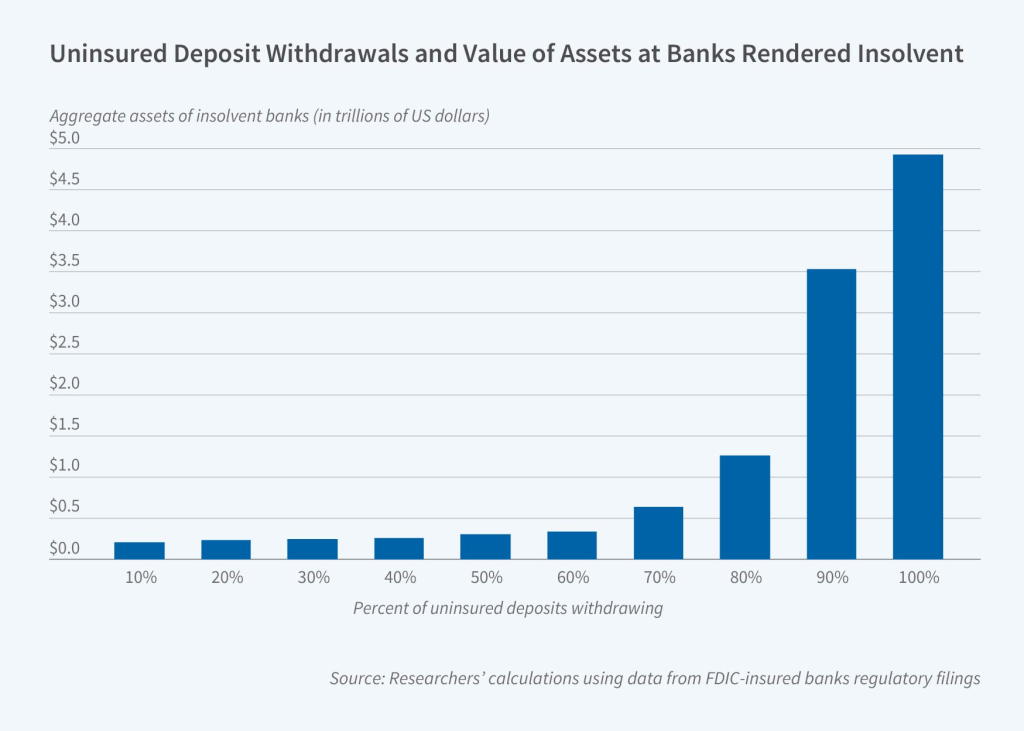
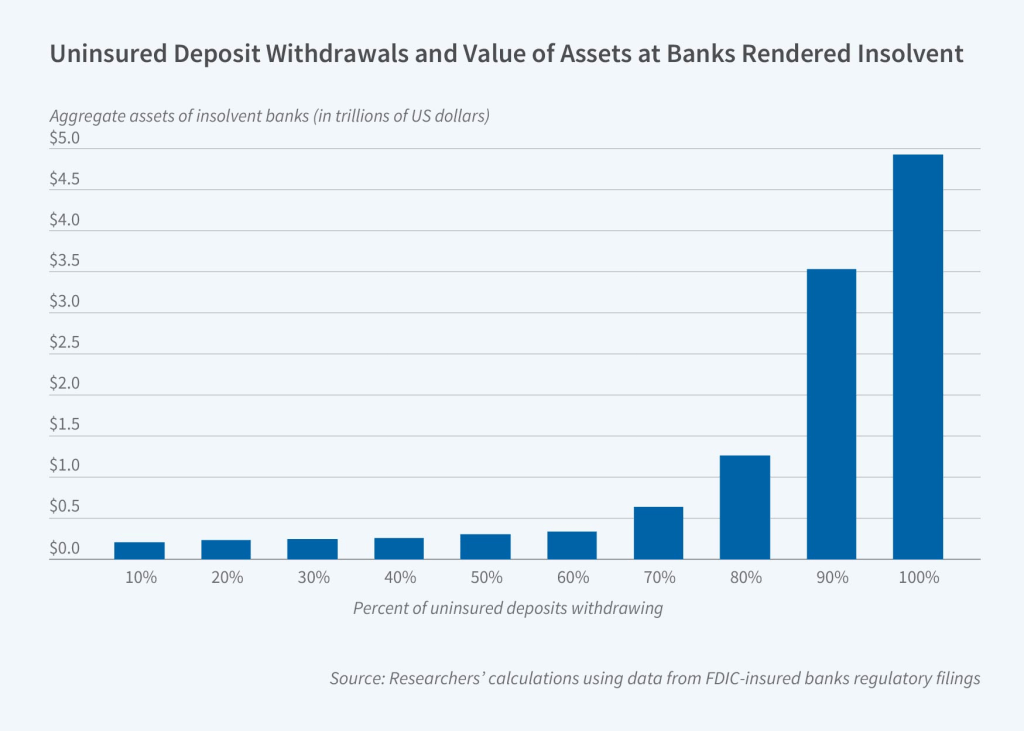
“The researchers show that uninsured leverage, a bank’s uninsured debt-to-assets ratio, is the key to understanding whether these declines in asset values could lead to insolvency through “solvency runs.” Unlike insured depositors, uninsured depositors stand to lose a part of their deposits if their bank fails, potentially giving them incentives to run. If the insured depositors are sticky and are content with low deposit rates, a bank’s survival depends on market beliefs about the share of uninsured depositors who will withdraw their funds following a decline in the market value of bank assets. When interest rate increases and the associated decline in the market value of the banks’ assets are small, there is no risk of a run and banks can survive any withdrawals by the uninsured depositors. However, for larger increases in interest rates, there can be equilibrium outcomes in which uninsured depositors run and make banks insolvent. Banks with smaller initial capitalization and higher uninsured leverage are more likely to experience such outcomes, which increases their fragility to uninsured depositor runs. Such banks can remain solvent only if a relatively small share of the uninsured depositors is expected to withdraw; otherwise, there will be a run.”

Uninsured deposits account for about half of all bank deposits and close to $9 trillion of aggregate bank funding. The researchers estimate banks’ vulnerability to self-fulfilling solvency runs across a wide range of possible beliefs regarding the share of uninsured depositors who may withdraw their money. Prior to the recent rise of interest rates, even if all uninsured depositors withdrew their money, the insured deposit coverage ratio for all banks would have been positive. Banks were not very vulnerable to uninsured depositor runs. After monetary tightening raised rates, however, withdrawal by half of uninsured depositors would turn into a self-fulfilling run for 186 banks with total assets of about $300 billion.

The researchers also study the geographical distribution of exposure to bank failure risk using data on the counties in which each bank has branches. They compute the share of deposits in each county that are held at banks that would not have sufficient mark-to-market assets to cover their deposits if half of their uninsured deposits were withdrawn. Counties with a greater share of residents from minority populations, with lower median income, and with a higher percentage of individuals without a college degree are more exposed to bank insolvency risk. Finally, the researchers show that a recent decline in banks’ asset values also eroded their ability to withstand adverse credit events — focusing on commercial real estate loans.

Is There a Counteroffensive?

Moon of Alabama -May 2, 2023:https://www.moonofalabama.org/2023/05/ukraine-sitrep-offensive-in-doubt-no-talks-social-breakdown.html#more

May 02, 2023

Ukraine SitRep: Offensive In Doubt – No Talks – Social Breakdown

Since early April, when Pentagon briefing slides about the state of the Ukrainian army ‘leaked’ onto the web, the writing in ‘western’ media about the much discussed Ukrainian counteroffensive has become more gloomy.The hyping is largely gone and the assessments become more realistic. Three days ago the London Times offered a piece in that category:

Ukraine isn’t ready for its big offensive, but it has no choice (paywalled, archived version)
Kyiv is locked into a spring or summer push despite burning through ammo so fast that the West can’t keep up. Luckily Russia is out of ideas too

[W]hile the Ukrainians are moving quickly to assimilate their 230 new and reconditioned western tanks and 1,550 armoured vehicles, they still lack proper air defences for any big offensive operation. That puts them at risk from Russian airpower. Western defence sources are also uncertain whether senior commanders can adapt to the new systems as well as their soldiers on the ground.

Yet Kyiv has little real choice but to launch a major spring or summer offensive. Its leaders are increasingly boxed in. As an American defence official put it: “The Ukrainians have surprised us as well as Putin in the past, but have much less room for manoeuvre now . . . and the Russians know it.”

President Zelensky has managed the West with great skill, but to maintain its support he has to show what Washington insiders rather tastelessly call a “return on investment”.

He must also balance domestic politics. Hawks such as Kyrylo Budanov, Ukraine’s military intelligence chief, prevent any meaningful talk about negotiations, even though some in the government think now is the time to put out feelers. One western diplomat in Kyiv described a “surreal parallel experience” as his interlocutors “discuss potential formats for negotiations one evening” and then “shout that there can be no talks with Russia” in public the next day.

During the war Kiev first burned through its standing army material and personnel. It then received a large amount of Soviet era equipment from former Warsaw Pact members and burned through that stash. It has now received ‘western’ arms for a third army that will largely consist of mobilized civilians with little military experience. After the counteroffensive has run its course, no matter the outcome, that third army will largely be destroyed. There will be no more material and personnel for a fourth army.

In contrast the Russian military is largely undamaged. So says General Cavoli, the U.S. commander in Europe:

Russian ground forces have suffered significant losses in Ukraine. Despite these setbacks, and their diminished stockpiles of equipment and munitions, Russian ground forces still have substantial capability and capacity, and continue to possess the ability to regenerate their losses.

Russia remains a formidable and unpredictable threat that will challenge U.S. and European interests for the foreseeable future. Russian air, maritime, space, cyber, and strategic forces have not suffered significant degradation in the current war. Moreover, Russia will likely rebuild its future Army into a sizeable and more capable land force [..] Russia retains a vast stockpile of deployed and non-deployed nuclear weapons [..]

Russia pursues a military modernization program that prioritizes a range of advanced conventional, hybrid, and nuclear capabilities to coerce the West. […] These weapons provide Russia asymmetric threats to NATO and present new challenges to Western response options.

If or when the Ukrainian counteroffensive will start is still an open question. The weather is a major factor:

The spring rains have been much more intense this year than normal. The heavy downpours in Zaporizhzhia over the last few weeks have turned the battlefield into a gelatinous soup.

“This has been an unusual spring,” a commander with the brigade said. “There has never been this much rain before.”

There is of course also the question of ammunition. Ukraine already lacks sufficient numbers of artillery rounds. Each days it uses more than it receives and what it receives is more than the ‘west’ can produce. The counteroffensive will burn through whatever ammo is left. Then what?

There may be additional reasons to hold up the counter offense. The British Ministry of Defense is requesting offers from the industry for some specific equipment. Among it are mine breaching equipment for main battle tanks, tank launched bridges with 70 tons capacity and transporters for heavy main battle tanks.

With around 40 tons Soviet tanks are build significant lighter than ‘western’ tanks which weigh up to 70 tons. The newly delivered Leopard and other tanks can not pass over typically Ukrainian country bridges without seriously damaging them. Without the necessary infrastructure and support equipment in place the ‘western’ tanks are largely useless. To launch a counteroffensive against hardened Russian defense lines without such equipment is not really possible.

But waiting is not possible either. There is not only the pressure from Washington and other supporters of the war in Ukraine but there is also the permanent threat of Russian strikes on the accumulated stocks and forces. As longer those stay in the preparation areas the higher is the chance that they will get detected and destroyed.

Over the last two weeks Russia destroyed a large part of the Ukrainian air defenses in the Kherson and Pavlograd region. There are no replacements for those systems.

Still, the British Ministry of Defense seams to believe that the war will continue for several more years. For Ukraine it also wants to acquire:

Missiles or Rockets with a range 100-300km; land, sea or air launch. Payload 20-490kg

The closing day for that request is May 4. If you happen to have a few of those missiles laying around or if can produce those you have two more days to make your offer. But realistically the earliest possible delivery for such missiles will likely be in 2024/25. One wonders if Ukraine will by then still be around.

Yves Smith is discussing the chances of a ceasefire after the counteroffensive has run its course. She finds that Russia is unlikely to agree to one without receiving very significant concessions:

I don’t see how peace talks get anywhere. The hawks are still in the driver’s seat and will either balk at negotiations or set preconditions. Recall Russia previously rejected preconditions; even if they were to entertain them now, the odds are very high the West’s initial demands, like an immediate ceasefire, would be rejected, or quickly vitiated by Russian counters like “Only if you suspend the sanctions.” That does not mean there won’t be backchannel chatter, but don’t expect it to go far.

Let’s charitably assume, despite all that, that the West actually does ask Russia to negotiate. Unless the request is made in an obviously unacceptable manner, Russia has to entertain it.

But I don’t see how this goes anywhere until leaders in West have really, really internalized that Russia holds a great hand and does not have good reasons to stop until it has subjugated Ukraine.

And all Russia has to do to substantively sabotage negotiations is to bring up the demand that Putin has been making in different forms since the Munich Security Conference of 2007: security guarantees.

Who will give them? The gleeful French and German admissions of duplicity with respect to the Minsk Accords means no NATO state can be trusted, save maybe Turkey (and if Erdogan survives, he’ll likely be deemed too close to Russia to be acceptable). The US clearly can’t be trusted. China would not be acceptable, and is not suited to the role (it’s not a land power and does not have a presence in theater).

So unless some tail events happen (and Taleb warns tails are fat), we still look to be on course to Russia prosecuting the war until it can impose terms on Kiev.

Meanwhile the social-economic situation in Ukraine is getting worse:

The scene in the pawn shop illustrates the crisis of growing poverty in Ukraine, the reality of which stands in contrast to the surface bustle of Kyiv’s busy restaurants and bars where it is often hard to get a table, with many living a precarious existence.

Poverty increased from 5.5% to 24.2% in Ukraine in 2022, pushing 7.1 million more people into poverty with the worst impact out of sight in rural villages, according to a recent report by the World Bank. With unemployment unofficially at 36% and inflation hitting 26.6% at the end of 2022, the institution’s regional country director for eastern Europe, Arup Banerji, had warned that poverty could soar.

Behind his window in Treasure, Stepanov describes the hardships experienced even by those who have work. “The price of everything has gone up. Food is the most expensive and then it is fuel for the car. Some things have gone up by 40-50%. Before the war my wife would go to the supermarket to shop and it would cost 200 hryvnia, now the same shop costs 400-500.”

The billions of dollars and Euros the ‘west’ provided to Ukraine are skimmed off by those who visit fancy restaurants and bars in Kiev. Those not in the bribes receiving circles will have to get used to being hungry.

And here’s Macgregor:

US Bank Deposits

Like some many sectors, US commercial banks are an oligopoly. The market power power of the dominant players is often measured from the Herfindahl-Hirschman Index Index (HHI).

HHI is computed as the sum of the squares of the competitor market shares as whole numbers:

The term “HHI” means the Herfindahl–Hirschman Index, a commonly accepted measure of market concentration. The HHI is calculated by squaring the market share of each firm competing in the market and then summing the resulting numbers. For example, for a market consisting of four firms with shares of 30, 30, 20, and 20 percent, the HHI is 2,600 (302 + 302 + 202 + 20= 2,600).

Here are the top 10 US Commercial Banks, by deposit share:

  • JPM (“House of Jamie”): 16.1%
  • Bank of America (“House of Brian”): 14.8%
  • Wells Fargo (“”House of Wells Notice”): 10.9%
  • Citibank (“Hamilton House”): 5.8%
  • US Bank: 3.4%
  • Truist: 3.4%
  • PNC Bank: 3.3%
  • TD Bank: 2.9%
  • Charles Schwab: 2.7%
  • Capital One: 2.6%

They control 75% of US deposits.

And yet, their HHI-10 is a still somewhat competitive 675.61.

DOJ says agencies generally consider markets in which the HHI is between 1,500 and 2,500 points to be moderately concentrated, and consider markets in which the HHI is in excess of 2,500 points to be highly concentrated (See U.S. Department of Justice & FTC, Horizontal Merger Guidelines § 5.3 (2010)).

Transactions that increase the HHI by more than 200 points in highly concentrated markets are presumed likely to enhance market power under the Horizontal Merger Guidelines issued by the Department of Justice and the Federal Trade Commission.

Let’s see how this shakes out as banks continue to hit the floor.

Bakhmut: Out of Ammo? Fix Bayonets

The phrase “fix bayonets” rings throughout military history. It means different things — final assault or out of ammunition and last stand.

Sometimes, both.

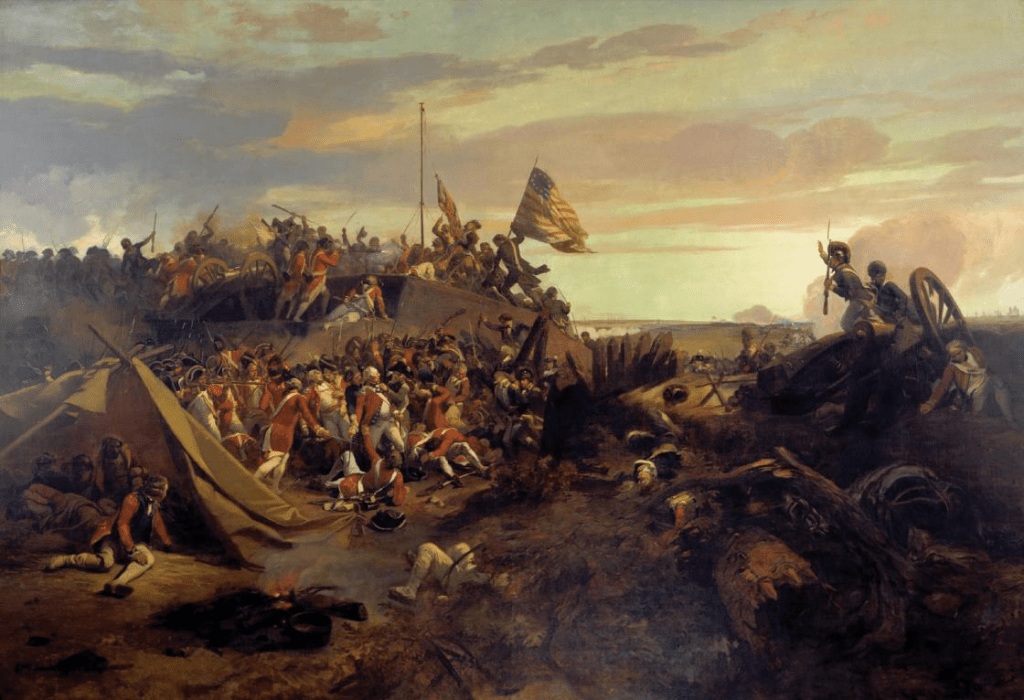
On the evening of October 14, 1781, the sharp clanking of steel bayonets being fixed to muskets echoed through the dense fog that descended over the American earthworks outside of Yorktown Va.

Every young American should visit Yorktown. The earthworks are still there. Even more than Gettysburg, Yorktown stands as the monument to an incredible American victory.

Visit the redoubts where American light infantry and French troops secured the victory.

The bayonet had been used extensively and effectively throughout the Revolutionary War, but this instance at Yorktown was extreme — night assault on 2 Brit redoubts.

On the American side, Continental light infantry (regulars – not militia) led by the Marquis de Lafayette and Alexander Hamilton were to storm British Redoubt No. 10 in a night assault.

400 French regular soldiers of the French Royal Deux-Ponts Regiment were to take the adjacent Redoubt 9.

A choreographed attack.

Troops were forbidden to even load their muskets. Secrecy was paramount in this endeavor, and a single accidental musket shot could sink the whole operation. Success would mean that the Americans would be on top of the British soldiers before they could respond, a climactic assault in what had become a protracted siege.

The stakes were clearly high as General George Washington implored his men that they “act the part of firm and brave soldiers.”

Captain Stephen Olney, commanding a company that would take part in the assault, later wrote that “his Excellency’s knees rather shook, but I have since doubted whether it was not mine.” Fear must have pervaded many of the men’s minds, as Olney remembered that many of the men were “no doubt, thinking, that less than one quarter of a mile would finish the journey of life with them.”

In the Redoubts, awaiting the assault. In the Redoubts were Brit and Hessian troops of the 71st Foot, 33rd, 43, and von Bose Regiments – almost our of ammo.

And so goes the AFU in the Bakhmut cauldron – surrounded, units decimated, and low on ammo.

Moon of Alabama (The Last Hurrah): https://www.moonofalabama.org/2023/04/the-last-hurrah.html

The Last Hurrah

ZubuBrothers has a piece that reports about a talk given by the Chief of the General Staff of the Polish Armed Forces General Rajmund Andrzejczak:

Andrzejczak said that the situation doesn’t look good for Kiev at all when considering the economic dynamics of this conflict, with him drawing particular attention to finance, infrastructure issues, social issues, technology, and food production, et al. From this vantage point, he predicts that Russia can continue conducting its special operation for 1-2 more years before it begins to feel any structural pressure to curtail its activities.

By contrast, Kiev is burning through tens of billions of dollars’ worth of aid, yet it still remains very far away from achieving its maximum objectives. Andrzejczak candidly said that Poland’s Western partners aren’t properly assessing the challenges that stand in the way of Ukraine’s victory, including those connected to the “race of logistics”/war of attrition” that the NATO chief declared in mid-February. Another serious problems concerns refugees’ unwillingness to return to their homeland anytime soon.

As Andrzejczak himself admitted, “We just don’t have ammunition. The industry is not ready not only to send equipment to Ukraine, but also to replenish our stocks, which are melting.” Considering that Poland is Ukraine’s third most important patron behind the Anglo-American Axis, this strongly suggests that all other NATO members are struggling just as much as it is to keep up the pace, scale, and scope of support, if not more since many are a lot smaller and thus less capable of contributing in this respect.

Accordingly, this observation means that Kiev’s upcoming counteroffensive will likely be its “last hurrah” prior to resuming peace talks with Russia since the West won’t be able to keep up its assistance for much longer. Andrzejczak seems keenly aware of this “politically inconvenient” fact, hence why he wants his side to give its proxies as much as possible until the end of that operation in the hopes that they can then be in a comparatively more advantageous position by the time these talks recommence.

I agree with the General’s analysis.


bigger

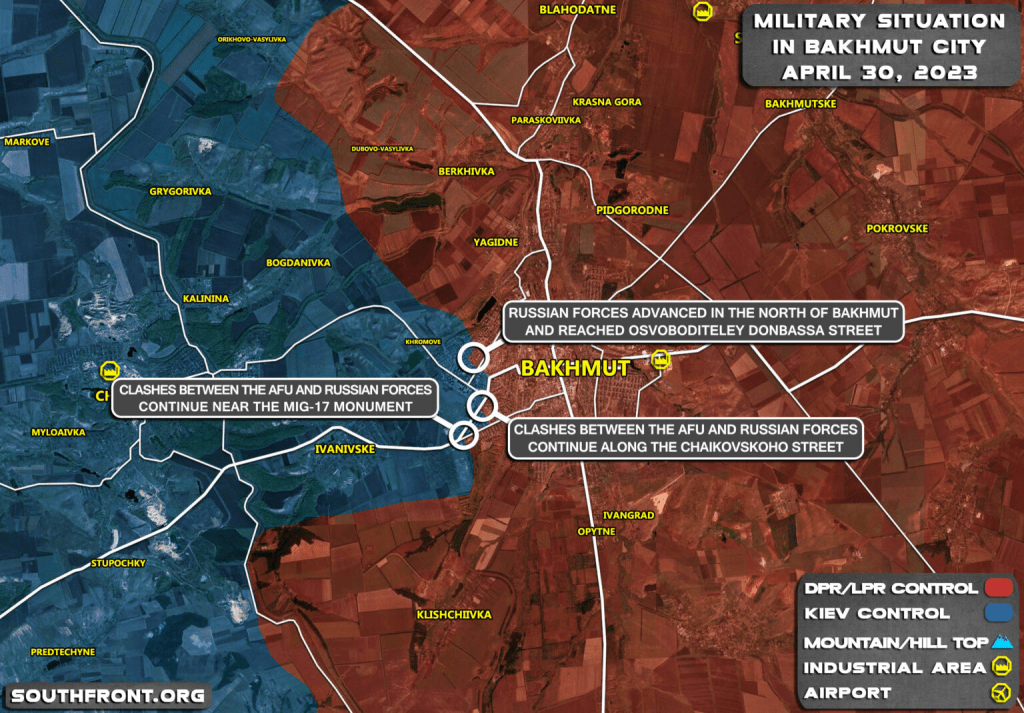
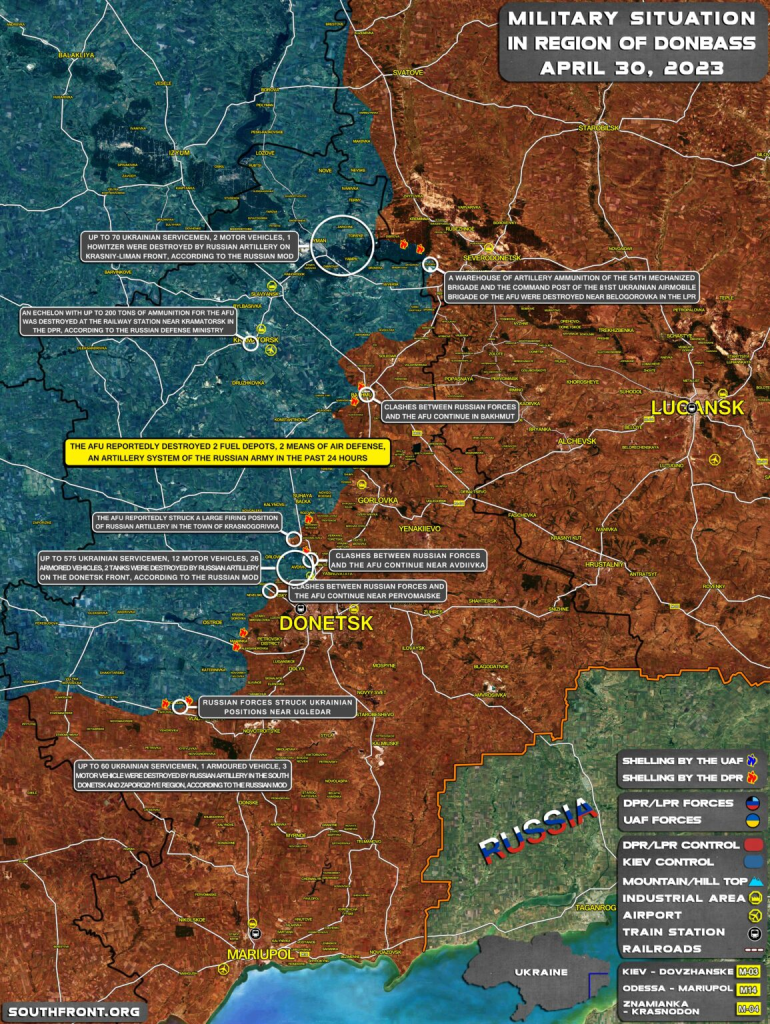
Bakhmut/Aryomovsk is to 90% under Russian control and the rest will be captured during the next few days. Ukrainian losses in the city must have been huge. The Ukrainian troops who try to escape from the city immediately come under artillery fire. The latest daily Russian clobber report counts 575 ‘enemy losses’ in Bakhmut over the last 24 hours for a total of 815 along the whole frontline. This is the largest number reported over the last two months.

Holding onto the city at all cost was in my view the wrong decision. A more mobile defense would have cost more land but also would have had much fewer losses than occurred in those static positions under strong artillery fire. As Ukraine is geographically big but has relative few mobilizable soldiers it would have been better to trade land its for time and not its soldiers.

The defense of the lowland city cost the Ukrainian army dearly as it eroded its material and human reserves. Those will be missing to patch the holes in the front line when that long announced ‘last hurrah’ counteroffensive fails to make any serious gains.

Posted by b on April 29, 2023 at 16:37 UTC |

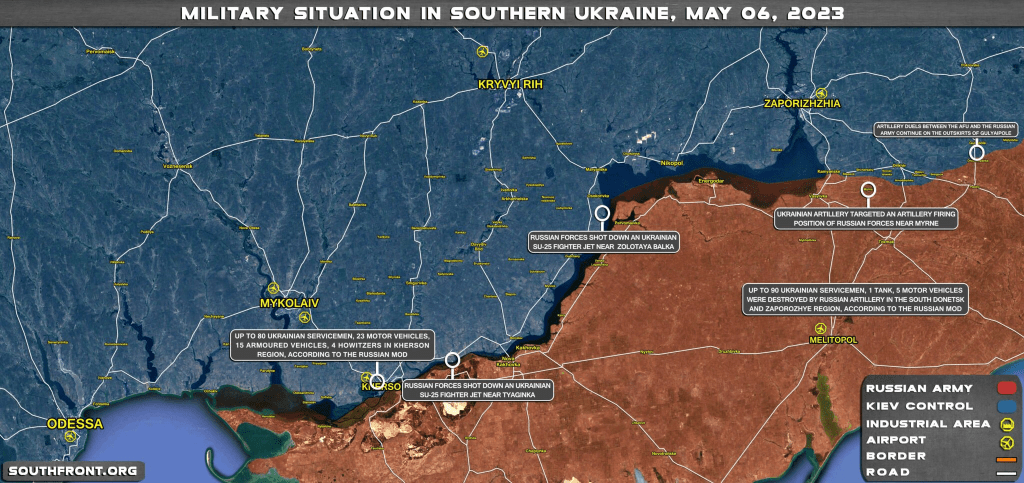
Here is the bigger picture in the Donbass

And, here is Dima at the Military Summary Channel – first at Bakhmut:

We’re within 2 weeks of the AFU charge.

Or, perhaps, 2 weeks when Russian attacks in the north and east steals the march.

Commercial Bank Deposit Rollover

Fed policies are squeezing banks from multiple sides like the Wagner PMC meat-grinding the dwindling survivors of the decimated AFU brigades in Bahkmut.

AOCI trends have been negative putting an ever bigger drag on roll-offs.

Credit lines are hardening.

Rightfully so — deposits are tanking for the first time in, well, decades and decades. This is uncharted waters for most bankers.

It’s “May Day, May Day, Super-64 going down” time. Over $800 billion evaporated in Q1.

Down ~$1 trillion from peak deposit.

So, a lot of banks are going to have to go away in some fashion — voluntarily or “otherwise”.

There are several ways.

For example, there’s the “SVB way”. Or the “Signature Way” if you prefer.

Then, there’s also the firesale way. Or “break up into pieces way”.

Finally, a merger/acquisition of the survivors.

It’s fast becoming “eat or be eaten” as consolidation is all but a headline in Bloomberg.

Actually, Bloomberg is calling for stability – check this out: https://www.bloomberg.com/news/articles/2023-04-14/us-bank-lending-deposits-increase-in-the-first-week-of-april

LOL – yeah, right.

Of course, FT is on the case calling for 5600 banks at risk.

Which means those who sell into banks have a problem, don’t you think” Steve O”?

And if you are selling to these people when they are cutting back, well, let me tap into my “diversity training” to explain what that means (diversity is our strength, yada yada):

“Su problema es tu gran problema.”

Problema muy grande, camaradas!

These days, when any standard Fortune 500 woke-corp faces a crisis, its strategy is to double-down on woke principles that assume drive succes — translation manufacture more diversity.

You know, focus on discriminating more against some people for the usual reasons — skin tone, last name, age, gender — while promoting others for preferred characteristics like — different skin tone, different last name, different age, different gender.

Knowledge, skills, competency, and experience? LOL. Of course not — in times of crisis, it’s important you have the right statistical mix and emphasize your pronouns.

Which gets you betting your business on people like this

Oops, that’s back at Harvard. I meant this:

Her credentials: Groton, Harvard, Whaton, Intern … and then straight to VP and Chief Marketing Officer.

Not. Kidding.

Intern with minimal experience to “capa” with no real skills or industry experience.

No suprise, A-B bet an inexperienced exec with no knowledge of standard marketing analytics practice — like running focus groups on both the (1) target demo and (2) current cash cow — BEFORE approving the campaign to ensure net uptake is positive.

One does need quant skills for that — just “white board” and PPT skills taught at HBS.

And the ability to “think outside the box.”

Alisa went woke and bet on this

Which unfortunately can get you performance like this.

“However, since the furor over the partnership with Mulvaney, it saw a fall in that value of over $3 billion, with a market cap on April 10 of $130.8 billion. That figure has continued to decline since then, and as of 8 a.m. ET on Thursday, the company had a market cap of $110.6 billion—which would represent a fall of around $24 billion in 13 days.” Per Newsweek.

That’s the beer saga.

If your market is banking and insurance, you’re selling to people who are about to get whacked.

Go woke, go broke? Or get some competency.

Unlike beer where you can clip the woke team (good bye, Alisa), trust the competent and experienced who speak directly at you and stabilize the business before the squall hits and seas get heavy.

Meanwhile, my bank clients will handle this storm. They seem comfortable betting on quant skills, experience, and leadership.

In some places, that still counts.

Ma’am I Am

With thanks to The Burning Platform

I see your hair. It is a wig.

Your Adam’s apple still looks big.

You are a man, and that is clear.

I do not see a woman here.

I must admit. It’s rather odd.

To hear you say you’re now a broad.

You have no uterus, so no;

You cannot bleed from down below.

I do not like your padded bra!

You should not use the women’s spa!

You tell me you had surgery;

Your pronouns still are “him” and “he.”

Your chromosomes are X and Y.

That means you’ll always be a guy.

You gave yourself a girly name.

That does not mean you’re now a dame.

A surgeon chopped your eggs and ham?

I still won’t call you Ma’am I Am.

Atlanta Fed GDPNow: April 5, 2023

Latest estimate: 1.5 percent — April 5, 2023

The GDPNow model estimate for real GDP growth (seasonally adjusted annual rate) in the first quarter of 2023 is 1.5 percent on April 5, down from 1.7 percent on April 3. After recent releases from the US Census Bureau, the US Bureau of Economic Analysis, and the Institute for Supply Management, a decrease in the nowcast of first-quarter real personal consumption expenditures growth from 3.7 percent to 3.4 percent was slightly offset by an increase in the nowcast of first-quarter real gross private domestic investment growth from -8.5 percent to -7.8 percent, while the nowcast of the contribution of the change in real net exports to first-quarter real GDP growth decreased from 0.44 percentage points to 0.29 percentage points.

The next GDPNow update is Monday, April 10.

Comments:

  • March ADP <150K and JOLTS slowest since May 2020
  • ISM down 10 points to 40.3 — the second lowest since 2020 with new orders sub-45
  • Factory orders rolled over and declining

Tech Wreck With Odd Todd

Catch the MCI reference?

Here’s the Q1 2023 list:

  • Roku: ~100
  • EA: ~800
  • Indeed (the irony): ~2200
  • Amazon: ~9,000
  • Meta: ~10,000
  • Atlassian: ~500
  • House of Elon (aka Twitter): ~200
  • Ericksson: ~1,400
  • DocuSign: ~700
  • iRobot: ~85
  • Twilio: ~1,400
  • Yahoo: ~1600
  • GitHub: ~300
  • eBay: ~500
  • Zoom: ~1,300
  • Dell: ~6,650
  • PayPal: ~2000
  • Groupon: 500
  • SAP: 3,000
  • IBM: 3,900
  • Intel: 544
  • Spotify: ~600
  • Alphabet/Google: ~12,000
  • Microsoft: ~10,000
  • SmartNews: ~120
  • Goldman Sachs: ~3,200
  • Coinbase: ~950
  • Twitter: ~18,000
  • Amazon: ~18,000 (January)
  • Salesforce: ~8,000

Let’s close it out with a little more “Todd”: