Sock Puppet Provocations in Ukraine

The Donbass War Of 2021?

Since the installation of “Sock Puppet Joe” as President, we’ve seen no small amount of ecalating national suicide – open borders and subsidizing illegal immigration, criminalization of opponents to the oligarchy, and destruction of key American industries.

Why not some foreign adventures?

As reported by Dave DeCamp in AntiWar.com, American intervention in the Minsk Agreement picked up with the Corrupt Joe Administration: https://news.antiwar.com/2021/04/07/us-delivers-military-cargo-to-ukraine-as-it-hypes-russian-military-movements/

US Delivers Military Cargo to Ukraine as it Hypes Russian Military Movements

Deliveries were made on March 25th, April 2nd, and April 4tth.

While hyping the movement of Russian troops near the border with Ukraine, the US has delivered multiple military shipments to Kyiv.

A  Newsweek report that cited local media said that over the past two weeks, the US had made three military cargo deliveries to Ukraine. On March 25th, 350 tonnes of cargo was delivered by ship to the Black Sea port city of Odessa in southern Ukraine. Included in the delivery were 35 Humvees.

On April 2nd, a US Air Force C-17A Globemaster III military transport aircraft flew to Kyiv from a US base in Germany. On April 4th, another C-17A Globemaster III landed in the western city of Lviv. It’s not clear what the planes were carrying, but the C-17A Globemaster IIIs can transport up to 102 troops and 77 tons of cargo.

Since the US-backed coup in Kyiv in 2014 that sparked the fighting in the eastern Donbas region, the US has provided Ukraine with more than $2 billion in military aid. The Pentagon recently announced a new $125 million package for Ukraine that includes armed patrol boats, and another $150 million is expected to be provided sometime this year.

The news of the military deliveries come as tensions in the region are skyrocketing. Ukrainian President Volodymr Zelensky is calling for Ukraine to become a full-fledged member of NATO and is traveling to the conflict zone in Donbas on Thursday.

J. Hawk at Southfront weighs in with his assessment of a “Donbass-2021”: https://southfront.org/the-donbass-war-of-2021/

Ever since assuming office, the Biden Administration has been probing countries it designated as America’s enemies for weaknesses through a variety of provocations. So far this approach has not had any successes. China plainly told Biden’s SecState Blinken to go packing, Iran is showing no eagerness to kowtow to Washington under new management, and Russia itself has stayed the course, brushing off verbal attacks and promising either in-kind or asymmetrical responses to any new chicaneries from Washington or Brussels.

That does not mean that Washington has acknowledged defeat. Unwilling to concede, it is liable to escalate a crisis situation elsewhere. Since Navalny’s perennial “poisonings”, “hunger strikes”, and “leg pains” have not had the desired effect on Western governments and his life and health are moreover quite secure in a Russian prison, so the prospect of a new war in Eastern Ukraine is back on the agenda, and the opponents of Nord Stream 2 now have two things to pray for: Aleksey Navalny’s death and a Russia-Ukraine war.

Zelensky on the Spot

The Russian government has made it clear on numerous occasions that it is adhering to the Minsk Agreements, will not abandon the Donbass, but at the same time will not escalate the situation out of the desire to minimize the damage to all concerned. In practical terms it means a continuation of “coercive diplomacy”. Russian military force will be used only if Ukraine attempts to create facts on the ground through offensive action. For that reason it is unlikely in the extreme that Russia will be the one to escalate first. It is worth remembering that both the summer 2014 campaign and the winter 2014/15 campaign were initiated by Kiev which first sent troops and bombers to suppress the then-peaceful protests against the Maidan and referenda to secede, and then to hope to quickly resolve the stalemate. Both operations ended in failure through the efforts of the hastily assembled and armed militias of the breakaway republics, with some “Northern Wind” military support that decimated Ukrainian forces.

Poroshenko survived the disasters that shredded the Ukrainian military thanks to the alliances he’s made with the nationalists while preparing for the Maidan. Zelensky’s position is considerably weaker and more vulnerable to the consequences of a military defeat. Having been elected on a promise to end the war in the Donbass, he has already badly disappointed his supporters on that score. But his transformation into a warhawk, perhaps best characterized by his awkward appearances on the front lines wearing an ill-fitting helmet and a remarkably short armor vest, has not earned him even grudging respect from the nationalists and neo-Nazis on whose shoulders much of Ukraine’s war effort rests. While Poroshenko could get out of many a tight spot with his “Cynical Baderite” jacket, Zelensky is now a very lonely person in Kiev, a hostage to the decisions of Ukraine’s National Security and Defense Council whose decisions he automatically signs, in contrast with Poroshenko who often simply ignored them.

In practice it means that Zelensky might be in process of being a scapegoat for Ukraine’s all-but-inevitable defeat at the hands of Russian forces hastening to aid the republics in the event of Ukraine’s military scoring early victories. Blackmail might be playing a role in Zelensky’s calculus too. There were persistent reports in March of an imminent release of a documentary implicating Zelensky’s office in the failure of Ukrainian intelligence operation to lure Wagner associates to Ukraine in order to imprison and try them. At the same time, if Zelensky sends his military to a defeat, his reputation will be gravely damaged, possibly to the point of forcing him to resign and even endangering his life. His nervous activity of the first week of April, including a total non-sequitur of a visit to NATO headquarters in order to plead for Ukraine’s quick admission to the alliance, is indicative of a man in a tight spot with no easy ways out.

Resistible Force Meets Immovable Object

Zelensky might be in a less anxious mood if he had a reliable military instrument to wield. The Ukrainian Armed Forces are not that instrument. While the Russian military entered 2014 rather unprepared for the prospect of high-intensity land warfare thanks to the Serdyukov reforms that made the brigade the main tactical unit, since that time much lost ground has been recovered through the reactivation of several divisions and armies, such as the First Guards Tank Army, and modernization of Land Forces’ equipment. Russia’s military today is a considerably more impressive force than it was seven years ago.

Meanwhile Ukraine’s armed forces stagnated. Unmodernized T-64 remains its most numerous main battle tank while production of light armored vehicles proceeds at a trickle. Considering that artillery has been the most active arm in the years of static warfare along the line of separation, Ukraine’s “god of war” remains in poor shape and is suffering from ammunition shortage. In the last decade, Ukraine has suffered seven major ammunition depot explosions, in addition to the tremendous expenditure of munitions during the 2014 and 2015 battles and the occasional escalations of shelling since. Since Ukraine is a failing state that cannot even maintain its crumbling civilian infrastructure, it is little wonder that it has failed to establish domestic munitions manufacture. It did receive some supplies of weapons and munitions from NATO member states which have stores of Soviet-pattern weapons themselves, most notably Bulgaria, but little in the way of heavy artillery munitions. Since Ukraine also does not manufacture artillery pieces, specifically the technology-intensive barrels, for either its tanks or howitzers, the existing artillery park is being gradually used up, and every shell fired not only diminishes existing reserves but also adds to the wear and tear of the artillery pieces. An effort to provide cheap indirect fire capabilities by procuring 120mm “Molot” mortars manufactured in a factory owned by Poroshenko did not live up to expectations. There have been several cases of these mortars bursting during live fire exercises, with dire consequences for their crews. And if a simple technology of a mortar cannot be mastered by Ukraine’s defense industry, what success can it have attempting more challenging tasks?

Nor is the human factor any better. To borrow Wellington’s characterization of his own soldiers, UAF rank and file are “scum of the earth, enlisted to drink.” Military service remains highly unpopular and attracts only those who cannot find lucrative employment in the civilian economy—or abroad. Draft evasion and bribery of military recruitment officials is widespread, leading the Rada to drastically increase penalties for such activities to include lengthy prison terms. Even if such measures do not result in an exodus of able-bodied males out of the country, they are hardly likely to fill the ranks with motivated recruits. In the first week of April 2021 alone, Ukrainian forces have lost on average one soldier a day to non-combat causes, which included alcohol and drug overdoses, careless handling of weapons, suicide, and murder. The single greatest killer of Ukrainian soldiers, however, are their own minefields, which have killed 57 soldiers and injured 126 between July 27, 2020 (the beginning of the last ceasefire) and April 3, 2021, a statistic indicating a very low level of training and discipline.

Units themselves remain understrength. Some of the brigades are short of 60% of enlisted personnel and 30% of officers. Troops’ low morale translated into not only irregular and erratic training but also into poor equipment maintenance habits. An inspection of the 59th Brigade whose results fell into the hands of Novorossia intelligence services revealed that as of March 2020, some 60% of the brigade’s heavy weapons and vehicles were either greatly behind their maintenance schedule or were altogether unserviceable. The brigade has not held any maneuvers because the fuel supplies delivered to its logistics units never made it to the actual tactical subunits, suggesting theft by brigade’s leadership.

Cossack Mace

For all of the above reasons, a Ukrainian military operation, even a limited one, seems unlikely in the immediate future. The very visible Ukrainian troop movements meant that no element of surprise could be achieved. The aim appears to have been to relocate sizable formations to the Donbass so as to provide them with an ability to launch a quick, almost no-warning attack in the future, after Novorossia’s vigilance has been dulled by months of alerts and provocations.

Unless other events intervene, the period of greatest danger will be the Cossack Mace exercise held during the summer of 2021. The aim of the exercise which will take place under British leadership is to practice repelling a “Russian invasion” and then launching an offensive to secure the Ukraine-Russia border which would mean the end of Novorossia.

The fact of British leadership is particularly worrisome, since that country seems to have undertaken the task of “dirty tricks” on Washington’s behalf. In this instance, the “dirty trick” could be using the exercise to rehearse invasion of the Donbass immediately prior to its execution or, equally plausibly, the exercise itself might turn into an invasion. Foreign command of the invasion would be consistent with the Ukrainian trend of slipping under direct control by Western powers, and reminiscent of the role of the Military Professional Resources Incorporated (MPRI) in the planning and execution of Croatia’s Operation Storm in 1995.

One can’t even rule out direct British participation in such an operation, since a British-supported Ukrainian offensive against Novorossia forces would not be an offensive against Russia. The Defence Review released in March 2021 stated that the British Army would stand up four so-called “ranger regiments”, or battalion-sized formations whose aim would be to train “indigenous forces” and, if need be, actually go to battle with them in order to pursue British interests as part of the “Global Britain” project. An addition of professional British soldiers, in conjunction with British planning and execution of the operation, would provide a morale boost to the UAF and increase the chances of at least moderate success. Once embedded within Ukrainian forces, British troops would also serve as a deterrent against a direct Russian intervention.

An Ounce of Prevention

It may well be that the sudden Russian troop movements, the reinforcement of Crimea, and even Belarus’ deployment to the border of Ukraine, indicate contingency planning to launch an enveloping counteroffensive that would trap Ukrainian forces in a giant cauldron between the Dnepr River and Novorossia itself. At the very least, their presence forces Ukraine to divert forces away from its offensive grouping on the Donbass toward the border with Russia and even Belarus. It is also possible that the snap deployment was intended to pre-empt Ukraine’s increasingly obvious moves to mount an offensive during the summer, an offensive with direct foreign military employment. Russia’s pre-emption may also include a changed status of the Donbass. President Putin’s declaration that the rights of 600,000 holders of Russian passports in Novorossia has become a priority for him. An official recognition of Novorossia, combined with the placement of a Russian peacekeeper force, would stop the Ukrainian offensive dead in its tracks and moreover render any British participation unsustainable, though at certain diplomatic cost due to the withdrawal from the Minsk Agreements it would entail. The forceful Russian response has already had the effect of knocking not only Ukraine but, judging by the panicky demands for Russia to “explain” its troop movements, all of NATO. It communicated that under no circumstances will Ukraine enjoy tactical, operational, or strategic surprise. Now the question is whether Russia and major European powers can craft a diplomatic solution that will allow Zelensky to back down in a face-saving manner, thus ending the danger of war against the Donbass.

British “ranger regiments” and “greyzone warfare”

Use of NATO forces directly vs. unrecognized republics is no the same as use of NATO forces against Russia. Recognition by Russia would, on the other hand, create an additional layer of deterrence, though associated with risks for Russia.

If LPR/DPR are formally recognized by the Russian Federation which then spreads the umbrella of “extended deterrence” which, it should be noted, is backed by a potent nuclear arsenal. It would also mean Russia’s formal rejection of Minsk Agreements and of the Normandy Four format, creating a legal limbo fraught with unpredictability. NATO countries which committed themselves to preserving Ukraine’s “sovereignty and integrity” could hardly be expected to ratify this move.

Major minelaying operations by Ukrainian forces, which may be part of the offensive preparations. The greater the extent and intensity of mines on a certain sector of the front, the greater the ability to concentrate forces on other sectors—suggesting that whichever  sectors of the front are not seeing a minelaying operations are being reserved as corridors for future assault, making them eligible for DPR/LPR defensive minelaying.

While we are on the subject of “British Ranger Regiments”, recall that crucial role of local air superiority. That means both USAF and USN (i.e., carrier strike groups or CSGs).

Also worth keeping in mind is the location of Marine Expeditionary Units. General positions are reported weekly by the US Naval Institute (https://news.usni.org/2021/04/05/usni-news-fleet-and-marine-tracker-april-5-2021).
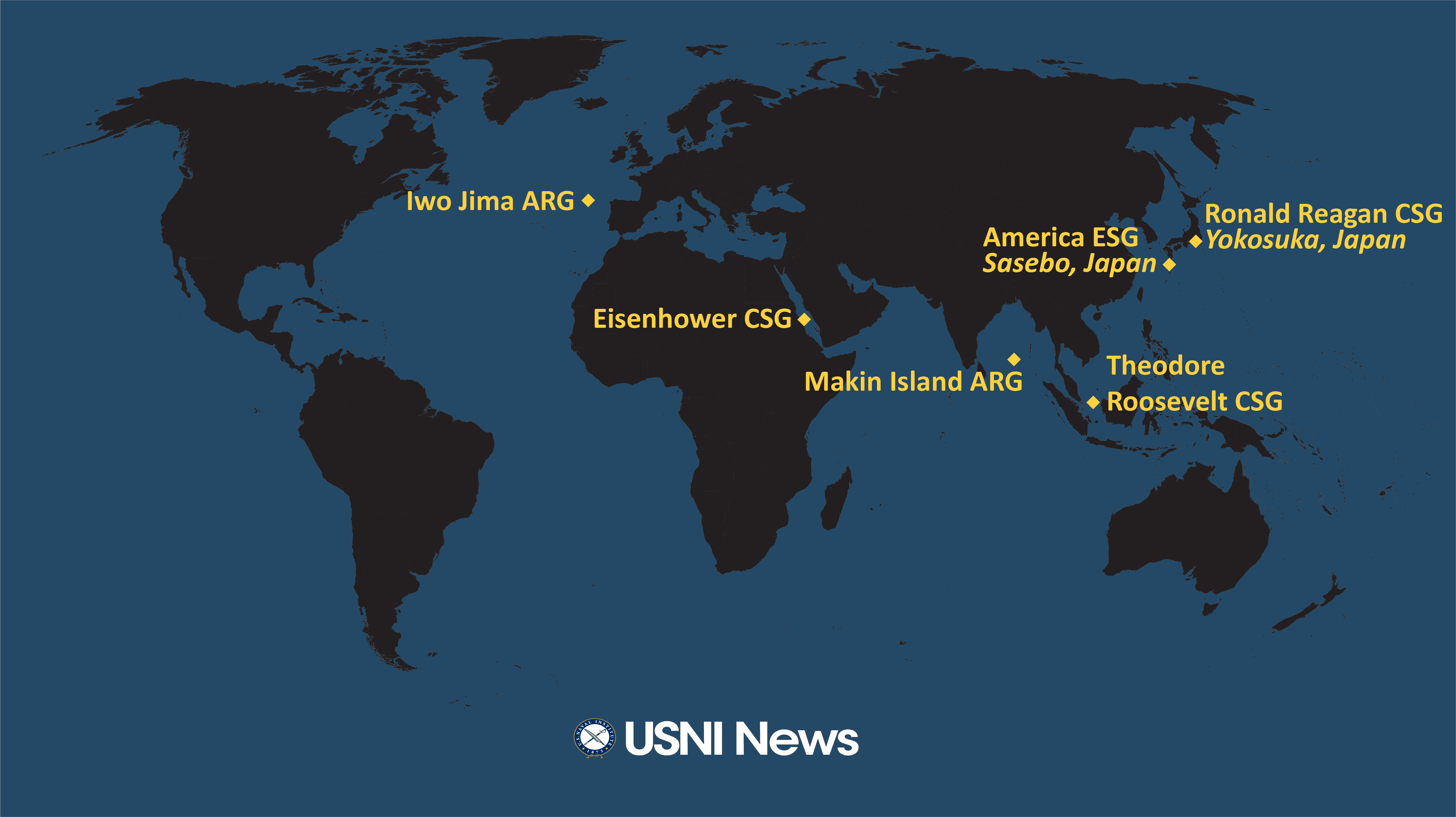
We see the Eisenhower CSG in the Red Sea with Carrier Air Wing 3 aboard USS Dwight D. Eisenhower.

Approaching the European coast is the Iwo Jima Amphibious Ready Group and the 24th Marine Expeditionary Unit.

Wasp-class amphibious assault ship USS Iwo Jima (LHD-7), Harpers Ferry-class dock landing ship USS Carter Hall (LSD-50) and amphibious transport dock USS San Antonio (LPD-17) make up the ARG. Embarked detachments for the Iwo Jima ARG include Amphibious Squadron Four, Fleet Surgical Team (FST) Six, Helicopter Sea Combat Squadron (HSC) 26, Tactical Air Control Squadron (TACRON) 21, Naval Beach Group (NBG) Two, Beach Master Unit (BMU) Two, Assault Craft Unit (ACU) Two and Four, and Sailors from Amphibious Construction Battalion (ACB) Two.

The 24th MEU, which is headquartered at Marine Corps Base Camp Lejeune, N.C., consists of a ground combat element, Battalion Landing Team (BLT) 1/8, a logistics combat element, Combat Logistics Battalion (CLB) 24, and an aviation combat element, Medium Tilt-Rotor Squadron (VMM) 162 Reinforced. The 24th MEU also includes a Light Armored Reconnaissance detachment.

The 24th MEU is big enough to seize a beach or a port, or hold off an armored brigade – not big enough to conduct larger offensive operations.

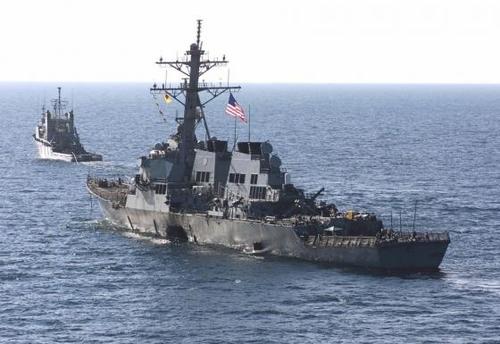
While the Eisenhower CSG sits in the Red Sea, we have an announcement by Turkey’s foreign minister that it granted permission for US warships to use the Bosporus and Dardanelles straits to enter the Black Sea at a moment tensions with Russia over Ukraine. Given it revealed the initial notification was two weeks ago, a pair of American warships are expected imminently to enter the Black Sea.

The foreign ministry said in a statement while referencing the treaty that regulates passage through the straits: “A notice was sent to us 15 days ago via diplomatic channels that two U.S. warships would pass to the Black Sea in line with the Montreux Convention. The ships will remain in the Black Sea until May 4.

Importantly, all of this comes just days after Ukraine’s president Volodymyr Zelensky personally urged NATO to immediately expand its Black Sea presence. He had said in a phone call with NATO Secretary-General Jens Stoltenberg, “Such a permanent presence should be a powerful deterrent to Russia, which continues the large-scale militarization of the region and hinders merchant shipping,” the president’s press service indicated in a readout.

But Russia’s Defense Ministry on Thursday announced naval maneuvers of its own, confirming that it’s moving more than 10 navy vessels from the Caspian Sea to the Black Sea in order to conduct naval exercises. 

With the rival naval build-up on the Kremlin and Ukraine’s doorstep, and with the mutual amassing of troops on either side of the border… what could go wrong?

Achegos Margin Call

3 Important Business Lessons From Movies - business movies consulting sales  marketing

Robert Gore teaches some great truths in his “Everything I Know About Business I Learned From The Godfather.”

I grew up in that neighborhood so I never needed to read Gore. I got it every day. Bodies dumped in allies, Grazy Joey Gallo, Colombo. I lived within 200 feet of Don Carlo Gambino’s house. Very generous to all the kids visiting for trick or treat. Safest block in Brooklyn.

One of my favorite movies is “Margin Call.” Jeremy Irons plays John Tuld who runs an investment bank who suddenly finds itself sitting on illiquid assets far in excess of their risk capital.

Tuld has some great quotes as risk management briefs the executive committee, including “There are three ways to make a living in this business. Be first, be smarter, or cheat.” Knowing they need to exit ahead of market recognition of the bottom falling, Tuld plans to exit his positions ahead of everyone else.

Navesink offers a great summary of the Archegos debacle: https://navesinkinternational.com/2021/04/04/archegos-the-questions-nobody-asks/?utm_source=mailpoet&utm_medium=email&utm_campaign=Navesink-International-April-2021.

Unlike “John Tuld”, Archegos wasn’t first to the exit. Nor was CS.

There has been a lot of press articles on the Archegos blow-up already, but many important questions have still not been asked.

The factual background

  • Archegos Capital Management is a family office, which manages the money of Sung Kook “Bill” Hwang since 2013. Hwang is a “Tiger Cub”, a former PM/Analyst from famous Tiger Management. Hwang was managing $500m of his own money, which he earned through his role as a portfolio manager in the previous decade.
  • Hwang started as a stock Salesman in early 90’s at Hyundai Securities. After a legal battle which started in 2009, Hwang and his firm Tiger Asia Management pleaded guilty in 2012 to insider trading & stock manipulation charges. They settled $44m with the SEC and HKD 45m with the HK Securities and Futures Commission.
  • Archegos is actually the new name of his old company Tiger Asia Management. The firm is based in New York, since Hwang was banned from trading in Hong-Kong in 2014, as well as other Asian markets in which he specialized.
  • Archegos held large concentrated bets in a few companies, notably ViacomCBS, Discovery, Baidu, Tencent and Vipshop.
  • Besides his own stock positions (already large), he also held stocks synthetically through swaps at prime brokers.
  • The primes didn’t know of the extent of his other prime relations and how large the positions were. The overall position was not $10bn, but more than $50bn – rumored to reach $100 bn.
  • The list of affected primes is increasing. Only JP and Deutsche seem to have escaped that wreckage. JP, because they refused to offer services to Archegos, and Deutsche, because they were quick to offload positions.

The unbundling

  • His large direct and synthetic acquisitions pushed the stocks up, often becoming one of the largest shareholders, just with regular stock ownership.
  • It is speculated that Hwang accepted, if not bet, on the stock rise since momentum traders would have to follow-up and purchase more shares. The stock would also attract activist retail traders (think “a new Gamestop!”)
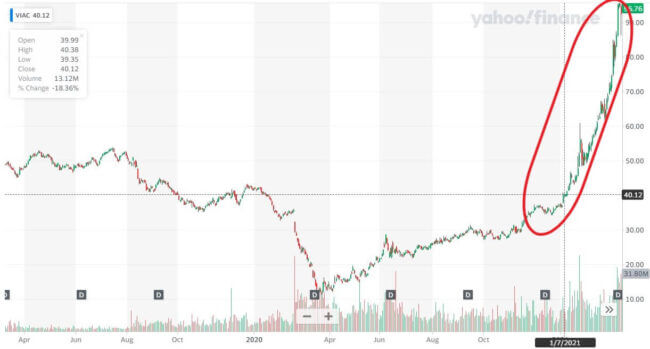
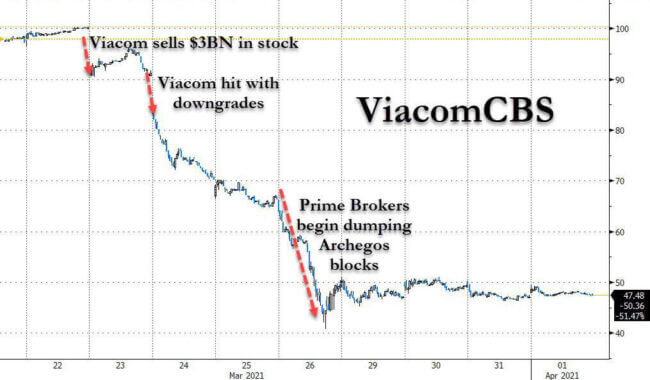
    • ViacomCBS notably went up 300% in early 2021, surely thanks to its well-delivered online movie platform Paramount+, but surely also thanks to Hwang’s purchases.Viacom CBS 2019-2020
  • Unfortunately, late on March 22nd, ViacomCBS announced a $3 bn stock and convertible bond sale to cash in on its $100 stock price. The stock dropped 10% on the open.
  • Analysts announced stock downgrades. The stock loses another $20 in the next few days.
  • On March 25th, some of the prime brokers called Archegos on margin, or at least to sell some stocks to free capital and meet the margin call. Hwang adamantly refused. A posteriori, we can guess that he would never have freed enough capital, and that the stock sale would have generated more margin call, starting a snowball effect.
  • The primes talked to each other that day. Credit Suisse wanted to give him a few days. Goldman and Morgan Stanley seized the collateral instead.
  • On Friday, March 26th, and maybe during the weekend as well, Goldman sold $3.3bn of ViacomCBS collateral via block sales before the open. Deutsche quickly unwound $4bn of shares, notably to Marshall Wace. Morgan Stanley and Wells Fargo followed. The stock ended the day around $45, down ~50% from its top.VIAC downfall
  • On Monday, Zurich time, Credit Suisse announced that it faces a “highly significant loss”. Its share fell 21%. The rumor mill indicates $4-5 bn of losses. The firm, which recently took losses for the Luckin Coffee fraud, the Greensill Capital collapse, as well as a laundry list of other compliance issues, is now considering exiting its CRO and its investment bank head (respectively Lara Warner and Brian Chin). Closer to home for the shareholders, Credit Suisse has a CHF1.5 bn ($1.6bn) share buy-back in progress, and it is now at risk.
  • Nomura announced a $2bn loss. The stock barely moved.
  • JP Morgan estimates there is $10bn of loss spread between Wall Street banks.

The questions everybody asks

Archegos was estimated to have $10 bn of capital at the time of the events.

Note: by comparison, in 2007, Lehman’s leverage was 31, while its large mortgage securities portfolio made it highly susceptible to the deteriorating market conditions. On March 17, 2008, due to concerns that Lehman would be the next Wall Street firm to fail following Bear Stearns’ near-collapse, its shares plummeted nearly 48%. They subsequently pulled off a capital raise, and boosted its liquidity pool to an estimated $45 billion, decreased gross assets by $147 billion, reduced its exposure to residential and commercial mortgages by 20%, and cut down leverage from a factor of 32 to about 25. By September 2008, they were down to $1 billion.

Back to the Archegos story.

  • At the time of its wreck, the fund was rumored to have 50-100bn of exposure through swaps. That would be a 5x – 10x leverage on an indicated capital of $10 bn. That level of leverage is rarely offered by primes. Only the biggest, most diversified and excellent risk manager hedge funds like Citadel or Millennium are offered that type of leverage. A concentrated stock picker would be offered probably around 2x, at best 3x.
  • The reason Archegos was able to gain such high leverage, was because the primes didn’t know of the existence of so many other prime brokers (8?) supporting Archegos… in the same trades! There is here a structural issue at the confluence of confidentiality and leverage.
  • Hwang had a checkered past. He was caught manipulating stocks, and trading on insider information. He was a persona non grata in Asia. Why was he offered so much leverage in the US? We all know that primes prefer big famous PMs to smaller less-known PMs, but there are some risk-management issues to be learned here.
  • The fact that a fund was able to leverage so much – and costing so much to Wall Street – by hiding its multiple swaps is a glaring fault from a risk-management perspective.
    • The world of prime brokerage and swap trading is competitive, and banks do not disclose to each other how much leverage they extend to their clients (or even which clients they have).
    • In a world with low interest rates, the client-facing synthetic equity business is valuable. It is mathematically market risk-free (no VaR, only credit risk), while real money (institutionals and family offices) are considered very safe credit-wise. It is also profitable, with probably 20-40 bp margin, posted against a highly leverageable balance sheet.
    • Building prime brokerage activities is not cheap – systems, staff, compliance, support functions, etc, require top dollars. Banks have heavily invested in the activity, because prime brokerage becomes highly profitable when it reaches a critical mass of large hedge funds and family offices.
    • As a result, banks are bending over backward to attract and keep these top clients. This explains why Archegos was able to bend the rules and acquire extra leverage.
  • The Archegos situation is also a problem from a regulatory perspective.
    • There are no disclosure requirements for family offices, which are neither banks (heavily regulated) nor hedge funds (lightly and recently regulated). [Family offices are investment vehicles for a single investor. Because a 401(k) also fulfills that definition, a minimum of $100m in assets is usually considered as a minimum. If there are probably 50k individuals with that wealth, and 5-10k are managing their wealth themselves in a family office.]
    • Family and multi-family offices are now managing an estimated $6 trillion in assets. For comparison, the ETF business is now around $7.5 tn, and it is highly regulated and closely monitored.
    • Now, there is plenty of criticism already about the source of the wealth from wealthy families, or how they (mis-)manage their wealth, or how they influence the world… Some of these questions deserve to be asked if there is some wrongdoing. But I think also that people are entitled to some privacy. If Bill Gates wants to invest into farm land or Coca-Cola, that is his absolute right and none of our business. Which means regulating family office and private wealth like other asset managers is probably over-the-top.

The questions nobody asks

Now, there are inconsistencies in the currently available information. Here are some of the questions which needs to be asked:

  • If Hwang started with $500m, where do the $10bn come from? Archegos is said to be a single-family office, and therefore has no other investors.
    • So, Archegos would have leveraged $500m into $10 bn of assets by trading stocks on margin. A 20x leverage? Unlikely.
    • Archegos accumulated gains from $500m to $10bn. A 20x gain over six years cannot happen unless you are highly leveraged. And if you are highly leveraged, the losses can be as fast as the gains.
    • Or a combination of both.
    • Anyhow, it is obvious that Archegos was highly leveraged.
    • And if you have any doubt, that leverage would have shown in the Sharpe and volatility monitoring executed by the primes.
  • We do not know the origin of the $10 bn he was indicated as managing. Was he managing money from other investors in his family office? If he was, he may be swimming with concrete shoes sooner than later.
  • We have no true idea of Archegos positions. Right now, we only hear rumors on positions and leverages. JP says there is $10 bn of losses between the various PBs. Where is that information coming from?
  • Hwang has managed a hedge fund. He knows the difference between long-only and long-short. Was he really long only, without market hedge, with his own money? Was he instead shorting stocks against his known longs, in a relative value play?
    • The $50bn would be the gross capital, aka 2x $25 bn. That reduces the leverage by as much. But we haven’t heard of any short wins/losses.
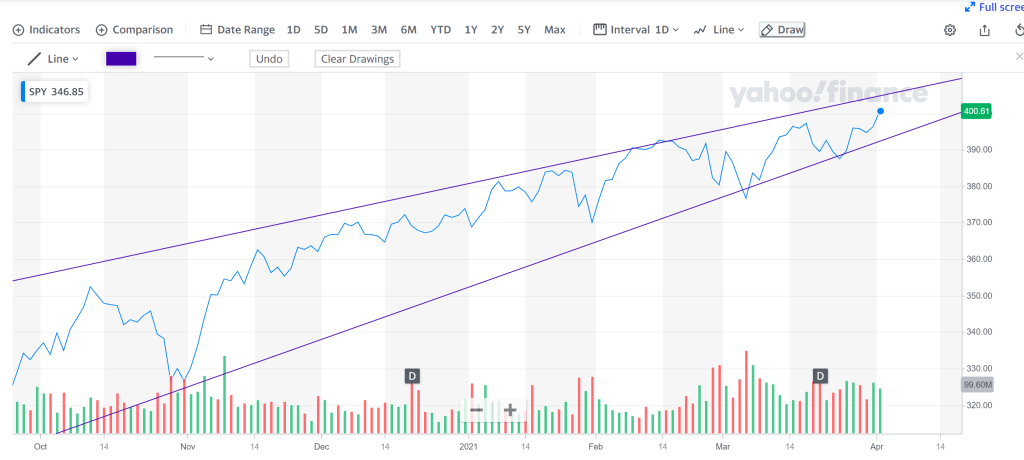
    • Also, even $25bn of S&P futures creates a lot of margin calls when the S&P goes from 2,500 to 4,000+…
  • The prime-brokers would have had a conversation on March 25th to decide between themselves what to do with the Archegos situation. Such a conversation between primes is hard to believe:
    • They are bound by confidentiality requirements. They simply are not allowed to discuss their clients’ positions to anybody (but regulators).
    • The PM would have had to agree to the call, if not be present on the call. Why would Hwang have agreed to that call?
    • Prime brokers talking between themselves of the overleverage? Credit Suisse asking for time? That’s not how it works. As soon as the PBs would have realized the extent of the leverage from the conversation, they would immediately have started liquidating the positions. The first one to rush to the door has a chance of making it alive. The 3rd or the 5th does not. It is unlikely they would discuss such a coordinated action, because they know that the other brokers were not going to respect the rule.
  • How is it possible that PBs would have lent billions based on Archegos STATED (not deposited) AUM? Primes lend based on the money deposited on their account. If Archegos say that it is worth $10bn, but deposits only $1bn, a prime would only leverage the $1bn, not the $10 bn. So how could we reach $50 or $100bn of TRS?
  • I have never met Hwang. Some of my contacts have. He doesn’t appear to be a perfect angel. Prime brokers are market professionals who have seen a lot, and they know how to read between the lines. He may be a messianic and charismatic presence (large charity donations, an openly strong God-believer, running bible groups…), but the insider trader and the rule bender are also visible. Settling $50+m with the top regulators for criminal charges is no small feat. How would so many prime brokers leverage someone with such a history and such a dubious character?
  • Also, primes do not decide, but calculate, the allowed leverage. They take into account the type of risks (concentration, availability of information…). They use complicated formula and processes. It would be a major faux-pas to over-ride those processes, aka senior management involvement.
  • Did the prime brokers really not know that he was building large positions through swaps? Maybe Hwang had good insider information and he was avoiding regulatory scrutiny by using swaps? If the brokers knew, then willful blindness could be another word to describe this situation.
  • Could it be, that primes got additional information about Archegos that has not been disclosed yet, say an investigative letter from authorities for instance, and decided to unwind the positions for that reason?

IMO, we do not have enough information at this stage to truly understand what happened. In other words, the SEC needs to open an investigation… if it has not started already.

This investigation will be private, but some statements will surely follow in the months and years to come…

Clearly, somebody needs to explain where the $10 billion came from in words simple enough a golden retriever can understand.

See Much of a Trend?

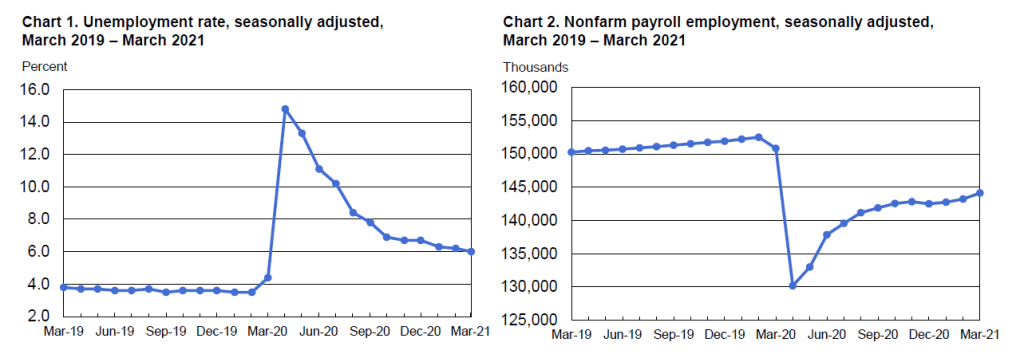
The BLS jobs report shows a trend that’s years from a recovery.

Total nonfarm payroll employment up 916,000 in March, and the unemployment rate edged down to 6.0 percent. But when you unpack things, it’s a bit squishy.

The 916K was led by gains in leisure and hospitality, public and private education, and construction.

Leisure and hospitality took 280,000 of the total. Construction grabbed 110,000 while government schools claimed 76,000.

Let’s look back a year to see what the trend was then – 347,000 in March 2020 which was essentially continuing the flatline from Summer 2019.

When you throw in the U-6 and the “not in the workforce but looking” cohort, that 6.0 percent unemployment looks more like 13.4% – reinforcing the “flatline” trend.

Teachers finally going back to work, construction projects restarted, and hospitality reopening – not anything related to “America back to work”. After all, we’re still seeing jobless claims north of 700K.

Like a year ago, we’re still ~10 million jobs short of the labor top.

And today’s leading gigs are not going to drive the labor market anywhere.

March 2021 Lower Troposphere Prints -0.01C v. 20-year Baseline

As the Sun enters the Modern Minimum, we continue to see temperatures fall versus the the 20-year warming period that just ended.

Full dataset available here: http://nsstc.uah.edu/climate/

No surprise, the snowpack is starting to build at 2-3 sigma above long-term trends, and now at 500 gigtaons north of the 1982-2012 average.

Checking IDs Is Racist!!!!

Babylon Bee Exclusive: https://babylonbee.com/news/mlb-games-to-no-longer-require-id-for-buying-alcoholic-beverages

US — Major League Baseball has announced that they will no longer be requiring any form of valid ID for the purchase of alcohol at all games. 

“We stand firm against racism and will never again require ID, and unfairly restrict people from purchasing alcohol,” said MLB spokesman Doug Wisacre. “Drinks are for everyone and hydration should always be easier to access, not harder!”

“Not everyone has the same level of access to acquiring an ID and we want to create an inclusive environment.” Mr. Wiseacre continued. “That’s why we will serve beer to all fans, no fuss no muss!”

In addition to not checking for ID, MLB is committing to no longer requiring locker room passes, or security badges which are harmful and unfairly discriminate against those who would want to enter restricted areas for nefarious reasons. They hope that this important step will provide more fairness and increase safety at all games.

No IDs at the tap – no IDs at Will-Call.

Less hate’n – more participat’n.

Crimea 2.0

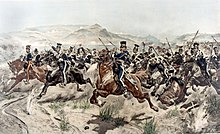
“Forward, the Light Brigade!”
Was there a man dismayed?
Not though the soldier knew
   Someone had blundered.
   Theirs not to make reply,
   Theirs not to reason why,
   Theirs but to do and die.
   Into the valley of Death
   Rode the six hundred.

Immortalized by Tennyson in his 1854 poem “The Charge of the Light Brigade” published in The Examiner, praising the brigade (“When can their glory fade? O the wild charge they made!”) while trenchantly mourning the appalling futility of the charge (“Not tho’ the soldier knew, someone had blunder’d… Charging an army, while all the world wonder’d”).

I won’t retrace the insanity of the Crimean War. You might want to check it out for yourself.

Wiki has a nice summary.

The Charge of the Light Brigade was a failed military action involving the British light cavalry led by Lord Cardigan against Russian forces during the Battle of Balaclava on 25 October 1854 in the Crimean WarLord Raglan had intended to send the Light Brigade to prevent the Russians from removing captured guns from overrun Turkish positions, a task for which the light cavalry were well-suited. However, there was miscommunication in the chain of command and the Light Brigade was instead sent on a frontal assault against a different artillery battery, one well-prepared with excellent fields of defensive fire. The Light Brigade reached the battery under withering direct fire and scattered some of the gunners, but they were forced to retreat immediately, and the assault ended with very high British casualties and no decisive gains.

What is it with the Brits and their taste for pointless gestures? The “last stand” legacy of their colonial wars that reached its apex in the Great War and the disaster at Mons? The pointless slaughter at Ypres and the Somme?

Repeated again a generation later with their futile guarantee of Polish independence when the socialist dictatorships swept away the Versailles construct that was “Poland” and restored imperial borders. Poland never had a chance, and the Brits couldn’t guarantee the borders. But their gesture got themselves into a war in which they could not win.

In World War 2.0, the BEF once again advanced into Belgium to the line of the Dyle River. And, again, just as quickly retreated after the German breakthrough at the Battle of Sedan (12–15 May). The BEF, French and Belgian forces north of the Somme River outran the German Army to Dunkirk which, as with all Brit “last stands” manufactured a “victory” in defeat.

And so, now it’s our turn in Crimea?

Seems that’s what our Sock Puppet President wants.

Crimea was colonized by the Greeks, the Persians, the Romans, the Byzantine Empire, the Crimean Goths, the Genoese and the Ottoman Empire, while at the same time its interior was occupied by a changing cast of invading steppe nomads and empires, such as the  CimmeriansScythiansSarmatiansGothsAlansBulgarsHunsKhazarsKipchaksMongols and the Golden Horde. Crimea and adjacent territories were united in the Crimean Khanate during the 15th to 18th century.

In 1783, Crimea was annexed by the Russian Empire as the result of the Russo-Turkish War (1768–1774).

Following the Russian Revolution of 1917, Crimea became an autonomous republic within the Russian Soviet Federative Socialist Republic in the USSR. During World War II, Crimea was downgraded to the Crimean Oblast after its entire indigenous population, the Crimean Tatarswere deported to Central Asia, an act recognized as a genocide by Ukraine and three other countries. In 1954, it was transferred to the Ukrainian SSR from the Russian SFSR.[5]

With the collapse of the Soviet Union, Ukraine was reestablished as an independent state in 1991, and most of the peninsula was reorganized as the Autonomous Republic of Crimea, while the city of Sevastopol retained its special status within Ukraine. The 1997 Partition Treaty on the Status and Conditions of the Black Sea Fleet partitioned the former Soviet Black Sea Fleet and allowed Russia to continue basing its fleet in Crimea: both the Ukrainian Naval Forces and Russian’s Black Sea Fleet were to be headquartered in Sevastopol. Ukraine extended Russia’s lease of the naval facilities under the 2010 Kharkiv Pact in exchange for further discounted natural gas.

In February 2014, following the 2014 Ukrainian revolution backed by the Obama Administration, that ousted the elected Ukrainian PresidentViktor YanukovychRussia annexed Crimea after a military intervention by pro-Russian separatists and Russian Armed Forces.

Crimea-wide referendum was held on the issue of reunification with Russia; its official results showed over 90% support for reunification, however, the vote was boycotted by many loyal to Ukrain and declared illegitimate by Western governments and the United Nations. Russia formally annexed Crimea on 18 March 2014, incorporating the Republic of Crimea and the federal city of Sevastopol as the 84th and 85th federal subjects of Russia.

That brings us to the present.

Less than a month ago, the Oligarch’s Sock Puppet was awakened from his nap to sign off on $125 million in military supplies to Ukraine – or maybe “Dr.” Jill signed off – whatever. (https://www.defensenews.com/global/europe/2021/03/01/us-announces-125-million-in-military-aid-for-ukraine/)

Recall Corrupt Joe Inc. (a family business) has been cashing in on Ukraine for quite some time. Seems we’re into guaranteeing Ukraine’s military adventure.

Should we expect Russia might guarantee Venezuelan adventures in reply. What might we do in that case?

Well, I presume some serious military mobilization.

Sort of like what Michael Snyder describes is happening right now.

At this hour, more Russian military forces are massed near Ukraine’s borders than we have ever seen before.  Western military leaders say that they are concerned that the troop movements that we have witnessed in recent days may be leading up to an invasion, and if an invasion does happen it will greatly test the resolve of the Biden administration, EU leaders and NATO brass.  In particular, the hawks in the Biden administration would almost certainly not be willing to just sit back and let the Russians conquer all of Ukraine.  There would likely be a major response by the United States, and that could set off a chain reaction that could ultimately spark World War 3.

So what made the Russians suddenly move a massive invasion force toward Ukraine?

Well, it turns out that Ukrainian President Volodymyr Zelensky essentially signed a declaration of war against Russia on March 24th.  The document that he signed is known as Decree No. 117/2021, and you won’t read anything about it in the corporate media.

Read the rest here – some great road photos of Russian artillery and armor heading to the border:

As Russian Tanks Move Toward Ukraine, The Globe Braces For The Possibility That World War 3 Could Soon Erupt

Note – the Russians aren’t sending their “National Guard” –  Федеральная служба войск национальной гвардии Российской Федераци. Nope, they are sending first-line troops to the border: the 56th Guards Air Assault Brigade. The brigade was first formed in 1979 and fought in the Soviet–Afghan War, the 1st & 2nd Chechen War.

Check them out:

So, when US-backed provocation is met by Russian counter-force, what’s the US/Ukraine response?

Let’s let Southfront explain it.

I get that Joe Biden Inc. has some dough on the line in Ukraine. But, is all this worth it? Is confronting Russia on its border in land that is demographically Russian worth the risk?

And when Russia doubles-down – as they said they will – how far will we meet each “raise”?

Can we prevail in Crimea? Doubtful unless we are willing to go “all-in”.

To what end?

Solar Driver of Climate Change

Energy imbalance is central to understanding and explaining climate change.

The NASA-Goddard simplified representations does not show any long-term imbalance; others (Trenberth, Fasullo, & Kiehl, 2009) show an “net absorbed” of 0.9 W·m-2. The U.S. Global Change Research Program (USGCRP) indicates a “Surface imbalance” of 0.6 ±0.17 W·m-2 (one appreciates the margin precision).

Judith Curry observes taking into account all potential errors leaves the true range of validity of this imbalance of the order of hundreds of percent, thus challenging the narrative of a ticking time bomb accumulated in the ocean depths.

The take-away is a small change in energy balance can have measurable impacts on climate temperature.

Zharkhova (2021) modeled the daily ephemeris of Sun-Earth distances in two millennia (600–2600), and explains the two-millennial variations (Hallstatt’s cycle) of the baseline solar magnetic field measured from Earth. These S-E distance variations translate to variation of total solar irradiance (TSI) with increases in February–June by up to 10–12 W-m-2 in M1 and 14–18 W-m-2 in M2. Note these variations exceed the imbalances attributed to measured GHG concentration increases.

The annual TSI magnitudes, calculated from the daily S-E distances reveal a much larger annual increase of the total solar irradiance by about 20–25 W-m-2 by 2500 in M2 compared to millennium M1. This means there is an excess of solar radiation input into the terrestrial atmosphere in millennium M2 not accounted for by any other consideration that has to be considered for the solar forcing.

For the present, the Sun entered the period of a reduced solar activity in 2020: the Grand Solar Minimum (2020–2053). Zharkova anticipates a decrease of solar irradiance during this GSM is expected to be about 3 W-m-2, or 0.22%.

References:

Curry, J. A. (2021, March 28). A pertinent climate question. Retrieved April 1, 2021, from Judithcurry.com website: https://judithcurry.com/2021/03/28/a-pertinent-climate-question/

Kramer, R. J., He, H., Soden, B. J., Oreopoulos, L., Myhre, G., Forster, P. M., & Smith, C. J. (2021). Observational evidence of increasing global radiative forcing. Geophysical Research Letters, 48(e2020GL091585). https://doi.org/10.1029/2020GL091585

Trenberth, K. E., Fasullo, J. T., & Kiehl, J. (2009). Earth’s global energy budget.
Bulletin of the American Meteorological Society, 90(3), 311–323. https://doi.org/10.1175/2008BAMS2634.1

Zharkova, V., (2021). Millennial Oscillations of Solar Irradiance and Magnetic Field in 600–2600. DOI: 10.5772/intechopen.96450