CCP/SARS-CoVid-19 Phylogeny Update

NextStrain update: https://nextstrain.org/ncov/global

For the longest time, CCP/CoVid-19 has shown remarkable viral genetic stability – remarkable for a zoonotic pathogen that only “recently jumped” species.

Even more remarkable in that the “jump” occurred without any known species as the vector.

And further remarkable that CCP/CoVid-19 is ~96% similar to a virus “discovered” in an abandoned mine in 2013, and only mentioned in 2020 but which no known samples are available (Zhou et al. (2020)).

This stability is particularly remarkable since CCP/CoVid-19 is a single-strand RNA virus – a class of viruses that normally evolve rapidly.

Only after widespread disperson did this stability finally begin to give way to evolution. Note the emergence of the new variants in late Q4, 2020 (upper right of the phylogeny diagram). The sudden ruse in reported COVID-19 cases are attributed to new SARS-CoV-2 variants 501Y.V1 (B.1.1.7) in the UK and 501Y.V2 (B.1.351) in South Africa.

These variants share a key mutation N501Y on the receptor binding domain (RBD) that make them more infectious to humans.

As reported by Tian et al. (2021), RBD N501Y mutations are of higher binding affinity to ACE2 than the wild type, a faster association rate, and slower dissociation rate.

Steered Molecular Dynamics (SMD) simulations on the dissociation of RBD-ACE2 complexes revealed that the N501Y introduced additional π-π and π-cation interaction for the higher force/interaction.

The reinforced interaction from N501Y mutation in RBD should play an essential role in the higher transmission of COVID-19 variants observed to date and likely to continue.

All in, quite “remarkable.”

Reference:

Tian, F., Tong, B., Sun, L., Shi, S., Zheng, B., Wang, Z., … Zheng, P. (2021). Mutation N501Y in RBD of spike protein strengthens the interaction between COVID-19 and its receptor ACE2 (p. 2021.02.14.431117). doi:10.1101/2021.02.14.431117

Zhou, P., Yang, X.-L., Wang, X.-G., Hu, B., Zhang, L., Zhang, W., … Shi, Z.-L. (2020). A pneumonia outbreak associated with a new coronavirus of probable bat origin. Nature579(7798), 270–273.

Last Stand

Holding the line – it’s a phrase that flows through history. Poetic imagery.

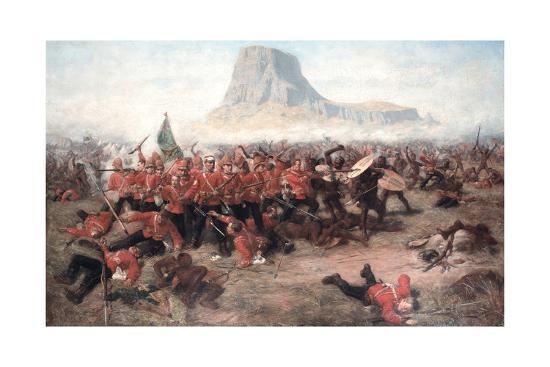
Like the Battle of Iswandllwana:

The Battle of Isandlwana: the Last Stand of the 24th Regiment of Foot  (South Welsh Borderers)…' Giclee Print - Charles Edwin Fripp | Art.com

At Thermopylae, King Leonidas I of Sparta faced overwhelming odds from the Achaemenid Empire of Xerxes I over the course of three days during the second Persian invasion of Greece. As Herodotus tells us: “Here they defended themselves to the last, those who still had swords using them, and the others resisting with their hands and teeth.”

Scene of the Battle of the Thermopylae.jpg

The list is endless – Masada, Mecca, Kosovo, Agincourt, Constantinople, Stand of the Swiss Guard, Fort St. Elmo, Alamo, Kabul, Little Big Horn, Rorke’s Drift, Warsaw Ghetto, Berlin.

Some were triumphant in the face of the onslaught (Agincourt) – most, well, not so. Aftr all the odds are overwhelming in last stands.

But all glorious(?) At least the poets say so.

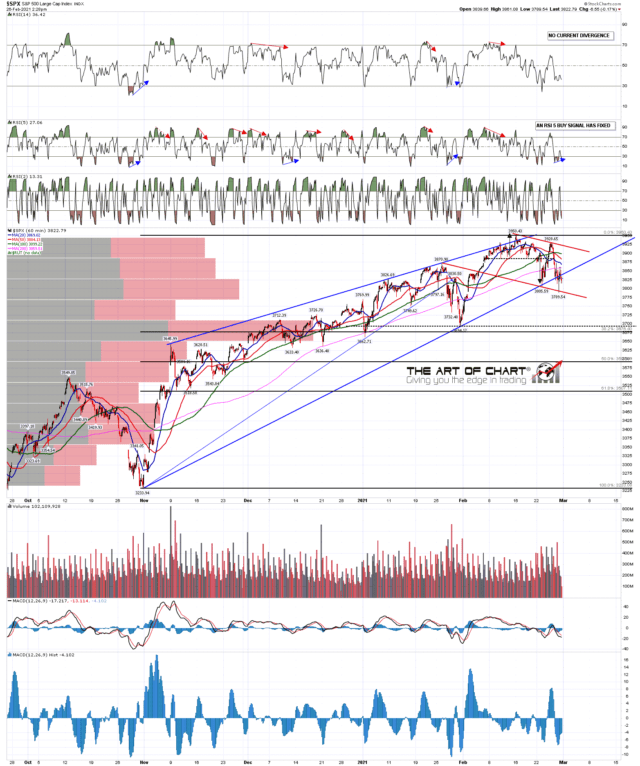
And so, in the tradition of Last Stands, we find Evil Speculator draw the SPX battle line (https://evilspeculator.com/battle-lines/). ES offers us two scenarios:

Scenario A:

  • A drop through 380 followed by a snap back higher (which is what we’re seeing in the ES futures right now).
  • From there the previous lows holds and we are done with this correction.

Scenario B:

  • A drop through 380 followed by a reversal or retest higher.
  • The retest fails or fizzles out and gravity takes over drawing us toward 370 or even lower.

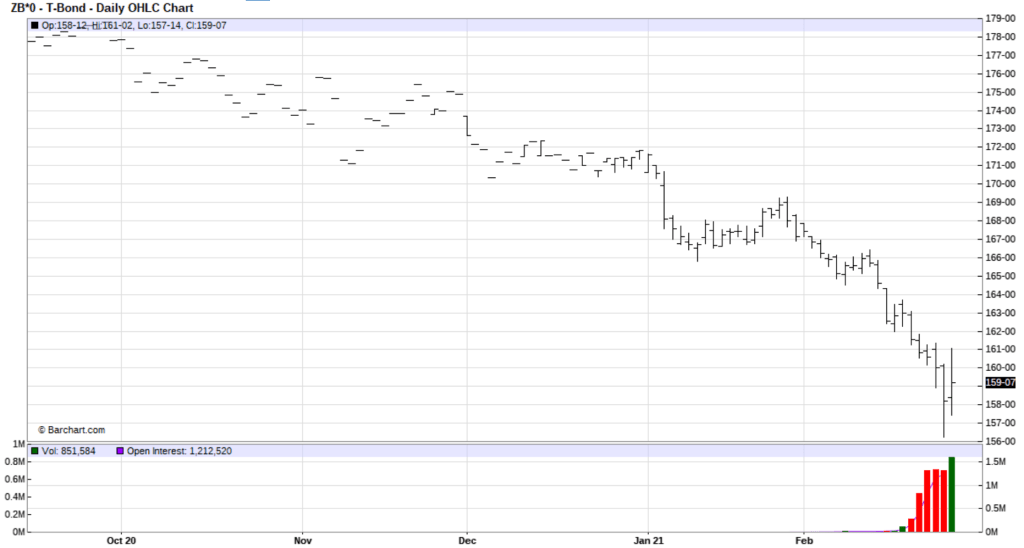
The canary in the bond “landmine” could well be ZB – treasuries.

How long it will last is anyone’s guess but the battle line has been drawn and it’s at the 156 mark. Let me be crystal clear about this: If that threshold is being breached in the near future then it will open the floodgates of panic selling.

For those of you scoring at home, here’s the latest ZB – a true last stand picture. This is where acceleration to the downside may be far too much to successfully pull out:

Will bonds hold the line? They’re coming up on it fast and acclerating.

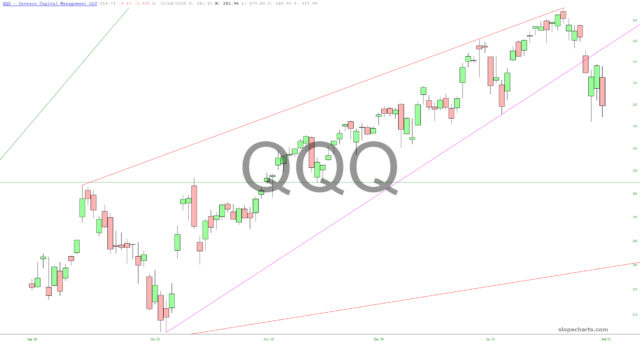
Over at Slope of Hope, Tim Knight sees bull flags forming among the rising wedges and retracements: https://slopeofhope.com/2021/02/likely-bull-flags-forming.html

Thermopylae? Or Agincourt?

Hard to say.

This story shall the good man teach his son;
And Crispin Crispian shall ne’er go by,
From this day to the ending of the world,
But we in it shall be rememberèd—
We few, we happy few, we band of brothers;
For he to-day that sheds his blood with me
Shall be my brother; be he ne’er so vile,
This day shall gentle his condition;
And gentlemen in England now a-bed
Shall think themselves accurs’d they were not here,
And hold their manhoods cheap whiles any speaks
That fought with us upon Saint Crispin’s day.

William Shakespeare Henry V, Act IV Scene iii(3)

Capitol Police Could Use a Refresher on Weapons Safety

US military weapons training provides a set of “rules” for safe handling and use of firearms.

Army, Marines, Navy, etc., they’re all very similar.

Here are 5 of the most important:

Rule 1: Treat every weapon as if it were loaded.
Rule 2: Never point a weapon at anything you do not intend to shoot.
Rule 3: Keep your finger straight and off the trigger until you’re ready to fire.
Rule 4: Keep the weapon on “safe” until you intend to fire.
Rule 5: Know your target and what is beyond it.

Seems from these photos, the Capitol Police Lieutenant on the left violated Rules 2, 3, and 5 – the guys in front of him were lucky he didn’t inadvertently shoot them.

Anybody with weapons experience knows you never put your finger on a trigger until you are in the proper combat stance (e.g., Weaver, Isosceles), cleared the area near the target, engaged the target, and are about to shoot.

At least the guy on the bottom had his finger in the proper position as required under Rule 3 – OFF the trigger.

Question remains: was he really planning to shoot unarmed trespassers?

Given the number of weapons drawn at this point, were these bozos really planning to shoot unaramed trespassers while behind locked doors and not at immediate risk of harm? If that was not their intent, why the drawn weapons?

Sure seems like they had the mindset to take a shot.

Monetary Politburo News

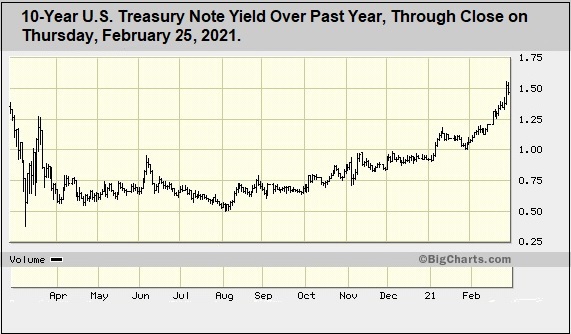
U.S. Treasury Note Yield Through February 25, 2021

The “Martens” at Wall Street on Parade weighed in today on the dynamics of endless money creation: https://wallstreetonparade.com/2021/02/wall-street-sends-a-message-to-the-fed-we-have-run-out-of-places-to-stuff-your-treasuries/

The practical dynamics.

As in “where all this sh___ goes” dynamics.

Recall we have a monetary politburo for all sorts of reasons you likely heard before – bankers want to offload their liquidity risk onto the public, politicians want to hide taxes in plain sight, those close to the food chain wanted an arbitrage subsidized by the public.

All true, of course.

The problem is when assets are created without regard to demand, this stuff has to go somewhere.

Let’s let the Martens spell it out for you:

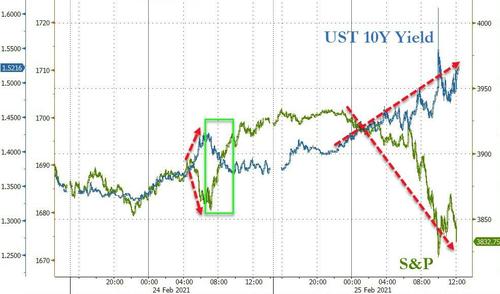
That was the scene in the Treasury market yesterday – too much supply and no where to stuff it, causing a sharp spike in yields which set off a stock market selloff that left the Dow down 559.8 points or 1.75 percent on the day, while the tech-heavy Nasdaq fared far worse, losing 478.5 points or 3.52 percent.

That the Treasury market is now projectile vomiting T-notes should come as a surprise to no one. As the chart above indicates, yields on the 10-year note have been rising sharply since early August, with the yield more than tripling from 0.50 percent to an intraday spike yesterday of 1.61 percent. The 10-year note opened this morning at 1.52 percent.

The sharp and persistent rise in yields have left those who bought the T-notes at dramatically lower yields licking their wounds from heavy losses. (Prices of notes and bonds move inversely to their yields.) That has also dramatically lessened the appetite to buy more Treasuries at the current yields when the supply is expected to continue to increase as a result of rising government deficits and stimulus spending.

Another catalyst for yesterday’s selloff in Treasuries was a very sloppy Treasury auction where the government attempted to stuff $62 billion of a 7-year Treasury note into an already over-supplied market.

The spike in yields comes despite the fact that the Federal Reserve itself has been buying $80 billion each month in various maturities of Treasury notes and bonds. That started in June of last year. As of this past Wednesday, the Fed owned $4.8 trillion of Treasury securities, part of that resulting from its purchases of Treasuries (QE programs) after the 2008 Wall Street crash.

In an additional effort to hold overall interest rates down, the Fed is also buying $40 billion each month in agency mortgage-backed securities (MBS). It owns $2.18 trillion of those, much of that also resulting from the aftermath of the 2008 crash.

The Fed’s Federal Open Market Committee (FOMC) has also directed the New York Fed’s trading desk “to increase holdings of Treasury securities and agency MBS by additional amounts and purchase agency commercial mortgage-backed securities (CMBS) as needed to sustain smooth functioning of markets for these securities.”

Aside from the Fed, the other big domestic buyers of Treasury securities are the mega Wall Street banks. These banks are known as “Primary Dealers” and are contractually bound to have to buy at Treasury auctions. This is how the New York Fed describes the role of Primary Dealers:

“Primary dealers serve as trading counterparties of the New York Fed in its implementation of monetary policy. This role includes the obligations to: (i) participate consistently in open market operations to carry out U.S. monetary policy pursuant to the direction of the Federal Open Market Committee (FOMC); and (ii) provide the New York Fed’s trading desk with market information and analysis helpful in the formulation and implementation of monetary policy. Primary dealers are also required to participate in all auctions of U.S. government debt and to make reasonable markets for the New York Fed when it transacts on behalf of its foreign official account-holders.”

On top of the problem of a supply glut is the fact that these mega banks/Primary Dealers have been allowed to gobble up other banks over the years, leading to a dramatic decline in the number of Primary Dealers available to bid at Treasury auctions. In 1988 there were 46 primary dealers. By 1999, there were only 30. Today, there are just 24. (Click on the plus sign under “List of Primary Dealers” here to see the names.)

As the House Financial Services Committee continues its investigation into the structure of stock trading on Wall Street, the Senate Banking Committee needs to tackle the structure of the Fed, its cronyism with Wall Street, and the process of government debt issuance.

27% of Household Income now comes from the Government

USBEA Personal Income and Outlays: https://www.bea.gov/news/2021/personal-income-and-outlays-january-2021

Let’s think in terms of a good news/bad news joke.

Personal income increased $1,954.7 billion (10.0 percent) in January according to estimates released today by the Bureau of Economic Analysis (tables 3 and 5). Disposable personal income (DPI) increased $1,963.2 billion (11.4 percent) and personal consumption expenditures (PCE) increased $340.9 billion (2.4 percent). (BEA)

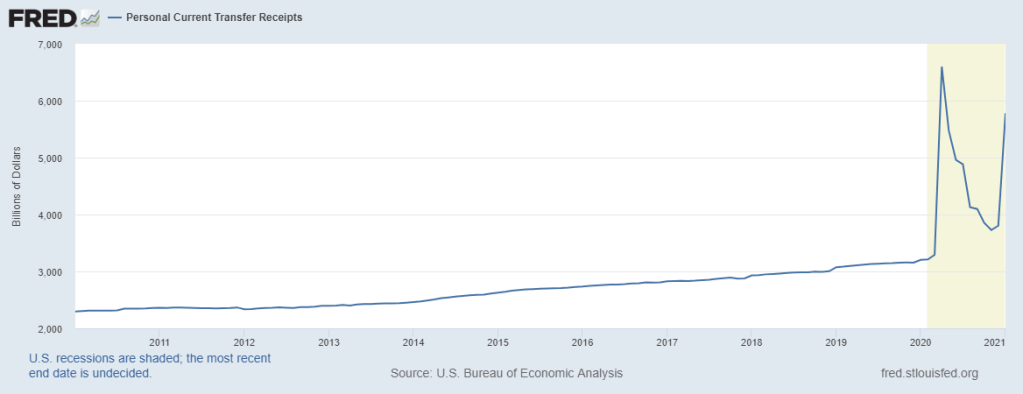
But Personal Current Transfer payments (aka government-sourced income, such as unemployment benefits, welfare checks, and so on) were up in January $5.781 trillion annualized.

That’s ~$2 trillion from the $3.8 trillion in December when it was also $2 trillion above the pre-Covid trend where transfer receipts were approximately $3.2 trillion.

And we haven’t even gotten to the good news/bad news joke.

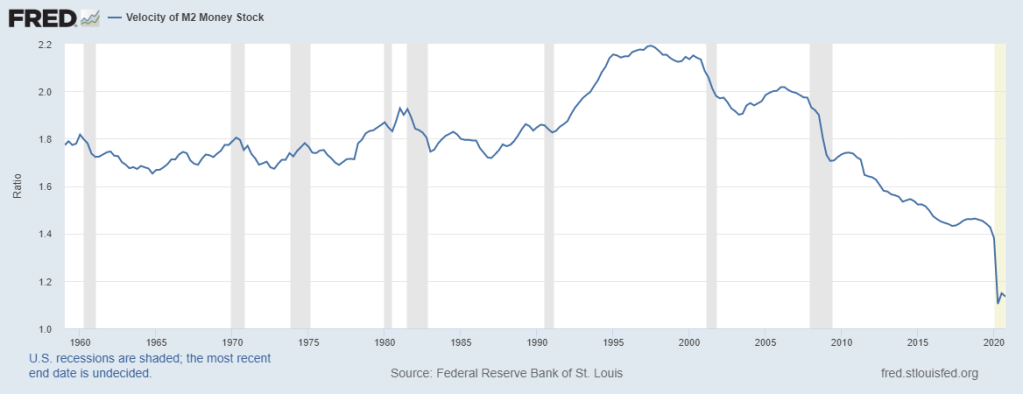
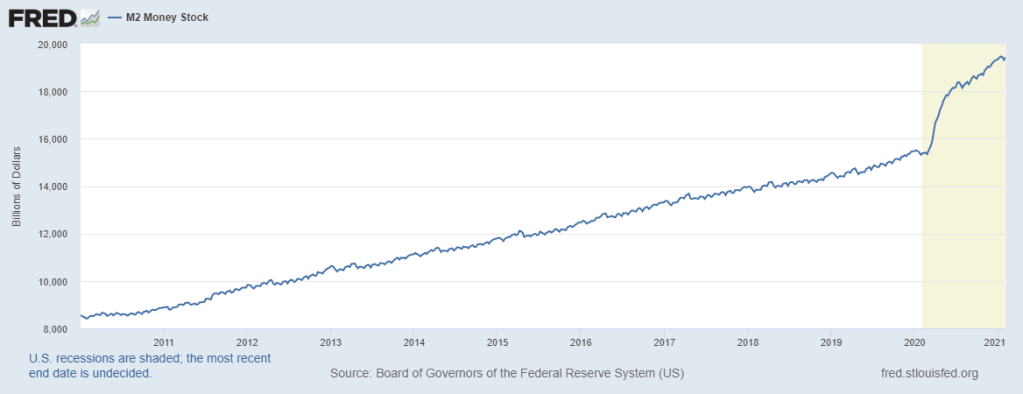
Like consider the impact of these “hot checks” on the M2 velocity and stocks:

Now THAT’s funny!

So are your supermarket bills.

Second Largest Gas Withdrawal Recorded

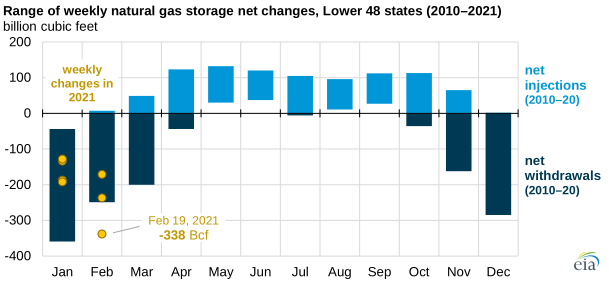
range of weekly natural gas storage net changes

EIA: https://www.eia.gov/todayinenergy/detail.php?id=46916

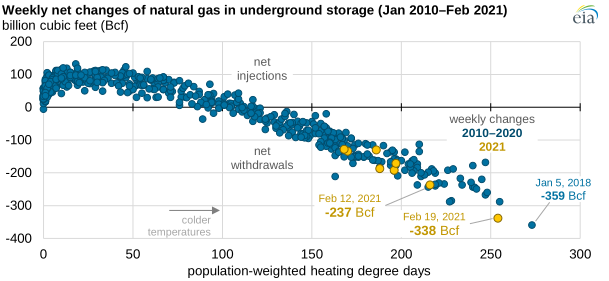
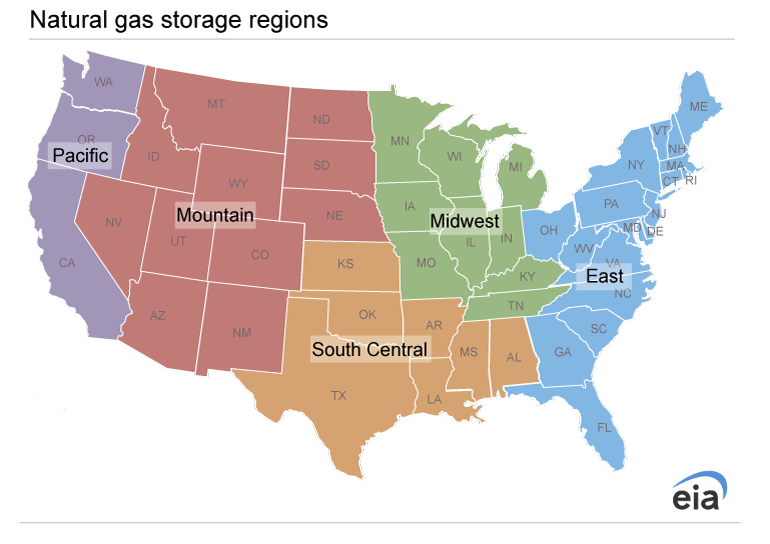
Significant demand for natural gas in mid-February led to the second-largest reported withdrawal of natural gas from storage in the United States, according to the U.S. Energy Information Administration’s (EIA) Weekly Natural Gas Storage Report (WNGSR). Weekly stocks fell by 338 billion cubic feet (Bcf) in the week ending February 19, 2021, nearly three times the average withdrawal for mid-February. A record amount of natural gas, 156 Bcf, was withdrawn during that week in the South Central region, which includes Texas.

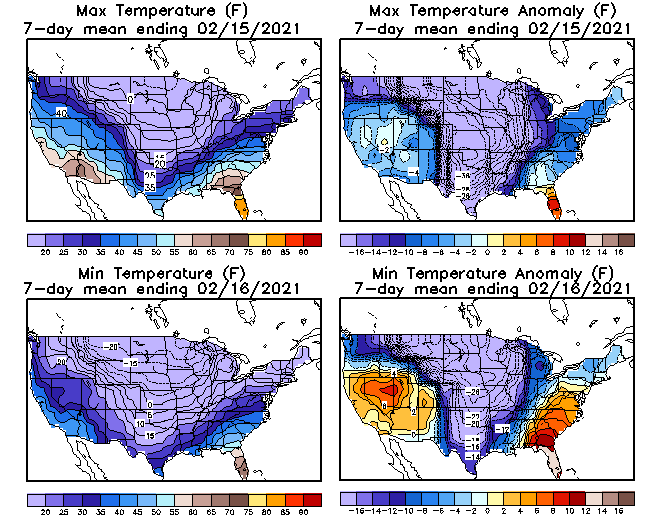
Colder-than-normal temperatures across much of the Lower 48 states, especially in Texas, led to increased demand for space heating. Population-weighted heating degree days (HDDs) represent temperature deviations lower than 65 degrees Fahrenheit and are weighted based on population distributions across the country. For the week ending February 19, U.S. HDDs reached 254, or nearly 40% colder than normal, according to the National Oceanic and Atmospheric Administration.

weekly net changes of natural gas in underground storage

Source: U.S. Energy Information Administration, Weekly Natural Gas Storage Report and heating degree days from National Oceanic and Atmospheric Administration, Climate Prediction Center


In Texas, the two most common space heating fuels are electricity (the primary heating fuel in more than 60% of Texas homes, according to Census data) and natural gas (36%). Increases in electricity demand also affect natural gas demand because natural gas is the most prevalent electricity generation source in Texas and in much of the South.

Estimated U.S. natural gas demand on February 14, 2021, reached 148.3 Bcf, surpassing the previous single-day record set in January 2019, according to estimates from IHS Markit. In addition, during the week ending February 19, U.S. average weekly dry natural gas production fell by 13.8 billion cubic feet per day (Bcf/d), according to estimates from IHS Markit. The decline in natural gas production was primarily because of freeze-offs, which occur when water and other liquids freeze at the wellhead or in natural gas gathering lines near production activities. Dry natural gas production fell by an estimated 10 Bcf/d in Texas alone, according to IHS Markit estimates.

Information in EIA’s Weekly Natural Gas Storage Report is also available on the Natural Gas Storage Dashboard, which shows natural gas inventories, storage capacity, prices, and consumption.

I’ve got three words to summarize all this: Modern Solar Minimum.

Solar Cycle 24 (December 2008 to December 2019) is recorded to be the weakest in magnitude in the “Space Age” (after 1957).

And the first for which radiometers aboard Earth-orbiting satellites can provide accurate and reliable lower tropospheric temperature (began in 1979). Temperatures (and sea level estimates for that matter) prior to 1979 are notoriously unreliable.

Which, of course, comprise the bulk of the IPCC dataset used to forecast future climate and sea levels.

Solar Cycle 24 is not only the weakest in solar activity, but also in average solar wind parameters and solar wind–magnetosphere energy coupling. This resulted in lower geomagnetic activity, lower numbers of high-intensity long-duration continuous auroral electrojet (AE) activity (HILDCAA) events and geomagnetic storms.

In fact, Solar Cycle 24 exhibited a ≈54 – 61% reduction in HILDCAA occurrence rate (per year), ≈15 – 34% reduction in moderate storms (−50 nT≥Dst>−100 nT), ≈49 – 75% reduction in intense storms (−100 nT≥Dst>−250 nT) compared to previous cycles, and no superstorms (Dst≤−250 nT).

The solar-wind energy flux into Earth’s magnetosphere (Ein) can explain up to 25% total interannual variance of the northern-hemispheric temperature in the subsequent boreal winter.

In other words, with a weakening cycle, the next decade or so will be very interesting.

And cold.

Ron Burgundy: Boy, that escalated quickly. I mean, that really got out of hand fast.

Was looking so good right up to crashing support.

Wedges in bonds and stocks, to be precise. Can you say “fear and loathing?”

I see a red door and I want it painted black.

Count on Tim Knight (Slope of Hope) to explain this in metaphysical terms we can all understand: https://slopeofhope.com/2021/02/the-problem-with-distortion.html

My point is that the “targets” of the Fed, like the ES, are freakish mutations that aren’t allowed to behave as a free market should, whereas there are still pockets of the equity world which more or less can actually behave As God Intended.

Well said.

ERCOT Margin Call

ERCOT is a “just-in-time” energy market without a capacity market and missing the ability to “call” adjacent systems or ready-to-go capacity to cover supply shortages.

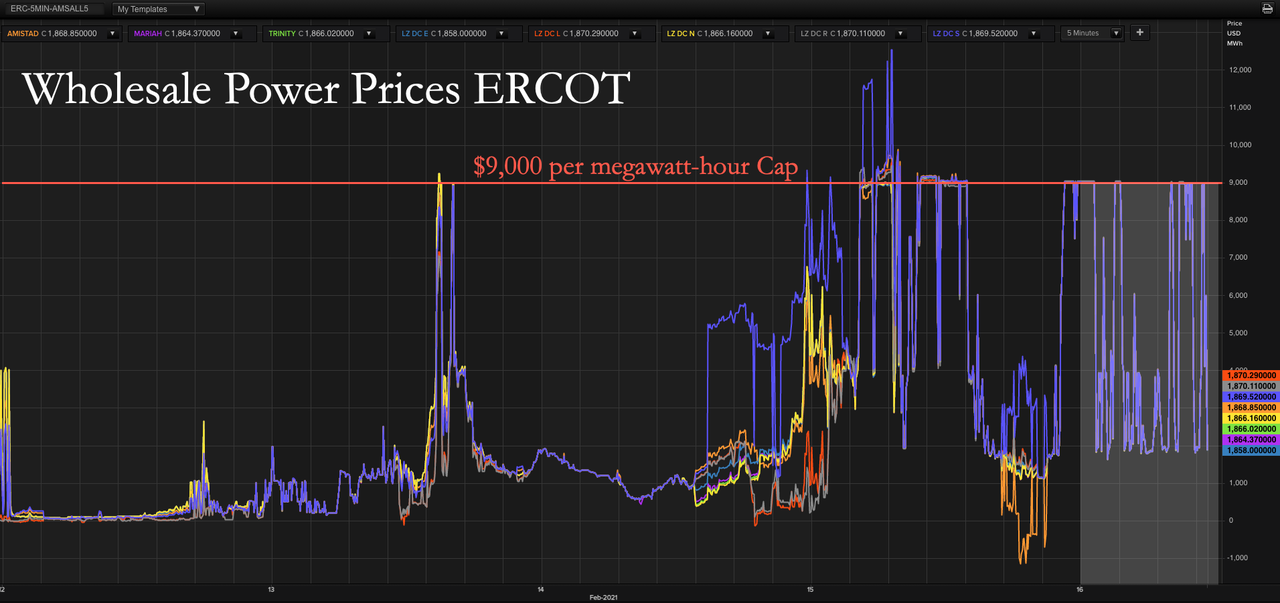
And so, – surprise, surprise – market clearing prices can get rather spikey when confronted by high demand and limited capacity.

As reported by Zero Hedge: https://www.zerohedge.com/commodities/texas-grid-operator-warns-defaults-credit-crisis-develops

The Texas energy crisis has morphed from a power grid failure to a humanitarian emergency to a credit crisis as billions of dollars in power bills come due. 

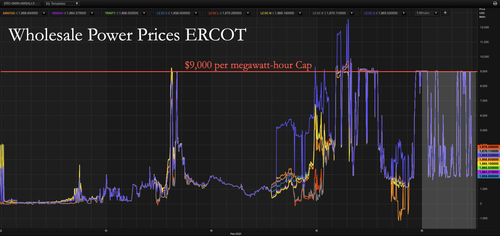
According to FT, electricity retailers, municipal utilities, and power generation companies were purchasing wholesale energy during the crisis when rates surged to a cap of $9,000 a megawatt-hour last week, owe a whopping $50 billion. 

ERCOT, the state’s grid operator, warns that some market participants have yet to post collateral to cover some of the bills as defaults begin. 

Kenan Ogelman, ERCOT’s vice-president of commercial operations, said market participants who buy power from them have to post collateral as a down payment on energy purchases. He said some entities have “failed to deliver it.” 

“Defaults are possible, and some have already happened,” Ogelman warned.

Due to surging energy prices last week and the week before, collateral requirements jumped for power buyers. At the beginning of February, ERCOT held around $600 million in total collateral. 

On Wednesday, Exelon Corporation posted $1.4 billion of collateral with the Texas power company. Exelon said it might record losses between $560 million to $710 million due to power rate volatility when three of its gas generating plants went offline. 

Ogelman said collateral requirements would peak by the end of the week and add “financial stress” to market participants. 

The Public Utility Commission of Texas ordered the grid operator on Monday to use “discretion” on settlements, collateral obligations, and payments. 

Ogelman said there are consequences for halting payments that would cascade into problems for energy futures markets operated by Intercontinental Exchange.

“There are consequences to any pause,” Ogelman said. “I think it’s important to understand that there’s a train of dominoes, essentially, that flow through ERCOT and into other markets.” 

Sean Taylor, ERCOT chief financial officer, said there are “several billions of dollars of invoices outstanding, then it’s a matter of how much of those get paid relative to the collateral we have.” 

Taylor warned: “The next couple of days will really determine where we stand.”

“To cover shortfalls from defaulting parties, the non-profit had begun to tap an almost $1bn fund supported by electric transmission contracts,” Taylor said. 

Additional stress is developing for individual customers (such as households or companies) who were socked with huge power bills. Residential customers who had variable-rate electricity plans experienced steep increases in their monthly bills; one customer’s bill went from $660 on average to more than $17,000 this month. 

… and earlier this week, it appears the first casualty of the Texas power grid crisis is Just Energy who warned the “financial impact of the Weather Event on the Company once known, could be materially adverse to the Company’s liquidity and its ability to continue as a going concern.” 

Jumpin’ Jack Flash It’s a Gas, Gas, Gas

Texas dry natural gas production

In this morning’s “Today in Energy” (https://www.eia.gov/todayinenergy/detail.php?id=46896), US EIA explains what happened with the freeze hit:

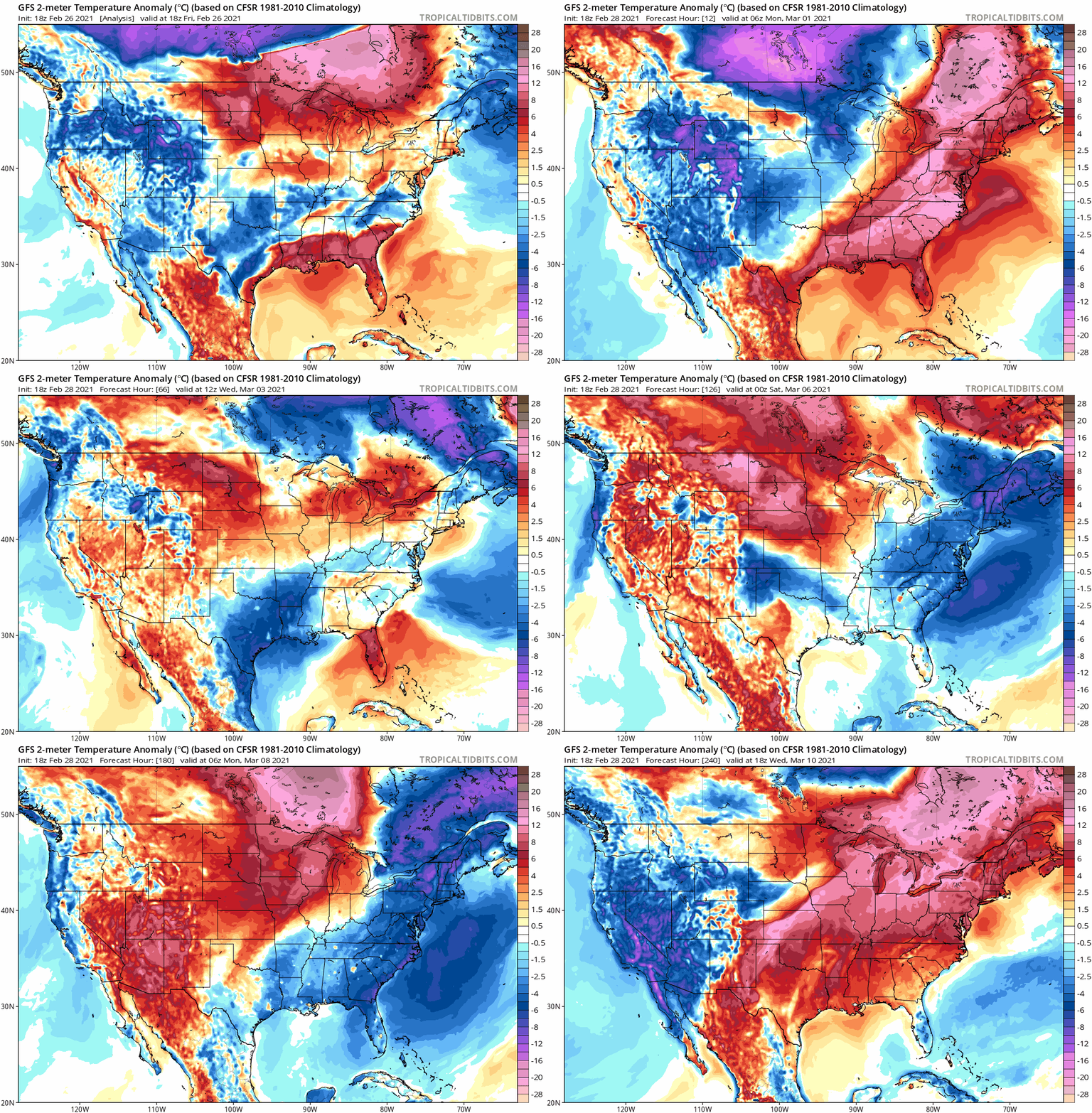
During the cold snap that affected much of the central part of the country, U.S. dry natural gas production fell to as low as 69.7 billion cubic feet per day (Bcf/d) on February 17, a decline of 21%, or down nearly 18.9 Bcf/d from the week ending February 13. Natural gas production in Texas fell almost 45% from 21.3 Bcf/d during the week ending February 13 to a daily low of 11.8 Bcf/d on Wednesday, February 17, according to estimates from IHS Markit. Temperatures in Texas averaged nearly 30 degrees Fahrenheit lower than normal during the week of February 14.

The decline in natural gas production was mostly a result of freeze-offs, which occur when water and other liquids in the raw natural gas stream freeze at the wellhead or in natural gas gathering lines near production activities. Unlike the relatively winterized natural gas production infrastructure in northern areas of the country, natural gas production infrastructure, such as wellheads, gathering lines, and processing facilities, in Texas are more susceptible to the effects of extremely cold weather. [Emphasis added]

After reaching a daily low on February 17, natural gas production in Texas began increasing as temperatures started to rise. Daily production reached an estimated 20.9 Bcf/d on February 24, only about 0.3 Bcf/d lower than the average in the week ending February 13.

That explains the evaporation of dispatched power.

What about the nondispatched? The wind turbines?

Well, Max Rust and Kyle Kim already addressed that in the piece in the aftermath of the freeze: https://www.wsj.com/articles/why-cold-weather-cut-the-power-in-texas-11613765319

Following a similar weather event in 2011, plant operators in Texas created a set of best practices for winterizing equipment, but these were voluntary recommendations, according to Dan Woodfin, senior director of system operations at Ercot.

Another major source of Texas’ electricity also susceptible to the cold contributed in part to the outages. Wind turbines installed in warm weather climates can generally operate above -4 degrees Fahrenheit but will shut down in colder temperatures. Ice buildup on the blades can also lead to slower rotations and even shut down a turbine. In northern climates such as Canada and Scandinavia, winterization measures are typically built into the turbines during manufacturing, but can be retrofitted to turbines already in operation.