As the low frequency Solar Minimum cycle continues into a 30-year bottom, we are seeing effects of the new multi-decadal cold era in the form of increasing snowmass levels in the northern hemisphere.
Sea ice bottom out 5 years ago and beginning to climb back up
The Antarctic highsheet has already returned to normal.
Many scientists have speculated that the virus leaped from animals, such as bats, to humans, perhaps with an intermediate stop in another animal. This kind of zoonotic spillover has occurred before, such as in the West Africa Ebola outbreak in 2014.
But there is another pathway, also plausible, that must be investigated. That is the possibility of a laboratory accident or leak. It could have involved a virus that was improperly disposed of or perhaps infected a laboratory worker who then passed it to others.
…
But that must not be the end of the story. China actively covered up the early stages of the pandemic, concealed the transmissibility of the virus from its own people and the world, and punished Wuhan doctors who expressed worry about it in late December 2019. President Xi Jinping did not warn the public in China or abroad until mid-January.
Since then, Chinese officials and scientists have advanced a host of dubious theories to suggest the origin of the virus was beyond China’s borders: perhaps brought to China by contaminated packaging of frozen food from abroad or from the U.S. military biodefense laboratory at Fort Detrick, Md., or from mink farms. The disinformation only heightens suspicions that China is trying to distract from or conceal something. –Washington Post
Exactly one year ago today, Zero Hedge was ‘enjoying’ our suspension by Twitter after we pointed out that scientists from the Wuhan Institute of Virology had been experimenting on bat coronaviruses, and that investigators trying to determine the origins of the COVID-19 outbreak might want to have a word with them.
We later reported that the same scientists had been using ‘gain-of-function‘ research to make bat coronaviruses more transmissible to human beings – for which they were roundly criticized in 2015.
I’ve been covering the decline of America’s middle class for over a decade with charts, data and commentary on the social depression that has accompanied the decline.
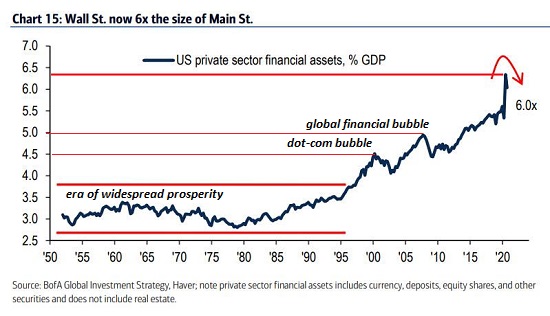
While there are many mutually reinforcing dynamics in this 45-year decline–demographics, global energy costs, financialization and globalization, to name a few– one term describes the accelerating erosion of America’s middle class: decapitalization.
To understand decapitalization, we need to start with the fundamentals of any economy between labor (wages) and capital and between investment and speculation. Although it’s tempting to oversimplify and demonize one or the other of these basics (speculators bad! etc.), they each provide an essential role in a healthy economy, one which is in dynamic equilibrium, a state analogous to a healthy ecosystem with constantly changing interactions of numerous species, individuals and inputs (weather, etc.). This variability enables the order of fluctuations (to use Ilya Prigogine’s profound phrase), a dynamic stability / equilibrium.
If labor’s share of the economy drops too low, the workforce cannot consume enough to support their households and the economy as a whole. If capital can no longer earn an attractive return, investment dries up and production stagnates. If speculators are not allowed to take on risk, liquidity dries up and risk crushes investment. But if speculation becomes the foundation of the economy’s “growth,” then the inevitable collapse of speculative bubbles will crash the economy.
In modern social-capitalist systems, the core stabilizer of the system is the wage-earning middle class which provides the stable workforce driving production and the stable pool of consumers needed to borrow money and consume enough to soak up the production of goods and services at a profit to producers.
Without a stable, dominant middle class, capital has few opportunities to invest in productive capacity. Without a stable, dominant middle class, the economy stagnates and is prone to collapse as it is far from equilibrium.
The process of middle class decline is best explained as decapitalization because the middle class is fundamentally a means of transforming labor into capital via savings and investment. The traditional ladder of social mobility from the working class to the middle class is one of capitalizing work: time and savings are invested in higher education, in effect capitalizing future labor by increasing productivity.
Capital isn’t limited to cash, land or tools; in an information economy, knowledge and skills are also capital, as is the social capital of social networking and relationships formed with mentors, suppliers, lenders, colleagues, investors, etc.
The second way to capitalize work is to save earnings and invest the savings in assets that produce income or gain value: a house, land, rental property, small business and income-producing financial assets such as bonds or dividend-paying stocks.
Thrift, investing, long-term planning and deferred consumption are all essential to capitalizing work by turning that labor into income-producing assets. As the household’s ownership of these assets that yield unearned income rises, so does their income and wealth. These increase the financial security of the household and build a nestegg which can be passed down to the next generation, improving their security via inheritance of income-producing assets.
As long as productivity is increasing the value of their labor, the middle class can leverage future earnings into assets by borrowing money to invest in assets: to buy a house, a mortgage is borrowed against future earnings. As long as the mortgage is a fixed-interest loan and income can be expected to rise with productivity, then this is a win-win situation: capital earns a predictable, low-risk return from the mortgage and the middle class household has stake in a family home, an asset which acts as a savings mechanism as the mortgage slowly pays down the debt and increases the household’s home equity–a form of savings.
The processes of decapitalization have upended this entire structure. In the systems context outlined above, our economy is out of balance and far from equilibrium and thus prone to collapse.
For the bottom 90%, which of course includes the middle class however you define it, it’s increasingly difficult to capitalize labor into capital. There are a number of factors driving this decapitalization:
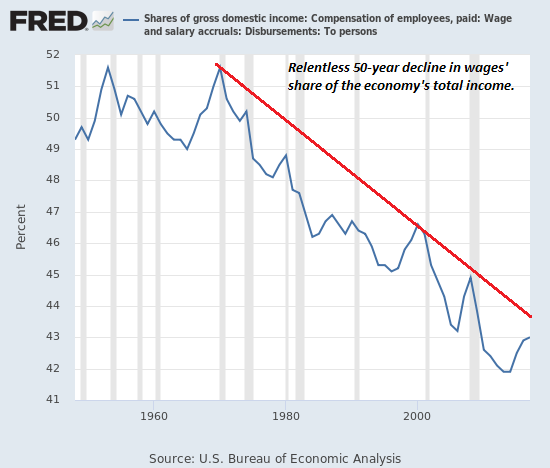
1. Wages’ share of the national income has continued a five-decade downtrend. (See chart below) National income since 1973 has shifted from labor (wages) to capital and more specifically, to debt and speculative gaming of the system, a.k.a. financialization.
Total household income in the U.S. in 2018 was $17.6 trillion. The decline in wages’ share of the national income from 1973 to 2018 is about 8.5%, which equals $1.5 trillion, the sum shifted from labor to capital every year. (See chart below)(source: https://www.statista.com/statistics/216756/us-personal-income/)
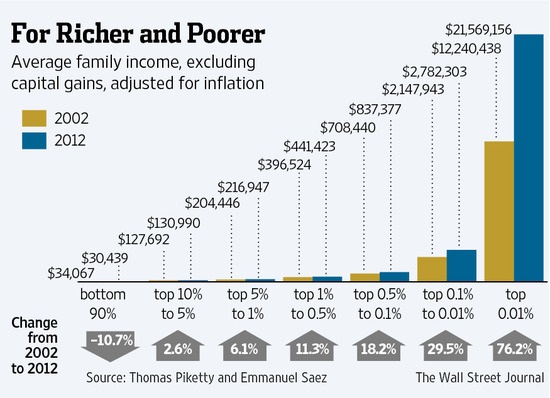
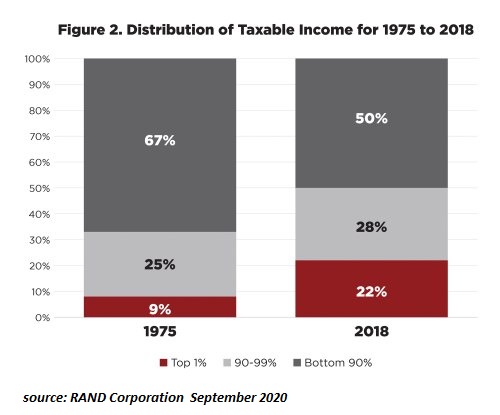
No, this is not a typo. As this RAND report documents, $50 trillion has been siphoned from labor (the lower 90% of the workforce) to the Financial Aristocracy and their technocrat lackeys (the top 10%) who own the vast majority of the capital (see charts below): Trends in Income From 1975 to 2018.
2. Within the workforce, wages have shifted to the top 10% who now earn 50% of all taxable income. (See RAND chart below) Financialization and globalization have decapitalized the skills of entire sectors of the workforce as automation and offshoring reduced the human capital of workers’ skills and experience and the value of their social capital. When the entire industry is offshored, skills and professional relationships lose their market value.
In a fully globalized economy, every worker producing tradable goods/services is competing with the entire global workforce, a reality that reduces wages in high-cost developed nations such as the U.S.
Financialization has heavily rewarded workers with specialized gaming the financial system skills and devalued every other skill as only the skills of financialization are highly profitable in a globalized, financialized economy.
3. As the high-wage jobs and capital shifted to coastal urban centers, middle class owners of homes and capital elsewhere saw the value of their assets decline. If a home valued at $100,000 in the late 1990s is now worth $150,000, the owners lost ground even with “official” inflation. In terms of real-world purchasing power, their home actually lost significant value in the past 23 years.
Meanwhile, middle class owners who bought their home in a coastal hot-spot for $100,000 23 years ago are now enjoying home valuations close to $1 million. Homes, along with every other asset, have been shifted into a casino where almost everyone is sorted into winners and losers, less often by skill and more often by luck.
For those who were too young to buy in 1997, sorry–the opportunity to buy a home for three times average middle class income is gone. The lucky generation who bought in the late 1990s in booming coastal magnets for global capital joined the top 10% and their colleagues in less desirable regions lost ground.
4. As capital siphoned off income and appreciation from labor (human and social capital), the gains accruing to capital accelerated. Those who already owned income-producing assets reaped both income and asset appreciation gains as yields on savings collapsed to near-zero as the Federal Reserve and other central banks dropped yields to near-zero in 2009 and kept them low for the following 13 years.
This had two devastating effects on the middle class: hundreds of billions of dollars that once flowed to savers and money markets disappeared, swallowed by the banks as a direct (and intentional) effect of the Fed’s ZIRP (zero-interest rate policy).
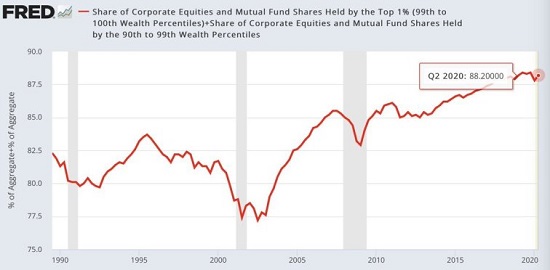
Since the Fed destroyed low-risk yields, anyone seeking any real yield (i.e. above inflation) would have to enter the casino and compete with hedge funds, insiders and the Financial Aristocracy. Very few middle class workers have the skills and experience to beat the pros in the casino, and so income and wealth accrued to those who already owned capital.
This is a key reason why the rich got richer and the poor got poorer. Those with capital accrued the majority of gains in income and wealth, leaving the bottom 90% in the dust.
Ten percent of Americans now control 97 percent of all capital income in the country. Nearly half of the new income generated since the global financial crisis of 2008 has gone to the wealthiest one percent of U.S. citizens. The richest three Americans collectively have more wealth than the poorest 160 million Americans. (emphasis added.)
The 3% of income from capital collected by the bottom 90%–which includes the middle class– is basically signal noise: the middle class collects inconsequential crumbs of income from capital.
Prior to the Fed’s ZIRP and financialization of the economy, the middle class could both collect income from capital they owned and they could afford to acquire assets that yielded low-risk solid returns. Now they can do neither. Even worse, the puchasing power of their labor continues to decline, leaving them less able to save and buy assets.
This is why The Top 10% Is Doing Just Fine, The Middle Class Is Dying on the Vine. Please study these charts as a means of understanding the inevitability of economic stagnation and a revolt of the decapitalized middle class.
President Joe Biden vowed to put a “quick end” to the Trump administration’s Title IX regulations and return to Obama-era ones at universities. If this happens, the sexual misconduct hearings will be deeply impacted. These “trials” judge whether those accused of sexual misconduct are innocent or guilty. The Obama-era hearings expressed social justice standards that greatly favored an accuser; the Trump-era ones were closer to the Western tradition of due process. The hearings remain a major battleground in the culture war.
Universities are the wellspring of social justice and of the “warriors” who have carried the leftist ideology into the streets and every American institution. With the 2020 riots, the average person now appreciates the threat that social justice poses to traditional Western values such as due process. No compromise is possible between the two world views.
What is the heart of the conflict? Social justice rests on three dogmatic assertions. Gender and race define every individual; discrimination against oppressed races and genders defines America; all social inequality, such as pay differentials, is the result of systemic discrimination. Justice requires skewing society’s law and policies to favor “oppressed” groups in order to forcibly redistribute wealth, status, and opportunities to them from privileged ones—most notably white males. Traditional Western values are individualistic, not collectivistic; every person possesses the same human rights to the same degree, all of which spring from the fundamental right of those who are peaceful to live without interference. Individuals define their own character and are responsible for their actions. Justice means respecting everyone’s equal right to person and property and providing remedy when those rights are violated.
People now associate social justice with street-gang activism or shrill accusations of racism and sexual abuse. But many cultural changes that arrive on campus and flow inevitably into society do so quietly. They come from behind-the-door meetings and obscure organizations that forge policy, such as ATIXA (Association of Title IX Administrators) and Title IX campus compliance offices. These agencies are the bureaucracy of social justice, and ATIXA is a cautionary tale about what happens in the bureaucratic shadows. It is happening right now.
…
ATIXA and Title IX may seem arcane to those not on campus or without a loved one who is. But the incredible bias and injustice embedded in earlier sexual misconduct hearings was integral in promoting a social division that borders on hatred. Close attention must be paid to the social justice measures on campuses, because they are part of the ideology promoting street riots, increased violence and hostility between groups. College administrators and professors have actively stoked hatred between the genders and the races for decades. And now society reaps a whirlwind.
In Chapter 5 of The Prince, Niccolo Machiavelli describes three options for how a conquering power might best treat those it has defeated in war. The first is to ruin them; the second is to rule directly; the third is to create “therein a state of the few which might keep it friendly to you.”
The example Machiavelli gives of the last is the friendly government Sparta established in Athens upon defeating it after 27 years of war in 404 BCE. For the upper caste of an Athenian elite already contemptuous of democracy, the city’s defeat in the Peloponnesian War confirmed that Sparta’s system was preferable. It was a high-spirited military aristocracy ruling over a permanent servant class, the helots, who were periodically slaughtered to condition them to accept their subhuman status. Athenian democracy by contrast gave too much power to the low-born. The pro-Sparta oligarchy used their patrons’ victory to undo the rights of citizens, and settle scores with their domestic rivals, exiling and executing them and confiscating their wealth.
The Athenian government disloyal to Athens’ laws and contemptuous of its traditions was known as the Thirty Tyrants, and understanding its role and function helps explain what is happening in America today.
…
What seems clear is that Biden’s inauguration marks the hegemony of an American oligarchy that sees its relationship with China as a shield and sword against their own countrymen. Like Athens’ Thirty Tyrants, they are not simply contemptuous of a political system that recognizes the natural rights of all its citizens that are endowed by our creator; they despise in particular the notion that those they rule have the same rights they do. Witness their newfound respect for the idea that speech should only be free for the enlightened few who know how to use it properly. Like Critias and the pro-Sparta faction, the new American oligarchy believes that democracy’s failures are proof of their own exclusive right to power—and they are happy to rule in partnership with a foreign power that will help them destroy their own countrymen.
What does history teach us about this moment? The bad news is that the Thirty Tyrants exiled notable Athenian democrats and confiscated their property while murdering an estimated 5% of the Athenian population. The good news is that their rule lasted less than a year.
Read the rest – it’s a powerful analysis and summary of the threat of Oligarchical Collectivism that rules America
Well, now we know for sure that the bulk of the Republican members of the House do not represent their constituents — not at all. They represent themselves and their coveted membership in that school for scoundrels we call Congress. Despite Liz Cheney’s gross betrayal of President Trump and her own constituents in Wyoming, 145 of them by secret ballot voted not to remove her from her leadership position. This demonstrates that those 145 representatives value their standing in the swamp more than they value their oath to uphold the Constitution.
Official Photo of an Official Swamp Creature
They all know that Trump in no way incited any insurrection. They all know that it was planned in advance, most likely by anti-Trumpers whom the left encourages and adores. Pity the several Trump-supporters among them who got mixed up in an orchestrated plan to further damage Trump by any means necessary. They all know that the 2020 election was characterized by all manner of fraud; Biden was installed, not elected. That truth will come out one day, someday, hopefully sooner than later.
Liz Cheney’s statement of support for this nonsensical and unconstitutional second impeachment was truly disgusting. She certainly knows that President Trump did not “summon the mob, assemble the mob and light the flame.” Her hyperbole is laughable. It is she who should be removed from her third-in-line position in the House, along with truly anti-American bigots like Ilhan Omar and Rashida Tlaib.
Rep. Cheney is an old-school member in good standing of the military-industrial complex, that amorphous institution that makes war so profitable for those who gain admission to it and thus get rich in it. No wonder all the Bushies supported Cheney. Like-minded newbies all want in on the spoils; they too want a piece of that pie. They are likely all thrilled that Biden is sending troops here, there, and everywhere, especially D.C., which is now an armed camp for no earthly reason.
The pretense that domestic terrorism is a serious threat is sheer moonbattery. For decades, the worst violence in the homeland has been perpetrated by leftists: Antifa, BLM, and Occupy Wall Street. There is no serious threat from the imaginary “white supremacist” groups the Democrats have conjured up.
Trump was a threat to the massive corruption that thrives in the colossal bureaucracy that is the Deep State. Now he has exposed them all for who and what they are, contemptuous of the people who sent them there, who donated to their campaigns and believed they were honorable. They’re not. They feel nothing but scorn for those people who sent them to D.C.
Those 145 Republicans are likely the same go-along-to-get-alongs who have allowed American children to be robbed of an entire year of education even though neither they nor their teachers were at much risk. The Democrats relished COVID, for it gave them the opportunity to do what, at the core of their beings, they have long yearned to do: control the population, how they eat, drive, vote, think — how they live.
Given Biden’s 42 executive orders in two weeks, his Alinskyite handlers are dangerously drunk on power, and this democratic republic is more at risk than at any time in modern history. Let all of us who love this country as founded, that has improved the lives of countless millions of people here and abroad over our 245 years, do everything in our individual and collective power to fight this takeover in process. Joe Biden is the instrument of acquisition; China is the beneficiary.
We are all in for a rough ride. Be sure to read Michael Devon’s piece on surviving what is coming our way. Disraeli wrote, “There is no act of treachery or meanness of which a political party is not capable; for in politics there is no honour.”
Liz Cheney and her defenders have once again proven his premise.
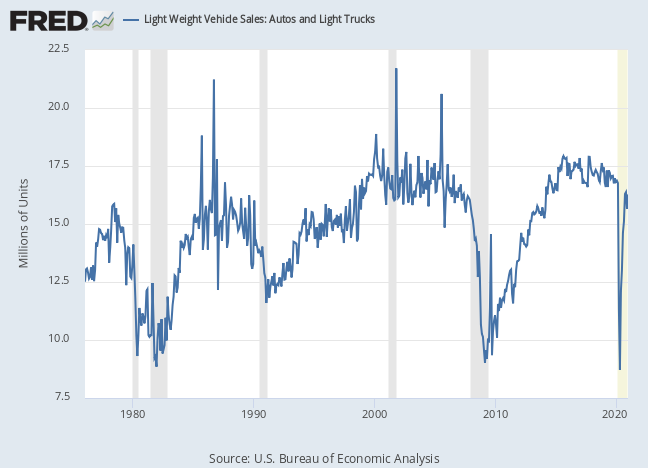
The latest data point is the December count published by the BEA in their monthly Auto and Truck Seasonal Adjustment report, which shows a seasonally adjusted annual rate of 16.3 million units, which is a 4.0%decrease from the previous month’s figure from the BEA.
The first chart shows the series since 2007, which illustrates the dramatic impact of the Great Recession. The blue line smooths the volatility with a nine-month exponential moving average suggested by our friend Bob Bronson of Bronson Capital Markets Research. The moving average reduces the distortion of seasonal sales events (e.g., Memorial Day and Labor Day weekend) and thus helps us visualize the trend.
In a request for a study which shows complete isolation and purification of the particles claimed to be SARS-CoV-2, Michael Laue from one of the world’s most important representatives of the COVID-19 “panicdemic,” the German Robert Koch Institute (RKI), answered that[1]:
I am not aware of a paper which purified isolated SARS-CoV-2.
This is a more than remarkable statement, it is admitting a complete failure. This concession is in line with the statements we presented in our article “COVID-19 PCR Tests Are Scientifically Meaningless” which OffGuardian published on June 27th, 2020 — a piece that was the first one worldwide outlining in detail why SARS-CoV-2 PCR tests are worthless for the diagnosis of a viral infection.
Of course, a line like that should prompt a full reading of the piece. There is more to this story than the lead. And the story is worth reading.
In line with the thread is a perspective published in the New England Journal of Medicine (Mina et al., 2020) from which a no less tantalizing line leads:
It’s time to change how we think about the sensitivity of testing for Covid-19. The Food and Drug Administration (FDA) and the scientific community are currently almost exclusively focused on test sensitivity, a measure of how well an individual assay can detect viral protein or RNA molecules. Critically, this measure neglects the context of how the test is being used. Yet when it comes to the broad screening the United States so desperately needs, context is fundamental. The key question is not how well molecules can be detected in a single sample but how effectively infections can be detected in a population by the repeated use of a given test as part of an overall testing strategy — the sensitivity of the testing regimen.
A similar story by The New York Times reports:
In three sets of testing data that include cycle thresholds, compiled by officials in Massachusetts, New York and Nevada, up to 90 percent of people testing positive carried barely any virus, a review by The Times found.
In addition to false positives reported by RT-PCR tests, there is the question of false negatives. How often does the general class of RT-PCR tests report negative results when the virus may be associated with pneumonia?
Here is Fang et al.,2020:
In our series, the sensitivity of chest CT was greater than that of RT-PCR (98% vs 71%, respectively; P < .001). The reasons for the low efficiency of viral nucleic acid detection may include (a) immature development of nucleic acid detection technology, (b) variation in detection rate from different manufacturers, (c) low patient viral load, or (d) improper clinical sampling. The reasons for the relatively lower detection rate with RT-PCR in our sample compared with a prior report are unknown (3). Our results support the use of chest CT to screen for COVID-19 in patients with clinical and epidemiologic features compatible with COVID-19 infection, particularly when results of RT-PCR tests are negative.
Here is Zitek, 2020:
The sensitivity and specificity of nasopharyngeal swabs using RT-PCR for the diagnosis of COVID-19 cannot be precisely determined with the published data to this point. However, the available in vitro data along with minimal clinical data suggest that the test has very high specificity. On the other hand, the sensitivity is moderate (perhaps between 63–78%). Among the various ways of performing RT-PCR, pharyngeal swabs seem to have lowest sensitivity; nasal swabs may be a bit more sensitive than pharyngeal swabs. RT-PCR analysis of BAL fluid seems to be the most accurate means of virologic confirmation, but BAL fluid can only reasonably be collected on the sickest cohort of patients. For patients with moderate to severe COVID-19 symptoms, identifying characteristic findings on CT imaging of the chest may be more sensitive than RT-PCR testing.
Boger et al., 2021 provides a meta-analysis of CoVid test accuracy considering 16 studies published in April 2020. They assessed a range of tests, including several kinds of PCR tests and observer:
Sixteen studies were evaluated. Meta-analysis showed that computed tomography has high sensitivity (91.9% [89.8%-93.7%]), but low specificity (25.1% [21.0%-29.5%]). The combination of IgM and IgG antibodies demonstrated promising results for both parameters (84.5% [82.2%-86.6%]; 91.6% [86.0%-95.4%], respectively). For RT-PCR tests, rectal stools/swab, urine, and plasma were less sensitive while sputum (97.2% [90.3%-99.7%]) presented higher sensitivity for detecting the virus.
Jaafer et al., 2021 breaks this all down.
It can be observed that at Ct = 25, up to 70% of patients remain positive in culture and that at Ct = 30 this value drops to 20%. At Ct = 35, the value we used to report a positive result for PCR, <3% of cultures are positive. Our Ct value of 35, initially based on the results obtained by RT-PCR on control negative samples in our laboratory and initial results of cultures [8], is validated by the results herein presented and is in correlation with what was proposed in Korea [9] and Taiwan [10]. We could observe that subcultures, especially the first one, allow an increasing percentage of viral isolation in samples with Ct values, confirming that these high Ct values are mostly correlated with low viral loads. From our cohort, we now need to try to understand and define the duration and frequency of live virus shedding in patients on a case-by-case basis in the rare cases when the PCR is positive beyond 10 days, often at a Ct >30.
References:
Böger, B., Fachi, M. M., Vilhena, R. O., Cobre, A. F., Tonin, F. S., & Pontarolo, R. (2021). Systematic review with meta-analysis of the accuracy of diagnostic tests for COVID-19. American Journal of Infection Control, 49(1), 21–29.
Fang, Y., Zhang, H., Xie, J., Lin, M., Ying, L., Pang, P., & Ji, W. (2020). Sensitivity of chest CT for COVID-19: Comparison to RT-PCR. Radiology, 296(2), E115–E117.
Jaafar, R., Aherfi, S., Wurtz, N., Grimaldier, C., Hoang, V. T., Colson, P., … La Scola, B. (2020). Correlation between 3790 qPCR positives samples and positive cell cultures including 1941 SARS-CoV-2 isolates. Clinical Infectious Diseases: An Official Publication of the Infectious Diseases Society of America. doi:10.1093/cid/ciaa1491
Mina, M. J., Parker, R., & Larremore, D. B. (2020). Rethinking covid-19 test sensitivity – A strategy for containment. The New England Journal of Medicine, 383(22), e120.
Zitek, T. (2020). The appropriate use of testing for COVID-19. The Western Journal of Emergency Medicine, 21(3), 470–472.
Arctic air is set to hamer North America from the midwest to the northeast.
The temperature anomalies are expected to drive temperatures some 20C below winter average, piling onto the declining climate temperature trends observed in recent months.
Unprecdented amounts of snow is also expected.
The weakened solar cycle translates to disrupted jet streams, reverting their flows created intense merdional flows as is evident in the NOASS GFS simulations sinking polar cold unusually-far south.
Note the shifting temperature trends are evident in prior months and will continue to attentuate cyclic patterns both annually and in the short solar cycle.
Social media giants have been channeling their inner Wile E. Coyote over the past few days for rather obvious reasons you are most likely aware of but which clearly fall outside the context of what we do and worry about here at Evil Speculator. Again, there is a myriad of places that relish in that kind of discourse and if you feel like yelling at and insulting people you’ve never met on the Internet you’ll be much better off over there. So let’s put our respective political ideologies on ice for a moment and simply look at what’s going on from a purely strategic perspective. Or in other words – how we can we take advantage?
Facebook seems to have an Acme anvil tied to its ankle right now and the current formation does not invoke a lot of optimism. Earnings are coming up in a week or so, and that in addition to the current political drama may drag it toward the 220 mark or lower. Assuming it breaches through the 245 mark which appears to be a major inflection point.