There are a lot of ways physics can explain climate warming. But the best explanations are those that successfully backtest – where the physics can reliably hindcast the past from the present.
Two issues, in particular, plague the IPCC CMIPx model series: (1) cloud formation and (2) the role of el Nino and the Southern Oscillation (ENSO).
Dr. Roy Spencer: “Since El Nino produces global average warmth, and La Nina produces global average coolness, I have been using our 1D forcing feedback model of ocean temperatures (published by Spencer & Braswell, 2014) to examine how the historical record of ENSO variations can be included, by using the CERES satellite-observed co-variations of top-of-atmosphere (TOA) radiative flux with ENSO.”
Spencer’s one dimensional model of mid-latitude climate dynamics generates the requisite net radiative feedback parameter corresponding to an equilibrium climate sensitivity of 1.91 degree C, matches the sea surface temperature (SST) observations during 1979-2020, and corresponds to IPCC HadSST1 or HadSST4 data.
As Dr. Spencer explains:
“ENSO can then be turned off in the model to see how it affects our interpretation of (and causes of) temperature trends over various time periods. Or, one can examine the affect of assuming some level of non-equilibrium of the climate system at the model initialization time.
“If nothing else, the results in Fig. 3 might give us some idea of the ENSO-related SST variations for 300-400 years before anthropogenic forcings became significant, and how those variations affected temperature trends on various time scales. For if those naturally-induced temperature trend variations existed before, then they still exist today.”
So which is the dominant driver of climate – natural variation or anthropogenic GHG emissions?
“It’s been truly extraordinary. DoorDash, a food delivery company that’s never made a penny profit is worth $70bln? It exists in a no-barriers-to-entry, highly price competitive, and ultimate risk sector – where if Micky D makes a bad burger they get the blame. It’s also a concept that’s shifting on the value curve. Money ain’t made on deliveries, but in the manufacture of meals: you probably aren’t getting your Kentucky Fried Rat from the Colonel, but from some Dark Kitchen on an industrial site. Costs are slashed, but they can still charge extra by slapping a posh restaurant’s name on a 50 pence burger from Iceland.
“Yesterday’s Airbnb IPO was just completely hat-stand.
“This was a company IPO that analysts were struggling to justify a $40 dollar price last week, and it finally opened at $163 y’day. It’s a very, very mildly profitable company, but is its really worth more than the global hotel industry or a multiple of the package sector? As some wag noted it values each Airbnb property around $13k, so all any competitor needs to do is clone the software and marketing, then pay Airbnb owners $10K to switch to their new firm to become instant billionaires. “
Indeed – all this from the Monetary Politburo also known as the Federal Reserve
As Bill explains:
“Ultimately, every investor wants to invest in something that is a monopoly and will reap monopoly profits. So they buy into things like Standard Oil, Microsoft, Apple, and Facebook and pretenders like Tesla, Snowflake, AirBnb and the petfood delivery company that is now worth more than the land value of the Emperor’s Palace in Tokyo. Some are safe monopolies – like no one else can make an iPhone. Some are risk-monopolies where regulation to break oil giants, control social media and calls to break up Facebook or deter Amazon are tangible risks. The pretenders might have first mover advantage, but they are vulnerable to competition as they progress.
“If you are Elon Musk you can make lots of noise about the company and extend the illusion it’s a monopoly by controlling the narrative – its not a car company, it’s an energy, self-driving, taxi monopoly. Eventually it bursts. (Credit where credit is due. Even though the spaceship crashed earlier this week, SpaceX is brilliant. It could have become a valid monopoly/duopoly in space launch if Musk hadn’t decided to use it to create his Starlink satellite internet monopoly – which will compete with every other provider of same.)
“At the moment the market is being deluged by the money governments and central banks have injected in to stimulate recovery. Oh, you thought that money was being used to create jobs and companies? Wrong. All that free money is pushing up financial asset prices, making the rich richer. Everyone wants to be rich, so everyone (bear with me here) is investing in stocks – which pushes them yet higher confirming what these new investors believe.. stocks can only go higher.
“Remember Blain’s Market Mantra No 1: The Market Has But One Objective: To Inflict The Maximum Amount of Pain on the Maximum Number of Participants. “
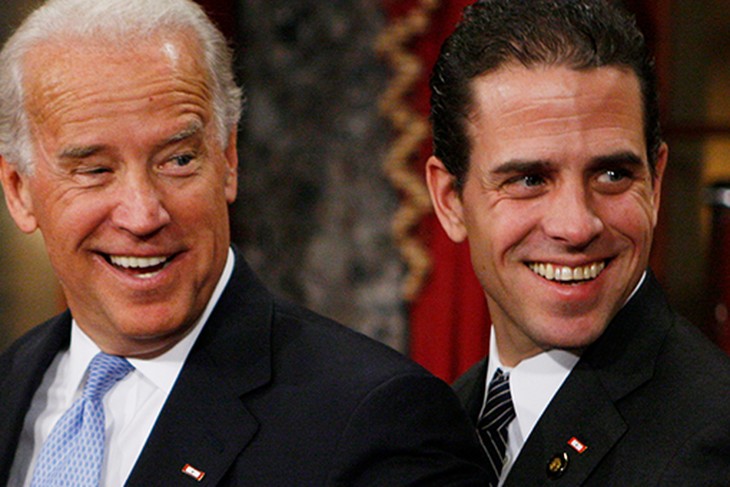
“The fact that this is being done in Delaware means everyone in Delaware who has a business connection to Hunter Biden is at risk for getting drawn in.
“The FBI and IRS criminal investigators who do these types of investigations are exceptionally good at what they do. The combination of this investigation and health considerations will lead to the resignation of Joe Biden from office. Health reasons will be the public explanation, but there is no way for Joe Biden to escape the web of criminal entanglements that Hunter Biden was involved in with the Chinese and others based on the information that became public prior to the election. I’m confident there is much more evidence than what has been seen.
“Now that the fact of the investigation is public, when combined with the specific information, documents, and witness statements that were revealed prior to the election — and suppressed by the media — this can’t be made to quietly disappear.”
My Prediction: If Joe Biden Is Sworn in, the Investigation of Hunter Biden Will Lead to Joe’s Resignation
“When data from the various dosing regimens were combined, the study found that the vaccine was 70% effective at preventing symptomatic coronavirus infections. The standard regimen — two doses of the same strength administered a month apart — had an efficacy of 62%, whereas the regimen with a lower initial dose yielded an efficacy of 90%.
…
“Overall, it remains unclear how much the over-55 age group will benefit from even the standard dose of the vaccine: only 12% of those in the group evaluated for vaccine efficacy were over 55.
…
“Oxford and AstraZeneca have agreed to provide the vaccine to buyers for US$2–3 per dose. And the vaccine is made of DNA encoding a coronavirus protein that is shuttled into cells in a harmless virus, a product that will be cheaper and easier to make in bulk than the RNA vaccines from Pfizer and Moderna, says Griffin. It also does not need to be stored at temperatures as low as the RNA vaccines, one of which must be kept at −70 ºC until shortly before it is administered.”
“Each State shall appoint, in such Manner as the Legislature thereof may direct, a Number of Electors, equal to the whole Number of Senators and Representatives to which the State may be entitled in the Congress: but no Senator or Representative, or Person holding an Office of Trust or Profit under the United States, shall be appointed an Elector.” The Constitution of the United States, Article II, Section 1
As Michael Every (Rabobank) observes: “A Texas-sized mess may have just appeared but if you check the news you will not see much reference to it.”
Well, if you rely on corporate media for your news, they censored it (for your own good, of course).
Why the Supremes?
Well, because the Constitution says so:
“In all Cases affecting Ambassadors, other public Ministers and Consuls, and those in which a State shall be Party, the supreme Court shall have original Jurisdiction.” The Constitution of the United States, Article III, Section s
Here’s the Texas opening salvo, err, uhm, I mean “complaint”:
Pursuant to 28 U.S.C. § 1251(a) and this Court’s Rule 17, the State of Texas respectfully seeks leave to file the accompanying Bill of Complaint against the States of Georgia, Michigan, and Wisconsin and the Commonwealth of Pennsylvania (collectively, the “Defendant States”) challenging their administration of the 2020 presidential election. As set forth in the accompanying brief and complaint, the 2020 election suffered from significant and unconstitutional irregularities in the Defendant States:
Non-legislative actors’ purported amendments to States’ duly enacted election laws, in violation of the Electors Clause’s vesting State legislatures with plenary authority regarding the appointment of presidential electors.
Intrastate differences in the treatment of voters, with more favorable allotted to voters -whether lawful or unlawful– in areas administered by local government under Democrat control and with populations with higher ratios of Democrat voters than other areas of Defendant States.
The appearance of voting irregularities in the Defendant States that would be consistent with the unconstitutional relaxation of ballot-integrity protections in those States’ election laws.
All these flaws – even the violations of state election law – violate one or more of the federal requirements for elections (i.e., equal protection, due process, and the Electors Clause) and thus arise under federal law. See Bush v Gore, 531 U.S. 98, 113 (2000) (“significant departure from the legislative scheme for appointing Presidential electors presents a federal constitutional question”) (Rehnquist, C.J., concurring). Plaintiff State respectfully submits that the foregoing types of electoral irregularities exceed the hanging-chad saga of the 2000 election in their degree of departure from both state and federal law. Moreover, these flaws cumulatively preclude knowing who legitimately won the 2020 election and threaten to cloud all future elections.
Taken together, these flaws affect an outcome determinative numbers of popular votes in a group of States that cast outcome-determinative numbers of electoral votes. This Court should grant leave to file the complaint and, ultimately, enjoin the use of unlawful election results without review and ratification by the Defendant States’ legislatures and remand to the Defendant States’ respective legislatures to appoint Presidential Electors in a manner consistent with the Electors Clause and pursuant to 3 U.S.C. § 2.
As one election law expert put it, the US constitution is effectively a contract between the 50 states, including how their president is elected, and Texas is claiming other parties broke parts of that contract.
Texas is apparently now supported by 17 other states. Talk about a divided country.
Perhaps not a surprise, the Supreme Court took the Texas case in expedited fashion, and has called for a response by 3PM Thursday.
Yes, it *is* a huge can of worms it is opening if it acts. Yet it is also a can of worms if it doesn’t act when Texas and other states claim:
Our Country stands at an important crossroads. Either the Constitution matters and must be followed, even when some officials consider it inconvenient or out of date, or it is simply a piece of parchment on display at the National Archives. We ask the Court to choose the former.
In short, this *might* be the most significant Supreme Court case since 2000, which notoriously decided the presidential election in Florida.
Every: “Markets don’t know how to price these kind of tail risks. They will ignore this right up until the last second: but if we get a surprise result, be ready for resulting surprises.“
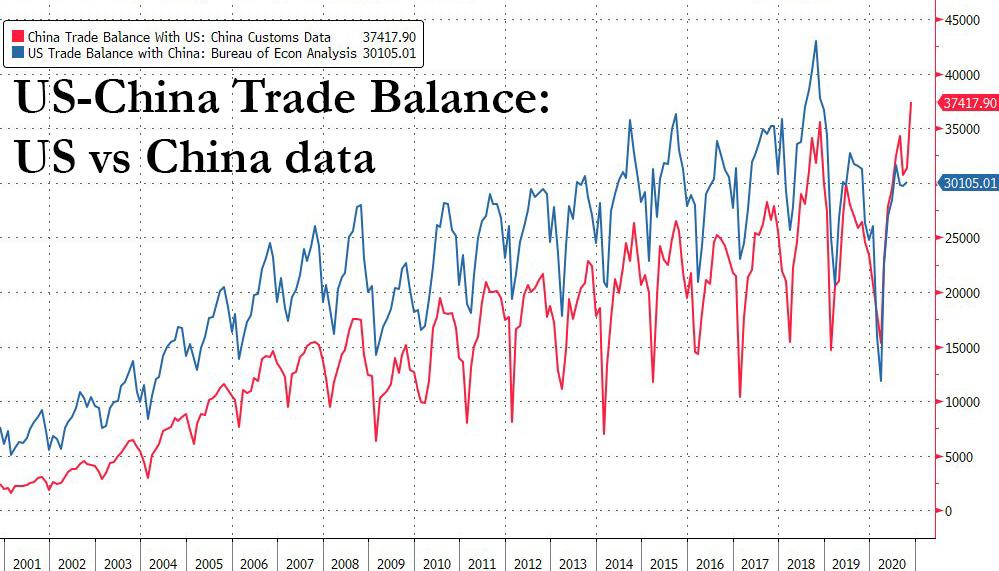
Maybe Chinese exporters are overstating their exports, in general and to the United States. Overstating exports is a classic way of getting capital into a country with capital controls.
Or, maybe US tariffs have created a strong incentive for firms importing into the United States to go to some lengths to understate their imports from China. Thus, U.S. imports from China are now likely under-counted (which by implication holds the bilateral trade deficit down).
Pepe Escobar in Asia Times discusses Cedric Durand’s “Techno-Feudalism”:
“When it comes to the new property rights of the new Eldorado, all power should be exercised by the Silicon Valley ‘pioneers’, a Narcissus bunch in love with their mirror image as superior Randian heroes. In the name of innovation they should be allowed to destroy any established rules, in a Schumpeterian ‘creative destruction’ rampage.
That has led to our current environment, where Google, Facebook, Uber, and co. can overstep any legal framework, imposing their innovations like a fait accompli.
“Durand goes to the heart of the matter when it comes to the true nature of ‘digital domination’: US leadership was never achieved because of spontaneous market forces.
“On the contrary. The history of Silicon Valley is absolutely dependent on state intervention – especially via the industrial-military complex and the aero-spatial complex. The Ames Research Center, one of NASA’s top labs, is in Mountain View. Stanford was always awarded juicy military research contracts. During WWII, Hewlett Packard, for instance, was flourishing thanks to their electronics being used to manufacture radars. Throughout the 1960s, the US military bought the bulk of the still infant semiconductor production.
“The Rise of Data Capital, a 2016 MIT Technological Review report produced “in partnership” with Oracle, showed how digital networks open access to a new, virgin underground brimming with resources: “Those that arrive first and take control obtain the resources they’re seeking” – in the form of data.
“So everything from video-surveillance images and electronic banking to DNA samples and supermarket tickets implies some form of territorial appropriation. Here we see in all its glory the extractivist logic inbuilt in the development of Big Data.“